STUDY ON ROOFTOP GARDENING AS AN AGRIBUSINESS PRACTICE IN DHAKA CITY
MAISA TASLIM WASHI
DEPARTMENT OF AGRIBUSINESS AND MARKETING SHER-E-BANGLA AGRICULTURAL UNIVERSITY
DHAKA- 1207
JUNE, 2021
Sauda Afrin Anny Assistant Professor
Department of Agribusiness and Marketing Sher-e-Bangla Agricultural University
Co-Supervisor Abul Hasnat M. Solaiman,PhD
Professor
Department of Horticulture Sher-e-Bangla Agricultural University
Supervisor
Md. Rashidul Hasan Chairman
Examination Committee Department of Agribusiness and
Marketing
Sher-e-Bangla Agricultural University
Dhaka-1207
STUDY ON ROOFTOP GARDENING AS AN AGRIBUSINESS PRACTICE IN DHAKA CITY
BY
MAISA TASLIM WASHI Reg. No. 14-06275 A thesis submitted to
The Department of Agribusiness and Marketing, Sher-e-Bangla Agricultural University, Dhaka-1207 In partial fulfillment of the requirements for the degree of
MASTER OF SCIENCE IN
AGRIBUSINESS AND MARKETING SEMESTER: JANUARY-JUNE, 2021
APPROVED BY:
DEPARTMENT OF AGRIBUSINESS AND MARKETING Sher-e-Bangla Agricultural University
Sher-e-Bangla Nagar Dhaka-1207
CERTIFICATE
This is to certify that the thesis entitled ‘STUDY ON ROOFTOP GARDENING AS AN AGRIBUSINESS PRACTICE IN DHAKA CITY’ submitted to the Faculty of Agribusiness Management, Sher-e-Bangla Agricultural University, Dhaka, in partial fulfillment of the requirements for the degree of Master of Science in Agribusiness and Marketing, embodies the result of a piece of bona fide research work carried out by MAISA TASLIM WASHI, Registration Number:14-06275, under my supervision and guidance. No part of the thesis has been submitted for any other degree, diploma, title, recognition before.
I further certify that any help or source of information received during the course of this investigation has duly been acknowledged.
Dated:
Dhaka, Bangladesh
………..
Abul Hasnat M. Solaiman, PhD Supervisor
Professor
Department of Horticulture
Sher-e-Bangla Agricultural University Sher-e-Bangla Nagar, Dhaka-1207
Page | I
ACKNOWLEDGEMENTS
All praises to Allah, the Almighty, for gracious generosity and immeasurable mercy, which has enabled the author with the chance to complete the research required work for partial fulfillment of the Master of Science.
The author owes a debt of gratitude to her parents, who prayed for her success on a daily basis and this work would not have been done without their love, affection, inspiration and sacrifice.
The author wishes to convey her heartfelt gratitude and enormous debt of gratitude to her supervisor Abul Hasnat M. Solaiman,PhD, Professor, Department of Horticulture, Sher-e-Bangla Agricultural University, for his active, sincere, ingenious and undying guidance, unfailing interest, constructive criticism, constructive advice, helpful comments and constant monitoring throughout this research. The author might not be able to finish the study without his tremendous support.
The author wanted to express her gratitude to her co-supervisor, Sauda Afrin Anny, Assistant Professor, Department of Agribusiness and Marketing, Sher- e-Bangla Agricultural University, for her guidance, constructive direction, unconditional support, affectionate encouragement and kind co-operation at every stage of the research.
The author gratefully appreciates the involvement of the rooftop owners of the Dhaka region for their kind assistance, cooperation and time; this research would not have been possible without their willingness to contribute with information.
The Author
Page | II
ABBREVIATION AND ACRONYMS
AEO: Agricultural Extension Officer AO: Agriculture Officer
BADC: Bangladesh Agricultural Development Corporation BBS: Bangladesh Bureau of Statistics
BCR: Benefit Cost Ratio
DAE: Department of Agricultural Extension DAM: Department of Agricultural Marketing RTG: Rooftop Garden
SPSS; Statistical Package for Social Sciences Sq ft; Square feet
TK: Taka
UN: United Nation
VIF: Variance inflation factor
Page | III
TABLE OF CONTENTS
CHAPTER TITLE PAGE
ACKNOWLEDGEMENTS I
LIST OF ABBREVIATIONS II
LIST OF CONTENTS III-VII
LIST OF TABLES VII-X
LIST OF FIGURES X- XI
LIST OF APPENDIX XII
ABSTRACT XIII
CHAPTER I INTRODUCTION 1-3
CHAPTER II REVIEW OF LITERATURE 4-10
2.1 Section 1: Socio economic status of rooftop owner and affecting
factors of rooftop production
4
2.1.1 On the basis of Age 4
2.1.2 On the basis of Education 5
2.1.3 On the basis of Family size 5
2.1.4 On the basis of Income 5
2.1.5 On the basis of Roof top area 6
2.1.6 On the basis of Training exposure 6
2.1.7 On the basis of Knowledge 6
2.2 Section 2: Review of the Previous Research Findings on Rooftop Gardening
7 2.3 Section 3: Find out the rooftop gardening
scope and possibility of agribusiness through production
8
2.4 Section 4: Research Gap of the Study 8 2.5 Section 5: Conceptual Framework on the
objectives
9-10
CHAPTER III MATERIALS AND METHODS 11-25
3.1 Study Area 11
3.2 Population and Sample of the Study 12
3.3 Data collection methods 12
3.4 Data collection tool 13
3.5 Measurement of Variables 13
3.6 Variables of the Study 13
3.7 Measurement of dependent and independent variables
13
3.7.1 Age 14
Page | IV
CHAPTER III MATERIALS AND METHODS
3.7.2 Gender 14-15
3.7.3 Education 15-16
3.7.4 Profession 16
3.7.5 Family size 17
3.7.6 Rooftop garden size 17-18
3.7.7 Monthly family income 18
3.7.8 Access to training 19
3.7.9 Growing season of rooftop production 19-20
3.7.10 Given time in rooftop 20
3.7.11 Production Technique to implement for developing rooftop garden
21
3.7.12 Selected region in Dhaka city 21-22
3.7.13 Service provider Organization 22-23
3.8 Rooftop production gives more nutrition than buying from market
23 3.9 Vegetables and fruits produced in current
RTG in Dhaka
23
3.10 Collection amount from rooftop 23
3.11 Used of pesticides for controlling pest and diseases
24
3.12 Intension to do rooftop Business 24
3.13 Existing plant with respective yield and income in the last year on 1 year
24
3.14 Model fitting Assumptions 25
3.15 Creating Dummy Variable 25
3.16 Data processing and analyzing 25
CHAPTER IV RESULTS AND DISCUSSION 26-58
4.1 Socio Economic Characteristics of the respondents
26 4.1.1 Respondents according to their Age 26-29 4.1.2 Respondents according to their Gender 30
Page | V
CHAPTER IV RESULTS AND DISCUSSION
4.1.3 Level of education 30-31
4.1.4 Respondents according to their family size 32-34 4.1.5 Respondents according to Rooftop Area 34-35 4.1.6 Respondents according to family income 36-37 4.1.7 Respondents according to their Profession 37-38
4.2 To determine the factors that affecting rooftop production in Dhaka city
38-39 4.2.1 Significance contribution of Total roof
space of the rooftop gardeners to Rooftop production in Dhaka city
39
4.2.2 Significance contribution of family income of the rooftop gardeners to Rooftop production in Dhaka city
40
4.2.3 Significance contribution of support from government organization to Rooftop production in Dhaka city
40
4.2.4 Significance contribution of support from online platform to Rooftop production in Dhaka city
41
4.2.5 Significance contribution of government employee to Rooftop production in Dhaka city
41
4.2.6 Significance contribution of other profession of the rooftop gardeners to Rooftop production in Dhaka city
42
4.3 Scope and possibility of agribusiness through rooftop gardening production
43 4.3.1 Statement on sustainability of rooftop
production
43
4.3.2 Growing Seasons of rooftop 43-44
Page | VI
CHAPTER IV RESULTS AND DISCUSSION 4.3.3 Relationship between production and
growing season
44 4.3.4 Statement on rooftop production gives
more nutrition
44-45 4.3.5 Vegetables and Fruits produced in current
RTG’s in Dhaka
45
4.3.6 Given time in rooftop 46
4.3.7 Collection amount from rooftop 46-47
4.3.8 Use of pesticides for controlling pest and diseases of fruits and vegetables in the existing roof top garden
48
4.3.9 Training about strategy of rooftop that people want to attend
48 4.3.10 Technique implementation for developing
rooftop garden
49
4.3.11 Service provider Organization 50
4.3.12 Organizational support on the basis of Area 50 4.3.13 Existing plants with respective Average
yield and income in last one year
51 4.3.13a Existing plants with respective Average
yield one year in Mirpur
52
4.3.13b Existing plants with respective yield and income in the last year one year in Mohammadpur
53
4.3.13c Existing plants with respective yield and income in the last year one year in Uttara
54 4.3.13d Existing plants with respective yield and
income in Dhanmondi
55 4.3.13e Existing plants with respective yield and
income in the last year one year Badda
56 4.3.14 Willingness to do rooftop Business 57 4.3.15 BCR on the basis of Region in Dhaka city 57-58
Page | VII
CHAPTER V SUMMARY, CONCLUSIONS AND
RECOMMENDATIONS 59-65
5.1 Summary of the findings 59-63
5.2 Conclusions 63-64
5.3 Recommendations 64
5.4 Recommendation for further study 65
CHAPTER VI REFERENCES 66-67
CHAPTER VII APPENDICES 68-75
LIST OF TABLE
TABLE TITLE PAGE
3.2 Sample size of the study 12
3.7.1 Age coding by SPSS 14
3.7.2 Gender coding by SPSS 15
3.7.3 Level of education coding by SPSS 16 3.7.4
Respondents profession coding by SPSS
16
3.7.5
Respondents family size coding by SPSS
17
3.7.6
Respondents roof area coding by SPSS
18 3.7.7 Respondents monthly income coding
by SPSS
18 3.7.8 Access to training coding by SPSS 19
3.7.9 Growing season coding by SPSS 20
3.7.10 Given time in rooftop coding by SPSS
20
Page | VIII
TABLE TITLE PAGE
3.7.11 Production technology coding by SPS
21 3.7.12 Respondents’ region coding by SPSS 22 3.7.13 Service provider organization coding
by SPSS
23
4.1.1
Distribution of the respondents according to their age is presented in Mohammadpur
27
4.1.2
Distribution of the respondents according to their age is presented in Dhanmondi
28
4.1.3
Distribution of the respondents according to their age is presented in Mirpur
28
4.1.4
Distribution of the respondents according to their age is presented in Uttara
29 4.1.5 Distribution of the respondents
according to their age is presented in
Badda 29
4.1.4a Distribution of the respondents according to their family size (Mohammadpur)
32 4.1.4b Distribution of the respondents
according to their family size (Dhanmondi)
33 4.1.4c Distribution of the respondents
according to their family size (Mirpur)
33 4.1.4d Distribution of the respondents
according to their family size (Uttara)
34
Page | IX
TABLE TITLE PAGE
4.1.4e Distribution of the respondents according to their family size (Badda)
34
4.2
To determine the factors that affecting rooftop production in Dhaka city
39 4.3.1 Statement on sustainability of rooftop
production
44
4.3.4
Statement on Rooftop production gives more nutrition than buying from market
45 4.3.5 Vegetables and Fruits produced in
current RTG’s in Dhaka
46 4.3.7 Collection amount from rooftop
(Crop Harvested)
47 4.3.8 Use of pesticides for controlling pest
and diseases of fruits and
49
4.3.13
Existing plants with respective average yield and income in last one year
52 4.3.13a Existing plants with respective
average yield and income in last one year in Mirpur
53 4.3.13b Existing plants with respective yield
and income in the last year one year
in Mohammadpur 54
4.3.13c Existing plants with respective yield and income in the last year one year in Uttara
55 4.3.13d Existing plants with respective yield
and income in the last year one year in Dhanmondi
56
Page | X
TABLE TITLE PAGE
4.3.13e Existing plants with respective yield and income in the last year one year Badda
57
4.3.14 Willingness to do rooftop Business 58 4.3.15 BCR on the basis of Region in Dhaka
city
59 3.12b Independent variables collinearity
statistics
72-73 3.12c Independent variables collinearity
statistics
74-75
LIST OF FIGURE
FIGURE TITLE PAGE
2.5 Conceptual Framework on the objective
9-10 3.1 Map of the selected area in Dhaka
city
11 4.1.1 Distribution of the respondents
according to their age
27 4.1.2 Respondents according to their
gender
30 4.1.3 Distribution of the respondents
according to their level of education
31 4.1.4 Respondents according to their
family size
32
Page | XI
FIGURE TITLE PAGE
4.1.5 Respondents according to their rooftop area
35 4.1.6 Respondents according to family
income
36 4.1.7 Respondents according to their
profession
37
4.3.2 Growing season in Dhaka city 44
4.3.3 Relationship between production and growing season
45 4.3.6 Given time in rooftop on the basis of
region
47
4.3.7 Production per rooftop in a year on the basis of region vegetables in the existing roof top garden
48 4.3.9 Access to training on the basis of area 49 4.3.10 Production Technology on the basis
of region
50 4.3.11 Organizational support and
production
51 4.3.12 Organizational support on the basis
of area
51
3.12a Linear relationship 72
Page | XII
LIST OF APPENDICES
APPENDIX NO TITLE PAGE
A English Version of the Interview Schedule on ‘Study on Rooftop Gardening as Agribusiness practice in Dhaka city’
68-70
B Multiple linear regression model fitting Assumption
71-74
C Field visit plates 75
Page | XIII
STUDY ON ROOFTOP GARDENING AS AN AGRIBUSINESS PRACTICE IN DHAKA CITY
ABSTRACT
The main thrust of the study was to determine the factors that affecting rooftop production and the scope and possibility of agribusiness through rooftop gardening production in Dhaka city. The study was conducted at five selected areas namely Dhanmondi, Mirpur, Mohammadpur, Uttara and Badda. Data were collected by using an interview schedule(Questionnaire) and Multiple linear regression was used to analyze the data. The result showed that 65% old aged (above 50 years) respondents involved in RTG from Dhanmondi, Mirpur and Uttara area and majority of the respondent was female. All the factors cooperatively contribute 52.7% of the variance of rooftop production (R2 = 0.527). Total roof space, family income, support from government organization, support from online platform, government employees and others profession such as homemaker were found significant contribution to rooftop gardening while rest of the variables found having no significant contribution. To estimate the agribusiness scope and possibility five fruits and five vegetables were selected those were common in maximum rooftop. The production level per rooftop was medium (71-100) kg/year in Dhaka city but it had maximum small family (upto3 members) to consume. There will be an opportunity to sell the surplus. After family consumption the BCR was calculated with the surplus production. Final result showed that every selected region from this research has an opportunity and scope of agribusiness as BCR was greater than 1. Mirpur region BCR value was 1.345 which was highest among other areas. So Mirpur region had highest production of fruits and vegetables among five selected areas.
Page | 1
CHAPTER I INTRODUCTION
Rooftop farming can help meet rising food demand while also promoting a more sustainable and livable city. Roof gardens in Dhaka city can offer local, fresh, and safe food. Because of the production of rooftops is increasing every day, it is now possible to have a sustainable agribusiness with rooftop gardening on a small scale. Rooftop agriculture has the potential to reduce food poverty. Green roofs will provide a rare opportunity to grow food efficiently in often underutilized locations, assisting in the support and sustainability of food for urban people. Alternative agricultural production systems, such as green roof technologies, will become increasingly important as human populations get more urbanized and urban customers become more interested in local food for their families. Green roofs provide area for vegetable crop cultivation, allowing agriculture to become more integrated into urban neighborhoods. The majority of homemakers will engage in agribusiness with their rooftop cultivation, which will boost a family's income while also ensuring organic food sourcing and nutritional security.
Our agricultural land is dwindling. In today's world, rooftop farming can give a solution in which we can grow our own food on our roofs and sell the surplus to agribusiness.
Our building's roof will be used to raise vegetables and fruits for family consumption and also for selling purpose. So, rooftop production can give health security to produce organic fruits and vegetables, ensure food security, scope of agribusiness and employment opportunity by agribusiness (Wardard, 2014).
Rapid urbanization and expansion are putting a pressure on city food supply systems.
Today in this urban planet, 54 percentage of the world’s population are living in urban areas and the share is expected to increase to 66 percentages by 2050 (United Nations, 2014). Rapid urbanization and urban growth is placing massive demand on urban food supply systems. Moreover, many cities in the world are facing problems like rapid decrease in green space and increase in heat island effects. Urban agriculture or farming is promoted as a potential solution to these problems. For city dwellers, urban agriculture can provide a source of fresh produce, a healthier diet, and significant financial savings. Vegetated surfaces offer important sound-insulating capabilities and are frequently employed in urban contexts for noise reduction. Green roofs can help
Page | 2
buildings reduce noise pollution significantly. Through its backward and forward relations, it can also provide jobs and economic opportunities (Islam and Ahmed, 2011).
In Dhaka, one of the world’s fastest growing mega cities, open and cultivable land has been converting to built-up area indiscriminately and thus agricultural land has been decreased at an alarming rate (Islam and Ahmed, 2011). Implementing rooftop farming can be a possible solution to reduce the food supply problems, make urban living more self-sufficient and make fresh vegetables more accessible to urban individuals. It is estimated that 10,000 ha space of Dhaka city can be brought under rooftop farming and the residents of the city can taste fresh vegetables as well as over 10 percent of the demand can be fulfilled through rooftop farming (Wardard, 2014). A survey shows that most of the roofs of Dhaka city are suitable for gardening and do not require major improvement work, sometimes only need some modifications (Islam, 2002). A rooftop garden can supplement diets of a community as it supplies with fresh produce and provide a tangible benefits tie to food production. With rapid and unplanned urbanization, incidence of urban poverty and food insecurity has been also increasing alarmingly in Dhaka (Choguill, 1995).
A rooftop garden can be the primary way of our urban agriculture to keep the environment calm and cool. It can be a great source of our local food system, employment and daily engagement with nature (Jahan, 2016).
A survey found that the majority of Dhaka city's rooftops are suitable for gardening and do not require costly renovations; in some cases, modest alterations are all that is required (Islam, 2002).
In Dhaka, one of the world's fastest growing megacities, open and cultivable land has been unlawfully changed to builtup area, resulting in an alarming loss of agricultural l and (Islam and Ahmed,2011). Using rooftop farming to alleviate food shortages, enha nce urban selfsufficiency, and make fresh vegetables more available to city people co uld be a viable option. RTGs might provide Bologna (Italy) with more than 12,000 t of vegetables per year1, satisfying 77 percent of the city's demands (Orsini et al., 2013).
Page | 3
Dhaka is one of the world’s most populated cities with current population of 20.628 million within a small area of 300 square kilometers (BBS, 2018). Population is increasing day by day. However, to maintain a pleasant living environment, the balance between green and concrete built-up areas cannot be overlooked. With the fundamental layout of cities unlikely to change for some years to come, city planners and decision makers face the challenge of finding other solution of increasing and enhancing the amount of greenery in city areas. The fiber glass containers and raised beds set up are used for the roof farming in cities of Hong Kong (Hui, 2011). In Montreal, Lufa farmers utilize sustainable hydroponics methods, which poses less environmental impact, to produce foods (Carrot City, 2014). In recent years, some people in Taiwan are trying to develop effective growing methods for promoting rooftop farming (Hui, 2011).
Rooftop gardening can be an effective way to provide food security and meet people’s nutritional needs. Understanding the problems and opportunities associated withpolicy of insurance adoption will go a long way towards improving the city's food supply.
A study of Dhaka's densely populated rooftop gardens is urgently needed in lightof the aforementioned situations. The current study looks at the production of rooftop gardening in Dhaka and tries to figure out the scope and possibility of agribusiness. The goal of this research is to find out the scope and possibility of agribusiness by rooftop production and figure out the significant factors that affecting most in rooftop gardening production.
OBJECTIVES
The present study has been taken under consideration to achieve the following objectives:
To analyze socio economic status of rooftop gardeners in Dhaka city.
To determine the factors that affecting rooftop production in Dhaka city.
To find out the scope and possibility of agribusiness through rooftop gardening production in selected region of Dhaka city.
Page | 4
Socio economic status of rooftop owner and affecting factors of rooftop production
Find out the rooftop gardening scope and possibility of agribusiness through production
Socio economic status of rooftop owner and affecting factors of rooftop production
CHAPTER II
REVIEW OF LITERATURE
A literature review is a descriptive, analytic summary of the existing material relating to a particular topic or area of study. This study is mainly concerned with influencing factors of roof top gardening. There were very few literatures works with respect to research studies on this agenda. Therefore, the findings of such studies related to roof top gardening by the house owners and other partial studies have been reviewed in this Chapter.
Section 1:
Section 2: Review of the previous research findings on rooftop gardening Section 3:
Section 4: Research gap of the study
Section 5: Conceptual framework on the objectives
2.1. Section 1:
2.1.1. On the basis of Age
Mithon (2016) observed that the old-aged rooftop gardeners comprised of the highest proportion (76.8 percent) and the middle-aged category constituted by 23.2 percent respondents in Dhaka city.
Rahaman’s (2014) findings was that there is no relationship between age of the respondents and roof top gardening in Dhaka city.
Nira (2006) found that there is no relationship between age of the respondents and their adoption of roof gardening.
Akhter (2003) established that the age of the farmers had no significant relationship with their knowledge on agricultural activities.
Page | 5
2.1.2. On the basis of Education
Mithon (2016) examined that there was negative significant relationship between Education of the respondents and their problems of roof top gardening.
Rahaman (2014) also found that there was negative significant relationship between education of the respondents and their problems of roof top gardening.
Adhikary (2012) explained that there was positive significant relationship between education and their awareness on the environmental pollution caused by the use of pesticides.
Nira (2006) found that there is no relationship between family education of the respondents and their adoption of roof gardening.
Akhter (2003) experienced in his study that level of education of the farmers had a significant and positive relationship with their knowledge on agricultural activities.
2.1.3.On the basis of Family size
Mithon (2016) examined that the medium size family constitute the highest proportion (67.1 percent) followed by the small size family (24.4 percent).
Rahaman (2014) examined that the finding indicated that the family size of the respondents had no significant relationships with their problems of roof top gardening.
Nira (2006) explained that family size of the respondents had a positive significant relationship with their adoption of rooftop gardening.
2.1.4. On the basis of Income
Mithon (2016) found that from house rent : Medium annual income constituted the highest proportion (67.1%), while the lowest proportion in low annual income from house rent (13.4 percent)category.
Rahaman (2014) concluded from the finding that there was no significant relationship between family annual income of the respondents and their problems of roof top gardening.
Page | 6
Nira (2006) examined that there is no relationship between family annual income of the respondents and their adoption of roof gardening.
2.1.5. On the basis of Roof top area
Mithon (2016) examined that most of the respondents (40.2 percent) had medium rooftop area while 23.2 and 36.6 percent of them had low and high rooftop area respectively.
Rahaman (2014) examined that the finding implied that roof top space of the respondents had no significant relationship with their problems of roof top gardening.
Nira (2006) explained that there is no relationship between roof top area of the respondents and their adoption of roof gardening.
2.1.6. On the basis of Training exposure
Mithon (2016) explained that the highest proportion (48.8 percent) of the roof top gardeners had medium training exposure compared to 28.0 percent in low training exposure.
Rahaman (2014) examined that 65 percent of the respondents’ had no training exposure; while 20 percent of the respondents’ very low training exposure and 15 percent had low training exposure.
2.1.7. On the basis of Knowledge
Mithon (2016) concluded that 63.4 percent of the respondents had medium rooftop gardening knowledge, 19.5 percent had low knowledge and 17.1 percent had high knowledge on rooftop gardening.
Rahaman (2014) observed that half of the respondents possessed medium knowledge on roof top gardening.
Nira (2006) explained that there is no relationship between roof gardening experience of the respondents and their adoption of roof gardening.
Akhter (2003) found in his study that level of education of the farmers had a significant and positive relationship with their knowledge on agricultural activities.
Page | 7
2.2. Section 2: Review of the Previous Research Findings on Rooftop Gardening Mithon (2016) found that the highest proportion (42.7 percent) of the respondents had medium use of information sources as compared to 30.5 percent of them having low use of information sources.
Mithon (2016) found that rooftop gardeners attitudes at Dhaka city, the findings was that maximum (62.1 %) of the roof top gardeners had moderately positive attitude towards roof top gardening.”
Kamrujjaman (2015), Bangladesh Agricultural Research Institute, wrote a Book name
“Green Banking” regarding the Rooftop Gardening. The book contains 7 chapters describing the thermal benefits of roof gardens and the overall techniques and farming procedures of vegetables, fruits, flowers/ornamental plants and multipurpose use of Roof garden.
Rahaman (2014) stated that there is no relationship between use of information sources of the respondents and their problems of roof top gardening.
Nira (2006) stated that there is no relationship between use of information sources of the respondents and their adoption of roof gardening.
Nira (2006) found that 62% of the roof owners possessed no adoption compared to 15%
and 23% had low and medium adoption of roof gardening respectively. Lack of time was the main problem for roof gardening. Maximum people wanted to grow flowers.
Kashem (2001) found in his study that farm size of the farmers had no relationship with the awareness on the environmental pollutions.
Hanif (2000) noticed that there was a negative insignificant relationship between farm size of the respondents and their awareness on environmental pollution.
Page | 8
Find out the rooftop gardening scope and possibility of agribusiness through production
2.3. Section 3:
In a survey done by Stamford University -- on 2,700 buildings in Dhanmondi, Lalmatia, Mohakhali DOHS and Uttara, researchers found 36.4 percent rooftops were used for gardening.
There is no previous work on rooftop gardening production in Dhaka city.
2.4. Section 4: Research Gap of the Study
Rooftop gardening had been studied in the lab, but there is a social science component missing. Some study had been done on the social science aspects of home owners' problems and adoption of rooftop gardening, with a focus on assessing house owners' attitudes about rooftop gardening.
Some researchers also conducted on problem faced and adoption of rooftop gardening were held in Mohammadpur , Mirpur-10 and Mirpur-1, Dhaka.
There was previous work on rooftop gardeners socio economic characteristics but this study based on agribusiness scope and possibility in Dhaka city. On the other hands the researcher covered total 5 selected areas as in previous study we could find only one region.
The present study had done on the basis of Multiple linear regression analysis and calculation of BCR whereas the past study on rooftop gardening were analyzed through correlation analysis
Page | 9
Target achievements
Age Gender
Level of education Profession of the respondents Family size Family income Access to training Giving time in rooftop Total roof space Growing season Production technology Support from
organization
Region in Dhaka city 2.5. Section 5: Conceptual framework of the objectives
According to Rogers and Havens (1960), the conceptual framework is kept in mind while framing the structural arrangement for the dependent and independent variables.
A dependent variable is that which appears, disappears or varies as the researcher introduces, remove or varies the independent variables (Townsend,1953).
This study is concerned with the “Rooftop gardening as an agribusiness practice in Dhaka city”. Here for objective 1 socio economic characteristics are independent variables. For objective 2 rooftop production is dependent variable. The researcher can select a lots of independent variables if he/she wants. But it is quite impossible to deal with the independent variable in single thesis. So, the researcher chose some selective independent variables. The independent variables are age, gender, level of education, profession, family size, family income, access to training, giving time in rooftop, total roof space, growing season, production technology, support from organization and region in Dhaka city. For objective 3 Profitability is analyzed with BCR and tabular analysis is used. Depend on the above discussion a conceptual frame work has been developed.
Age Gender Education Family size Family income Rooftop area Profession Socio
economic characteristics
Factors affecting rooftop production in Dhaka city
Objective 1 Objective 1
Objective 2 Objective 2
v
Involved data components
Page | 10
Growing season Rooftop
production
Rooftop using input
Training Facility Service provider Organization BCR
Willingness to do agribusiness Figure 2.5. Conceptual Framework of the objectives
Scope and possibility of agribusiness through
rooftop gardening production
Objective 3
Objective 3 v
Page | 11
CHAPTER 3
MATERIALS AND METHODS
The approach used in each scientific study is crucial. Appropriate technique aids the researcher in gathering valid and reliable data and appropriately analyzing the data in order to reach correct findings.
This chapter explains the methodologies and procedure that were used to perform the research. In the later section of this Chapter, statistical methods and their applications are also discussed.
The research approach used is divided into the following sections:
3.1 Study Area
Dhaka city has a huge population and total rooftop in Dhaka city is around 7000 (Islam and Ahmed, 2011)..So it was quite impossible to collect data from all of them. The data was collected from the existing rooftop that had a minimum level of productions.
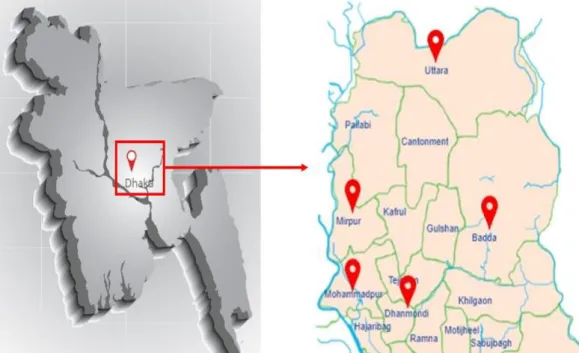
So, Study area is divided into 5 groups from Dhaka city. Theses are Mohammadpur, Uttara, Mirpur, Dhanmondi and Badda. The researcher compiled a list of city Dwellers with rooftop gardens with the help of Green Bangladesh Society , Fablab Sher-e-Bangla Agricultural university and Asters innovation ltd, Dhaka.
Figure 3.1: Map of the selected areas in Dhaka city
Page | 12
3.2 Population and Sample of the Study
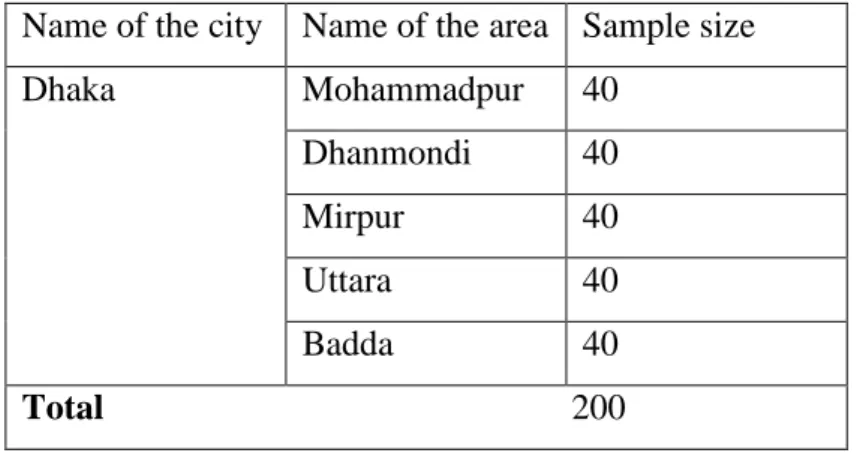
The active population of this stored consisted of people who lived in the designated area permanently and the owner and tenant of a multi-story building. However, data were collected using the percentage approach on a representative sample of the population. The respondent was one rooftop gardener (who mostly operated the rooftop garden) from each of the family. With the support of Green Bangladesh Society online platform and Aster innovation ltd,Agargawn, Dhaka updated lists of all respondents who owned and rented in the designated area were compiled. The respondents for the research region were chosen using a random sampling process. The overall number of rooftop gardeners in the study area was estimated to be around 2500, with 200 selected for an interview session.
Table 3.2. Sample size of the study
Name of the city Name of the area Sample size
Dhaka Mohammadpur 40
Dhanmondi 40
Mirpur 40
Uttara 40
Badda 40
Total 200
3.3 Data collection methods
The survey approach was used to obtain quantitative and qualitative data that allowed researchers to answer study questions and gain a better knowledge of respondents' factors. While interviews, over the phone conversations (if extra information was needed), and face-to-face interviews with 200 respondents were employed in the survey. Face to face interviews were excellent for eliciting unexpected responses and allowing respondents to explain the world as they see it rather than as the researcher sees it (Bryman, 2001).
Page | 13
3.4 Data collection tool
Structured interview schedule was prepared to reach the objectives of the study. A structured interview schedule was prepared containing open and closed questions. The instruments were first developed in English and then translated into Bengali. The survey tools were initially constructed based on an extensive literature reviews and pre-tested.
The schedule was pre-tested with 12 randomly selected respondents in the study areas.
The pre-test was helpful in identifying faulty questions and statements in the draft schedule. Thus, necessary additions, deletions, modifications and adjustments were made in the schedule on the basis of experiences gained from pretest.
The questionnaires were also checked for validity by supervisor, co-supervisor and educational experts at Sher-e-Bangla Agricultural University (SAU). Finally, based on background information, an expert appraisal and the pre-test, the interview schedule was finalized. Data were gathered by the researcher personally. During data collection, necessary cooperation was obtained from Urban roof gardeners society of Dhaka city, specially Green Bangladesh. The primary data were collected from 1 october to 15 october, 2019 for the draft to finalize the questionnaire.The final data was collected from 20 October 2019 to 25 February 2020. Books, journals, thesis, reports and internet documents were used as secondary sources of data supporting or supplementing the accurate findings of the study.
3.5 Measurement of Variables
The researcher used Microsoft Excel as data analysis tools for BCR calculation and SPSS statistical software for analyzing multiple linear regression.
3.6 Variables of the Study
In the present study, selected characteristics of the respondents, viz. age, education, family size, rooftop garden size, family income, profession, cost of rooftop, sales portion of rooftop and BCR are selected characteristics and their perception of rooftop garden constituted focus issue.
3.7. Measurement of dependent and independent variables
The selected characteristics of this study were some selected characteristics of the respondents. Rooftop production is dependent variable and independents variables are age, gender, education, family size, rooftop garden size, family income, profession,
Page | 14
access to training, growing seasons, support from organization and technical production knowledge. The procedures followed in measuring the independent variables are briefly discussed below:
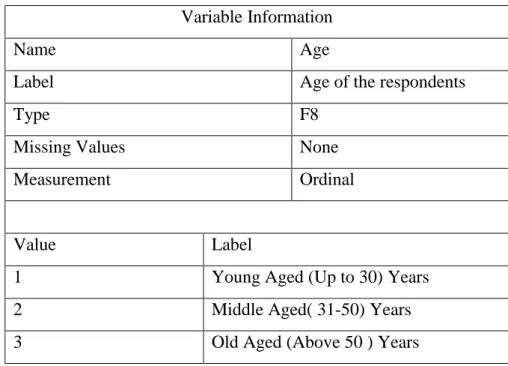
3.7.1 Age
Actual age of a respondent was measured by counting the actual years from his/her birth to the time of collecting data with an interview schedule. It was expressed in terms of complete years. Age variable was counted on both categorical and continuous basis.
This variable appears in the interview schedule as presented in Appendix-A section 1.
SPSS Coding is shown below:
Table 3.7.1: Age coding by SPSS
Variable Information
Name Age
Label Age of the respondents
Type F8
Missing Values None
Measurement Ordinal
Value Label
1 Young Aged (Up to 30) Years
2 Middle Aged( 31-50) Years
3 Old Aged (Above 50 ) Years
3.7.2 Gender
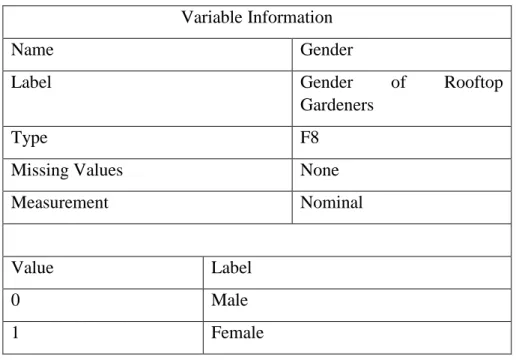
Gender is an indicator that shows the percentage of male and female, whose were maintaining the rooftop garden. For male the researcher considered 0 and for female considered 1. This variable also appears in item in the interview schedule as presented in Appendix-A. section 1. SPSS Coding is shown below:
Page | 15
Table 3.7.2: Gender coding by SPSS
Variable Information
Name Gender
Label Gender of Rooftop
Gardeners
Type F8
Missing Values None
Measurement Nominal
Value Label
0 Male
1 Female
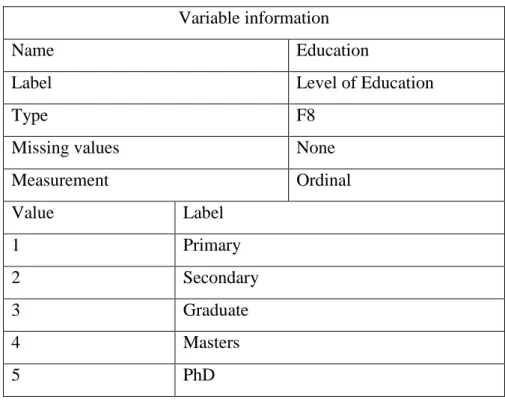
3.7.3 Education
Education of a respondent was measured by the number of years of schooling completed in an educational institution. A score was given for each year of schooling completed. If a respondent completes primary level of education his/her score was considered as 1 as well as 2 for secondary level of education ,3 means graduation, 4 means Masters and 5 for PhD. This variable appears in the interview schedule as presented in Appendix-A. section 1. SPSS Coding is shown below:
Page | 16
Table 3.7.3: Level of education coding by SPSS Variable information
Name Education
Label Level of Education
Type F8
Missing values None
Measurement Ordinal
Value Label
1 Primary
2 Secondary
3 Graduate
4 Masters
5 PhD
3.7.4. Profession: This variable appears in the interview schedule as presented in Appendix-A. section 1. Other sector counted housewife, student, freelancers .SPSS Coding is shown below:
Table 3.7.4: Respondent’s profession coding by SPSS Variable information
Name Profession
Label Profession of the
respondent
Type F8
Missing values None
Measurement Nominal
Value Label
1 Govt. Employee
2 Private Employee
3 Business
4 Other(homemaker, freelancer)
Page | 17
3.7.5. Family size
The family size was measured by the total number of members in the family of a respondent. The family members included family head and other dependent members like husband/wife, brother and sister, parents, children etc. who lived and ate together.
The total number of family members was considered as his family size score. Family size variable was counted on both categorical and continuous basis This variable appears in the interview schedule as presented in Appendix-A section 1. SPSS Coding is shown below:
Table 3.7.5: Respondents family size coding by SPSS Variable Information
Name Family Size
Label Total Family Members
Type F8
Missing Values None
Measurement Ordinal
Value Label
1 Small Family (Up to 3 members)
2 Medium Family (4-6 members)
3 Large Family (Above 6 members)
3.7.6. Rooftop garden size
Rooftop garden size of a respondent is referred to the total roof area which his/her family carried out farming operations, own roof under own gardening, roof given to others on share roof taken from others on share and roof taken from others on lease.
Rooftop garden size variable was counted on both categorical and continuous basis This variable appears in the interview schedule as presented in Appendix-A section 1. SPSS Coding is shown below:
Page | 18
Table 3.7.6: Respondents roof area coding by SPSS Variable Information
Name Area
Label Total roof space sq feet
Type F8
Missing Values None
Measurement Nominal
Value Label
1 Small – (Up to 2200) Sq-ft
2 Medium – (2200-3200) Sq-ft
3 Large - (Above 3200) Sq-ft
3.7.7. Monthly family income
The income of a respondent is an important indicator that shows how much he can invest in his rooftop gardens. Income of a respondent was measured in taka on the basis of monthly earnings in which the respondent as well as his family members were involved. This variable also appears in item in the interview schedule as presented in Appendix-A section 1. SPSS Coding is shown below:
Table 3.7.7: Respondents monthly income coding by SPSS Variable Information
Name Income
Label Family Income
Type F8
Missing Values None
Measurement Ordinal
Value Label
1 Low – (Up to 30000) Tk
2 Medium - (40001-50000) Tk
3 High – (Above 50000) Tk
Page | 19
3.7.8. Access to training: Respondents those were took part in rooftop gardening training and those are wanted to attend the training session were counted to see the willingness of the respondents. section 2. SPSS Coding is shown below:
Table 3.7.8: Access to training coding by SPSS Variable Information
Name Training
Label Access to Training
Type F8
Missing Values None
Measurement Nominal
Value Label
0 Taking Training
1 Does not attend training
3.7.9. Growing season of rooftop production
Rooftop farming is a policy that vegetable and fruit production are an important goals of rooftop farming for ensuring organic food. So sustainability of rooftop covers that every agricultural session has sessional fruits and vegetable production. This variable also appears in item in the interview schedule as presented in Appendix-A section 2.
SPSS Coding is shown below:
Page | 20
Table 3.7.9: Growing season coding by SPSS Variable Information
Name Growing Season
Label Growing Season
Type F8
Missing Values None
Measurement Nominal
Value Label
1 Kharif 1
2 Kharif 2
3 Rabi
4 All season
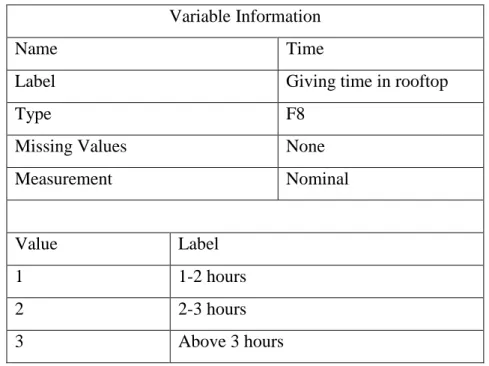
3.7.10. Given time in rooftop
The respondents may spend how many hours in rooftop garden. Minimum 1 hour to maximum above 3 hours is counted. This variable also appears in item in the interview schedule as presented in Appendix-A section 2. SPSS Coding is shown below:
Table 3.7.10: Given time in rooftop coding by SPSS Variable Information
Name Time
Label Giving time in rooftop
Type F8
Missing Values None
Measurement Nominal
Value Label
1 1-2 hours
2 2-3 hours
3 Above 3 hours
Page | 21
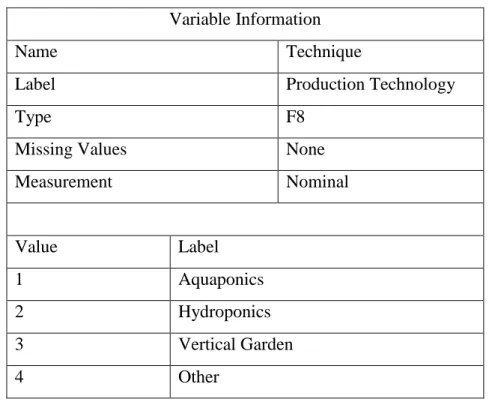
3.7.11. Production technique to implement for developing rooftop garden
This variable also appears in item in the interview schedule as presented in Appendix- A section 2. SPSS Coding is shown below:
Table 3.7.11: Production technology coding by SPSS Variable Information
Name Technique
Label Production Technology
Type F8
Missing Values None
Measurement Nominal
Value Label
1 Aquaponics
2 Hydroponics
3 Vertical Garden
4 Other
3.7.12. Selected region in Dhaka city: This variable also appears in item in the interview schedule as presented in Appendix-A section 1. SPSS Coding is shown below:
Page | 22
Table 3.7.12. Respondents region coding by SPSS Variable Information
Name Location
Label Location in Dhaka City
Type F8
Missing Values None
Measurement Nominal
Value Label
1 Mohammadpur
2 Dhanmondi
3 Mirpur
4 Uttara
5 Badda
3.7.13. Service provider Organization
Respondents who got help from any government organization like Agricultural university, DAE, BADC, Horticultural center those were counted. Private organization like Aster innovation ltd, Nagar krishi, etc. On the other hands online platform is kike social media group, youtube, etc. This variable also appears in item in the interview schedule as presented in Appendix-A section 2. SPSS Coding is shown below:
.
Page | 23
Statement on rooftop production gives more nutrition than buying from market
Table 3.7.13: Service provider organization coding by SPSS Variable Information
Name Support
Label Support from organization
Type F8
Missing Values None
Measurement Nominal
Value Label
1 Govt. Organization
2 Private Organization
3 Online platform
3.8.
The respondents that are positive with this statement, count as 0 and those are negative upon the statement count as 1. This variable also appears in item in the interview schedule as presented in Appendix-A section 3.
3.9. Vegetables and fruits produced in current RTG in Dhaka
10 common fruits and 10 common vegetables were counted on the basis of respondent cultivation in the rooftop
3.10. Collection amount from rooftop production
The respondents may collect the fruits and vegetables per day, per week or monthly basis. This amount is counted as kg basis as continuous variable. For factors affecting rooftop production it is calculated in SPSS and for BCR it is calculated by Excel. This variable also appears in item in the interview schedule as presented in Appendix-A section 3.
Page | 24
Proposed total cash benefit of a project Proposed total cash cost of the project.
3.11. Used of pesticides for controlling pest and diseases of fruits and vegetables in the existing roof top garden
The respondents whose are using pesticides count as 1, those are using herbal method count as 2 and those are not using any method count as 3. This variable also appears in item in the interview schedule as presented in Appendix-A section 3.
3.12. Intension to do rooftop Business
The respondents whose are willing to do rooftop business count as 0 and those are not willing to do rooftop business count as 1. This variable also appears in item in the interview schedule as presented in Appendix-A section 3.
3.13. Existing plant with respective yield and income in the last year on 1 year Most Common five fruits and vegetables among all the data was selected for calculating the yield.
BCR : A benefit-cost ratio (BCR) is a ratio used in a cost-benefit analysis to summarize the overall relationship between the relative costs and benefits of a proposed project.
BCR Calculation=
BCR can be expressed in monetary or qualitative terms.
If BCR > 1 , the return from rooftop garden is expected and economically satisfactory for the investors.
BCR < 1 , the return from rooftop garden is rejected and economically not satisfactory for the investors
BCR =1, There exist economic breakeven point that the rooftop owners did not have any profit or loss, it totally depends on their thought that they would invest or not.
Page | 25
3.14. Model fitting Assumptions: There was a question why the researcher used regression analysis. So there was similarity with this data that Regression could run for this thesis research.
i) Linear relationship: It was examined that the data had liner relationship.From graph 3.14a it would be clear which was attatched in Appendix.
ii)No auto correlation: There was no auto correlation because all the correlation value was below 0.7. From table 3.14c it would be clear which was attatched in Appendix.
iii) No multi collinearity: Tolerance was greater than 0.10 and VIF was below 10 as shown on table 3.14b in Appendix.
3.15. Creating Dummy Variable: For multiple linear regression model dependent variable was continuous. Some independent variables were categorical for that dummy variables were created by SPSS.
3.16. Data processing and Analyzing
The collected raw data were carefully analyzed for inaccuracies and omissions. The investigator created a detailed coding plan after consulting with the study supervisor.
The information was then entered into a coding sheet. In the case of qualitative data, appropriate scoring techniques were used to assign correct weight to each of the traits in order to convert the data into quantitative forms. The study's collected data was collated, tabulated, and analyzed in accordance with the study's objectives with the help of Excel and SPSS. The variables of the study were described using statistical measures such as number and percentage distribution, range, cost calculation and BCR. For ease of comprehension, tables and figures used to show data.
Page | 26
CHAPTER IV
RESULTS AND DISCUSSION
Under this chapter, the recorded observations were presented in accordance with the study's purpose, and a probable discussion of the findings was held, with a likely justifiable and applicable interpretation. This chapter summarizes the study's findings and discusses how they were interpreted. According to the study's goal, these are organized into three divisions. The first half focuses on the respondents' chosen socioeconomic factors, while the second section focuses on factors affecting rooftop production. The final portion looks into the breadth and potential of agribusiness through rooftop gardening.
4.1 Socio Economic Characteristics of the respondents
Personal qualities play a big role in determining an individual's behavior. The respondents had a variety of traits that could have an impact on rooftop gardening.
However, seven characteristics of them were chosen as independent variables in this study for socio economic characteristics, including their age, gender, level of education, family size, profession, family income and rooftop area, all of which could have a significant impact on the house owner's attitude toward rooftop gardening production.
4.1.1. Age
The age of the respondents has been varied from 25 to 66 years. Considering the recorded age, the respondents were classified into three categories namely ‘young’,
‘middle’ and ‘old’ aged. young aged people considered as up to 35 years, Middle aged considered as 36 to 50 years and old aged considered as above 50 . From this figure, it explained that majority of old aged people did rooftop gardening in Dhaka city.The distribution of the respondents from selected area in accordance of their age is presented in the following tables.
Page | 27
Distribution of the respondents according to their age is presented in Mohammadpur
% Within Location in Dhaka City
Figure 4.1.1. Distribution of the respondents according to their age Table 4.1.1.
From Table 4.1.1 total 40 respondents are selected from Mohammadpur area, it was revealed that the old-aged respondents comprised the highest proportion (50 percent) followed by middle aged category (30 percent) and (20 percent) respondents were in the young aged category. Data indicates that young aged, middle and old aged respondents were involved in rooftop gardening in Mohammadpur.
20 20 22.5 22.5 22.5
30
15 12.5 12.5
20.5 50
65 65 65
57.5
0 10 20 30 40 50 60 70
Mohammadpur Dhanmondi Mirpur Uttara Badda
Young Aged( 25-30) Years Middle Aged( 31-50) Years Old Aged( Above 50) Years
Category Range(years) Respondent
Year observed Number Percent Young
aged
Up to 30 25-66 8 20
Middle aged
31-50 12 30
Old aged Above 50
20 50
Total 40 100.0
Page | 28
Distribution of the respondents according to their age is presented in Mirpur
Distribution of the respondents according to their age is presented in Dhanmondi
Table 4.1.2.
From Table 4.1.2 total 40 respondents are selected from Dhanmondi area, it was revealed that the old-aged respondents comprised the highest proportion (65 percent) followed by young aged category (20 percent) and (15 percent) respondents were in the middle-aged category. Data indicates that young and old aged respondents were involved most in rooftop gardening in Dhanmondi.
Table 4.1.3.
From Table 4.1.3 total 40 respondents are selected from Mirpur, it was revealed that the old-aged respondents comprised the highest proportion (65 percent) followed by young aged category (22.5 percent) and (12.5 percent) respondents were in the middle- aged category. Data indicates the old aged respondents mostly found in leisure time to do rooftop gardening at the study area for their recreational activity. Rahman (2014) also found the similar findings in his studies related to rooftop gardening in Dhaka city.
Category Range(years) Respondent
Year observed Number Percent
Young aged Up to 30 25-66 8 20
Middle aged 31-50 6 15
Old Aged Above 50 26 65
Total 40 100.0
Category Range(years) Respondent Year observed Number Percent Young aged Up to
30
25-66 9 22.5
Middle aged 31-50 5 12.5
Old Aged Above 50
26 65
Total 40 100.0
Page | 29
Distribution of the respondents according to their age is presented in Badda
Distribution of the respondents according to their age is presented in Uttara
Table 4.1.4.
From Table 4.1.4. total 40 respondents are selected from Uttara; it was revealed that the old-aged respondents comprised the highest proportion (65 percent) followed by young aged category (22.5 percent) and (12.5 percent) respondents were in the middle aged category. Data indicates the old aged respondents mostly found in leisure time to do rooftop gardening at the study area for their recreational activity. Rahman (2014) also found the similar findings in his studies related to rooftop gardening in Dhaka city.
Table 4.1.5.
From Table 4.1.5 total 40 respondents are selected from Badda, it was revealed that the old-aged respondents comprised the highest proportion (57.5 percent) followed by young aged category (22.5 percent) and (20 percent) respondents were in the young aged category. Data indicates the old aged respondents mostly found in leisure time to do rooftop gardening at the study area for their recreational activity. Rahman (2014), also found the similar findings in his studies related to rooftop gardening in Dhaka city.
Category Range(years) Respondent
Year observed Number Percent
Young aged Up to 30 25-66 9 22.5
Middle aged 31-50 5 12.5
Old Aged Above 50 26 65
Total 40 100.0
Category Range(years) Respondent
Year observed Number Percent Young
aged
Up to 30 25-66 9 22.5
Middle aged
31-50 8 20
Old Aged Above 50
23 57.5
Total 40 100.0
Page | 30
% Within Location in Dhaka City
4.1.2. Respondents according to their Gender
Gender refers to biological identification of the respondents in the form of either male or female. In the study area, the level of gender of the respondents were divided into two categories such as male and female.
Figure 4.1.2: Respondents according to their Gender
Figure 4.1.2. shows that the majority of the rooftop gardeners in Mohammadpur has female which was account to 82.5 percent and rest 17.5 percent of the respondents were male. In Dhanmondi region, 70 percent of the respondents were female and 30 percent were male while 95 percent female and 5 percent male respondents were found in Mirpur area. In Uttara and Badda region, the majority of the respondents were female which was account to 85 percent and 95 percent respectively. The number of male respondents was 15 percent for Uttara and 5 percent for Badda.
4.1.3. Level of education
The respondent's education can be extremely beneficial to effective administration and operations, as well as successful output. A well-educated person will have easier access to essential technical and scientific information and will be able to make more informed economic decisions. The respondents' educational levels in the study area were divided
17.5
30
5
15
5 82.5
70
95
85
95
0 10 20 30 40 50 60 70 80 90 100
Mohammadpur Dhanmondi Mirpur Uttara Badda
Male Female
Page | 31
% Within Location in Dhaka City
into five categories: primary, secondary & higher secondary, graduate, master's, and PhD.
Figure 4.1.3 : Distribution of the respondents according to their Level of education Figure 4.1.3 shows that in the Mohammadpur area, 42.5 percent of the respondents had secondary & higher secondary level of education, while 40 percent had a graduate degree, compared to 7.5 percent who had a master's degree, 5 percent had primary degree and the remaining 5 percent had a PhD degree. However, the results of this research show that all of the respondents in the Mohammadpur area had some level of schooling.
In the Dhanmondi area, the highest 62.5 percent of respondents were graduates, while the lowest respondents were from primary education level (0 percent). Across all Mirpur areas of Dhaka city, the highest 60 percent of the respondents were graduates, while the lowest 7.5 percent had a PhD. In Uttara, the highest 62.5 percent of the respondents were graduates, while the lowest 5 percent had a PhD level of education.
In the Badda area, the biggest percentage of respondents (62.5 %) had a graduate level of education, while there were no one who had a PhD level of education. This result indicates that in those area all the respondents have some level of schooling.
5
12.5
20 17.5
2.5 42.5
62.5 60 62.5
27.5 40
22.5
12.5 15
62.5
7.5
55
7.5 5 7.5
5 0
10 20 30 40 50 60 70
Mohammadpur Dhanmondi Mirpur Uttara Badda
% Within Location in dhaka city
Primary Secondary Graduate Masters PhD
Page | 32
Distribution of the respondents according to their family size (Mohammadpur)
% Within Location in Dhaka City
4.1.4. Respondents according to their family size
The respondents’ size of family in the study area were divided into three categories such as small size, medium size and large size family. Small size family consists of up to 3 members, medium size family consists of 4-6 members and large size family has more than 6 members. This was categorized by Kabir (2018). From this figure we can understand that small family in Dhaka city has highest portion.
Figure 4.1.4: Respondents according to their family size
Table 4.1.4a.
52.5
45
57.5
45 32.5 35
40
32.5
27.5
32.5
15 15
10
27.5
32.5
0 10 20 30 40 50 60 70
Mohammadpur Dhanmondi Mirpur Uttara Badda
Small Family (Upto 3) Medium Family (4-6) Large Family (>6)
Category Range(member) Respondent Member observed Number Percent Small Family Up to 3 2-7 21 52.5
Medium Family 4-6 13 32.5
Large Family >6 6 15
Total 40 100.0