Ahmad Ismail Mustafa, Dean, Department of Pharmacy, Faculty of Allied Health Sciences, Daffodil International University and Suriya Sharmin, Research Fellow, PSRD, Bangladesh Council for Scientific and Industrial Research (BCSIR), impartially fulfilling the requirement for the degree of Master of Pharmacy. This study presents the development, optimization and validation of a simple HPLC method for the determination of trimetazidine hydrochloride in bulk drug and modified-release tablets, since trimetazidine hydrochloride in the form of modified-release tablets is not included in any of the official monographs. A simple, rapid, economical, accurate, precise and reproducible HPLC method was developed for the determination of trimetazidine, which acts as an antianginal agent, a modifier of myocardial metabolism.
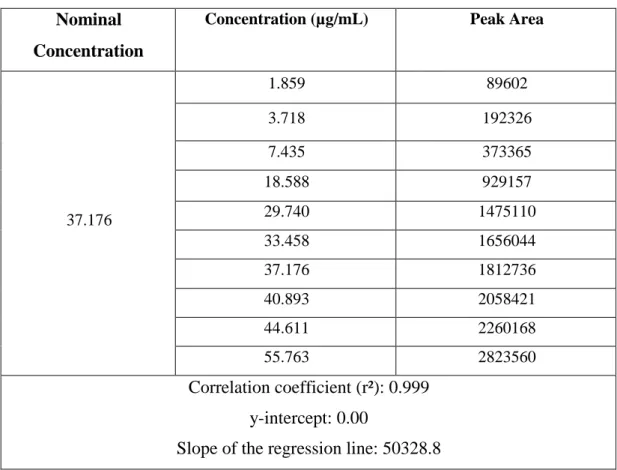
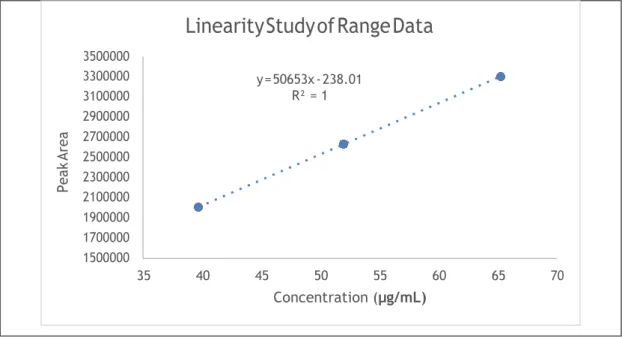
The wavelength for maximum absorption was selected at 232 nm by spectral scanning of Trimetazidine standard solution in UV-VIS spectrophotometer. The results of the proposed method were found to be satisfactory and suitable for the determination of Trimetazidine for routine drug quality control in bulk drug and formulation wavelength. The method was found to be linear with a regression coefficient value of 0.999 at a concentration of μg/ml trimetazidine.
System suitability parameters were checked for acceptance limit in terms of asymmetry, theoretical plates, capacity factor and relative standard deviation (%) of six replicates of injection in 10 µL value of standard solution at specific concentration. Further study of the degradation pathway of the compound will provide an idea of the stability that shows the nature of the method to distinguish the active ingredient, trimetazidine, from its associated impurities and degradants.
CHAPTER SIX: DISCUSSION
CHAPTER SEVEN: CONCLUSION
CHAPTER EIGHT: REFERENCES
CHAPTER : ONE INTRODUCTION
INTRODUCTION
Pharmaceutical Analysis
Pharmaceutical Analysis: Role
Pharmaceutical Analysis: Major activities
Pharmaceutical Quality Management System
Quality Assurance
Good practices in Quality Control
Standards of the Quality
Analytical Method Development: Choice of Instrumentation
Purposes of analytical method development
- Linearity
- Range
- Precision
- Limit of Detection and Limit of Quantitation
- Robustness
- System Suitability
Data from the regression line itself can be helpful in providing mathematical estimates of the degree of linearity. The correlation coefficient, y-intercept, slope of the regression line, and residual sum of squares should be. Determining the accuracy of the drug .. a) Using the analytical procedure for synthetic mixtures of the drug components, to which known amounts of the active substance to be analyzed have been added;.
The accuracy of the analytical procedure expresses the accuracy of agreement (the degree of dispersion) between series of measurements obtained by repeatedly sampling the same homogeneous sample under prescribed conditions. Reproducibility should be assessed using a minimum of 9 determinations covering the specified range for the procedure (eg 3 concentrations/3 replicates each); or at least 6 determinations at 100% of the test concentration. ii) Intermediate accuracy. Reproducibility should be considered in the case of standardization of the analytical procedure, for example for the inclusion of procedures in pharmacopoeias.
The robustness of an analytical procedure is the characteristic of its stability with respect to small variations of the system parameters possible under real conditions. These tests are used to verify that the resolution and repeatability of the system is sufficient for the analysis to be performed.
Titrimetric techniques
Chromatographic techniques
Spectroscopic techniques
Hyphenated techniques
Technique Used in this Work UV/VIS spectrophotometry
Chromatographic Techniques
High-performance liquid chromatography
The main requirement for the mobile phase is that it must dissolve the analytes to the concentration suitable for detection. Other polar solvents such as Methanol, Acetonitrile or Tetrahydrofuran are added, pH is adjusted by buffers to change separations of ionizable solutes. Non-polar solvents such as hexane, heptane iso-octane are used in combination with slightly more polar solvents such as isopropanol, ethyl acetate or chloroform in normal phase applications.
Mobile phase degassing is important before use to remove entrapped air from the mobile phase from the atmosphere. Such bubbles can cause noise in the detector, react, or impede the flow of mobile phase through columns.
HPLC Method Development
CHAPTER ONE: INTRODUCTION 1) Mobile phase in the solvent reservoir: The main requirement for the mobile phase is that it should dissolve the analytes to a concentration suitable for detection.
Aims and Objectives
Daffodil International University's forced degradation research will ensure that analytical procedures are able to distinguish between the main active (intact) pharmaceutical ingredients (API) and any degradation products formed under defined storage conditions. Therefore, the aim of this study is to conduct method development and validation studies of the selected drug, namely Trimetazidine, using high-performance liquid chromatography, as there is no standard compendial method for the analysis of this drug.
CHAPTER : TWO
REVIEW OF LITERATURE
Jeraldmaria antony et.al (2009) A new validated spectrophotometric method for determination of Trimetazidine in Formulation and comparison with UV method
This method was based on the formation of a yellow ion pair complex between trimetazidine and methyl orange using chloroform as solvent at pH 4 phosphate buffer. 2014) Development and validation of a stability-indicating RP-HPLC method for the determination of trimetazidine dihydrochloride. The linear regression analysis data for the calibration plots showed good linear correlation within the concentration range 10-80 μgmL-1.
CHAPTER : THREE DRUG INFORMATION
Coronary Artery Disease: Angina Pectoris
Drug Choice: Trimetazidine (Antianginal agent)
Trimetazidine: Physicochemical Properties
CHAPTER : FOUR
MATERIALS AND METHODS
Materials and Methods
Materials
Pharmaceutical ingredients
Solvents and reagents
Apparatus
Instruments
Wavelength Determination
Mobile Phase Selection
Various solvent systems were prepared to select the right solvent ratio as the mobile phase in which the trimetazidine HCL peak was stable and regular. For this standard stock solution was prepared in the mobile phase (buffer:acetonitrile=50:50) and the standard solution was injected into the HPLC system for the next five days.
Buffer preparation
Assay of Trimetazidine Tablets
Diluent preparation
Standard solution preparation
Sample solution preparation
Linearity
Range
Precision Repeatability
Intermediate precision
Accuracy
Sensitivity
Specificity
By Checking the Chromatogram
By Checking the Response of Placebo Placebo preparation
Standard Stock Preparation
Placebo Stock Preparation
Working solutions preparation with fixed excipient stock solution and different standard solution
Working solutions preparation with fixed standard stock solution and different excipients solution
Robustness
System suitability
CHAPTER : FIVE RESULT
Result
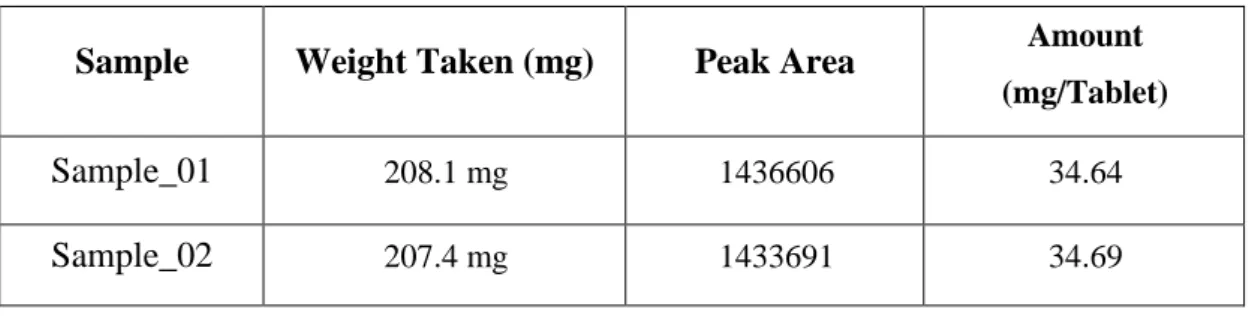
Assay
Precision
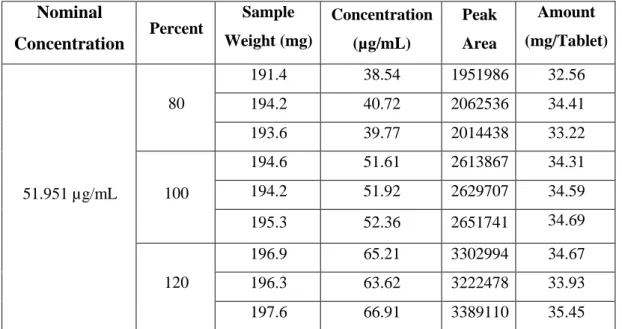
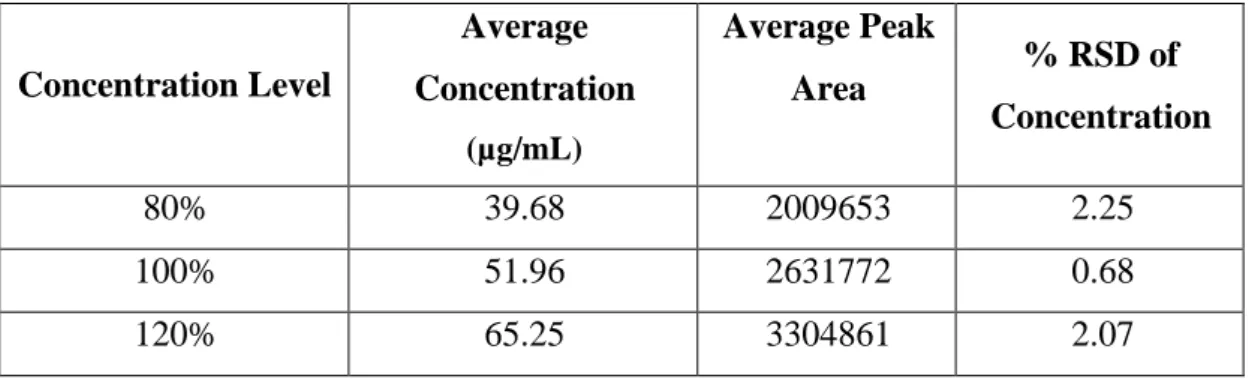
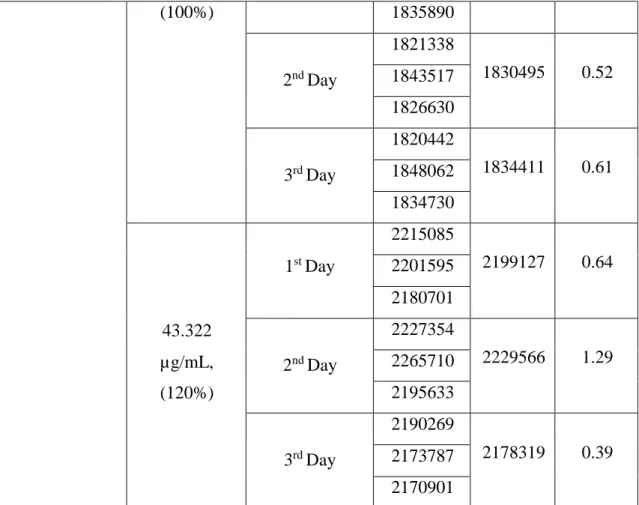
The intermediate precision or interday precision was determined by repeated analyzes of the standard solution at 80%, 100% and 120% of the nominal test concentration for three (03) consecutive days. The sample recovered from the HPLC test was determined by the calibration curve of the standard solution. Chromatogram observation: A chromatogram of diluent (blank), standard, sample and excipient solution at LOQ level was observed for any interference.
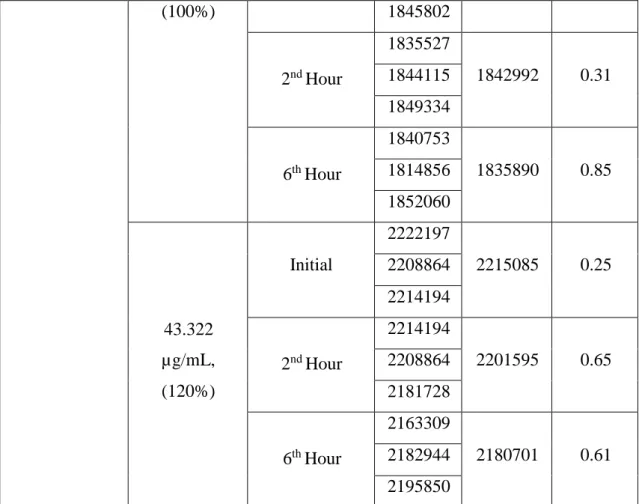
System Suitability
CHAPTER : SIX DISCUSSION
Discussions
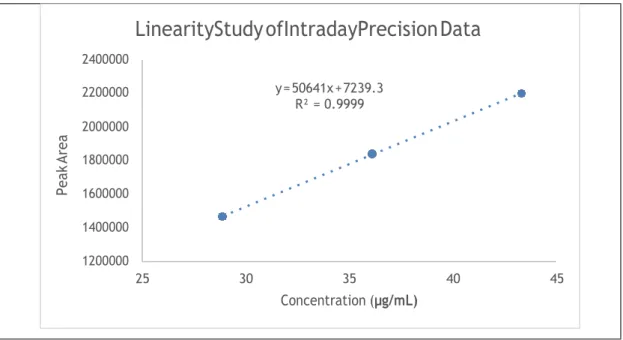
Repeatability or intra-day precision study at three different concentrations in three replicates showed a %RSD value of at these three concentrations with a regression coefficient value of 0.999. The study of inter-day precision or inter-day precision at three different concentrations in three replicates showed a %RSD value of at these three concentrations with a regression coefficient value of 0.995. No chromatographic interference was observed in the retention time of the standard solution for the excipients.
Addition of a varying amount of excipient solution to a specific amount of standard solution results in a response with a %RSD of 0.39. The results of both experiments indicate the specificity of the method for the analysis of trimetazidine. A robustness study gives an idea of the changes that can occur in peak properties with small changes in system parameters. i) A change in the content of the organic solvent in the eluent (±2%) showed a change in the retention time by a value of ±2.8.
No significant changes in peak area were observed here. iii) Changing the temperature of the HPLC column from 20 °C to 30 °C (±5 °C) did not cause a significant change in the response. iv) Changing the mobile phase flow rate from 0.8 to 1.2 mL/min changes the retention time from 8.29 to 5.53 minutes with a significant change in peak response. you).
CHAPTER : SEVEN CONCLUSION
CONCLUSION
CHAPTER : EIGHT REFERENCES
Having reached step 4 of the ICH process at the ICH Steering Committee meeting on November 6, 1996. Avdeef, Development and validation of a stability-indicating RP-HPLC method for the determination of trimetazidine dihydrochloride. Mukkanti RP-HPLC method development and validation for estimation of trimetazidine in tablet dosage forms.
Jeraldmaria Antony, A new validated spectrophotometric method for the determination of Trimetazidine in the formulation and comparison with the UV method. Naushad, Development and validation of the HPLC method for the analysis of trimetazidine hydrochloride bulk drug and pharmaceutical dosage forms. Andrei Medvedovici, Non-extractive procedure followed by LC/APCI MS/MS analysis of trimetazidine in plasma samples for assessing the bioequivalence of immediate/modified release formulations.
25 Mistri, Sensitive and rapid method to determine trimetazidine in human plasma by liquid chromatography/tandem mass spectrometry, 2008. Nagula, Development and validation of a stability-indicating RP-HPLC method for the determination of trimetazidine dihydrochloride trimetazidine.