Pressure toward Creativity: Individual/Group Work in Student Design
Competition
Jesenka Pibernik, Diana Milcic and Josip Bota
Faculty of Graphic Arts, University of Zagreb, Croatia
Abstract. There are several ways to organize creative work in an educational environment. Among the most frequently applied models is the design workshop. Depending on the desired outcomes, a workshop can be organized as a design competition. The general objectives of the workshop may be: to improve student's design and problem solving skills and competencies, to increase their creativity, awareness and understanding of the issues relating to the specific project. This paper is based on the analysis of the organization of the Student Creative Workshop CROPAK 2010. Previous research has shown that factors associated with creativity can be viewed on three different levels: the individual, the team and the organizational level. It is necessary to explore how the existing organization of the student design competition workshop works on all three levels and whether it can be improved.
Keywords: Creativity, Individual/Group Setting, Graphic Design, Competition
1 Introduction
The significant progress in the approach to modern graphic design is a result of discussions about the graphic designer as author. There are many definitions of authorship in graphic design that are being expanded and updated on a daily basis by designers, design critics and academic circles. Traditionally, the figure of the author implied total control over creative activity and an unique author’s touch. However, as the reception theory-based model given by design educators Michel and Katherine McCoy states, “Design for interpretation involves the audience in the creative process…graphic communication does not truly exist until each receiver decodes or interprets the message. Interpretive design challenges the viewer to participate and affect the outcome….“(Rock, 2005). Thinking about the audience as receivers offers a new perpective. The goal of creativity in graphic design is not to find the right answer, but to explore the range of possibilities. The broader the range of ideas that are
explored, the more likely it is that the designer will discover a breakthrough concept (Canaan, 2003).
What results from these new criteria in practice is the new role graphic designers are taking on. While traditional graphic design training was typically based on designers maintaining their specific identity as the originators, „authors“ or controllers of visual ideas, lots of new media products turn out to be created by a team of anonymous authors whose organizational structure does not support a hierarchical division of creative roles (Wild, 2005). The teaching strategies in graphic design education are increasingly paying attention to the need to train designers to work collaboratively. Collaboration and team work become a necessity for solving higher-level design problems that are characteristic of complex societies, like the one in which we live. Innovative curricula in many undergraduate and graduate programs are beginning to tackle these issues. Since educators have recognized that design knowledge has to be integrated into interdisciplinary ways of thinking, the criteria for messuring the effectiveness of design education have changed. It has been argued that teams may be more creative compared to the individual in isolation and this is why teamwork is often the vehicle employed by design studios seeking to enhance creativity (Stemple and Badke-Schub 2002, Andriopoulos 2001).
process of creating a project, rather than by the act of creation itself and by personal inventiveness. The act of creation is here understood as viewing graphic design as a craft. Craft is a type of knowledge students gain through experience or know-how. The tacit knowledge required to make something work is hard to describe – it has to be experienced, it is individual and very personal - it makes up a designer's style. Practical work generates a special kind of tacit knowledge complements conceptualism, a theoretical and interpretative knowledge system. For her, craft is a window into what designers do and a difference that marks their activity as valuable both in the making and production of ideas.
As stated above, the tendency to shift from visual form (craft) towards design strategy (concept) can lead to changes in the way the act of creativity in design how such creativity can be further stimulated.
2 Previous research
Numerous researchers have investigated the effects of different organizational factors on student creativity. Byron at al suggested that a low evaluative context increased creative performance, whereas a highly evaluative context decreased creative performance (Byron at al, 2010). Amabile also explored the effects of external evaluation on artistic creativity and concluded that the group which received explicit instructions on how to make artwork that would be judged creative performed better (Amabile, 1979). In terms of time management, the individual creativity of participants was positively related to perceived control of time and expressed confidence in long-range planning (Zampetskis at al, 2010). Shalley at al systematically reviewed empirical research which has examined personal and contextual characteristics that enhance employee creativity. They concluded that several contextual characteristics have consistent,
significant effects on individual creativity and that the direction of these characteristics is in line with the intrinsic motivation perspective. Specifically, individuals tend to exhibit high creativity when their jobs are complex, their supervisors engage in supportive, noncontrolling behaviors, and their work is evaluated in a developmental, nonjudgmental fashion. However, the picture is less clear with regard to the effects on creativity when coworkers are supportive, rewards are absent and few deadlines or production goals are present. Results suggested that employees' personality and cognitive style do influence their response to contextual factors. This is especially important for designers, because results showed that the highest creativity occurred when employees had a strong creative role identity and perceived that their organization valued creative work. Possessing creativity-related skills and strategies increases the likelihood that one identifies the right problem, generates a variety of ideas and uses appropriate standards to evaluate and refine ideas. In terms of team creativity, researchers found that for new product development teams a moderate frequency of communication was best for creativity (Shalley at al, 2004).
3 Problem statement
Previous research has shown that factors associated with creativity can be observed on three different levels: the individual, the team and the organizational level (Chamakiotis at al, 2010). There are several ways in which collaborative work in an educational environment can be organized. One of the most frequently applied models is the design workshop. Depending on the desired outcomes, a workshop can be organized as a design competition.
3.1 Student Design Competition Workshop CROPAK 2010
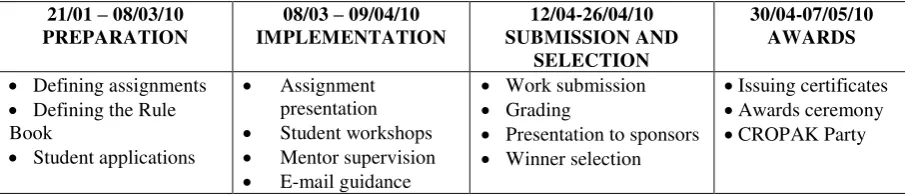
The aim of the workshop is synergy of action between professional designers, educational institutions (universities) and the economy, stimulation of creativity in students of similar institutions of higher education, and early inclusion of future experts in real processes of graphic design/redesign of brand packaging, with expert leadership and according to a precisely defined objective given by the owner of the brand product (design user - commissioner). The brain behind the concept of the creative workshop is Mrs. Drena Milijević, manager of Tectus d.o.o., based in Zagreb, and the participants are students from five institutions of higher education (a total of 100 students), their mentors (5 in total), the author of the creative assignment and two representatives of the commissioner. The concept of the workshop is articulated in the following way: students are first given creative assignments in terms of thinking about the design/redesign of the packaging of specific products, with instructions from the author of the assignment and the commissioner. With guidance from the mentor, in an institution of higher education, through a defined period of time, and respecting deadlines, students create packaging samples in terms of graphic design/redesign (Table 1.). Throughout the duration of CROPAK 2010, at the Faculty of Graphic Arts, University of Zagreb, all information was provided via Facebook, three student workshops were held, a supervision session by the mentor and the author of the creative assignment took place, and 198 e-mails were exchanged between assistant professors and workshop participants. See Table 1.
For the purposes of improving the CROPAK organizational context, several aspects have to be analyzed:
Which are the factors that enhance creativity? How does the individual/group competitive
spirit affect student creativity?
How to surpass creativity barriers in the organizational framework?
4 Methodology
Quantitative and qualitative methods were used in our research. For the purposes of comparing the variables related to the organization of individual and group work, we used numerical evaluation methods, while the interview method was used in order to better understand the factors affecting creativity.
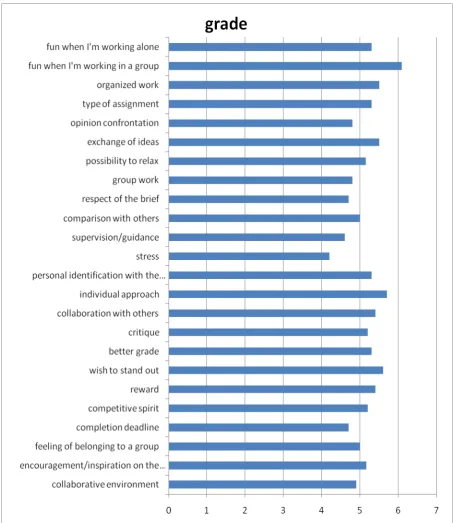
In order to compare the roles of variables affecting student creativity during work on their design assignment, an on-line survey was created, named “Creativity Enhancers in Graphic Design.” The survey was completed by 86 students of graphic design at the Faculty of Graphic Arts, more than half of whom had never before participated in a student competition. The survey was taken in the period from 24 May to 27 May 2010. The analysis of the survey yielded a list of general student preferences in terms of student workshop organization and individual versus group work.See Table 2.
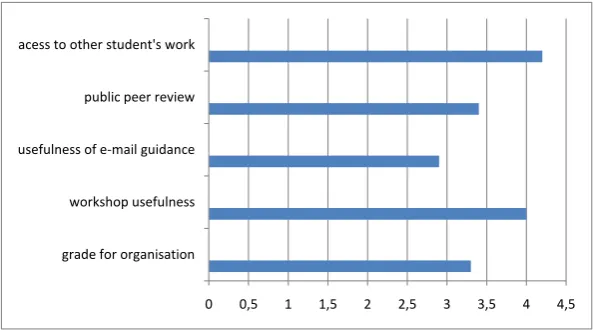
A second on-line survey was organized in order to explore student attitudes toward the Student Design Competition Workshop CROPAK 2010. The survey was taken between 7 May and 14 May 2010. This survey included the seventeen students who participated in the workshop. The aim of the survey was to determine whether students were satisfied with the organization of the workshop, and which elements of organization they liked or found useful. See Table 3.
The third part of research was conducted through a structured interview with students, consisting of nine questions. The aim of the interview was to gain better understanding of the advantages and disadvantages of individual/group work, and of the organization of CROPAK. Eight male and three female students were interviewed individually in the period from 7 May to 14 May 2010. Previous research did not suggest any difference between male and female creativity. All interviewees had previously participated in designer competitions and experienced both individual and group work on design assignments.
5 Research results
For the interview the participant was asked to bring along a written response to the nine questions. The written response was then discussed during the interview. The following statements illustrate the findings:
1. What are the advantages/disadvantages of individual vs. group work?
Individual work has advantages in terms of time organization and work on assignments based n own wishes, aesthetics, concept, idea, and in accordance with other commitments; but it can also represent a creative blockade. Sometimes the scope of knowledge needed to individually realize an idea is too wide….
The advantages of group work are a more detailed breakdown of ideas, a more varied approach to concept design, more criticism towards the work at hand (staring for hours at a given project, the individual designer can experience sensory deprivation and "stray" from work), multiplicaton of knowledge, faster completion of work, creation of a sense of community and improvement of the work atmosphere... I would say the disadvantages are a constant need for compromise, the possibility of conflict of esthetic values among individuals in the group, and the ever present small dose of competition, not to mention taking individual credit for group work. (R1)
If members of the team are also good friends and think in the same way, very good creative solutions can be found. (R2)
Since I am a stubborn perfectionist, I admit I find it hard to work in a group. (R3)
Group work requires extra creativity just to communicate one's idea, and, if necessary, to change and adapt it so that everyone is satisfied. (R4)
A joking comment by one member of our group gave birth to an idea in me that was later chosen for further development. (R5)
Synergy between colleagues in a group can be a good thing… Some people are better at expressing themselves and functioning in a group, while others express themselves better as individuals, but creativity is a thing of the moment. (R6)
I was always interested to hear a second opinion, which is very important, but not always crucial in my work. I try to maintain my own so-called "style“. (R8)
2. What were the advantages/disadvantages of the organization of CROPAK?
In this year's case, although the majority of selected works came from the Faculty of Graphic Arts, a significant dose of rivalry could be felt among students, as well as the wish to prove themselves, which overshadowed the initial feeling of collective success and satisfaction that I, as a student of the Faculty, felt at the beginning. As far as individual creativity is concerned, it is always present to the same extent, whether individual or team work is involved. (R1)
The advantage of the Cropak competition over others is precisely the physical contact. Participants Table 3
.
On-line Survey “CROPAK 2010 - Organisation
“0 0,5 1 1,5 2 2,5 3 3,5 4 4,5
meet each other and introduce themselves, from basic facts to their own views of the completed design. (R3)
Such organized work creates a feeling of belonging, as well as mutual motivation which yields a better end result. (R8)
3. How, in your opinion, can the organization of CROPAK be improved?
Organize more workshops with mentors, which beside providing feedback on design solutions could also teach us more about the thoughtful realization of design solutions. (R2)
Perhaps a little more mentored work. (R4)
I think the awards fund for Cropak is shamefully low. (R6)
Through additional education. Only student guidance and individual learning would be the primary goals of such workshops. (R8)
6 Discusion
Which are the factors that enhance creativity? The results of the first survey showed students’ attitudes towards factors that stimulate creativity in graphic design. The most stimulating factors are thought to be fun in group work and the individual approach, followed by the wish to stand out, organized work, awards, exchange of ideas and personal identification with the assignment. The elements which received the lowest grades were the following: stress, respecting deadlines, supervision, respecting the brief, group work, conflict of opinions, and a collaborative environment. As far as the organization of the CROPAK competition is concerned, students thought that access to others’ work and work in workshops were the most useful factors. The least useful aspect was e-mail guidance. Public peer review was also not highly graded. Survey results have shown that CROPAK’s organizational contexts are in line with previous research, which showed that individuals tend to exhibit high creativity when their jobs are complex, their supervisors engage in supportive, noncontrolling behaviors, and their work is evaluated in a developmental, nonjudgmental fashion. Also, students perceived that their organization (Faculty) valued their creative work. However, the level of communication centralization was relatively high because instructions about the sponsor’s wishes were being filtered through just two of the members – a supervisor and a sponsor’s representative. The results
of both surveys are in line with previous research, which points to the importance of the intrinsic motivation perspective in the evaluation of factors affecting creativity. The reason for such a subjective approach may lie in the fact that survey questions were not related to a specific problem-solving situation or student competition, but were general.
How does the individual/group competitive spirit affect student creativity?
7 Conclusion
The key question this article poses is: how do students feel in a group surrounding versus the individual, that is, do they think that group surroundings can affect the sense of authorship expressed in individual work and thereby impair creativity? Because of student’s perception that the goal of creativity in graphic design is to explore the range of possible ideas, their creativeness does not depend on his/her role in the strategy of creating a project. In other words, students do not perceive authorship as a main issue in design competition. So, the main question this article posed was misguided, even though, in author’s opinion, it was worth posing. Unlike the experienced designer, majoriti of students do not yet identify with the role of author. As noted in discussing the results, the preference for individual/group work rests with the psychological traits of the individual and the type of assignment. Each approach has its advantages and disadvantages which have to be taken into account in any given situation. In case of a more complex assignment, however, it is absolutely necessary to encourage group work because only group work can widen the range of ideas that are explored.
The above findings have major implications for the organization of future CROPAK events, when the number of workshops should be increased. This shows that students recognize that possession of related skills increases the likelihood that one succeeds as a designer. Also, the level of communication centralization should be lowered and instructions about the sponsor’s wishes should be communicated in a broader way. Given that awards are a strong motivator in the competition, and competition may encourage creativity, it is necessary to increase the awards fund. Future studies could also include the division of creative roles inside a particular group.
References
Amabile T., „Effects of External Evaluation on Artistic Creativity“, Journal of Personality and Social Psychology, Volume 37, Issue 2, February 1979, Pages 221-233.
Andriopoulos, C., "Determinants of Organizational Creativity: A Literature Review", Management Decision, Vol.39, No.10, 2001, pp 834-841. Byron K., Khazanchi S., Nazarian D. „The
Relationship Between Stressors and Creativity: A Meta-Analysis Examining Competing Theoretical Models”, Journal of Applied Psychology, Volume 95, Issue 1, January 2010, Pages 201-212. Canaan D. “Research to Fuel the Creative Process”,
Design Research, Methods and Perspectives, Lurel B. Ed., The MIT Press, Cambridge, Massachusetts, London, 2003.
Chamakiotis P., Dekoninck E.A., Panteli N.
„Creativity in Virtual Design Teams“, International Design Conference – Design 2010, Proceedings, Design Organization and Management, 2010, pp. 1035-1044.
Rock M., „Graphic Authorship“, The Educations of A Graphic Designer S. Heller ed., Allworth Press, New York, 2005, pp.200-2009.
Shalley C., Zhou J., Oldham G.,“ The Effects of Personal and Contextual Characteristics on Creativity: Where Should We Go from Here? Journal of Management
Volume 30, Issue 6, November 2004, Pages 933-958
Stempfle, J. and Badke-Schaub, P., "Thinking in Design Teams-an Analysis of Team
Communication", Design Studies, Vol.23, No.5, 2002, pp 473-496.
Wild L. „That Was Then:
Corrections&Amplifications“, The Educations of A Graphic Designer, S. Heller ed., Allworth Press, New York, 2005, pp.41-54.