BORANG PENGESAHAN STATUS TESIS*
JUDUL: OPTMIZA TION OF DECENTRALIZE NETWORK FOR RESOURCE SHARING
SESI PENGAJIAN: 2012/2013
s。ケ。セセセセセセセMn⦅a⦅i⦅mセb⦅inセh⦅a⦅d⦅i⦅d⦅a⦅r⦅s⦅o⦅n⦅oセセセセセセセ@
mengaku membenarkan tesis Projek Sarjana Muda ini disimpan di Perpustakaan Fakulti Teknologi Maklumat dan Komunikasi dengan syarat-syarat kegunaan seperti berikut:
Tesis dan projek adalah hakmilik Universiti Teknikal Malaysia Melaka.
Perpustakaan Fakulti Teknologi Maklumat dan Komunikasi dibenarkan membuat salinan untuk tujuan pengajian sahaja.
Perpustakaan Fakulti Teknologi Maklumat dan Komunikasi dibenarkan membuat salinan tesis ini sebagai bahan pertukaran antara institusi pengajian tinggi.
**
Sila tandakan (/)SULIT
TERHAD
TIDAK TERHAD
Alamat tetap: ?:if , :TAI-AN g'
!AMAN
Hl[W
flOW /セ_LUgッ@ SGN\fNYIH S[LAN frOfZ..
/ Tarikh:
(Mengandungi maklumat yang berdarjah keselamatan atau kepentingan Malaysia seperti yang termaktub di dalam AKT A RAHSIA RASMI 1972)
(Mengandungi maklumat TERHAD yang telah ditentukan oleh organisasi/badan di mana penyelidikan dijalankan)
(T ANDA TAN GAN PENYELIA)
<;,
'i
A
'RM
Lµ f'rz;.
I A-14
Nama PenyeliaOPTMIZATION OF DECENTRALIZE NETWORK FOR RESOURCE SHARING
NAIM BIN HADI DARSONO
This report is submitted in partial fulfilment of the requirements for the
Bachelor of Computer Science (Computer Networking)
DECLARATION
I hereby declare that this project report entitled
OPTMIZATION OF DECENTRALIZE NETWORK FOR RESOURCE SHARING
STUDENT
is written by me and is my own effort and that no part has been plagiarized
without citations.
7
j
Date: 5 / ( /RPQセ@
(NAIM BIN HADI DARSONO)
SUPERVISOR
LOHゥOOセ@
Date: f;/°J /
>o
13
..
7
ii
DEDICATION
iii
ACKNOWLEDGEMENT
First and foremost , I would like to express my gratitude to my family for always being
there for me when time I needed someone to be with, for giving me place when I needed shelter,
for showing me the way when I needed direction and for putting me back on my feet when I am
down and hopeless.
Next a thousand thanks to my supervisor, Ms. Syarulnaziah Anawar, for guiding me all
the way to complete this research study. The supervisions and supports given are very helpful in
my progression to this research study. The co-operation is much indeed appreciated. Without her
help, this research study project would end in failure. No word can describe the way I wanted to
thank her, and gratitude is definitely never enough for her.
Lastly, I would like to take this chance to thanks my friends for supporting me on
iv
ABSTRACT
v
ABSTRAK
vii
1.6
PROJECT SIGNIFICANCE4
1.7
RESEARCH IN MAP5
1.8
CONCLUSION5
CHAPTER 2: LITERATURE REVIEW
2.1
INTRODUCTION6
2.2
FACTS AND FINDING6
2.2.1
Coverage7
2.2.2
MANET 102.2.3
AODV 112.3
PROPOSED WORK AND JUSTIFICATION 132.4
CONCLUSION15
CHAPTER3:METHODOLOGY
3.1
INTRODUCTION16
3.2
METHODOLOGY (DESCREET EVENT SIMULATION)16
3.3
ANALYSIS17
3.3.1
EXPERIMENT17
3.3.2
SIMULATION20
3.3.3 TESTBED
22
3.4
MILESTONES24
viii
CHAPTER 4: ANALYSIS AND DESIGN
4.1
INTRODUCTION26
4.2
PROJECT REQUIREMENT26
4.2.1
Software Requirement27
4.2.2
Hardware Requirement28
4.2.3
Network Requirement28
4.2.4
Simulation Requirement29
4.3
EXPERIMENTAL SETUP30
4.3.l
Setup Scenario33
4.3.2
Performance Matric39
4.3.3
Simulation of Experimental Scenario41
4.4
CONCLUSION43
CHAPTERS: TESTING
5.1
INTRODUCTION44
5.2
TEST PLAN44
5.2.1
Test Environment45
5.2.2
Test Schedule49
5.3
TEST STRATEGY49
5.4
TEST DESIGN52
ix
5.6
TEST DATA54
5.6.1
Result55
5.7
CONCLUSION80
CHAPTER 6: CONCLUSION
6.1
INTRODUCTION81
6.2
ANALYSIS SUMMARIZATION82
6.3
LIMITATION82
6.4
CONTRIBUTION82
6.5
FUTURE WORKS83
6.6
CONCLUSION83
x
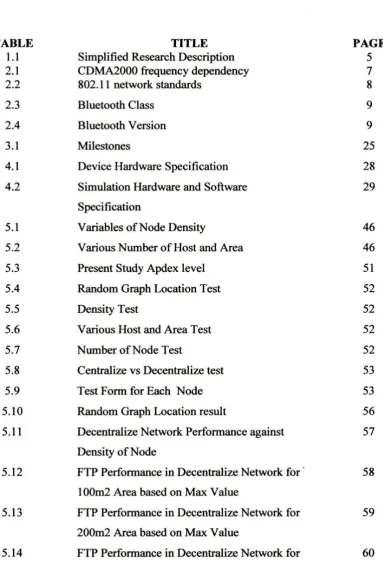
LIST OFT ABLES
TABLE TITLE PAGE
1.1 Simplified Research Description 5
2.1 CDMA2000 frequency dependency 7
2.2 802.11 network standards 8
2.3 Bluetooth Class 9
2.4 Bluetooth Version 9
3.1 Milestones 25
4.1 Device Hardware Specification 28
4.2 Simulation Hardware and Software 29
Specification
5.1 Variables of Node Density 46
5.2 Various Number of Host and Area 46
5.3 Present Study Apdex level 51
5.4 Random Graph Location Test 52
5.5 Density Test 52
5.6 Various Host and Area Test 52
5.7 Number of Node Test 52
5.8 Centralize vs Decentralize test 53
5.9 Test Form for Each Node 53
5.10 Random Graph Location result 56
5.11 Decentralize Network Performance against 57
Density of Node
5.12 FTP Performance in Decentralize Network for 58 l 00m2 Area based on Max Value
5.13 FTP Performance in Decentralize Network for 59 200m2 Area based on Max Value
[image:11.530.72.456.112.695.2]xi
400m2 Area based on Max Value
5.15 FTP Performance in Decentralize Network 61
based on Max Value
5.16 FTP Performance in Decentralize Network for 62 100m2 Area based on Min Value
5.17 FTP Performance in Decentralize Network for 63 200m2 Area based on Min Value
5.18 FTP Performance in Decentralize Network for 64 400m2 Area based on Min Value
5.19 Best Performance of Decentralize in All 65
5.20 FTP Performance in Decentralize Network for 66 100m2 Area based on Mode Value
5.21 FTP Performance in Decentralize Network for 67 200m2 Area based on Mode Value
5.22 FTP Performance in Decentralize Network for 68 400m2 Area based on Mode Value
5.23 FTP Performance in Decentralize Network 69
based on Mode Value
5.24 Performance of AODV running FTP in 400m2 70
Area
5.25 Performance of OLSR running FTP in 400m2 71 Area
5.26 Performance of AODV versus OLSR running 72
FTP application
5.27 Performance of AODV running HTTP in 73
400m2 Area
5.28 Performance of OLSR running HTTP in 74
400m2 Area
xii
5.30 Infrastructure Performance for FTP service in 76 FICT
5.31 OLSR Performance for FTP service in FICT 77
5.32 Infrastructure Performance against OLSR for 78 FTP service in FICT
5.33 Infrastructure Performance for HTTP service 79 in FICT
5.34 Infrastructure Performance for HTTP service 80 in FICT
xiii
[image:14.530.70.479.83.703.2]LIST OF FIGURE
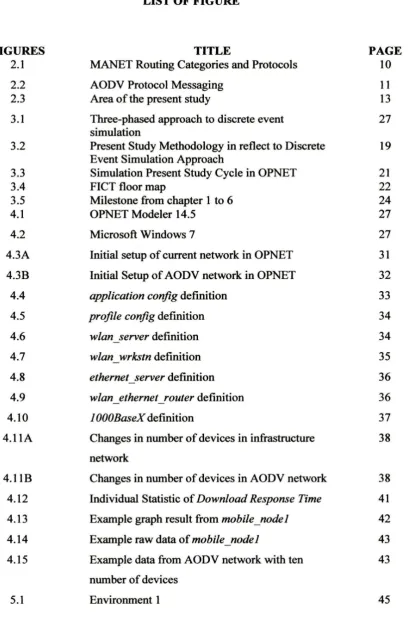
FIGURES TITLE PAGE
2.1 MANET Routing Categories and Protocols 10
2.2 AODV Protocol Messaging 11
2.3 Area of the present study 13
3.1 Three-phased approach to discrete event 27
simulation
3.2 Present Study Methodology in reflect to Discrete 19 Event Simulation Approach
3.3 Simulation Present Study Cycle in OPNET 21
3.4 FICT floor map 22
3.5 Milestone from chapter 1 to 6 24
4.1 OPNET Modeler 14.5 27
4.2 Microsoft Windows 7 27
4.3A Initial setup of current network in OPNET 31
4.3B Initial Setup of AODV network in OPNET 32
4.4 application conjig definition 33
4.5 profile conjig definition 34
4.6 wlan server definition 34
4.7 wlan wrkstn definition 35
4.8 ethernet server definition 36
4.9 wlan ethernet router definition - - 36
4.10 1 OOOBaseX definition 37
4.llA Changes in number of devices in infrastructure 38 network
4.llB Changes in number of devices in AODV network 38 4.12 Individual Statistic of Download Response Time 41
4.13 Example graph result from mobile_nodel 42
4.14 Example raw data of mobile_ node 1 43
xiv
5.2 Environment IV 47
5.3A Centralize Network Setup 48
5.3B Decentralize Network Setup 48
5.4 OPNET test schedule configuration 49
5.5 FTP Request 50
5.6 HTTP Page Request 50
5.7 AP DEX 51
5.8 Samples of Collected Data 54
5.9 Decentralize Network Performance VS Density 57
5.10 FTP Performance in Decentralize Network for 58 100m2 Area based on Max Value
5.11 FTP Performance in Decentralize Network for 59 200m2 Area based on Max Value
5.12 FTP Performance in Decentralize Network for 60 400m2 Area based on Max Value
5.13 FTP Performance in Decentralize Network based 61 on Max Value
5.14 FTP Performance in Decentralize Network for 62 100m2 Area based on Min Value
5.15 FTP Performance in Decentralize Network for 63 200m2 Area based on Min Value
5.16 FTP Performance in Decentralize Network for 64
400m2 Area based on Min Value
5.17 FTP Performance in Decentralize Network based 65 on Min Value
5.18 FTP Performance in Decentralize Network for 66 100m2 Area based on Mode Value
5.19 FTP Performance in Decentralize Network for 67 200m2 Area based on Mode Value
xv
400m2 Area based on Mode Value
5.21 FTP Performance in Decentralize Network based
69
on Mode Value5.22 Performance of AODV running FTP in 400m2 70
5.23 Performance of OLSR running FTP in 400m2 71
5.24 Performance of AODV versus OLSR running FTP 72 5.25 Performance of AODV running HTTP in 400m2 73
5.26 Performance of OLSR running HTTP in 400m2 74
5.27 Performance of AODV vs OLSR running HTTP 75
5.28 Infrastructure Performance for FTP service in 76 FICT
5.29 OLSR Performance for FTP service in FICT 77
5.30 Infrastructure Performance against OLSR for FTP 78 service in FICT
5.31 Infrastructure Performance for HTTP service in 79 FICT
5.32 OLSR Performance for HTTP service in FICT 80 5.33 Infrastructure Performance against OLSR for 81
CHAPTERl
INTRODUCTION
1.1 Introduction
The so-called "information revolution" has made resource sharing around the world to adopt new philosophies and technologies to reduce the cost of information. Resource sharing in computer networking is resource that can be remotely access from another computer. Network resource sharing is the process of copying resource from one computer to another using a live network connection (Bradley Mitchell, 2013).
Resource sharing enables the users of the network to obtain information as if they were there at the location themselves and they are physically connected to the storage media
that stores the information. Information transfer over network medium is very efficient when fetching information that is located in a computer that is distance away from the user. However, resource sharing over the network consumes a lot of network bandwidth. Sometimes, this bandwidth hunger service may tremendously affect the performance of the
2
1.2 Project Background
Faculty of Information and Communication Technology, FICT consists thousands of
users that rely on network connectivity within its area. These users are the students and staffs of FICT. These users are provided with an infrastructure network for wireless connectivity.
Wireless access points are placed within the area of the faculty to support these users and get
them connected to the network.
The students and staffs of FICT share their resources' over the current infrastructure network. The staff, the lecturer for instance, shares the latest notes of his or her subject to the
students on the local server in the faculty. The students have to download these notes themselves. The students are also required to upload their assignments to the local server.
Sometimes, the tasks given to these students require collaboration among themselves.
Therefore, resources of one' s student must be shared over the network in order to complete those tasks. Thus, File transfer protocol, FTP is one of the important services for local usage
in FICT.
The network performance of the wireless infrastructure network in FICT are varies depending on the time of the day. During peak hour (time when students having break before
their next class), demand on network usage is extremely high. In fact, bandwidth provided to them is limited. Therefore, some of them may not get the access to the current infrastructure
network.
The present study takes the networking environment of FICT to a whole new level. The present study is carried out to help in improving the current wireless infrastructure
network in FICT. The present study improves the resource sharing service among users in FICT. The method chosen is the key to carry out the whole process of the present study. The
experiment conducted help in simulating the environments of the network. The variables of experiment are manipulated to get the outcomes of the experimental processes. These
3
1.3 Research Problem
Normally, the infrastructure network provides connectivity to the users. However,
there are times when the infrastructure network failed to serves these users. Those times are
times when infrastructure network is temporarily down and the coverage area of the
infrastructure network is out of reach. Therefore, backup connection and alternative network
is essential to overcome these issues respectively. Decentralized network, is a type of network
that does not require infrastructure. It connects a group of users in an area creating a
networking environment. It may help in providing continuity plan for the current
infrastructure network when the current network is down. Decentralized network provide coverage regardless to the surface of the geographical area. The resource sharing activities in
the local network will get affected when the infrastructure network failed. Decentralized
network can helps in maintaining the resource sharing service of the network. It may also aid
in providing better performance of resource sharing by load balancing resource sharing over
the network. This will also boost the Quality a/Service , QoS ofresource sharing.
1.4 Research Question
The present study constructs research questions from the problem above as followed:
1.4.1 Resource unavailable when the current infrastructure network is down
1. What is the alternative network?
2. How does decentralized network work? 3. What are variables of decentralized network?
1.4.2 Performance of decentralized network for resource sharing in FICT is poor
1. What cause the performance to degrade? 2. How does the performance affect the network?
1.4.3 No framework as bench mark for availability of resource sharing
1. What is the optimum number of connected users?
1.5 Objective
1. To investigate the variables that affects the availability of resources in decentralized network.
4
2. To analyze an optimal solution for decentralized network for resource sharing m
FICT.
3. To evaluate optimized decentralized network for resource sharing.
1.6 Project Significant
The present study improvises the networking environment in FICT. An approach that
will help in the current network to support more number of connected users. It provides alternative and backup connection to the current network. The present study discovers the
variables that affect the performance measure of decentralized network. Therefore, parameter
5
1. 7 Research in Map
[image:21.530.41.506.196.552.2]Tabie 1.1 simply describe all about the research done:
Table 1.1: Simplified Research Description
RESEARCH
RESEARCH QUESTION OBJECTIVE DELIVERABLE
PROBLEM
I. What is the alternative network?
2. How does decentralized
I. To investigate the variables that Resource network work?
affects the availability of
•
Literature Review unavailable when 3. What are variables ofresources in decentralized the current infra decentralized network?
network net is down
Performance of I. What cause the performance I. To analyze an optimal solution
•
Analysis &decentralized to degrade? for decentralized network for Design
network for 2. How does the performance resource sharing in FICT.
resource sharing affect the network?
in FICT is poor
No framework as I. What is the optimum
•
Implementationbench mark for number of connected users? I. To design a framework for availability of 2. What is the acceptable optimized decentralized network
resource sharing performance? for resource sharing.
1.8 Conclusion
CHAPTER2
LITERATURE REVIEW
2.1 Introduction
Based on the present study background in chapter one, in this literature review of the
present study, the AODV network will be elaborated in details as it is the proposed solution
to the current networking system in FICT. External sources will be used as the reference
materials for the present study. Refence materials are taken from academic papers. Most
informations referred focuses on the objective of present study. This chapter will be use as
guidelines for the next phase, analysis and design.
2.2 Fact And Finding
The present study did in-depth research on the objectives by usmg tools. In the
context of present study, journal, thesis, research and case study which is closely related to the
main title, is refered as the main source. The present study found a number of problems exist.
A study will be carried out to tackle the problem . In order to obtain an extensive literature
review, the current work of decentralize network is studied.
7
2.2.1 Coverage
Network coverage is the geographical area, in which a wireless network provide offers service for users (Raymond Mulligan, 2010).
Types of wireless network coverage :
2.2.1.1 Wide Area Network
Wireless Wide Area Networks are the networks provided to user in a large geographical area (John Kelsey, 1997). This type of network is provided by mobile cellular carriers. In Malaysia, some of the mobile cellular service providers are Maxis, Celcom and DiGi. Data service is added to cellular voice services, creating voice-plus-data networks. The geographical area of this network is determined by cariers and their business strategy, and Quality of Service (QoS), is also being controlled by them.
WAN s is used when reach the most important aspect of your solution. Reach is essential to provide wireless solutions to the public at large.
In the context of present study, the term reach is refered to the furthest distance
of wireless signal can be extend. It is a capability of wireless signal to cover
the amount of geographical area. The further the distance is reached, The higher the reach of the wireless network. Thus, the greater amount of geographical area coverage.
Wireless WAN technology
[image:23.530.104.502.674.749.2]CDMA2000 is a family of 3G mobile technology standards, which use CDMA channel access, to send voice, data, and signaling data between mobile phones and cell sites. The name CDMA2000 actually denotes a family of standards that represent the successive, evolutionary stages of the underlying technology. The range of CDMA 2000 technology is represented as cell (Vieri Vanghi, 2004). The dependency of the coverage area of one cell on the frequency of a CDMA2000 network will be explained in Table 2.1.
8
2.2.1.2 Wireless Local Area Network
Wireless LAN networks are set to provide wireless connectivity within a finite coverage area. University is one of typical coverage areas and it has a predetermined users; students and staffs.
WLANS is used when high data-transfer rate is the most important aspect of your solution, and reach is restricted.
Wireless LAN technology
[image:24.530.51.498.354.483.2]802.11 is the standard for wireless LANs (IEEE Computer Society, 1999). In fact, it is a family of technologies such as 802.11 a. 802.11 b, 802.11 g and the latest 802.11 n, differing in speed and attributes like approximate range for outdoor and indoor. The characteristic of 802.11 will be explained in Table 2.2
Table 2.2: 802.11 network standards
802.11 Fequency Bandwidth Data rate per MIMO Approximate
protocol stream Rane;e
Indoor Outdoor
A 5 GHz 20MHz 54 Mbit/s 1 35 m 120 m
B 2.4 GHz 20MHz 11 Mbit/s 1 35 m 140 m
G 2.4 GHz 20MHz 54 Mbit/s 1 38m 140 m
N 2.4 GHz 20MHz 72.2 Mbit/s 4 70m 250 m
40MHz 150 Mbit/s 70m 250m
2.2.1.3 Personal Area Networks
These are networks that provide wireless connectivity over distances
depending on class and bluetooth is a common キゥイ・ャ・セウ@ PAN technology. For
example, a class 2 bluetooth may provide wireless connectivity up to 11 m.
This range allows a computer to be connected wirelessly to a nearby printer.