http://dx.doi.org/10.3926/jiem.486
Lean principles adoption in environmental management system
(EMS): A survey on ISO 14001 certified companies in Malaysia
Perumal Puvanasvaran, Robert Kerk Swee Tian, Vasu Suresh, Mohd Razali Muhamad
University technical malaysia melaka (Malaysia)
[email protected]
,
robert
_
[email protected], [email protected], [email protected]
Received: May 2012 Accepted: November 2012
Abstract:
Purpose:
The purpose of this study is to examine the characteristic of the lean principles in
ISO 14001 and to propose linkage between lean principles and ISO 14001.
Design/methodology/approach: To achieve the objective of the study, literature survey
and quantitative research method using questionnaire survey are used.
Findings and Originality/value:
The findings of this study confirm that ISO 14001
certified company adopted lean production practices. The study also proves that lean
principles have a positive and significant relationship with ISO 14001 EMS and the linkage
can be made between lean principles and ISO 14001 to achieve Continual Improvement.
Research limitations/implications:
The small sample sizes of the participating companies
are the main limitations of this study and this research mainly focus on the manufacturing
environment and services industry in Malaysia.
Practical implications:
This research shows that all ISO 14001 companies do adopt at least
one of lean production practices and the main findings are lean principles has positive and
highly significant relationship with ISO 14001 requirements. This is because the integration of
lean principles in ISO 14001 will serve practical methods for ISO14001 EMS to achieve the
Originality/value: This research is amongst the first to study on the combination of lean
principles with ISO 14001. Based on the current situation, there is no integration between this
two management system.
Keywords: Lean Principles, EMS, ISO 14001, Integration.
1. Introduction
Management practices in the recent days have undergone rapid transformations owing to
global changes taking place. The focus of organizations has been on increasing operational
efficiency, reducing costs, enhancing quality levels, ensuring steady profits, and meeting
customer needs. The efforts of the management in the recent times have been on enhancing
productivity through efficient methods of production that emphasizes on the elimination of
unnecessary procedures and processes that add to production costs. The efficiency of
production process determined by the optimal use of resources and adopting an
environmentally friendly production method. Environment management systems or EMS has
been the focal point of management strategies in most organizations today.
EMS practices within an organization need to be integrated with exiting organizational
practices to realize its true potentials. Research studies have revealed that the majority of
organizations focuses more on gaining market competitive advantage, improving customer
relations, and increasing profit potentials than adopting work processes that satisfy
environmental safety and policy requirements.
Lean is one such business model that focuses on delivering quality products to the customer at
reduced cost of production. The principles of Lean are founded on understanding of customer
needs and demands, eliminating non-value added activities from the production process,
involving the workforce in resolving operational issues, define metrics for measuring
organizational performance, assist in the decision making process and problem solving (Ross &
A.E.C, 2004).
ISO 14001 is the world’s most recognized EMS framework that helps organizations both to manage better the impact of their activities on the environment and demonstrate sound
environmental management. ISO 14001 is designed to be flexible enough to be applied to any
size of organization in both the private and public sectors by Montabon, Meinyk, Stroofe and
Calantone (2000).
The organization of this paper is as follows. Section 1 is the introduction. Section 2 literature
review. Section 3 presents the research methodology. Section 4 results. Section 5 discussion.
2. Literature review
The literature review will focus on identifying the various aspects of Lean and EMS systems,
ISO 14001 standards and its prospective business applications. Lean principles encourage an
organisation to bring about significant changes in their operational and cultural environment.
This in turn has a positive impact on the environmental performance of the company reducing
pollution, waste and emissions. Lean principles enable companies to deliver with lesser
resources resulting in lesser scrap and wastage. It encourages organisations to judiciously use
natural resources, such as energy, water and forest products. Lean pushes for continuous
improvement and empowers companies to better their environment performance (Environment
Protection Agency, 2010).
It can be seen that Lean principles and ISO 14001 standards have a lot of common ground and
both aim at reducing waste. Lean focuses on delivering the maximum value to the customer
using the required resources at minimizing waste. When an organisation implements Lean,
there are significant cost savings. There is optimum utilization of resources and wastage is
reduced. This has a positive impact on the environmental performance of the company. When
a company is implementing Lean principles into EMS, it must clearly set forth the objectives of
such an initiative (Mc Donald, 2005). The senior management must play an important and
visible role in implementing the Lean and green initiatives. The procedures and measures for
attaining the goals must be clearly communicated to the employees at all levels. There must
be cross functional cooperation in the organisation to learn and benefit from mutual
experience. There should be a process of acknowledging the best practices of each unit and
introducing the same at the company level. A company can benefit tremendously from
combining the Lean and green efforts. The company will be seen as contributing to protecting
the environment and preserving it for future generations. It will result in reduced cost of
operations, optimum utilization of resources, reduction in wastage and better profitability for
the organisation.
2.1. Environmental Management System (EMS)
In the 21st century, there is great emphasis on companies and businesses to contribute
towards protecting the environment as part of their corporate social responsibilities.
Companies need to adopt measures to protect and enhance the environment in order to
maintain good relations with customers, suppliers and vendors. There is a growing need for
businesses to fulfil their corporate social responsibilities in order to survive in the global
economy. Environment management system (EMS) can help the company in fulfilling their
responsibilities towards protecting the world environment (Gbedemah, 2004). An EMS provides
the framework to manage the company’s environmental responsibilities effectively and also
EMS is critical to all types of business irrespective of the nature, size and scale of operations.
In the global market, it is important for manufacturing, automotive, retail and service
industries to have an EMS in place. An effective EMS contributes to cost savings and reduces
the environmental liabilities (Cheremisinoff, Rosenfeld and Rosenfeld, 2010). It also helps in
ensuring that employees, suppliers and vendors understand their role in the environmental
policy and contribute effectively towards meeting the environmental objectives of the
organization (Visser, Matten, Tolhurst & Pohl, 2010).
2.2. ISO 14001 standard and principles
ISO 14001 is an internationally accepted standard that sets out the steps to be taken by a
business to put in place an effective EMS (Environmental Protection Agency, 2002). It helps in
integrating the environmental goals into the overall operations of the company. ISO 14001
standards were written by consensus of nearly 50 countries and more than 100 countries have
endorsed it as an international standard. ISO 14001 is applicable to all types of organizations
with varying nature and size of operations. It is also relevant to companies with different risk
profiles. It is easily adaptable either to an entire organization or a specific function (Woodside
& Aurrichio, 2000). ISO 14001 has become an administrative tool towards corporate
environmental management (Puvanasvaran, Muhamad & Kerk, 2010). It also helps in reducing
insurance and prosecution risks. ISO 14001 helps in gaining investor confidence and brings in
more ethical investment (Whitelaw, 2004).
2.3. Lean system
Lean is a tool for process improvement that aims at maximizing customer value and
minimizing waste (Miller, Pawloski & Stanridge, 2010). Lean helps in focusing on key processes
that affect the output to the customer. It focuses on continuously improving the process
management elements to deliver maximum value to customers. Lean helps in achieving the
organizational goals with fewer resources and zero waste. Lean does not focus individually on
systems, tools, technologies, assets and functions. It works on optimizing the process flow
across assets, systems, technologies and functions to deliver the best value to customers
(Lean Enterprise Institute, 2009).
Earlier, lean principles were thought to be relevant only to manufacturing companies. This is
no longer true. Lean can be implemented successfully across all industries. To reap the full
benefits of lean, the company must adopt it as part of their business strategy (Turbide, 2005).
This will result in lean principles being implemented consistently across all the functions in the
organization and will have a positive impact on the overall performance.
Lean should be adopted as a way of thinking and as a way of doing business in order to fully
than having cost reduction as the exclusive focus of lean thinking, the conceptual framework of
lean also has tremendous potential for increasing top-line revenue by creating a sustainable
differential value advantage for the enterprise that deploys the concept in its entirety.”
2.4. Integrating lean into ISO 14001
defined in lean management also has significant environmental impact. Implementation of lean
principles will have a positive impact on the company’s environmental performance. A business should take a holistic approach in implementing an EMS and integrate the lean principles to the
environmental aspects of the company. Companies should work towards fostering an effective
relationship between the lean and green activities to maximize customer satisfaction and
minimize waste (Mitsuishi, Ueda & Kimura, 2008).
For the lean principles to be integrated into the ISO 14001 standards in an organization, the
environment policy and lean objectives must be clearly defined. A well defined system must be
in place setting out the roles and responsibilities of the employees in different departments
across various levels. The employees should clearly know what their lean and green goals are
and the means to achieve them. This helps in reducing the time and effort spent on searching
for solutions (Gordon, 2001).
The process of integrating Lean into the EMS is a multi-layered process and involves many
steps. The first step is listing those areas of function in the company which has the largest
environmental impact. The business should ensure that the Lean principles are integrated into
those processes that impact the environmental performance. The next step is creating
awareness amongst the employees about the Lean and green efforts of the company.
Employees must be made to feel that their company does really care about the environment
and not merely undertaking to implement an EMS for ISO certification. They must be able to
see and understand the vision of the company in integrating Lean principles into ISO 14001
standards. Employees must be fully aware of the course of their actions and their
environmental impact. Another important factor for deriving the system successfully was the
employee problem solving capability (Puvanasvaran, Megat, Tang, Muhamad & Hamouda,
2008). Top management commitments play a very important role and have a strong
understanding that organisations can get the full support and participation of the employees in
integrating Lean principles into the EMS (Gordon, 2001).
The company should work on integrating the EMS requirements into the existing systems. If a
separate process flow is created for EMS, there could be issues of lack of coordination between
the environmental measures and other processes. The procedures and measures for attaining
the goals must be clearly communicated to the employees at all levels. The study done by
Puvanasvaran, Kerk and Muhamad, (2011) effectiveness of integrating Lean and EMS can be
realized by adopting processes and procedures designed to eliminate waste and create an
economically sustainable work environment.
3. Research methodology
The research design is one of the key factors in determining the effectiveness of the research
study. If the method applied does not meet the needs of the objectives, the findings and
analysis of data collected are wasted. A mixed method of Qualitative and Quantitative research
design would be employed. The Review of current literature will provide a meaningful addition
to the qualitative aspect of the study, while survey questionnaire will contribute to the
quantitative aspect of the study. The purpose of this study is to ensure internal and external
validity of the study with Cronbach’s Alpha. This study conducted using the cross-sectional survey which is the most appropriate tool to be used. Information of this study was gathered
from various ISO 14001 certified companies in Malaysia. The best approach to gather data for
this study is through a survey by distributing questionnaires to the respondents. The set of
questionnaire is designed to collect the data and information needed in this study.
3.1. Questionnaire development
The questionnaire development is done by referring to all the data gather such as literature
review, books, and etc. For this study, the questionnaire was divided into two sections. Section
A and Section B.
In the first section of the questionnaire, the question was developed by referring to previous
study conducted by Puvanasvaran, Megat, Tang and Muhamad (2009); Boyer (1996). It is
used to identify the ISO 14001 certifies companies adopted the lean production practices. In
the second section of the questionnaire, the questions were developed from Womack et al.
(1990) and Malaysian Standard Environmental System (EMS) requirement with guidance for
use (ISO 14001:2004). The second section of the questionnaire was used to measure the
3.2. Pilot test
Pilot test conducted to ensure that the result of the questionnaire is valid and meet the
objective of the research. This is done by sending the questionnaire to 10 ISO 14001 certified
companies around Melaka. Discussion of the questionnaire was held when the company was
visited. Opinion was given which help the researcher to modify the existing questionnaire.
Besides that, from the pre-test, the total time spend with the company also can be identified.
3.3. Sending and receiving questionnaire
In this study, data was obtained only from primary sources. Primary data in this context refer
to the information obtained first hand by the researcher on the variables of interest for the
specific purpose of this study. In this study, the primary data obtain from the ISO 14001
certified companies around Malaysia. The data collection method used is questionnaire.
A questionnaire is a pre-formulated written set of questions which respondents record their
answers. This study is preferred to use this method because it is easy for the researcher to get
the information. In addition by using this method, it is less costly compared to other methods.
Type of question asked in the questionnaire is close-ended. This is to make sure the
respondents easy to fill in the answer and state in the questionnaire. In the questionnaire,
Likert scale questions will be used. The questionnaire was distributed around May 2011 and
the process of distributing and collecting the questionnaires takes around 8 weeks.
The data were collected from ISO 14001 certified company in Malaysia. The list of the 420 ISO
14001 certified company was collected from the Malaysian Certified Database. A total of 140
questionnaires were mailed by hand into the respondent. With close follow up by telephone
call, email, and personally meet up with the respondent to hand in and collected the
questionnaires, only 48 completed questionnaires was received. Clear instructions were given
to ensure individual selected as respondents must be those involved with the ISO 14001 in
their respective company.
3.4. Data analyzing
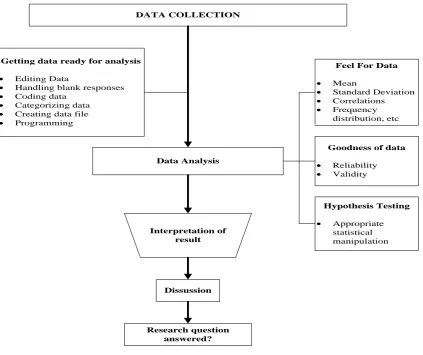
The data analysis flow chart in the Figure 1 shows the data analysis process. From the data
collection, feel for data, goodness of data, hypothesis testing to the interpretation of the result,
the step and flow can be seen.
There are a number of different reliability coefficients. One of the most commonly used is
Cronbach’s alpha (Coakes, 2005). It is used to assess the internal consistency reliability of several items or scores that the researcher wants to add together to get a summary or
summated scale score (Morgan et al., 2004). Cronbach’s alpha is based on the average
should be positive and usually greater than 0.70 in order to provide good support for internal
consistency reliability (Morgan, Leech, Gloeckner & Barret, 2004).
In this study, the first part of the questionnaire, the mean and standard deviation were
computed with the scores of the eight variables. The mean is the value of the degree of
adoption of lean production practices in the ISO 14001 certified company. The percentage of
each variable also has been measure to support the value of the mean and standard deviation.
In the second part of the questionnaire, reliability coefficients, descriptive statistics, and
correlation will do to measure the relationship of lean principles with the ISO 14001
requirement. Correlations measure how variables are related. Before calculating a correlation
coefficient, data is screened for outliers and evidence of a linear relationship. Pearson’s
correlation coefficient is a measure of linear association. If the relationship is not linear,
Sprerman’s rho will be used to measure the correlation between the variables (Morgan et al.,
2004). A Pearson correlation coefficient describes the relationship between two continuous
variables. A correlation between two dichotomous or categorical variables is called
phi-coefficient (Coakes, 2005). Correlation is measured between each variable of the lean
principles that is value, value streams, flow, pull and perfection with the ISO 14001
requirement.
Reliability Test, Descriptive Statistics and Correlation are used for this study. The Statistical
Package of The Social Science (SPSS version 19) uses to record, analyse and interpret raw
data. The data obtains were compiled, summarized and display in a form that is easily
DATA COLLECTION
Melaka, Johor, Kedah, Pulau Pinang, and Perak are selected. This is because the ISO certified
company from others states mostly come from a government agency and plantation industries.
From 290 companies located in these 8 states, only 140 companies were selected as sample
size. The other 150 companies were excluded from the survey because they are from
plantation industry, construction industry and government agency.
Questionnaires are distributed to the selected company by mail except for a company in
Melaka and Negeri Sembilan because most of the questionnaires were delivered by hand. From
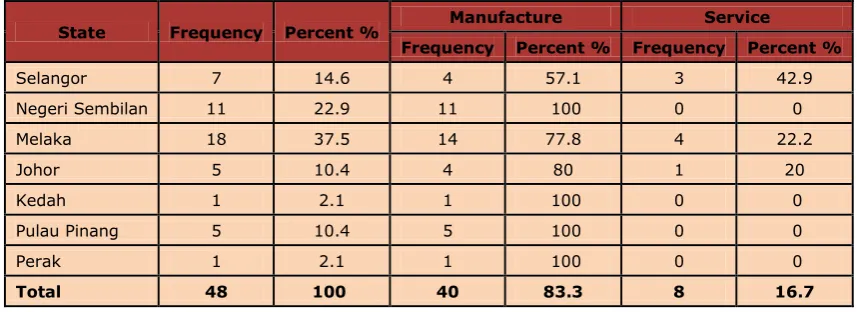
this 140 ISO 14001 certified companies, only 34.3% or 48 respondent response and return
back the questionnaires show as Table 1. According to Sekaran (2010), a 30 percent response
rate is considered acceptable because the return rates of mail questionnaires are typically low.
In the rules of thumb, sample size larger than 30 and less than 500 is also appropriate for
State Frequency Percent % Manufacture Service
Frequency Percent % Frequency Percent %
Selangor 7 14.6 4 57.1 3 42.9
Negeri Sembilan 11 22.9 11 100 0 0
Melaka 18 37.5 14 77.8 4 22.2
Johor 5 10.4 4 80 1 20
Kedah 1 2.1 1 100 0 0
Pulau Pinang 5 10.4 5 100 0 0
Perak 1 2.1 1 100 0 0
Total 48 100 40 83.3 8 16.7
Table 1. Distribution of respondent based on State and Industry
4.1. Lean Production Practices in the ISO 14001 Certified Companies
The lean production practices are identified in the ISO 14001 certified companies. This section
also will measure the adoption of lean production practices in the ISO 14001 companies.
Reliability Test and Descriptive Statistics are discussed in this section. This section will discuss
the result from analysis to prove that the ISO 14001 certified companies has adopted lean
production practices.
Reliability
Cronbach’s alpha is used to assess the inter-item reliability, with alpha values of 0.7 or higher considered to indicate acceptable reliability for establishing scales (Soriano-Meier & Forrester,
2002). Cronbach’s alpha is based on the average correlation of items within a test if the items
are standardized (Coakes, 2005). Table 2 shows that the alpha value for the ISO 14001
certified company that has adopted lean production practices is 0.772 and no of item is 8,
which is exceeded or higher than 0.70.
Other than that, with the exception of Cellular Manufacturing, the scale reliabilities are highest
when all the 8 items are included which is 0.809. The alpha value just slightly increased
approximately 4.8% of the increment, even after elimination of the item Cellular
Manufacturing.
Similar to the study done by Puvanasvaran et al., (2009) on Lean Process, the results show
that the alpha value just increased slightly in their studies and no elimination has been done.
Scale Mean SD Alpha if Deleted
Lean Production Practices (Alpha = 0.772) -
Items
Continuous Improvement (Kaizen) 1.94 0.24 0.758
Zero Defect 1.81 0.39 0.723
Just-In-Time (JIT) 1.9 0.31 0.741
5S' and General Visual Management 1.88 0.33 0.747
Total Preventive Maintenance (TPM) 1.79 0.41 0.72
Pull Production and Kanban 1.69 0.47 0.719
Standardized Work 1.88 0.33 0.747
Cellular Manufacturing 1.63 0.49 0.809
Table 2. Reliability analyses of Lean Production Practices
Descriptive Statistics
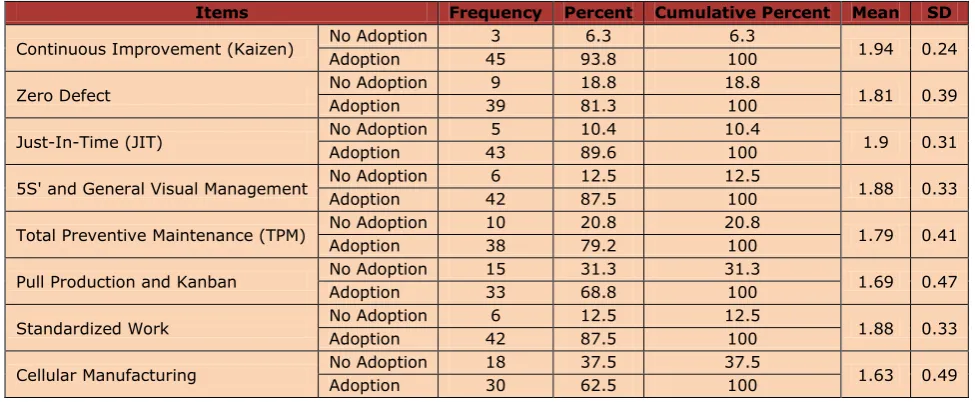
Descriptive Statistics of lean production practices are shown in Table 3. It shows that the
highest lean production practices in the ISO 14001 certified company are Continuous
Improvement (Kaizen). 93.8% or 45 respondents have adopted Continuous Improvement
(Kaizen) in their companies. This is followed by Just-In-Time that is 89.6% or 43 respondents.
5S’ and General Visual Management and Standardized Work have the same value that is
87.5% or 42 respondents. It follows by Zero Defect that is 81.3% or 39 respondents. Other
than that, 79.2% or 38 respondents have adopted Total Preventive Maintenance (TPM) in the
companies. It is followed by Pull Production and Kanban that is 68.8% or 33 respondents. The
last lean production practice is Cellular Manufacturing that is 62.5% or 30 respondents.
Items Frequency Percent Cumulative Percent Mean SD
Continuous Improvement (Kaizen) No Adoption 3 6.3 6.3 1.94 0.24
N Valid 48
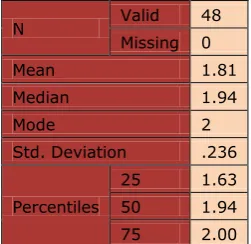
Table 4. Mean, Median, and Mode for All Lean Practices
From Table 4, the statistics show that the lean production practices had the mode value of 2.
It shows that ISO 14001 companies have adopted the lean principles in their organization. The
mean value of 1.81 also shows that the result is more toward to the adoption of lean
production practices.
Similar from the previous study, value of the Mean and Standard Deviation is used to analyse
the result (Roslan, Taib & Watee, 2009). Similar to the study done by Puvanasvaran, Tay,
Megat, Tang and Rosnah (2009), Mean and Standard Deviation was used to identify the degree
of adoption in the analysis. Other than that, alpha values of 0.7 or higher considered to
indicate acceptable reliability for establishing scales (Soriano-Meier & Forrester, 2002). In the
study done by Najmuddin et al., (2009) Descriptive Statistical analysis was used for the study
to analyse the result. Result of reliability analysis and descriptive statistic in the Table 2 till
Table 4 clearly support that the ISO 14001 certified companies has adopted lean production
practices.
4.2. Relationship of lean principles with ISO 14001 requirement
This section will measure the agreement of adoption of lean principles and ISO 14001 (EMS)
implementation. Reliability Test and correlation are discussed in this section. This section will
discuss the result from analysis to prove that Lean Principles have a positive and significant
relationship with the ISO 14001 requirement.
Reliability
The result of reliability analysis for each set of lean principles; value, value streams, flow, pull,
and perfection are shown in Table 5. Cronbach’s alpha is used to assess the internal
consistency reliability of several items or scores that the researcher wants to add together to
get a summary or summated scale score (Morgan et al., 2004). In addition, the mean and
standard deviation for each of the items are also indicated. Cronbach’s alpha is used to assess
the inter-item reliability, with alpha values of 0.7 or higher considered to indicate acceptable
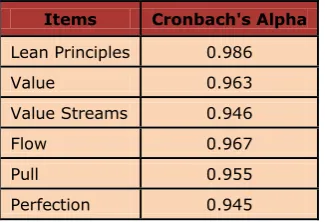
Items Cronbach's Alpha
Lean Principles 0.986
Value 0.963
Value Streams 0.946
Flow 0.967
Pull 0.955
Perfection 0.945
Table 5. Overall lean principles Cronbach’s Alpha
From the result, Table 5 shows that Cronbach’s Alpha for first lean principle Value has the
alpha value at 0.963. For the second lean principle, Value Stream has the alpha value at
0.946. Flow, the third principle has the alpha value at 0.967. The alpha value of Pull is 0.955
and lastly the alpha value for Perfection is 0.945. All the alpha value for each lean principle is
higher than 0.70 and the overall Lean Principles Cronbach’s Alpha value is 0.986. George & Mallery (2003: pp. 231) provide the following rules of thumb:
> 0.9 – Excellent,
> 0.8 – Good,
> 0.7 – Acceptable,
> 0.6 – Questionable,
> 0.5 – Poor, and
< 0.5 – Unacceptable
That means all questions are highly reliable with the study. Therefore, it is concluded that the
measured have an acceptable level of reliability.
Correlation
This section will discuss the analysis and result of correlation on lean principles with ISO
14001. Each of the lean principles will be identified and studied to measure how strong and
significant the correlation is. Lean Principles have a positive and significant relationship with
ISO 14001 requirement can be analysed and support from the result in this section.
According to our survey shows that the inter-correlation between 1st lean principle Value with
ISO 14001 requirements are highly significant where p is less than 0.01. All five variables
were positively correlated with Value. According to the correlation analysis between 1st lean
principles Value and ISO 14001 requirements (Table 6), we discover that the higher variable
with value are implement documented environmental objectives and targets has the highest
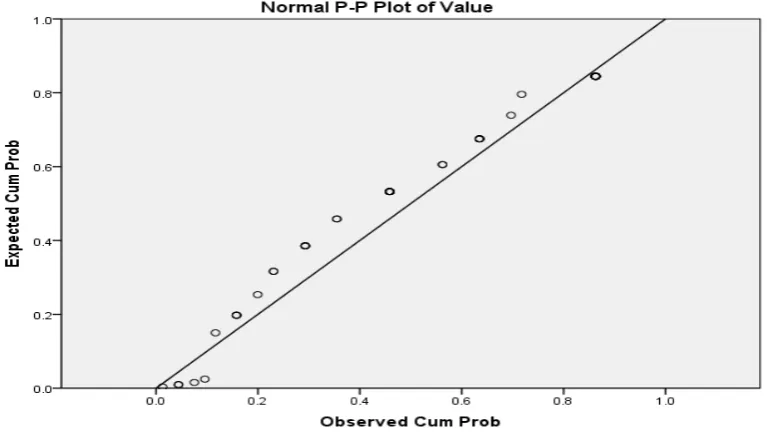
“Value” against ISO 14001 Requirements. The PP plot is useful to compare the centre of the distribution. In this case, we can quite reasonably conclude that the normal distribution
provides a good model for the data.
According to Womack and Jones (2003), lean Value is specified from the perspective of the
customer. It is about listening to the voice of the customer in order to meet the customer
requirements and recognizing and eliminating waste. The understanding of Value from the
customer’s perspective then carefully to take the time to actually explore this with the
customers so that inaccurate assumptions will not be made (Womack & Jones, 2003).
Performance indicators can be used to track progress in achieving the objectives and targets
as the documentation and communication of objectives and targets improves an organization’s
ability to achieve its objectives and target (EMS ISO 14004:2004 Requirements with Guidelines
– 4.3.3.1). This is where Value shall establish, implement and maintain documented
environmental objective and targets as from the customer perspective consistent with the
environmental policy and to continual improvement.
1th
Lean Principles
Items Value
Correlation
Value help to improve our fulfillment to customer requirements in ISO 14001 .935**
Value help to implement documented environmental objectives and targets .948**
Value help to implement program for achieving environmental objectives and target. .929**
Value helps an organization comply with environmental laws and regulations. .938**
Value help to increase awareness and participation of employees. .923**
**. Correlation is significant at the 0.01 level (2-tailed).
Table 6. Value with ISO 14001 Requirements
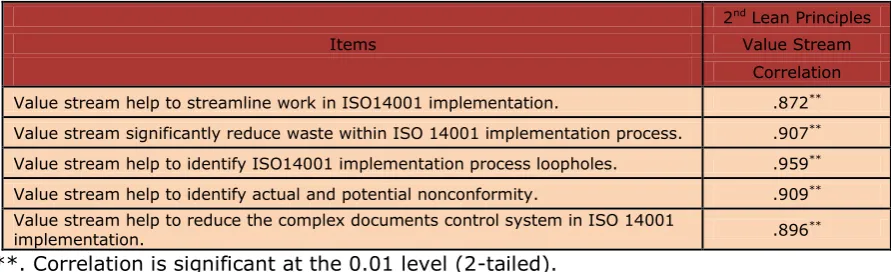
From the correlation analysis between 2nd lean principles Value Stream and ISO 14001
requirements (Table 7) are highly significant where p is less than 0.01. We can see that, the
higher variable with value stream are identified ISO14001 implementation process loopholes
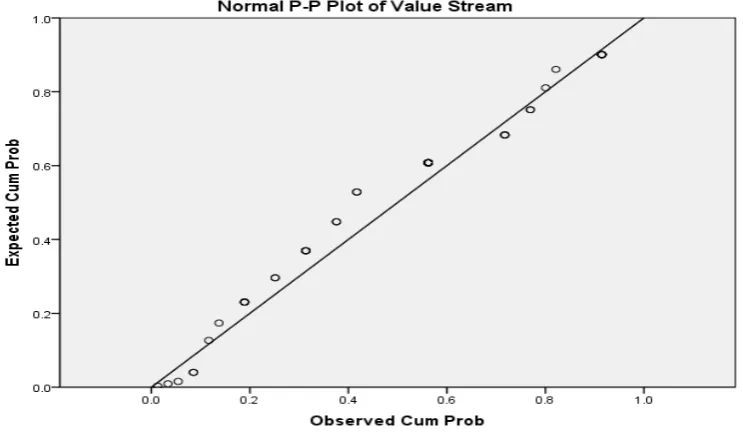
has the highest correlation, where value r is equal to 0.959. Figure 3 shows the PP plots of
Lean Principles “Value Stream” against ISO 14001 Requirements. The normal probability plot
shows a strongly linear pattern. There are only minor deviations from the line fit to the points
on the probability plot. The normal distribution appears to be a good model for these data.
Value Stream will recognize waste or non value added step in the process and is known as
Value Stream Mapping (Womack & Jones, 2003). The organization shall establish, document,
implement, maintain, and continually improve an environmental management system in
accordance with the requirements of the international standard and determine how to fulfil the
requirement (EMS ISO 14001:2004 Requirements – 4.1). This where Value stream helps to
identify ISO 14001 implementation process loopholes. Value Stream Mapping will identify all
the steps in the value stream for each process by eliminating whenever possible the steps that
do not create value and continuous improvement.
2nd
Lean Principles
Items Value Stream
Correlation
Value stream help to streamline work in ISO14001 implementation. .872**
Value stream significantly reduce waste within ISO 14001 implementation process. .907**
Value stream help to identify ISO14001 implementation process loopholes. .959**
Value stream help to identify actual and potential nonconformity. .909** Value stream help to reduce the complex documents control system in ISO 14001
implementation. .896
**
**. Correlation is significant at the 0.01 level (2-tailed).
Figure 3. Lean Principles “Value Stream” against ISO 14001 Requirements
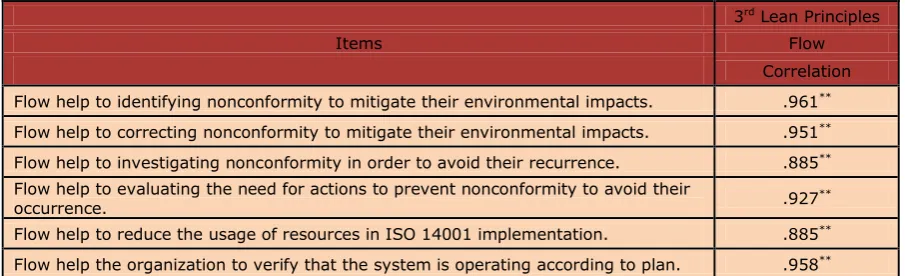
Based on the relationship between 3rd lean principles Flow and ISO 14001 requirements (Table
8) are highly significant where p is less than 0.01. All six variables were positively correlated
with Flow, we find that identifying nonconformity to mitigate their environmental impacts has
the highest correlation, where value r is equal to 0.961. Figure 4 shows the PP plots of Lean
Principles “Flow” against ISO 14001 Requirements. The normal probability plot shows a reasonably linear pattern in the centre of the data. However, the tails, particularly the lower
tail, show departures from the fitted line. A distribution other than the normal distribution
would be a good model for these data.
According to Womack and Jones (2003), Flow is about working towards a process that delivers
value with the most effective use of resources. EMS has to be effective on an ongoing basis so
organisations should have a systematic method for identifying actual and potential
nonconformity, making corrections and taking corrective and preventive action (EMS ISO
14004:2004 Requirements with Guidelines – 4.5.3). This where Flow will come in to identifying
nonconformity to mitigate the environmental impacts as flow makes the value-creating steps
3rd Lean Principles
Items Flow
Correlation
Flow help to identifying nonconformity to mitigate their environmental impacts. .961**
Flow help to correcting nonconformity to mitigate their environmental impacts. .951**
Flow help to investigating nonconformity in order to avoid their recurrence. .885** Flow help to evaluating the need for actions to prevent nonconformity to avoid their
occurrence. .927
**
Flow help to reduce the usage of resources in ISO 14001 implementation. .885**
Flow help the organization to verify that the system is operating according to plan. .958**
**. Correlation is significant at the 0.01 level (2-tailed).
Table 8. Flow with ISO 14001 Requirements
Figure 4. Lean Principles “Flow” against ISO 14001 Requirements
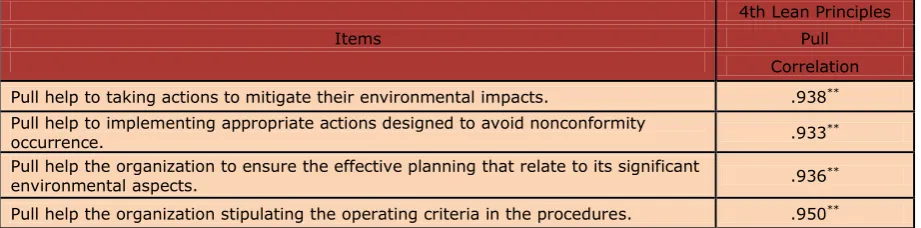
According to our survey shows that the inter-correlation between 4th lean principle Pull with
ISO 14001 requirements are highly significant where p is less than 0.01. All four variables
were positively correlated with Pull. From the Table 9, the correlation between lean principle
Pull and ISO 14001 Requirement, the organization stipulating the operating criteria in the
procedures has the highest correlation, where value r is equal to 0.950. Figure 5 shows the PP
plots of Lean Principles “Pull” against ISO 14001 Requirements. For data with long tails relative
to the normal distribution, the non linearity of the normal probability plot shows the middle of
the data may show an S-like pattern. In this particular case, the S pattern in the middle is
fairly mild. In this case we can reasonably conclude that the normal distribution can be
improved upon as a model for these data.
Womack & Jones (2003), Pull is to get close as they can to produce according to demand or
Requirements with Guidelines – 4.4.6, an organization needs to apply some type of operational
controls to meet its environmental policy commitments, achieve its objectives and targets,
comply with applicable legal requirements and other requirements to which the organization
subscribes and manage its significant environmental aspects. This is where Pull can help the
organization stipulating the operating criteria in the procedures as Pull can produce to demand
and link the process closer to actual customer demand with little or no inventory in the
systems.
4th Lean Principles
Items Pull
Correlation
Pull help to taking actions to mitigate their environmental impacts. .938** Pull help to implementing appropriate actions designed to avoid nonconformity
occurrence. .933
**
Pull help the organization to ensure the effective planning that relate to its significant
environmental aspects. .936
**
Pull help the organization stipulating the operating criteria in the procedures. .950**
**. Correlation is significant at the 0.01 level (2-tailed).
Table 9. Pull with ISO 14001 Requirements
Figure 5. Lean Principles “Pull” against ISO 14001 Requirements
Table 10 shows that the inter-correlation between 5th lean principle Perfection with ISO 14001
requirements. All four variables were positively correlated with lean principle Perfection highly
significant where p is less than 0.01. From the table, correlation between lean principle
Perfection and ISO 14001 requirement, to ensure this standard continuing suitability,
adequacy and effectiveness has the highest correlation, where value r is equal to 0.960. Figure
are only minor deviations from the line fit to the points on the probability plot. The normal
distribution appears to be a good model for these data.
Perfection is about the continuing striving for the perfect process by continually removing
successive layers of waste as it was uncovered (Womack & Jones, 2003). An organization
should periodically review and continually improve its environmental management system with
the objective of improving its overall environmental performance (EMS ISO 14004:2004
Requirements with Guidelines – 4.5.3). With Perfection it can help to ensure the standard
continuing suitability, adequacy and effectiveness of the ISO 14001.
5th Lean Principles
Items Perfection
Correlation
Perfection helps to assessing opportunities for improvement and the need for changes
to the standard. .922
**
Perfection helps to ensure this standard continuing suitability, adequacy and
effectiveness. .960
**
Perfection helps to ensure this standard consistent with the commitment to continual
improvement. .879
**
Perfection helps in sustaining the ISO 14001 standards certification. .949**
**. Correlation is significant at the 0.01 level (2-tailed).
Table 10. Perfection with ISO 14001 Requirements
Figure 6. Lean Principles “Perfection” against ISO 14001 Requirements
5. Discussion
The results of the data analyses show that all ISO 14001 companies do adopt at least one of
lean production practices. Other than that, the result of reliability analysis in the Table 2 show
that all the variables are indicated acceptable reliability for establishing scales with the
General Visual Management, Total Preventive Maintenance (TPM), Pull Production and Kanban,
Standardized Work, and Cellular Manufacturing has the Mean value higher than average
toward the adoption of lean production practices. Similar from the previous study, value of the
Mean and Standard Deviation is used to analyse the result (Roslan et al., 2009). Similar to the
study done by Puvanasvaran (2009), Mean and Standard Deviation was used to identify the
degree of adoption in the analysis. Other than that, alpha values of 0.7 or higher considered to
indicate acceptable reliability for establishing scales (Soriano-Meier & Forrester, 2002).
This study also found that there was a significant and positive relationship between Lean
Principles: value, value stream, flow, pull and perfection with the ISO 14001 requirement.
Similar to the study done by Puvanasvaran (2009), Reliability Test and Correlation was used to
identify the degree of adoption and commitment in the analysis to support and prove the
Hypotheses. Similar to the study done by Roslan et al., (2009), the hypotheses are proved and
clarify with the Pearson Correlation Analysis.
Table 5 shows that all the variables are indicate highly acceptable reliability for establishing
scales with the Cronbach’s Alpha which is exceed or higher than 0.70. The table also shows
that the Cronbach’s Alpha value of five lean principles that are Value (0.963), Value Streams
(0.946), Flow (0.967), Pull (0.955) and Perfection (0.945). The Cronbach’s Alpha for lean
Requirement, to identify nonconformity to mitigate their environmental impacts has the largest
correlation, where value r is equal to 0.961.
To use skewness and kurtosis to see if the distribution is normal, we need to convert the given
skewness and kurtosis scores to z-scores. Use the following formula: zskewness =
(K-0)/SEskewness or z kurtosis = (S-0)/SEkurtosis. S = Skewness; K = kurtosis; SE = Standard
Error (of skewness or kurtosis). If the value is smaller than 1.96, the distribution is normal. In
larger samples, this value should be increased to 2.58. The results of the Z score of Skewness
for lean principles value is 0.478/0.343 = 1.39, value stream is 0.739/0.343 = 2.15, flow is
-0.471/0.343 = 1.37, pull is -0.378/0.343 = 1.10 and perfection -0.477/0.343 = 1.39. The
results show the Z score for the five lean principles is smaller than 1.96, the distribution is
normal. Another way in which normality can be tested is by means of the Kolmogorov-Smirnov
(K-S) and the Shapiro-Wilk tests. These tests compare the distribution with a comparable
results of the tests are shown in Table 11. Shapiro-Wilk test for Lean principles value p= 0.053,
value stream p= 0.056, Flow p= 0.052, Pull p=0.072 and perfection p= 0.114. If the Sig
p>0.05 and therefore the data is normally distributed. From these result we reach the
conclusion that lean principles has a positive relationship with ISO 14001 requirements.
Table 11. Output of Kolmogorov-Smirnov and Shapiro-Wilk Test for Checking the Normality of the Lean Principles
6. Conclusion
The purpose of this paper is to identify the ISO 14001 certifies companies adopted the lean
production practices and to measure the positive and significant relationship of lean principles
with the ISO 14001 requirement. The results show that all ISO 14001 companies do adopt at
least one lean production practices. Primarily, the main findings show that the lean principles
have positive and highly significant relationship with ISO 14001 requirements.
There is a need for everyone to be aware and understand the lean principles and the process
of implementation. This is where it plays a crucial role in ensuring the successful
implementation of lean principles integrates with ISO14001 requirements. This is because the
integration of lean principles in ISO 14001 will serve practical methods for ISO14001 EMS to
achieve the continual improvement.
There are still some limitations in the research. Firstly, the research mainly focuses on the
manufacturing environment and services industry. Secondly, the research can be further
enhanced through a bigger population with various types of industries to understand the
adoption of lean principles in ISO14001 implementation.
6.1. Recommendations and future study
This is one of the first attempts to understand and integrate the lean principles into ISO
14001. Based on the current situation, there is no integration within this two management
system. The integration of lean principles into ISO 14001 will serve practical methods for this
There are few interesting recommendations and future study that can be done in the future.
They are:
· will become another interesting area for future study would be to understand the
impacts of lean principles on ISO 14001. The first is related to the so called
environmental management system and the second is to the five lean principles.
· lean principles and ISO 14001 have natural coexistence whether people understand the
relationship or not. As the study to understand the correlation between lean principles
and ISO 14001, future study can better integrate both and upgrade the organization or
company in terms of efficiency as well as continuous improvement of the ISO 14001.
· once the linkage has been analysed and identified, the development of the framework
can be done in the future study. With this framework, the study can be implemented in
the ISO 14001 certified companies in Malaysia and the success of the lean principles
and ISO 14001 integration can be measured.
· from this measurement and study, more improvement can be done with the framework
and implementation process before the integration of lean principles and ISO 14001 can
be truly a success.
Acknowledgement
The author would like to acknowledge the Ministry of Science, Technology and Innovation
(MOSTI) for the project granted for this study: PROJECT NO.: 06-01-14-SF0046
References
Boyer, K.K. (1996). An assessment of managerial commitment to lean production.
International Journal of Operations & Production Management, 16(9), 48–59.
http://dx.doi.org/10.1108/01443579610125589
Cheremisinoff, N.P., Rosenfeld, P., & Rosenfeld, P.E. (2010). Handbook of pollution prevention
and Cleaner production (1st ed.). Norwich, NY: Elseiver Inc.
Coakes, S.J. (2005). SPSS: Analysis without Anguish-version 12.0 for Windows. Queensland,
Australia: John Wiley & Sons.
Environmental Protection Agency. (2002). Practical guide to environmental management for
small businesses. Washington: Diane Publishing.
Environment Protection Agency. (2010). Lean & the Environment Fact Sheet. Retrieved from
Gbedemah, F.S. (2004). Environment Management System (ISO 14001) Certification in
manufacturing companies in Ghana: prospects and challenges. Thesis paper. Retrieved from
http://www.lumes.lu.se/database/alumni/03.04/theses/gbedemah_francis.pdf
George, D., & Mallery, P. (2003). SPSS for Windows step by step: A simple guide and
reference 11.0 update (4th ed.). Boston, MA: Allyn & Bacon.
Gordon, P.J. (2001). Lean and green: profit for your workplace and the environment. San
Francisco, Calif.: Berrett-Koehler Publishers.
Grandzol, J. R., & Gershon, M. (1998). A survey instrument for standardizing TQM modeling
research. International Journal of Quality Science, 3(1), 80–105.
http://dx.doi.org/10.1108/13598539810203887
ISO 14001:2004 (2004). Environmental management system: Requirements with guidance for
use. Geneva, Switzerland: International Organization for Standardization.
Lean Enterprise Institute (2009). What is Lean. Retrieved from
http://www.Lean.org/whatsLean/
MacDonald, J.P. (2005). Strategic sustainable development using the ISO 14001 Standard.
Journal of Cleaner Production, 13(6), 631–643. http://dx.doi.org/10.1016/j.jclepro.2003.06.001
Miller, G., Pawloski, J., & Standridge, C. R. (2010). A case study of lean, sustainable
manufacturing. Journal of Industrial Engineering and Management, 3(1), 11-32.
http://dx.doi.org/10.3926/jiem.2010.v3n1.p11-32
Mitsuishi, M., Ueda, K., & Kimura, F. (2008). Manufacturing Systems and Technologies for the
New Frontier. Proceedings of the 41st CIRP Conference on Manufacturing Systems, 2008.
Montabon, F., Meinyk, S.A., Stroofe, R., & Calantone, R.J. (2000). ISO 14000: Assessing Its
Perceived Impact on Corporate Performance. The Journal of Supply Chain Management, 4-16.
http://dx.doi.org/10.1111/j.1745-493X.2000.tb00073.x
Morgan, G.A., Leech, N.L., Gloeckner, G.W., & Barret, K.C. (2004). SPSS for introductory
Statistics: Use and Interpretation (2nd ed). Mahwah, NJ: Lawrence Erlbaum Associates.
Najmuddin, S., Hassan, S., Kamarudin, M.F., Rajikon, M.A., Saadan, R., Yunus, A.R.,
Mustapha, R., & Omar, M. (2009). The Importance of Soft Skills in Tourism Industry in
Puvanasvaran, A.P., Megat, M.H.M.A., Tang S.H., Muhamad, M.R., & Hamouda, A.M.S. (2008).
A Review of Problem Solving Capabilities in Lean Process Management. American Journal of
Applied Sciences, 5(5), 504-511. http://dx.doi.org/10.3844/ajassp.2008.504.511
Puvanasvaran, A.P. (2009). Implementation of lean Process Management through Enhanced
Problem Solving Capabilities, Melaka, Malaysia: Universiti Teknikal Malaysia Melaka.
Puvanasvaran, A.P., Megat, M.H.M.A., Tang, S.H., & Muhamad, M.R. (2009). The Roles of
Communication Process for an Effective Lean Manufacturing Implementation. Journal of
Industrial Engineering and Management, 2(1), 128-152.
http://dx.doi.org/10.3926/jiem.2009.v2n1.p128-152
Puvanasvaran, A.P., Tay, C.H., Megat, M.H.M.A., Tang, S.H., Rosnah, M.Y., Muhamad, M.R., &
Hamouda, A.M.S. (2009). Leanness Achievement through People Development System in
Implementing Lean Process Management. American Journal of Applied Sciences, 2(1),
105-119. http://dx.doi.org/10.3844/ajeas.2009.105.119
Puvanasvaran, A.P., Muhamad, M.R., & Kerk, R.S.T. (2010). A Review of Purpose, Benefits,
Impediments and Structure of Environmental Management System (EMS). Australia Journal
of Basic and Applied Sciences, 4(10), 4710-4716.
Puvanasvaran, A.P., Kerk, R.S.T., & Muhamad, M.R. (2011). Principles and Business
Improvement Initiatives of Lean Relates to Environmental Management System. Proceedings
of the 1st International Technology Management Conference (pp.439-444). IEEE.
http://dx.doi.org/10.1109/ITMC.2011.5996010
Reidenbach, R.E., & Goeke, R.W. (2006). Value-driven channel strategy: extending the Lean
approach. Milwaukee, Wisconsin: American Society for Quality.
Roscoe, J.T. (1975). Fundamental Research Statistics for the Behavioral Sciences, (2nd ed.).
New York, NY: Holt, Rinehart and Winston, Inc.
Roslan, R., Taib, M., & Watee, N. (2009). Efficiency of competitiveness Priorities on Adoption of
e-Procurement System to Enhance Service Performance. Journal of Human Capital
Development, 2(2), 71-85.
Ross, B & A.E.C (2004). Findings and recommendations on Lean production and Environmental
Management Systems in the shipbuilding and ship repair sector.
The U.S. Environmental Protection Agency. Retrieved from
Sarkar, D. (2007). Lean for Service organisations and Offices: A Holistic Approach for
Achieving Operational Excellence and Improvements. Milwaukee, Wisconsin: American
Society for Quality.
Sekaran, U. (2010), Research Methods for Business: A Skill Building Approach. Queensland,
Australia: John Wiley & Sons.
Soriano-Meier, H., & Forrester, P.L. (2002). A Model for Evaluating the Degree of Leanness of
Manufacturing Firms. Integrated Manufacturing System, 13(2), 104-109.
http://dx.doi.org/10.1108/09576060210415437
Turbide, D.A. (2005). Five ways ERP can help you implement Lean. Retrieved from
http://www.computerworld.com/pdfs/Epicor_5_Ways_WP
Visser, W., Matten, D., Tolhurst, N., & Pohl, M. (2010). The A to Z of corporate social
responsibility. Hoboken, NJ: John Wiley & Sons.
Whitelaw, K. (2004). ISO 14001 environmental systems handbook (2nd ed.). Burlington, MA:
Elseiver Inc.
Womack, J.P., Jones, D.T., & Roos, D. (1990). The Machine that Changed the World. New
York, NY: HarperCollins Publishers.
Womack, J. P., & Jones, D. T. (2003). Lean thinking: Banish waste and create wealth in your
corporation. New York, NY: Free Press.
Woodside, G., & Aurrichio, P. (2000). ISO 14001 auditing manual. New York: McGraw-Hill.
Journal of Industrial Engineering and Management, 2012 (www.jiem.org)
El artículo está con Reconocimiento-NoComercial 3.0 de Creative Commons. Puede copiarlo, distribuirlo y comunicarlo públicamente
siempre que cite a su autor y a Intangible Capital. No lo utilice para fines comerciales. La licencia completa se puede consultar en