clitian melalui Unggulan I erpndu XI1 15-2006.
H.R. dan Lampe. Contcmpu- y &mistry. Prcntici-1 Iall, In<..
lglewmd Cliff& Nciv J~rSey
3 882-02, 20b6. Slandar Melhod :mile Propertics
S o c i e Tesling Mntcrials iSTIVI Int. S W r d s ) .
.g [2 Novemk 20061. D3418-03, 2W. Standar
ransition Teroperatures P o l y m e ~ ifferential Scming CalorimeQ. ociety Tes* and
tandarils). h h ~ d / w e b s l o r e . a n s i . ~ (11 Nb- zmkr 20061,
P.J,
Otun E.L, Hulmcs P.A. 1981. rystatlization d Morphology OF Oacttrialhermqdastic: Poly-3-liydr~xyhutyrate~
Sci 19(9): 2781-94.
C h w , Y. K.!
B.
Chang.1995. PoIy
i-hydroxybutyrate) Using Disper- ons o l S d i w r Hypr~hlurite Soolution md h l o m f m Biotwhnolqy Bioengi- wring 4d. 25b262.
da? ULhmer, 1951. Entyc:~~edio hemical Tcchnnlogy. Inter Scicncr: ncyvlqxdia, Inc. New
Choi, I., Han, rknd J.Y. ernoval Endotorin
>ly-3-hyJroybuIyrate from Gram
actcria. a ~ d Envirunrnental Micro- ology 65(6):2762-2764.
A . dan Adijuwana. Tsknik Spch- ~skopi d ~ l a r n Analisis Ridogis. Departemen :ndidikan Direklorat Jen- al Pendidikan Pusal Antar Univer-
IImu Hayat, IPB, Bogor.
F. 1983. Experirnn~tal P o w e r ~emistq, Physiwl Principies and Applica-
ms. York WileyIn~zrscienct Pu- icalion.
jin, N. 1993. Iketan Kim~n. Edisi Pcmma.
~djah Yogyakaria.
Fauzi. Hartoto. Surymi, Atifah,
N.
( 2 W ) PHA olyhydroxyalkanoat) Ralsronia euimphaIiydrolysed Sterch
ing Fedhatch Cultiratim Merhd. Procee-
155 nf tl~c: is1 I[~tt~~uiliontll Cunfcrence 1tura.1 Resnurzcs linginr:cring t2 l~~cl!~;ologv
n6, k l a \ ~ : u . \ pr 1!.;-\!7
METHYL ESTER EXTRACTION O F RIINFI,OWER OIL IN A W I N SCREW EX'I'RUDER Ika Antaliw Kartika
bcpikrtcmcut 0fAgroiodustrial Technology FATErA-IPB Darn~uga Car~~pus. P.O. Sox !ZV Rogor f60(IZ
-
lndonaiar~l: +62 251 621 971; Fax: t62 251 621 974 E-mail a d d r ~ : ikntW&ythoo.com
Sunflnw~r iril 14'- cxrructsd .fi,onr whole sunflower seeds using ntel&/ ester 05 he sobent. Experirnen~s were conducred in a co-rotating in-screw rtxrruder Th& oil extracliutl yield was memured as junction of screw confIgurarfion andso/veni-m-~nlid ralro. Thc posiiio~i of !he rfverse FCrelV ekments aflected oil extraction yrrld Higfrcr oil r r c o r r y IVUJ prodwedas the S/S rurio #.as increased up to 90% of rlie oil rernov~dfrvm see& under S/S ratio of 0.65, Tl;e mcllryl Ester IS thus a promisrng olternnfivc. so/wtztfor exfruzlior~ oJsunflo~+~er orl.
Xejnaords
.-
twin-screw d r u d c r , sunflower oil, methyl ester and ex?rarfinn111 thc food i~~dublry, twin-scrci~' extruder is pilncipa!ly used in the p~oduction o f various pro- dccts such as mark?, cereals and pct food. Tudaq, the application of twin-screw exhude has been
success5~lly carried out to extracl ni! frotr oleaginous seeds (Isobe et al., 1992: Gugorna~d. 1993; Bouvier and Guyornard, 1997; Lncaze-
Dufuurr et al., 1999: hlualia Kartika et a]., 2005, 2036).
Conventiunal indust~ial uil cxtnctlnn iroln oilseeds is usually realized thrnugh mechanical
pressing with a hydraulic o r singlc cxpcller press. fo1;owed by solvent extraction. The combination cf t h a c operations p~ educed oil extraainn yirld up in
911?/0 with residual oil content in cake nleal of 11.5
-
1.5% (Campbell, 1983). Thc solvent exlraction most vommunty used toda) rs peicolalinn extrac~ion iritha counter-currenl t l o i ~ using besanc as n solvent (Johnson and Lusas, 1983; Wan et al., 1995;
Conkerton c! a!., 1995; Proctor and Rowen, 1996; Hu et al.. 1996). Ho\vevcr, toxicological risks,
flammability, health and environmental concerns havc motivated intcrest to replace hexane. Several slkrnative sdvents have been reported by a
few
researchers (Hron et al., 1982;ILron and
Ko!tun.1983: Johnwn et al., 19 86; Lusas el a\., 1990; Hron
et al., 1992; Abraham et al.. i 993; Hron ct al., 1994; Deviltori et a]., 2000, Harl~rruunjai, 2UW; Hojilla- Evangelish and Johnson, 2002; Kwiatkowski and Cheryan, 2002; Kiriamiti, 2002; Gonlez and
Martinez de la Ossa. 2002). The application of solvent derivcd from vegctablc nil,<, such as fatty
acid mcthyl esterf. has attracted aiicntian rcccntly fiurn a icy,, icr;e;irclicrs d ~ r c I C 11s r:n\,ironmcntal
benefits, and bccause vegetable oils are non-toxic, renexvnblt. and biodegmd:ihle (Cikric. 7002).
The great capability of L!e twin-screw cxrruder to conduct diverse fur.ctinns and processes cnmcs
from its characteris~ics, According 10 Dziezak
(1989), those advantages include (i) ability to pro- vide bcner prwess control and vers~tiIily, especially
in pumping efficiency, controlling residence rime
distribution and uniformity of proceasir~g, [ii) ability lo process spccial1,v formulation (iii) flexi bilitp in design of the machine. which permit5 self-zlcuning
mechanisms and rapid change over o f screu configura~ion without disassembling the extrurler
A twin-screw extrlldcr is based aro~!nd clc- menis, narneiy saews, including (i) funyard pitch
screw, ~vflicl I principally canducls a conveying actton. (ii) monolobe paddle
(DM).
which primarilyexerts a radial compression und shea:ing action, (iii)
bilobe paddle (BB), which excrts a significant
mixing and shearing adicw, conveying and eainl
compression actions in combination with forward pitch screw, and (iv) reversed pitch screw, which carries out intensive shearing and cumideraMe mixing, and exerts a strong axial compression in combination wilh a iorwtlrd pitch scrcw (Rigal, 1996).
The
arrangement of dit'fercnt characteristicso f screw elements (pitch, stagger ar~gle, length] in
different positions determine screw profile,'
configuration that is the main factor influencing performance (product transformation, residence time distribution, mechanical energy input,! during extru- sion processing (Gogoi et al.. 1996; Choudhury et al., 1998; Gautarn and Choudhury, 19992, 19996; Amalia Kartiku el al., 200.5, ZUllh). Furlhermore, by modularity of i t s configuration and scrcw profile. the (win-ccrew es[rudt.r r~iithlc:i a 1.+1ce r i ~ n i h c r (if b ~ s ~ c
crushing, mixing. chemical reaction, liquid-solid cxuaction, liquid-solid stparation and drying, to be carried out in a single step (Rigal, 1996), not possi- ble with conventional presses.
In the case of oil extraction of sunflower seeds using a co-rotatirlg twin screw extruder. the screw configuration and the operating conditions hnd sn
imporlant influence on the nil extraction yield, ihe
enel gy input and the quality of oil extracted (Amnlia Kartib3 et al., 2006). Higher oil extraction yield and spccific mechanical energy were reached as the reversed screw elements wcre moved with increased spacing between elements and w i ~ h smaller pitch elements. A systematic increase in nil extraction yield was observed as the barrel temperature, the screw rotation speed and the feed rate were dccreased. 1 lighest oil extraction yield of 85% wid1 very good oil quality (acid valuc below 2 mg of
KOl4ig of oil and total ph~>sphorus contcnt below 100 m g k g ) was obtained under operating conditions of IZO°C, 75 rpm and 19 kglh. However, h e quality
of h e cake meal was low &cause the residual oil
content was high (> 12%) while the rnuisture content
was iow (< 1.5%). For further uutilizatiun
of the
cakemeal, those qualities were very favorable, particular- l y for cxtraction o f residual oil wntained in the cake meal, as solvent extraction is an adaplable methud to treat this t)pc of cake meal. I n addition, thc charac- :cristic parlicle size distribution of cake meal, nhich
was dominated by particles less than 0.5 mrn in
dismeter <> 80%) facilitates the applica-tion oI' this rr,ciho~l.
This study set out to evaluate the applicatinn o i twin-screw cxtrudcr to conduct linoleic methyl ester cxtraction of sunflower oils in a continuous
mode. The characterization of extraclion perforrnan-
ce was obscrved by the determinations of oil extrar- tion yield and mechanical energy input as function of screw configuration and solvent-ro-solid ratio.
hIATERIALS AND METHODS
All trials were carried out using whole and un- cleaned sunflower seeds, which were supplied by La
Toulousaine de Cereales. The sunflower seeds were of :he classic and oleic types. The oil content of srcds used, expressed in relation to the dry matkr contcnt uf u r ~ l e a n e d seed, was 48.5% (classic type) and 42.2% (oleic type). The seed moisture conlent at storage was 6.6% (classic type) and 6.2% (oleic
type). The linoleic methyl esters were of the sun- flvwcr oils type, which was supplied by COGNIS. AH s o l ~ e n t s and chemicals were analytical grades tlial were obtained from Sigma-Aldrich. Fluka: I'rrrlcbo arjd ICS.
Twin-Screw Extruder
Experiments were conductcd with o
CLEXTRAL
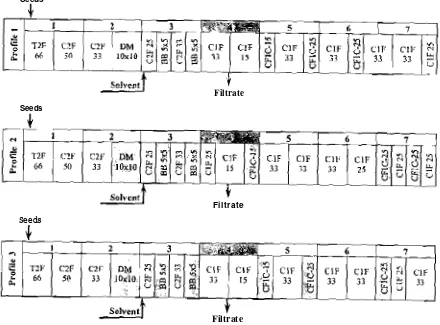
BC 45 co-rotating txvin-screw extruder. It was built with seven modular barrels, csch 200 mrn in length, and diffcrent twin-screu,s which had segmental screw elements cach 50 and 100 mm in length. The modules were hestcd by thermal induc- tion and cooled by water circulation. Seeds werc Icd into the extruder inlet port by 3 volumic screw feeder, and linoteic methyl esters werc injected on module S by a piston pump. The filter section con- sisting of six hemisphericat dishes with perforations 1 mm in diameter was outfitted on module 4 to separate extracted oil. Figure 1 shows three scre~v profiles tested.Experimental
For all experiments, the ternpcrature along the
barrel and the feed rate were fixed at 80°C and 25 kg/h, respectively. The screw rotation speed was fixcd at 166
-
210 rpm, while the solvenl-to-solid ratio was varied from 0 to 0.63. To ensure a stable flow rate and barrel temperaturc, Ihe extruder was operated fur 20-
25 minutes before processing the actual samples. Upon achieving steady operation, filtrate (oil.1 inolcic methyl ester mixture containing the foot) and cake meal samplcs were imrnediatcly collected over a period ~f 20 minutes. The filtraic dnd cake meal were urighed. The filtrat:: was liifiher centrifuged to separate the foot from Ihc uil/linoleic methyl ester rnixturc. The rnolsturc andrcsidual nil contents of the cake meal were mzasu~cd accocding to sbndards NF V03-903 and NF V03- 908. The linoleic methyl ester content of filtratc and residual oil contained in cake mcal was determined by gas chromatography using F A M E methcd. O i l
extraction yield was calculated from the following relationship :
where R is the oil ehbaction yield based on rrsidual oil content of cake mcal (% mass).
&
is the inlet flow rate of the dry s e d (kg%) and Qcd is the outletflow rate of the dry cake meal (kg%). Tw and Trdare the oil contents of the seed (%) and the cake meal (%), respectively, in relation to the dry matter.
Oil Quality Analysis
The quality parameters of a crude oil includcd
ti)
the acid value, expressed in mg of KOH/g o f oil ( N F T 60-204), which is an indication of the free fatl! acid mnterit of the oil, and (ii) the iodinc L ~ I U C , cxprtssed in terms of [lie number of cr.ntigr,.i~~~.r 01'iodine absorbed pcr gram of nil (.AOCS-Td 1 d-'12 ).
ttllizh i s a nlensul-c ot'tllc unsaturaliot~ oj I b i l . ..
J.
10x10
j,
profiles ttsted
Sccds
J.
nlcchanical
1
U
g
&
The rncchanical cnergj calculatrd
SME [P/Qd and [(460 I r 0. C where I clectiic currcnt f'
(W),
Qs
flow rattS,$
spel(Volt) efficiencx of
T2F
lincleic extracti~ 'esidual
b:
!,icld was
289b. More oil nl
!!IC r ~ ~ l ~ r ~ ~ t . r t r - s i h i d ( S ! S ) mtio x i s it
VI
tj
UC2F
2
J Tek. Ind Pprr 1'01 I # ( l ) . 1 7 - j 2
Seeds
L
riments
wae with,L BC
c o - d n g twin-sacw d e rsevm
d u l a r
gth, and diffaenl Wn-srews
s c r c w e l e r m n t s d 5 0 a n d 1 0 0 m i n e mdutes m Lhermal induc-
mled
circulation.
S
~
S
:much id& v a l w i c w e \ v 1
lindeic d y l
cJters w r e injactedby Tht wn-
h m i s w
d i s k $&msdiameter was &mad
XW
oil.
1sttd.
experiments, tern-
3 feed rate wac fixcd
nxtively.
Tht
sacw
M i m sped66 rpm, while
from
0 to slablcbarrel tempatwe, the t m d e r
br minutes befwe pmssing
npIes. Upon steady Ulinoltic m h y l etu mixture
md
cake m d sample wereover 20 filtratc
w m weigh& The f~ltrat-, was
lo separate fml Ihs
: ester molsture
1 conten& h c =kc mcal vicrc ~nciuurccl
&
NF
V03-conminod cake meal w x
romatogruphy methcd.
rollo~ving :
oil
exhction: cake meal
I%
niass). &is t t ~ c i r l i c ~bf the dfj
ssed
(kgh) QCd is the~f cake (kgh).
Tm
Toareltcnts
seed
md meal:tively, to
u ~ l i t y paramettrs
1 exprwsed KOHlg
2041, the
mnter,! thc the i d i n c ~ ~ i u c , t c m s d ~ c numbcr c e n t i g ~ d t ~ ~ h ~ I I '
7 r k J pcr ( A ( ~ ( ' s - l ' d 1 I!-"? 1.
mcasurc of thc u n l l u ~ ,illnln o t ' r ~ ~ l \
J Tek, [rid Per, Loi ISi I t . J:-j-'
Filtrate
Seeds
+
t
Filtrate
Seeds
J.
11
FiltrateFigure I . Scrcxv profiles ic.ird f n r oi! exlraclion of sunflower scrds in a twin-scrcw e ~ l r u d e r BC 45
Specific n~echanical energy
,
.
I he specific mechanical energy (SME) waq calculatrd from the following equation :
S,t fE
{C17/'U,d
and P = r(460 I r 0.95 S33.'600j..\'hcrc I i s t:11; el~clric current (A), P is ~ h c nlotvr power (W),
Qs
is the inlet flow rdte of thr seed (kglli) and SJ i s thc scrcw 1.0taiioi1 speed (rpm). 160 (Voll) and 600 (rpm) are used to deszribe theefficiency of the ektruiler.
Results and discussion
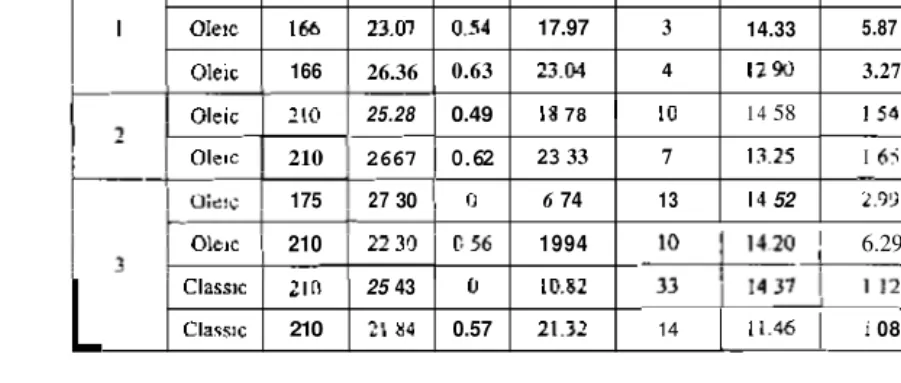
The i~jcction of Iin~leic methyl ester on module 3 improved rhe oil extraction yield
and
decreased the residual oil content of czke nlcal (Tablc 1). I he injection o f linoleic rnethyl ester ticilita~cd the extraction processing by solubilizing
thc oil cuiltilined in ma:criais, the oil cxteaction y e l d was thus increa*d by approximately 1 0 -
2xn4. hiclrc oil c x t m c ~ i u n yield was obser~ed whcu :! L, ::$d\-rf~t-t+ -\(did (5:s) r ~ ~ i i o ~ 2 % i x r r;~<ri\. ~.n(\
the I-ctersed screw elements were wafigured w i ~ h increased spacing telween elements.
In addition, the solvent-to-sdtd { S / S ) nlio
affected the specific mechanical energy. The
a~~gmenlation of the spccific mechar~ical energy with
an inaeasc of the solvenl-to-solid (4;s) ratio increased the pressing efficacy of the rcvcrxd hcl.eiv elerncnts due tu an increase in the residence time in
the whole cxtrudrr, thc oil ewtract;on yield rhus i~icrcased. The flow rate of fillrate increased whm the solvent-10-solid (S/S j ratio incressed. fol lowed by rr decrease in the flow ratc of cake meal and Ihr
tbnt content of filtrate.
Fur all operating condilions tested, the quality of filtrate was good (Table 2). The acid value
remaincd stable (c 2 mg of KOH/g
of
oil) and theiodine
values
were acceptable. The linoleic methyl eskr contenl of filtrate rcn~airlod at 50-
66%. Morelinoleic methyl ester content was observed when
solvent-to-did (S/S) ratio was incrcascJ. These qualilies were advantageous for direc! u~ilintion u f filtrate such as bio-fuels. Increasing the use ~i bio-
fuels for el-iergy purposes is of particular inicrvst
hcc411sc ;he!' hnve cnn~iderablc cnt i r ~ o ~ ~ r i i ~ ~ ~ : ~ : ~ 11: tl'tct~cll!, potc.lii;ll. pro! idc nw:\uh c.1lc.r . C :
[image:3.851.73.513.59.384.2]Melhyl Esler h!r<rction QfStmnjlower Oil In A ... ... ...
renewable and may even offer new ernploynlent possibi-lilies (Demirbas and Mustah Balat, 2006). Actually, these bio-oils ore being in~estigated a5a substitute for fossil fuels to generate heat, power zn&ur chemicals.
The operating condilions generally improved the quality of cake meal. mainly the residual oil content. The values obtained were low (< 10%) for all operating conditions tested (Tablc 1). However, the residual linoleic methyl ester contained in cake
meal was still high(> 8%). Although these qua! ities were disadvantageous for direct utilization of cake meal, they ca be converted into uzable cncrgy by combustion, gasification and pyrolysis (Yorgun et a\., 2001; Gerqel, 2002). or transformed into the
c o m p s i ~ c agro-ma~crials, such thermoplastics materials (1,eyris ct al.. 1998; Rouilly ct al., 20041.
CONCLU SlON
This study shows that the application of twin-
screw extruder tu conduct soIvent extraction of sunflower oils in a continuous mode hare been successfully carried out, and was a promising alternative technology for oil proccssing of sunflower srrds, l Iighest oil extraclion yield of 90.7% with gcod oil quality and modrratc specific mechanical energy (282.1 W .h/kg) was obG,ned under SlS ratio of 0.65 and screw profile of I).
[image:4.842.84.535.509.701.2]'Table 1. lnfiuence of screw configuration and solvcnt-to-solid (SIS) ratio on methyl ester extraction of sunflower oils in a twin-screw extruder BC 45
Table 2. Influence of screw* configuration and sulvent-to-solid ( S I S ) ratio on oil qualiry pro..
I
1
r n5(1 .I, 7'ek Itrd Pert. L'ol I !?(I), 47-r2
1
Oleic1 1
27.301
01
I2
Oleic 210 25.28 0.49
O l e ~ c 210 2667 0.62
U;2!2 175 27 30 C1
Ole~c 210 2231) 1?56
Iodinc value
(mg iodinelIO0 g oil)
85.00
1 12.02 1 14.90
111.18
113.73
85.16
Abmham, M.S..
W in
of SOC. 207-108.
A~nalia Pontal~cr, P.Y., Oil extraction nf oleir wntlower s
erxlruder: screu
operding lndl
22.267-222. Amalia Ksrtika, Pontalicr. P.Y.,
of
cxiruder: config
'I'echnolngy 7302-23
Bouvier, J.bi., Guyomard.
P.,
Me1talla!inn cxtractir~~
coniained PCTil
Campbell, 1:..1.$ 1983. Sunflower C l ~ c ~ n . Soc. 387-392.
C'houdl~ury, G.S.. R K . , Oswalt 'T'itin-ycrcw cxtrusion sa!
flour effects
E
rncnls. or P
nology
P.J.,
llrxane extractios
cuttonsc-d: n laburalor~ -scale s Chem Soc.
72,963-465.
I )emirbas, M.1-.. Mus;afa Balat, Pczs produclirtn utilizal
bin-fucls: glob21 perspective
Prcss. Energy M8
I>evittori, C., Ciumy, [I., t f . ,
Lnt~ibclct, 2000. extrac~ion frun~ Uhem. SOC. 573-579. Ijzie~ak. 1 11, 1989.
tbod Tec
163-174.
Ciaukm, A., G.S., 1999a. gcwtion efTect starch
flo~
Ciautam, A., Ctroudhury, 199%.
raidence tim,
mi?cing
extrus;on flour. 22,263-285. Solvants industriels:
s
Masson, Gercel, FI.F.,
pj~olysis (
oilcakr. Riornaw Bioenergy
:
L
Class~cClass~c
Solvent content
("4
59.39
4
65.73 50.64 61.12
ss
(rprn) 166 166 166 210 110 Q s (kgh) 23.79 23.07 26.36 25.28 26.67 -I Secd ProfileI
0 18 78
23 33
6 74
1
2
I
Oleic 22.30 0.56 114.80 54.87
0
0.54
0.63
1 10
7
13
Fl LTTUTE
Oleic
OIelc
Oleic
Z l n 210 S/s ratio 0 0.54 0.63 0.49 0.62 type Olcic Oleic Oleic Oleic Oleic Flaw rate
w ' l t )
5.43
17.97
23-04
Acid value (mg KOHlg oil) - 3.15 1.28 2.27 1.47 1.64
8 1 3
8 9 7
7 7 9 CAKE MEAL
Foot control ( 0 Y 3 4
1 4 58
13-25
14 52
166 ?3.79
25 43
21 84
402 4
3 1 2 6
2 8 9 5
88.0
75.9
89 8 H
(
1994
10.82
21.31
1 5 4
-
I h i-
2,99 9.15 10.68 -. n 166 166 O 0.57 377.2 3279360 7
SDlE
I
(1V.hlkg)
62 7
84.9
W.7
6.29
14
I
11-461
i 08 -I rate
(kg(h)
1 6 2 9
14.33
12%)
10.29
9 15
16.91
9 dR
0 7.68 23.07 26.36 2490 374.7 282.1 MoYIui-t content I%) 7.81 5.87 3.27
7 93