Untung Praptohardjo**, Susilo
Wibowo***
Abstrak
Perkwnpulan Keluarga Berencana Indonesia (PKBI) Jawa-Tengah mengkreasi klem susuk dan metoda pelepasan Norplant yang lebih cepat dan sederhana yang disebut teknik "U ". Studi perbandingan pada pelepasan susuk pada 76 pasien dengan susuk yang teraba dan membayang di bawah kulit dilakuknn selana bulan
Juni
1991 sanpaiMei
1992. Secara acak pasien dibagi menjadi 2 kelotnpok. KelonrpokI
(38 pasien) dilepas dengan tehnik lana seperti disarankan oleh produsen dan kelotnpok II (38 pasien) dengan teknik 'U". Setelah dilakukan insisi, waktuyang diperlukan untuktnelepas seluruhsusuk,jwnlahsusukyang utuh, sertajutnlah insisiyang diperlukan dicatat. Hasil studi menunjukkan, waktu pelepasan susuk dengan teknik "IJ" (nean:6,8 nenit) secara statistik sangat bennakna lebih cepatdari
19,9 tnenit dengan teknik yang biasa datt juttilah susuk yang utuh lebih banyak dibanding dengan teknik latna. Meskipun jrunlah insisi secara statistik tidak berbeda bennakna tetapi perlu dicatat bahwa 5 pasien yang dilepas dengan teknik lann nenterlukan2 irrsisi sedangkan yang dilepas dengan teknik "U" selnruhnya hanya dengan
/
irusLsi.Abstract
The Indonesian Planned Paretûhood Associatiott (IPPA) of Central-Java in Setnarang, Itrdonesia has designed the "IJ" technique using specific inplantforceps (nodifiedfro,nvas deferensfixing clamps or henostaticforceps) as avery sinple procedurefor inplant renoval. A comparative study was done on the renoval techniques on T6visible and or palpable inplant patients during June
l99I
to Mei 1992. Patients were randonly divided into two groups. GroupI
(38 patients) was allocatedfor
the ordinary technique suggested by the nanufacturer and groupII
(j8 patients)for the "IJ" tecfutique. The tine for the coutplete renoval after incisionTor each technique as well as the nwnber of undanaged silastic tube of inplant and nunbers of ittcision were cotnpared. The result of this study revealed that the inplant retnoval tinefor
the UIJ' technique (nean:
6.8 ninutes) was statistically significant shorter than (19.9 tninutes) the ordinary technique and produced sigttificantly greater nuntber of unrlanagedinplant
silastic tubes. Five parients with the ordinary technique needed to have 2 incisiotts and none with the "U" technique.Keywords: New technique of itnplant renroval, Itnplantforceps, Site ofincision VoL 3, No 2, April-June 1994
The
"U"
Technique
Technique 113
tions should also be ready
to
remove the
implants
anytime upon
requestby
the patients
or
at
the endof
the
fifth
year. The removal
of
the implants should
beperformed
very
gently and
will
take longer than
in-sertion.r
Recently, Darney,
Klaise
and Walker2
developed analternative
methodwhich
requirefingers
and scalpel
only
and named as "Pop-out"
method.Unfortunately
the"Pop-out" removal required
slightly
more
time
(meantime 20
minutes) than the ordinary
technique.An
Easiest
Norplant
Removal
Procedure
INTRODUCTION
By
the end of 1989 theNorplantR subdermal implants
contraception has been used
in
clinics
and
preintro-duced
in
44
countries.
World-wide
useof
NorplantR
contracept
to bedramatically
increasedover the
n
As well as
many
countries,Indonesia
nd
NorplantR
services
andregularized
theminto
theFamily
Planning program.
It
is important that
clinics
carrying out NorplantR
inser-*
Presented at the IPPF ESEAO Regional l(orkshop on Contraceptive Technology and Field Observation on Nbrplant Progranune, Desentber 14-18, 1992, Senarang, Ittdonesia.ll4
Praptohardjo and WibowoAfter
several yearsof
experiencewith difficulties
to remove theimplants,
the Indonesian PlannedParen-thood Association (IPPA)
of
Central-Java
in
Sema-rang,
Indonesia,
had developed anew technique. This
paperwill discuss
the study
aqddetails
in
developing
the new technique on NorplantRremoval.
MATERIALS
AND
METIIODS
The study was conducted
from
June 1991toMay
1992 atIPPA
Central
JavaClinic
and atKemlokol village,
Central
Java,Indonesia.
In
order
to
eliminate
the bias anderror
dueto
thedifficulties in finding or
locating
the unpalpable
implants, only
patients
who
had beenusing
NorplantR
for
5
years and
having a visible
or
palpableimplants
were retainedfor
this study. Seventysix
patients participated
in
this study. They were
ran-domly divided into two
groups. Group
I
(38
patients) wasallocated
for
theordinary technique
suggestedby
the
manufacturer
and groupII
(38 patients)for
the"U"
technique.
The
same
local
anesthesiaprocedure
andpatient position
wereperformed to both
groups. Each patient was treatedwith careful
aseptic tech-nique, and thehigh-level disinfection
of instrumentsby
boiling
orsoakingin
a chemicaldisinfectant
were used asrecommended.'
The
conventional
("Ordinary")
technique
The
main equipments
suggested
by
NorplantR
manufacture
areMosquito
forceps,
Crile
forceps
and scalpel.l
2.2
-
2.4 mmMed
J
Univ IndonThe implants were
located
by
palpation
and
if
possible,their
positions were marked
with
aballpoint
pen.
After
local
anesthesia, a 4 mm transversalincision
was
made
close
to
the end
of
implants (below
theimplants).
The implants were pushed
gently
toward the
in-cision
with left fingers
andthen
eachvisible implant
tip
was graspedwith
mosquito forceps.
Open thecap-sul which
covered
eachimplant
andremove
it
using
thecrile
forceps.
In
most
caseswe
hadto
remove
the implants using the techniquefor removing
inaccessiblecapsules suggested
by
the manufacturer and
if
not
successful
the patients were asked
to
return
for
a secondvisit.l
The "LJ" technique
In
this particular technique,
thefollowing
equipmentsare
needed:
(1)
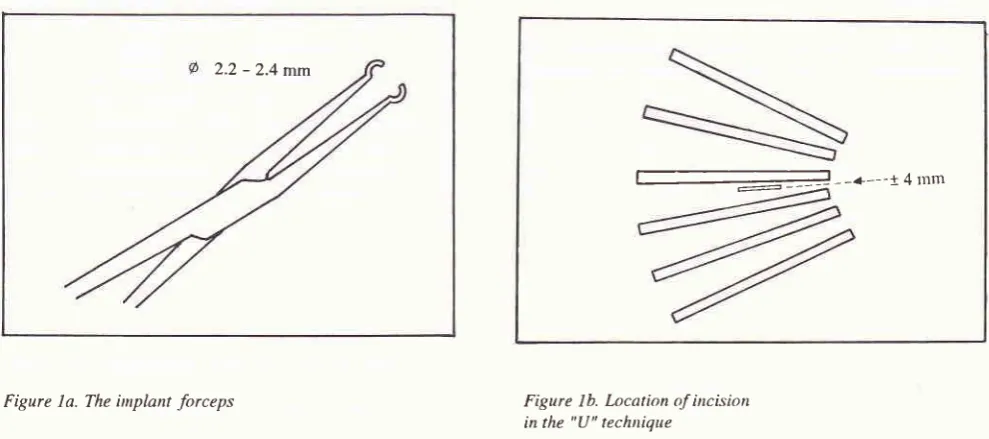
special forceps (modified
from
vasdefferent-fixing
clamps or hemostatic forceps). Thetip
was
bendedto form
acircular tip with
adiameter
of
approximatelly
the same as theimplant
that is 2.2mm
- 2.4mm
and named as"implant
forceps"
(Fig.
1a). (2)Other forceps (Mosquito
or
Crile or
hemostatic
for-ceps).(3)
Scalpel.The implants were also located
by
palpation.
Whenever
possibletheir positions
were markedwith a
ballpoint
pen. Thelocation of
incision
isdifferent
thanthe ordinary
technique.
In
this
technique
the site
of
incision is
determined close
to
the
implant
number
3or
4,
approximately
0.5-1 cm
along
the
implants
toward
the endof
all implants
(fig. lb). After
aproper
local
anesteticprocedure,
a4 mm incision
was madelongitudinally.
---+---a4rllrrt
[image:2.595.48.543.519.738.2]---Figure Ib. Location of incision in the "U" techtùque
Vol 3, No 2, April-June 1994
The
implant's
rods were
graspedusing implants
forceps and
pulled
out.Afterwards,
theimplant forceps
handle was turned
over l80o toward patient's shoulder
[image:3.595.93.298.179.357.2]or
palm
(fig.2).
Figure 2. Procedure to grasp the itnplant in the ,IJ, technique
The soft
tissue surrounding the
rod
of
implants
were cleaned
with
gauze. The scalpelcould
be usedto
scrape
away the soft
tissue,
then the
capsules were
opened
longitudinally. Using the
second forceps
thevisible part
of
the implant
could
be
grasped
andremoved easily.
The
time
for
the
proper local
anesthetic varied,
merely
depending on the
patient's sensitivity.
There-fore
the
time of removal
was
assessedfrom
the
time
after incision
to
the time
of
complete
removal.
Thenumber
of
undamaged/
unbroken implants
aswell
asthe number
of
incisions
were also counted and
com-pared.
RESULTS
Sample data
collected
from
this study
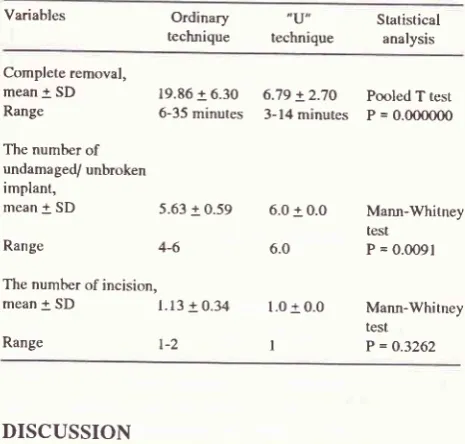
showed that theremoval time
wasin
normal
distribution,
but
thenum-ber
of
undamaged/
unbroken silastic tube
of
implant
as
well
as thenumber
of
incisions were not
in
normal
distribution.
Therefore
the pooled
T
test
and
Mann-Whitney
test were used.The
removal of implants usually
takelonger time
than insertion.
Using the
ordinary technique,
theremoval
of visible
andor
palpable implants
took
6to
35
minutes
andthe
meantime
was
19.86minuts
(seetable
1) . The number ofincisions
were notsignificantly
different,
5
patients
needed
2
incisions
in
order
to
The uU'Technique 115
remove complete
implants
with
theordinary
technique and nonewith
the
"U"
technique.Table
L
The mean removal time (minutes), the number of undamage/ unbroken implants, the number of incision in the ,,U,, (3gpatiens) and Ordinary technique (3g patients)
Variables Ordinary
technique
,U"
technique
Statistical analysis
Complete removal, mean + SD Range
The number of
undamaged/ unbroken
implant,
mean
!
SD19.86 + 6.30 6-35 minutes
6.79 + 2.70 3-14 minutes
Pooled T test P = 0.0ooO0O
Range
4-6The number of incision,
mean
! sD
l.l3
+ 9.345.63 + 0.59 6.0 + 0.0
6.0
l.O + 0.0
I
Mann-Whitney
test P = 0.0O91
Mann-Whitney
test P = O.3262 Range
DISCUSSION
The removal time using
theordinary technique
in
this
study
seem close
to
the removal time
of
,,pop-Out,,method
(meantime
20minutes)
developedby Darney,
Klaise
and
Walker.2 During tire removal
proceduresthe operator
often
faced theproblems
that someof
thesilastic
tube-end
were
inaccessible
(more than
1
cmfrom
the
incision
site).
In this particular condition,
it
was
really
hard
to
push
with
the
left fingers or
graspand
pull
theimplant
usingMosquito
forcepstoward
theincision.
Some
of
these
problems
seem
likely to
besolved
if
the implants were
grasped
using
implants
forceps. Therefore the removal time using the
,,U,,technique
was much
shorter
i,e. the
mean
time
was 6.79minutes (table
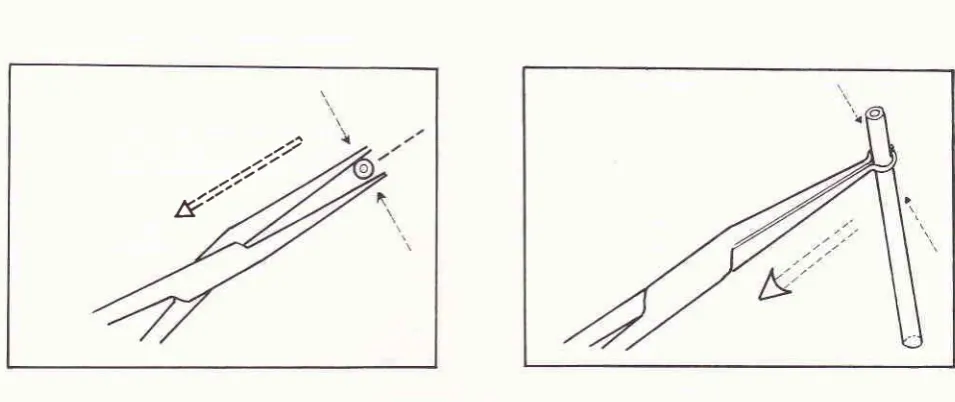
1).It
is
well known
that the
cylindrical
capsulesof
the
silastic tube
are easyto slip
out under
open angle(mouth)
of
mosquito forceps
(fig.
3a).Under
these circumtances the operator shouldtry
to
grasptightly
and perhaps alsoto
push theimplants
harder
in
order topull it
out.Ifthe
operator grasps tootight, the silastic
tube
might be broken
or
damagedduring
theeffort.
After
severalunsuccesfull efforts
theoperator
might
decideto
make another
incision
closeto the remainder implants.
This
problem
did
not
hap-pen
if
we used theimplant
forceps. Theimplant forceps
would hold the cylindrical
capsulesof
implants
per-fectly
(Fig.
3b). Thecircular tips
of theimplant forceps
[image:3.595.333.568.183.408.2] [image:3.595.334.567.186.408.2]116 P r ap to hardj o and Wibowo Med
J
Univ Indon.rt/
./?'
[image:4.595.59.537.82.283.2]e
Figure 3. The position of the silastic tube of implant in the tip of tnosquito forceps (3a) and implanr forceps (3b)
would
act
as an exeellent hook, thetefore theimplant
could be pulled out through
theincision
more easily,
In our experiences, some of the tissue or capsules
at the
tip
of implants were thicker
than at thesurround-ing rod
of
implants. Therefore, the operator might
spend more time to clean, to scrape away the soft tissue
and
to
open
the capsules
compared
to
those
who
grasped the rodof
implants using
implant
forceps.The location
of incision
also played animportant
role in implant
removal.
Firstly, in
the ordinary
tech-nique the operator
would
grasp thetip of
the implants andin
the new technique the operatorwould
grasp therod
as we mentioned above.Secondly, if the distances
of inter-lower-end
of
implants
are morethan
I
cm and the operator made anincision
0.2 - 0.5 cm close to the end of most implants (below the implant), the distanceof
the furthest implant-end
to
the incision
openingmight
be morethan
1 cm. In this condition,it
wasvery
difficult to
remove the
remainder
implant.
It
would
take
longer
becausethe implants
capsuleswere
slip-pery
or
the operator had
to
make
another incision.
When the new technique
was adapted, the distancesof
eachimplant rod to
the
incision might
be less
than I
cm, Even
if
the distance was more
than
1cm the rod
of
the implants was
easier
to
grasp
than the
tip
of
implants. Nowadays, the
operators
at IPPA
Central
Java
are more
familiar with
the
"U"
technique
and experienced operatorswere able to remove the
visible
imptants
asquick
asinserting
it.
This new
technique was thencalled
"UNTUNG"
technique
or "U"
techni-que after the nameof
the founder.The
"U"
technique seems
likely
to be more
con-venient
andpreferable
for
both the operators and
thepatients.
Acknowledgements
We gratefully
acknowledge
Dr.
Endang Ambarwati,
Mrs.
Didit
Budiningsih
andMr.
Abadi for their help
in
datacollecting.
The authors also
would
like to
thank
Dr.
Fatimah Moeis,
MSc,
for
her
generous
help in
preparing this manuscript.
REFERENCES
l.
NorplantR, Contraceptive implants. Instruction for insertiory'removal. Leiras Oy, Turku, Finland.
2.
Damey PD, Klaise CM and Walker DM. The 'pop-out'method
of
Norplant removal. Advancesin
Contraception. (Abstracts Eighth Annual Meeting, Barcelona, Spain; 1992; 8(3):
188-9.3.
Tietjen L, W. Comain, Mclntosh N, Infection Prevention forFamily Planning Service Programs. A Problem-Solving Ref-erences Manual, Essential Medical Information Systems,