CHAPTER 2
LITERATURE REVIEW
2.1Introduction
This chapter studies earlier research related to the definition, importance and former studies of Chinese bargaining behavior. The information was collected from several sources such as journals, books, and other trustworthy source from the Internet. The Theory of Planned Behavior by Fishbein, term explanation about bargaining and cultural notes on Chinese Negotiating Behavior are related to the previous studies and elaborated to this current study. The Factors that influence the intentions to do bargaining (i.e. attitude, subjective norm, and perceived behavioral control) and the hypothesis would be examined.
2.2Bargaining
accepted, and are still prevalent in certain types of retail business (Kaynak, 1988).
2.3Previous Research
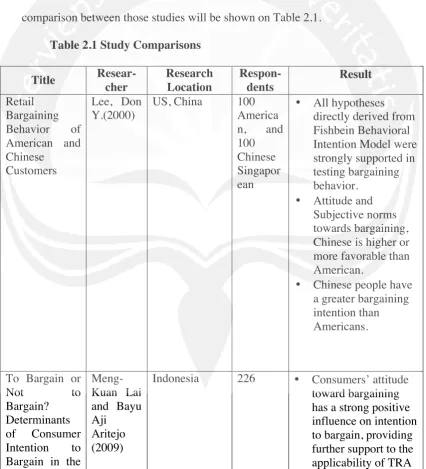
There has been many studies that also observed the bargaining culture of Chinese consumers, whether being compared with another developed country styles of negotiation, related with historical, the type of markets, or retailing business, or competition between Chinese people in Mainland or other countries. The study conducted in various country and use different sampling method. The comparison between those studies will be shown on Table 2.1.
Table 2.1 Study Comparisons
Retail Market in a bargaining and is quite costly for consumers with a
• As foreigners take the time to come to commit ourselves to building and
2.4Cultural Notes on Chinese Negotiating Culture (James & Cheng, 2008)
Western businesses negotiating with Chinese firms face many challenges, from initiating and smoothing communication to establishing long-lasting relationships and mutual trust, and from bargaining and drafting agreements to securing their implementation. Chinese negotiators can be at once warm hosts and friends and tough bargainers. China has been undergoing rapid political,
economic, and social change since the early 20th century. Its cultural heritage,
guo qing (i.e. “special national circumstances” caused by frequent institutional
and political turnovers), and international exposure/exchange are three intertwined and interacting factors that have been the major determinants of Chinese business culture and negotiating style.
First, traditional Chinese philosophies—largely Confucianism, Taoism, and war stratagems— that have governed Chinese society for two thousand years remain the core value system in Chinese business behavior today. They are manifested in such well-known characteristics of Chinese business negotiation as patience (a famous Confucian virtue), an orientation towards harmonious relationships (a fundamental concept of Taoism), and survival instinct (a motivation of war stratagems).
Second, China’s contemporary guo qing has greatly affected the way business is conducted between Chinese and foreign firms. For instance, one element of China’s guo qing is lack of economic and social development due to
foreign invasions and exploitation in the late 19th and early 20th centuries, and the military and political movements that ensued. Humiliation and trauma disposed the Chinese to deeply distrust foreigners, with the result that today Chinese businesses employ with foreigners hard, win-lose bargaining tactics motivated by nationalistic emotions.
Third, Chinese business has become increasingly integrated into the international business arena long dominated by the West. Chinese negotiators’ exposure to increasing opportunities to learn international practices and sharpen their skills through cross-border deals has resulted in growing similarity in the business styles of western businesspeople and young, under-40 Chinese entrepreneurs.
relationship between businesses is ultimately built upon relationships between individuals. As a Swedish businessman once observed:
Business in China is not about doing business between organizations, but
about doing business between people . . . . Your successor does not automatically
inherit your friends and relationships. As I perceive, Chinese do business with
you, not with your company. You can’t be blue-eyed and believe that you have
made friends through one or two deals. It takes a little more time.2
2.5The Theory of Planned Behavior
The Theory of Planned Behavior (TPB; Ajzen, 1991) is an extension theory
of Reasoned Action (TRA) model, which is proposes a model about how human
action is guided. The difference between TRA and TPB that is the perceived
behavioral control (i.e., the determinant of behavioral intention) has been added to
the TPB, as well as control beliefs, which influence the perceived behavioral
control (Chang, 1998, p1826). It predicts the occurrence of a specific behavior
provided that the behavior is intentional. The model is depicted in Figure 1
represents the three variables, which the theory suggests will predict the intention
to perform a behavior. Intentions are the precursors of behavior.
2Fang, Chinese Business Negotiation Style, p. 235.
The Fishbein behavioural intention model (also referred to as a model of reasoned action) (Fishbein and Ajzen, 1975; Ajzen and Fishbein, 1980) postulates a set of relations between attitudes, subjective norm, intentions and behavior. An attitude is a learned predisposition to behave in a consistently favorable or unfavorable way with respect to a given action (or object). Therefore, the attitude towards an action is the overall favorable or unfavorable feeling towards the action, or the amount of affect for performing the action (Fishbein, 1980, pp. 1-3). In fact, in attitude literature, attitude and affect are typically treated as synonymous (Cohen and Areni, 1991; Lutz, 1991). Generally speaking, the more favorable a person's attitude towards an action, the more likely the person will intend to perform the action. This intention, however, is also influenced by a person's subjective norm in performing the action; that is, his subjective judgment that people who are important to him think he should or should not engage in the action. The stronger the intention, the more likely the person will be to perform the action (behavior) in question.
the theory itself have been applied in many different settings (e.g. various products and actions), and have been shown to be robust even under conditions which are different from those the authors initially proposed for the model (refer to Sheppard et al., 1980 for a detailed review). Nonetheless, the Fishbein model has also been challenged over its treatment of the independence (isolation) between attitudes and subjective norm (e.g. Miniard and Cohen, 1981; Oliver and Bearden, 1985; Ryan, 1982). It has received support not only when tested in Western countries (mainly the USA), but also in Confucian cultures (Lee and Green, 1991). Fishbein and Ajzen have long asserted that their model can be used to understand and predict most human behavior.
Behavior is one of the major components of the TPB (Ajzen, 2002). Behavior is an individual's observable response in a given situation with respect to a given target. Ajzen said behavior is a function of compatible intentions and perceptions of behavioral control in that perceived behavioral control is expected to moderate the effect of intention on behavior, such that a favorable intention produces the behavior only when perceived behavioral control is strong. In the following, we will use their framework to develop our hypotheses for bargaining behavior.
2.6Hypothesis Development
discount on the price that the seller offers, or for a free gift/service at the offered price.
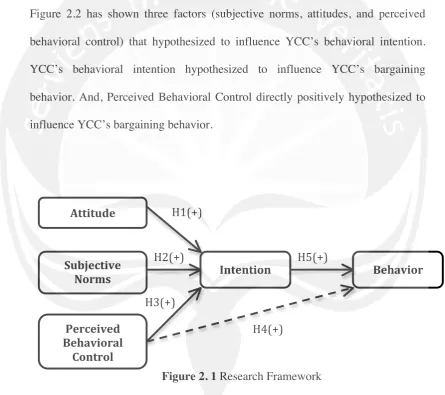
Since the present research is a modified replication of Lee, Don Y’s study (2000), the following hypotheses was adapted from the original study. Based on the previous review of variables influencing bargaining behavior, a model of Bargaining Behavior of YCC (Young Chinese Customers) was developed. The Figure 2.2 has shown three factors (subjective norms, attitudes, and perceived behavioral control) that hypothesized to influence YCC’s behavioral intention. YCC’s behavioral intention hypothesized to influence YCC’s bargaining behavior. And, Perceived Behavioral Control directly positively hypothesized to influence YCC’s bargaining behavior.
Figure 2. 1 Research Framework
Source : Ajzen (1991)
Attitude
Subjective Norms
Perceived Behavioral
Control
Intention Behavior
H1(+)
H2(+)
H4(+)
H5(+)
2.6.1 Attitude
Attitude or affect is a customer's feelings or emotions about bargaining actions, either favorable or unfavorable. For instance, some customers feel excited when bargaining while others feel bored; some like to bargain and some hate it (Lee Don, Y, 2000). Thus, Attitude toward the behavior is a person’s overall evaluation of the behavior. It is assumed to have two components which work
together: beliefs about consequences of the behavior (behavioral beliefs; e.g.
‘referring Tiong Hua youths still generates the bargaining cultures in future’) and
the corresponding positive or negative judgments about each these features of the
behavior (outcome evaluations; e.g. ‘still like bargaining….
desirable/undesirable’). Hence, the first hypothesis, H1 helps to determine the
relationship between attitude and bargaining intention.
H1: Young Chinese Customers’ attitudes will effect positively to bargaining
intention.
2.6.2 Subjective Norms
Subjective norm is a customer's judgment of what relevant others would think about his engagement in bargaining, or whether bargaining is an acceptable practice in their society. The intention to engage in bargaining is a state of readiness for the customer to start bargaining when shopping (Lee Don, Y, 2000). Subjective norms are a person’s own estimate of the social pressure to perform or
not perform the target behavior. Subjective norms are assumed to have two
components which work in interaction: beliefs about how other people, who may
beliefs). The, the second hypothesis is the relationship between subjective norms
and bargaining intention.
H2: Young Chinese Customers’ subjective norm will affect positively to
bargaining intention.
2.6.3 Perceived Behavioral Control
Perceived behavioral control is an individual's perceived ease or difficulty of performing the particular behavior. It is assumed that perceived behavioral control is determined by the total set of accessible control beliefs. However, Control beliefs are an individual's beliefs about the presence of factors that may facilitate or impede performance of the behavior (Ajzen, I., 1991). The concept of perceived behavioral control is conceptually related to self-efficacy. Perceived behavioral control is the extent to which a person feels able to enact the behavior. It has two aspects: how much a person has control over the behavior (e.g. I would bargain if the price is quite expensive); and how confident a person feels about
being able to perform or not perform the behavior (e.g. I am a good bargainer). It
is determined by control beliefs about the power of both situational and internal
factors to inhibit or facilitate the performing of the behavior (e.g. ‘Whether I
bargain or not is entirely up to me’; ‘I could bargain if I wanted to’). Therefore, it
comes two hypotheses, first is the relationship between perceived behavioral
controls with bargaining intention, and second is perceived behavioral control is
directly influence to bargaining behavior without influenced by attitudes and
H3: Young Chinese Customers’ perceived behavioral controls will affect
positively to bargaining intention.
H4: Young Chinese Customers’ perceived behavioral control will affect positively
to bargaining behavior.
2.6.4 Bargaining Intention
Behavioral Intention is an indication of an individual's readiness to perform a given behavior (Ajzen, 2002). It is assumed to be an immediate antecedent of behavior. Although there is not a perfect relationship between behavioral intention and actual behavior, intention can be used as a proximal measure of behavior.
This observation was one of the most important contributions of the TPB model in
comparison with previous models of the attitude-behavior relationship. Thus, the
variables in this model can be used to determine the effectiveness of
implementation interventions even if there is not a readily available measure of
actual behavior.
H5: Young Chinese Customers’ bargaining intention will affect positively to