Journal of Management Vol. XX No. X, Month XXXX 1 –22 DOI: 10.1177/0149206316638161 © The Author(s) 2016 Reprints and permissions: sagepub.com/journalsPermissions.nav
Relationships Between Work Team Climate,
Individual Motivation, and Creativity
Yu-Qian Zhu
National Taiwan University of Science and Technology
Donald G. Gardner
University of Colorado Colorado Springs
Houn-Gee Chen
National Taiwan UniversityCreativity of employees is a major focus of research in the organization sciences. In this study we examine the relationships between both micro (intrinsic and extrinsic motivation) and molar (team climate) variables with manager-rated creativity of R&D employees. Specifically, we hypothesize that (a) extrinsic motivation has a direct relationship with creativity, (b) intrinsic motivation is more strongly related to creativity when extrinsic motivation is low compared to when it is high, (c) team collaborative and competitive climates have direct effects on creativity as well as indirect effects through individual motivation, and (d) intrinsic motivation mediates relationships of the climate variables with creativity, which in turn is moderated by extrinsic motivation. Data were collected from R&D engineers and their managers at a large high-tech company headquartered in Taiwan. Results indicate that a collaborative team climate has a direct positive relationship with creativity as well as one that operates through intrinsic motiva-tion, which in turn was moderated by employee’s extrinsic motivation level. A competitive team climate positively related to extrinsic motivation, but extrinsic motivation did not directly relate to creativity. However, extrinsic motivation did have strong relationships with creativity when intrinsic motivation was low. Results suggest that perhaps the different types of motivation relate
Acknowledgments: The authors are appreciative of the many constructive comments offered by the anonymous reviewers and the action editor, J. Craig Wallace. The authors also thank the following individuals for their con-tributions to this study: Gary Klein, James J. Jiang, Eldon Li, Ja-Shen Chen, Ling-Ling Wu, and Matthew Metzger. The first author is grateful for the support from the Ministry of Science and Technology of Taiwan (Grant No. NSC 102-2410-H-011-030). The third author is grateful for the funding provided by the Ministry of Science and Technol-ogy, Taiwan, under project NSC 103-2410-H-002-107-MY3.
Corresponding author: Donald G. Gardner, College of Business, University of Colorado Colorado Springs, 1420 Austin Bluffs Parkway, Colorado Springs, CO 80918, USA.
to different types of creativity (incremental versus radical). Managerial and theoretical implica-tions of results are discussed as are the study’s limitaimplica-tions.
Keywords: creativity; motivation; team climate
Creativity in organizations has been the focus of much research in the organization sciences (e.g., Anderson, Potocnik, & Zhou, 2014; George, 2007; Montag, Maertz, & Baer, 2012). This increased research attention given to creativity has not been misplaced from an applied per-spective. In the face of rapid technological advances and the internationalization of business, the development of creative and innovative products and services has become a key driver of growth, performance, and valuation in organizations today (Cefis & Ciccarelli, 2005).
Anderson et al. (2014) provided a comprehensive review of theory-based research on creativity and innovation in organizations, and called for more research on the interaction of the social (team) context and individual differences, with multilevel research designs (the team-individual interface). Similarly, George (2007) highlighted the need to concurrently study both individual (micro) and group (molar) influences on creativity because molar effects stem, in part, from internal processes within individual group members in the context of their group membership and their interactions with others. Indeed, the team context in which employees are embedded may play a central role in stimulating individual creativity (Hirst, van Knippenberg, Chen, & Sacramento, 2011; Shalley & Gilson, 2004). Thus, manag-ing creativity requires not only the identification of employees with creative potential but also an understanding of how the team context influences the creativity of individuals who have different types of motivation (Hirst, van Knippenberg, & Zhou, 2009).
Anderson et al.’s (2014) review of the effects of team level variables on individual creativ-ity does not explicitly discuss two important team climate variables in organizational research: collaboration and competition. Team members oftentimes are motivated to engage simultaneously in both competition and collaboration (Loch, Galunic, & Schneider, 2006). On the one hand, motivation to satisfy needs for relatedness may lead to a collaborative team climate; on the other hand, individual performance-based rewards motivate team members to compete, producing a competitive team climate (Gagné & Deci, 2005). Unfortunately, the effects (good or bad) of this intrateam competition and collaboration on individual team members’ creativity remains an empirical question.
In this study we examine the independent and combined effects of micro (motivation) and molar (team climate) factors on the creativity of employees, employing self-determination theory (SDT; Gagné & Deci, 2005) as a foundation. We seek to answer the following ques-tions: First, at the individual level, what are the direct and interactive effects of intrinsic motivation and extrinsic motivation on individual creativity? Second, at the team level, what are the effects of collaborative and competitive team climates on individual creativity, after controlling for effects of intrinsic and extrinsic motivation?
influences individual creativity and addresses a notable gap in creativity research (Anderson et al., 2014).
Theoretical Background and Hypotheses
Effects of Intrinsic and Extrinsic Motivation on Creativity
A lack of consensus in the conceptualization and measurement of creativity has led to inconsistencies in results from creativity research (Montag et al., 2012). Thus, it is important to clearly define creativity. Following Anderson et al. (2014), Montag et al. (2012), and Somech and Drach-Zahavy (2013), we define creativity as individual behaviors that give rise to ideas that are novel and useful. Implicitly these ideas are tangible enough to be evaluated for potential enactment, but in this research, we do not explicitly consider the outcome effec-tiveness of those novel ideas (Montag et al., 2012).
SDT proposes that any factors in the work environment that satisfy basic human needs for autonomy, competence, and/or relatedness will enhance intrinsic motivation and subsequent task performance (Gagné & Deci, 2005). This is especially true for jobs that require complex, heuristic thought processes (like R&D), as opposed to simpler, programmed types of jobs (Gagné & Deci, 2005). Several recent studies provide insights into the relationship between intrinsic motivation and task performance. For example, a meta-analysis of effects of intrin-sic motivation on job/task performance finds support for baintrin-sic SDT propositions (Cerasoli, Nicklin, & Ford, 2014). Intrinsic motivation positively relates to all types of performance but especially so for qualitative (complex, including creative) types versus quantitative (simple). This is because intrinsic motivation affects the choice to perform a particular task, the effort expended to achieve success on the task, and persistence at the task after achieving initial success (Cerasoli et al., 2014). Similarly, another meta-analysis estimated that the population correlation between intrinsic motivation and creative outcomes is .30 (de Jesus, Rus, Lens, & Imaginario, 2013). Other research also supports the direct relationship between intrinsic motivation and creativity in field settings (e.g., Leung, Chen, & Chen, 2014), and we expect to replicate that finding in our study.
Propositions about the direct effects of extrinsic motivation on creativity are more com-plicated. Performance-contingent rewards create extrinsic motivation, but there is not a con-sensus about how extrinsic motivation affects creativity (Shalley, Zhou, & Oldham, 2004). One of the key questions about the effects of external rewards on creativity concerns the nature of the contingency between rewards and creativity (Cerasoli et al., 2014). According to SDT, when external rewards are obtained only through successful performance of a speci-fied behavior, extrinsic motivation increases and intrinsic motivation decreases (Gagné & Deci, 2005). This enhances performance levels on simple tasks and decreases performance levels on complex tasks, like creative ones, that are otherwise intrinsically motivating (Gagné & Deci, 2005).
However, it has also been argued that extrinsic rewards can create intrinsic motivation (Kasof, Chen, Himsel, & Greenberger, 2007). SDT explicitly considers situations in which extrinsic rewards can satisfy needs for autonomy through the process of internalization (Gagné & Deci, 2005).1 Similarly, Eisenberger and Shanock (2003) proposed that rewards
contingency. Contingent rewards can satisfy needs for autonomy, as the recipient can choose whether or not to attempt the task; additionally, receipt of contingent rewards can signify task success and satisfy needs for competence (Eisenberger & Shanock, 2003). The learned indus-triousness theory (Eisenberger & Shanock, 2003) assumes that individuals learn which dimensions of current performance are rewarded and generalize that learning to new activi-ties. Thus, to the extent that employees perceive that creativity is one of the dimensions that affect overall performance ratings, there may be a positive correlation between receipt of extrinsic rewards and creativity.
Montag et al. (2012) advanced the proposition that when creative behaviors are an expec-tation for job performance, then extrinsic motivators will enhance creativity. Some profes-sions, like R&D, require “professional creatives” (Unsworth, 2001), with creativity being an expected and vital part of job performance. In this study we examine the relationships between extrinsic motivation and creativity with a sample of R&D engineers for whom cre-ativity was an expected and rewarded part of their jobs. Thus, we propose the following:
Hypothesis 1: Extrinsic motivation is positively related to individual creativity.
How intrinsic and extrinsic motivation combine to affect performance has been a major focus of research (e.g., Amabile, 1993; Eisenberger & Shanock, 2003; Gagné & Deci, 2005) since cognitive evaluation theory, a predecessor to SDT, was proposed (Deci, 1971). Since then, SDT (Gagné & Deci, 2005) has evolved to explicitly address the direct and interactive effects of intrinsic and extrinsic motivation on performance. SDT proposes that the more one’s behavior is controlled by external rewards, creating greater extrinsic motivation, the less that intrinsic motivation will drive task performance. In a meta-analysis of 183 samples that included over 200,000 participants, Cerasoli et al. (2014) found that the relationship between intrinsic motivation and performance was highest when extrinsic motivation was low and lower (but still positive and significant) when extrinsic motivation was high. Conversely, when extrinsic motivation is high, it displaces intrinsic motivation as a driver of performance; the intrinsic motivation to performance relationship becomes weaker (a cor-ruption effect; Deci, 1971).
Cerasoli et al. (2014) point out the fact that in the “real world” it is rarely the case that either employees are intrinsically motivated or they are extrinsically motivated but not both; most employees have some combination of both types of motivation. There are few studies that have measured both types of motivation in employees for whom creativity is a major expectation for their jobs, a void that this study addresses. Based on SDT and Cerasoli et al.’s results, we examine the following hypothesis:
Hypothesis 2: Intrinsic motivation and extrinsic motivation interact such that the relationship
between intrinsic motivation and creativity is stronger when extrinsic motivation is low than when extrinsic motivation is high.
Team Climate and Individual Creativity
George, 2007). It is likely that team factors affect individual variables, like motivation, and subsequently, creativity (Kozlowski & Ilgen, 2006). Knowing which team factors affect the creativity motivation of employees would be useful for managers responsible for enhancing the creativity of their subordinates. However, there is still much to learn about team context effects on individual creativity (Anderson et al., 2014; George, 2007). To address this gap, we develop hypotheses about how collaborative and competitive team climates affect cre-ativity directly and indirectly through individual motivation, based on the social relationships inherent in team work.
Each team member has a perception of the level of competition between members in the team, and when members of the same team have similar perceptions of intrateam competi-tion, it can be said that there is an intrateam competitive climate (cf. Brown, Cron, & Slocum, 1998). In a purely competitive climate, team members are in a situation where they are trying to outperform each other to obtain extrinsic rewards. The motivation of members is not so much to perform well as it is to perform better than other members of the group. Inasmuch as this might displace the motivation to perform because of satisfaction of needs for autonomy, competence, and/or relatedness—and increases the desire to perform at a high level so as to secure a limited amount of rewards—this suggests that the direction of causality is from competition to extrinsic motivation. Thus, we hypothesize that a highly competitive team climate creates a situation where extrinsic motivation is high as well:
Hypothesis 3: Intrateam competitive climate is positively related to team members’ extrinsic motivation.
There has been a considerable amount of research on the effects of competition on intrinsic motivation (e.g., Deci, Betley, Kahle, Abrams, & Porac, 1981; Eisenberger & Thompson, 2011; Epstein & Harackiewicz, 1992; Reeve & Deci, 1996), with differing conclusions. On the one hand, SDT predicts that the higher the level of competition, the less likely team members will attribute their task behaviors to their internal drive, resulting in less intrinsic motivation (Deci et al., 1981; Reeve & Deci, 1996). On the other hand, competition can satisfy needs for auton-omy, as one’s decision to compete or not is largely attributable to the self (Eisenberger & Shanock, 2003). The results from competing may also satisfy the fundamental need for compe-tence, if feedback is available (Reeve & Deci, 1996; Vallerand & Losier, 1999). The competition→intrinsic motivation relationship is stronger when individuals compete to demon-strate their competence, rather than only to obtain extrinsic rewards (Vallerand & Losier, 1999). Consistent with this, an experiment by Eisenberg and Thompson (2011) found that individual-level competition had positive effects on both intrinsic motivation and creative performance. Noteworthy in this experiment was that participants were skilled at the creative task (music), as opposed to the novice children and young adults (students) studied in much prior research on creativity (e.g., Conti, Collins, & Picariello, 2001; Shalley & Oldham, 1997). Given that compe-tition addresses needs for autonomy as well as competence, we hypothesize the following:
Hypothesis 4: Intrateam competitive climate is positively related to team members’ intrinsic motivation.
Dillenbourg, Baker, Blaye, & O’Malley, 1995). Similarly, intrateam collaborative climate describes the shared perception among team members that interpersonal collaboration is descriptive of the team. Collaboration is expected to have a positive effect on intrinsic moti-vation (Amabile, 1998). Positive interactions of team members can lead to the satisfaction of the need for relatedness, which in turn leads to intrinsic motivation. Furthermore, the ideas, information, and viewpoints exchanged during collaboration enrich one’s knowledge base (cf. Carmeli, Dutton, & Hardin, 2015) and thus positively affect one’s self-perceived compe-tence. From an SDT perspective, we would expect intrateam collaborative climate to have a moderately strong relationship with intrinsic motivation:
Hypothesis 5: Intrateam collaborative climate is positively related to individual intrinsic motivation.
A collaborative team climate does not explicitly, by itself, include extrinsic rewards for collaborating. Thus, we do not expect a relationship between intrateam collaboration and extrinsic motivation.
There has not been much research that has examined the direct contributions of a col-laborative work climate on creativity over and above effects of individual motivation. However, we believe that there is evidence that such an effect exists because collaboration between team members will generate more task-related information than would be pos-sessed by the average member of the team (e.g., Carmeli et al., 2015). In addition, there can be synergistic effects when diverse ideas are united or when creative material in one domain inspires or compels fresh thinking in another (Uzzi & Spiro, 2005). These collab-orative structural preconditions suggest that creativity is not only the work of individuals but also the consequence of a social system of actors that amplify one another’s creativity (George, 2007; Gilson & Shalley, 2004). For example, Carmeli et al. (2015) found that relational information processing, an active level of interpersonal behavior that seeks col-leagues’ inputs and reactions to employees’ work, which is conceptually related to collabo-ration, had a significant relationship with employee creative behaviors. A meta-analysis concluded that there is a positive relationship between “open” team environments, where members are encouraged to participate in discussions, and creativity (Ma, 2009). Other research also supports the proposition that collaboration has direct positive effects on cre-ativity (e.g., Hon, Bloom, & Crant, 2014).
This is an important research question because if collaboration affects creativity only through intrinsic motivation, then any number of management practices that bolster intrinsic motivation might be as effective (e.g., job enrichment) and perhaps more feasible. We adopt a multisource view of antecedents of creativity (George, 2007) and expect that intrateam col-laborative climate directly enhances team members’ creativity over and above any effects associated with intrinsic and extrinsic motivation, for the reasons discussed above.
Hypothesis 6: Intrateam collaborative climate is positively related to individual creativity after con-trolling for intrinsic and extrinsic motivation.
individual creative behavior” (p. 439). Similarly, Cerne, Nerstad, Dysvik, and Skerlavaj (2014) found no direct relationships between a competitive team climate (“performance climate”) and either creativity or knowledge-hiding behaviors. In contrast, several research-ers have hypothesized and found positive relationships between competition and creativity, particularly for male participants (Baer, Vadera, Leenders, & Oldham, 2014; Conti et al., 2001). Shalley and Oldham (1997) found support for the hypothesis that competition can increase creativity if the social interactions with others provide information about creativ-ity competence, satisfying one of the needs from SDT. Harvey (2014) proposed that at the team level of creativity, conflicting ideas are a necessary prerequisite for creative synthe-sis, enhancing team-level creativity. To the extent that team members are trying to outper-form one another in a competitive climate, conflicting ideas might be generated and proactively defended when team members suggest different solutions to problems requir-ing creativity. This collision of ideas might enhance creativity at both the team and indi-vidual levels.
While this research alludes to a potential positive effect of competition on creativity, none of it has considered the direct effects of a team competitive climate on individual creativity after controlling for any effects of competition on motivation. We propose a positive, direct relationship between a competitive environment and creativity. If team members perceive a high level of competition, and the generation of creative ideas is a common goal for all group members, it seems reasonable to propose that team member creativity will be enhanced as each member tries to outperform the others on the dimension of creativity. This in turn might stimulate the search for and acquisition of knowledge that forms the building blocks for effective job performance, including creativity. Thus we hypothesize the following:
Hypothesis 7: Intrateam competitive climate is positively related to individual creativity after
con-trolling for intrinsic and extrinsic motivation.
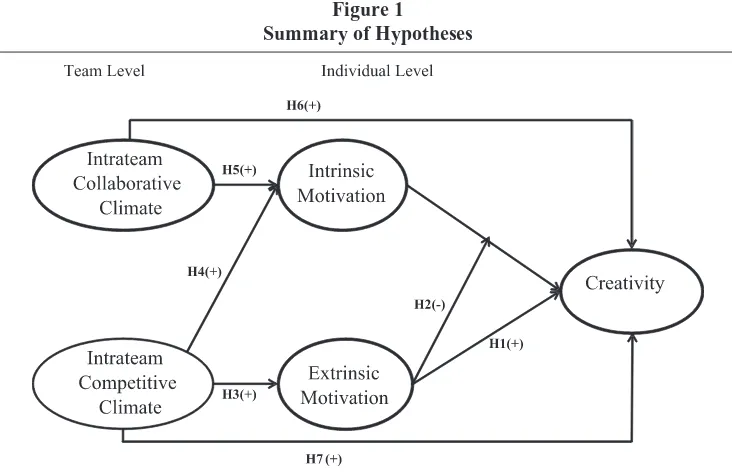
A summary of the theoretical arguments and study hypotheses is presented in Figure 1. When the “pieces” (Hypothesis 1 to Hypothesis 7) are combined into a whole, they illustrate a moderated-mediation model in which we hypothesize direct effects of team competitive and collaborative climates on creativity and indirect effects partially mediated by intrinsic motivation, which is itself moderated by extrinsic motivation. Following Hayes’s (2013) recommendation on moderated-mediation hypothesis development, we summarize the pro-posed moderated-mediation effects as follows:
Hypothesis 8: The indirect positive relationship between collaborative climate and creativity
through intrinsic motivation will be stronger when extrinsic motivation is low than when it is high.
Hypothesis 9: The indirect positive relationship between competitive climate and creativity through intrinsic motivation will be stronger when extrinsic motivation is low than when it is high.
Method
Sample and Procedure
We tested our hypotheses with data collected from employees in R&D departments from an Infotech 100 company headquartered in Taiwan. The company emphasizes innovation and creativity, with innovation listed as one of the company’s four core corporate values. Employees were expected to be creative and were held accountable for their creativity as part of the annual performance review process, along with several non-creativity-related perfor-mance dimensions.
Participants included software, systems, and hardware engineers and their managers from the Taipei headquarters office. Team members worked closely with each other as they shared similar roles within their project teams. In addition, their annual monetary bonuses were substantially affected by overall team performance (on average, about 34% of their bonuses was based on overall team performance).
Approximately 100 R&D teams were invited by mail to participate in the survey in exchange for a small cash coupon. A total of 247 engineers and 55 functional managers agreed to participate from two strategic business units, resulting in a team response rate of 55%. After deleting missing data, we had a final sample of 54 teams and 238 members. The engineers were 83.2% male, averaged 3.1 years of organizational tenure, possessed either bachelors (42.9%) or masters (52.1%) degrees, and were 36 years old on average. Managers were 83.3% male and averaged 6.06 years of tenure. The teams had an average size of 7.04 members (range 3-17), with a standard deviation of 3.30 (87% of the teams had between 3 and 11 members). Our final sample averaged 4.4 respondents per team, with an average response rate per team of 72.7% (the range was 33% to 100%).
Figure 1
Two different surveys were used. Engineer-participants answered questions about their perceptions of within-team competition and collaboration as well as their intrinsic and extrin-sic motivation for work. The participants’ managers assessed their subordinates’ creativity at work. Surveys were given to the team manager, who distributed them to his or her members, who then returned their completed surveys to their managers in sealed envelopes, with no identifying information on them. Managers wrote a code on the envelopes upon receipt from each employee and then filled out individual creativity ratings on a separate form, using the code on the envelopes to identify the ratee.
Measures
Constructs were operationalized with previously validated measures. Unless otherwise indicated, all measures used a Likert-type scale anchored 1 (strongly disagree) to 7 (strongly agree). Scales were translated into Mandarin Chinese from English and utilized a translation–
back translation procedure to enhance the accuracy of the translation (Brislin, 1980).
Intrateam collaborative climate. The availability of measures of collaboration at the
functional team level is limited. Our measure of intrateam collaborative climate combined items from several published studies into one measure (Aram & Morgan, 1976; Baggs, 1994; Lin, Wang, Tsai, & Hsu, 2010; Singh & Avital, 2007; see appendix). We believe this tactic leverages the construct validity evidence from the four studies from which the items were drawn.
Intrateam competitive climate. Intrateam competitive climate was measured using the
within-school competition scale from Mael and Ashforth (1992). The original scale was modified to fit the working context. One item was removed because we were not interested in the specific causes of competition. After performing confirmatory factor analyses, another item from the original scale was removed due to its low factor loading. The final six-item scale focuses on perceived rivalry and social comparisons (see appendix).
Intrinsic motivation. Intrinsic motivation was assessed with Grant’s (2008) four-item
scale, which is based on SDT. It opens with the question, “I go to work every day because . . .” and then asks respondents to rate their motivations: (a) “I enjoy the work itself,” (b) “It’s fun,” (c) “I find the work engaging,” and (d) “I enjoy it.”
Extrinsic motivation. Extrinsic motivation was measured using four items adapted from
Manolopoulos (2006), which was based on prior extensive surveys of employee self-ranked extrinsic motivations. It opens with the statement, “I go to work every day for . . .” and then allows respondents to rate their motivations for (a) the salary, (b) promotion opportunities, (c) the bonuses, and (d) job security.
Employee creativity. Montag et al. (2012) differentiated creative performance behaviors—
and useful. This research focused on manager-rated creative performance behaviors as the pri-mary dependent variable, as opposed to creative outcome effectiveness. We used Farmer, Tier-ney, and Kung-Mcintyre’s (2003) four-item creativity scale, for two major reasons. First, it was developed and tested to reliably assess R&D creativity. Second, it reflects creative behaviors that fit the Chinese view of employee creativity. Participants were rated on the following items: (a) seeks new ideas and ways to solve problems, (b) generates ideas revolutionary to the field, (c) is a good role model for innovation/creativity, and (d) tries new ideas and approaches to problems. This primarily reflects the idea generation stage of the creativity process (Montag et al., 2012).
Control variables. Several potentially confounding variables were measured and used as control variables in analyses. Reward structure (the percentage of the reward that is individ-ual based vs. team based) is a team contextindivid-ual factor that might affect motivation (Beersma, Hollenbeck, Humphrey, Moon, Conlon, & Ilgen, 2003). Consistent with prior research that measures pay mix as a ratio (Zenger & Marshall, 2000), team reward structure was assessed with a single item reported by the manager: “In my team, [a number between 1 and 100]% of compensation is determined by individual performance, and [a number between 1and 100 that sums to 100 with the previous number]% of compensation is determined by team per-formance.” Team size (Yong, Sauer, & Mannix, 2014), education and job level (Chusmir & Koberg, 1986), and tenure with the company (Gilson & Shalley, 2004) were also measured and used as statistical control variables.
Analyses
The proposed model is multilevel in nature, with constructs reflecting both the individual and team levels. To control for team-level variables, hierarchical linear modeling was used to test the proposed model (Figure 1). Following Zhang, Zyphur, and Preacher’s (2009) recom-mendation on testing cross-level mediation, we group-mean centered the Level 1 predictors and introduced the subtracted means at Level 2 (Kreft & de Leeuw, 1998) and then grand-mean-centered the Level 2 predictors (across all groups).
Confirmatory factor analyses were used to test the fit of the proposed measurement model. The results indicated that the five-factor structure fit the data well: χ2(199) = 459.12,
compara-tive fit index (CFI) = 0.94, and root mean square error of approximation (RMSEA) = 0.07. Compared to the hypothesized model, an alternative model in which indicators of extrinsic motivation and intrinsic motivation were forced to load on a single latent factor fit the data significantly worse: χ2(203) = 850.79, CFI = 0.86, RMSEA= 0.12, as did a second alternative
model in which indicators of intrateam competitive climate and intrateam collaborative cli-mate were forced to load on a single factor: χ2(203) = 748.39, CFI = 0.89, RMSEA= 0.11.
To support the aggregation of individual responses for intrateam collaboration and com-petitive climates, we calculated three indicators of interrater agreement and reliability. First, average interrater agreement, rwg, measures the amount of agreement among a single group of
judges, such as team members (James, Demaree, & Wolf, 1984). Second, Intraclass Correlation 1 (ICC1) reflects the significance of between-group variances (James, 1982), and third, Intraclass Correlation 2 (ICC2) estimates the reliability of the group means within the sample of means. For intrateam competitive climate, median rwg(j) was .91, ICC1 was .24, and ICC2
was .42. The ICC1 and rwg(j) values are consistent with prior research involving aggregation (e.g., Woehr, Loignon, Schmidt, Loughry, & Ohland, 2015). The ICC2 values are somewhat low (below .60), which we attribute to the small average team size (4.4 team members; Bliese, 1998). ICC2 values are a function of ICC1 values and group size (Bliese, 1998), and ICC2 tends to underestimate the true reliability in small teams (Snijders & Bosker, 1999). Our rela-tively low ICC2 values are comparable to ICC2 values reported in other studies that had small team sizes (e.g., .43 in Chen & Bliese, 2002; .35 in Erdogan, Liden, & Kraimer, 2006; .37 in Hofmann & Jones, 2005). Low ICC2 values limit the ability to detect relationships involving group-level variables as it attenuates observed relationships (Bliese, 1998); similarly, Hofmann and Jones (2005) argued that unreliability at the group level increases Type II errors. Thus, analyses reported below are conservative in light of that possible attenuation.
Results
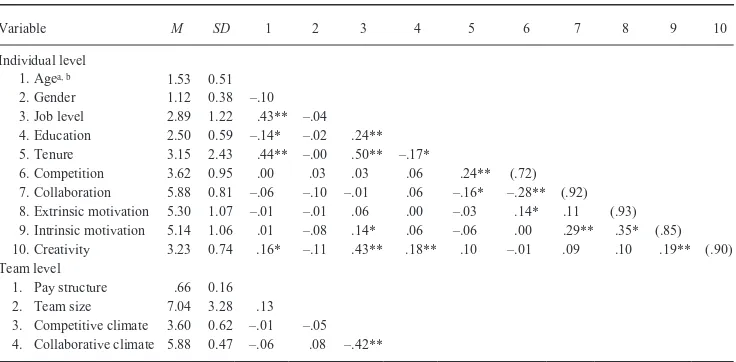
The means, standard deviations, intercorrelations, and sample reliability estimates (coef-ficient alphas) for the measures are presented in Table 1.
Tests of Hypotheses
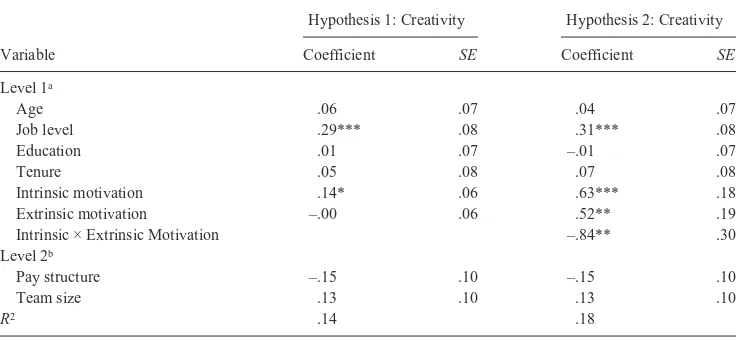
Hypothesis 1 proposes that extrinsic motivation is positively related to creativity. As shown in Table 2, with age, job level, education, and experience controlled at the individual
Table 1
Means, Standard Deviations, Correlations, and Sample Reliabilities for the Measures
Variable M SD 1 2 3 4 5 6 7 8 9 10
Individual level
1. Agea, b 1.53 0.51
2. Gender 1.12 0.38 –.10 3. Job level 2.89 1.22 .43** –.04 4. Education 2.50 0.59 –.14* –.02 .24** 5. Tenure 3.15 2.43 .44** –.00 .50** –.17*
6. Competition 3.62 0.95 .00 .03 .03 .06 .24** (.72) 7. Collaboration 5.88 0.81 –.06 –.10 –.01 .06 –.16* –.28** (.92) 8. Extrinsic motivation 5.30 1.07 –.01 –.01 .06 .00 –.03 .14* .11 (.93) 9. Intrinsic motivation 5.14 1.06 .01 –.08 .14* .06 –.06 .00 .29** .35* (.85) 10. Creativity 3.23 0.74 .16* –.11 .43** .18** .10 –.01 .09 .10 .19** (.90) Team level
1. Pay structure .66 0.16 2. Team size 7.04 3.28 .13 3. Competitive climate 3.60 0.62 –.01 –.05 4. Collaborative climate 5.88 0.47 –.06 .08 –.42**
aIndividual-level measurement internal consistency reliability estimates (coefficient alphas) are on the diagonal.
bAge, 1 = 20-29, 2 = 30-39, 3 = 40-49, 5 = 50-59, 6 = 60 and above; gender, 1 = male, 2 = female; job level, 1 = assistant engineer,
2 = engineer, 3 = senior engineer, 4 = principle engineer; education, 1 = associate degree, 2 = 4-year college, 3 = master’s degree, 4 = doctoral degree; tenure = number of years with the company.
*p < .05.
level, and pay structure and team size controlled at the team level, intrinsic motivation has a statistically significant positive relationship with manager-rated creativity (as expected), but extrinsic motivation does not (β = –.00, ns). Thus, Hypothesis 1 received no support.
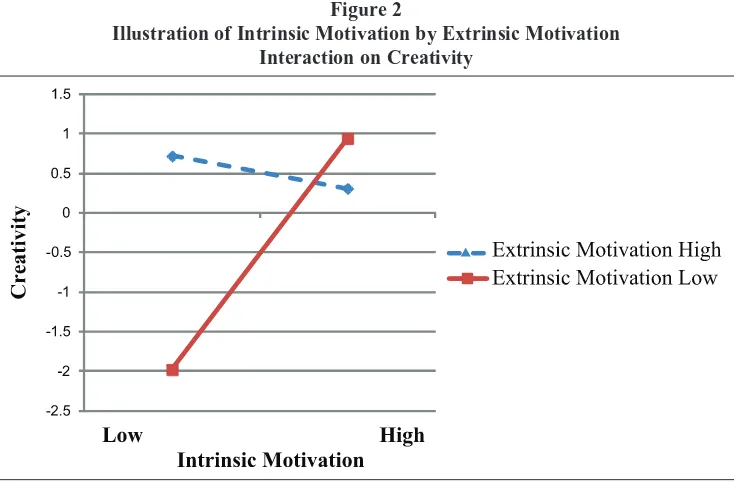
Hypothesis 2 states that extrinsic motivation interacts with intrinsic motivation in such a way that the relationship between intrinsic motivation and creativity is stronger for employ-ees low in extrinsic motivation versus high. The interaction of employemploy-ees’ intrinsic and extrinsic motivation is statistically significant (β = –.84, p < .01; see Table 2). Figure 2 illus-trates the pattern of this interaction. The relationship between intrinsic motivation and cre-ativity is substantially positive when extrinsic motivation is low and is slightly negative when extrinsic motivation is high (supporting Hypothesis 2). For participants who are low in extrinsic motivation, high intrinsic motivation significantly increased their creativity. However, for participants high in extrinsic motivation, high levels of intrinsic motivation did not lead to higher creativity.
Hypothesis 3 proposes that intrateam competitive climate is positively related to team members’ extrinsic motivation. To test for this hypothesis, we conducted an intercept-as-outcome model where team-level competitive climate was regressed on individual extrinsic motivation at Level 1. Intrateam competitive climate has a statistically significant positive relationship with team member’s extrinsic motivation (β = .13, p < .05), after controlling for intrinsic motivation (β = .34, p < .001), supporting Hypothesis 3. Hypothesis 4 states that intrateam competitive climate is positively related to team member’s intrinsic motivation; however, this hypothesis was not supported as the hypothesized relationship is not statisti-cally significant (β = –.04, ns), after controlling for extrinsic motivation (β = .33, p < .001).
Table 2
Results for Tests of Hypotheses 1 and 2
Hypothesis 1: Creativity Hypothesis 2: Creativity
Variable Coefficient SE Coefficient SE
Level 1a
Age .06 .07 .04 .07
Job level .29*** .08 .31*** .08
Education .01 .07 –.01 .07
Tenure .05 .08 .07 .08
Intrinsic motivation .14* .06 .63*** .18
Extrinsic motivation –.00 .06 .52** .19
Intrinsic × Extrinsic Motivation –.84** .30
Level 2b
Pay structure –.15 .10 –.15 .10
Team size .13 .10 .13 .10
R2 .14 .18
Note: Standardized coefficients reported.
an = 238. bn = 54.
*p < .05. **p < .01.
Hypothesis 5 states that intrateam collaborative climate is positively related to intrinsic moti-vation and is supported by a statistically significant β of .25 (p < .001), after controlling for extrinsic motivation (β = .33, p < .001).
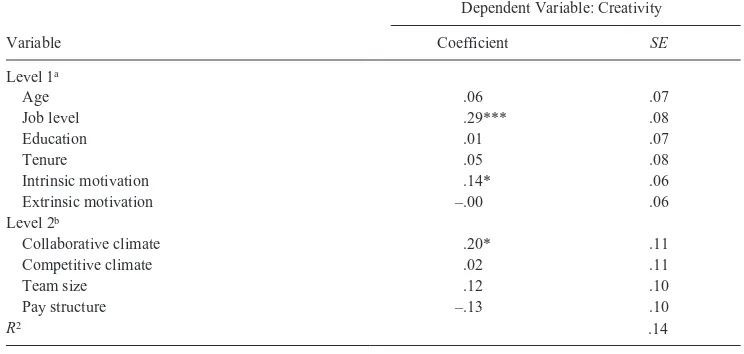
Finally, Hypotheses 6 and 7 state that there are direct relationships between intrateam col-laborative and competitive climate, and individual creativity. These hypotheses were tested with an intercept-as-outcomes multilevel model, and the results are summarized in Table 3. The results show that with intrinsic and extrinsic motivation and the control variables statisti-cally controlled, and with both climate variables in the model, intrateam collaborative cli-mate has a positive and significant direct relationship with team members’ creativity, while intrateam competitive climate does not. Thus, Hypothesis 6 received support while Hypothesis 7 did not.
Tests for Moderated Mediation
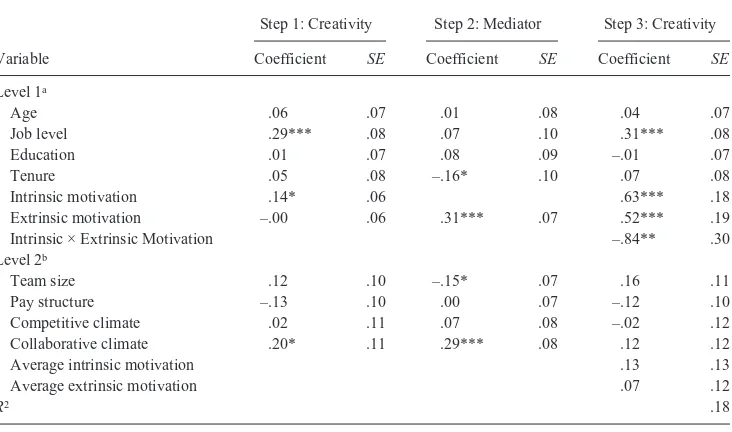
Hypotheses 8 and 9 posited that effects of team climate on creativity through intrinsic motivation would be moderated by extrinsic motivation. We tested the moderated mediation relationships following Zhang et al.’s (2009) recommendations on testing cross-level media-tion, as well as Hayes’s (2013) recommendations on moderated mediation (conditional pro-cess analysis). Because the relationship between competitive climate and individual creativity (Hypothesis 7) was not statistically significant, we did not examine it for moderated media-tion. Thus, we examined only Hypothesis 8, but we do control for competitive climate. The results of the test are reported in Table 4. Collaborative climate’s relationship with individual creativity through intrinsic motivation as moderated by extrinsic motivation (Hypothesis 8) is supported. Collaboration has statistically significant relationships with the dependent
Figure 2
variable (creativity; Step 1) and mediator (intrinsic motivation; Step 2), and the interaction of the mediator with the moderator (extrinsic motivation; Step 3) is statistically significant after all of the other variables are in the equation, and controlling for the opposing team climate and control variables. Using the response surface technique, a three-dimensional graph of the interaction between intrinsic motivation, extrinsic motivation, and creativity is presented in Figure 3. This graph shows that amotivation (when both intrinsic and extrinsic motivation are low) leads to the lowest creativity, and high intrinsic or high extrinsic motivation (with the other motivation low) leads to highest levels of creativity. High intrinsic motivation by itself seems to lead to a slightly higher level of creativity than does high extrinsic motivation by itself. Finally, high levels or medium levels of both motivations simultaneously lead to medium levels of creativity.
Discussion
We address several research gaps raised by Anderson et al. (2014) and George (2007) in the current study. First, we used SDT as a conceptual framework for explaining “how and why intrinsic motivation mediates the effects of various factors (e.g., contextual characteris-tics) on creativity” (George, 2007: 444). Second, we explicitly evaluated extrinsic motiva-tion’s utility in enhancing creativity both directly and in combination with intrinsic motivation. Third, we theoretically considered effects of team contextual factors (collaborative and
Table 3
Results for Tests of Hypotheses 6 and 7
Dependent Variable: Creativity
Variable Coefficient SE
Level 1a
Age .06 .07
Job level .29*** .08
Education .01 .07
Tenure .05 .08
Intrinsic motivation .14* .06
Extrinsic motivation –.00 .06
Level 2b
Collaborative climate .20* .11
Competitive climate .02 .11
Team size .12 .10
Pay structure –.13 .10
R2 .14
Note: Standardized coefficients reported.
an = 238. bn = 54.
*p < .05. **p < .01.
Table 4
Test for Moderated Mediation: Collaboration→Intrinsic Motivation→Creativity,
Moderated by Extrinsic Motivation
Step 1: Creativity Step 2: Mediator Step 3: Creativity
Variable Coefficient SE Coefficient SE Coefficient SE
Level 1a
Age .06 .07 .01 .08 .04 .07
Job level .29*** .08 .07 .10 .31*** .08
Education .01 .07 .08 .09 –.01 .07
Tenure .05 .08 –.16* .10 .07 .08
Intrinsic motivation .14* .06 .63*** .18
Extrinsic motivation –.00 .06 .31*** .07 .52*** .19
Intrinsic × Extrinsic Motivation –.84** .30
Level 2b
Team size .12 .10 –.15* .07 .16 .11
Pay structure –.13 .10 .00 .07 –.12 .10
Competitive climate .02 .11 .07 .08 –.02 .12
Collaborative climate .20* .11 .29*** .08 .12 .12
Average intrinsic motivation .13 .13
Average extrinsic motivation .07 .12
R2 .18
Note: 1. Standardized coefficients reported.
an = 238. bn = 54.
*p < .05. **p < .01.
***p < .001 (one-tailed tests).
Figure 3
competitive climate) on creativity, exploring factors other than intrinsic motivation as sources for creativity. We used SDT as a conceptual framework to derive theory-based hypotheses about direct and interactive individual- and team-level effects on creativity but also build on other research (e.g., Eisenberger’s learned industriousness theory).
We hypothesized that extrinsic motivation would directly relate to creativity (Hypothesis 1) as well as moderate the relationship between intrinsic motivation and creativity such that the relationship was stronger for employees low in extrinsic motivation versus high (Hypothesis 2). Tests of the direct relationship provided no support for Hypothesis 1, but the interaction was statistically significant (supporting Hypothesis 2). It appears that extrinsic motivation can contribute to creativity but that the relationship needs to be considered in light of an individual’s intrinsic motivation. When extrinsic motivation is low, there is a strong positive relationship between intrinsic motivation and creativity, as predicted from SDT. When extrinsic motivation is high, however, higher intrinsic motivation does not contribute to more creativity; there is no additive effect.
Perhaps the most interesting aspect of the interaction occurs when extrinsic motivation is high and intrinsic motivation is low, which results in high creativity levels. For these employ-ees, extrinsic motivation did not undermine intrinsic motivation; it appears to compensate for it. If Figure 2 were rearranged, it would show a strong positive relationship between extrinsic motivation and creativity when intrinsic motivation is low and a slight negative one when intrinsic motivation is high. Employees who were not intrinsically motivated by the nature of their work but who were highly extrinsically motivated received high creativity ratings. It is worth noting that there is still a positive direct relationship between extrinsic motivation and creativity even when intrinsic motivation is at its average (zero because of standardization of coefficients; see Table 2), providing some weak support for Hypothesis 1.
Speculating on these findings, we know that motivation affects innovative performance via two main pathways: through the quantity of effort (e.g., time spent) and through the char-acter of that effort (e.g., the quality of cognitive effort; Sauermann & Cohen, 2010). While intrinsic motivation is reported to be related to both the quality and quantity of efforts (Cerasoli et al., 2014; Sauermann & Cohen, 2010), extrinsic motivation primarily enhances the quantity of effort and persistence (Eisenberger & Thompson, 2011). Task persistence in turn is positively related to creativity (Lucas & Nordgren, 2015; Sauermann & Cohen, 2010). R&D engineers high in intrinsic motivation likely have already exerted high levels of effort and persistence, and thus additional extrinsic motivation is unlikely to appreciably increase them (i.e., a ceiling effect). However, engineers who have only low intrinsic motivation may expend limited effort and give up easily, resulting in poor performance. Because extrinsic motivation can increase task effort (Eisenberger & Thompson, 2011), engineers with low intrinsic motivation will more dramatically increase their effort when offered performance-based rewards, spending more time thinking about and trying different solutions and subse-quently improving their creativity.
nature (Montag et al., 2012), intrinsic and extrinsic motivations may diverge in their effects on creativity (Gilson, Lim, D’Innocenzo, & Moye, 2012). Engineers who are highly rated by their managers receive higher rewards and are extrinsically motivated; if those engineers are simultaneously highly intrinsically motivated, it may cause them to divert their efforts away from behaviors desired by managers to those that result from intrinsic motivation, decreasing their manager-rated creativity. Research does suggest that when people are engaged in intrin-sically motivating tasks, extrinsic incentives, and presumably the different behaviors that lead to them, have diminished effects (Woolley & Fishbach, 2015). In our study, this may have diminished employees’ creativity ratings.
Our results may provide a middle ground for the debate regarding intrinsic and extrinsic motivations’ effects on creativity. Eisenberger and Shanock (2003: 122) observed that there is a “clash between romantic and behaviorist worldviews concerning basic human nature.” Romantic worldviews generally assume creativity to be affected by intrinsic motivation only and that extrinsic motivation from rewards or competition undermines intrinsic motivation and creativity. Behaviorists assert that creativity, like any other discriminable response class, is increased by favorable consequences, and extrinsic motivation is a way to promote this reinforcement process (Eisenberger & Shanock, 2003). This study provides some support for both views but under different circumstances. For people with low intrinsic motivation, high extrinsic motivation significantly increases their creativity, as a result of more time and effort dedicated to work. A reinforcing effect of extrinsic rewards on creativity is present, support-ing learned industriousness theory (Eisenberger & Shanock, 2003). However, when extrinsic motivation is low, there is a strong positive relationship between intrinsic motivation and creativity, supporting SDT.
We hypothesized that a competitive team climate would increase the motivation to secure performance-contingent tangible rewards. Competitive team climate did significantly relate to extrinsic motivation, supporting the hypothesis. That in turn did not directly relate to cre-ativity for all employees, but it did relate to crecre-ativity for team members who had low intrin-sic motivation.
We hypothesized that both competitive and collaborative team climates would be posi-tively related to intrinsic motivation. While the positive relationship between collaborative climate and intrinsic motivation was supported, the relationship between competitive climate and intrinsic motivation was not. It appears that in real work settings, collaboration, but not competition, between team members is compatible with enjoyment, fun, and engagement (from our intrinsic motivation measure). We think this result may in part be due to the culture of Taiwan (and Asia in general). Taiwan is quite high in collectivism and somewhat low in masculinity (Lu, Rose, & Blodgett, 1999). Working collaboratively in a team environment is consistent with the cultural expectations of people in a collectivistic society, where in-group loyalty and contributions to group success are expected and self-focused employees might be ostracized. A competitive climate is more consistent with individualistic and masculine soci-etal values and may be a poor fit for Asian societies. Future research should ascertain the degree to which our results are culture bound (an underresearched aspect of creativity; Anderson et al., 2014). It would be interesting to see whether our results replicate in individu-alistic, masculine societies, like Australia, the United Kingdom, and the United States.
confounding variables, and with both Level 2 climate variables in the equation, we found that only collaborative climate had a significant direct relationship with individual creativity (despite the low ICC2 for collaborative climate). The results confirmed Navaresse et al.’s (2014) and Cerne et al.’s (2014) findings that intragroup competition seems to be unrelated to individual creativity. Tests using moderated mediation analyses provide additional evi-dence that a collaborative team climate had an indirect effect through the moderated (by extrinsic motivation) path from intrinsic motivation to creativity.
To the extent that we can infer causality from the pattern of results in this cross-sectional study, they suggest that team collaboration is more effective than team competition as a means to motivate creative performance.2 Although competition appears to have some effect on
extrinsic motivation, the latter failed to demonstrate a direct relationship with creativity. In addition, competitive climates are negatively related to collaborative climates (see Table 1). Managers who promote a competitive climate may simultaneously be diminishing collabora-tion, although the opposite may be true as well (collaboration reduces competition). Managers of creative employees should cautiously use competition, especially if a collaborative climate already exists.
Competition, however, may be an effective management technique in some situations (Baer, Leenders, Oldham, & Vadera, 2010). When the intrinsic motivation of team members is generally low, competition might increase extrinsic motivation, resulting in higher levels of creativity (see Figure 2). A competitive climate might be effective when the tasks or proj-ects involved are not intellectually challenging and do not create interest on their own. This would not be typical for creative work for most people. Still, employees oftentimes find themselves in jobs for which their interests and abilities are a poor match, resulting in low intrinsic motivation. In other situations, employees perform interesting work but still might require some external motivators (George, 2007). For example, would professors be as moti-vated to publish research if there were no rewards for it and no peer pressures? Introducing competition may enhance extrinsic motivation and creativity in such situations, especially for jobs that wholly or in part are not particularly interesting/enjoyable.
Limitations and Future Research
As with most research, the results of this study should be interpreted with caution. First, although the exogenous and endogenous variables are from different sources to avoid problems with common-method variance, the cross-sectional nature of the study does not allow for firm conclusions regarding causal relationships. In particular, it is pos-sible that the relationships between intrinsic and extrinsic motivation and creativity may be nonlinear, with there being a minimum threshold effect for extrinsic motivation before intrinsic motivation becomes potent. In addition, there may be nonrecursive relationships between creativity performance and the different types of motivation (e.g., high creativity positively affects intrinsic motivation).3 While our results partially confirm our
hypothe-ses, future research should replicate tests of these hypotheses with longitudinal or experi-mental research designs.
and integrated (Gagné & Deci, 2005), were not measured. Fine-tuning theory regarding the various categories of extrinsic motivation may provide us with a deeper understanding of the complicated interactions between intrinsic and extrinsic motivation as a whole.
Third, we studied R&D engineers for whom creativity and innovation are explicit expecta-tions for their jobs. As Montag et al. (2012) emphasize, it is important to consider the degree to which creative behaviors are an expectation for the jobs of participants under study. Future research might develop theory and test hypotheses for employees who have varying levels of creativity expectations for their jobs (e.g., manufacturing employees, professional staff). It may be that the level of creativity expectations for jobs moderates the relationships between different types of motivation and creativity. For example, some types of extrinsic motivators may be more effective than others for different types of work (Montag et al., 2012).
Fourth, we explored the possible effects of two team climate variables (competition and collaboration) on member creative performance. However, it should be noted that even though we controlled for motivation and several other variables, it may be that direct effects of collaboration operate through other unmeasured individual- and team-level variables. For example, collaboration is related to but distinct from the construct of team cohesion, which reflects both the affective attachment that members have to the group (social cohesion) as well as consensus about group goals (task cohesion; Kozlowski & Ilgen, 2006). Future research could explore this and other team variables (e.g., team safety climate) to provide a more holistic view of the benefits and pitfalls in promoting different types of team climates.
Finally, a collaborative team climate might suppress behaviors (and ideas) that potentially cause conflict, just as a competitive environment might negatively affect collaboration. To the extent that competition generates interpersonal conflict (e.g., Mellalieu, Shearer, & Shearer, 2013), a competitive team climate might adversely affect a collaborative one. Outside of a true experiment, it would be difficult to tease apart these reciprocal effects. In our analyses, how-ever, we did control for this potential negative covariance to assess the unbiased relationships between collaborative and competing climates with the other study measures.
Appendix
Team Climate Measures
Intrateam collaboration climate
1. My team members work collaboratively as a team to achieve goals. 2. My team members provide support and help to each other.
3. My team members collaborate to find the best solution to problems. 4. My team members coordinate efforts with each other.
Intrateam competition climate
1. In my team you feel left out unless you compete with each other. 2. The competition at my team was intense.
3. My team members did not compete with each other. (Reverse coded) 4. My team members find it painful when others were getting ahead.
5. My team members would try to find out how their peers were being evaluated. 6. My team members try to outdo each other at impressing the manager.
Notes
1. Self-determination theory also posits intermediate levels of motivation that fall on a continuum from purely extrinsic to purely intrinsic. In this study, we focus only on the extrinsic versus intrinsic dichotomy.
2. We also examined the interaction of the two climate variables on creative performance. It was not statistically significant.
3. We thank an anonymous reviewer for this suggestion.
References
Amabile, T. M. 1993. Motivational synergy: Toward new conceptualizations of intrinsic and extrinsic motivation in the workplace. Human Resource Management Review, 3: 185-201.
Amabile, T. M. 1998. How to kill creativity. Harvard Business Review, 76(5): 76-87.
Anderson, N., Potocnik, K., & Zhou, J. 2014. Innovation and creativity in organizations: A state-of-the-science review and prospective commentary. Journal of Management, 40: 1297-1333.
Aram, J. D., & Morgan, C. P. 1976. The role of project team collaboration in R&D performance. Management Science, 22: 1127-1137.
Baer, M., Leenders, R., Oldham, G., & Vadera, A. K. 2010. Win or lose the battle for creativity: The power and perils of intergroup competition. Academy of Management Journal, 53: 827-845.
Baer, M., Vadera, A. K., Leenders, R. T. A. J., & Oldham, G. R. 2014. Intergroup competition as a double-edged sword: How sex composition regulates the effects of competition on group creativity. Organization Science, 25: 892-908.
Baggs, J. G. 1994. Development of an instrument to measure collaboration and satisfaction about care decisions. Journal of Advanced Nursing, 20: 176-182.
Beersma, B., Hollenbeck, J. R., Humphrey, S. E., Moon, H., Conlon, D. E., & Ilgen, D. R. 2003. Cooperation, competition, and team performance: Toward a contingency approach. Academy of Management Journal, 46: 572-590.
Bliese, P. D. 1998. Group size, ICC values, and group-level correlations: A simulation. Organizational Research Methods, 1: 355-373.
Brislin, R. W. 1980. Translation and content analysis of oral and written materials. In H. C. Triandis & J. W. Berry (Eds.), Handbook of cross-cultural psychology, Vol. 3: 389-444. Boston: Allyn & Bacon.
Brown, S. P., Cron, W. L., & Slocum, J. W. 1998. Effects of trait competitiveness and perceived intraorganizational competition on salesperson goal setting and performance. Journal of Marketing, 62: 88-98.
Carmeli, A., Dutton, J. E., & Hardin, A. E. 2015. Respect as an engine for new ideas: Linking respectful engage-ment, relational information processing and creativity among employees and teams. Human Relations, 68: 1021-1047.
Cefis, E., & Ciccarelli, M. 2005. Profit differentials and innovation. Economics of Innovation & New Technology, 14: 43-61.
Cerasoli, C. P., Nicklin, J. M., & Ford, M. T. 2014. Intrinsic motivation and extrinsic incentives jointly predict performance: A 40-year meta-analysis. Psychological Bulletin, 140: 980-1008.
Cerne, M., Nerstad, C. G. L., Dysvik, A., & Škerlavaj, M. 2014. What goes around comes around: Knowledge hid-ing, perceived motivational climate, and creativity. Academy of Management Journal, 37: 172-192.
Chen, G., & Bliese, P. D. 2002. The role of different levels of leadership in predicting self- and collective efficacy: Evidence for discontinuity. Journal of Applied Psychology, 87: 549-556.
Chusmir, L. H., & Koberg, C. S. 1986. Creativity differences among managers. Journal of Vocational Behavior, 29: 240-253.
Conti, R., Collins, M. A., & Picariello, M. L. 2001. The impact of competition on intrinsic motivation and creativity: Considering gender, gender segregation and gender role orientation. Personality and Individual Differences, 31: 1273-1289.
de Jesus, S. N., Rus, C. L., Lens, W., & Imaginario, S. 2013. Intrinsic motivation and creativity related to product: A meta-analysis of the studies published between 1990-2010. Creativity Research Journal, 25: 80-84. Deci, E. L. 1971. Effects of externally mediated rewards on intrinsic motivation. Journal of Personality and Social
Deci, E. L., Betley, G., Kahle, J., Abrams, L., & Porac, J. 1981. When trying to win: Competition and intrinsic motivation. Personality and Social Psychology Bulletin, 7: 79-83.
Dillenbourg, P., Baker, M., Blaye, A., & O’Malley, C. 1995. The evolution of research on collaborative learning. In P. Reimann & H. Spada (Eds.), Learning in humans and machines: Towards an interdisciplinary learning science: 189- 211. London: Pergamon.
Eisenberger, R., & Shanock, L. 2003. Rewards, intrinsic motivation, and creativity: A case study of conceptual and methodological isolation. Creativity Research Journal, 15: 121-130.
Eisenberger, J., & Thompson, W. F. 2011. The effects of competition on improvisers’ motivation, stress, and cre-ative performance. Creativity Research Journal, 23: 129-136.
Epstein, J., & Harackiewicz, J. 1992. Winning is not enough: The effects of competition and achievement orienta-tion on intrinsic interest. Personality and Social Psychology Bulletin, 18: 128-139.
Erdogan, B., Liden, R. C., & Kraimer, M. L. 2006. Justice and leader-member exchange: The moderating role of organizational culture. Academy of Management Journal, 49: 395-406.
Farmer, S. M., Tierney, P., & Kung-Mcintyre, K. 2003. Employee creativity in Taiwan: An application of role identity theory. Academy of Management Journal, 46: 618-630.
Gagné, M., & Deci, E. L. 2005. Self-determination theory and work motivation. Journal of Organizational Behavior, 26: 331-362.
George, J. M. 2007. Creativity in organizations. Academy of Management Annals, 1: 439-477.
Gilson, L. L., Lim, H. S., D’Innocenzo, L., & Moye, N. 2012. One size does not fit all: Managing radical and incre-mental creativity. Journal of Creative Behavior, 46: 168-191.
Gilson, L. L., & Shalley, C. E. 2004. A little creativity goes a long way: An examination of teams’ engagement in creative processes. Journal of Management, 30: 453-470.
Grant, A. M. 2008. Does intrinsic motivation fuel the prosocial fire? Motivational synergy in predicting persistence, performance, and productivity. Journal of Applied Psychology, 93: 48-58.
Harvey, S. 2014. Creative synthesis: Exploring the process of extraordinary group creativity. Academy of Management Review, 39: 324-343.
Hayes, A. F. 2013. Introduction to mediation, moderation, and conditional process analysis. New York: Guilford Press.
Hirst, G., van Knippenberg, D., Chen, C. H., & Sacramento, C. 2011. How does bureaucracy impact individual cre-ativity? A cross-level investigation of team contextual influences on goal orientation-creativity relationships. Academy of Management Journal, 54: 621-641.
Hirst, G., van Knippenberg, D., & Zhou, J. 2009. A cross-level perspective on employee creativity: Goal orientation, team learning behavior, and individual creativity. Academy of Management Journal, 52: 280-293.
Hofmann, D. A., & Jones, L. M. 2005. Leadership, collective personality, and performance. Journal of Applied Psychology, 90: 509-522.
Hon, A. H. Y., Bloom, M., & Crant, J. M. 2014. Overcoming resistance to change and enhancing creative perfor-mance. Journal of Management, 40: 919-941.
James, D. L., Demaree, R. G., & Wolf, G. 1984. Estimating within-group interrater reliability with and without response bias. The Journal of Applied Psychology, 69: 85-98.
James, L. R. 1982. Aggregation bias in estimates of perceptual agreement. Journal of Applied Psychology, 67: 219-229.
Kasof, J., Chen, C., Himsel, A., & Greenberger, E. 2007. Values and creativity. Creativity Research Journal, 19: 105-122.
Kozlowski, S.W.J., & Ilgen, D. R. 2006. Enhancing the effectiveness of work groups and teams. Psychological Science in the Public Interest, 7: 77-124.
Kreft, I., & de Leeuw, J. 1998. Introducing multilevel modeling. Thousand Oaks, CA: Sage.
Leung, K., Chen, T., & Chen, G. 2014. Learning goal orientation and creative performance: The differential mediat-ing roles of challenge and enjoyment intrinsic motivations. Asia Pacific Journal of Management, 31: 811-834. Lin, C.-P., Wang, Y.-J., Tsai, Y.-H., & Hsu, Y.-F. 2010. Perceived job effectiveness in competition: A survey of
virtual teams within business organizations. Computers in Human Behavior, 26: 1598-1606.
Litchfield, R. C., Gilson, L. L., & Gilson, P. W. 2015. Defining creative ideas: Toward a more nuanced approach. Group and Organization Management, 40: 238-265.
Lu, L.-C., Rose, G. M., & Blodgett, J. G. 1999. The effects of cultural dimensions on ethical decision making in marketing: An exploratory study. Journal of Business Ethics, 18: 91-105.
Lucas, B. J., & Nordgren, L. F. 2015. People underestimate the value of persistence for creative performance. Journal of Personality and Social Psychology, 109: 232-243.
Ma, H.-H. 2009. The effect size of variables associated with creativity: A meta-analysis. Creativity Research Journal, 21: 30-42.
Mael, F., & Ashforth, B. E. 1992. Alumni and their alma mater: A partial test of the reformulated model of organi-zational identification. Journal of Organizational Behavior, 13: 103-123.
Manolopoulos, D. 2006. Motivating R&D professionals: Evidence from MNEs decentralized laboratories in Greece. International Journal of Human Resource Management, 17: 616-647.
Mellalieu, S., Shearer, D., & Shearer, C. 2013. A preliminary survey of interpersonal conflict at major games and championships. Sport Psychologist, 27: 120-129.
Montag, T., Maertz, C. P., Jr., & Baer, M. 2012. A critical analysis of the workplace creativity criterion space. Journal of Management, 38: 1362-1386.
Navaresse, D. O., Yauch, C. A., Goff, K., & Fonseca, D. J. 2014. Assessing the effects of organizational culture, rewards, and individual creativity on technical workgroup performance. Creativity Research Journal, 26: 439-455. Reeve, J., & Deci, E. L. 1996. Elements of the competitive situation that affect intrinsic motivation. Personality and
Social Psychology Bulletin, 22: 24-33.
Sauermann, H., & Cohen, W. M. 2010. What makes them tick? Employee motives and firm innovation. Management Science, 56: 2134-2153.
Shalley, C. E., & Gilson, L. L. 2004. What leaders need to know: A review of social and contextual factors that can foster or hinder creativity. Leadership Quarterly, 15: 33-53.
Shalley, C. E., & Oldham, G. R. 1997. Competition and creative performance: Effects of competitor presence and visibility. Creativity Research Journal, 10: 337-345.
Shalley, C. E., Zhou, J., & Oldham, G. R. 2004. The effects of personal and contextual characteristics on creativity: Where should we go from here? Journal of Management, 30: 933-958.
Singh, B., & Avital, M. 2007. The impact of collaboration and competition on project performance. Paper presented at International Conference on Information Systems (ICIS), Montreal, Canada.
Snijders, T. A. B., & Bosker, R. J. 1999. Multilevel analysis: An introduction to basic and advanced multilevel modeling. London: Sage Publications.
Somech, A., & Drach-Zahavy, A. 2013. Translating team creativity to innovation implementation: The role of team composition and climate for innovation. Journal of Management, 39: 684-708.
Unsworth, K. 2001. Unpacking creativity. Academy of Management Review, 26: 289-297.
Uzzi, B., & Spiro, J. 2005. Collaboration and creativity: The small world problem. American Journal of Sociology, 111: 447-504.
Vallerand, R. J., & Losier, G. F. 1999. An integrative analysis of intrinsic and extrinsic motivation in sport. Journal of Applied Sport Psychology, 11: 142-169.
Woehr, D. J., Loignon, A. C., Schmidt, P. B., Loughry, M. L., & Ohland, M. W. 2015. Justifying aggregation with consensus-based constructs: A review and examination of cutoff values for common aggregation indices. Organizational Research Methods, 18: 704-737.
Woolley, K., & Fishbach, A. 2015. The experience matters more than you think: People value intrinsic incen-tives more inside than outside an activity. Journal of Personality and Social Psychology. doi:http://dx.doi. org/10.1037/pspa0000035
Yong, K., Sauer, S. J., & Mannix, E. A. 2014. Conflict and creativity in interdisciplinary teams. Small Group Research, 45: 266-289.
Zenger, T. R., & Marshall, C. R. 2000. Determinants of incentive intensity in group-based rewards. Academy of Management Journal, 43: 149-163.
Journal of Management Vol. XX No. X, Month XXXX 1 DOI: 10.1177/0149206316661718 © The Author(s) 2016 Reprints and permissions: sagepub.com/journalsPermissions.nav
Corrigendum
Zhu, Y.-Q., Gardner, D. G., & Chen, H.-G. In press. Relationships between work team cli-mate, individual motivation, and creativity. Journal of Management. [Epub ahead of print April 20, 2016.] (Original DOI: 10.1177/0149206316638161)
On page 10 of this article, in the second paragraph under the “Analyses” subsection, cer-tain χ2, CFI, and RMSEA values and the second sentence were incorrect in the initial
OnlineFirst version. This did not affect the statements or conclusions in the study. The correct values are indicated below in bold, and the revised paragraph appears in the most recent online version:
Confirmatory factor analyses were used to test the fit of the proposed measurement model. The results indicated that the five-factor structure fit the data well: χ2(199) = 459.12,
compara-tive fit index (CFI) = 0.94, and root mean square error of approximation (RMSEA) = 0.07. Compared to the hypothesized model, an alternative model in which indicators of extrinsic motivation and intrinsic motivation were forced to load on a single latent factor fit the data significantly worse: χ2(203) = 850.79, CFI = 0.86, RMSEA= 0.12, as did a second alternative