MYBUS TRACKING SYSTEM
LOO SHI MIN
BORANG PENGESAHAN STATUS TESIS*
JUDUL: MYBUS TRACKING SYSTEM SESI PENGAJIAN: 2014/2015
Saya, LOO SHI MIN
mengaku membenarkan tesis (PSM/Sarjana/Doktor Falsafah) ini disimpan di Perpustakaan Fakulti Teknologi Maklumat dan Komunikasi dengan syarat-syarat kegunaan seperti berikut:
1. Tesis dan projek adalah hakmilik Universiti Teknikal Malaysia Melaka.
2. Perpustakaan Fakulti Teknologi Maklumat dan Komunikasi dibenarkan membuat salinan untuk tujuan pengajian sahaja.
3. Perpustakaan Fakulti Teknologi Maklumat dan Komunikasi dibenarkan membuat salinan tesis ini sebagai bahan pertukaran antara institusi pengajian tinggi.
4. ** Sila tandakan (/)
________ SULIT (Mengandungi maklumat yang berdarjah
keselamatan atau kepentingan Malaysia seperti yang termaktub di dalam AKTA RAHSIA RASMI 1972)
________TERHAD (Mengandungi maklumat TERHAD yang
telah ditentukan oleh organisasi/badan di mana penyelidikan dijalankan)
________TIDAK TERHAD
_________________________ ___________________________
(TANDATANGAN PENULIS) (TANDATANGAN PENYELIA)
Alamat tetap: 82, jalan batu injur 2, Nama Penyelia :
Taman bayu perdana, 41200 klang. Dr. Massila Kamalrudin
Selangor Darul Ehsan.
Tarikh: __________________ Tarikh: ___________________
CATATAN: * Tesis dimaksudkan sebagai Laporan Akhir Projek Sarjana Muda (PSM)
MYBUS TRACKING SYSTEM
LOO SHI MIN
This report is submitted in partial fulfillment of the requirements for the Bachelor of Computer Science (Software Engineering)
FACULTY OF INFORMATION AND COMMUNICATION TECHNOLOGY UNIVERSITI TEKNIKAL MALAYSIA MELAKA
DECLARATION
I hereby declare that this project report entitled
MYBUS TRACKING SYSTEM
is written by me and is my own effort and that no part has been plagiarized without citation
STUDENT: _____________ Date: _____________
(LOO SHI MIN)
SUPERVISOR: _____________ Date: _____________
iii
DEDICATION
ACKNOWLEDGEMENT
v
ABSTRACT
Among all the services provided by the university, bus service is the major service that used by UTeM’s student because the student hostel is mainly located outside the university. However, the current bus service in UTeM still need to be improved because the student cannot track the location of the bus. Sometimes, the bus may be delay or arrived late. Student may miss their class because they can’t estimate the time that the bus will reach. Compare to university in oversea, UTeM do not used any system or application to track all their buses position in every bus stop. The management of the bus service is still run in manually where the bus schedule is done manually by the officer using excel and bus driver will work based on the schedule. This process waste a lot of time and human error may be occur when it is done manually. To overcome these problem, an application called “MyBus” has been develop to help UTeM student to have better bus service. MyBus is a mobile
application that able to help student in tracking the location of the bus. The student will know the location of the bus and help them to estimate the time the bus will reach the hostel. Besides that, this system will also help the admin to save all the bus schedule information in more systematic way. The agile software development methodology has been selected as the software development reference to this project. This methodology is an iterative, team-based approach to development and it
TABLE OF CONTENTS
CHAPTER SUBJECT PAGE
DECLARATION II
DEDICATION III
ACKNOWLEDGEMENT IV
ABSTRACT V
CONTENT
VI-VIII
LIST OF TABLES IX
LIST OF FIGURES X-XI
CHAPTER I INTRODUCTION
1.1 Project Background 1-2
1.2 Problem Statement 2-3
1.3 Objective 3
1.4 Scope 3-5
1.5 Project Significant 5
1.6 Expected Output 5-6
1.7 Conclusion 6
CHAPTER II LITERATURE REVIEW PROJECT METHODOLOGY
2.1 Introduction 7-8
2.2 Fact Finding 8
2.2.1 Domain 8
2.2.2 Analysis of Existing System 9-16
2.2.3 Technique - Questionnaire 17-22
2.3 Project Methodology 22-23
2.4 Project Requirement 24
2.4.1 Software Requirement 24
2.4.2 Hardware Requirement 24-25
2.4.3 Other Requirement 25
2.5 Project Schedule and Milestone 25-26
2.6 Conclusion 26
CHAPTER III ANALYSIS
3.1 Introduction 27
3.2 Problem Analysis 27-28
3.3 Requirement Analysis 28
3.3.1 Data Requirement 29
3.3.2 Functional Requirement 29-31
3.3.2.1 Use Case Diagram 31
3.3.2.2 Sequence Diagram 32-36
3.3.3 Non-Functional Requirement 36-37
3.3.4 Others Requirement 37
vii
3.3.4.2 Hardware Requirement 38
3.3.4.3 Network Requirement 38
3.4 Conclusion 38
CHAPTER IV DESIGN
4.1 Introduction 39
4.2 High-Level Design 40
4.2.1 System Architecture 40-41
4.2.1.1 Class Diagram MyBus 41
4.2.2 User Interface Design 42-49
4.2.2.1 Navigation Design 50
4.2.2.2 Input Design 51
4.2.2.3 Output Design 51
4.2.3 Database Design 52
4.2.3.1 Conceptual and
Logical Design 52-55
4.3 Detailed Design 55
4.3.1 Physical Database Design 55-57
4.4 Conclusion 57-58
CHAPTER V IMPLEMENTATION
5.1 Introduction 59
5.2 Software Development Environment
Setup 60-62
5.3 Software Configuration Management 62-63
5.3.1 Configuration environment
setup 63
5.3.2 Version Control Procedure 63-64
5.4 Implementation Status 64-65
5.5 Conclusion 65
CHAPTER VI TESTING
6.1 Introduction 66
6.2 Test Plan 67
6.2.1 Test Organization 67-68
6.2.2 Test Environment 68-69
6.2.3 Test Schedulet 69
6.3 Test Strategy 70
6.3.1 Classes of tests 70
6.3.1.1 Unit Testing 70
6.3.1.2 Integration Testing 70
6.3.1.3 System Testing 71
6.3.1.4 User Acceptance
Testing 71
6.4 Test Design 71
6.2.1 Test Description 71
6.2.2 Test Data 72
6.5 Test Result and Analysis 72
6.5.1 Unit testing result analysis 72-73
6.5.2 Integration testing result
analysis 73-74
6.6 Conclusion 75
7.1 Introduction 76 7.2 Observation on Weaknesses and
Strengths 76-77
7.3 Propositions for improvement 77-78
7.4 Project Contribution 78-79
7.5 Conclusion 79
REFERENCE 80
APPENDICES A: MILESTONE AND DATES 81
APPENDICES B: USER MANUAL 82
APPENDICES C: TEST CASE OF UNIT TEST 83-94
APPENDICES D: TEST CASE OF INTEGRATION TEST 95-98
ix
LIST OF TABLES
TABLE TITLE PAGE
2.1 Advantages and limitation of existing system 27-28
2.2 Comparison of Existing System 29
2.3 Advantages and disadvantages of agile
development 36
3.1 Functional requirements 42-44
3.2 Non-Functional requirements 49-50
3.3 Software requirement 50-51
4.1 Table of input design 64
4.2 Table of output design 64
4.3 Data dictionary of table BusDriver 66
4.4 Data dictionary of table Bus 66
4.5 Data dictionary of table Hostel 67
4.6 Data dictionary of table Bus Schedule 67
4.7 Data dictionary of table Track 67-68
5.1 Hardware configuration 73-74
5.2 Proposed version of MyBus 77
5.3 Implementation for each module 77-78
6.1 Responsible of personnel in testing process 80-81
6.2 Software requirement and hardware requirement for
testing purpose 81-82
6.3 Test Schedule of MyBus 82
LIST OF FIGURES
FIGURE TITLE PAGE
2.1 APU bus tracking system 22
2.2 Rice University Shuttle Tracking 23
2.3 NIU bus tracking – Route 5 24
2.4 NIU bus tracking – Route 11 24
2.5 SBS iris NextBus - Webpage Version1 25
2.6 SBS iris NextBus - Webpage Version2 25
2.7 Search interface of SBS iris NextBus (mobile) 26
2.8 Result of Search interface of SBS iris NextBus
(mobile) 26
2.9 Bus arrival time interface of SBS iris NextBus
(mobile) 26
2.10 Analysis of faculty 30
2.11 Analysis of hostel stay 31
2.12 Analysis of main problem taking bus 32
2.13 Analysis of bus schedule 32
2.14 Analysis of bus stop to wait bus and reason 33
2.15 Analysis of student satisfaction and improvement of
bus 34
2.16 Analysis of student decision and platform they
prefer 35
2.17 Agile software development diagram 36
2.18 Project milestone 38-39
3.1 Use case diagram 44
3.2 Sequence Diagram for bus driver manage location 45
3.3 Sequence Diagram for admin login 45
3.4 Sequence Diagram for exception flow of admin
login 46
3.5 Sequence Diagram for bus driver login 46
3.6 Sequence Diagram for exception flow of bus driver
login 47
3.7 Sequence Diagram for admin add bus schedule 47
3.8 Sequence Diagram for admin view bus schedule 48
3.9 Sequence Diagram for admin view location 48
3.10 Sequence Diagram for student view location 49
4.1 3-tier architecture design 53
4.2 Class Diagram for MyBus 54
4.3.1 Admin login interface 55
4.3.2 Admin login error user interface 55
4.4 Admin main menu user interface 56
4.5.1 Admin add schedule user interface 56
4.5.2 Admin add schedule fill required user interface 57
4.5.3 Admin add schedule successful user interface 57
4.6.1 Admin view schedule user interface 58
xi
4.6.3 Admin view schedule no data found user interface 59
4.7 Admin view driver status user interface 59
4.8 Mobile app main page user interface 60
4.9.1 Bus driver login user interface 60
4.9.2 Bus driver login error user interface 61
4.10 Driver main page user interface 61
4.11 Student main page user interface 62
4.12 Student view location user interface 62
4.13 Navigate design for admin webpage 63
4.14 Navigate design for mobile application 63
4.15 ERD of MyBus 65
5.1 Deployment diagram of MyBus 73
6.1 Step in create a test plan 80
6.2 Unit Test cycle 1 85
6.3 Unit Test cycle 2 86
6.4 Integration Test cycle 1 87
CHAPTER I
INTRODUCTION
1.1Project Background
Among all the services provided by the university, bus service is the major service that used by UTeM’s student because the student hostel is mainly located outside the university. Student that without their own transport is highly depend on the bus service to travel from hostel to university and vice versa.
However, the current bus service in UTeM still need to be improved because the student cannot track the location of the bus. When student want to take bus, they need to wait at the bus stop before the time stated in the manual bus schedule. Sometimes, the bus may be delay or arrived late. Student may miss their class
2 based on the schedule. This process waste a lot of time and human error may be occur when it is done manually.
To overcome these problem, an application called “MyBus” has been develop to help UTeM student to have better bus service. MyBus is a mobile application that able to help student in tracking the location of the bus. The student will know the location of the bus and help them to estimate the time the bus will reach the hostel. By knowing the location of the bus, the student also can find the nearest bus stop to wait for their bus to go back hostel from university. Besides that, this system will also help the admin to save all the bus schedule information in more systematic way.
1.2Problem Statement
One of the main problem in UTeM bus service is student cannot track the location of the buses. Student need to wait early at bus stop to prevent them miss the bus because the student do not know when the bus will reach the hostel and whether the bus reach the hostel or not. Sometime, student might feel impatient and anxious especially when they are rushing of time but the buses does not reach on time.
Besides that, the irresponsible driver cannot be known when there are no proper application for admin to track the location of bus. The bus driver may take chance to skip for their duty or does not follow their schedule. This situation will cause the students need to wait long time in the bus stop and they might become robbery target especially for student that take 7am bus because that is still early and the sky is still dark.
in hostel Bunga Raya always miss the bus because the buses is already occupied when it stop in hostel Emerald Park.
Lastly, the bus schedule for bus driver is done manually by the officer using excel which is time consuming and the data may lost easily. The officer will find it difficult to find for the driver that on duty on specific time because the schedule is done manually.
1.3Objective
To track the nearby bus and save student time
By tracking the location of the bus, student able to estimate the time the bus reach and prevent them to miss the bus and miss their class. It also can increase the efficiency of the bus service because the driver no need to wait for the student to reach the bus stop.
To increase the productivity of the bus driver
When the bus is being track, the admin able to observe the bus and make sure the bus is working and can increase student safety in waiting bus.
To save admin time and save the data of schedule in systematically way The admin can save time in prepare the schedule and the data stored in database will be more secure compare to save it in computer.
1.4Scope
4 service more efficiency and effectively. The location of the project is focus on
Universiti Teknikal Malaysia Melaka only.
1.4.1 Modules:
a.) Admin module
Enables the admin to perform administrative and manage information such as manage the bus driver schedule and view the bus status in map.
b.) Searching module
User of UTeM bus can get their current location and search for the active bus by the map shown in the application. The application will show the bus driver position on the map when the driver is switch on the gps on their phone and the driver position will disappear when they turn off the gps. This will allow the user to identify which driver is working.
c.) Bus positioning module
This module is to identify the position of the bus. This module will
continuously update the bus position to the server and display by the admin through the webpage and bus user through the phone application.
1.4.2 User
a.) User of UTeM Bus
system in mobile application is developed. Student able to search for the bus position based on the map shown
.
b.) Bus Driver of UTeM
Bus driver is the second important user of this system. They are the one who will update the bus position the bus is on the operating hours.
c.) Admin
Bus admin is the user that will manage the bus schedule and view the bus driver status in the webpage of this system.
1.5Project Significance/Contribution
“Bus Tracking System” can help both the bus user in save time to wait the bus and bus admin in save time to manage the bus driver and can observe the bus in more effective way. Besides that, this system is convenient for user that stay far from UTeM bus stop because when they can track the location of the bus, they can estimate the time they should out from their house. Furthermore, when the system is being develop, the data of the bus schedule will not lose easily.
1.6Expected Output
6 the time they should come out to wait for the bus and find nearby bus stop to wait for the bus.
1.7Conclusion
CHAPTER II
LITERATURE REVIEW AND PROJECT METHODOLOGY
2.1Introduction
MyBus is a mobile application that will help the students to track the location of the bus and enables the admin to observe the bus driver. This project required some research and fact finding to support it. Therefore, literature review plays an important role when a project is carried out.
8 Project methodology was also developed in this chapter. Project methodology is to complete project using principles, techniques and methods. It refers how to collect data and gather information to be applied project. Next, project requirement such as software requirement, hardware requirement and other requirements will be defined applied to the project. Project schedule and milestones also will be defined in the project.
2.2Facts and findings
In facts and findings, there are some ways to develop the system in order to solve the existing problem. For this literature review, the resources such as study and research can be found from the books and internet. These resources can show some of the relevant system that have been done before and to see how it can satisfy the user requirement.
2.2.1 Domain
Vehicle tracking is the process of detect the location of the vehicle by using the technologies of global positioning system (GPS). Real time tracking
becoming increasingly popular as the GPS become more readily available. Letham (1999) stated that GPS is an outdoor location based service that is capable of determining the location of a receiver within 15 to 100 meters
2.2.2 Analysis of existing system
1.) Bus Tracking System by Asia Pacific University
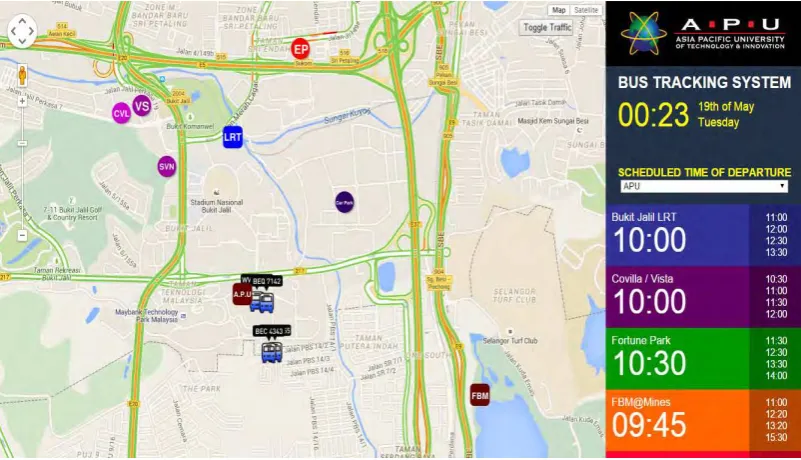
Figure 2.1- APU bus tracking system.
APU bus tracking system is developed by Malaysia premier private university-Asia Pacific University (APU). This system is embedded with google map and built in APU webpage to allow their student to check for bus traffic status. This system can be used by all the student as long as they have a device with internet access.
10 2.) Rice University Shuttle Bus Tracking System
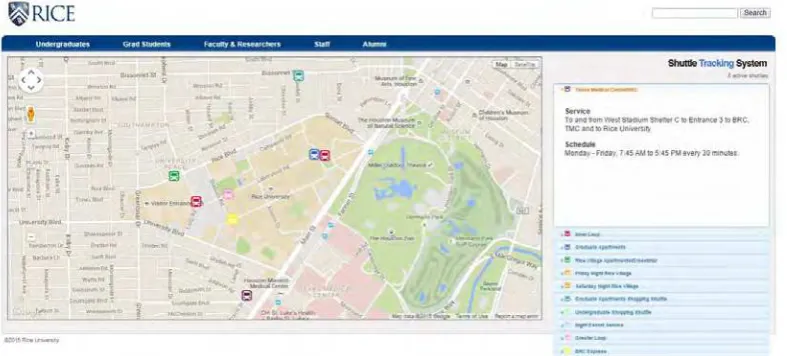
Figure 2.2 : Rice University Shuttle Tracking
Shuttle tracking system show in Figure 2.2 is developed by Rice University located in Texas, USA. The system embedded with google map and built in webpage with simple interface that display the information of bus service in Rice University.
3.) Northern Illinois University (NIU) Bus Tracking System
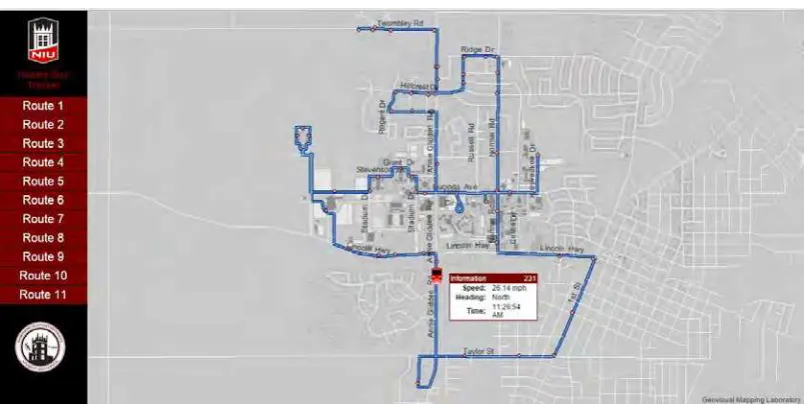
Figure 2.3- NIU bus tracking system- Route 5.
Figure 2.4- NIU bus tracking system- Route 11.