STUDENTS’ READABILITY OF ENGLISH TEXTBOOKS (A Mix-Method Study of the Tenth Grade Students at Five Vocational Schools in Majalengka West Java)
By:
IDAH MUJAHIDAH S. N. 2111014000010
MASTER PROGRAM ON ENGLISH EDUCATIONAL DEPARTMENT FACULTY OF TARBIYA AND TEACHERS’ TRAINING
UIN SYARIF HIDAYATULLAH JAKARTA
i
ACKNOWLEDGEMENT
In the name of Allah the Most Gracious and the Most Merciful. All praises and gratitude be to Allah SWT, because of His Blessing this thesis is able to be completed. Peace and salutation for our Prophet Muhammad SAW, his companions and his followers.
This thesis is presented to Master Program on English Educational Department, The Faculty of Tarbiya and Teachers’ Training, as a partial fulfillment of the requirement for Master Degree (S2). This work could not be completed without a great deal of help from many people who always guide and suggest the writer in writing this thesis from the beginning to the end.
In this occasion, the writer would like to express the sincere gratitude to:
1. Nurlena Rifa’i, MA. Ph.D, the Dean of Faculty of Tarbiya and Teachers’ Training.
2. Dr. Fahriany, M.Pd., as the Head of English Department for Master program and as a counselor during arranging this thesis.
3. Dr. Alek, M.Pd., as academic counselor of the writer.
4. All the lecturers in Master Program of English Department who had transferred his/her knowledge and also for the valuable guidance and encouragement.
5. The principals of SMKN 1 Majalengka, SMKN 1 Maja, SMKN 1
Kadipaten, SMKN 1 Panyingkiran and SMKN 1 Palasah for helping and giving contribution to the writer when she was doing research.
6. My beloved consort (Muhammad Syukron), my son (El Jalaluddin Rumi), my loving mother (Sayati), my loving father (Djaelani) and brothers (Jaja, Yayan and Yudi) for their support, prayer, and kindness. 7. My second family at UIN Syarif Hidayatullah, students of master
program 2011 thanks for your helping, relationship and kindness.
iii
ABSTRACT
IDAH MUJAHIDAH, 2014. Students’ Readability of English Textbooks (A Mix-Method Study of the Tenth Grade Students at Five Vocational Schools in Majalengka West Java)
Thesis, Master Program on English Educational Department, Faculty of Tarbiya and Teachers’ Training UIN Syarif Hidayatullah Jakarta.
Keywords: readability, textbooks, reading level.
The objectives of this study were to find out the readability levels of English textbooks for the tenth grade of vocational school students and to find out whether the readability levels of English textbooks matched to the
tenth grade students’ readability at five vocational schools in Majalengka or not.
The main data collection was gained by making use of tests. The first test measured students’ comprehension on the textbooks by using cloze test. The second test was determining the readability level of English textbooks by
using Fry’s Readability Graph. Both tests were done to assure that this study was reliable. The supporting data were gained by making use of interview both English teachers and students. There were five English teachers and ten students interviewed in this study. The interview was conducted to figure out
their assessment of the readabality and their students’ readability towards the English textbooks namely Get Along with English 1 and English for SMK 1.
v
vii
ABSTRAK
IDAH MUJAHIDAH, 2014. Keterbacaan Siswa terhadap Buku Teks Bahasa
Inggris (Sebuah Penelitian Metode Campuran pada Siswa Kelas X di Lima SMK di Majalengka Jawa Barat)
Tesis, Program Master Pendidikan Bahasa Inggris, Fakultas Ilmu Tarbiyah dan Keguruan UIN Syarif Hidayatullah Jakarta.
Katakunci: Keterbacaan, Buku Teks, Tingkat Membaca.
Tujuan dari penelitian ini adalah untuk mengetahui tingkat keterbacaan buku teks Bahasa Inggris oleh siswa kelas X Sekolah Menengah Kejuruan (SMK) dan untuk mengetahui apakah tingkat keterbacaan buku teks Bahasa Inggris sesuai dengan tingkat keterbacaan siswa di 5 SMK di Majalengka Jawa Barat atau tidak.
Pengumpulan data utama diperoleh dengan menggunakan tes. Tes pertama mengukur pemahaman siswa terhadap buku teks tersebut dengan menggunakan tes rumpang. Tes kedua yaitu menentukan tingkat keterbacaan buku teks Bahasa Inggris dengan menggunakan Grafik Keterbacaan Fry. Kedua tes tersebut dilakukan untuk memastikan bahwa penelitian ini reliabel. Data pendukung diperoleh dengan menggunakan interview terhadap guru Bahasa Inggris dan siswa. Dalam penelitian ini telah diwawancara 5 guru Bahasa Inggris dan 10 siswa. Interview dilakukan untuk mengetahui penilaian mereka terhadap keterbacaan dan tingkat keterbacaan siswa terhadap buku teks bahasa Inggris yaitu Get Along with English 1 dan English for SMK 1.
ix
TABLE OF CONTENTS
ACKNOWLEDGEMENT ... i
ABSTRACT ... iii
TABLE OF CONTENTS ... ix
LIST OF TABLES ... xi
LIST OF GRAPHS ... xiii
LIST OF CHARTS ... xv
FIGURE ... xvii
APPENDICES ... xix
LIST OF ABBREVIATIONS ... xxi
CHAPTER I INTRODUCTION ... 1
A. Research Background ... 1
B. Research Focus ... 5
C. Research Questions ... 5
D. Aims of Research ... 5
E. Significance of Research ... 6
CHAPTER II THEORETICAL REVIEW ... 7
A. The Nature of Readability ... 7
B. Aspects Affecting to Readability of Textbook ... 7
C. Textbook Readability ... 8
D. Formulas of Readability ... 9
1. Classics Readability Formula ... 9
2. New Readability Formulas ... 11
E. Students’ Reading Level ... 17
F. English Foreign Language Teaching and Learning 27 G. The Role of Textbook in the EFL Classrooms ... 29
H. English for Vocational Students ... 32
I. Previous Study ... 33
CHAPTER III RESEARCH METHODOLOGY ... 39
A. Design of the Study ... 39
B. The Analysis Unit ... 40
1. English Textbooks ... 40
2. The Tenth Grade Students of Vocational Schools ... 40
C. Instrument of the Study ... 40
1. Test ... 40
2. Interview Sheet ... 43
D. Data, Source of Data and Sort of Data ... 43
x
2. Source of Data ... 43
3. Sorts of Data ... 44
E. Time and Place of the Study ... 44
1. Time of the Study ... 44
2. Place of the Study ... 44
F. Data Collecting Procedure ... 45
G. Data Analysis Procedure ... 46
H. Trustworthiness ... 47
CHAPTER IV FINDINGS AND DISCUSSION ... 49
A. Findings ... 49
1. The Result of Test ... 49
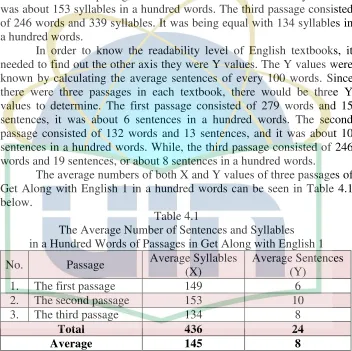
a. The Result of Readability Level Test of English Textbook by Using Fry Readability Graph ... 49
1) The Readability Level of Get Along With English 1 ... 49
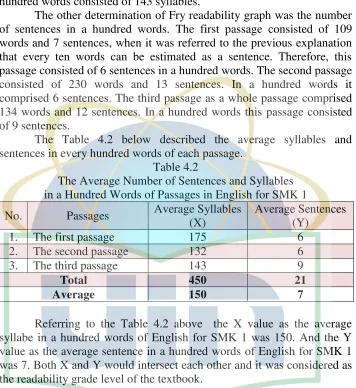
2) The Readability Level of English for SMK 1 ... 51
b. The Result of Students’ Readability Towards the English Textbooks by Using Cloze Test ... 53
2. The Result of Interview ... 67
a. Interview Result with the English Teachers At Five Vocational Schools in Majalengka. 67 b. Interview Result with the Students at Five Vocational Schools in Majalengka ... 73
B. Discussion ... 74
1. The Readability Level of English Textbooks .. 74
2. The Readability Level of English Textbooks And Students’ Readability ... 78
CHAPTER V CONCLUSION AND SUGGESTION ... 83
A. Conclusion ... 83
B. Suggestion ... 84
REFERENCES ... 87
xi
LIST OF TABLES
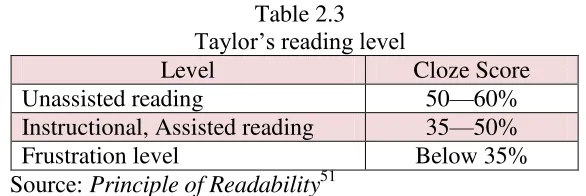
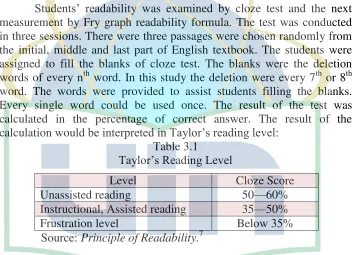
Table 2.1 Corrected Grade Level Estimation of Dale Chall Formula .. 10 Table 2.2 Reading Ease Scale ... 11 Table 2.3 Taylor’s Reading Level ... 27 Table 3.1 Taylor’s Reading Level ... 42 Table 4.1 The Average Number of Sentences and Syllables in a
Hundred Words of Passages in Get Along with English 1 ... 50 Table 4.2 The Average Number of Sentences and Syllables in a
Hundred Words of Passages in English for SMK 1 ... 52 Table 4.3 The Classification of Cloze Score of the First Passage
Based on Taylor’s Reading Level ... 55 Table 4.4 The Classification of Cloze Score of the Second Passage
Based on Taylor’s Reading Level ... 57 Table 4.5 The Classification of Cloze Score of the Third Passage
Based on Taylor’s Reading Level ... 58 Table 4.6 Percentage of Students’ Correct Answer towards Get
Along With English 1 ... 59 Table 4.7 Taylor’s Reading Level ... 59 Table 4.8 The Summary of Classification of Cloze Score Based on
Taylor’s Reading Level ... 60 Table 4.9 The Classification of Cloze Score of the First Passage
Based on Taylor’s Reading Level ... 62 Table 4.10 The Classification of Cloze Score of the Second Passage
Based on Taylor’s Reading Level ... 63 Table 4.11 The Classification of Cloze Score of the First Passage
Based on Taylor’s Reading Level ... 64 Table 4.12 Percentage of Students’ Correct Answer Towards English
for SMK 1 ... 65 Table 4.13 The Summary of Classification of Cloze Score Based on
xiii
LIST OF GRAPHS
Graph 2. 1 Fry’s Readability Graph ... 13 Graph 3. 1 Fry’s Readability Graph ... 46 Graph 4. 1 Fry Graph Readability Level of Get Along with English 1
Estimated per Hundred Words Each Passage ... 51 Graph 4. 2 Fry Graph Readability Level of English for SMK 1
xv
LIST OF CHARTS
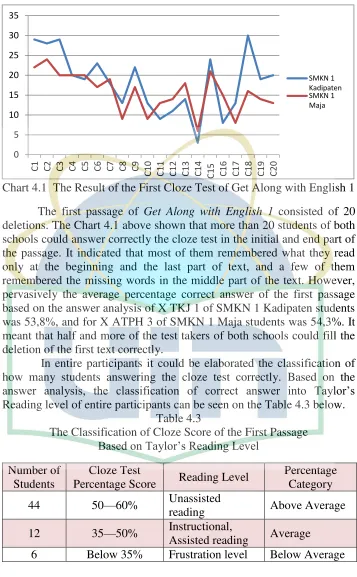
Chart 4. 1 The result of cloze test for the first passage of Get Along
with English 1 ... 55 Chart 4. 2 The result of cloze test for the second passage of Get
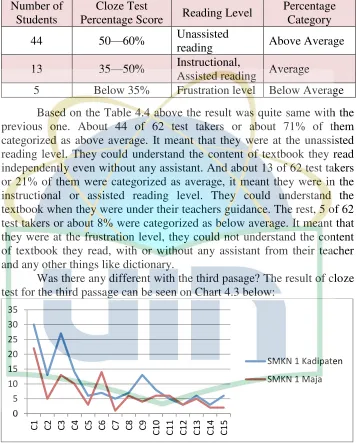
Along with English 1 ... 56 Chart 4. 3 The result of cloze test for the third passage of Get Along
with English 1 ... 57 Chart 4. 4 The result of cloze test for the first passage of English for
SMK 1 ... 61 Chart 4. 5 The result of cloze test for the second passage of English
for SMK 1 ... 62 Chart 4. 6 The result of cloze test for the third passage of English for
xvii
[image:15.516.96.424.193.510.2]FIGURES
xix
APPENDICES
Appendix 1 The First Reading Text of Get Along with English 1 ... 91 Appendix 2 The Second Reading Text of Get Along with English 1.. 92 Appendix 3 The Third Reading Text of Get Along with English 1 .... 93 Appendix 4 The First Reading Text of English for SMK 1 ... 94 Appendix 5 The Second Reading Text of English for SMK 1 ... 95 Appendix 6 The Third Reading Text of English for SMK 1 ... 96 Appendix 7 Cloze Test of the First Reading Text of Get Along with English 1 ... 97 Appendix 8 Cloze Test of the Second Reading Text of Get Along
with English 1 ... 99 Appendix 9 Cloze Test of the Third Reading Text of Get Along
with English 1 ... 100 Appendix 10 Cloze Test of the First Reading Text of English for
SMK 1 ... 102 Appendix 11 Cloze Test of the Second Reading Text of English for
SMK1 ... 103 Appendix 12 Cloze Test of the Third Reading Text of English for
SMK 1 ... 105 Appendix 13 Teachers Interview Guidance ... 106 Appendix 14 Students Interview Guidance ... 107 Appendix 15 Answer Analysis of Cloze Test I Get Along with
English 1 X TKJ 1 ... 109 Appendix 16 Answer Analysis of Cloze Test I Get Along with
English 1 X ATPH 3 ... 110 Appendix 17 Answer Analysis of Cloze Test II Get Along with
English 1 X TKJ 1 ... 111 Appendix 18 Answer Analysis of Cloze Test II Get Along with
English 1 X ATPH 3 ... 112 Appendix 19 Answer Analysis of Cloze Test III Get Along with
English 1 X TKJ 1 ... 113 Appendix 20 Answer Analysis of Cloze Test III Get Along with
English 1 X ATPH 3 ... 114 Appendix 21 Answer Analysis of Cloze Test I English for SMK 1
X TPM-B ... 115 Appendix 22 Answer Analysis of Cloze Test I English for SMK 1
X TIK 3 ... 116 Appendix 23 Answer Analysis of Cloze Test I English for SMK 1
xx
X TPM-B ... 118
Appendix 25 Answer Analysis of Cloze Test II English for SMK 1 X TIK 3 ... 119
Appendix 26 Answer Analysis of Cloze Test II English for SMK 1 X UPW ... 120
Appendix 27 Answer Analysis of Cloze Test III English for SMK 1 X TPM-B ... 121
Appendix 28 Answer Analysis of Cloze Test III (EfS3p163cVII) X TIK 3 ... 122
Appendix 29 Answer Analysis of Cloze Test III (EfS3p163cVII) X UPW ... 123
Appendix 30 Interview Script English Teacher of SMKN 1 Majalengka ... 125
Appendix 31 Interview Script English Teacher of SMKN 1 Panyingkiran ... 129
Appendix 32 Interview Script English Teacher of SMKN 1 Kadipaten 133 Appendix 33 Interview Script English Teacher of SMKN 1 Maja ... 137
Appendix 34 Interview Script English Teacher of SMKN 1 Palasah ... 141
Appendix 35 Interview Script Student of SMKN 1 Majalengka ... 145
Appendix 36 Interview Script Student of SMKN 1 Majalengka ... 149
Appendix 37 Interview Script Student of SMKN 1 Panyingkiran ... 153
Appendix 38 Interview Script Student of SMKN 1 Panyingkiran ... 157
Appendix 39 Interview Script Student of SMKN 1 Palasah ... 159
Appendix 40 Interview Script Student of SMKN 1 Palasah ... 163
Appendix 41 Interview Script Student of SMKN 1 Maja ... 165
Appendix 42 Interview Script Student of SMKN 1 Maja ... 167
Appendix 43 Interview Script Student of SMKN 1 Kadipaten ... 169
xxi
LIST OF ABBREVIATIONS
AM : Alis Malinda, S.Pd (English teacher of SMKN 1 Palasah)
ARI : Automated Readability Index
ASL : Average Sentence Length
ASW : Average Number of Syllables per Word
ATOS : Advantage-TASA Open Standard
ATPH : Agribisnis, Tanama Pangan dan Holtikultura
C% : Percentage of correct cloze completions
C1 : The First Cloze Test of Get Along with English 1
C2 : The Second Cloze Test of Get Along with English 1
C3 : The Third Cloze Test of Get Along with English 1
CCOTP : Community College Open Textbook Projects
Cs : Cicih Sutarsih (Student’s name)
DG : Deni Gustini, S.Pd (English teacher of SMKN 1
Majalengka)
DLL : Number of words in the original Dale-Chall list in passage
X
DR : Dede Ramdhani, S.Pd.I (English teacher of SMKN 1
Maja)
DRP : Degrees of Reading Power, on a 0 – 100 scale with 30 (very easy) to 100 (very hard)
DS : Dede Suryadi, S.Pd (English teacher of SMKN 1
Kadipaten)
EFL : English as a Foreign Language
ELT : English Language Teaching
ESL : English as a Second Language
G : Reading grade level
GL : Grade Level
I : Average idea unit length
Ia : Irma Asriyani (Student’s name)
ICsK : Interview of Cicih Sutarsih Student of SMKN 1 Kadipaten
Ii : Indra Irawan (Student’s name)
IIaM : Interview of Irma Asriyani Student of SMKN 1 Maja
IIiML : Interview of Indra Irawan Student of SMKN 1 Majalengka
IimPn : Interview of Imas Musyarofah Student of SMKN 1
Panyingkiran
IK : Teacher’s Interview of SMKN 1 Kadipaten
Im : Imas Musyarofah (Student’s name)
xxii
IMnhK : Interview of Meisi Nuramaliah H. Student of SMKN 1
Kadipaten
IMrML : Interview of M. Risan Student of SMKN 1 Majalengka
INtPn : Interview of Nadya Trie Student of SMKN 1 Panyingkiran
IPL : Teacher’s Interview of SMKN 1 Palasah IPn : Teacher’s Interview of SMKN 1 Panyingkiran
IRrM : Interview of Roby Ramdani Student of SMKN 1 Maja
IShPl : Interview of Shofiyatul Hidayah Student of SMKN 1
Palasah
IYyPl : Interview of Yuli Yani Student of SMKN 1 Palasah
LD : The average number of words in a hundred-word sampling
that do not appear on Dale’s long list (3,000 words)
LET : Letters in passage X
LRI : Lorge Readability Index
Mnh : Meisi Nuramaliah H. (Student’s name)
Mr : M. Risan (Student’s name)
NAEA : The National Academy of Education Administration
NRI : The Navy Readability Indexes
NS : Nono Supriatno, S.PdI, M.Pd.I (English teacher of SMKN
1 Panyingkiran)
Nt : Nadya Trie (Student’s name)
P : Number of pronouns per 100 words
Prep : Number of prepositions per 100 words
R : Mean cloze score
Rr : Roby Ramdani (Student’s name)
S : Number of sentences per 100 words
SEN : Sentences in passage X
Sh : Shofiyatul Hidayah (Student’s name)
SMKN : Sekolah Menengah Kejuruan Negeri
SMOG : Simple Measure of Gobbledygook
TIK : Teknik Informasi dan Komunikasi
TKJ : Teknik Komputer Jaringan
TPM : Teknik Permesinan
UPI : Universitas Pendidikan Indonesia
UPW : Usaha Perjalanan Wisata
W : Number of one-syllable words per 100 words
W : Words in passage X
X : The average number of syllables per 100-word
Y : The average number of sentences per 100-word passage
Yy : Yuli Yani (Student’s name)
1 CHAPTER I INTRODUCTION
A. Research Background
Textbook is assured as a salient source of teaching materials for most teachers, moreover in the foreign language classes like English in Indonesia. The advantages are not only sensed by teachers, the students also got various benefits from the existence of textbook. Since the users of textbook, in this case English textbook, are mostly students, readability of English textbook become the most important consideration. Teachers as the manager of teaching learning activities should be aware that their students have a differentiation one to another. Examining the readability level of the English textbooks then become a necessity in choosing the appropriate source of teaching material which is read not only by teachers but also students. Therefore, selecting the appropriate English textbooks which meet the students’ needs and agreeable with the curriculum will be easier.
A well-selected English textbook is not only providing many advantages for teachers, but also for students, especially in transferring the knowledge. Providing a readable and understandable textbook also will
decrease the distance of students’ understanding to teachers’. Within language teaching, it is very possible that the multifaceted interactions happen between students and teachers with one another, with methodology and material and with the broader context. In this situation Tudor assumes
that “the role of course books can become a significant constitutive element
of classroom dynamics”.1
Therefore, the existence of textbook is supporting teaching and learning activity, and enhancing the creativity within teaching learning process.
According to Cunningsworth, with textbooks, teachers are greatly helped in delivering instructional materials. In order that it will be in accordance with learning objectives that have been defined previously. Since they are commonly made in line with the curriculum, the result is the teachers will have much time to do another task other than preparing teaching material. Teaching and learning process will also be more focused, because apart from teaching materials, textbooks also usually equipped by the exercises as tool to measure the extent to which students are able to absorb the teaching materials. In addition, textbooks can be used as a guide for
1
Ian Tudor. The dynamic of Language Classroom, (Cambridge: Cambridge University
2
novice teachers so they can be more confident in delivering teaching materials.2
According to Richards, besides benefit, textbooks also give many drawbacks. For instant, teachers become textbook-bound and as a result they are not creative to present such innovation to keep the dynamic of classroom activity. Sometimes, the content of textbook is too idealized, so is not reflected the real language use. Generalizing the content, for the sake of broad market, is affecting to the content that quite far from what students' needs. Moreover, for published textbook with a good quality, both teachers and students need to spend much cost, since it is sold very expensive in the market.3
There are numerous textbooks published by famous publishers in the market, with various prices and layouts. Teachers as user and who are responsible in managing and preparing teaching materials should be aware of some considerations in selecting the appropriate textbook to be used in their classrooms. The most important matter is it should meet the need of students, concordance with the aims of teaching learning English for certain level and be tailored to the syllabus that has been set in the curriculum.
In the content standard of the curriculum, as stated by Badan Standar Nasional Pendidikan (BSNP) that the aim of teaching learning English for vocational school students are as follows:
“English lesson is intended that students have capabilities as the following:1) They are able to master the basic knowledge and skills of English language to support achieving of competency skills program. 2) They are able to apply the skills and mastery of English language skills to communicate both orally and in writing at the intermediate level.”4
From the general aims of teaching learning English above, BSNP specify the scope of English subjects namely: “The scope of English subjects are the following aspects: 1) Basic English communication novice level; 2) Basic English communication elementary level; 3) Basic English
communication intermediate level.”5
The classification of English subject scopes above are indicating the limitation of English language mastery for each grade. The Basic English
2
Alan Cunningsworths. Choosing Your Coursebook, (Oxford: Heinemann. 1995), p. 7.
3
Jack C. Richards. Curriculum Development in Language Teaching, (Cambridge:
Cambridge University Press. 2001), p. 255. 4
Badan Standar Nasional Pendidikan. Standar Isi untuk Satuan Pendidikan Dasar dan
Menengah, Standar Kompetensi dan Kompetensi Dasar SMK/MAK, (Jakarta: BSNP. 2006),
pp. 111—112. 5
3
communication novice level is studied by the tenth grade of vocational school students. Basic English communication elementary level is studied by the eleventh grade of vocational school students. While, Basic English communication intermediate level is studied by the twelfth grade of vocational school students.
From this explanation, we can conclude that the aim of teaching learning English for the tenth grade of vocational school is that the students supposed to be able to master the basic knowledge and skills of English to support their achievement of other subjects particularly in their special competency subjects. Achieving basic knowledge and skills of English as a foreign language, of course, could not separate from the existence of textbook as a source of teaching learning materials.
The distributions of published textbooks, in fact, help teachers in preparing teaching materials. In accordance with Cunningsworth that course books are best considered as a resource in achieving aims and objectives that have already been set in terms of learners needs.6 Meanwhile, it is known that most teachers are not the creator of teaching materials, adapting some materials provided in some textbooks is suggested in which meet the learners needs. In this case Richards elaborated that “commercial textbook can seldom be used without some form of adaptation to make them more suitable
for particular context in which they will be used.”7
It is not impossible for teachers to adopt some teaching materials from several textbooks to adapt them in their classrooms, since the condition of students in every single class is quite different and unpredictable. Mixing and matching the material to meet their needs then become a good way out to overcome the monotonous situation. Certainly, a suitable method which is chosen will give an important role as well. Therefore, in selecting textbook teachers should consider not only the price and display cover, but also the content of textbook.
The content of textbook is very influential on students' comprehensible input that will ultimately form their character. Therefore, involving the local culture in the subject matter is very important to establish the character of the nation's culture. Likewise learning the language, because the language is very closely related to culture. However, the essential issue is the way authors convey the material to the students, is it easy to understand or not. Because a good textbook is that can be used either at the time the students under the teacher guidance in the classroom, or when they learn independently without teachers. Therefore, the readability of textbooks by students is the most important consideration in choosing textbooks especially
6
Cunningsworth, Op. Cit., p. 7.
7
4
for English lesson. The textbook readability here is involving some indicators such as understandability, usability and interestability. These indicators are interrelated each other, when the textbook understandable it will be usable by both teacher and students and at least they are interesting, especially, in the contents conveyed by the author.
Measuring students’ readability towards the content of textbook
become a crucial matter before they have an interaction. The interaction of textbook and students depends on the readability level of the textbook itself.
Both students’ readability and the readability level of textbook need to
measure and determine to find out whether the textbook is suiatable for the students or not.
In Majalengka district, there are many English textbooks for the tenth grade of vocational school students, among others Get Along with English 1 from Erlangga, and English for SMK 1 from Books centre of Ministry of Education. These textbooks provide the materials those are represent the curriculum set by the government. Especially, Get Along with English 1; it is equipped by CD to support listening activity which the narrators sound like native. It is useful to lead students make sense the language in a real English context. They are also enriched by exercises which are useful to examine the
students’ understanding of the matter, and activities which are worthy to
experience students with the language they learnt. The present of English textbooks, like Get Along with English 1 and English for SMK 1, absolutely guided teachers to hold a various activity in their classrooms, in order that students will not be saturated in learning the language. How important is the
textbook in facilitating teaching learning activities? What are the teachers’
considerations to choose the right textbooks for experiencing their students with English? Do the readability, the price, or the lay out of textbooks which become the consideration? Or are there many reasons that caused the book usable or unusable in most vocational schools in Majalengka?
5
Selecting textbooks that are readable and understandable by vocational school students in Majalengka then become a very important consideration. How to raise their understanding towards English, then? It might be different when English lesson supports their competency and skills improvement. English is supposed to be enriched by the matter which is kindred to each program in vocational school. Tourism program, for instant, their English lesson should be rich by tourism terms, introduction of local cultures, practising language use in tourism field and so forts. On the other words, English in vocational school supposes to be introduced to English for Special Purposes. In order to bring the students to the world of professional worker. Later on, it is expected that students will be more motivated and excited to learn English instead of current English of vocational school.
Based on the condition and problems mentioned above, this study was focused on the students’ readability of English textbooks. The title of the research is: “Students’ Readability of English Textbooks; A Mix-Method Study for the Tenth Grade Students at Five Vocational Schools in
Majalengka West Java.”
B. Research Focus
Since there are many problems appear within the process of selecting the right textbook especially English, this study will focus on readability level of English textbook for the tenth grade students of vocational school
and students’ readability towards the textbooks.
C. Research Questions
Based on the focus and subfocus above, this research stands on the following questions:
1. To what extent do the levels of readability of English textbooks Get Along with English 1 and English for SMK 1 for the tenth grade of vocational school students?
2. Do the readability levels of English textbooks Get Along with English 1 and English for SMK 1 match to the tenth grade students’ readability at five vocational schools in Majalengka?
D. Aims of Research
In accordance with the research questions above, the aims of this study are as follows:
6
2. To reveal the match of English textbooks readability levels of Get Along with English 1 and English for SMK 1 to the tenth grade students’ readability level in five vocational schools in Majalengka.
E. Significance of Research
The significances of research among others that the results of this study are expected to be such input and information as well as contribution for parties which have an interest to it, especially, for the English teachers, students, the writer herself, the institutions, and the textbook writer.
a. The English teachers
The result of this research is expected giving inspiration for the English teachers of vocational schools in Majalengka, particularly, where the
research was conducted. They should take into account of their students’
needs and capability before they selecting and choosing a textbook. One way is by measuring the readability of textbooks accompanied with reading comprehension test like cloze test to make it more reliable.
b. Students
The result of this research is expected giving a reflection and
motivation to enhance students’ understanding towards the English textbook
they used in their classrooms.
c. Writers
The writer herself takes many advantages from the result of this research. That is a worthy experience of conducting a research, since preparing, accomplishing, data processing untill reporting the result of research.
d. Institutions
The result of this research also is expected can add such source to educational literature for school libraries where the study was conducted as well as the institution where the master program is acquired.
e. Textbook writers
7
CHAPTER II
THEORETICAL REVIEW
A. The Nature of Readability
Readability has become a crucial aspect of texts or books that should be considerations of teachers, librarians or writers before they select or launch them to readers. One of printing materials used by teachers in schools is English textbook. As teachers of EFL, selecting the appropriate textbook for their students is urgency. Considering textbook is not only containing learning materials but also culture and other social aspects which can affect
to their students’ attitudes and way of thinking. Understanding of what they read from textbook will much affect to their comprehension of the material as well. It is no wonder if there are many researchers who are interesting in
investigating the readability of textbooks and students’ readability.
Readability is defined by Gould as quoted by Flesch that “...is the writing method that makes a news report as easy to read as it is interesting, as well organized as it is expertly done, as clear to the average reader and
listener as it is fair and balanced”1
. Simply the definition of readability is the ease in which text can be read and understood. Prins and Ulijn as quoted by
Kasule define readability as “the ability of the text to communicate the intention of the writer to the intended reader.”2
It is in accordance with what revealed by Johnson that:
“...readability is concerned with the problem of matching between
reader and text. An accomplished reader is likely to be bored by simply and repetitive text. A poor reader will soon become discouraged by texts which she/he finds too difficult to read
fluently.”3
The definition above clarify the main aspects that should be exist in measuring readability of textbooks, they are easy to read, have a well-organized content and the explanation and elaboration of the content is clear, so that the reader or listener that even average or poor can easily understand the content of the book.
B. Aspects Affecting to Readability of Textbook
The nature of reading is the interaction between the author and reader towards reading material the readers read. Therefore, the difficulty of reading
1
Alan J. Gould. Foreword. In Rudolph Flesch. The Art of Readable Writing, (New York,
Harper & Row Publisher. 1949), p. ix. Digitalized 2007.
2
Daniel Kasule. Textbook Readability and ESL learners. Rasa 2010, Vol. 1 No. 2 pr3. 2011, p. 63. 3
8 is affected by many factors namely the text, the way author convey the meaning of reading material and the reader as the target of the author.4
The text factor involves the syntactic structures and semantic content. Syntactic structure means the way words constructed into sentence. The length of sentence have an influence over readers’ understanding. The shorter sentence is the more understandable, likewise the longer one is the harder. Semantic content means the way reader make sense the text. Considering the readers age and group might be the key of the authors to deliver their ideas in their writing, in order that reader are able to inferring and making meaning the text. Therefore, according to Kasule selection of appropriate vocabulary is necessary to make the text readable by the reader.5
The author factor is determined by their sensitivity of who are their target reader. Are they children, teenagers or adults? Are they male or female? Since the task of the author is selecting the appropriate vocabularies. Considering the readers age and group might be the key of the authors to deliver their ideas in their writing, in order that reader are able to inferring and meaning making the text.
The readers factor is intended to the way they comprehend the text. Meaning that they understand the ideas of the authors through the sentences and implicit meaning of the text. This condition much influenced by the prior knowledge of the readers, their motivation, linguistics proficiency and so on.
These factors are interrelated to each other and inducing the readability of both text readability and readers readability factors. The intention of text readability in this study is textbook readability. It involves the content of the textbook and the author ways of delivering their ideas.
Readers readability in this study is intended to students’ readability towards
their textbook especially English which is used in their classroom.
C. Textbooks Readability
Based on the above explanation, this study assumed that there are many aspects within the interactive process regarding readability of textbooks namely the text, the reader and the author. Text aspect is related to words and vocabularies used by the authors to convey their ideas and objectives in writing a textbook. It is related to linguistics field like syntax and semantic which arranged into meaningful discourse or text. It is also involving the third factors mentioned by Johnson above that is the complexity of words and sentences in relation to reading ability of the reader. During reading activity there is a sophisticated interaction between the content of the text involving syntactic content and semantic structure such as the way author selecting proper vocabulary and arranging words into
4
Kasule. Op. Cit., p. 64.
5
9 sentences in accordance with their target reader level, the reader prior knowledge and the author who is responsible in selecting the words and arranging them into sentences and who is aware of the real condition of their reader or listener as their last target. Syntactic content and semantic structure author-based aspect that is related to their skill in selecting appropriate words and sentences are as text-based aspect.
Measuring the readability of textbooks in terms of text aspect can use special software programs that have been computerized and can be downloaded from the internet. The test is called readability test, readability formulas or readability matrices that work by counting syllables, words and sentences. There are many popular readability formulas among other Coleman Liau index, Flesh Kincaid Grade Level, Automated Readability Index (ARI), SMOG, Fry’s Readability Graph and many others.
D. Formulas of Readability
1. Classic Readability Formulas
There are many formulas of readability, according to Dubay they are divided into classic and new readability formulas. Since the earliest of 1930s, many researchers have done their study in measuring the difficulties of texts or books. For instant, the research of adults reading materials, Waples and Tyler have been done their research entitled What Adults Want to Read About, Ralph Ojemann under the title The Difficulty of Adults Materials, Dale and Tyler entitled Adults of Limited Reading Ability, and Lyman Bryson Books for The Average Reader. In the 1931, Patty and Painter did their research in measuring The Vocabulary Burden, and in 1935 Gray and Leary did their research entitled What Makes a Book Readable. The formulations they used in measuring words, phrases or sentences are supposed as the beginning of the birth of readability formulas.6 Later on Dubay called them as classic readability formulas such as The Lorge Readability Index (LRI), The Dale Chall Readability Formula, and The Flesch Formulas.
The Lorge Readability Index (LRI) is created by Irving Lorge who is interesting in psychological studies of language and human learning. To him as quoted by Dubay that readability is based upon the comprehension of passages by school children. The comprehension itself is judged by the correctness and completeness of responses to questions about a passage. The questions commonly deal with specific details,
general import, appreciation, knowledge of vocabulary and
6
10 understanding of concept. The Lorge Readability Index was used to predicting readability of passages.7
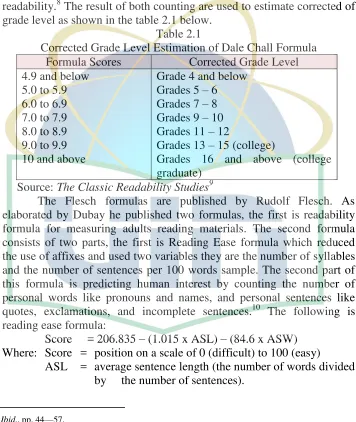
[image:29.516.90.446.196.618.2]The Dale Chall Readability Formula is created by Edgar Dale and Jeanne Chall. The Dale Chall formula uses a list of 3000 easy words. The way using the formula is by counting the hard words outside the list. It spends much time, since it should be done manually; however, it is easier in practice. As overviewed by Dubay, the formula is based on two counts; average sentence length and percentage of unfamiliar words (outside the Dale list of 3000 words). This formula is used for predicting readability.8 The result of both counting are used to estimate corrected of grade level as shown in the table 2.1 below.
Table 2.1
Corrected Grade Level Estimation of Dale Chall Formula
Formula Scores Corrected Grade Level
4.9 and below 5.0 to 5.9 6.0 to 6.9 7.0 to 7.9 8.0 to 8.9 9.0 to 9.9 10 and above
Grade 4 and below Grades 5 – 6 Grades 7 – 8 Grades 9 – 10 Grades 11 – 12
Grades 13 – 15 (college)
Grades 16 and above (college graduate)
Source: The Classic Readability Studies9
The Flesch formulas are published by Rudolf Flesch. As elaborated by Dubay he published two formulas, the first is readability formula for measuring adults reading materials. The second formula consists of two parts, the first is Reading Ease formula which reduced the use of affixes and used two variables they are the number of syllables and the number of sentences per 100 words sample. The second part of this formula is predicting human interest by counting the number of personal words like pronouns and names, and personal sentences like quotes, exclamations, and incomplete sentences.10 The following is reading ease formula:
Score = 206.835 – (1.015 x ASL) – (84.6 x ASW) Where: Score = position on a scale of 0 (difficult) to 100 (easy)
ASL = average sentence length (the number of words divided by the number of sentences).
7
Ibid., pp. 44—57.
8
Dubay. Op. Cit., pp. 61—95.
9
Ibid. p. 71 10
11 ASW = average number of syllables per word (the number of
syllables divided by the number of words).
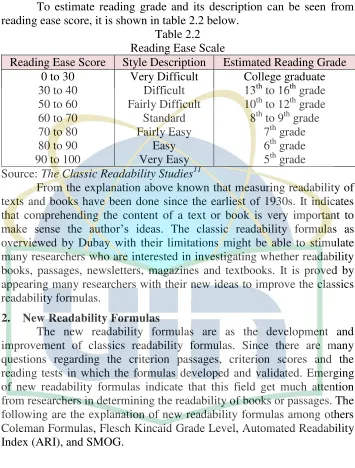
[image:30.516.91.446.105.573.2]To estimate reading grade and its description can be seen from reading ease score, it is shown in table 2.2 below.
Table 2.2 Reading Ease Scale
Reading Ease Score Style Description Estimated Reading Grade
0 to 30 30 to 40 50 to 60 60 to 70 70 to 80 80 to 90 90 to 100
Very Difficult Difficult Fairly Difficult
Standard Fairly Easy
Easy Very Easy
College graduate 13th to 16th grade 10th to 12th grade 8th to 9th grade
7th grade 6th grade 5th grade Source: The Classic Readability Studies11
From the explanation above known that measuring readability of texts and books have been done since the earliest of 1930s. It indicates that comprehending the content of a text or book is very important to
make sense the author’s ideas. The classic readability formulas as overviewed by Dubay with their limitations might be able to stimulate many researchers who are interested in investigating whether readability books, passages, newsletters, magazines and textbooks. It is proved by appearing many researchers with their new ideas to improve the classics readability formulas.
2. New Readability Formulas
The new readability formulas are as the development and improvement of classics readability formulas. Since there are many questions regarding the criterion passages, criterion scores and the reading tests in which the formulas developed and validated. Emerging of new readability formulas indicate that this field get much attention from researchers in determining the readability of books or passages. The following are the explanation of new readability formulas among others Coleman Formulas, Flesch Kincaid Grade Level, Automated Readability Index (ARI), and SMOG.
11
12
a) Coleman Formulas
Coleman formulas as explained by Dubay were introduced by Edmund B. Coleman. The formulas are used in a research project sponsored by the National Science Foundation. He published four readability formulas for general use; among other they are very important for predicting mean cloze scores (percentage of correct cloze completions). Coleman was also the first who used cloze procedures as a criterion rather than the conventional multiple-choice reading tests or rankings by judges. The four formulas use different variables shown as the followings: 12
C% = 1.29w – 38.45
C% = 1.16w + 1.48s – 37.95 C% = 1.07s + 1.18s + .76p – 34.02
C% = 1.04w + 1.06s + .56p – .36prep – 26.01
Where: C% = percentage of correct cloze completions;
w = number of one-syllable words per 100 words
s = number of sentences per 100 words
p = number of pronouns per 100 words
Prep = number of prepositions per 100 words
b) Bormuth Mean Cloze Formula
The second one is the Bormuth Mean Cloze Formula. This formula is introduced by John Bormuth which intends to measure the degrees of reading power. This formula uses three variables namely number of words on the original Dale-Chall list of 3,000, average sentence length in words, and average word length in letters. The Bormuth Mean Cloze Formula is as follows:13
R = .886593 – .083640 (LET/W) + .161911 (DLL/W)3
– 0.021401 (W/SEN) + .000577 (W/SEN)2
– .000005 (W/SEN)3 DRP = (1-R) x 100
Where: R = mean cloze score LET = letters in passage X W = words in passage X
DLL = Number of words in the original Dale-Chall list in passage X
SEN = Sentences in passage X
12
William H. Dubay. The Principles of Readability, (Costa Mesa, CA: Impact Information. 2004), p. 42.
13
13 DRP = Degrees of Reading Power, on a 0 – 100 scale with
30 (very easy) to 100 (very hard)
c) Fry Readability Graph
Fry Readability Graph is introduced by Edward Fry. One of the popular readability tests that use a graph. Then it is validated with comprehension scores of primary and secondary school materials and by correlations with other formulas.
Directions of doing a measurement namely: 1) Select sample of 100 words. 2) Find y (vertical), the average number of sentences per 100-word passage (calculating to the nearest tenth). 3) Find x (horizontal), the average number of syllables per 100-word sample. 4) The zone where the two coordinates meet shows the grade score. While scores that appear in the dark areas are invalid.14 It can be seen in the following graph:
Graph. 2.1 Fry’s Readability Graph 15
National Partnership for Women and Families describes the score shown by the intersection of x line (horizontal) and y line (vertical) of the Fry graph. The descriptions are: 1) 4th – 6th grade means readable by most adults. 2) 7th – 8th grade mean readable by half or more adults. 3)
14
Dubay. Op. Cit., pp. 44—46. 15
National Partnership for Women and Families. Fry Readability Formula; an Overview.
14 High school and above mean readable by few adults.16 The grades of readability level are equal with the grades of school ages.
d) The Listening Formula
The Listening Formula is the other formula of readability for spoken sentence. Rogers published a formula for predicting the difficult of spoken text. As Dubay explained that the formula is:17
G = .669 I + .4981 LD – 2.0625 Where:G = reading grade level
I = average idea unit length
LD = the average number of words in a hundred-word
sampling that do not appear on Dale’s long list (3,000
words)
e) SMOG Formula
The other one is the SMOG formula, G. Harry McLaughlin as elaborated by Dubay,18 published his SMOG formula in the belief that the word length and sentence length should be multiplied rather than added. By counting the number of words of more than two syllables (polysyllable count) in 30 sentences, he provides this simple formula:
SMOG grading = 3 + square root of polysyllable count.
McLaughlin validated his formula against the McCall-Crabbs passages. He used a 100 per cent correct-score criterion.
f) FORCAST Formula
The FORCAST formula is one of readability formula used for measuring reading material for adults especially in the U.S. Army. This formula created by Caylor and friends under the requirements such as, 1) Based on essential Army-job reading material; 2) Adjusted for the young adult-recruit population; 3) Simple and easy for standard clerical personnel to apply without special training or equipment. The FORCAST formula is as follow:
Grade level = 20 – (N:10)
Where N = number of single-syllable words in a 150-word sample. Since the formula does not use a sentence-length measurement, it can also use with short statements it is in accordance with what Dubay has elaborated in his overview of new readability formulas.19
16
Ibid., p. 2.
17
Dubay. Op. Cit., p. 46.
18
Dubay. Op. Cit., p. 47.
19
15 g) The Army’s Automated Readability Index (ARI)
The other formulas of readability which is used for the U.S Army
is The Army’s Automated Readability Index (ARI). As elaborated by
Dubay, that this formula is created by Smith and Senter that used an electric typewriter modified with three micro switches attached to cumulative counter for words and sentences. The ARI formula produces reading grade levels (GL) as the following:20
GL = 0.50 (words per sentence) + 4.71 (strokes per word) – 21.43.
h) The Navy Readability Indexes (NRI)
The Navy Readability Indexes (NRI) is the recalculation of ARI, Flesch and Fog Count Formulas. Those readability formulas recalculated by Kincaid, Fishburne, Rogers, Chissom and Fishburne. They make the experiment aimed to recalculating the readability formulas and to validating the effectiveness of the recalculated formulas on Navy materials. In which they are measured by comprehension scores on Navy training manuals, and finding out the relationship of readability and learning time, as it is considered being an important measurement of readability. The results of the recalculations are as follows:21
ARI simplified:
GL = .4 (words per sentence) + 6 (strokes per word) – 27.4 Fog Count New:
))
Where: Easy words = number of number of 1 and 2-syllable words per 100 words
Hard words = number of words of more than 2 syllables per 100 words
Sentences = number of sentences per 100 words
Flesch Reading Ease formula which is simplified and converted to grade level (GL) and later on it is known as Flesch Kincaid Grade Level.
GL = 0.39 ASL + 11.8 ASW – 15.59
Where: GL = position on a scale of 0 (difficult) to 100 (easy), ASL = average sentence length (the number of words
divided by the number of sentences).
ASW = average number of syllables per word (the number of syllables divided by the number of words).
20
Ibid., p. 49.
21
16
i) ATOS Readability Formula
Dubay elaborates the other readability formula namely Advantage-TASA Open Standard (ATOS) Readability formula for books.22 It is an open formula that would be available to the educational community free of charge, that would be easy to use and that could be used with any nationally normed reading tests. This computerized system developed by combining three variables namely words per sentence, the average grade level of words, and characters per word. The researchers at Renaissance as the creators of the formula conclude that: 1) Maximum learning gain requires careful matching of book readability and reading skill, 2) The amount of time spent reading correlates highly with gains in reading skill, 3) Book length can be a good indication of readability, 4) Feedback and teacher interaction are the most important factors in accelerated reading growth.
Measuring readability of textbook is not as simple as we think, since there are many factors involved and interrelated. It is known that most both classic and new readability formulas above concern to measure the readability from the syntactic and semantic structure of text. Only a few of them consider the reader reading skill. Researchers break down readability into three factors area of measurement as mentioned by Kasule text-based, reader-based and author-based of readability. Therefore, measuring readability of certain textbooks is not provided a reliable assessment when it is only measuring the text based and author based factors. To present the more reliable one Kasule suggests the appropriate way to measure readability as follows:
“Not all these factors are quantifiable... Therefore, a combination of
formulas (to measure text-based and author based factors) and tests (to measure reader-based factors) provide a more reliable assessment
of the readability a given textual item.”23
Further, Chall as quoted by Elizabeth stated that “Readability formulas do not determine how easy or hard the materials should be for a class, a group, or an individual, instead, they give only estimates of how
difficult the materials probably are”.24
Therefore, the way teachers or librarians find out if the text is understandable for their students is by giving them the actual experience to read the text themselves. After that it is followed by giving them some questions related to the text they read. We could not know how far students understand the text and how much they
22
Ibid., pp. 53—54.
23
Kasule. Loc. Cit., p.64.
24
Instone Elizabeth. The Variance Amongts The Results of Readability Formulas
Regarding U.S. History Textbooks. College of Bowling Green State University. 2011. pp.
17 comprehend the content revealed in the text before testing them. Concerning the current interest of readability which has a close relation with reading ease and comprehension of a text or book and to measure it Elizabeth elaborates
Chall statement that “At best, readability formulas give only predictions of
readability. The ultimate test of difficulty is a try-out or field test with readers
for whom the material is intended”.25
As a result, the readability level of textbook gained is not automatically reflected the ease level of students to comprehend a text. Now widely used by researchers, teachers and librarians to predict the legibility of text, book, or other printed media.
The explanation above encourages writer to conduct a research in readability of English textbook by making use of a formula to measure the readability of text and a test to measure reader-based factor. Johnson as quoted by Kasule recommended that readability be objectively determined using formula and cloze test. Therefore in this research, for measuring English textbook readability the writer will make use of Fry Readability Graph and Coleman formula which uses cloze procedures as a criterion test to determine whether the textbook is readable by students.
E. Students’ Reading Level
Measuring readability of textbook on the reader factor has close relation with reading and reading comprehension. Students can make sense the matter and the language they learn reflected by their understanding of their English textbook. The way students comprehend textbook is much influenced by their reading level. As overviewed by Perekem and Agbor that
“Students read most successfully if the reading material they are given
matches their reading level.”26 Therefore, students’ performance in reading and reading comprehension is such focus in relating the readability of textbook to students reading level. However, textbooks are rarely used by teacher in supporting teaching learning activities in their classroom especially reading instruction. In accordance with Wade and Moje as overviewed by Kamil and friends as follows:
“Although textbooks and their accompanying curriculum guides are used extensively by teachers to present content and to structure classroom learning activities, most studies have found that students
25
Ibid., p. 15
26
Bertola Perekem and Catherine Alex Agbor. Readability of Language Textbooks
Prescribed for Junior Secondary Schools and Students’ Performance in Reading
Comprehension in Bayelsa State, Nigeria. British Journal of Arts and Social Sciences, Vol. 9
18 engage in little reading of any kind of published text, either in class or as homework, other than basal texts used for reading instruction.”27
The quotation above revealed that only a few students who can engage in reading textbook both in class and out side the class. Whereas, reading is one of comprehensible inputs for the students. If they are reluctant to read any book or other reading materials, potentially that they could not understand the content of the book. That is why the book become unreadable among them. As mentioned above that textbook readability has a close relation with reading and reading comprehension. Reading is one of the language skills that should be experienced by the students when they are learning a language. Researchers of India, Patel and Jain give an overview that:
“Reading means to understand the meaning of printed words i.e. written symbols. Reading is an active process which consists of recognition and comprehension skill. Reading is an important activity in life with which one can update his/her knowledge. Reading skill is
an important tool for academic success.”28
By means of reading one can update and expand his/her knowledge through information provided by the text, passage, discourse and the like.
Other than that, it can affect to one’s thought in generating the ideas in
writing, stimulating discussion, and studying a language covered foreign language.
Brown notes that “reading comprehension is primarily a matter of developing appropriate, efficient comprehension strategies”29
. Thus students should be equipped by skills and strategies in order that their comprehension of a text will be more in-depth. Both teachers and students have their own role in carrying out such approach in reading comprehension, which is
affecting to the students’ understanding of a text.
Further Patel and Jain elaborate the process of reading that broadly classified into three stages namely recognition stage, strcuturing stage and interpretation stage. At the recognition stage the learner simply recognizes the graphic counterparts of phonological items. At the structuring stage learners sees the syntactic relationship of the items and understands the structural meaning of the syntactical units. While at the interpretation stage learners comprehend the significance of a word, a phrase, or a sentence in the overall context of the discourse, and it is the highest level in reading
27
Michael L. Kamil, Peter B. Mosenthal, P. David Pearson and Rebecca Barr. Handbook
of Reading Research Vol III. Mahwah: Lawrence Erlbaum Associates. 2000, p. 613.
28
M. F. Patel and Praveen M. Jain. English Language Teaching: Methods, Tools, and
Techniques. Jaipur: Sunrise Publisher. 2008, p. 113.
29
H. Douglas Brown. Teaching by Principles. An Interactive Approach to Language
19 process.30 Therefore reading comprehension is standing on the third stage of reading. Besides, the other significant information or knowledge that helps reader understanding the text is required as well.
There are two great types of reading those are intensive and extensive reading. Intensive and extensive reading according to Eskey as overviewed
by Hinkel is “Intensive reading working with small amounts of text in class
to make various points about the nature of texts and reading process... extensive reading is assigning whole texts to be read outside of class or in a
reading lab setting.”31
Intensive reading materials in this case are very limited. It is only what has relation with readers going to learn, discuss and might be the sources for writing activity unlike the extensive one. According to Patel and Jain state that:
“Intensive reading material will be the basis for classroom activity. It
will not only be read but will be discussed in detail in the target language, sometimes analysed and used as a basis for writing exercises... extensive reading is the reading for pleasure. The reader wants to know about something. The usually people read for to keep
them update.”32
The two definitions above are indicating that the purpose of extensive reading is to fulfil their curiosity and need of knowledge, information and joys. Formal shape setting is not required in this situation, therefore reader can have it anywhere and anytime like reading newspapers, magazines, novels and many others.
A different point of view regarding intensive reading come from
Nation, he states that “intensive reading focuses on comprehension of a
particular text with no thought being given to whether the features studied in this text will be useful when reading other texts. Such intensive reading
usually involves translation and thus comprehension of the text.”33
So that intensive reading needs such interpretation to get the points of a text. The result could be a reference when one intends to read other texts.
Meanwhile, regarding extensive reading, Nation views that
“Extensive reading fits into the meaning-focused input and fluency development strands of a course, depending on the level of the books that the
learners read.”34
Extensive reading is an enrichment input for readers to accomplish their task or satisfaction. What adults read will differ with what
30
Patel and Jain. Op. Cit., pp. 115—116.
31
Eli Hinkel. Handbook of Research in second Language Teaching and Learning,
(Mahwah: Lawrence Erlbaum Associates. 2005), pp. 543—547.
32
Patel and Jain. Op. Cit., pp. 118—120.
33
I.S.P. Nation. Teaching ESL/EFL Reading and Writing, (New York: Routladge. 2009),
p. 25.
34
20 young learners read, what university students read will differ with what elementary or junior high school read. As every level age has different need of input and different aims of accomplishment.
In addition, Renandya and Jacobs in their journal, overview Davis’s
description of extensive reading as edited by Richards and Renandya that:
“An extensive reading programme is a supplementary class library scheme, attached to an English course, in which pupils are given the time, encouragement, and materials to read pleasurably, at their own level, as many books as they can, without the pressures of testing or
marks.”35
From the explanation above intensive reading have some characteristics among others: intensive reading helps students to develop active vocabulary; in this type of reading teacher plays the main role; during comprehending the text linguistic item are developed; this kind of reading purposes to make the language used actively; since intensive reading is reading aloud, so speech habit are emphasized in order that accent, stress, intonation and rhythm could be corrected.
The characteristics of extensive reading as elaborated by Patel and Jain that:
“...same like intensive reading, the extensive one help learner to
develop to active vocabulary as well; because it is silent reading the subject matter is emphasized; the main role is played by the students themselves, in the sense they have to ask for measures; the idea here can be developed it is in line with the aim of this extensive reading
that is to enrich learners’ knowledge; and by extensive reading the
habit of good reading can be developed.36
The difference between intensive reading and extensive one is the passion. Passion of extensive reading appears from the reader themselves, so it gives more impression to them. It differs with the intensive one which is commonly based on such assignment, so the impression seems forced the readers up.
While Nation mentions that intensive reading is focus on some aspects, namely comprehension, regular and irregular sound-spelling relations, vocabulary, grammar, cohesion, information structure, genre features and strategies.37 These aspects are interrelated each other when students promote to translate and comprehend a text.
It is known that reading comprehension is part of intensive reading. It usually involves translation and comprehension of the text. By translating the
35
Jack C. Richards and Willy A. Renandya. Methodology in Language Teaching. An
Anthology of Current Practice, (Singapore: Cambridge University Press. 2002), p. 296.
36
Patel and Jain. Op. Cit., p. 119. 37
21 text expected students understand it, teacher can make sure and it will be
conducted well when it follows Patel and Jain’s guidelines as follows38
: a. The material presented before the students hold reading comprehension,
and should be concordance with the previous knowledge or related to their own experience.
b. Teacher should emphasize on students’ stressing.
c. If any mistake committed by the student during the process of reading is going on, teacher should correct it friendly and productively.
d. Teacher should care about all readers especially for the weak one.
e. While teacher presenting a model of reading, it should be according to
the students’ level of reading.
In teaching reading and leading students to comprehend a text, teacher should integrate with the other language skills those are listening, speaking, and writing. This collaboration of all language skills possibly brings students to their level of understanding of a text. So that, through speaking or writing, they are able to describe and express what they have read on their English textbook easily. Other than the previous guidelines, comprehension is also affected by illustrations. Chall and Squire overviewed as edited by Barr that:
“Most researchers report that illustration can either facilitate or hinder
comprehension, depending on the nature of the visual, its location, the level of the reading materials, and the extent to which it is designed to
direct reader to the instructional focus rather than detract of it.”39
From the quotation above known that the illustration is not a basic
principle to enhance students’ comprehension, it depends on many factors among other the level of the reading materials and the extent to which it is designed to the instructional focus.
Measuring students’ comprehension then becomes a necessity. Some
linguists state that to determine students’ comprehension of a text can be
measured by making use of various types of comprehension questions as major means of focusing on students reading comprehension of a text. Nation elaborates some types of questions can be used as follows40:
a. Pronominal questions are questions beginning with who, what, when, how, why, etc. These questions commonly use in testing writing ability as well as reading ability.
e.g.: Who is Jokowi? What is his opinion about his New SUV? Etc.
b. Yes/No questions and alternative questions only need short answers, so the learners do not need to have a high level of writing skill.
e.g.: Was Kiat Esemka assembled by students of SMKN 2 Surakarta?
38
Patel and Jain. Op. Cit., p. 121.
39
Rebecca Barr, Michael L. Kamil, Peter B. Mosenthal and P. David Pearson. Handbook
of Reading Research Vol II, (Mahwah: Lawrence Erlbaum Associates. 1996), p.128.
40
22 c. True/false sentences are similar to yes/no questions. As with yes/no question the learners have a 50 per cent chance of guessing correctly. Meanwhile true/false provides an opportunity for more learning to take place. So the learner may also be asked to rewrite the false sentence and make change the true one.
d. Multiple-choice sentences are easy to mark but not easy to make. If the choices are only four the chance of guessing is only 25 per cent. It means that it has a little possibility to guess.
e.g.: Jokowi is....
b. A Surakarta Mayor
c. A Vice Mayor of Surakarta d. A Vocational School Student
e. An Indonesian Ambassador to Thailand
f. Sentence completion by filling the empty spaces to show that they understand the reading passage. The sentences come after the reading passage. The following are four different types of sentence completion:
1) The sentences are exact copies of sentences in the passage. 2) The missing words can be found in the passage.