Trop. For. Manage. J. VIII (1) : 51-64 (2002)
MYCORRHIZAL INOCULUM PRODUCTION TECHNIQUE FOR
LAND REHABILITATION
Teknik Produksi Inokulum Mikoriza Untuk Rehabilitasi Lahan
YADI SETIADI1)
ABSTRAK
Spora cendawan mikoriza arbuskula (CMA) telah dikoleksi dan diisolasi dari berbagai jenis tanah masam berfikasi P-tinggi di Indonesia. Lima isolate CMA lokal telah berhasil diperoleh dari
spora tunggal dengan teknik “test tube culture” dan dikembangkan-biakan dengan sistem “open pot
culture”. Kelima isolate tersebut adalah Acaulospora delicata (EJ-01). Acaulospora tuberculata (INDO-2), Glomus manihotis (INDO-1), Glomus mosseae (PAL-03) dan Entrophospora colombiana (LAM-36). Kelima biakan isolate CMA tersebut, dipelihara dengan tanaman inang Kudzu pada media zeolit yang diperkaya nutrisi. Dengan mempelajari berbagai tipe media, ukuran partikel, pH dan komposisi nutrisi, isolate CMA terpilih telah berhasil dapat diperbanyak dalam skala industri dengan menggunakan inang sorghum. Dengan tehnik pra-inokulasi di persemaiaan maka penggunaan mikoriza dalam skala besar di bidang kehutanan dapat direalisasikan.
INTRODUCTION
The novel functions of Arbuscular Mycorrhizal Fungi (AMF) as biological agent for improving growth and health of plants and help early seedling establishment on degraded reforestation sites are recognized. Most tree species in tropical regions are colonized by mycorrhizal fungi, however, the exploitation of these potential benefits of AMF has yet to be widely adopted, and they are not yet used as part of standard silviculture management in Indonesia. This may be related to the limited availability of inoculum of AMF and the lack of data demonstrating a benefit from large scale application of AMF inoculum in the field.
Arbuscular mycorrhizal fungi (AMF) are obligate biotrophs, and although several attempts at axenic culturing of these fungi have been made, sustained axenic culture has not yet been achieved (Piche et al., 1994). Thus they cannot be multiplied on artificial media without a living host (Sieverding, 1991). For reproduction, these fungi depend on a supply of photosynthate from the host plant or on Ri T-DNA-transformed root components when the roots are grown meristimatically on artificial growth media under axenic conditions ( Becard and Piche, 1990; Williams,1992).
Nevertheless, several techniques for producing and formulating inoculum of AMF in dual culture with plant hosts are now available i.e. aeroponic cultures (Hung and Sylvia, l988), nutrient film techniques (Elmes et al., 1983), Ri T-DNA transformed roots (Williams, 1992),
1)
alginate beads (Strullu and Plenchette, 1991), and hydrogels (Hung et al., 1991). The culturing of AMF on plants grown in disinfected soil or in inert soil-less media, however, remains the most frequently used technique (Feldmann and Idczak,1992; Sylvia and Jarstfer,1994).
Soil-less cultures can be used to produce high quality inoculum of AMF, with a propagule number much greater than that achieved in the soil-based methods used in the past. Using soil-less media also avoids the need for sterilization of the media necessary to remove detrimental organisms, and also allows better control over the physical and chemical characteristics of the growth media. Soil-less media are more uniform in composition, and better aeration is often possible compared with soil (Sylvia and Jarstfer, 1994).
Limited success in the propagation of tropical AMF has frequently be reported and this is often due to an inappropriate selection of host and medium, or the use of unsuitable environmental conditions (Dodd and Thompson, 1994). The current procedures for the establishment of pure pot cultures of AMF have mainly been developed for temperate species collected from soils of neutral pH with moderate to high fertility. The adoption of similar procedures for the culture of AMF collected from tropical conditions (especially from acidic poor soils) is not always satisfactory.
This paper explained the practical procedure for bulking up of mycorrhizal inoculum for tropical conditions, that may be used for reforestation activities, thus application of mycorrhizal inoculum as an alternative low input technology for rehabilita-ted degraded forest can be recommended.
MATERIALS AND METHOD
Tube Culture Establishment
Spore preparation
Spores of tropical AMF were extracted by wet sieving and decanting from kudzu (Pueraria javanica) pot cultures. Under a dissecting microscope, apparently healthy spores were selected, and transferred into a small Petri dish (3 cm diam). While transferring the spores, transference of debris such as fine colonised roots, small fragments of hyphae, and organic matter was avoided, as this can introduce other AMF as contaminants. Spores were then surface-sterilized with 0.05% (w/v) sodium hypochlorite for 3 min and washed in several changes of distilled water.
Seed germination and inoculation
A single surface-sterilized spore was then placed near the root tip of kudzu, or on the roots of bahia grass using fine forceps. This procedure was carried out under the dissecting microscope (x40 magnification) to ensure the spores were clearly placed near the root tips.
Culturing in test tubes
Large test tubes (2 cm diam x 15 cm length) were partially filled with 13 g of sieved (1.4 mm mesh sieve) terragreen. This media was moistened with 12 ml half-strength Hoaglands (-P) solution which had been adjusted to a pH similar to that of the original soil from which the AMF originated. The tubes were then steam-sterilized at 121 oC for 15 min. After the tube had cooled, inoculated seedlings were transplanted into each test tube by placing the seedling between the glass and substrate. The tubes were then plugged with cotton wool and the rooting zone covered in aluminium foil. The tubes were placed in the growth room (temp 20oC, PAR 300 mol m-2 s-1, with continuous light) for two weeks before being transferred to the greenhouse for a further 4-6 weeks under ambient tropical conditions. The tubes were re-moistened every two weeks by gently removing the cotton wool plug and pipetting 5 ml of sterile water onto the growth medium.
Checking the rate of colonization by AMF
Two to three weeks after inoculation, root colonization was checked by opening the foil and exposing the root zone. The unopened tubes were directly examined under a dissecting microscope, and root colonization was recognized by observing the presence of extramatrical mycelium near the root or on the glass surface. After 6-8 weeks in the glass tube, the colonized roots of seedlings were checked by removing them from the tube and examining them under a dissecting microscope. Those confirmed to have extramatrical mycelium of AMF were transplanted into open pot cultures in the greenhouse as described below.
Pot culture Establishment
Substrate preparation
In earlier work, untreated terragreen had been used successfully for culturing tropical AMF. The particle sizes of this substrate, however, are heterogenous. In order to improve the homogeneity, the substrate was sieved through a 1.4 mm mesh. Particles retained in the sieve were then used as a substrate for culturing tropical AMF. To remove any remaining fine particles (which also contain a high level of plant-available nutrients), the substrate was washed in running water until the wash water was clean. It was discovered that the nutrient content of terragreen after washing was not sufficient to support the growth of the host plant as well as supporting mycorrhizal development. To overcome this deficiency, the terragreen was soaked overnight in half-strength Hoagland's solution minus-P (INVAM, 1991) with the pH of the solution adjusted as described previously.
Harvesting of tube cultures and potting cultures establishment
After 6-8 weeks growth in the test tube, colonized seedlings were harvested in one of two ways. Firstly, by direct transplanting, after shaking the tube and gently removing the whole seedling using forceps. Each seedling was then transplanted into a plastic pot (capacity 150 ml) containing moistened treated terragreen. The second technique involved the harvesting of the colonized roots of the seedling. The contents of the tube were allowed to dry, and were then shaken out, and the entire root of the seedling was placed in a petri dish and carefully washed to remove the adherent particles. It was then transferred into another Petri dish containing distilled water and examined under a dissecting microscope. Colonized roots with mycelium and young spores were selected and cut into 1-2 fragments. These fragments were used as inoculum for starting new pot cultures of AMF. Two pieces of root fragments were inoculated onto roots of one-week old bahia grass or kudzu seedlings, then transplanted into plastic pots contained treated terragreen (capacity 150 ml).
Maintaining pot cultures and harvesting inoculum of AMF as starter
The pots containing inoculated plants were placed in the greenhouse. Nutrients were added every week using 25 mls half-strength Hoagland's solution (-P) per pot, in addition to daily watering. One month after inoculation, root colonization and culture purity were checked by taking a small root sample and placing it into a Petri dish and checking for the presence of extramatrical hyphae under a dissecting microscope. Plants which had good colonization and were free of contamination were carefully taken out. The ends of the roots were trimmed before each plant was re-potted into bigger plastic pots (capacity 0.6-3 L) containing treated terragreen. They were maintained for a further 2-3 months in the greenhouse. After this period the plant shoots were pruned, and the substrate allowed to dry in situ for one week. The substrate containing roots and spores was then ready for use as STARTER inoculum. This inoculum was used as starter for bulking-up tropical AMF inoculum.
Bulking-up of Inoculum of Tropical AMF
colonization, transplanting to bigger plastic pots (capacity 1 L), drying and harvesting (after 4 months), were carried out as previously described.
Effect of Different Host and Medium Combinations on Sporulation of Tropical AMF
To improve inoculum production, different combination of host and local medium was tested following procedure above.
Inoculum preparation
The colonized roots were harvested and separated from the starter inoculum and cut into small (0.5-1 cm length) fragments for use as inoculum in this experiment.
Substrate preparation
Three different local substrates, zeolite, inolite and river sand were sieved, washed and fertilized with VITAFEED-102, then pasteurised. The prepared substrates were then placed in 250 ml plastic cups.
Seed germination and pre-transplant inoculation
Plastic boxes (24 cm long, 15 cm wide and 6.5 cm deep) were filled with pasteurized zeolite to a depth of 3 cm. To permit drainage, 6 holes (diam 4 mm) were made in the base of the box. The chopped root inoculum was evenly spread over the surface of the zeolite and then a further 2 cm depth of zeolite was placed over it. This was used as the seed bed on which seeds of kudzu, bahia grass or sorghum were germinated.
Potting and maintenance
Two-week-old seedlings of bahia grass, kudzu and sorghum were gently removed from the seed bed using sterile forceps, and transferred to Petri dishes containing distilled water. The roots of each seedling were checked under a dissecting microscope for the presence of extramatrical hyphae. Colonized seedlings were transplanted into 250 ml plastic cups containing either treated zeolite, inolite or river sand previously moistened with VITAFEED-102 solution. Pots were placed in the laboratory at room temperature for 3 days before being laced in the greenhouse at the Faculty of Forestry IPB,Bogor. Every week, the plants were fertilized with 25 ml of VITAFEED-102 solution, in addition to daily watering.
Data collection and analysis
extracted by wet-sieving and decanting and transferred to a Petri dish on which a gridline scale had been previously marked on the base. They were then counted under a dissecting microscope. Only free spores were counted which may lead to an underestimate for spores of
G. clarum (CLAR-17) and G. manihotis (INDO-1) which can also be formed inside the roots. Counts of spore numbers were subjected to ANOVA and the treatment means were further separated by Duncan's multiple range test (DMRT) for the significant differences at P< 0.05.
R E S U L T S
Test tube Culture Technique
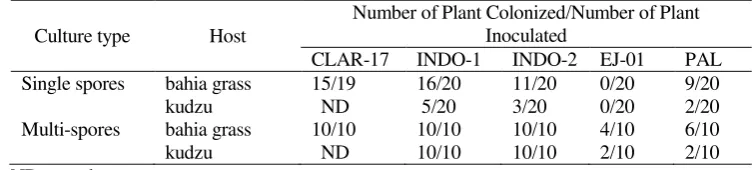
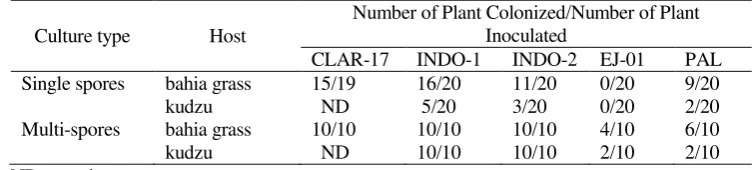
By using the test tube culture techniques (Setiadi, 1996), three species of indigenous AMF i.e. G. manihotis (INDO-2), A. tuberculata (INDO-2), G. mosseae (PAL-03) and one species of exotic AMF G.clarum (CLAR-17) were successfully obtained in pure pot-culture. The success rate (number of tubes colonized) using this technique varied according to the isolates and the host (see Table-1). Using bahia grass as a host, 80% of the plants in tubes inoculated with G. manihotis were colonized, whilst the corresponding figure for A. tuberculata was 55%, for G. mosseae it was 45%, and for G. clarum it was 70%. However, if kudzu was used as the host the success rate was reduced i.e. for G. manihotis, 25% success, for A. tuberculata 15% and for G. mosseae 10%. Single-spore cultures of A. delicata failed to establish using this technique both on bahia grass and on kudzu. To check the suitability of the test tube technique as a culture system of AMF, multispore (20 spores per plant) cultures were also tested. The success rate using multispore inoculum was increased relative to single spore inoculum for each fungus tested using either host (see Table-1). A 100% success rate was achieved for both G. manihotis and A. tuberculata cultured on either kudzu or bahia grass. A success rate of 100% was also achieved for G. clarum cultured on bahia grass. For G. mosseae
cultured on bahia grass and kudzu the success rates were 60% and 20% respectively.
Although the culturing attempts for A. delicata using single spores failed, when multispores were used the success rate was increased to 40% on bahia grass and 20% in kudzu. In general, in all the attempts at culturing of single or multispore inoculum, the number of host plants of bahia grass colonized was higher than for kudzu, for each fungus tested.
Table-1. Number of successful cultures for single and multispore attempts using AMF in test tube cultures using kudzu or bahia grass as a host
Culture type Host
Number of Plant Colonized/Number of Plant Inoculated
CLAR-17 INDO-1 INDO-2 EJ-01 PAL
Single spores bahia grass 15/19 16/20 11/20 0/20 9/20
kudzu ND 5/20 3/20 0/20 2/20
Multi-spores bahia grass 10/10 10/10 10/10 4/10 6/10
kudzu ND 10/10 10/10 2/10 2/10
Starter Inoculum Development
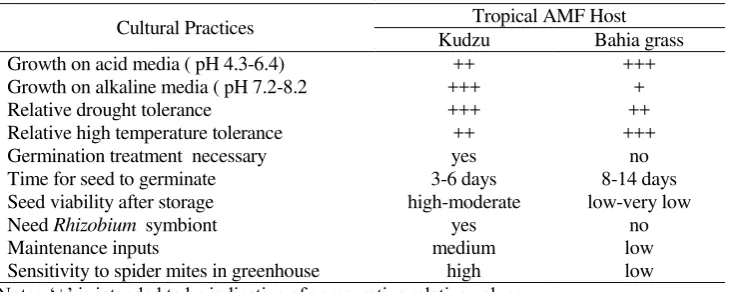
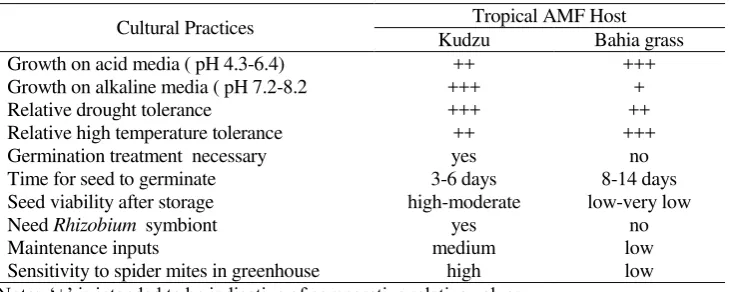
Starter inoculum was initiated by transferring a colonized seedling from the test tube into an open pot (150 ml). The success rates after transplanting, either from direct transplanting or by using colonized roots of the seedlings are presented in Table-3. Using colonized roots, a success rate of 100% was achieved for isolates INDO-1, INDO-2, EJ-01 and PAL-03 either using bahia grass or kudzu. A success rate of 100% was also achieved for isolate CLAR-17 on bahia grass. However, a lower success rate was obtained when direct transplanting was used. For example a success rate of 90% was obtained for isolate INDO-1 using bahia grass as a host and 40% using kudzu as a host. For isolate INDO-2, the corresponding values were 60% for bahia grass and 40% for kudzu. The cultures established on these hosts (as shown in Table-3) were maintained as starter cultures to be bulked-up. In general, the success rate when transferring colonized plants (from the test tube) using colonized roots of either host was higher than for direct transplanting. But, when direct transplanting was carried out, higher success rates were obtained for bahia grass than for kudzu. It was also noted that in acid media (pH 4.3-6.4), bahia grass grew relatively better than kudzu, but in alkaline media (pH 7.2-8.2) kudzu grew more strongly than bahia grass (Table- 2)
Table- 2. Comparison of bahia grass and kudzu for culturing tropical AMF isolates
Cultural Practices Tropical AMF Host
Kudzu Bahia grass
Growth on acid media ( pH 4.3-6.4) ++ +++
Growth on alkaline media ( pH 7.2-8.2 +++ +
Relative drought tolerance +++ ++
Relative high temperature tolerance ++ +++
Germination treatment necessary yes no
Time for seed to germinate 3-6 days 8-14 days
Seed viability after storage high-moderate low-very low
Need Rhizobium symbiont yes no
Maintenance inputs medium low
Sensitivity to spider mites in greenhouse high low
Note: ‘+’ is intended to be indicative of comparative relative values
Bulking-up of Tropical AMF Inoculum
density of spores of each AMF isolate produced in bigger pots using kudzu as a host, were always higher than those obtained on bahia grass but these differences were not significant.
Table- 3. Number of successful cultures establishment following transfer of tropical AMF by direct transplanting or by using colonized roots
Host Transfer
Technique
Number of Plants Colonized/Number of Plants Inoculated
INDO-1 INDO-2 EJ-01 PAL-03 CLAR
Bahiagrass Direct 9/10 6/10 ND ND ND
Root 10/10 10/10 10/10 10/10 10/10
Kudzu Direct 4/10 4/10 ND ND ND
Root 10/10 10/10 10/10 10/10 ND
ND = no data
Table-4. Number of spores of AMF per 25g inoculum, after bulking-up in 250 ml and 1000 ml pots containing zeolite using kudzu or bahia grass as hosts
AMF Species Host Pot Size
250 ml 1000 ml
G.manihotis (INDO-1) bahia grass 580 a 263 a
kudzu 671 a 272 a
A.tuberculata (INDO-2) bahia grass 782 a 226 a
kudzu 834 a 273 a
G.mosseae (PAL-03) bahia grass 279 a 84 a
kudzu 158 a 125 a
A.delicata (EJ-01) bahia grass 1068 a 555 a
kudzu 992 a 657 a
G.clarum (Clar-17) bahia grass 239 a 75 a
kudzu 304 a 87 a
Means with the same letter within columns of each isolate of AMF are not significantly different at P< 0.05
Effect of Different Host and Medium Combinations on Sporulation of Indonesian AMF
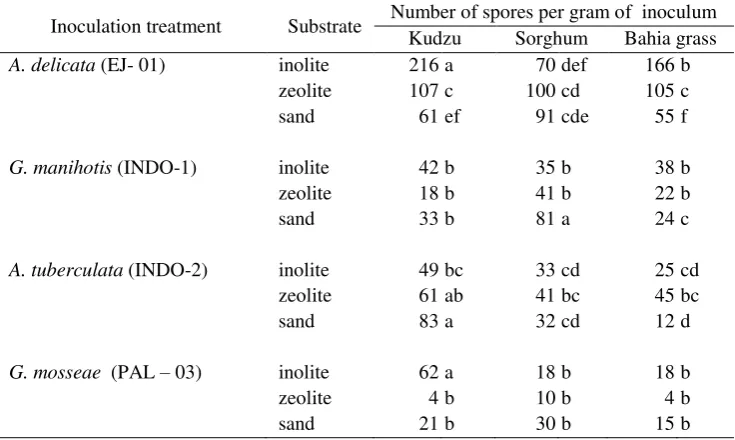
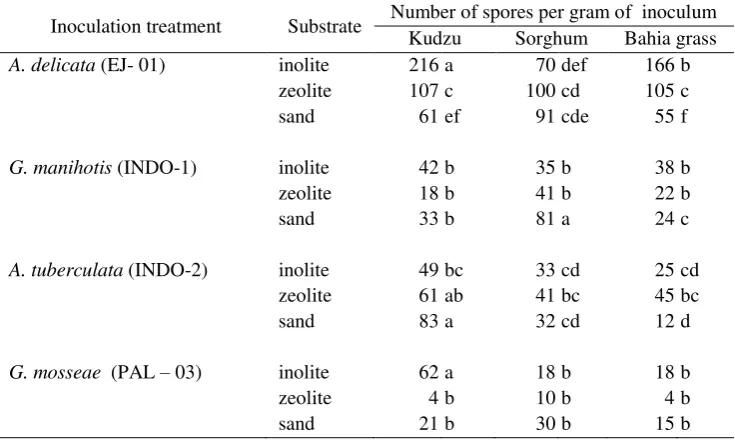
Table-5 The effect of substrates and host on the sporulation of Indonesian AMF
Inoculation treatment Substrate Number of spores per gram of inoculum
Kudzu Sorghum Bahia grass
A. delicata (EJ- 01) inolite 216 a 70 def 166 b
zeolite 107 c 100 cd 105 c
sand 61 ef 91 cde 55 f
G. manihotis (INDO-1) inolite 42 b 35 b 38 b
zeolite 18 b 41 b 22 b
sand 33 b 81 a 24 c
A. tuberculata (INDO-2) inolite 49 bc 33 cd 25 cd
zeolite 61 ab 41 bc 45 bc
sand 83 a 32 cd 12 d
G. mosseae (PAL – 03) inolite 62 a 18 b 18 b
zeolite 4 b 10 b 4 b
sand 21 b 30 b 15 b
Means followed by same letters within the columns and rows for each fungus are not significantly different at P < 0.05
Comparing the nine host-substrate treatments on spore production of G. manihotis, the highest spore densities (81 spores g-1 of substrate) were produced in the combination of sand-sorghum, whilst the lowest spore densities (24 spores g-1 of substrate) were produced in sand-bahia grass. No significant differences were observed between the rest of the treatments. The highest spore production of A. tuberculata was achieved either in sand-kudzu (83 spores g-1 of substrate) or in zeolite-kudzu (61 spores g-1 of substrate) combinations. Kudzu-inolite was significantly the best combination for producing spores of both A. delicata and G. mosseae
(i.e. 216 spores g-1 of substrate and 62 spores g-1 of substrate respectively). Combinations of sand and bahia grass were the two materials which had been previously used as a substrate medium and plant host respectively for establishing open pot cultures of AMF at the IUC-IPB in Indonesia. Table-5, shows that modification of this host-substrate combination can significantly increase the production of spores.
D I S C U S S I O N
l991); or the selection of host and soil medium or the growth room and greenhouse conditions may have been inappropriate (INVAM, l991; Dodd and Thomson, l994). To improve the success rate of pot-culturing of tropical AMF, the trapping of the indigenous propagules present in the soil to induce their sporulation prior to pot culture establishment is recommended (Dodd and Thomson, l994). To provide optimum conditions for the trap cultures, a suitable medium (substrate, nutrition and pH) and appropriate mycotrophic host plants is also recommended (INVAM, l991). Pot cultures of AMF can then be initiated using spores recovered from the trap cultures. Following consideration of these statements, it was decided to select different substrate mixes, to adjust the pH and to adapt culture procedures to tropical conditions.
Initial testing of twelve substrates, it was found that terragreen was the most suitable medium for both the growth of the host and for colonization by the tropical AMF. The main advantages in using this clay-based substrate for pot-culturing of AMF is the physical structure it possesses which promotes good aeration and root development, coupled with the adsorptive capacity of the clay. This latter property means that this substrate slowly releases added nutrients, particulary phosphate, thus reducing the need for frequent application of fertilizer.
The limited success in obtaining subcultures of tropical AMF using other soil-less media may be due in particular to the inappropriate pH of the medium and pH of water used for watering for both the growth of the host and colonization by AMF. Previous studies have shown the importance of medium pH for germination and establishment of AMF (INVAM, 1992). Some fungi particulary those isolated from tropical soil, prefer low pH conditions (Sieverding, 1991; Dodd, pers. comm.), whilst others may require alkaline conditions. For example, spore germination of Acaulospora laevis was optimum at pH 4.5 and this germination capacity was reduced by 10% in neutral or alkaline conditions (Hepper 1984). In contrast, some Glomus spp. have a neutral to alkaline pH for optimum germination (Siquera et al.,1984). Mixed soil-less substrates used in the experiment, except terragreen, had a pH greater than 7.4. This may mean that they were too alkaline for both growth of the host and of the indigenous AMF.
appropriate host, and with the pH adjusted to a value similar that of the soil of origin is recommended.
As a result of the early experiments, terragreen was chosen as a suitable substrate for culturing tropical AMF. There is a disadvantage, however, in using this substrate directly. The heterogenous nature of the particle size means that after some time most of the fine particles in the pot culture will accumulate in the bottom 1/3-1/2 of the pot. This can create an imbalance in water-availability down the pot, and the water capillarity from the base to the top is poor (INVAM, 1991). As a consequence the bottom portion of the pots are always wet and suffer from poor aeration. In addition, the fine particles may contain most of the easily accessible nutrients e.g. P (Dodd, pers. comm.). Thus untreated terragreen can be unsuitable for mycorrhizal root colonization and the length of root colonized may be limited. The inoculum quality, however, can be improved by using a homogenous large particle size. This can be achieved by sieving terragreen to remove the fine particles and collecting only the particles retained in a 1.4 mm mesh sieve. Further analysis of terragreen showed a high level of bicarbonate extractable-P (Wadham, pers. comm.) which could result in a poor level of colonization by certain AMF e.g. Scutellospora heterogama (Dodd, pers. comm).
Washing the terragreen (after sieving) and adding known nutrients using 1/2 strength Hoagland's solution minus P (INVAM, l990) improved the proportion of root length colonized and stimulated early sporulation of AMF. It was also noted that the trace element concentration in the Hoagland's solution recipe reported by INVAM (l990) was 10 fold higher that it should have been (INVAM, l991). This higher concentration, however, does not apparently cause any negative effect on the development of mycorrhizas. High concentrations of these trace elements and presence of MES {2-(N-Morpholino)ethanesulfonic acid} with sulphur-containing compounds, stimulated the mycelial development of G. manihotis (INDO-1) (Setiadi, 1996). It has been reported previously that some sulphur-containing compounds can stimulate the development of mycelium from spores of the AMF. For example, sulphite was shown to increase hyphal growth of some Glomus species (Andrade and Barea, l994), and application of potassium sulphite can increase in hyphal length by up to 20 times for Glomus
spp. (Hepper, 1986). Further investigation is required to determine whether the hyphal stimulation is due to the high concentration of trace elements or to the presence of MES or both.
Zeolite is an alternative and inert soil-less medium that is equivalent to terragreen. It is preferred for use in Indonesia because it is easy to obtain, the chemical and physical properties are relatively uniform (compared to soil), it is high in cation exchange capacity (thus reducing fertilizer inputs) has good aeration, and a good water retention capacity (compared with sand). Further research on increasing the sporulation of tropical AMF by manipulation of nutrient levels, and by using alternative hosts, in a zeolite medium is recommended.
concentrations in the bigger pots, may have resulted from substrate dilution, thus the number of spores per gram of inoculum was less.
Once the choice of appropriate host and medium had been determined, it was decided to modify culture methodology. A simple glass tube culture system for the establishment of pure pot-cultures of tropical indigenous AMF from single spores was devised (Setiadi, 1996). The test tube system described here has been shown to increase the success rate of initial AMF single spore culture establishment of AMF. The advantages of using this technique for starting pure pot cultures are:
(a) The system avoids spore detachment from the root, because there is no initial disturbance due to watering for at least 2 weeks.
(b) Plugging of the tube with cotton wool helps to prevent water loss and thus creates suitable conditions for spore germination.
(c) The tubes can be easily checked under the microscope for colonization without disturbing the roots.
(d) The small volume of the tube facilitates the spread of the mycelium between the roots. (e) Up to 40 new pure pot cultures can be generated from a single tube by inoculating
fragments (0.5-1 cm) of infected root from the colonized seedlings onto the root of appropriate host seedlings.
LITERATURES CITED
Andrade, G., and Barea, J.M. (1994). Germination and growth of Glomus clarum with maize (Zea mays. L.) under aseptic condition in minirhizotron. Abstract. 4th ESM. Estacion Experimental del Granada. pp. 129.
Becard, G., and Piche, Y. (l990). Physiological factors determining vesicular-arbuscular mycorrhizal formation in host and non host Ri T-DNA transformed roots. Can. J. Bot.
68, 1260-1264.
Becard, G., and Piche, Y. (l992). Establishment of vesicular arbuscular mycorrhiza in root organ culture: Review and proposed methodology.. InMethods in Microbiology. Vol 24. (Norris, J.R. Read, D.J. and Varma, A.K.,eds). Academic Press. London. pp 89-108 Dehne,H.W., and Backhaus, G.F. (1986). The use of vesicular- arbuscular mycorrhizal in
plant production. I. Inoculum production. J. Plant Dis. Protec. 93, 415-424.
Dodd, J.C., and Thomson, B.D. (1994). The screening and selection of inoculant arbuscular mycorrhizal and ectomycorrhizal fungi. Plant Soil 159, 149-158.
Douds, D.D., and Schenck, (1990). Increased sporulation of vesicular- arbuscular mycorrhizal fungi by manipulation of nutrient regimes. Appl. Environ. Microbiol. 56, 413-418.
Elmes, R.P., Hepper, C.M., Hayman, D.S., and O’Shea, J. (1983). The use of vesicular
arbuscular mycorrhizal roots grown by the nutrient film technique as inoculum for field sites. Ann. Appl. Biol. 104, 437-441.
Feldmann, F., and Idczak, E. (1992). Inoculum production of vesicular-arbuscular mycorrhizal fungi for use in tropical nursery. InMethods in Microbiology. Vol 24. (Norris, J.R., Read, D.J., and Varma, A.K., eds). Academic press. London. pp 1-21.
Hepper, C.M. (1984). Isolation and culture of mycorrhizal (VAM) fungi. In VA Mycorrhizae. (Powell, C.L. and Bagyaraj, D.J., eds). CRS Press. Boca Raton, Florida. pp. 95-125.
Hepper, C.M. (1986). Growth of hyphae from Glomus spores in the presence of sulphur-containing compounds. pp. 527-530. Abstract 1st ESM. Dijon. INRA.
Hung, L.L., and Sylvia, D.M. (1988). Production of vesicular-arbuscular mycorrhizal fungus inoculum in aeroponic culture. Appl. Environ. Microbiol. 54, 353-357.
Hung, L.L., Okeefe, D.M., and Sylvia, D.M. (1991). Use of a hydrogel as a sticking agent and carrier of vesicular-arbuscular mycorrhizal fungi. Mycol Res 95, 427-429.
Invam, (1990). INVAM Newsletter. Vol 1(1),p 12.
Invam, (1991). INVAM Newsletter. Vol 1(2),p 12. Invam, (1992). INVAM Newsletter. Vol 2(1),p 5.
Piche, Y., Simon, L., and Segun, A. (1994). Genetic manipulation in vesicular-arbuscular fungi. In Management of Mycorrhizas in Agriculture, Horticulture and Forestry. (Robson, A.D., Abbott, L.K., and Malajczuk, N.,eds). Kluwer Academic Publ. Netherlands. pp 171-178
Jeffries, P., and Dodd, J.C. (1991). The use of mycorrhizal inoculants in forestry and agriculture. InHandbook of Applied Mycology: Soil and Plants. Vol 1. (Arora, D.K. Rai, B. Mukerji, K.G. Knudsen, G.R., eds). Marcel Dekker, New York. pp 155-186.
Setiadi,Y. 1996. Working with Arbuscular-mycorrhizal fungi for tropical condtions. Inter University Report. Unpublished
Sieverding, E. (1991). Vesicular-Arbuscular Mycorrhizal Management in Tropical Agrosystems. (GTZ). Federal Republic of Germany. pp. 371.
Siquera, J.O., Hubbell, H., and Mahmud, A.W. (1984). Effect of liming on spore germination, germ tube growth and root colonization by vesicular-arbuscular fungi. Plant Soil 76, 115-124.
Strullu, D.G., and Plenchette, C. (1991). The entrapment of Glomus sp. in alginate beads and their use as root inoculum. Mycol Res 95, 1194-1196.
Sylvia, D.M., and Jarstfer. A.G. (1992). Sheared-root inocula of vesicular-arbuscular mycorrhizal fungi. Appl. Environ. Microbiol 58 , 229-232.
Sylvia, D.M., and Jarstfer, A.G. (1994). Production of inoculum and inoculation with arbuscular mycorrhizal fungi. In Management of Mycorrhizas in Agriculture, Horticulture and Forestry. (Robson, A.D, Abbott, L.K. and Malajczuk, N., eds). Kluwer Academic Publ. Netherlands. pp 231-238.
Williams, P.G. (1992). Axenic culture of arbuscular mycorrhizal fungi. In Methods in Microbiology. Vol 24. (Norris, J.R., Read, D.J., and Varma, A.K., eds). Academic Press. London. pp 203-220
Trop. For. Manage. J. VIII (1) : 51-64 (2002)
MYCORRHIZAL INOCULUM PRODUCTION TECHNIQUE FOR
LAND REHABILITATION
Teknik Produksi Inokulum Mikoriza Untuk Rehabilitasi Lahan
YADI SETIADI1)
ABSTRAK
Spora cendawan mikoriza arbuskula (CMA) telah dikoleksi dan diisolasi dari berbagai jenis tanah masam berfikasi P-tinggi di Indonesia. Lima isolate CMA lokal telah berhasil diperoleh dari
spora tunggal dengan teknik “test tube culture” dan dikembangkan-biakan dengan sistem “open pot
culture”. Kelima isolate tersebut adalah Acaulospora delicata (EJ-01). Acaulospora tuberculata (INDO-2), Glomus manihotis (INDO-1), Glomus mosseae (PAL-03) dan Entrophospora colombiana (LAM-36). Kelima biakan isolate CMA tersebut, dipelihara dengan tanaman inang Kudzu pada media zeolit yang diperkaya nutrisi. Dengan mempelajari berbagai tipe media, ukuran partikel, pH dan komposisi nutrisi, isolate CMA terpilih telah berhasil dapat diperbanyak dalam skala industri dengan menggunakan inang sorghum. Dengan tehnik pra-inokulasi di persemaiaan maka penggunaan mikoriza dalam skala besar di bidang kehutanan dapat direalisasikan.
INTRODUCTION
The novel functions of Arbuscular Mycorrhizal Fungi (AMF) as biological agent for improving growth and health of plants and help early seedling establishment on degraded reforestation sites are recognized. Most tree species in tropical regions are colonized by mycorrhizal fungi, however, the exploitation of these potential benefits of AMF has yet to be widely adopted, and they are not yet used as part of standard silviculture management in Indonesia. This may be related to the limited availability of inoculum of AMF and the lack of data demonstrating a benefit from large scale application of AMF inoculum in the field.
Arbuscular mycorrhizal fungi (AMF) are obligate biotrophs, and although several attempts at axenic culturing of these fungi have been made, sustained axenic culture has not yet been achieved (Piche et al., 1994). Thus they cannot be multiplied on artificial media without a living host (Sieverding, 1991). For reproduction, these fungi depend on a supply of photosynthate from the host plant or on Ri T-DNA-transformed root components when the roots are grown meristimatically on artificial growth media under axenic conditions ( Becard and Piche, 1990; Williams,1992).
Nevertheless, several techniques for producing and formulating inoculum of AMF in dual culture with plant hosts are now available i.e. aeroponic cultures (Hung and Sylvia, l988), nutrient film techniques (Elmes et al., 1983), Ri T-DNA transformed roots (Williams, 1992),
1)
alginate beads (Strullu and Plenchette, 1991), and hydrogels (Hung et al., 1991). The culturing of AMF on plants grown in disinfected soil or in inert soil-less media, however, remains the most frequently used technique (Feldmann and Idczak,1992; Sylvia and Jarstfer,1994).
Soil-less cultures can be used to produce high quality inoculum of AMF, with a propagule number much greater than that achieved in the soil-based methods used in the past. Using soil-less media also avoids the need for sterilization of the media necessary to remove detrimental organisms, and also allows better control over the physical and chemical characteristics of the growth media. Soil-less media are more uniform in composition, and better aeration is often possible compared with soil (Sylvia and Jarstfer, 1994).
Limited success in the propagation of tropical AMF has frequently be reported and this is often due to an inappropriate selection of host and medium, or the use of unsuitable environmental conditions (Dodd and Thompson, 1994). The current procedures for the establishment of pure pot cultures of AMF have mainly been developed for temperate species collected from soils of neutral pH with moderate to high fertility. The adoption of similar procedures for the culture of AMF collected from tropical conditions (especially from acidic poor soils) is not always satisfactory.
This paper explained the practical procedure for bulking up of mycorrhizal inoculum for tropical conditions, that may be used for reforestation activities, thus application of mycorrhizal inoculum as an alternative low input technology for rehabilita-ted degraded forest can be recommended.
MATERIALS AND METHOD
Tube Culture Establishment
Spore preparation
Spores of tropical AMF were extracted by wet sieving and decanting from kudzu (Pueraria javanica) pot cultures. Under a dissecting microscope, apparently healthy spores were selected, and transferred into a small Petri dish (3 cm diam). While transferring the spores, transference of debris such as fine colonised roots, small fragments of hyphae, and organic matter was avoided, as this can introduce other AMF as contaminants. Spores were then surface-sterilized with 0.05% (w/v) sodium hypochlorite for 3 min and washed in several changes of distilled water.
Seed germination and inoculation
A single surface-sterilized spore was then placed near the root tip of kudzu, or on the roots of bahia grass using fine forceps. This procedure was carried out under the dissecting microscope (x40 magnification) to ensure the spores were clearly placed near the root tips.
Culturing in test tubes
Large test tubes (2 cm diam x 15 cm length) were partially filled with 13 g of sieved (1.4 mm mesh sieve) terragreen. This media was moistened with 12 ml half-strength Hoaglands (-P) solution which had been adjusted to a pH similar to that of the original soil from which the AMF originated. The tubes were then steam-sterilized at 121 oC for 15 min. After the tube had cooled, inoculated seedlings were transplanted into each test tube by placing the seedling between the glass and substrate. The tubes were then plugged with cotton wool and the rooting zone covered in aluminium foil. The tubes were placed in the growth room (temp 20oC, PAR 300 mol m-2 s-1, with continuous light) for two weeks before being transferred to the greenhouse for a further 4-6 weeks under ambient tropical conditions. The tubes were re-moistened every two weeks by gently removing the cotton wool plug and pipetting 5 ml of sterile water onto the growth medium.
Checking the rate of colonization by AMF
Two to three weeks after inoculation, root colonization was checked by opening the foil and exposing the root zone. The unopened tubes were directly examined under a dissecting microscope, and root colonization was recognized by observing the presence of extramatrical mycelium near the root or on the glass surface. After 6-8 weeks in the glass tube, the colonized roots of seedlings were checked by removing them from the tube and examining them under a dissecting microscope. Those confirmed to have extramatrical mycelium of AMF were transplanted into open pot cultures in the greenhouse as described below.
Pot culture Establishment
Substrate preparation
In earlier work, untreated terragreen had been used successfully for culturing tropical AMF. The particle sizes of this substrate, however, are heterogenous. In order to improve the homogeneity, the substrate was sieved through a 1.4 mm mesh. Particles retained in the sieve were then used as a substrate for culturing tropical AMF. To remove any remaining fine particles (which also contain a high level of plant-available nutrients), the substrate was washed in running water until the wash water was clean. It was discovered that the nutrient content of terragreen after washing was not sufficient to support the growth of the host plant as well as supporting mycorrhizal development. To overcome this deficiency, the terragreen was soaked overnight in half-strength Hoagland's solution minus-P (INVAM, 1991) with the pH of the solution adjusted as described previously.
Harvesting of tube cultures and potting cultures establishment
After 6-8 weeks growth in the test tube, colonized seedlings were harvested in one of two ways. Firstly, by direct transplanting, after shaking the tube and gently removing the whole seedling using forceps. Each seedling was then transplanted into a plastic pot (capacity 150 ml) containing moistened treated terragreen. The second technique involved the harvesting of the colonized roots of the seedling. The contents of the tube were allowed to dry, and were then shaken out, and the entire root of the seedling was placed in a petri dish and carefully washed to remove the adherent particles. It was then transferred into another Petri dish containing distilled water and examined under a dissecting microscope. Colonized roots with mycelium and young spores were selected and cut into 1-2 fragments. These fragments were used as inoculum for starting new pot cultures of AMF. Two pieces of root fragments were inoculated onto roots of one-week old bahia grass or kudzu seedlings, then transplanted into plastic pots contained treated terragreen (capacity 150 ml).
Maintaining pot cultures and harvesting inoculum of AMF as starter
The pots containing inoculated plants were placed in the greenhouse. Nutrients were added every week using 25 mls half-strength Hoagland's solution (-P) per pot, in addition to daily watering. One month after inoculation, root colonization and culture purity were checked by taking a small root sample and placing it into a Petri dish and checking for the presence of extramatrical hyphae under a dissecting microscope. Plants which had good colonization and were free of contamination were carefully taken out. The ends of the roots were trimmed before each plant was re-potted into bigger plastic pots (capacity 0.6-3 L) containing treated terragreen. They were maintained for a further 2-3 months in the greenhouse. After this period the plant shoots were pruned, and the substrate allowed to dry in situ for one week. The substrate containing roots and spores was then ready for use as STARTER inoculum. This inoculum was used as starter for bulking-up tropical AMF inoculum.
Bulking-up of Inoculum of Tropical AMF
colonization, transplanting to bigger plastic pots (capacity 1 L), drying and harvesting (after 4 months), were carried out as previously described.
Effect of Different Host and Medium Combinations on Sporulation of Tropical AMF
To improve inoculum production, different combination of host and local medium was tested following procedure above.
Inoculum preparation
The colonized roots were harvested and separated from the starter inoculum and cut into small (0.5-1 cm length) fragments for use as inoculum in this experiment.
Substrate preparation
Three different local substrates, zeolite, inolite and river sand were sieved, washed and fertilized with VITAFEED-102, then pasteurised. The prepared substrates were then placed in 250 ml plastic cups.
Seed germination and pre-transplant inoculation
Plastic boxes (24 cm long, 15 cm wide and 6.5 cm deep) were filled with pasteurized zeolite to a depth of 3 cm. To permit drainage, 6 holes (diam 4 mm) were made in the base of the box. The chopped root inoculum was evenly spread over the surface of the zeolite and then a further 2 cm depth of zeolite was placed over it. This was used as the seed bed on which seeds of kudzu, bahia grass or sorghum were germinated.
Potting and maintenance
Two-week-old seedlings of bahia grass, kudzu and sorghum were gently removed from the seed bed using sterile forceps, and transferred to Petri dishes containing distilled water. The roots of each seedling were checked under a dissecting microscope for the presence of extramatrical hyphae. Colonized seedlings were transplanted into 250 ml plastic cups containing either treated zeolite, inolite or river sand previously moistened with VITAFEED-102 solution. Pots were placed in the laboratory at room temperature for 3 days before being laced in the greenhouse at the Faculty of Forestry IPB,Bogor. Every week, the plants were fertilized with 25 ml of VITAFEED-102 solution, in addition to daily watering.
Data collection and analysis
extracted by wet-sieving and decanting and transferred to a Petri dish on which a gridline scale had been previously marked on the base. They were then counted under a dissecting microscope. Only free spores were counted which may lead to an underestimate for spores of
G. clarum (CLAR-17) and G. manihotis (INDO-1) which can also be formed inside the roots. Counts of spore numbers were subjected to ANOVA and the treatment means were further separated by Duncan's multiple range test (DMRT) for the significant differences at P< 0.05.
R E S U L T S
Test tube Culture Technique
By using the test tube culture techniques (Setiadi, 1996), three species of indigenous AMF i.e. G. manihotis (INDO-2), A. tuberculata (INDO-2), G. mosseae (PAL-03) and one species of exotic AMF G.clarum (CLAR-17) were successfully obtained in pure pot-culture. The success rate (number of tubes colonized) using this technique varied according to the isolates and the host (see Table-1). Using bahia grass as a host, 80% of the plants in tubes inoculated with G. manihotis were colonized, whilst the corresponding figure for A. tuberculata was 55%, for G. mosseae it was 45%, and for G. clarum it was 70%. However, if kudzu was used as the host the success rate was reduced i.e. for G. manihotis, 25% success, for A. tuberculata 15% and for G. mosseae 10%. Single-spore cultures of A. delicata failed to establish using this technique both on bahia grass and on kudzu. To check the suitability of the test tube technique as a culture system of AMF, multispore (20 spores per plant) cultures were also tested. The success rate using multispore inoculum was increased relative to single spore inoculum for each fungus tested using either host (see Table-1). A 100% success rate was achieved for both G. manihotis and A. tuberculata cultured on either kudzu or bahia grass. A success rate of 100% was also achieved for G. clarum cultured on bahia grass. For G. mosseae
cultured on bahia grass and kudzu the success rates were 60% and 20% respectively.
Although the culturing attempts for A. delicata using single spores failed, when multispores were used the success rate was increased to 40% on bahia grass and 20% in kudzu. In general, in all the attempts at culturing of single or multispore inoculum, the number of host plants of bahia grass colonized was higher than for kudzu, for each fungus tested.
Table-1. Number of successful cultures for single and multispore attempts using AMF in test tube cultures using kudzu or bahia grass as a host
Culture type Host
Number of Plant Colonized/Number of Plant Inoculated
CLAR-17 INDO-1 INDO-2 EJ-01 PAL
Single spores bahia grass 15/19 16/20 11/20 0/20 9/20
kudzu ND 5/20 3/20 0/20 2/20
Multi-spores bahia grass 10/10 10/10 10/10 4/10 6/10
kudzu ND 10/10 10/10 2/10 2/10
Starter Inoculum Development
Starter inoculum was initiated by transferring a colonized seedling from the test tube into an open pot (150 ml). The success rates after transplanting, either from direct transplanting or by using colonized roots of the seedlings are presented in Table-3. Using colonized roots, a success rate of 100% was achieved for isolates INDO-1, INDO-2, EJ-01 and PAL-03 either using bahia grass or kudzu. A success rate of 100% was also achieved for isolate CLAR-17 on bahia grass. However, a lower success rate was obtained when direct transplanting was used. For example a success rate of 90% was obtained for isolate INDO-1 using bahia grass as a host and 40% using kudzu as a host. For isolate INDO-2, the corresponding values were 60% for bahia grass and 40% for kudzu. The cultures established on these hosts (as shown in Table-3) were maintained as starter cultures to be bulked-up. In general, the success rate when transferring colonized plants (from the test tube) using colonized roots of either host was higher than for direct transplanting. But, when direct transplanting was carried out, higher success rates were obtained for bahia grass than for kudzu. It was also noted that in acid media (pH 4.3-6.4), bahia grass grew relatively better than kudzu, but in alkaline media (pH 7.2-8.2) kudzu grew more strongly than bahia grass (Table- 2)
Table- 2. Comparison of bahia grass and kudzu for culturing tropical AMF isolates
Cultural Practices Tropical AMF Host
Kudzu Bahia grass
Growth on acid media ( pH 4.3-6.4) ++ +++
Growth on alkaline media ( pH 7.2-8.2 +++ +
Relative drought tolerance +++ ++
Relative high temperature tolerance ++ +++
Germination treatment necessary yes no
Time for seed to germinate 3-6 days 8-14 days
Seed viability after storage high-moderate low-very low
Need Rhizobium symbiont yes no
Maintenance inputs medium low
Sensitivity to spider mites in greenhouse high low
Note: ‘+’ is intended to be indicative of comparative relative values
Bulking-up of Tropical AMF Inoculum
density of spores of each AMF isolate produced in bigger pots using kudzu as a host, were always higher than those obtained on bahia grass but these differences were not significant.
Table- 3. Number of successful cultures establishment following transfer of tropical AMF by direct transplanting or by using colonized roots
Host Transfer
Technique
Number of Plants Colonized/Number of Plants Inoculated
INDO-1 INDO-2 EJ-01 PAL-03 CLAR
Bahiagrass Direct 9/10 6/10 ND ND ND
Root 10/10 10/10 10/10 10/10 10/10
Kudzu Direct 4/10 4/10 ND ND ND
Root 10/10 10/10 10/10 10/10 ND
ND = no data
Table-4. Number of spores of AMF per 25g inoculum, after bulking-up in 250 ml and 1000 ml pots containing zeolite using kudzu or bahia grass as hosts
AMF Species Host Pot Size
250 ml 1000 ml
G.manihotis (INDO-1) bahia grass 580 a 263 a
kudzu 671 a 272 a
A.tuberculata (INDO-2) bahia grass 782 a 226 a
kudzu 834 a 273 a
G.mosseae (PAL-03) bahia grass 279 a 84 a
kudzu 158 a 125 a
A.delicata (EJ-01) bahia grass 1068 a 555 a
kudzu 992 a 657 a
G.clarum (Clar-17) bahia grass 239 a 75 a
kudzu 304 a 87 a
Means with the same letter within columns of each isolate of AMF are not significantly different at P< 0.05
Effect of Different Host and Medium Combinations on Sporulation of Indonesian AMF
Table-5 The effect of substrates and host on the sporulation of Indonesian AMF
Inoculation treatment Substrate Number of spores per gram of inoculum
Kudzu Sorghum Bahia grass
A. delicata (EJ- 01) inolite 216 a 70 def 166 b
zeolite 107 c 100 cd 105 c
sand 61 ef 91 cde 55 f
G. manihotis (INDO-1) inolite 42 b 35 b 38 b
zeolite 18 b 41 b 22 b
sand 33 b 81 a 24 c
A. tuberculata (INDO-2) inolite 49 bc 33 cd 25 cd
zeolite 61 ab 41 bc 45 bc
sand 83 a 32 cd 12 d
G. mosseae (PAL – 03) inolite 62 a 18 b 18 b
zeolite 4 b 10 b 4 b
sand 21 b 30 b 15 b
Means followed by same letters within the columns and rows for each fungus are not significantly different at P < 0.05
Comparing the nine host-substrate treatments on spore production of G. manihotis, the highest spore densities (81 spores g-1 of substrate) were produced in the combination of sand-sorghum, whilst the lowest spore densities (24 spores g-1 of substrate) were produced in sand-bahia grass. No significant differences were observed between the rest of the treatments. The highest spore production of A. tuberculata was achieved either in sand-kudzu (83 spores g-1 of substrate) or in zeolite-kudzu (61 spores g-1 of substrate) combinations. Kudzu-inolite was significantly the best combination for producing spores of both A. delicata and G. mosseae
(i.e. 216 spores g-1 of substrate and 62 spores g-1 of substrate respectively). Combinations of sand and bahia grass were the two materials which had been previously used as a substrate medium and plant host respectively for establishing open pot cultures of AMF at the IUC-IPB in Indonesia. Table-5, shows that modification of this host-substrate combination can significantly increase the production of spores.
D I S C U S S I O N
l991); or the selection of host and soil medium or the growth room and greenhouse conditions may have been inappropriate (INVAM, l991; Dodd and Thomson, l994). To improve the success rate of pot-culturing of tropical AMF, the trapping of the indigenous propagules present in the soil to induce their sporulation prior to pot culture establishment is recommended (Dodd and Thomson, l994). To provide optimum conditions for the trap cultures, a suitable medium (substrate, nutrition and pH) and appropriate mycotrophic host plants is also recommended (INVAM, l991). Pot cultures of AMF can then be initiated using spores recovered from the trap cultures. Following consideration of these statements, it was decided to select different substrate mixes, to adjust the pH and to adapt culture procedures to tropical conditions.
Initial testing of twelve substrates, it was found that terragreen was the most suitable medium for both the growth of the host and for colonization by the tropical AMF. The main advantages in using this clay-based substrate for pot-culturing of AMF is the physical structure it possesses which promotes good aeration and root development, coupled with the adsorptive capacity of the clay. This latter property means that this substrate slowly releases added nutrients, particulary phosphate, thus reducing the need for frequent application of fertilizer.
The limited success in obtaining subcultures of tropical AMF using other soil-less media may be due in particular to the inappropriate pH of the medium and pH of water used for watering for both the growth of the host and colonization by AMF. Previous studies have shown the importance of medium pH for germination and establishment of AMF (INVAM, 1992). Some fungi particulary those isolated from tropical soil, prefer low pH conditions (Sieverding, 1991; Dodd, pers. comm.), whilst others may require alkaline conditions. For example, spore germination of Acaulospora laevis was optimum at pH 4.5 and this germination capacity was reduced by 10% in neutral or alkaline conditions (Hepper 1984). In contrast, some Glomus spp. have a neutral to alkaline pH for optimum germination (Siquera et al.,1984). Mixed soil-less substrates used in the experiment, except terragreen, had a pH greater than 7.4. This may mean that they were too alkaline for both growth of the host and of the indigenous AMF.