The level of
Escherichia coli
contamination in foods and drinks sold at canteens
campus
Dewi Susanna,1 Tris Eryando,2 Yvonne M. Indrawani3
1 Department of Environmental Health, Faculty of Public Health, University of Indonesia, Depok Campus, Jawa Barat, Indonesia 2 Department of Biostatistics and Health Informatic, Faculty of Public Health, University of Indonesia, Depok Campus, Jawa Barat,
Indonesia
3 Department of Nutrition, Faculty of Public Health, University of Indonesia, Depok Campus, Jawa Barat, Indonesia
Abstrak
Latar belakang: Kontaminasi bakterial pada makanan yang disediakan di kantin kampus merupakan hal yang sering terjadi dan dapat mengganggu aktivitas akademik. Penelitian ini bertujuan mengetahui tingkatan kontaminasi Escherichia coli pada makanan dan minuman yang dijajakan di kantin sebuah kampus universitas.
Metode: Sebanyak 49 makanan dan 24 jenis minuman diperiksa dengan menggunakan metode konvensional untuk pengukuran Most Probable Number (MPN), yaitu uji penduga, uji penguat, dan uji pelengkap. Analisis kontaminasi pada makanan dan minuman dilakukan di Laboratorium Kesehatan Lingkungan Fakultas Kesehatan Masyarakat Universitas Indonesia. Analisis data dengan membuat tingkatan kontaminasi berdasarkan kelompok makanan dan minuman serta lokasi kantin.
Hasil: Hampir semua kelompok makanan terkontaminasi. Makanan dengan sambal adalah makanan yang paling berisiko untuk terkontaminasi E. coli (90,15 %), diikuti oleh makanan kering, sedangkan makanan berkuah adalah yang paling kecil risikonya (38,89%). Minuman yang paling tinggi kontaminasinya adalah jus lacy, diikuti oleh jus jambu, lalu jus sirsak dan orange di peringkat ketiga, sementara jus mangga kontaminas nya terendah. Jus melon, cappucino dan coctail tidak menunjukkan adanya kontaminasi.
Kesimpulan: Makanan dan minuman yang ditemukan pada tiga lokasi yang menduduki urutan tertinggi disebabkan oleh terkontaminasinya alat makan dan tangan penjamah makanan. (Med J Indones 2011; 20:66-70)
Abstract
Background: Bacterial contamination is a common phenomenon in foods served in campus canteens and my cause physical illness which will affect academic activity. The aim of this study was to rank the level of Escherichia coli contamination in food and drink in campus canteens.
Methods: Forty nine (49) foods and 24 types of drink were examined using conventional agar broth method for calculation of most probable number (MPN). The steps of the mothod were presumptive test for coliforms, fecal coliforms and E. coli, confi rmes test for coliforms, fecal coli and E. coli and then completed test for E. coli. An analysis for contamination by E. coliin meals, utensils, and on the hands of the server was also undertaken. The data analyzed in percentage and rank all type of foods and drinks, also rank based on the location.
Results: Almost all type of meals was contaminated. Meals with chili sauce were the most risky from the contamination of E. coli (90.15 %), then followed by dry meals (38.89%), while the wet meals were the the most unrisky meals. In drinks, the highest was lacy juice, followed by jambu (guava) juice, then Sirsak and Orange juices on the third rank, while the mango juice was the lowest contamination. Melon juice, cappucino and fruit-coctail did not have E. coli contamination.
Conclusion: The contamination in the top three rank of contamination could be from the utensils used and foodhandler. (Med J Indones 2011; 20:66-70)
Key words:campus, canteen, drink, Escherichia coli, food
Correspondence email to: [email protected]
Meals that served for university members in campus, mainly served in canteen and some by group of mobile eatery in the area of the campus, which organized or not by the faculty management. Meals contamination may cause physical illness, which related to productivity of the costumers, and will affect the academic activity. The previous studies in the same area found that there were quite low in knowledge on food hygiene and sanitation of the food handlers.1,2
as well as the materials and utensils used, since they are all related to the so called food-borne diseases. Some physical illness that related to hygiene and sanitation of the meals are diarrhea, gastroenteritis and poisoning. 3
The Decree of Ministry of Health no.715/MENKES/ SK/V/2003 mentioned that it is necessary to control food, people, place and the utensil uses to avoid possible hazards or illness. The decree also mentioned that every eatery or canteen need to have the licence from local government, and for the hygiene and sanitation aspect has to be certifi ed by the local health offi ce. The workers in the canteen has their own health standard, since they related directly to the foods and the instruments that served to the costumers, so they have to possess health and chef certifi cate, but sometimes is neglected especially in small canteens.
There are limited number of information and literature on food hygiene and sanitation and so are researches in this related area in Indonesia. Survey in Three type of food establishment in Jakarta in 2003 study found that E. coli contamination in served cooked, fresh cooked food, and raw food were 12.2 %, 7.5 %, and 40 % respectively. Contamination also found in water, food handlers and kitchen utensil with various percentage, they were 12.9 %, 12.5 %, and 16.9 %.4 In an outbreak in Bogor (2005), E. coli found in raw meat and beefsteak seemed to be causative organism. 5
The source of E. coli contamination might be from meat, milk, water, and food handlers. It have been proven that all meat (100%) coming from abattoirs and traditional markets were contaminated with E. coli O157:H7, in addition to most of the fresh and pasteurized milk samples (73.3%) coming from cattle ranches and home industries. Contamination was also found in most of the water samples (60%) and in food handlers (41.7%).6
Another study showed that there are more or les around 35 types of common bacteria exist in foods, some of them are Bacillus, Camphylobacter, Clostridium, Escherichia, Salmonella, Shigella, and Staphylococcus.7 One of the strains of E. coli is E. coli O157:H7. The contamination of E. coli O157:H7 will risk people with diarrhea and could lead to hemorrhagic colitis, hemolytic uremic syndrome (HUS), and thrombotic thrombocytopenic purpura (TTP), which is quite dangerous to human body.
Canteen costumers in a campus are mostly students, and they prefer to get cheap meals. The problem then is not about cheap or expensive meals, but the most
important aspect is whether these meals are healthy or save to be consumed. During fi rst to fourth semester 2006, gastroenteritis was put at the second position of the ten diseases in University of Indonesia, although moved from 2 to 3 in fi rst semester 2007. In order to know the contaminating bacteria and to guarantee that the foods and or drinks served by canteens are healthy, measuring the presence Escherichia coli in food and drinks is needed. The objective of this study was to measure the existence of E. coli in all type of foods sold in canteens around the campus of University of Indonesia.
METHODS
This was a cross-sectional study, conducted around campus of University ‘X’ (this is a university’s initial), between 2007 and 2008. Thirteen canteens around the Depok Campus of University of Indonesia were observed for the presence of E. coli in meals served in each canteen. For ethical purposes, the real name of the canteens was given by the initial names. Those were A for canteen from Faculty of Mathematic and Sciences, B for Faculty of Engineering, C for Faculty of Law, D for Faculty of Economic, E for Faculty of Psychology, F for Faculty of Humanities, G for Faculty of Social and Politics Science, H for Faculty of Public Health, I Faculty of Nursing, J for Faculty of Computer Science, K canteen next to the Tower, and fi nally L for Rectorate’s canteen. There were 4 category of foods observed and analyzed: dry foods where no water added in the meals, wet foods, and food with sambal (chili) and sambals itself. Food mixture with sambal is kind of traditional meals; named as gado-gado, pecel, karedok, siomay, which contain vegetables added or mixed with sambal (mix of chili, peanut, onion, garlic, sugar, and salt). A total of 49 type of foods were sampled, consisted of 18 dry food, 14 wet food, 9 food with sambal mixture or poured, and 8 type of sambals that used in many different type of meals. Twenty four types of drink were also examined, which consisted of 16 juices, 4 iced teas, and others. An analysis for contamination by E. coli in meals, utensils, and on the hands of the server was also undertaken. Each sample measured in food and drink, in the utensil used for preparation and serving, and on the hand of the food handlers.
rank of each category of meal for all type of foods, also made rank based on the location where the samples were come from with symbolic letters from A to M (13 locations).
Colonies of the bacteria were calculated using formula;
N =
Where;
N: number of colonies per mL or gram sample p: solution ratio
s: volume (mL) or weight of the sample in grams
RESULTS
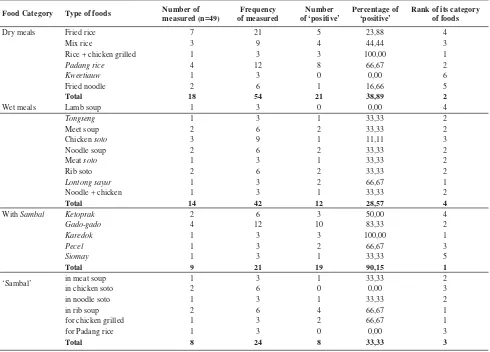
Totally there were 49 types of foods that divided into 4 categories. The examination found that almost all type
s p petridish
colony
å
´1of meals from eah canteen were contaminated by E. coli. Meals with sambal were the most risky from the contamination of E.coli (90,15 %), then followed by dry meals (38,89%), while the wet meals were the the most unrisky meals.
For the dry meals, rice with chicken grilled has the highest contamination of E. coli, whereas Kweetiauw was the lowest. Lontong sayur was in the fi rst rank of E.coli contamination in wet meals, while the lowest contamination was lamb soup. In food with sambal, karedok, gado-gado, pecel, and ketoprak were the type of foods with higher contamination compared with siomay. At last, the sambal in rib soup and in chicken grilled were riskier than others type of sambals from 13 canteens around Campus. (Table 1)
Table 2 shows the rank of ‘positive’ percent of E. coli in drinks per mL from 13 canteens around campus, 2008.
Food Category Type of foods Number of
measured (n=49)
Frequency of measured
Number of ‘positive’
Percentage of ‘positive’
Rank of its category of foods
Dry meals Fried rice 7 21 5 23,88 4
Mix rice 3 9 4 44,44 3
Rice + chicken grilled 1 3 3 100,00 1
Padang rice 4 12 8 66,67 2
Kweetiauw 1 3 0 0,00 6
Fried noodle 2 6 1 16,66 5
Total 18 54 21 38,89 2
Wet meals Lamb soup 1 3 0 0,00 4
Tongseng 1 3 1 33,33 2
Meet soup 2 6 2 33,33 2
Chicken soto 3 9 1 11,11 3
Noodle soup 2 6 2 33,33 2
Meat soto 1 3 1 33,33 2
Rib soto 2 6 2 33,33 2
Lontong sayur 1 3 2 66,67 1
Noodle + chicken 1 3 1 33,33 2
Total 14 42 12 28,57 4
With Sambal Ketoprak 2 6 3 50,00 4
Gado-gado 4 12 10 83,33 2
Karedok 1 3 3 100,00 1
Pecel 1 3 2 66,67 3
Siomay 1 3 1 33,33 5
Total 9 21 19 90,15 1
‘Sambal’ in meat soup 1 3 1 33,33 2
in chicken soto 2 6 0 0,00 3
in noodle soto 1 3 1 33,33 2
in rib soup 2 6 4 66,67 1
for chicken grilled 1 3 2 66,67 1
for Padang rice 1 3 0 0,00 3
Total 8 24 8 33,33 3
Frequency of measured: in food, utensil, and food handler
The highest E. coli contamination was Lacy juice, followed by Guava juice, while the Mango juice was the lowest. Although Sour sop, Guava and Orange juices had a same percentage, here, they were given different rank because the number of samples undertaken was different. Since Jambu juice had more samples than
Sour sop and Orange, it is higher in rank, so Sour sop and Orange had the same lower rank because they had the same samples. Melon juice, cappucino and fruit-coctail did not have a rank because they were not E. coli contamination.
Drink Category Type of drink Number of
measured (n=24)
Frequency of measured
Number of ‘positive’
Percentage of ‘positive’
Rank of its category of drinks
Juice Mango 4 12 4 25 6
Sour sop 2 6 4 67 3
Guava 4 12 8 67 2
Orange 2 6 4 67 3
Avocado 4 12 6 50 4
Lacy 1 3 3 100 1
Melon 1 3 0 0
-Iced Tea 4 12 4 33 5
Others Cappuccino 1 3 0 0
-Fruit-cocktail 1 3 0 0
-Total 24 72 33 46
Frequency of measured: in food, utensil, and food handler
Tabel 2. The rank of ‘positive’ percentage of E. coli in drinks (per mL) from 13 canteens around campus, 2008
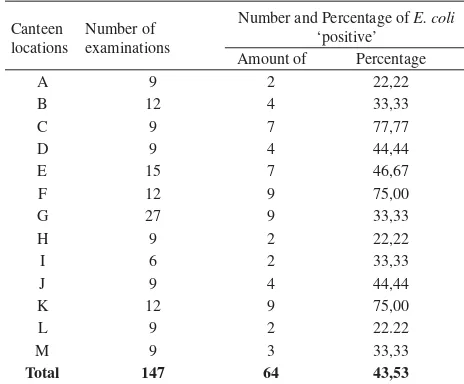
Based on the location where foods come from, we rank the order or level of E. coli contamination from the higest to the lowest: C; F and K; E; D and I; B, G, and M; A and L, respectively (Table 3).
DISCUSSION
Canteen or eatery around campus is one of the important location that to be observed periodically, since almost
Canteen locations
Number of examinations
Number and Percentage of E. coli
‘positive’
Amount of Percentage
A 9 2 22,22
B 12 4 33,33
C 9 7 77,77
D 9 4 44,44
E 15 7 46,67
F 12 9 75,00
G 27 9 33,33
H 9 2 22,22
I 6 2 33,33
J 9 4 44,44
K 12 9 75,00
L 9 2 22.22
M 9 3 33,33
Total 147 64 43,53
Table 3. The number of ‘positive’ Escherichia coli contamination for each canteen, from 13 canteens around campus, 2008
all people in campus at least ever consume the meals there. Meals that they consumed actually are risky , due to bacterial contamination, and it could lead to a very specifi c illness, which could be avoided if each canteen is managed properly.
Microbiology analysis from the sample survey of each meal that served in the canteen around campus showed that almost all of the category of sampled were positively contaminated by E. coli. Escherichia coli represents the most frequent contaminating bacteria where 90% of foods were contaminated, 8 and there are about 35 types of bacteria in meals, such as E. coli and Salmonella. Salmonella is bacteria that can cause typhoid, so the existence of salmonella in food becomes quite dangerous.7
same with that of Salmonella. The existence of E. coli is very dangerous, and accordingly, it would risen the posibility of the existence of other pathogen, such as Salmonella, Shigella, and Staphylococcus. 7
Karedok, gado-gado, pecel, and ketoprak were food that made by mixture of vegetables (sprouts, beans, kol, tofu, tempe, etc.) that poured by sambal. It is quite interesting to notice that according to the previous observation in the same area of canteens, those types of meals were still a risk to be consumed.1,10 This phenomenon proved that type of meals that made from many ingredients was risky to be contaminated. The more ingredient used in meals, the more the possibility to get contaminated is, including the contamination caused by food handlers and the utensil used.
The source of food and drink contamination might be caused by the water used. Regarding the source of the water, in general those have a good quality, since it is obtained from Water Drinking Supply Company, Pump, and water tower. No source of the water was contaminated by E. coli, but some of those were contaminated by Coliform.7 This condition is quite surprising, because the previous studies showed that most of the food and drink had E. coli contamination.1,2,10
The highest risk of food contamination was in meal ‘with sambal’. The reasons would be because the food comes from two kinds of sources. Firstly, food itself and the second is ‘sambal’. This fact can be seen in sambal contamination which had the third position. On the other hand, ‘wet meals’ had the lowest contamination. This can be explained that meals almost served in hot condition or cooked fi rst before served which is assumed to kill the bacterial.
The source of contamination in Lacy, Guava, and Orange juices could be from utensils and food handler, except for Sour sop juice from utensils only.9
The three top rank location of the canteen should obtain more attention concerning the contamination both food and drinks served. The fi rst attention is for the behavior of the food handler and then utensils.6,9 For the purpose of contamination prevention in all canteens, the support from University management is needed.
Since the contamination was from utensils and food handler, improving the knowledge and practice of the food handlers become important. The certifi cation regulation from district or provincial health offi ce is also important to implement, such as mentioned in the Ministry of Health Decree no.715/MENKES/SK/V/2003.
It is important to improve the quality of meals served in canteen by giving more attention the types and locations of foods and drinks which had a highest contamination to avoid the unnecessary sickness due to bacterial contamination and by maintaining routine monitoring and evaluation of the meals material and personal hygiene and sanitation. Since contamination was also high on the hand of food handlers, so improving the knowledge and practice of the food handlers become crucial.
In conclusion, it is important to develop a mechanism to assure the quality of the canteens by giving more attention on the types and locations of foods and drinks especially for those with high contamination. The certifi cation regulation from thr district or provincial health offi ce is also imortant to implement, such as mentioned in the Ministry of Health Decree.
REFERENCES
Rahman A, Susanna D, Kusumayati A, Makful A
1. , Zakianis.
Food Safety Socialization to Food handlers around Campus University of Indonesia(in Indonesian). Depok: Environmental Health Department, Faculty of Public Health, University of Indonesia; 1998: 12.
Susanna D, Sugihartini. The relation between the knowledge 2.
and practice of foofhandler and Escherichia coli Contamination in foods. J Ind Public Health Ass. 2009; 34:1
World Health Organization. Food Hygiene. Tech Rep Ser. 3.
1970;104. Djaja IM.
4. Escherichia coli Food Contamination on Three Type of Food Establishment in South Jakarta, 2003. Makara Health Ser. 2008; 12(1):36-41.
Sudikno, Suhartini. The Analysis of The Cause of Food 5.
Poisoning Outbreak (A Case Study of PT BK in Bogor District). J Food Nutr. 2006; 29(2):85-91.
Sartika RAD, Indrawani YM,
6. Sudarti T. Microbiological
Analysis of Escherichia coli O157:H7 on Cow’s Products during the Production Process. Makara Health Ser. 2005;9(1):23-8. Kurnia D. The Condition of Food Hygiene and Sanitaion 7.
in Tangerang Hospital 2004. [Thesis]. Depok: Faculty of Public Health, University of Indonesia; 2004: p 20. McSwane D, Rue RR, Linton R, Williams AG, Rue N. 8.
Essentials of Food Safety and Sanitation. 3rd edn. New Jersey; Prentice-Hall, Upper Saddle River. 2003. p 7. Susanna D, Eryando T, Indrawani YM. Bacterial Contamination 9.
in Food and Drink Sold at Canteens on a University Campus. J Env Health Aust. 2008; 9(1&2):74-7.
Susanna D, Hartono B. The Mycrobiology Monitoring of 10.