48 Gani et al Med J Indones
Seroepidemiology and risk
factors of Hepatitis B and
C
virus infections
among
drug
users
in
Jakarta, Indonesia
Rino A Gani,
Unggul
Budihusodo, Agus Waspodo,L.A.
Lesmana, ksan Hasan,Nurul Akbar,
H.M
Sjaifoellah Noer
Abstrak
Pasien pengguna obat-obatan sangat meningkat beberapa tahun terakhir
ini.
Telah dilakukan peneLitian untuk mendapatkan gambaran seroepidemiologi infeksi virus hepatitisB
dan C pada pelaku penyalahgunaan obat di Jakarta. Data diambil secara konsekutif di RSUPN Cipto Mangunkusumo dan RS Mitra Menteng Abadi, lakttrta, dari semua pasien yang menggunakan narkotika. Sampel serum diperiksa untuk mendeteksi HBsAg (RPHA, Laboratorium Hepatika, Mataram, Indonesia) dan anti-HCV (dipstik, Laboratorium Hepatika, Mataram, Indonesia). Dalam5
bulan (Maret-
Agustus 1999) terdapat 203 kasus pengguna narkotika. Kebanyakan (185/203 kasus,9l,I Vo)
adalah laki-laki dengan rerdta umur 21,2+
4,3 tahun. Rerata umur mulai menggunakan narkotikn adalah 18,8t
4,0 tahun. Prevalensi Anti-HCV dan HBsAg positif masing-masing adalah 74,9 Vo ( I51 kasus) dan 9,9 %(I9
knsus) dari seluruh sampel.Pada
168 kasus (84Vo), narkotika digunakan dengan cara suntik. Hubungan seksual di luar pernikahan diakui oleh 62 kasus (30,5 Eù, narnun hanya 16 kasus (8 Vo) yang berganti-ganti pasan7an. Tato terdapat pada 32 kasus (15,8 7a). Analisis muhivaiat menunjukkan bahwa penggunaan suntikan dan tato merupakan faktor risiko yang berkaitan dengan anTi-HCV positif, dengan OR masing-masing 9,15 (95Vo CI 3,28-
5,53) dan 13,24 (96Vo CI 1,6-
109,55). Tidak ada satupunfaktor risiko medikyangditeliti mempunyai hubungan secara bermal<na dengan positivitas HBsAg. Infel<si ganda virus hepatitis
B dan virus
hepatitis C didapatkan pada 15 knsus (7,4 Eù. Kesimpulan penelitian ini adalah: prevalensi infeksi virus hepatitis B dan C, serta infeksi ganda kedua virus tersebutdi
kalnngan pelaku penyalahgunaan obat sangat tinggi, dengan tato dan penggunaan suntikan sebagaifaktor
risikt penularanvirus hepatitis C. (Med J lrulones 2002;1I:
48-55)Abstract
The number
of
g users is mcrkedly increased in recent times. Data were collected consecutively in Cipto Mangunkusumo Hospital and Mitra Menteng Abadi Hospital in Jakarta. HBsAg were examined using reverse passive hemaglutination assay (RPHA) and anti-HCV with dipstick method; both were from the ktboratoium Hepatikn, Mataram, Indonesia. In a 5 month period (March - August i,999) there were 203 cases of drug users. Most of themwere male ( i'85 cases or 9l.l Va) with a mean age of 21.2 + 4.3 years. Mean age in starting to use the drug was 18.8+
4.0 years. The prevalence of anti-HCV and HBsAg positivity were 74.9 7o(I5l cases) and 9.9
Vo (19 cases), respectively. The prevalence of double infection was 7.4 Vo (15 cases). Injection drug users(IDU)
were 168 cases (84 Va). Extramarital sex was done by 62 cases (30.5Eù, but only 16 cases (87o) with more thnn one parûxer. Tattoo was found in 32 cases ( I5.8Vo). Multivariate analysisrevealedthatlDUandtattooweretheiskfactorsforanrt-HCVpositivity,withtheORof 9.15(95VoCI 3.28-5.53)and13.24 (9680 CI 1.6 - 109.55), respectively. No significant medical isk factor could be identifiedfor
HBsAg positivity. Double infection of HBV and HCV was found in 15 cases (7.4 7o). We concluded that the prevalenceof
HBV, HCV infection and double infection of HBV - HCV in drug users were high, with tattoo and injection drug usage as iskfactors for hepatitis C virus infection. (Med J Indones 2002;1l:
48-55) Keywords: HBsAg, Anti-HCV, tattoo, injection drug usersMarked increase
in
drug users
were noted,
recently.The
number
of drug
users
who get
infected
with
hepatitis viruses,
particularly
hepatitis
virus
B
(HBV)
Division of Hepatology, Department of Intemal Medicine, Faculty of Medicine, University of Indonesia
/
Dr. Cipto Mangunkusumo Hospital, Jakarta, Indones iaand
C
(HCV)
is
high,
due
to their high-risk
attitude.Data
from
other countries had
established
the
high
infection
ratein this particular
group.r'2HBV
and
HCV
infections are
the
most
important
causefor
chronic
liver
disease.About
80 7oof
chronic
liver
diseaseincluding liver
cirrhosis
andliver cancer
Vol 1
I,
No I , January-
March 2002FIBV
transmission
may result
from
accidentalinoculation of
minute
amountsof
contaminatedblood
or body fluids
asmay occur
during
medical,
surgicalor
dental procedure
using
inadequately
sterilized
syringes and
needles,
or
tattooing
or
bodypiercing
with
non-sterile equipment. Accidental
inoculation
may also
occur
via
sharedtooth
brushes, razorsor
anyobjects
that
have been
contaminated
with
blood
containing
the
virus. Unlike
HCV,
HBV is more
likely to
be transmitted
by
sexualcontact
andvertical
transmission
from
amother
to her infant.3HCV is
the most prevalent hepatitis virus
infection
among
chronic
liver
disease patients
in
severaldeveloped countries
which
have
aproblem
with
drug users.Many
of
them
got
infected
from
syringes
andneedles that
they
sharedwith
other drug users.Studies
on
Jakarta general population
in
1994 revealedthat the major route
of
transmission
of HCV
was through
blood
transfusion,
while
HBV
might
bethrough horizontal
transmission.
Viral transmission
among
drug
usersin
that
time
were
insignificant
dueto the
very
low
number
of
drug users.t''
In
this
study,
we
studied the drug
users
who
werdadmrned
into
hosprtals in Jakarta
in
order
to
get
theseroepidemiological data
of hepatitis
B
and
hepatitisC
virus infèction,
and to
identify
the
risk
factors
for
viral
transmissionin
drug
users.METHODS
This
studywas
approvedby
theEthical
Committee
of
the
Department
of
Internal Medicine, Faculty of
Medicine,
University of
Indonesia, and was donefrom
early March to
end
of
August
1999,
at
Cipto
Mangunkusumo
Central National Hospital
and
Mitra
MentengAbadi
Hospital,in
Jakarta. Data were collectedconsecutively
from drug
userswho
were admitted
for
rehabilitation
or
drug
related
complications,
andinfbrmed
consent was givenprior
to the study.Injection
drug
users (IDU)
were
thosewho
injected drugswith
syringe and needleinto
the vein.Interview
of the patients were done
by a
doctor
in
aprivate room
of
thehospitals, using
aquestionaire
assoon
as they
were
free
from drug
withdrawal
symptoms and
urinary
testfor
the drugs was negative.Demographic
data,drug
usage(type
of
drug, the
ageat
the
start
of
drug
usage,duration
andfrequency
of
Riskfactors of hepatitis B and C
virus
49drug
usage,
and medical
risk
factor data such
as:extramarital
sexual
relationship (yes/no),
blood
transfusion (yes/no),
history
of
surgery (yes/no),history
of
jaundice
(yes/no),
family
history
of
jaundice
(yeslno), tattooing (yes/no), body-piercing
(yes/no),circumcision (yes/no)
and
method
of
drug
usage(injection/non-inj ection)
were collected.The
hepatitis
B
surface
antigen
(HBsAg)
wasexamined
using
reverse passivehemaglutination
assay(RPHA)
kit
from Laboratorium Hepatika,
Mataram,Indonesia, and antibody
of
hepatitis
C
virus
core-protein (anti-HCV) was examined using anti-HCV
dipstick
from
Laboratorium
Hepatika,
Mataram, Indonesia. Thedipstick
methodfor anti-HCV
detectionhas been shown
to
have equalsensitivity
to
commonly
used
second-generation enzyme-linked
immuno-sorbent assay.5
Data were compiled
with Epilnfo
6.0 and
analyzedusing
StatisticalProduct
and ServiceSolutions
(SPSS)9.0
for
Windows (University
of
Califomia Davis).
Chi-square or Fisher exact test were applied
to
compare theresults between the
two viral
infected
groups.The
oddrisk
estimationis
assumed to besignificant
if
p
<
0.05.Multivariate
analyses
using
backward
logistic
regression
were
done to
analyze
the risk
factors
andcontrol the confounding
variablesfor all
the
variableswith
p < 0.2.RESULTS
In
the 5 months, there were 203 casesthat
was enteredinto
the study. There were
65
cases(32
Vo)
from
Cipto Mangunkusumo Hospital, and
138 cases(68
7o)from
Mitra
Menteng
Abadi
Hospital.
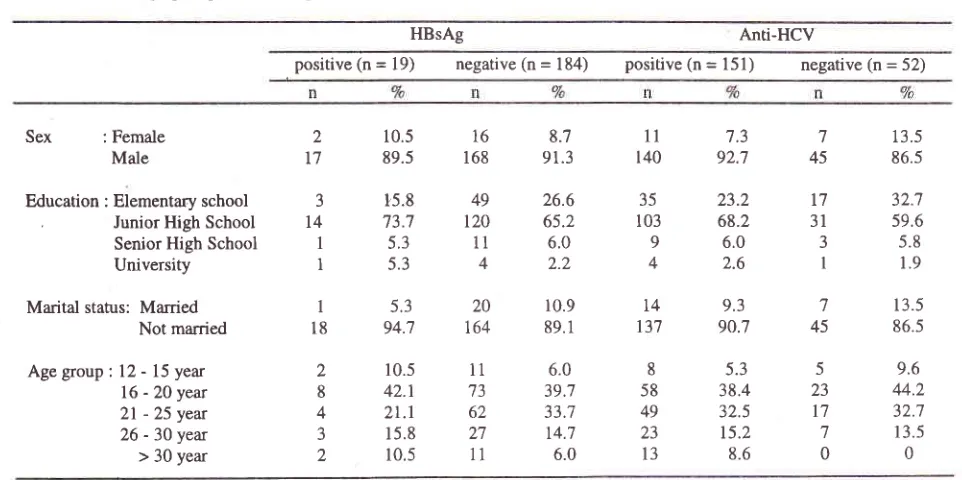
Table
I
showedthe demographic
profile of
the drug usersin
this study.The prevalence
of
HBsAg
andAnti-HCV
amongdrug
users
\ryere9.9
Vo and
74.9
70, respectively.
Both
HBsAg and
Anti-HCV
positivity (double
infection)
could be
detectedin
15patients
(7.4
7o).No HBsAg
nor Anti-HCV could be
detected in
48
(23.6
Vo)of
the patients.
Male
patients
were
predominant
in
this
study,
theyconsist
of
91.1Vo
(18512A3)of all
drug users.Almost
half of
the cases (49.5Vo)
wasin
the age rangeof
12-20 year.
Mean age at the startof
using drug was 18.8+
Med J Indones
50
Ganietal
Table
l.
The demographic profile of drug users (n = 203)HBsAg Anti-HCV
positive (n = 19) negative (n = 184) positive (n =
151)
negative (n = 52)Sex
: Female MaleEducation : Elementary school
.
Junior High SchoolSenior High School University
Marital status: Married Not married
Age group : 12 - 15 year 16 - 2O year
2l
- 25 yeN 26 - 3Oyeu > 30 year7 45 t7
3l
3I
7 45 5 23l7
7 0 7.3 92.'l1l
140 35 103 9 4 8 58 49 23l3
16 168 49 120 11 4 20 164l1
'73 62 27 11 2t7
3t4
I
I
I
18 2 8 4 J 2 10.5 89.5 15.8 73.7 5.3 5.3 5.3 94;l 10.5 42.12t.l
15.8 10.5 8.7 91.3 26.6 65.2 6.0 2.2 10.9 89.1 6.0 39.7 33.7 14.7 6.0 T4 137 23.2 68.2 6.0 2.6 9.3 90.7 5.3 38.4 32.5 t5.2 8.6 13.5 86.5 32.7 59.6 5.8 1.9 13.5 86.5 9.6 44.2 32.7 13.5 0There were
no
significant difference
in
mean
agebetween
the HBsAg
or
Anti-HCV
positive
groups,although
HBsAg
positive group
tendedto
be younger
(17.8
+
2.6)
than
Anti-HCV positive
groùp
(27.6
+
21.6).HBsAg positivity
was more prevalentin
the 16
-20
years age group,
as
were
Anti-HCV
positivity.
However, the numberof the positive cases decreased
in
the age groupof
more than 25 yearsin
both infections.The I{BsAg
positive and negative
cases
were
not
significantly different in terms of sex, education,
marital
Table 2. The association of drug usage with HBsAg and Anti-HCV positivity
s
s
and age group.
This
is
also
observed betweenAnti-HCV
positive and negative cases.Table 2. showed the association
of
drug usage
in
term
of type of drugs,
duration
and frequencyof
drug usage
with HBsAg
and
Anti-HCV
positivity. The
duration
of
drug
usage werenot significantly
associatedwith
HBsAg
nor Anti-HCV positivity. The
higher
thefrequency
of
drug
usage showedbigger
percentageof
positivity
for
HBsAg and Anti-HCV, but
the association was not statistically significant.HBsAe Anti-HCV
positive n =
l9
negative n = 184 positiven =151
negativen= 52Types ofdrugs Barbiturate Amphetamine Opiate Duration
<
I
yearI
- 2 years > 2 years Frequency First time Not everyday Everyday 36.5 17.3 0 3.8 96.2 1 6 45l9
9 24 0 2 50 020
980
0 J 148 38 36 77 2 5IM
l.l
3.3 95.7I
'l
176 47 43 94 52.6 10.5 36.8 0 5.3 94.7 0 2 I7 10 2 1 0I
l8
0 10.5 89.5 0.5 3.8 95.7 25.5 23.45l.l
1.9 l 1.5 86.5 2 6 176 25.2 23.8 51.0 1.3 2.3 95.4 [image:3.612.49.530.96.336.2] [image:3.612.53.533.532.714.2]Vol 1 1, No I, January,
-
March 2002 Riskfactors of hepatitis B and Cvirus
5l
Opiate was
abusedin
a total
of
193 cases(94.8
7o).
Univariate analysis
of the
medical
risk
factors
for
Type
of
drug was significantly
associatedwith
anti-
transmissionof
hepatitisB
andC virus were
shown inHCV positivity,
where opiate
was usedby
148of
l5l
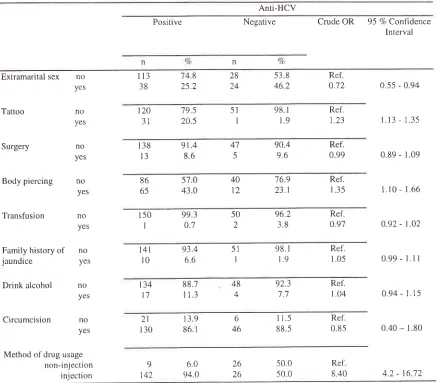
table
3
and4. Extramarital
sex were practiced
by
62patients
(98ok) withAnti-HCVpositivecomparedto
cases(30.5 Vo),but
only
in
16 cases(8
7o)with
more45
of
52
patients
(86.5
Vo)with
anti-HCV
negative.
than
one partner. Furthermore,
prevention
had
beenMost
patientswith HBsAg
posrtrve(89.5
Vo) alsoused
taken
for
save sex.
Tattoos were found
in
32
casesopiate,
but
there wasno significant difïerence
in
type
(15.8
Voof
all patients), but HBsAg
was positive
inof
drug,
duration
and
frequency
of
drug
usage
only
2 cases(6.2
7o),while Anti-HCV
positive
was in [image:4.612.46.466.254.624.2]between
HBsAg
positive
and negativecases.
31 cases(96.9 Vo).
Table 3. Some medical risk fàctors tbr HBsAg positivity in drug users (n = 203)
HBsAg
posirive
Negarive
t;'f"
95olo confidencenVonVo
Extlirmirrital
sex no
15
'78.9
126
68.5
Ref.yes
4
2l.l
58
31.5
1.50
0.61 - 3.67Tattoo
no
17
89.5
154
83.7
Ref.yes
2
10.5
30
I6.3
I
55
0.40 - 5.98Surgery
no
l8
94.7
167
90.8
Ref.ycs
I
5.3
17
9.2
1.76
0.25-
12.47Body
piercing no
12
63.2
I14
62.0
Rel.ycs
7
36.8
70
38.0
L03
0.56-
1.9 ITr:Lnslirsiorr no
19
100
l8l
98.4yes
0
0
3
1.6
NA
NAFamily history
of no
l9
100
l'13
94.0jaundice
yes
0
0
ll
6.0
NA
NADrink
alcohol no
l8
94.7
164
89.1
Ref.yes
I
5.3
20
10.9
2.07
0.29-
14.55Circurncision
no
3
15.8
'24
13.0
Rei.yes
16
84.2
160
87.0
0.98
0.85-
I .13Mcthod of drug usage
non-injection
4
21.I
31
16.8
Ref.injection
l5
'78.9
153
83.2
1.05
0.83-
1.3452
Gani et alTable 4. Some medical risk fàctors fbr Anti-HCV positivity in drug users (n = 203)
Metl J lndones
Anti-HCV
Positive Negative Crude
OR
95 % Confidence IntervalExtramarital sex
Tattoo
Surgery
Body piercing
Transfusi on
Family history of jaundice
Drink alcohol
Circumcision
no yes
113 38
748
25.2538 462 28
24
98 I 19 5t
I 120
3l
150
99.3
50
96.21
0.7
2
3.8ll5
ti8 5
21
139
6130
86I
46Ref. 0.12
no yes
no yes
no yes
no yes
no yes
79.5 20.5
Ref. 1.23
Ref. 0.99 90.4
9.6
9t.4
4'786
5Ref. r.35
0.55 - 0.94
l.l3
- 1.35
0.89
-
1.09l.r0-
I.660.92
-
t.020.99
-
l.l
I0.94-
I.t5
0.40
-
r.80 13813
86
570
4065
430
1276.9 23.1
Ref. o97
141 t0
98. r
1.9
93.4
516.6
IRef. r.05
no yes
no yes
t34 t7
88.7 I t.3
Ref. 1.04 92.3
7.7 48
4
Method of drug usage non-inject'ion
i njection
9 142
50.0 50.0
Ref. 0.8s
Rel'.
8.40 4.2
-
16'726.0
2694.0
26 Anti-HCV : antibody to hepatitis C virusIDU
were
identified
in
168cases
(82.8
Vo)and
127 cases(75.6
Vo) amongthem had ever
shared needle.In
IDIJ,
142were
positive
for
Anti-HCY (84.5
Vo),and
I5
wereHbsAg positive
(8.9Vo).Our
data showed
that
there were
no
medical
risk
f'actors(extramarital
sex,tattooing, ever had
surgery, bodyprercing, history of transfusion.
{amily
history
of
jaundice,
alcohol drinking)
that were
associatedwith
FIbsAgpositivity.
i"lrrlijvariate analysis
of
the
above mentioned
risk
iijù1,)s
revealedthat only
tattoo (yes/no)
and methodoi
JiLigr
usage (injection/non-injection)
were
risk
factors
associated
with
anti-HCV positivity.
The [image:5.612.55.500.109.492.2]model
of
the relationship
of
thesefactors were
shownin
table 5.Table 5. Model for Anti-HCV positivity
OR
95 % Contldence IntervnlMethod of drug usage :
Non-injection
Ref.Injection
9.1 5 Tattoo:No
Ref.Yes
13.243.28
-
25.531.6
-
r 09.55 [image:5.612.313.546.600.699.2]Vol I
l,
Nol,
Januar\,- March 2002DISCUSSION
This study
was donein
hospitals where
only
specificcases
were
admitted
which
make
it
difïicult
to compare the result to the condition in general population.However, the
two
hospitals have
a ditferent
patientcharacteristics.
Most
patients
admitted
to
Cipto
Mangunkusumo hosprtal
appeared
to
have
medicalcomplications
and cameïiom
the lower socioeconomiclevel. On the contrary, those admitted to Mitra Menteng
Abadi Hospital
were fieefiorn
complications and cameIiom
higher
socioeconomic
level.
Nevertheless,
nodetailed data about socioeconomic
level.
andthe
useof
household
Lrtensilscontributrng
in
the transmissionof
hepatitis virusescould
be obtained.Male patients were predominant
in
this
study
andmost of them were
IDU
who
used opiate.
Thesecharacteristics
were
difTerent
from
a
hospital
basedstLrdy
in
other
country
where most
of
them were non
IDU.
I
The use
of injection in
Indonesian drug
usersmay
just
recently arise and
is
increasing
very
f'ast.They
were
relatively
young
(adolescenceperrod)
andhad
started
to
use
the
drug
in
high
school.
TheyoLlngest case
of this study
wasa l2-year-old male who
already used opiate
by injection with a
shared needle.Adolescence
is
recognized as
a
period
of
time
wheresomeone has a strong bond to their group
of fiiends
and also needs to explore anythingincluding
drugs.In
general population,
HBsAg
positive
prevalence was4
%,.4 while rn the
present
study, it
is
9.9
7owhich
is
2.5 times
greater.
This
study
showed
that dru-{ userswere
on high-risk fbr
HBV
infèction.
The prevalenceof HBsAg positivity
among the drug usersrn this
str,rdy
is higher compared
to
the
westerncoLrntry,
but
it
rs about the same compared to the otherAsian
countries.T'so Th" ,"oron fbr
this discrepancy isnot clear, but
it
may
be associatedwith
the prevalenceof
HBsAg positivity in
the general popularion.HBV
and
HCV
may
share
the
same
pathway
of
transmission such as
via body
fluld or
biood,
hencethe
risk tàctor for viral
transmissionmay be the
sametbr
both
viruses.
However,
some
pathway may
beetIèctive
fbr HBV,
but notfbr HCV,
and vice versa.Hepatitis
B
virus
transmission
in
this
group
of
population
wasnot
relatedto
the several
medical risk
factors mentioned above.
Another
study also fbund norelationship
betweenthe use
of
syringe or needle
andRiskfactors of hepatiris B and C
virus
53HBsAg positivity.l
In
a generalpopulation
study, onlysocioeconomic,
ethnicity (Chinese) and number of
family
members
were
the
risk
fàctors
fbr
HBsAg
positivity, while medical risk factors
such as:
bloocltransfïsion, history
of
jaundice,
family
history of
jaundice
and
ever
had operation
were not
relateci toHbsAg
positivity.a However,
no
drug
users
wasincluded
in
that study. Risk factors
for
hepatitis
Btransmission
in
drug
users hasyet to be
determined,but
horizontal
transmission
may play
a
bigger
role, because age-specific prevalencein this
study
showedbigger
percentages
of
HBsAg posrtivity
in
the
agerange
of
16- 25
comparedto
the younger
age group.Since inter-relation
within drug
users
in
daily
lit-e isvery close, this can be the reason
for
the transmissionof
hepatitis
B
virus
among them. Therefore,
a
moredetailed study
in
the
behavior
of
drug users is needed.In
this
study, extramarital sex was practiced
by
onethird
of
the drug
users.
Having
sex
with IDU
isreported
as
a
risk
factor
for
HBV
and
HCV
transmission,T
although this study could not confirmed
it.
This
may
be
due
to
cases,who
confessedto
havesexual intercourse,
and
gave
the
data
about
thenumber
of
intercourse done,
or
the number
of
sexualpartner,
that
was
not
suficient
to
uncover
therelationship between those variables
with
HBsAg
orAnti-HCV positivity.
Nevertheless,
this
srudyrevealed
that some drug
users practiced unsat-e sexualrelatronship, whrch together
with
IDU
were also risk
factors
fbr
other diseases such asHIV.e
The prevalence
of
Anti-HCV positivity
amongIDU
inthis
study was lower comparedto the study on
IDU
inKuala Lumpur, Malaysia
where
92.5
7oof
the
caseswere positive
fbr
anti-HCV.
r0 The
just
recentlymarked increase
of
drug
users
in Indonesia
may explain the lower number ofHCV
prevalence comparedto the prevalence
in
Malaysia. However, the prevalenceof
Anti-HCV positivity
in
this
study was
highercompared to other countries where anti-HCV prevalence
in IDU
was50
-
J5
7n.r'8J '-'oThis is due to the lack of
specific and major
public
programs
to
prevent
viral transmissionamong
IDU in
Indonesia,
whrle
in
thecountry where
the
problem
of IDU
has already
beenrecognized as a major public
problem,
several programs have been introduced, such as syringe exchange programor methadone clinic.
In
the
same agegroup
of
the
general
population
in54
Gani et al Med J IndonesHCV
in
general
population
will
increase
rapidly. It
can be expectedthat
in
young people
(<
30 yearsold)
the prevalence
of
hepatitisB
and C virus infectionwill
beincreased. Furthermore, the double infection of
HBV
andHCV
was alsohigh,
andthis would
be a bad prognosisfor
the progression to chronicliver
disease.[n
the future,the number
of
peoplewith
chronic
liver
diseasein
thisarea may be increased due to this reason.
Experience
in
anothercountry
showed thatdrug
users,particularly
IDU,
who
began
in
the recent past
got
ahigher
risk
to suffèr
from
chronic hepatitis,
Ïver
cirrhosis
and
liver
"ancer.'u''o
A
large
population
based study should be conducted to
clarify
this
issue.Preventions
for
HBV
and
HCV
transmission
inIndonesia have been already implemented including
HBV
vaccination
and
screening
of
blood
donors.Hopefully such
measures
can
minimize
both
viral
transmission through vertical
route
for
HBV
andhorizontal
routefbr HCV.
However,
viral
transmissionfiom
drug user route maypotentially
be moreimporlant
in
the future and also need prompt management.No
vaccine
hasyet
beenavailable
fbr
the prevention
of HCV
inf-ection,
but
studies
in
this
field
are
still
progressing.
One
candidate
is
the
DNA
vaccinationwhich is
promising
in
animal models and shortly
can be expectedto
be studiedin
human.In
conclusion,this
study revealed thatin
drug
users theprevalence
of HCV, HBV
and double inf'ectionof
thesetwo
viruses arehigh
andmuch
higher comparedto
theinfècrions
in
general population. Injected drug usage andtattoo are risk factors
fbr
HCV
transmission.Acknowledgment
We
highly
appreciateProf.
Dr. Mulyanto
andhis statf
at
Laboratorium Hepatrka, Mataram
for
their help
intraining
of
our stafï
and
the
generosity
in
supplying
the reagent
for HbsAg RPHA
andanti-HCV dipstick'
Also to
Prof.
Dr.
Dadang
Hawari, Dr.
RatnaMS.
andDr.
Herdiman
who
were
willing
to give permission
tolet their
patientsparticipate in this
study.REFERENCES
l.
MaayanS,
ShulmanExposure
to
hepatitisEN,
EngelhardD,
Shouval D.B
andC
andto
HTLV-l
and 2only
0.4
Vn.t5
Our
data showed that the prevalenceof
anti-HCV positivity in
drug
userswas
150-
200
fold
higher
than
in
general
population. Hepatitis
C
virus
inf'ection
is rarely
symptomatic.
Most HCV
infection
occurs
as
chronic
hepatitis
which
leads
to
liver
cirrhosis
in
about 20 years.l6This
can be a substantialproblem
in
thefuture long after
theaddiction problem
in
drug users have beeneliminated.
This
study also showed that the
prevalenceof
doubleinfèction
of
hepatitis
B
and
C
was also
higher
compared
to
in
general
population
where only
0.2
Vo..or",
*"r"
positive
fbr
both anti-HCV
andHBsAg.a
Double intèction
of HBV
and
HCV is
one
of
thefactors
that may
lead
to the
development
of
chronic
liver
disease.Liver
diseaseis usually
more severe
inclor.rble
inf'ection
cases,and
the
risk
of
developrnghepatocellular
carcinoma
(HCC)
aremuch higher
thanpaiients inf-ected
by either
singlevirus alone.'7''t
The risk
factors
fbr
anti-HCV positivity
among
drugusers
in
this
study were injection drug
usage
andhaving tattoo.
Injection drug
usage wasalso
reportedas
one
of
the
risk
factors
for
hepatitis
C
virus transmission amongdrug
usersin
other
study.le'20Our
finclings
is
not
in
agreement
with
the study
in
thegeneral
population, where the
risk
tàctors
fbr
anti-HCV positivity
were
ageand
blood
transfusion.a Thereasons
for
the ditlèrence
might
bethe small
numberof
cases
who
ever had blood transfusion, and
therelatively narrower
rangeof
patients'
agein
this
study cornparedto
thestudy in
generalpopulation.
Tattoo
in
the
general population
study
was
notassociated
with
anti-HCV
positivrty.5This might
be dueto
the relatively
smaller number
of
people
who
hadtattoo
in
that
study comparedto our
data.
Tattooing
isoften
applied
by
the drug
users' companion,
who
inmost
circumstances
were'also
a
diug
user,
without
enough knowledge
of
sterility to prevent the transmissionof
microorganism.Tattoo
had also been reported as oneof
therisk tàctor
tbr
hepatitisC
virus infection
in
drugusers
in
a
study
in
an Asian
country.2l
Even
in
thepopulation
of
non injection drug
users,having
a tattoowas associated
with
anti-HCV
positivity.reSeveral studies
in
generalpopulation
conducted4
-
5years ago
could identify only
avery
small number
of
clrug
users.a''
Thit
group
of
population have
beenincreased
several
folds
recently. Therefore'
the-l
Vol I
l,
No I , January-
March 2002il
among
Israeli
drug
abusersin
Jerusalem. Addiction1994;89(7):869-'7 4.
Conry CC, VanRaden
M,
Gibble J, Melpolder J, ShakilAO, Viladomiu
L
et al. Routes of infection, viremia, andliver
diseasein
blood donors fbund to have hepatitis Cvirus infèction. N Engl J Med 1996;334:1691-6.
Zuckerman
JN,
ZuckermanAJ.
The epidemiology
ofhepatitis B. Clin Liver Dis 1999;3 (2):179-87.
Nurul
Akbar, Bastaman
Basuki, Mulyanto,David
HGarabrant, Ali Sulaiman, H.M Sjaifoellah Noer. Ethnicity,
socioeconomic status, transfusions and risk of hepatitis B
and hepatitis C infection. J Gastroentrerol Hepatol 1997;
l2:'752-7.
Wijaya S. Epidemiology
of
hepatitisB
and hepatitis Cvirus
intèctionin
urban areain
Jakarta, Indonesia: Ahospital
and
population
basedstudy.
IDissertation]Leuven: Catholic University Leuven Belgium; 1996.
Mulyanto, Suwignyo S, Tsauri S, Itoh K, Mizui M, Tsuda
F et al. An easy dipstick assay for anti-core antibodies to
screen blood donors
tbr
hepatitis C virus viremia. VoxSang 1996;70:229-31
Kaur S, Rybicki
L,
BaconBR, Golan JL, Rustgi
VK,Carey
WD. Pertbrmance characteristics
and resultsof
alarge-scale screening program for viral hepatitis and risk
factors associated with exposure to viral hepatitis
B
andC:
results 01'the Nâtional Hepatitis Screening Survey.National
Hepatitis
SurveillanceGroup.
Hepatology199624:919-56.
Srryth
BP, Keenan
E,
O'ConnorJJ.
Bloodborne viralintèction
in
lrish
injecting drug
users. Addiction"
1998;93(1 l):1649-56.
Baozhang T, Kaining Z, Jinxing K, Ruchang X, Ming L,
Czttxia
Z
etal
Infèction with human immunodeficiencyvirus
and
hepatitis virusesin
Chinesedrug
addicts.Epiderriol lnf-ect I 997; I 19(3):343-1.
Duraisamy C.
HIV and hepatitis
B,C and D markers in
intravenous drug addicts screen
in
1992ln:
Proceeding9'r' Biennial Scientifrc Meeting Asian Paciflc Association
fbr
the Studyof
the Liver; January 26-29, 1994.Ktala
Lumpur,
Malaysia.
Kuala Lumpur: Asian
PacificAssociation fbr the Study of the Liver; 1994. p.429-34.
Larnden
KH,
KennedyN,
BeechingNJ, Lowe
D,Morrison CL, Mallinson H, et al. Hepatitis B and hepatitis
Riskfactors of hepatitis B and C
virus
55C
virus
infections:risk
factors amongdrug
users inNorth west En gl and. J Infec t 199 8 ;3'7 (3) :260 -9 .
Galeazzi
B,
Tufano
A,
BarbieratoE,
Bortolotti
F.Hepatitis
C
virus infectionin
Italian intravenous drugusers: epidemiological and clinical aspects. Liver 1995;
l5(4):209-12.
Anand CM, Fonseca K, Walle RP, Powell S, Williams M
Antibody
to
hepatitisC
virus
in
selected groupsof
aCanadian
urban
population.Int J
Epidemiol
1992; 21(1):t42-5.Patti
AM,
Santi AL, Pompa MG, Giustini C, Vescia N,Mastroeni
I, et al.
Viral hepatitis and drugs: a continuingproblem. Int J Epidemiol 19931-22(I):135-9.
Nurul
Akbar, Fumio Tsuda, Bastaman Basuki, HiroakiOkamoto,
Ali
Sulaiman,HM Sjaifoellah Noer, et al.
Theprevalence of GB virus C, risk factors and its relationship
with
other virusesin
a
general populationin
Jakarta,Indonesia. Hepatol Res 1999;13:193-204.
Ke-Qin Hu, Myron J Tong. The long-term outcomes of
patients
with
compensatedhepatitis
C
virus-relatedcirrhosis and history of parenteral exposure
in
the UnitedStates. Hepatology 1999;29(4):131 I -6.
Fong
TL, Di
BisceglieAM,
Waggoner JG, Banks SM,Hoofnagle JH. The signilicance of antibody to hepattis C
virus
in
patientswith
chronic hepatitisB.
Hepatology 1991l'1464-7.Benvegnu
L,
FattovichG,
NoventaF,
Tremolada F,Chemello
L,
CecchettoA,
et al. Concurrent hepatitis Band C virus infection and risk ofhepatocellular carcinoma
in cirrhosis. A prospective study. Cancer 1994;74:2442.
Balasekaran
R,
BulterysM,
JamalMM,
Quinn
PG,Johnston DE, Skipper B, et
al.
A
case-control study ofrisk factors for sporadic hepatitis C virus infection
in
thesouthwestern United States.
Am
J
Gastroenterol 1999;94:1341-6.
Alter MJ, Kruszon-Moran D, Nainan OV, McQuillan G,
Gao F, Moyer
LA
et al. The prevalenceof
hepatitis Cvirus infection in the United States 1988 through 1994. N
J Engl Med 1999;341:556-62.
Chang
CJ,
Ko
YC,
Liu
HW.
Seroepidemiology ofhepatitis C virus intèction among drug abusers in southern
Taiwan. J Formos Med Assoc 1998;97(12):826-9.
2
l4
15
t3
t-7 .
21 .
6
16
l0
t8
l9