No. 126, Spring 2008 3
With a Little Help from our (Virtual) Friends (cont.)
For our intervention work, we have been observing the play of 7-12 year old TD children, and of children with autism, in a semi-structured setting. Each child tells stories in turn with a TD peer and a VP. The stories are analyzed both quan-titatively and qualitatively for narrative content, turn-taking behaviors, and topic management. This 2x2 design (children with ASD v TD children; VP v TD peer conversational partner) allows us to make several comparisons that contribute to the design of VPs: (1) where children with autism differ most from TD children in this kind of storytelling so that we can target our intervention to these areas; (2) where children with ASD may demonstrate increased competencies with the VP than they do with TD peers, so that we can build on these strengths in an intervention; and (3) where the behavior model of the VPs is deicient with respect to behaviors exhibited by TD children. Our current results
suggest that children with autism approach activities with the VP with excitement, and that their ability to contribute appropriately to the conversation may be more evident with VPs than with real peers, and may improve over the course of the interaction with a VP but not with a TD peer [4]. These results certainly suggest that VPs may be useful as an effective intervention for children with autism.
The research described here is in progress, and our current work includes evaluation of both the assessment and the intervention tools.
References
[1] C. Howes, “Peer interaction of young children,” Monographs of the Society for Research in Child Development, vol. 53, pp. 1-92, 1988.
[2] W. W. Hartup, “Peer relations “ in Socializa -tion, personality, and social development vol. 4, Handbook of child psychology, E. M. Hetherington,
Ed. New York: Wiley, 1983, pp. 103-196.
[3] J. Cassell, “Towards a Model of Technology and Literacy Development: Story Listening Systems,” Journal of Applied Developmental Psychology, vol. 25, pp. 75-105, 2004.
[4] A. Tartaro and J. Cassell, “Playing with Virtual Peers: Bootstrapping Contingent Discourse in Children with Autism,” presented at International Conference of the Learning Sciences, Utrecht, the Netherlands, 2008.
Justine Cassell, Andrea Tartaro, Miri Arie Centre for Technology and Social Be-havior
Northwestern University, USA
Multi-Robot Cooperation Inspired by
Immune Systems
Usually mobile robots need to interact and engage with one another in order to achieve assigned tasks more eficiently. These autonomous multi-robot systems would be highly beneicial in assisting humans to complete suitable tasks. This research is suitable to be applied to real-world situations for example, in rescue op-erations, military missions, service robots, and industrial robots. These areas would greatly beneit with the use of multiple robots that can effectively cooperate with one another. Furthermore, these types of scenarios have dynamically changing envi-ronments that require the robots to have a robust and adaptive cooperation.
In such multi-robot systems, distributed intelligence is highly needed in the team whereby decisions are processed in each individual robot. Biological systems are examples of information processing that
are capable of solving problems in living organisms in a distributed manner. Some of these biological systems have neural networks in the brain that is capable of pro-cessing information through impulses at the synapses, genetic systems in constructing the organism genes and immune systems that protect and maintain the homeostatic state of the living organism.
These salient characteristics lead to the advances in research on Artiicial Im-mune Systems (AIS) and their applications in engineering ields particularly in the Multi-Robot Systems (MRS) domain [1]. Moreover, situations faced by multi-robot systems require real-time processing and response, which are the apparent fea-tures of the biological immune systems. Therefore, this research proposes an im-mune system based algorithm to achieve cooperative behaviour in a team of robots.
Using the algorithm inspired by immune network theory, the robots can have the capability for performing their mission in an unstable environment.
AISB Quarterly
istics of the immune system is that there is no central control of the host’s cells in ighting antigens that invade the host, and the system’s adaptability in responding to various kind of antigens. The related cells cooperatively merge at the affected area and produce appropriate antibodies for that particular situation. This phase of immune response exhibits cooperative behaviour of the related cells.
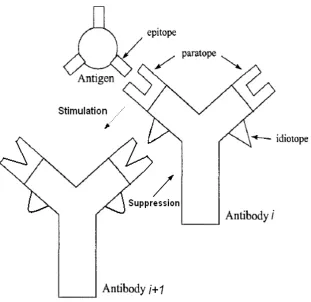
Studies in immunology have showed that antibodies are not isolated but they communicate with each other. Each type of antibody has its speciic idiotope, an antigen determinant as shown in Figure 1. Jerne proposed the Idiotypic Network Hypothesis which views the immune system as a closed system consisting of interac-tion of various lymphocytes (B cells that mainly produce antibodies to ight
spe-ciic antigens) [2]. Referring to Figure 1, idiotope of antibody i stimulates antibody i+1 through its paratope. Antibody i+1 views that idiotope (belonging to antibody i) simultaneously as an antigen. Thus, antibody i is suppressed by antibody i+1. These mutual stimulation and suppression chains between antibodies form a controlling mechanism for the immune response [3]. This large-scale closed system interaction is the main mechanism that can be used for cooperation of multi-robot systems.
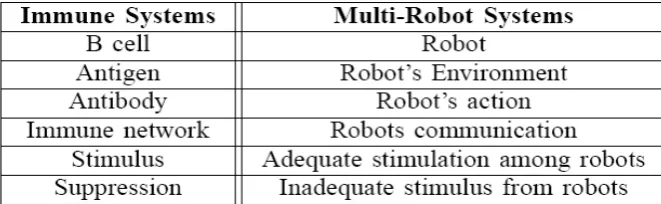
The relationship of the immune systems with multi-robot systems is evident where obstacles, robots and their responses are antigens, B cells and antibodies respec-tively.
Figure 2 lists the parallel of MRS and immune systems terminologies.
Immune network theory as described earlier is suitable as a basis for emulating cooperative behaviour in a multi-robot en-vironment. Obviously, in immune network the processing of information is done in real-time and in a distributed manner, as what a multi-robot system requires. The objectives of this study are to propose an immune-inspired approach on cooperation, and to establish an adaptive cooperation algorithm in heterogeneous robot teams. This is because the application areas would inevitably require multiple robots of differ-ent speciications and capabilities. Adaptive cooperation entails that the multi-robot teams would be able to withstand failures that might occur in the teams. Furthermore, the effect of the proposed approach in terms of eficiency in cooperation is also being studied.
Multi-Robot Cooperation Inspired by Immune Systems (cont.)
No. 126, Spring 2008 Currently we are using the Player/Stage
simulation platform on a Fedora Core 6 Linux OS to test the proposed algorithm [4]. The next phase is to transfer the simulation experiment onto mobile robots for further investigations. In this research, we argue that the immune network is a suitable analogy for multi-robot cooperation problems. Experimental data will ensue to validate the applicability and eficiency of the proposed algorithm. The study would continue in this area, whereby the robots’ tasks will be appropriately changed to suit other application domains.
Mr. Razali gratefully acknowledges Ma-laysian Ministry of Higher Education and Universiti Teknikal Malaysia Melaka (UTeM) for sponsoring his PhD study. Further in-formation on this project is available at: www-staff.lboro.ac.uk/~cosr/phd/
References
1. J. Li, H. Xu, S. Wang, and L. Bai, An immunol-ogy based cooperation approach for autonomous robots, ISKE-2007 Proceedings, 4, 2007.
2. N. K. Jerne and J. Cocteau, Idiotypic Networks and Other Preconceived Ideas, Immunological Reviews, 79 (1), p 5, 1984.
3. L. N. De Castro and J. Timmis, Artiicial Im -mune Systems: A New Computational Intelligence Approach, Springer, 2002.
4. B. Gerkey, R. T. Vaughan, and A. Howard, The player/stage project: Tools for multi-robot and distributed sensor systems, Proceedings of the 11th International Conference on Advanced Robotics, p 317, 2003.
Sazalinsyah Razali, Qinggang Meng, Shuang-Hua Yang
Department of Computer Science Loughborough Univeristy
Figure 2: Relationship between Immune Systems and Multi-Robot Systems.