UNIVERSITI TEKNIKAL MALAYSIA MELAKA
AUTOMATIC PINEAPPLE PEELER MACHINE USING PLC
This report submitted in accordance with requirement of the Universiti Teknikal Malaysia Melaka (UTeM) for the Bachelor Degree of Manufacturing Engineering
(Robotics and Automation) with Honours.
by
MAZALINDA BINTI MAZLAN
APPROVAL
This report is submitted to the Faculty of Manufacturing Engineering of UTeM as a partial fulfilment of the requirements for the Degree in Bachelor of Manufacturing Engineering (Robotic and Automation) with Honours. The member of the supervisory committee is as follow:
DECLARATION
I hereby, declared this report entitled “Pineapple Peeler Machine using PLC” is the results of my own research except as cited in references.
i
ABSTRAK
ii
ABSTRACT
iii
ACKNOWLEDGEMENT
I would like to thank to Faculty of Manufacturing Engineering of UTeM for giving me an opportunity to undergo this final year project as a partial fulfillment of the requirements for the degree of Bachelor of Manufacturing Engineering (Robotic & Automation) with Honours.
iv
2.2.2 Maturity Index of Mauritius Pineapple 17
2.3 Removal of Pineapple Skin using Peeling and Coring Machine 18
2.4 Overall Project Components 20
v
2.5.1 The Classes of Engineering Material 21
2.5.1.1 Aluminium 22
2.5.1.2 Stainless Steel 23
2.5.1.3 Acrylics 24
2.5.1.4 Comparison Table 24
2.6 Mechanical Fabrication 25
2.6.1 Mechanical Fastening 25
2.6.1.1 Screw Thread Fastener 26
2.6.1.2 Rivets 27
2.6.2 Welding 28
2.6.2.1 Gas Tungsten Arc Welding 28
2.6.2.2 Gas Metal Arc Welding 30
2.6.3 Machining 30
2.6.3.1 Drilling 31
2.6.3.2 Grinding 33
2.7 Actuator 35
2.7.1 Motor 36
2.7.1.1 Basic Principle of Electric Motor 36
2.7.2 Types of Motor 37
2.9.1 Programmable Logic Controller 46
2.9.2 PLC Architecture 47
2.9.2.1 Power Supply 48
2.9.2.2 Processor 49
vi
2.9.4.2 Function Block Diagram 56
2.9.4.3 Structured Text Language 57
2.9.5 Keyence PLC 58
2.9.5.1 Features of the Visual KV Series 58
2.10 Software for Project Development 60
2.10.1 Structural Design 60
2.10.1.1Solid Works 2008 61
2.10.1.2AutoCAD 62
2.10.1.3Catia 63
2.10.2 PLC Programming using Keyence Software 63
2.10.2.1Name and Function of Each Part of the Screen 65
2.11 Similar Past Project 66
2.12 Conclusion 67
3. METHODOLOGY 68
3.1 Introduction 68
3.2 Methodology Flow Chart 68
3.3 Methodology Section 69
3.4 Description of Methodology Flow Chart 69
3.4.1 Literature Review 70
3.4.2 Methodology 72
3.4.3 Design Consideration 72
3.4.3.1 Hardware 73
3.4.3.2 Software 73
3.4.4 Interfacing 74
vii
3.4.6 Testing 75
3.4.7 Result and Conclusion 75
3.5 Software Tools Selection 75
3.5.1 Solid Work 2009 76
3.5.2 Keyence Ladder Builder 76
3.6 Project Components 79
3.7 Material Selection 79
3.7.1 Mechanical Structure Selection 80
3.7.2 Motor Selection 80
3.8 Mechanical Fabrication Selection 81
3.8.1 Fastening Selection 81
3.8.2 Welding Selection 81
3.8.3 Machining Selection 82
3.9 Conclusion 82
4. DESIGN AND DEVELOPMENT 83
4.1 Introduction 83
4.2 Conceptual Design and Development 83
4.2.1 Design 1 84
4.2.2 Design 2 86
4.3 Quality Function Deployment 88
4.3.1 Pugh Concept Selection 88
4.3.2 Concept Selection 89
4.4 Development 90
4.4.1 Bill of Material 91
4.4.2 Mechanical Section 92
4.4.2.1 Body Frame 92
4.4.2.2Cutter Blade 94
4.4.3 Electrical Section 95
4.4.4 Programming Flow Chart 95
4.4.5 PLC Ladder Diagram 97
4.4.6 Steps of Programming 98
viii
4.4.6.2 Automatic Programming 99
4.4.6.3 Manual Programming 99
4.5 Conclusion 100
A Design of paper cutter machine
B Virtual Design and kinematic simulation for cutter of corn harvester C Integrated gripper and cutter in a mobile robotic system for harvesting
ix
LIST OF TABLES
1.1 Gross domestic product by kind of economic activity for 2000-2009 2 (Journal of Department of Statistics Malaysia, Volume 2, 2009)
1.2 Pineapple statistic (Malaysia Pineapple Industry Board) 5
1.3 Gantt chart for PSM I 8
1.4 Gantt chart for PSM II 9
2.1 Comparison table 25
2.2 Programming Language (Groover 2008) 54
2.3 Keyence PLC function (Keyence User Manual) 60
3.1 Motor selection table 80
4.1 Simple QFD Diagram Characteristics (Chitale and Gupta 2007) 89 4.2 Pugh concept selection for design 1 and design 2 90
4.3 Bill of Material 91
4.4 Input and Output of PLC 98
5.1 Function of switches in PLC programming 102
5.2 Performance test result 103
x
LIST OF FIGURES
1.1 Percentage distribution of establishment by sub-sector 2008 3 (Report on Census of Agricultural Establishment, Malaysia 2009).
1.2 A PLC system: CPU module and I/O rack (Chang, Wysk and 10 Wang 2006)
1.3 The manufacturing process industry to produce consumables 13 (Rockis and Mazur 2005)
2.1 Pineapple plantation (Malaysia Pineapple Industry Board) 15 2.2 Pineapple plant (Malaysia Pineapple Industry Board) 15
2.3 Morris pineapple 16
2.4 Hand sizing and coring machine (Muzium Nanas Johor) 19
2.5 Gigantic Machine (Muzium Nanas Johor) 19
2.6 The class of engineering material (Ashby 1999) 22 2.7 Mechanical assembly using (a) a screw, (b) a bolt, (c) a rivet, and 26
(d) a snap-fit joint (Benhabib 2003)
2.8 Screw and bolt heads (Benhabib 2003) 27
2.9 Rivet geometries: (a) solid, (b) tubular, (c) compression, and 28 (d) split (Benhabib 2003)
2.10 (a) The gas tungsten-arc welding process formerly known as tungsten 29 inert welding. (b) Equipment for gas tungsten-arc welding operations
(Kalpakjian and Schmid 2006)
2.11 (a) Schematic illustration of the gas metal-arc welding process or 31 metal inert gas welding. (b) Basic equipment used in gas metal-arc
welding operations (Kalpakjian and Schmid 2006)
2.12 (a) Chisel-point drill. (b) Crankshaft drill (Kalpakjian and Schmid 2006) 32 2.13 (a) Grinding wheel structure. (b) Material removal (Benhabib 2003) 33 2.14 Surface grinding with (a) a horizontal spindle. (b) a vertical 34
spindle (Benhabib 2003)
xi
2.17 A rotating electric motor (Groover 2008) 36
2.18 The classification of motor (Petruzella 2010) 37
2.19 AC Motor parts (Rockis and Mazur 2005) 38
2.20 DC Motor parts (Rockis and Mazur 2005) 40
2.21 Stepper motor (Petruzella 2010) 41
2.22 Application of limit switch (Rockis and Mazur 2005) 43 2.23 Exploded view of push button (Rockis and Mazur 2005) 43
2.24 Selector switches (Rehg and Sartori 2007) 44
2.25 Photoelectric sensor (Rockis and Mazur 2005) 45
2.26 Proximity sensor sensing range (Petruzella 2010) 46 2.27 An Example of Bosch Programming Logic Controller (Rockis 47
and Mazur 2005)
2.28 Components of PLC (Groover 2008) 48
2.29 Types of switches (Chang, Wysk and Wang 2006) 52
2.30 A relay (Chang, Wysk and Wang 2006) 53
2.31 A timer (Chang, Wysk and Wang 2006) 54
2.32 Ladder diagram and components (Chang, Wysk and Wang 2006) 56
2.33 Example FBD circuit (Rehg and Sartori 2007) 57
2.34 Keyence PLC part name (Keyence User Manual) 59
2.35 Solid Works 2008 interface 62
2.36 Catia interface 63
2.37 Ladder Builder interface (Keyence User Manual) 64
2.38 Sample of programming Ladder Builder 64
2.39 Name and function of Ladder Builder window 65
2.4 Name and function of each part of the screen 65
3.1 Methodology Flow Chart 71
3.2 Multi-file edits (Keyence Support Software) 77
3.3 Selection of instruction word and device (Keyence Support Software) 77 3.4 Selection of device by dragging and dropping (Keyence Support Software)78
3.5 The three window (Keyence Support Software) 78
xii
4.1 Design 1 85
4.2 Solid modeling for design 1 84
4.3 Design 2 87
4.4 Solid modeling for design 2 86
4.5 Body frame 92
4.6 Unfolded views of the sheet metal 93
4.7 Machining housing 94
4.8 Programming flow chart 96
4.9 PLC programming 97
4.10 Start-stop ladder diagram 98
4.11 Automatic mode ladder diagram 99
4.12 Manual mode ladder diagram 100
xiii
LIST OF ABBREVIATIONS
PLC - Programmable Logic Controller FKP - Fakulti Kejuruteraan Pembuatan PSM - Projek Sarjana Muda
GDP - Gross Domestic Product
MPIB - Malaysia Pineapple Industry Board MODICON - Modular Digital Controller
NEMA - National Electrical Manufacturing Association
AC - Alternating Current
PROM - Programmable read-only memory
EPROM - Erasable programmable read-only memory
EAPROM - Electronically alterable programmable read-only memory
CHAPTER 1
INTRODUCTION
This chapter cover the general information for the project title „Automatic Pineapple Peeler Machine using Programmable Logic Controller (PLC)‟ likes background and overview of the project, problem statement, project aim and objectives, scope, project planning, and the expected outcome for this project.
1.1 Background and Overview
The wealth of a nation is commonly measured by its gross domestic product (GDP), or the per capita GDP of the nation. The GDP reflects the “standard of living” for industrial countries. The GDP includes contributions from both private industry and government. Private industry is divided into the categories of agriculture, mining of oil and gas, manufacturing, construction, trade or commerce, financial intermediation, real estate, and services.
All of these industry sectors contribute to the wealth of a nation. Malaysia Department of Statistic indicate that in 2009, manufacturing sector contributed RM172, 696 million at current prices to real GDP of the nation. It shows the highest percentage among others sector for consecutive ten years as shows in Table 1.1. The statistics seem to tell a story of a declining and ever-marginalized manufacturing sector. However, the statistics also send signal of urgency and of a need for infrastructure transformation.
Table 1.1 : Gross domestic product by kind of economic activity for 2000-2009 (Journal of Department of Statistics Malaysia, Volume 2, 2009)
Based on the facts, agriculture provides infrastructure transformation. It is so because agriculture produced 9.59% of the GDP. It‟s a potential sector to be transformed. Farming meant using animal power to plow the fields. Nowadays, riding on air-conditioned machinery guided by a global positioning system, farmer can farm thousands of acres of land and produce a high yield. Improved crops, the precise delivery of fertilizer and insecticide, better weather forecasting, specialized farm equipment, and more made all that possible.
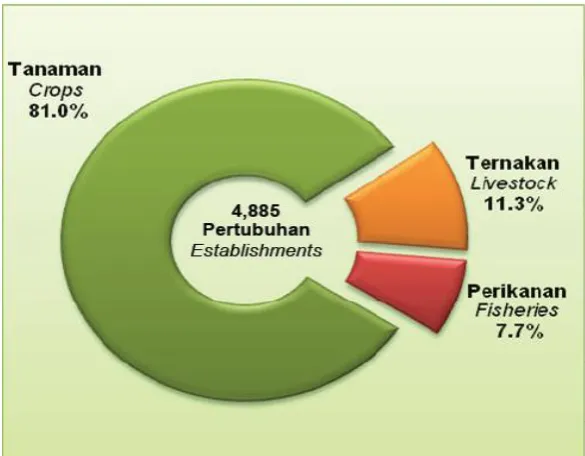
Figure 1.1: Percentage distribution of establishment by sub-sector 2008 (Report on Census of
Agricultural Establishment, Malaysia 2009).
The product from agriculture mainly used in food industry. In Malaysia, the food industry is dominated by small and medium scale companies. The major sub-sector is fish and fish products, livestock and livestock products, and crops and crops products (Figure 1.1). In the crops sector, besides mango, star fruits and papaya, the cultivation of pineapple is gaining interest among farmer. Most of these pineapples cater for the domestic market. The major locations pineapple cultivation is in Pekan Nanas, Johor.
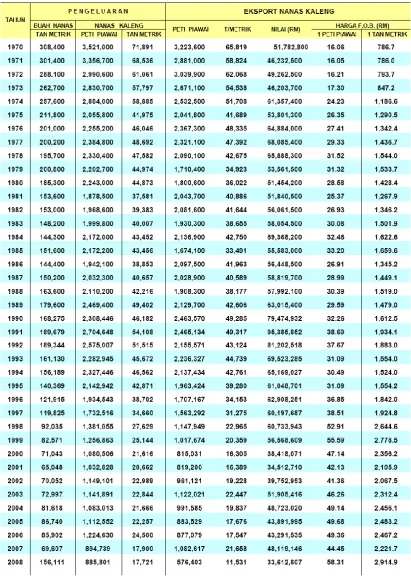
The manufacture of pineapple in 2008 had reached 173,832 metric ton, which 156,111 ton metric come from fresh pineapple and the balance come from canned pineapple (Table 1.2). Malaysia‟s export earnings from fresh and canned pineapples in 2008 had reached RM488 million. RM455 million in export earnings was from
fresh pineapples and RM33 million through the canned product. Canned pineapple contributes a great amount of that profit.
However, there still a lot of insufficient factor that effects the canned production line. One of the major problems in canned production line is how to peel the pineapples. The idea to design an automatic pineapple peeler machine using Programming Logic Controller (PLC) came up based on that circumstance. Automation is an answer to produce better product at lower cost and high quality because manufacturing is an activity that is traditionally labor intensive.
To compete in the global market and still maintain the standard of living of this country, the importance of developing and deploying new manufacturing technology must not ignored.
1.2 Problem Statement
In canned pineapple manufacturing in Malaysia, pineapple skin is removed using “Kwong Nam” machine (Malaysia Pineapple Industry Board, MPIB). However, the machine is not accurate because after the machining process, the pineapple still needs to be manually peeled by workers to remove the balance of the peel and the eyes. This increases process time and cost. It is also not effective. Critical hygiene factor also plays a big role in this type of production because it involves food processing. The machine that being used in the factory usually is big and are difficult to clean up and the cleanliness of the machine are often doubted.
Another issue is related to the small and medium scale pineapple canned industries. Most of the manufactures are not affordable to buy a large and expensive machine to peel the pineapples. A simple and smaller machine to peel the pineapple is needed for this purpose.
Table 1.2 : Pineapple statistic (Malaysia Pineapple Industry Board, 2008)
1.3 Project Aims & Objectives
This project aims to produce an efficient and accurate automatic pineapple peeler machine using Keyence PLC as its controller.
To fulfil the project aim, three objectives have been lined up and must be achieved: a) To design and develop the mechanical structure suitable for the machine task
of pineapple peeling and the mounting of sensors and motor.
b) To develop the electrical circuits and program the Keyence PLC to achieve the project task.
c) To interface between the hardware and programming software in order to for the machine to successfully carry out its task.
1.4 Scope
A PLC system will be used in this automatic pineapple peeler machine to make the machine operate automatically by using motor and a push button. Both the PLC system and the machine will communicate using a push button. This machine will include with push button which is the start button. The machine also include with a door as a passage to put a pineapple into the machine. When user activates the push button, the PLC will get the input and transfer it to the motor to move the cutter to cut the pineapple peel. It also included with sensor which is limit switch to act as safety mechanism to the system. The limit switch is attached at the door. When the door of the machine is close, the switch will triggered and the motor will function. Once the door of the machine is open, the motor will stop although the button is push. It designed to avoid injury and accident.
The PLC system is used to control the motor in the machine. The motor is attached with the cutter. When the button is push, the motor will trigger and moving down the cutter to cut the skin. After certain time, the motor will bring up the cutter again. A sensor which is limit switch is used to determine the limit level of the cutter to make sure that the cutter not crashes with the body of the machine. Another sensor is used
to determine whether the safety door is in open or close position for safety precautions.
1.5 Project Planning
The planning for this project starts with title selection for “Projek Sarjana Muda” (PSM) and a proposal preparation. In the report, details information and graphics for the machine will be discussed. The report covers the introduction, literature review, methodology, conceptual design, project development, results, discussion, and conclusion. The planning for the entire semester are list and shows in the Gantt chart in Table 1.3 and Table 1.4. Table 1.3 shows about the planning horizon for PSM I and Table 1.4 shows the planning for PSM II.
1.6 Expected Outcome
The expected outcome for this project is a fully functional an automatic pineapple peeler machine using PLC. The machine is designed for use in the small and medium scale industries. The expected cost for the machine will not exceed RM1000. The machine that will be produced must peel the pineapple skin automatically without leaving behind any single piece of the skin.
1.7 History of PLC
In the mid-1960s, Richard Morley, a partner in consulting firm specializing in control systems in England was involved in replacing relays with minicomputers in machine tool controls. In January 1968, Morley devised the notion and wrote the specifications for the first programmable controller. It would overcome some of the limitations of conventional computers used for process control at the time.