DRIVING MODE CONTROL OF A MULTILAYERED THIN
ELECTROSTATIC ACTUATOR SUPPORTED BY LUBRICATING OIL
FOR ULTRA-PRECISION POSITIONING
Kaiji Sato and Mariam Md Ghazaly
Interdisciplinary Graduate School of Science and Engineering
Tokyo Institute of Technology
Yokohama, Japan
INTRODUCTION
Fine stages are widely used in microscope systems, optical systems, and manufacturing systems. Electrostatic actuators have some advantages in terms of their low heat production and material availability. They are also able to transmit power without mechanical contact and do not require hinges. In addition, the multilayered structure can increase the produced thrust force.
Various types of electrostatic actuators have been studied which are supported by ball guides and enable a longer working range of motion that exceeds 200 m. The ball guides are effective at increasing the advantages of electrostatic actuators [1, 2]. However, they require complex fabrication processes for the guide structure and these mechanisms retain numerous beads between the mover and stator layers which are used to maintain the gap. As the solution, an electrostatic actuator supported by only lubricating oil has been proposed [3]. In the actuator, the motion characteristics depend on the driving signal since the frictional condition is changed by the driving signal. It is shown that a suitable pulse driving signal provides low friction, a long working range and high positioning accuracy. As an additional requirement, fine positioning with continuous large holding force is also required. In this paper, the friction force is continuously utilized as the holding force. The electrostatic actuator has the ability to change the friction force by using the suitable driving signals. This paper describes two driving modes provided by the different driving signals and the ultra-precision positioning based on the combination of the driving modes.
ACTUATOR STRUCTURE
Fig. 1 shows the driving method for the bi-directional motion of a multilayer electrostatic actuator supported by only lubricating oil. The actuator has two mover layers and three stator
layers. Each layer is covered with ethylene thetrafluoroethylene (ETFE) flat film as an isolation film. Only the lubricating oil is inserted between the layers.
The mover layers are grounded. When the absolute value of voltage V1 is not equal to zero
and voltage V2 is equal to zero, the mover
produces a thrust force toward the left due to the electrostatic attractive force between the electrodes (see Fig. 1(a)). As shown in Fig. 1(b), when the absolute value of voltage V2 is not
equal to zero and voltage V1 is equal to zero, the
mover produces a thrust force toward the right. When the absolute voltages of V1 and V2 are the
same, the mover does not produces a thrust force. However the frictional force between them increases and acts as the holding force.
EFFECT OF DRIVING SIGNAL
As described above, the electrostatic actuator has the ability to change the friction force by using the suitable driving signals. Based on the ability, the electrostatic actuator has two driving modes, that is, the wide driving mode and the fine driving mode. In the wide driving mode, the pulse driving signal is used to drive the mover under the low frictional effect and in a wide working range. The control performance with the signal is shown in [3]. The driving signal for the fine driving mode comprises the normal control signal and the signal generating the holding force.
Figure 2 shows the experimental open-loop displacement response of the actuator to a normal driving signal with a 1kV holding voltage. The holding voltage of 1kV generates a static force of 0.205 N. In the figure, the mover reciprocates in the range wider than 120nm. The result indicates that the actuator can finely and precisely adjust the mover position with the holding force.
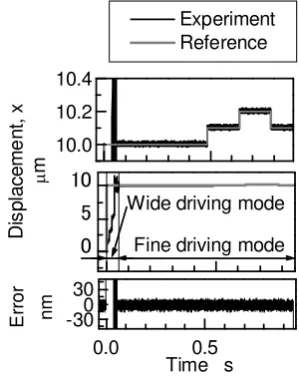
The combination of the two driving modes (referred as to dual driving mode) has the potential to achieve the point-to-point positioning in the wider working range and the ultra-precision adjustment with the continuous holding force near the reference position. The switching characteristics between the modes greatly influence the response of the control system with the actuator. For improvement of the switching characteristics, the wide driving mode signal is modified. The modified wide driving mode signal can provide the same driving characteristics as the previous one. However the modified signal shows the quicker response than the previous signal.
Figure 3 shows the positioning performance using a mixed input reference in the dual driving mode. The mixed input reference consists of a 10m step signal and a 100nm stepwise input. The positioning error in the fine driving mode is smaller than 14 nm. This result demonstrates the high positioning performance and high adjustment performance near the reference position under the dual driving mode.
CONCLUSION
This paper introduced the dual mode control used in the combination of the wide driving mode for precision positioning in the wide working range and the fine driving mode for ultra-precision position adjustment near the reference position with the continuous holding force. These driving modes are realized based on the friction control characteristics of the electrostatic actuator supported by only lubricating oil. The designed control system demonstrates the ability to adjust position ultra-precisely with the continuous holding force. The positioning error is smaller than 14nm.
REFERENCES
[1] Beyaz M. I. et al. Closed-Loop Control of Long-Range Micropositioner Using Integrated Photodiode Sensors. Sensors and Actuators A, 2009; 150(2): 187-194. [2] Yamashita K. et al. Voltage-Induction Type
Electrostatic Film Motor Driven by Two- to Four-Phase AC Voltage and Electrostatic Induction. Sensors and Actuators A, 2007;140(2): 239–250.
[3] Md Ghazaly M, Sato K. Basic Characteristics of A
Multilayer Thin Electrostatic Actuator Supported by Lubricating Oil for a
Fine-motion Stage, Precision Engineering, 2012; 36(1): 77-83.
FIGURE 1. Driving method for the bi-directional motion of a multilayer electrostatic actuator supported by only lubricating oil.
FIGURE 2. Experimental open-loop displacement response of the actuator to a normal driving signal with a 1kV holding voltage.
FIGURE 3. Positioning performance using a mixed input reference in the dual driving mode.