191
Evolution Sustainable Innovation Management in China
Puvanasvaran, A.P.
1, Zaid Ahmed Al-Hayali
2,Miza Farahana Yop Zain
3,Mukhiffun Mukapit
4 Puvanasvaran, A.P., Zaid Ahmed Al-Hayali, Miza Farahana Yop Zain,Mukhiffun Mukapit1Faculty of Manufacturing Engineering,
Universiti Teknikal Malaysia Melaka, Durian Tunggal, 76100 Melaka, Malaysia Phone: +606-3316002, Fax: +606-3316411, Email: [email protected]
2,3,4Faculty of Technology Management and Entrepreneurship, Universiti Teknikal Malaysia Melaka,
Hang Tuah Jaya, 76100 Durian Tunggal, Melaka. Email: [email protected]
Abstract – Innovation performance in China has become the focus of many studies. Rapid growth in China has brought the topic of innovation in China into discussion. In today business, innovation is the only way to achieve goals and objectives that lead to sustainable growth. Thus in this paper the question we proposed is how technical capabilities, R&D centers and research institutions, and human capital all together affect innovation performance in China. Previous studies on innovation in China have examined innovation performance regarding economic and marketing aspects. F ollowing discussion highlights the importance of each variable base on number of studies has conducted to study that particular variable.
Keywords– Innovation Performance, R&D, Technical Capabilities, Human Capital
I. INTRODUCTION
The word ‘innovation’ has become very popular. It’s
very common to hear statements like: if the company wants to survive, it must focus on innovation, there is only one way for the company to become more competitive which is through innovation, and innovation is one of the critical factors that can bring success for businesses. Humanity owes the word “innovation” a lot. Since the term innovation become very popular, world has changed significantly. Innovation has been and continues to be an important topic of study for a number of different disciplines, including economics, business, engineering, science, and sociology [1].
It’s not surprising that innovation brought welfare and
enhances the lifestyle. To this regard, scholars have defined innovation regarding different aspects. Sometimes different definitions give the same meaning. We try to highlight some of these definitions. Wikipedia website define Innovation as the creation of better or more effective products, processes, services, technologies, or ideas that are accepted by markets, governments, and society [2]. From the above definition we can see that the focus is on creating something new which should be accepted by the society and can be able to commercialize.
O'Sullivan and Dooley define innovation as; the process of making changes, large and small, radical and incremental, to products, processes, and services that result in the introduction of something new for the organization that adds value to customers and contributes to the
knowledge store of the organization [1].This definition carries the viewpoint of those organizations who want to focus on innovation as a competitive advantage. Moreover, it gives a clear direction for those organizations on what to do to be an innovative firm. In order to distinguish between innovation and creativity, Fry define innovation as; a new pattern or path or even paradigm that is adopted by an individual or a society [3].
Another definition for innovation related to the economical and technological aspect, Innovation refers to the economic application of new idea and technological innovation is described as a process which transforms idea to the commerce [4]. However ABS Innovation Survey define innovation as any new or substantially improved good or service which has been commercialized, or any new or substantially improved process used for the
commercial production of goods and services. ’New’
means new to your business [5].
Finally, Business Council of Australia defined innovation as follow; in business, innovation is something that is new or significantly improved, done by an enterprise to create added value either directly for the enterprise or indirectly for its customers [6]. .From all definition of innovation we can see that innovation is not just having an idea. It is how to turn these ideas to business and make it beneficial for wide range of people.
Innovation can be a product, or service, or a new system that adds value and improve quality. It is clear that innovation is very important for the future of any company wants to participate in the global market. Companies need not just focus on its current business practice, but to develop a new and creative innovation.
A.Why innovation is important
Studies have confirmed that all companies want to be more innovative. Many surveys conducted about how companies look to innovation found that a high percentage of companies believe that innovation is a priority for them; as a result, the importance of innovation is increasing
rapidly. In today’s business environment, innovation has
192 Innovation is very important for the company in both short and long term.
Organization most often measure and plan ideas, objectives and people leads to innovation as a result of new business ideas and technological revolutions. To qualify for value, innovation of new products and services must be strong enough to increase the critical process of commercialization and marketing. Peter Drucker once said that if an established organization, which in this age necessitating innovation, is not able to innovate, it faces decline and extinction. Many organizations have taken steps to strengthen their capacity to innovate. These companies are creating an effective operating system for innovation, an important indicator of corporate sustainability.
The successes of companies like Google, Apple, Microsoft and others demonstrate the importance of innovation and the need for hiring innovators more than any time before. Every organization and every company have to deal with issues like technological revolutions, obtaining knowledge, globalization, climate change, and migration which all can be a good opportunity to engage in innovation. Innovation will add value and expand the employment base. Innovation is essential if the quality of life in these difficult circumstances to improve. Innovation makes the world a better place for younger generations.
B.Innovation in China
The growth performance of China has been astonishing. Within two decades, economy rose out of poverty and transformed into (low) middle income countries [7]. There is a rise on the issue of growth in chine and the future of
the country; it’s believed that one of the factors that drove
growth in China is country's ability to become an innovative economy.
Innovation in China is driving by privet and public sectors. In recent years Chinese companies like MINDRAY, which makes medical devices, HUAWEI, a
telecommunications company, and LENOVO an
information technology and electronics company become capable to develop cheaper technologies and sometimes better than their counterparts in rich countries.
A new εcKinsey Quarterly article, “A CEO’s guide to innovation in China,” opens with striking dataμ since 2005,
China’s percentage of the world’s patents has doubled
[8].These statistics clearly show that China is actually increasing, in terms of its inventive production. In 2010, China was the fourth largest in the overall presentation of patent applications [9]. This follows a decade of unprecedented increases in investment in skills and research and development. If the country has to continue a stable progress, China may be classified for the first time in the very near future. Evidence showed that the growth of patent activity in China has been accompanied by growing Chinese inventors to create technologies with
high value. Part of the success of China has been attracting investment by foreign multinational companies.
In China's latest five-year plan, promises to change the economy from its dependence on exports to domestic consumption as a driver of growth. The key to this will be for the nation to improve its economic capacity to innovate and generate new technologies. However, the assessment of China on this issue is mixed. Understanding why this is, and how to fix it, it is important to estimate the probability that China will succeed in achieving its ambitious goals. Spending on research and development rose by 1.5 percent of GDP in 2008, 1.25 percent in 2004, even more impressive when you consider that GDP increased dramatically during this period. China accounts for 12 percent of R & D expenditures. Note that these measures spending on R & D research institutes, government-controlled companies of large enterprises and medium enterprises, which now account for 60 percent of total expenditures. Foreign investment enterprises account for the full 7 percent of these expenses, divided by nearly 1500 R & D centres set up by multinational corporations [10].
China showed strength in innovation processes and the creation of new manufacturing systems. Instead of staying in the field of low-end manufacturing, these capabilities will encourage China's economy in the coming years, and possibly allow China to become a country not only use technology, but produce technology as well.
Some observers note that China - is the second largest producer of science and technology thesis - runs the second largest economy. IMF has predicted and even bolder than the GDP of China will overtake the U.S. for the year 2016. However, the economic scale and capacity for innovation are different concepts.
China's economy relies on foreign technology and foreign direct investment. Innovation is exploited to create a great economic value. Innovation has never been more important than today, and is closely related to the sustainability of China's economy. China has been trying to establish innovation framework and implementation strategy to support and modernize its economy. China had 12.3 percent of global R & D in 2010, second only to the United States. China has 200,300 patent applications in 2008, which ranks third in the next Japan and the United [11]. Technology Strategy is definitely an important but often overlooked factor in the formation of strategic business development.
Technology alone will not create all the strength of a company or nation. However, the strategy of appropriate technology and effectiveness is a key driver in achieving a competitive advantage for industries and businesses. By integrating technology strategy right into your overall strategy, a nation can develop a clear policy towards technological development and technological innovation.
193 development of its economy and technological capacity building, while some critics questioning the strategy of technology in China has been successful in obtaining the basic technology.
Growing importance of China in international and regional science and technology business has created a growing need for a deeper understanding. A wide range of policies and programs have been implemented over the past two decades to make significant improvements in the innovation system of the country. After the traditional model of innovation strategy, the Chinese government has made "indigenous innovation" a cornerstone of the country's future development.
Many indicators and statistics such as number of scientific and engineering Chinese scholars who publish in international journals, the amount of investment in R & D and patents, indicate that China's science and technological capabilities have been spectacular growing. Meanwhile, the research environment in China has often been criticized as being detrimental to individual creativity. Policy makers in science and technology are considered dominant, and researchers in China face many obstacles.
The aim here is to examine the performance of innovation in China. It examines the various factors that promote innovation, and the obstacles facing innovation system in China. The paper tries to highlight the most important factors that affect innovation system in China. Studying implications related to innovation performance will be base on the literature about innovation in China.
II.LITERATURE REVIEW
Today it comes to industrial innovation as one of the fundamental forces, social development, as key to industrial restructuring and modernization, competition in the high-tech industry in the world will be harder that the essence of competition, the competition of the soul of science and technology capacity and innovation with the current situation is of national and international interest [12].
In fact, organizations do not want to be innovative, they want to continue striving to be successful, and achieve the goals and objectives they have constructed. The innovation is simply a lever that delivers success, not an end in itself. There are many levers can be used to achieve success, including mergers and acquisitions, and improved employment practices. Innovation is one of those levers and it should support the aims and objectives of an organization.
The knowledge of the innovation capacity of enterprises is also the understanding of the logic of innovation. Without scientific knowledge and full of innovation of the company, the true understanding of the innovation itself is inserted [13].An effective organization, their attention turns to innovation is looking for achievements. Innovation is in the quality and quantity of ideas and the efficiency and effectiveness of the implementation of these ideas.
These two parameters are independent, but when combined, they form the definition of innovation performance.
The real challenge is how to organize your organization to offer innovative services on the front. Two factors contribute to the quality and quantity of ideas. The first is the idea generation and the second is the selection of ideas. Organizations often lose with high strong ideas in terms of their way during the selection process. This tends, due to the absence of the relevant criteria. Choosing the right people to make the idea of evaluation is also crucial. Identify themselves as well as tools for generating ideas, methods and systems: Idea generation can be divided into two distinct parts, includes a systematic search for and compiles information, data and knowledge, which forms the basis for the development of consumer and timely technical data. There are many ways used to compile an overview, including the use of sources outside the organization such as consumers, users, technology drivers and so on. Insight will develop from this information, data and knowledge through the combination of ideas and developed specifically for the data obtained with respect.
The next performance factor innovation is idea selection. Idea of the selection will be divided into two sub-factors, the selection criteria and evaluation panels. The selections criteria are the parameters evaluated against the ideas and are best determined by the generation of ideas. If these criteria are determined by the generation of ideas, then they can be influenced by the ideas generated. The criteria may vary within business units and should be aligned with the overall business strategy and goals.
The evaluation panels and individual assessors are essential to the selection of effective ideas. First, the inclusion of experts in a matter of organization, you can ensure maximum intellectual output of an organized system is used. The evaluation process should include all those who will participate in the development and support of an idea or project. It is rare to find a group of people with the opportunity to undertake all the assessments of a group of ideas. With plates from internal and external experts offer the possibility of knowledge from experience, by transferred to less experienced employees, and creates an entry for a bank of innovation. The use of assessment tools based on the Internet is crucial for professionals and executives allow evaluating the ideas in real time. Innovation is the ultimate test for the efficiency and effectiveness of implementation. Resource management and business practices of a company the reaction can be seen from two different angles.
194 successfully, a number of roles and delegate should be described. In organizations where innovation is considered optional and the focus is the daily business, innovation activities are occurring frequently and latent failures in innovation performance. This creates a vicious circle in which innovation is a lower priority on the list of actions and longer still to be done.
To have more understanding for innovation in China we need to study what is the characteristics the affect the level of innovation. In other words, what are the factors that determine innovation performance in a particular country.
Three factors are the focus of this paper. These factors are; Technical capabilities, R&D centre and research institutions, and human capital. We try to see how important these factors for increasing innovation in China. Six implications have developed in this paper believed to be related to innovation performance in China:
i) Modern R&D facilities have a significant and positive effect on innovation performance in China.
R&D centers are very important for innovation practice. Even though there is still work to do outside these centers but it is still playing a major role to support innovation and encourage researchers to produce knowledge.
ii) Effective patent roles and regulations have a significant and positive effect on innovation performance in China.
A very common measure to assess the innovation performance for a particular county is number of patents produce yearly. Thus the role and regulation of patents in a particular country is very important to increase innovation performance.
iii) Effective education system has a significant and positive effect on innovation performance in China.
Education system is one of the ways to produce talented and skillful employees, who are very important to boost the innovation capabilities in any country.
iv) Technology transfer and sharing experience have a significant and positive effect on innovation performance in China.
Globalization has changed the way people think and act, thus in such a very important topic like innovation sharing knowledge and transfer of technology from outside China have a major impact on innovation performance.
v) Government expenditure on R&D has a significant and positive effect on innovation performance in China.
The money spend by government have a crucial impact on innovation performance, grants given by government help and motivate research to conduct more research.
vi) Easy access to the information has a significant and positive effect on innovation performance in China.
Exchange information between research centers, universities, and institutions has a major role to see what have been done by others and want things still need to be investigated.
III. METHODOLOGY
As we stated earlier the focus is to examine issues related to innovation performance in China and how factors such as: technical capabilities, human capital, and R&D centers and research institutions affect innovation performance in China. This paper uses secondary data
‘literature review’ as a main source of information.
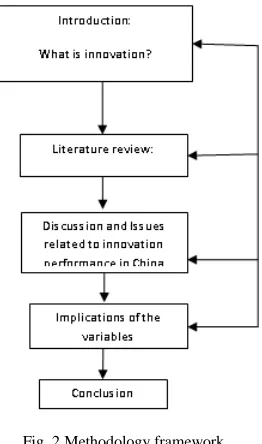
Secondary data refer to information gathered from sources that already exist. Secondary data is the information gathered by someone other than the researcher conducting the current study. This paper is aiming to see the importance of each factor base on the literatures that have written regarding each one of the three factors. We believe that the number of researches or papers that have written to support any of the variables could reflect theimportance of that variable. Below is a framework to highlight how we designed this paper.
Fig. 2 Methodology framework.
195 the three variables discussed in this paper. The third part of this paper is to discuss the issues related to innovation performance in China and to prove the implications that we proposed earlier. To show the importance of each variable, and to support all the implications we have proposed earlier, table constructed to explain how scholars have identified each one of the variables. The importance of each variable comes from the papers that have written to support this variable or issues related to it. Finally, the conclusion to shed light on the most important issues have discussed in this paper.
IV. DISCUSSION AND ISSUES RELATED TO
INNOVATION PERFORMANCE IN CHINA
Literature has showed the importance of innovation. There is no doubt that if China wants to become a fully developed country one of the most important issues the country needs to focus on is innovation. However some scholars agreed that China is moving forward towards achieving its goals, others are criticizing that China is not doing enough to boost its growth in innovation performance. During the last decades, China has showed enormous economic growth. Recently China becomes the second largest economy behind US. This new position has put more pressure on China to become one of the very few countries that have the ability to produce knowledge, in different word produce patents. In both public and private sector innovation performance become a priority. Vast numbers of researches and studies have been conducting in order to understand what is the characteristics that affect innovation performance, and how should be studied.
A.R&D centers and research institutions
The majority of the literature in this paper is focusing
on R&D centers and institutions. It’s obvious that for any
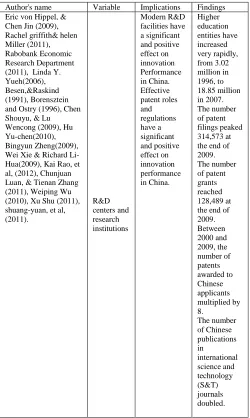
country to see whether it is innovative or not, is through number of patents produce per year. In the case of China, the country has showed a very rapid increase in the number of patents producing per year and the spending money be government and companies on R&D. Between 2000 and 2009, the number of patents awarded to Chinese applicants multiplied by 8, while the number of Chinese publications in international science and technology (S&T) journals doubled [7]. To this regard we have to mention that it is not only number of patents is important, the quality of these patents is very important for the country and the world as well, since we agreed all that innovation enhances the lifestyle and bring welfare for society.
In the case of China, even though there is an increase in the patents produce by both public and private sector, there is some questioning about the quality of these innovations and patents. For example, yet there no any internationally famous Chinese brand. Most of the famous and recognized brands come from western countries. All the most advanced technology comes from US, Europe, and Japan.
On the other hand there are two worthy examples about Chinese companies need to be consider. The first one is the
computer manufacturer ‘δENO↑O’. The second is high
speed trains producing by Chinese companies. Recently LINOVO is doing very well in terms of laptop design. Also in the recent years China has become very well known for its high speed trains. Currently it is producing the fastest train in the world. Some researchers arguing that the growing in Chinese patents will continue in the future if China has focused more on develop its education system. Such efforts can help to have more talented people, and those how work in research centers. If China continues in the same effort we can see China producing more and more patents with better value.To this extent we have to say that implication 1, 2 have proven base on the past discussion.
Table 3. R&D Centres and Research Institutions Implications and Findings
196 B.Technical capabilities
The second variable that is highlighted in this paper is technical capabilities. Regarding the literature we have seen that there are no many papers or researches have studied the issue of technical capabilities. The infrastructure is a crucial factor to support the innovation in chine. We all know that China is a very big county, and needed an efficient system to exchange the information cross R&D centers and research institutions. Even though the Chinese government is doing a lot of investment to enhance its infrastructure, there is still work to do.
It is said that we live in the era of computerization, internet, and social network. The Chinese government needs to focus more on how to facilitate the easy access to the information for researchers and public in order to increase the level of innovation. In its nature, innovation is kind of solving a problem and enhance people’s life, thus China need to focus more on how to highlight the problem that it wants to be solved. Having a good information system is a crucial factor for innovation in China to succeed. All universities, labs, research institutions, and entities should link together to see what have been done and what to do in the coming years. Previous studies about innovation in western countries have showed that one of the critical success factors for innovation in these countries is the efficient network they have. If China wants to contribute to the world knowledge, the country should deal with the issue of innovation as priority.
On the other hand, we have seen that there is an increase interest in the issue of tools and equipment needed in the R&D centers and research institutions in China. The country started to focus more on having a world class facility. We have to mention that private sector in China playing a major role to support the idea of having a world class facility.
All multinational companies when they come to China they like to bring all their machines, tools, and equipment that they need to operate in China. China has understood that having world class facility in their R&D centers should be in parallel with quality of researchers and human resource that the country has. Moreover, the design of these centers and institutions should help to increase the productivity of researchers.
The environment inside labs is a very important element to support innovation in China. Friendly environment will encourage innovators and researchers to focus more on their work. The safety in China is one of the important issues that China has been criticized of by the west. The
country should invest more on safety to save people’s life
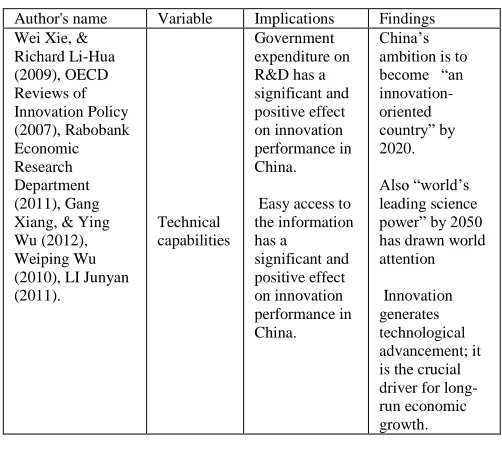
and motivate them which leads for sustainability. By highlighting the importance of having a good facility in the R&D centers and exchange of information system in China we have approved implication 4, 5.
Table 4. Technical Capabilities Implications and Findings
V.HUMAN CAPITAL
Literatures have showed that human capital is the second important variable from the point view of researchers. China demonstrated enormous increase in innovation field. This was leading by the changes that have made in its education system. The new education system has allowed students to focus more on doing research to solve problems. The old education system in China was kind of feeding spoon when the students need just to focus on following a specific instructions to solve problems. This kind of learning did not help the students to think freely in trying to come up with creative ideas to overcome the problems they face.
Creative thinking is the first step towards innovation. If we want to compare between education system in China and US for example or any western countries we have to say that China needs to do more to support its education system. The Chinese government should increase spending on education in all levels from primary schools until the academic level.
Studies showed that not only education is important, but training is an important issue to boost innovation. Training can be seen in both academic and business fields. Student during their study should have the opportunity to attend some training workshop to get the knowledge base on real success and failure stories. This can help student to; firstly, try to think in a creative manner to solve these problems, secondly, knowing the common problems can help to avoid such problems in the future when the students inter the real life of business or innovation field.
Author's name Variable Implications Findings Wei Xie, &
Richard Li-Hua (2009), OECD Reviews of Innovation Policy (2007), Rabobank Economic Research Department (2011), Gang Xiang, & Ying Wu (2012), Weiping Wu (2010), LI Junyan (2011).
Technical capabilities
Government expenditure on R&D has a significant and positive effect on innovation performance in China.
Easy access to the information has a significant and positive effect on innovation performance in China.
China’s ambition is to become “an innovation-oriented country” by 2020.
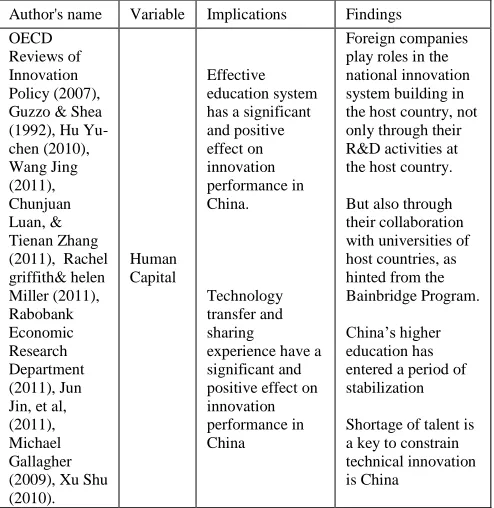
197 Table 5. Human Capital Implications and Findings
In the business sector training carries an important meaning for all companies and organizations. To help innovation to flourish in China companies especially local companies need to train their employees, researchers, and investigators to know how to use the new facility, deal with multitasking job, and how to be a creative to produce new innovations. From the previous discussion implication3 has approved
China has relied on transferring the basic and advanced technology to support its innovation system. In both private and public sector, China established roles and regulations in line with the international regulations to increase the flowing of technology to China. In Chinese case technology transfer was not only about bring the technology in terms of machine and equipment from
outside the country, it’s about sharing knowledge and experience with other countries, organizations, and institutions. Sharing experience has helped China to learn how to create its own technology base on Chinese conditions and environment. If China continues in the same manner China can move very fast from imitating to creating technology. To this extent implication 4 has approved and supported by the above discussion.
SUMMARY
In conclusion, R&D centers and research institutions, technical capabilities, and human capital are crucial factors for innovation performance in China. We found that the most important element for innovation in China is R&D centers and research institutions. Even though there is an increase in the number of patents in China, the country still needs to do more to sustain this number and enhance the quality of patents. On the other hand China has to increase its spending on R&D activities. Chinese government should collaborate with foreign companies and organization to establish a sold system of innovation in China. China has to continue the investment in its infrastructure to support innovation. China is a very big county which is need to link research centers in all territories with efficient communication system. Information exchange is a crucial factor for innovation performance in China. China has to do more with storing, and publishing data related to innovation performance in China. Talented people and good thinkers come from a well established education system. China should consider this fact to be able to compete with western countries. Finally, sharing experience and technology transfer are one of the mechanisms have been used by Chinese authority to support innovation performance.
REFERENCES
[1] David O'Sullivan, & Lawrence Dooley, “Applying Innovation”, Sage Publications, Inc (19 Augest, 2008), p5.
[2] “definitionofinnovation.”,retrievedfromwikipediaμ http://en.wikipedia.org/wiki/Innovation 15 April, 2012.
[3] Art Fry,” Creativity, Innovation and Inventionμ A Corporate Inventor’s Perspective”, Source CPSB’s Communiqué, ↑ol. 13, p.1 -5, 2002.
[4] Subrahmanya, M.H.B. Pattern of Technological Innovations in Small Enterprises: A Comparative Perspective of Bangalore (India) and Northeast England (UK). Technovation, 25, pp: 269-280. 2005. [5] "Research and Experimental Developmentμ Business Enterprises.”
Australia Bureau of Statistics, ABS 8104.0(Canberra), 1996. [6] “εanaging the Innovating Enterprise.” Business Council of
Australia Melbourne, BCA, 1993.
[7] “Innovation in China and India”, (4 October 2011), retrieved from Rabobank Economic Research Department: http://www.rabobank.com/content/images/SP1106aru%20Innovatio n%20in%20China%20and%20India_tcm43-147223.pdf, 15 April, 2012.
[8] Gordon Orr, & Erik Roth, “A CEO’s guide to innovation in China”,retrievedfromhttp://www.mckinseyquarterly.com/A_CEOs_ guide_to_innovation_in_China_2919, 2012.
[9] Rachel Griffith, & Helen Miller, Innovation in China: the rise of Chinese inventors in the production of knowledge, institute for fiscal studies, 2011.
[10] Chunjuan Luan,& Tienan Zhang, "Innovation in China: a patentometric perspective (1985-2009)", Journal of Knowledge-based Innovation in China, Vol. 3 Iss: 3 pp. 184 – 197, 2011.
tech Industries in China” λ78-1-4244-3672-9/09, 2009. Author's name Variable Implications Findings
198 [13] Bingyun Zheng, “Enterprise Innovation Abilityμ Concept,
Formation and Cultivation”, 200λ International Conference on Information Management, Innovation Management and Industrial Engineering, 978-0-7695-3876-1/09, 2009.
[14] Wei Xie,&, Richard Li-Hua,"What will make China an innovation-oriented country?", Journal of Knowledge-based Innovation in China, Vol. 1 Iss: 1 pp. 8 – 15, 2008.
[15] Eric von Hippel,& Chen Jin,"The major shift towards user-centred innovation: Implications for China's innovation policymaking", Journal of Knowledge-based Innovation in China, Vol. 1 Iss: 1 pp. 16-27, 2008.
[16] Kai Rao, et al,"The impact of government R&D investments on patent technology transfer activities of Chinese universities: From the perspective of triple helix theory", Journal of Knowledge-based Innovation in China, Vol. 4 Iss: 1 pp. 4 – 17, 2012.
[17] δinda Y. Yueh, “Patent δaws and Innovation in China”, ISSN 1471-0498, 2006.
[18] Jun Jin, et al, "International university-industry collaboration to bridge R&D globalization and national innovation system in China", Journal of Knowledge-based Innovation in China, Vol. 3 Iss: 1 pp. 5 – 14, 2011.
[19] Gang Xiang, & Ying Wu,"Enterprise's sustainable innovation in China: practice and theoretical research", Chinese Management Studies, Vol. 6 Iss: 1 pp. 92 – 107, 2012.
[20] Weiping Wu,"Higher Education Innovation in China". Retrieved(9,May,2012),from,http://siteresources.worldbank.org/INT EASTASIAPACIFIC/Resources/China
HigherEducationInnovation.pdf, (2010).
[21] “OECD reviews of innovation policy china.” organisation for economic co-operation and development in collaboration with the ministry of science and technology, china, 2007.
[22] shuang-yuan wang, et al, “Technology Innovation Problems Research In Chain Link of Commercial Aircraft Corporation of China”, λ78-1-61284-449-7/11, 2011.
[23] ↓u Shu, “On the Problems and Tactics of Technology Innovation of Small and εedium Enterprises in China”, λ78-1-4244-6581-1/11, 2011.
[24] →ang Jing, “The Analysis of SεE Innovation Route”, λ78 -1-4577-0358-4/11, 2011.
[25] δI Junyan, “Research on the Innovation Capacity of Chinese Sports Goods Enterprises under the global Competition Background”, λ78 -1-61284-109-0/11, 2011.
[26] Hu Yu-chen, “Problems and Solutions of China's Industrial Cluster Technology Innovation”, λ78-1-4244-6932-1/10, 2010.
[27] Chen Shouyu,& δu →encong,“The Key Factors Affecting Technological Innovation in Shaoxing’ Textile Industry”, 200λ. [28] International Conference on Information Management, Innovation
Management and Industrial Engineering, 978-0-7695-3876-1/09, 2009.
[29] Besen, S.ε. & Raskind, δ.J., “An Introduction to the δaw and Economics of Intellectual Property,” Journal of Economic Perspectives 5, 3-27, 1991.
[30] Gallagher, Michael, et al, OECD Reviews of Tertiary Education: China. Retrieved on 25 September 2009 from www.oecd.org, 2009. [31] “Unleashing Innovation in China.” (February 6, 2011), retrieved,
from Innowisdom.com: http://www.innowisdom.com/, 3 May, 2012.
[32] Guzzo, R.A. & Shea, G.P. (1992). Group performance and intergroup relations in organisations. In Dunnette, M.D. & Hough, L.M. (eds), Handbook Of Industrial And Organisational Psychology, 3.Consulting Psychologists Press, Palo Alto, CA, pp. 269–313.