FORMAL AND DYNAMIC EQUIVALENCE TRANSLATION
OF ENGLISH-INDONESIA INSURGENT NOVEL BY
VERONICA ROTH
A THESIS
Submitted as Partial Fulfillment of the Requirements for the Degree of Sarjana Sastra
By:
ANGGREYNI A TAMPUBOLON
Registration Number : 2123220004
ENGLISH AND LITERATURE DEPARTMENT
FACULTY OF LANGUAGES AND ARTS
DECLARATION
I have familiarized myself with The University’s Policy on Academic
Integrity. Except where appropriately acknowledged, this thesis is my own work,
has been expressed in my own words and has not been previously submitted for
assessment.
I understand that this paper maybe screened electronically or otherwise for
plagiarism.
Medan, September 2016
The Researcher,
Anggreyni A Tampubolon
i
ABSTRACT
Tampubolon, Anggreyni. Reg. No. 2123220004. Formal and Dynamic Equivalence Translation in Insurgent Novel by Veronica Roth. A Thesis. English Department of Faculty of Languages and Arts. State University of Medan. 2016
This study deals with Formal and Dynamic Equivalence Translation in Insurgent Novel by Veronica Roth. The objective of this study is to find out the most dominant types of equivalences in translation used in the translated version of the novel and to reason why it is used in that way. The population of this study is original version of Veronica Roth’s novel entitle “Insurgent”and its translation into bahasa Indonesia translated by Nur Aini. The original version consists of 47 chapters and 525 pages while its translated version consists of 47 chapters and 547 pages. Any single word or sentences are identified and classified based on the criteria of formal equivalence and dynamic equivalence proposed by Eugene Nida. The descriptive qualitative method is applied for the research design. The findings of the study show that the dominant type of equivalence is formal equivalence (72,73%) and then dynamic equivalence (27,27%). It means that, the translation process conducted by the translator is dominantly source language oriented because it still retains the source language features while dynamic equivalence shift the structure of source language to gain the same impact on the different readers it was addressing.
i
ACKNOWLEDGEMENT
Praise the Almighty God. First of all, the writer would like to thank God
for all His blessing, guarding, guidance and for everything that have been given
along her life, especially in accomplishing this thesis. This thesis is aimed to
fulfill one of the requirements to obtain the S1 degree of Sarjana Sastra at the
English Department, Faculty of Languages and Arts, State University of Medan.
In completing this thesis, the writer has received a lot of assistance and
academic support from some people. Therefore, the writer would like to express
her sincere gratitude, love and special thanks to:
Prof. Dr. H. Syawal Gultom, M.Pd., the Rector of State University of
Medan.
Dr. Isda Pramuniati, M.Hum., the Dean of Faculty of Languages and
Arts, State University of Medan.
Prof. Dr. Hj. Sumarsih, M.Pd., the Head of English Department, Dra.
Meisuri, M.A., the Secretary of English Department, Syamsul Bahri, SS,
M.Hum., the Head of English Literature Study Program and Nora
Ronita,S.Pd, SS, M.Hum., the Head of English Education Study
Program, Faculty of Languages and Arts, State University of Medan.
Drs. Lidiman S. M. Sinaga, M.Hum.,and Prof. Amrin Saragih, M.A.,
Ph.D., her Thesis Supervisors, for their patience and suggestions in
guiding the writer to finish this thesis.
Dr.Rahmah, M.Hum., and Syamsul Bahri, M.Hum., her
ThesisExaminers.
All beloved Lecturers of English and Literature Department during her academic year at State University of Medan, who have taught and given
knowledges to her encouragement and invaluable advices to complete this
thesis.
ii
Her beloved parents, Monang Marsal Bilyard Tampubolon and
Ramayana Siregar to whom this thesis is dedicated for their entire,
patient, pray, love, moral and financial support.
Thanks for the love, support, joke, financial support and great care all the
time from her sisters Basana Ayu Tampubolon, Desi Yunita
Tampubolon and also her brother Doni Putra Andreas Tampubolon.
Her Marbun’s family, alm. Pak Tua Hani Marbun, Mak Tua Hani
Siregar, Johana Butet Marbunand all big family of Op. Sotarduga
Tampubolonfor all their love, pray and care.
Her Lovely friends Yuditha Fajar Aritonang, Ipin Wiratama
Manurung, Mouridc Tampubolon, Tati Hasibuan, and all her friends
boarding house in Kost Dantob 12, and Op. Kost br. Sinaga.
Her beloved Sixties, Bi Hendro Douglas Simamora, Dhodo Kimbum Sinaga, Gatot Michael Tampubolon, Io Wira Buana Manalu, and
Shindy Egia Nina Tariganfeat Maria Clara Situmorangfor every
unforgetable moments that they had spent for 4 years and their bright
future which have waited for them.
Her beloved friends Boy Arie Sandy, Homograf, Go Home Fast,
Tragipo, Dede and all friends in English Literature A and B 2012 that
could not be mentioned one by one.
Her Families in Solfeggio Choir State University of
Medan,UKMKP-UP FBS, Aboda, and IMDAmore than amazing sisters and brothers who
have been there with her through her ups and downs and have supported
her through her academic activities.
Medan, September 2016
The writer,
i
CHAPTER I. INTRODUCTION ... 1
A. The Background of the Study ... 1
B. The Problems of the Study ... 5
C. The Objectives of the Study ... 5
D. The Scope of the Study ... 5
E. The Significance of the Study ... 6
CHAPTER II. REVIEW OF LITERATURE ... 7
A. Theoretical Framework 1. Definition of Translation ... 7
2. Types of Translation ... 9
a. Word-for-word translation ... 9
b. Literal translation ... 10
c. Faithful translation ... 10
d. Semantic translation ... 11
e. Adaptation ... 11
f. Free Translation ... 12
g. Communicative translation ... 12
h. Meaning-based translation ... 13
i. Form-based translation ... 13
3. Function of Translation ... 15
4. Process of Translation ... 16
5. Meaning in Translation ... 18
a. Referential meaning ... 18
b. Organizational meaning ... 18
c. Situational meaning ... 19
2) Grammatical categories ... 23
3) Semantic classes ... 25
ii
B. Brief Summary of the Novel “Insurgent” ... 26
C. Relevant Studies ... 28
D. Conceptual Framework ... 30
CHAPTER III. RESEARCH METHOD ... 32
A. The Research Design ... 32
B. Data and The Source ofData ... 32
C. The Technique of Collecting Data ... 33
D. The Technique of Analyzing Data ... 33
CHAPTER IV. DATA AND DATA ANALYSIS ... 34
A. Data ... 34
B. Data Analysis ... 34
1. Formal Equivalence ... 35
2. Dynamic Equivalence ... 43
C. Research Findings ... 46
CHAPTER V. CONCLUSIONS AND SUGGESTIONS ... 47
A. Conclusions ... 47
B. Suggestions ... 47
REFERENCES ... 48
i
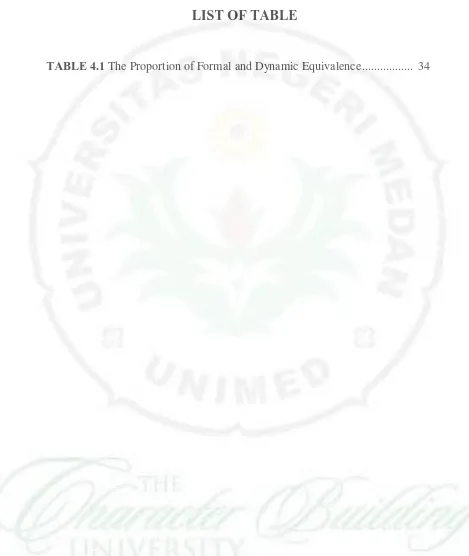
LIST OF TABLE
1
CHAPTER I
INTRODUCTION
A. The Background of the Study
Language is always needed in the communication process. It is used
mainly to communicate with others or to build social interaction with others or to
build social interaction with different background of people from all over
countries. Besides, humans are social creatures who cannot live alone and need
each other for the sake of living. Based on this, humans need communicate, and
the most common way humans use to communicate is through language. Surely, a
language used in one country is different from a language used in others.
Whenever there appear language barrier, then it takes someone who are able to
interpret or to translate the message so that it avoids the readers from misleading
the message and enable them to understand the messages comprehendly. Then,
the transfer of the message from source language to target language known as
translation.
Nida (2006: 11) states that translating is not a separate science, but it often
does represent specialized skills and can also require aesthetic sensitivity. Skilled
translators must have a special capacity for sensing the closest natural equivalent
of a text, whether oral or written. But translating is essentially a skill and depends
largely on a series of disciplines, for example, linguistics, cultural anthropology,
philology, psychology, and theories of communication.
In the future we may be able to speak more scientifically about translating
when we know more about the ways in which the brain manipulates information
2
and transfers concepts from one language to another. Without such information
about neural processes we cannot really understand what takes place in our brains.
According to Munday (2004: 5), the term translation itself has several
meanings. It can refer to the general subject field, the product (the text that has
been translated) or the process (the act of producing the translation, otherwise
known as translating).
In the field of linguistics, translation is one of complicated aspects that
entangled all languages devices both in source language and target language. It is
natural as translation involves new dimension and two different of language
usage. On the other hand each language has its own mechanism and system which
must be different from other language. It is the problem that always impedes a
translator to translator to translate a text or literature because it takes some
correspondences either in the form itself or in the aspect of meaning. It is one
fundamental process the judge whether a translation acceptable or not.
Munday (2001: 1) states that translation studies is the new academic
discipline related to the study of thetheory and phenomena of translation. By its
nature it is multilingual and alsointerdisciplinary, encompassing languages,
linguistics, communication studies,philosophy and a range of types of cultural
studies. Throughout history, written and spoken translations have played a crucial
role in interhuman communication, not least in providing access to important texts
for scholarship and religious purposes. Yet the study of translation as an academic
subject has only really begun in the past fifty years. In the English-speaking
3
One of phenomental approaches in translation is the notion of equivalence.
This is actually concepts of sameness and similarity, but it’s not as easy as it
should be. Equivalence is basically intended to gain the same impact between the
message and the speakers. It’s still until now result in different perpective among
the experts of translation. Panou (2013): the concept of equivalence has been of
particular concern to translation scholars since it has been inextricably linked with
both definitional and practical aspects of translating.Farrokh (2011: 75) states that
equivalence is a central concept in translation theory, but it is also a controversial
one. It’s clear that the notion of equivalence is undoubtedly one of the most
problematic and contoversial areas in the field of translation theory.
In its development, Nida and Taber (1982: 22), then introduce the term
formal equivalence and dynamic equivalence as the key concept in the field of
translation theory. Formal equivalence translation is basically source-oriented;
that is, it is designed to reveal as much as possible of the form and content of the
original message. (Nida in Lawrence Venuti, 2000: 134). On the other hand,
dynamic equivalence translation is defined in terms of the degree to which the
receptors of the message in the source language, Nida and Taber (1982: 22).
Formal equivalence is partically the same as Newmark’s semantic
translation and dynamic equivalence is relevant with Newmark’s communicative
translation. At first, dynamic equivalence is mostly intended in the translation of
bible but later on it is applied in linguistics aspects. Dynamic equivalence let the
translator to shift a message in source language in such a way to gain the same
4
acceptable as long as it doesn’t change the intention and purposeof the source
lamguage message. However, equivalence in translation should not be approached
as a search for sameness, since sameness can’t even exixt between the two TL
version of the same text, let alone between the SL and TL version.
It’s clear the ascpect of translation is not merely change a language to
another language, but it is complicated process as not every languages is exactly
the same whether in the concept of syntactic or semantic. On the basis of dynamic
equivalence, translation is more emphasized in the perpective of speaker rather
than in the comparison of the message itself.
On the other hand, text to be translated also hold special characteristic
which differs from other kind of text type. Syihabbudin (2002: 152) states that
texts to be translated may also vary, depending on their content, such as scientific
texts, literary texts, or religious texts. Thus translating a literary texts, such as
novel in this study, also share some different criteria compared with other text
type. Translating novels is different from translating science.
Science deals with universals, and literal translation may be welcomed by
the academics interested. The happenings in novels are semi-imaginary, being
designed to move the feelings of the community.Since many years ago, million of
people arround the world have a big interest to read novel include the translated
novel from other countries. In this case, novel entitled “insurgent” by Veronica
Roth is one of prominent novel for readers. However, there arise the problems of
5
B. The Problem of the Study
Based on background above, the problems of this study are formulated as
the following:
1) What is the dominant type of equivalence found in the translation process
of English-Indonesia Insurgent novel by Veronica Roth?
2) Why are the formal and dynamic equivalence used in that ways they are?
C. The Objective of the Study
In relation to the problems, the objectives of the study are:
1) to derive out the dominant type of equivalence translation in the
translation process of English-Indonesia Insurgentnovel by Veronica Roth
and
2) to reason why the formal and dynamic equivalence are used in Veronica
Roth’s InsurgentNovel
D. The Scope of the Study
The scope of this study is limited to the equivalence perspective translation
applied in the novel “Insurgent” by Veronica Roth and its translation into bahasa
Indonesia with the same title by Nur Aini. It consists of 47 chapters in the both
original and its translation novel “Insurgent”. This analysis will based on the
theory of translation equivalence by Nida Mc Guire. She propose two equivalence
perspective in doing a translation from Source Language to Target Language.
6
E. The Significance of the Study
Finding of the study are expected to offer theoretical and practical
signifacance.
1) Theoretically, the findings can add up more horizons in translation theories
and they can be reference for further studies.
2) Practically, the findings are expected to give an accurate information to the
48
CHAPTER V
CONCLUSIONS AND SUGGESTIONS
A. Conclusions
After analyzing the data, conclusions are drawn as following:
(1) The finding of dominant type of equivalence in the the novel is formal
equivalence (72,73%) and then dynamic equivalence (27,27%). Formal
equivalence still retain the source language and try to defend any structure
of word choice in the perspective of source readers rather than the target
readers, such as translating noun to noun, verb to verb, adjective to
adjective, phrase to phrase etc.
(2) Formal anf dynamic equivalence doesn’t retain the grammatical features of
source language whether its word class, grammatical units etc. It enables
the translator to shift the structure as long as it doesn’t change the nuance
of meaning and the purpose of the text. It’s clear that both formal
equivalence and dynamic equivalence are one of useful approach in
translating to gain the idiomatic translation.
B. Suggestions
In relation to the conclusions, suggestions are stated as the following:
(1) It is advisable for other translators to comprehend the source language
before translating a text to produce idiomatic translation.
49
(2)a. It will be much more valuable for those who interested in the field of
translation to have cultural background experience prior to translating a
text.
b. It will be better to translate a text in the perpective of target langauge
1
REFERENCES
Ary, Donald, Jacobs Lecy Cheser., & Razavieh, Asghar. 2002. Introduction To Research In Education. Belmont:Wadsworth.
Dayan, LIU. 2012. Dynamic Equivalence and Formal Correspondence in
Translation between Chinese and English. Chongqing: Chongqing Jiaotong University.
Fadhillah,Swari. 2015. English-Indonesian Translation Equivalence of Verbs Found in Depicable Me Movie. Thesis. Medan: State University of Medan.
Farrokh, Parisa. 2011. “The Equivalence and Shift in the Persian Translation of
English Complex Sentences with wh-Subordinate Clauses”. English Language and Literature Studies. Vol.1, No.2, 1-8.
Frank, David. 2008. What Kind of Theory Do We Need for Translation. England: UK Campus of the European Training Programme.
Hartoyo, Indra. 2013. Translation I: Theoretical Foundation and Practice. Medan: State University of Medan.
Hatim, Basil. 2001. Teaching and Researching Translation. England: Pearson Education Limited.
Larson L, Mildred. 1984. Meaning-based Translation. London: University Press of America.
Malmkjaer. 2005. Linguistics and The Language of Translation. Edinburgh: Edinburgh University Press.
McGuire, Susan Bassnett. 1980. Translation Studies. London: New Accents.
Munday, Jeremy. 2001. Intoduction Translation Studies, Theories and applications. London: Routledge.
Newmark, Peter. 1988. A Textbook of Translation. New York: Prentice Hall.
Newmark, Peter. 2007. “A New Theory of Translation”. Brno Studies in English. Vol.33, 1-14.
Nida, Eugene. 2006. Theories of Translation. Netherland: Pliegos de Yuste.
Nida, Eugene and Taber, Charles. 1982. The Theory and Practice of Translation. Netherland: Leiden.
Panou, Despoina. 2013. “Equivalence in Translation Theories: A Critical Evaluation”. Theory and Practice in Language Studies. Vol.3, No.1, 1-6.
2
Roth, Veronica.2012. Insurgent. New York: United States of America
Roth, Veronica.2012. Insurgent. Bandung: Mizan Media Utama
Shakernia, Shabnam. 2012. “Study of Nida’s (formal and dynamic equivalence)
and Newmark’s (semantic and communicative translation) translating
theories on two short stories”.Merit Research Journals. Vol.2, 1-7.
Simatupang, Maurits D.S. 1999. PengantarTeoriTerjemahan. Jakarta: Universitas Indonesia.
Syihabuddin. 2002. Teori dan Praktik Terjemah Arab-Indonesia Direktorat Jenderal Pendidikan Tinggi. Bandung: Depdiknas.
Venuti, Lawrence. 2000. The Translation Studies Reader. London: Routlege.
Welch, Sarah. 2014. Staying Alive: Dynamic Equivalence Theory and Film Adaptation. Pacific: Seattle Pacific University.