ContentslistsavailableatSciVerseScienceDirect
Neuroscience
Letters
j o ur na l ho me p a g e :w w w . e l s e v i e r . c o m / l o c a t e / n e u l e t
Frontal
lobe
role
in
simple
arithmetic
calculations:
An
fNIR
study
Hedva
Meiri
a,∗, Itamar
Sela
a,b, Pearla
Nesher
a,
Meltem
Izzetoglu
b,
Kurtulus
Izzetoglu
b,
Banu
Onaral
b,
Zvia
Breznitz
aaTheEdmondJ.SafraBrainResearchCenterfortheStudyofLearningDisabilities,UniversityofHaifa,Haifa,Israel bSchoolofBiomedicalEngineering,Science&HealthSystems,DrexelUniversity,Philadelphia,PA,UnitedStates
a
r
t
i
c
l
e
i
n
f
o
Articlehistory:
Received3November2011 Receivedinrevisedform 18December2011 Accepted30December2011
Keywords:
fNIR Frontallobe Calculation Arithmeticprocessing
a
b
s
t
r
a
c
t
Thisstudyaimedtoaffirmtheuseoffunctionalnear-infraredspectroscopy(fNIR)inexaminingfrontal loberoleduringautomatic(i.e.,requiresretrievalfromlong-termmemory)andmethod-based(i.e., requirescalculation)arithmeticprocessing.Adultuniversitystudents(mathdifficulties[MD]and con-trol)performedsimplearithmeticcalculationswhilemonitoredusinganfNIRsystemdesignedtoimage regionswithinthefrontalcortices.Additionandsubtractionproblemspresentedonacomputerscreen belongedtooneofthreecategories:triples“under10”(e.g.,2+3=?,5−3=?),triplesthat“break10” (e.g.,5+8=?,13−5=?),ortriples“including10”(e.g.,10+7=?,17−10=?).fNIRrecordingsindicated significantinteractionsbetweentypeoftriple,operation,andgroupoverleftfrontallobe,andbetween typeoftripleandgroupoverrightfrontallobe.
Within-groupdifferencesamongcontrolswerefoundinthe“break10”tripleswithhigherDeOxyHb levelrecordedduringsubtractionprocessing.Between-groupdifferenceswerefoundinthe“break10” and“including10”triplesforsubtractionwithhigherlevelsofDeOxyHbrecordedamongcontrols.Results implythatamongadultsfrontallobeisstillinvolvedduringsimplemathematicalprocessingandfNIR recordingscandifferentiateitsroleinadultsofvaryingmathematicalability.
© 2012 Elsevier Ireland Ltd. All rights reserved.
1. Introduction
Research on performing arithmetical operations in specific regionsofthebrainhasmainlybeendemonstratedbyfMRIand neuroimagingstudies[3,5,14].Thesestudieshavedrawnaclear distinctionbetweenautomaticretrievalofwell-practicedfacts con-sisting ofone-digit numbers(associated withtheparietallobe) andproblemsdemandingcalculationanduseofotherstrategies (associatedwithmorefrontalareas[14,4,8,13]).
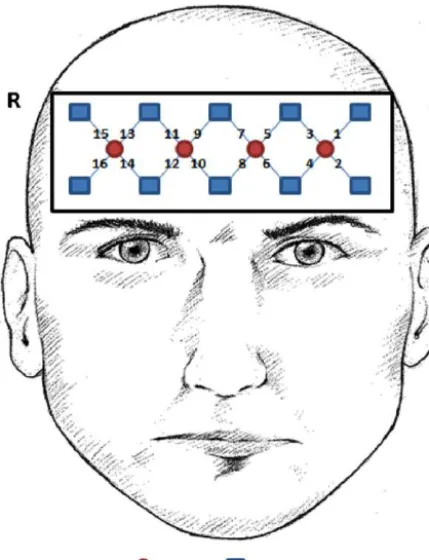
Thisstudy aimedto replicateand expand findings concern-ing frontal lobe role in arithmetic calculation and retrieval usingfunctionalnear-infraredspectroscopy(fNIR).fNIRuses spe-cific wavelengthsof light tomeasure levels of oxygenatedand deoxygenated hemoglobin in brain blood flow while partici-pantsperformvarioustasks[2,9,15].Thisstudyutilized anfNIR machine over the frontal lobe (see Fig. 1; fNIR Devices LLC;
http://www.fnirdevieces.com).
Stimuliselectedforthisstudydistinguishedbetweenoperations performedbyretrievalfromlong-termmemory(e.g.,additionof one-digit numbers)and those notretrieved automatically, such ascomplement subtractionin thesame rangeofnumbers (e.g.,
∗Correspondingauthorat:EducationBuildingRm.264,DepartmentofLearning Disabilities,UniversityofHaifa,Mt.Carmel,Haifa31905,Israel.
Tel.:+97248288433;fax:+97248249835.
E-mailaddress:[email protected](H.Meiri).
4+5=9;9−4=5).Subtractionissupposedlyharderandprocessed withseveraldifferentstrategies[7].Formostadultswithstrong mathematicalskillsretrievalofone-digitadditionfactsupto18 isprocessedautomatically.However,youngchildrenandstudents weakinmathusuallyusedifferentstrategiesforadditionproblems that“break”10,suchasdecompositiontoaknownproblem(e.g., ‘7+9’becomes‘7+7+2’)orcompletingfirstto10(‘8+7’becomes ‘8+2+5’[8,11]).Athird kindofsimple additionis adding one-digitnumbersto10itself(e.g.,10+6).Itseemssimplebutinvolves knowledgeoftheplacevaluesystem’ssyntacticstructure[6,16].
The research groups chosen for this study include students with math difficulties and an age-matched control group. The researchers hypothesize that fNIR results for both groups will be similar for stimuli which demand automatic retrieval of mathematicfacts,butdifferentwhencalculationsdemandmore involvement from the frontal lobe. It is expected that partic-ipants with math difficulties will display more variability in frontallobe blood oxygenationin response to specifickinds of stimuli.
2. Materialsandmethods
2.1. Participants
University-aged students (Control group: mean
age=25.79±3.22, five males; experimental group: mean
Fig.1. ThefNIRmachineutilizedinthisstudyincludedahead-piecewithsources andphotoreceptorstomeasureactivityinbrainfrontalregions.
age=25.93±3.39, four males) were recruited by advertise-ments placed around campus and sent through email. One ad requestedparticipantswithoutanyformsoflearningdisabilities. Anotherrequestedparticipantswithdocumentedorself-reported ms difficulties in mathematics. All participants were paid vol-unteers withnormal or corrected-to-normalvision and normal intelligence as measured by sub-tests of the Wechsler Adult Intelligence Scale III (WAIS-III). Group differences were found ontheDigitSymbolandDigitSpansub-tests(seeTable1).With theexceptionofoneparticipant,nonepresentedwithAttention Deficit/HyperactivityDisorder(ADHD)asdefinedbytheDSM-IV guidelines.Tobeclassifiedintotheexperimentalorcontrolgroup participants completed the Two-Minute Test ([TMT]; [12]; see descriptionbelow)whichexaminescalculationabilities.Anatural splitoccurredwhere19controlswereabletocompleteatleast62 correctcalculations(mean=72.00±5.96)intheallottedtimeand 15participantswithmathdifficulties(MD)completednomore than54correctcalculations(mean=45.40±9.05;seeFig.2).
2.2. Two-MinuteTest(TMT)
TheTMTisaquestionnaireconsistingof80open-endedmath facts employing the four basic mathematical operations (e.g., 2+2=?, 5−3=?, 3×3=?, and 10:2=?). Participants have two
Table1
Standardscoresofexperimentalandcontrolgroupsonsub-testsoftheWAIS-III. Bothgroupsscoredwithinnormalrange.
Mean(SD) t(32)
Control(n=19) MD(n=15)
Digitsymbol 11.79(2.53) 9.73(2.52) 2.36*
Digitspan 11.95(2.78) 9.87(3.04) 2.08*
Blockdesign 13.21(2.95) 11.80(3.05) n.s.
Similarities 12.26(2.54) 11.33(1.88) n.s.
* p<.05,**p<.01,***p<.001
Fig.2.ResultsofTMT.ParticipantsintheMDgroupscorednomorethan54correct. Participantsinthecontrolgroupscoredaminimumof62correct.
minutestocompleteasmanyofthe80questionsaspossiblewhile workingquicklyandaccurately.Questionsmustbecompletedin orderandarepresentedinincreasingdifficulty.
2.3. Apparatus
Experimentalmeasureswerecollectedusingtwocomputers. The firstpresented stimuli using E-Prime software(Psychology SoftwareTools,Inc.,http://www.pstnet.com)andcollected reac-tiontimes.ThesecondhostedthefNIRsystem.ThefNIRdeviceused inthisstudywascomposedoftwomainparts–ahead-piecewhich heldlightsourcesanddetectorsandacontrolboxfordata acqui-sition(samplingrateof2Hz).TheflexiblefNIRsensorconsistsof fourlightsourcesandtendetectorsdesignedtoimagedorsolateral andinferiorfrontalcortices.Withafixedsource-detector separa-tionof2.5cm,thisconfigurationresultsinatotalof16channels. Thecontrolboxwasconnectedtothecomputerfordatacollection andstorageutilizedbyCOBIstudiosoftware(DrexelUniversity). SynchronizationofthecomputerswasachievedwithaCOMcable whichsent onlineeventtriggersfromE-PrimetotheCOBI stu-diosoftware.Signalprocessinganddatapreparationforstatistical analysiswasdonewithMatlab(Version2010a,TheMathworks, Natick, MA). Statistical analysis was performed withIBM SPSS Statistics(Version19,IBMSPSSInc.,Chicago,IL).
2.4. Taskandstimuli
Table2
RT(ms)meansandstandarderrors(mean(SE))fortheinteractionstypeoftriple×groupandtypeoftriple×operation.
Typeoftriple
Under10 Break10 Including10
Group Control 720(60) 930(90) 760(60)
MD 790(70) 1220(100) 720(60)
Operation Addition 700(40) 910(60) 720(40)
Subtraction 810(60) 1230(90) 760(60)
2.5. Dataprocessingandfeatureextraction
Data processing began with the removal of heart pulsation, respiration and movement artifacts from the fNIRS intensity measurementsby using a finite impulseresponse low-pass fil-ter with a cut-off set to .14Hz. fNIR intensity measurements at 730 and 850nm wavelengths were then converted to rela-tivechangesinhemodynamicresponsesintermsofoxygenated (OxyHb)anddeoxygenatedhemoglobin(DeOxyHb)usingthe mod-ified Beer–Lambertlaw [10]. Epochsweresegmented fromthe stimulionsetto15slaterforeachtrial.fNIRfeaturesmaximum andmeanvalueswereextractedforeachtrialepoch,channeland participant.Forthestatisticalanalyses,eachparameterwas aver-agedover trials perparticipant.Noisy segments,mainlydueto movementartifacts,wereexcluded.
3. Results
Statisticalanalyseswere carried outwithrespect totype of triples(i.e.,“under10”,“break10”,or“including10”),operation (additionorsubtraction),andgroup(MDorcontrol).
3.1. Behavioralmeasures
3.1.1. Accuracy(ACC)
3×2×2 repeated measures ANOVAs (type of
triple×operation×group) revealed a main effect of type of triple(F(2,64)=9.77,p<.001),withACCinthe“break10”triples (mean=91.50±1.31)significantlylowerthanACCinthe“under 10” (mean=95.39±1.25, F(2, 31)=9.21, p<.02) and “includ-ing 10” (mean=97.81±60, F(2, 31)=9.21, p<.001) triples. A groupeffectwasalsofound(F(1,32)=5.49, p<.05),withoverall ACClower for theMD(mean=93.21±1.08)than controlgroup (mean=96.59±96).Independentt-testanalysesrevealeda signif-icantdifferenceinaccuracybetweencontrol(mean=95.26±8.42) andMD(mean=86.67±11.75)groupsinthe“break10”triplesfor subtraction(t(32)=−2.49,p<.05).
3.1.2. Reactiontime(RT)
3×2×2 repeated measures ANOVAs (type of
triple×operation×group) revealed main effects of type of triple (F(1, 27)=34.85, p<.001) and operation(F(1, 27)=18.57, p<.001).Themaineffect oftype oftriplewasfurtheranalyzed withposthocBonferronipairwisecomparisons.
RTfor the“break10”triples (mean=1070±70ms)was sig-nificantly longer than for the “under 10” (mean=753±40ms, F(2, 26)=22.61, p<.001) and “including 10” triples (mean=738±40ms, F(2, 26)=22.61, p<.001). RT for addi-tion (mean=780±40ms)was significantly shorter than RT for subtraction(mean=930±60ms,F(1,27)=18.57,p<.001).
ANOVAsalsorevealedinteractionsbetweentypeoftripleand group(F(1,27)=6.74,p<.02)andtypeoftripleandoperation(F(1, 27)=11.05,p<.01).Table2providesmeansandstandarderrorsfor theseparameters.Independentt-testanalysesrevealedsignificant differencesexistedinthe“break10”triplesbetweenthecontrol
(meanaddition=813±26ms, meansubtraction=1108±44ms) and
MD (meanaddition=1106±46ms, meansubtraction=1499±58ms)
groups for both addition (t(32)=2.35, p<.05) and subtraction (t(32)=2.24,p<.05).
3.1.3. fNIRresults
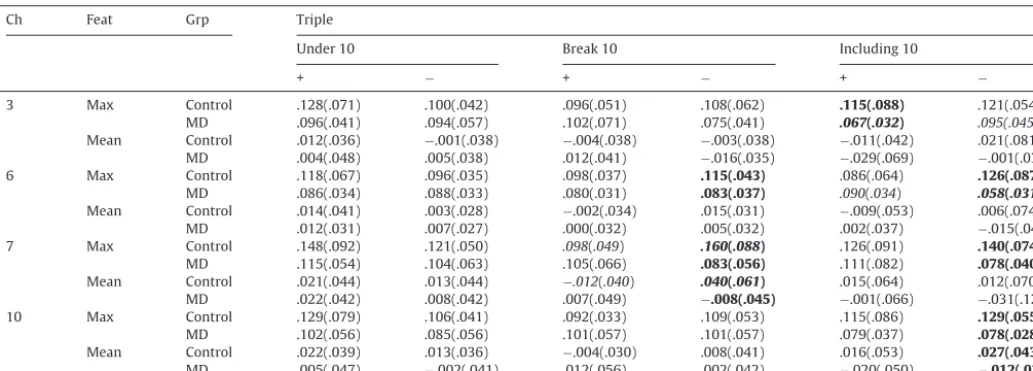
fNIRstatisticalanalyseswereemployedonthemeanandmax attributesoftheOxyHbandDeOxyHbmeasures.Analysesrevealed that mostsignificant differences betweenexperimentalgroups, operation,typeoftripleandinteractionsoccurredintheDeOxyHb measure.Thus,resultsarereportedwithrespecttoDeOxyHb.
Repeated measures ANOVAs were carried out separately for each channel in a 3×2 design (type of triple×operation) with experimental group as between-subjects variable. No significant main effects were found. However, type of triple×operation×groupinteractionswerefoundfor DeOxyHb-Meanatchannel3(F(2,54)=4.62,p<.02),andDeOxyHb-Maxat channels3(F(2,54)=3.71,p<.05)and 7(F(2,54)=3.78,p<.05). Operation×groupinteractionswerefoundfor DeOxyHb-Maxat channels6(F(1,27)=5.51,p<.05)and 7(F(1,27)=5.42,p<.05). Finally,typeoftriple×groupinteractionswerefoundatchannel 10forDeOxyHb-Mean(F(2,54)=6.15,p<.01)andDeOxyHb-Max (F(2,54)=5.59,p<.01).
In order to further examine interactions, independent and pairedt-testswereappliedtothesechannels.Independentt-tests revealedbetween-groupdifferencesinadditionwithinthe “includ-ing10”triplesinDeOxyHb-Maxatchannel3(t(23.84)=−2.197, p<.05),andinsubtractionwithinthe“break10”triplein DeOxyHb-Maxatchannels6(t(32)=−2.286,p<.05)and7(t(30.82)=−3.096, p<.01);withinthe“including10”triplesinDeOxyHb-Maxat chan-nels6(t(29)=−2.872,p<.01),7(t(23.17)=−2.931,p<.01),and10 (t(29)=−3.209,p<.01);andwithinthe“including10”triplesinthe DeOxyHb-Meanfeatureatchannel10(t(29)=−2.696,p<.02).
Significant results for paired t-tests examining differences between addition and subtraction within groups and type of triplewerefoundwithintheMDgroup,withinthe“including10” triplesinDeOxyHb-Maxatchannel3(t(13)=−2.338,p<.05)and 6(t(13)=3.145,p<.01).Withinthecontrolgroup,significant dif-ferences werefound at channel 7in the “break10” triplesfor both DeOxyHb-Max(t(18)=−2.900,p=.01)and DeOxyHb-Mean (t(18)=−3.151,p<.01).
Table3
MeansandSDsofchannelswhichrevealedsignificantinteractionsinrmANOVAanalyses.Valuesinboldrepresentbetween-groupdifferences,whileitalicizedvalues representwithin-groupdifferences.
Ch Feat Grp Triple
Under10 Break10 Including10
+ − + − + −
3 Max Control .128(.071) .100(.042) .096(.051) .108(.062) .115(.088) .121(.054) MD .096(.041) .094(.057) .102(.071) .075(.041) .067(.032) .095(.045) Mean Control .012(.036) −.001(.038) −.004(.038) −.003(.038) −.011(.042) .021(.081) MD .004(.048) .005(.038) .012(.041) −.016(.035) −.029(.069) −.001(.039) 6 Max Control .118(.067) .096(.035) .098(.037) .115(.043) .086(.064) .126(.087)
MD .086(.034) .088(.033) .080(.031) .083(.037) .090(.034) .058(.031) Mean Control .014(.041) .003(.028) −.002(.034) .015(.031) −.009(.053) .006(.074) MD .012(.031) .007(.027) .000(.032) .005(.032) .002(.037) −.015(.042) 7 Max Control .148(.092) .121(.050) .098(.049) .160(.088) .126(.091) .140(.074)
MD .115(.054) .104(.063) .105(.066) .083(.056) .111(.082) .078(.040)
Mean Control .021(.044) .013(.044) −.012(.040) .040(.061) .015(.064) .012(.070) MD .022(.042) .008(.042) .007(.049) −.008(.045) −.001(.066) −.031(.123 10 Max Control .129(.079) .106(.041) .092(.033) .109(.053) .115(.086) .129(.055)
MD .102(.056) .085(.056) .101(.057) .101(.057) .079(.037) .078(.028)
Mean Control .022(.039) .013(.036) −.004(.030) .008(.041) .016(.053) .027(.043)
MD .005(.047) −.002(.041) .012(.056) .002(.042) −.020(.050) −.012(.038)
4. Discussion
Thepurpose of this experiment wasto examine differences incognitiveactivityinthefrontallobebetweentwopopulations performingsimple mathematicalcalculations. fNIRwasusedto provideinformationaboutbloodflowandoxygenconsumption. Youngadultswithandwithoutmathematicaldifficulties partici-patedinthestudy.Inadditiontodifferencesbetweentheresearch groups,differencesbetweenadditionandsubtractionandtypesof stimuliwereexamined.
UseoffNIRenabledtheresearcherstopinpointseveral differ-encesbetweencontrolandMDparticipantsbeyondthebehavioral differencesfoundinaccuracyandreactiontimeinthe“break10” triples.Despite thecalculations being fairlyeasy (as evidenced byhighaccuracyrateamongboth groups),frontallobeactivity appearstodifferinyoungadultswithMDduringtaskperformance assumedtobeautomaticorduringretrievaloffactsassumedto beingrained.Furthermore,statisticalfindingsinspecificchannels revealedactivationinboth left(channels 3,6,and 7)andright (channel10)sidesofthefrontallobeamongbothgroups.Thismay suggestthatdetailedprocessingoccursontheleftandholistic pro-cessingontheright,much astherighthemisphereofthebrain ingeneralisbelievedtoberesponsibleforwholeorholisticand symbolicprocessing[3].Fromourresultsitcannotbeascertained whethertheobservedactivationisverbalornot.Futurestudies usingfNIRoverBroca’sareamaybeabletoclarifythispoint.
SimilarlytoDahaene’sfindings[3],thisstudyidentified differ-encesbetweentheoperationslearnedbyrotememoryandthose that requireactive calculation abilities. One-digit operations of additionandsubtractionwereretrievedautomatically.However, tripleswithatleastonetwo-digitnumber(e.g.,[7,10,17])required thenonverbalrepresentationandmanipulationofnumberthatis seeminglycontrolledbytherightsideofthebrain.Thisstudy’s resultswouldindicatethatrightfrontallobeisresponsibleforthis kindofprocessinginadditiontorightparietallobe.
Use of fNIRin this study allowedthe researchers to exam-inehemodynamicresponsestodifferentmathematicalconditions. Anincreaseinthevalueofdeoxygenatedhemoglobin(DeOxyHb) canbeinterpretedasanincreaseinoxygenconsumptionby neu-rons.Subtractioncausedbetween-groupdifferencesinrecorded DeOxyHbinthe“break10”and“including10”triples.Itislikelythat between-groupdifferenceswerenotfoundinthe“under10” con-ditionbecauseitwaseasyforbothgroups.Furthermore,itislikely thatbetween-groupdifferenceswerenotfoundfortheaddition
operationbecauseadditiontriplesrepresentmoreautomatic math-ematicalprocessingthansubtraction.
Ansarietal. [1]reportonashiftofcognitivefunctionsfrom thefrontallobetotheparietallobethatoccursoncemathematical factretrievalisautomatized,asseeninadultprocessingof num-ber.Childrenintheirstudyactivatedmorefrontalregions.Itseems thatthisstudy’sMDgroupsimulatedcognitiveprocessingsimilar tothatofchildren,inthattheyrelymoreonfrontalregionsthan studentswithoutMD.
Resultsfrom thisstudy supporttheuseoffNIR for examin-ingtheroleoffrontallobeduringmathematicalcalculations.The groupdifferenceshighlightdifferentialpatternsofbloodflowto specificareasofthefrontallobe,evenamongadults.Futurestudies usingfNIRhavethepotentialtoidentifyotherautomaticand non-automaticmathematicalprocesses,evenwhenthestudyisbased onrelativelysimplestimuli.
Acknowledgment
FundingforthisresearchprojectwasprovidedbytheEdmond J.SafraPhilanthropicFoundation.
References
[1] D.Ansari,N.Garcia,E.Lucas,K.Hamon,B.Dhital,Neuralcorrelatesof sym-bolicnumberprocessinginchildrenandadults,NeuroReport16(16)(2005) 1769–1773.
[2]H.Ayaz,P.A.Shewokis,S.Bunce,K.Izzetoglu,B.Willems,B.Onaral,Optical brainmonitoringforoperatortrainingandmentalworkloadassessment, Neu-roimage59(2012)36–47.
[3]S.Dehaene,M.Piazza,P.Pinel,L.Cohen,Threeparietalcircuitsfornumber processing,CognitiveNeuropsychology20(2003)487–506.
[4]M.Delazer,F.Domahs,L.Bartha,C.Brenneis,A.Lochy,T.Trieb,T.Benke, Learn-ingcomplexarithmetic–anfMRIstudy,CognitiveBrainResearch18(1)(2003) 76–88.
[5]F.Domahs,M.Delazer,Someassumptionsandfactsaboutarithmeticfacts, PsychologyScience47(1)(2005)96–111.
[6]F.Domahs,U.Domahs,M.Schlesewsky,E.Ratinckx,T.Verguts,K.Willmes, H.C.Nuerk,Neighborhoodconsistencyinmentalarithmetic:behavioraland ERPevidence,BehavioralandBrainFunctions3(2007)66.
[7] K.C.Fuson,Researchonwholenumberaddition andsubtraction,in:D.A. Grouws(Ed.),HandbookofResearchonMathematicsTeachingandLearning: AProjectoftheNationalCouncilofTeachersofMathematics,Macmillan,New York,1992,pp.243–275.
[8]R.H.Grabner,D.Ansari,K.Koschutnig,G.Reishofer,F.Ebner,C.Neuper,To retrieveortocalculate?Leftangularmediatestheretrievalofarithmeticfacts duringproblemsolving,Neuropsychologia47(2009)604–608.
[10]M.Izzetoglu,S.C.Bunce,K.Izzetoglu,B.Onaral,K.Pourrezaei,Functionalbrain imagingusingnear-infraredtechnologyforcognitiveactivityassessment,IEEE EngineeringinMedicineandBiologyMagazine,SpecialIssueontheRoleof OpticalImaginginAugmentedCognition26(2007)38–46.
[11]J.LeFevre,G.S.Sadesky,J.Bisanz,Selectionofproceduresinmentaladdition: reassessingtheproblemsizeeffectinadults,JournalofExperimental Psychol-ogy:Learning,Memory,andCognition22(1)(1996)216–230.
[12] S.Openhaim-Bitton,Z.Breznitz,Two-MinuteTest.Unpublishedtest,Haifa Uni-versity,Israel,2006.
[13] P.Pinel,S.Dehaene,Beyondhemisphericdominance:brainregions underly-ingthejointlateralizationoflanguageandarithmetictothelefthemisphere, JournalofCognitiveNeuroscience22(1)(2010)48–66.
[14]S.M.Rivera,A.L.Reiss,M.A.Eckert,V.Menon,Developmentalchangesinmental arithmetic:evidenceforincreasedfuncionalspecializationintheleftinferior parietalcortex,CerebralCortex15(11)(2005)1779–1790.
[15]I.Sela,T.Horowitz-Kraus,M.Izzetoglu,P.Shewokis,K.Izzetoglu,P.A. She-wokis,K.Izzetoglu,B.Onaral,Z.Breznitz,Brainactivityofyoungandadult hebrewspeakersduringlexicaldecisiontask:FNIRapplicationtolanguage, in:D.Schmorrow,C.Fidopiastis(Eds.),FoundationsofAugmentedCognition, DirectingtheFutureofAdaptiveSystems,Springer,Berlin/Heidelberg,2011, pp.231–239.