About the authors
Prof. Kurt April ([email protected]) is Professor of Leadership, Diversity & Inclusion at the Graduate School of Business, University of Cape Town, South Africa.
Kai Peters ([email protected]) is Dean at Ashridge Business School, Berkhamsted, England. Kurt April and Kai Peters
_____________________________________________________________
ABSTRACT
This paper explores some of the underlying principles of the Afro-centric paradigm, encapsulated by humanistic- and communalist principles. Suggestions on how South African Modes of Leadership could be incorporated into the workplace are presented, and explored further in conjunction with the results of the workplace survey that was designed to test what makes people feel valued in the workplace. These dimensions are explored and gaps identified where the current perceived state does not match the desired or expected state. Differences between these dimensions are highlighted where possible attitudinal obstacles could be encountered, and suggestions are put forward as to how these may be overcome.
Keywords: Ubuntu; interconnectedness; values, motivation, communication; learning.
_____________________________________________________________
INTRODUCTION
This section outlines some of the philosophical constructs of the different global paradigms to illustrate the underlying leadership values that exist, and places the study into a broader context. The importance of understanding these differences in a South African context is discussed, and the motivation for introducing African Modes of Leadership (AML) into organizations is presented.
While the Northern (European) construct values rationality and scientific thinking, as famously expressed by Descartes with: “Cogito, ergo sum” – I think, therefore I exist or rather “I am
because I think I am”, Western (North American) philosophy can be described as more individualistic and self-serving and expressed by the phrase: “I am because I, the individual hero,
dream and do”. Eastern (mainly Japanese) „Kaizen‟ philosophy, on the other hand, is more collectivist with a focus on continuous improvement to attain perfection: “I am because I
improve” – while key writers (April & Ephraim 2010; Theimann, April & Blass 2006; Nussbaum 2003; Mbigi 2002; Horwitz et al. 2002; Ahiauzu 1986) claim that the African philosophy is inherently collectivist in nature and is encapsulated in the concept of Ubuntu: “I am because we are; I can only be a person through others” (Mbigi 2002, p. 20; Louw 2001; Ramose 1999; Broodryk 1995; Mbigi & Maree 1995).
African Renaissance, a key part of the post-Apartheid intellectual agenda, is a concept famously popularized by South African ex-President Thabo Mbeki in his “I am an African” speech in May 1996. African Renaissance is a call to the African people and nations to solve the many problems facing Africa (Thiong‟o 2009) and, together with the heralded transformation of African colonies in 1950 to South Africa‟s democracy in 1994, have led to an increased interest in Africa and in the value sets and culture that make it unique, with suggestions being made that there are many valuable lessons contained in the African thought patterns that Western civilizations can learn from (April & Shockley 2007; Theimann et al. 2006; Nussbaum 2003; Mbigi 2000). However, it is in the South African economic context that understanding these principles is particularly important to this paper.
The South African business environment is made up of a cross-section of industries represented by local, national and international companies. Historically, predominantly Western or Anglo-Saxon type management principles have been adopted in the workplace (Theimann et al. 2006). However, the changing nature of the workforce (from an ethnic, gender, ability, sexual orientation, religious and generational point of view) as well as the changing nature of work (moving from an industrial-, to an information-based- and now emotionally-based economy where organizations depend increasingly, if not exclusively, on the emotions and knowledge of their employees and stakeholders for survival and success – and where creativity and innovation become the main sources for sustained competitive parity and advantage) requires the interrogation of current management practices for their validity and efficacy (Peters 2003; Ilgen & Pulakos 1999; Howard 1995), particularly as many of the traditional theories do not consider the dynamics of these variables.
THEORETICAL BACKGROUND
understood in the broader African society as a cultural model, have not had many empirical studies conducted on it and is not widely written about.
Ubuntu: A Model for South African Leadership
Unlike the more self-serving and individualist paradigm of the West, as described by Hofstede (1985), in his national culture study where strong individuals and achievers in Western society are valued, the African leadership paradigm is characterized by a purposeful emphasis on people and their dignity and takes a deeply entrenched collectivist perspective which is reflected in the concept of ubuntu which, literally translated means: “I am because we are; I can only be a person
through others” (April & Ephraim 2010; April & Shockley 2007; Van Der Colff 2003; Nussbaum 2003; Mbigi 2002).
While caution must be exercised when reviewing Hofstede‟s (1985) study, as his sample was drawn from one multinational case, it is regarded as one of the most influential studies on cultural differences. In his report, Hoftstede (1985) suggested that national cultures could be clustered along the lines of their similarities across a range of variables. These included the prevailing sense of individualism or collectivity, the degree of centralization or autocratic leadership and levels of hierarchy (also known as power distance), and the degree to which
uncertainty is tolerated or avoided. According to Hofstede‟s (1985, p. 347-8) theory, collectivism refers to a preference for a “tightly-knit social framework in which individuals can expect their relatives, clan, or other in-group to look after them, in exchange for unquestioning loyalty”. This is contrasted with the concept of individualism, which is defined as a preference for a “loosely knit social framework in a society in which individuals are supposed to take care of themselves and their immediate families only”. At face value, this would seem typical of Western and African constructs respectively, however, ubuntu goes beyond mere loyalty to a deep-seated sense of belonging and purpose that comes through community. Mbigi (2002, p. 20) outlines some of the key values of African leadership as follows:
Respect for the dignity of others
Group solidarity – an injury to one is an injury to all Teamwork – none of us is greater than all of us Service to others in the spirit of harmony
Interdependence – each one of us needs all of us
Unlike more individualistic societies, where there is a greater emphasis on self-interest (Erez & Early 1993), the African cultural paradigm considers the needs of the group first, believing that in so doing, individual needs and desires will be met. As a result, team rewards would take precedence over individual rewards. The consequences of rewarding individuals in this collectivist society could result in social punishment and sabotage of performance (Theimann 2003; Mbigi 2002).
2010; Robins 2007b). Rather than simply impose rule, the leader, who would have grown up among the people and within the context, would therefore truly lead by listening and assessing the collective opinions and aspirations of both the council and the people, thereby affirming their identities within the system and demonstrating respect for their deeper connectedness with things much larger than themselves and their self-interests, as well as acknowledging and respecting their humanity (April 1999). Additionally, deep understanding of the interconnectedness of the system and its stakeholders, as well as the sensitive and intelligent custodianship of the customs,
rituals and symbols are vital in how particular sectors of the leader‟s followership will respond
on any given issue or challenge (Gergen, McNamee & Barrett 2001; April 1999). Typically, within the council, issues are discussed and debated relentlessly until there is a shared understanding and consensus is reached that accommodates the minority positions to ensure justice and societal sustainability (April & Shockley 2007). “Compromise, persuasion, discussion and accommodation, listening and freedom of speech are the key elements of the African leadership paradigm” (Mbigi, 2002, p. 21). Paradoxically, there is also an extreme deference to authority which, when viewed through Western lenses, could be viewed as creating an autocratic environment or, as Robins (2007a) calls it, „dysfunctional hierarchies‟. However, when considered in the context of the collectivist paradigm where the “autocratic” decisions are being made, when the starting point of the decisions is a fundamental understanding of, and action for, the communal good, this dimension takes on a different pallor.
Some of the fundamental principles of ubuntu, such as putting the community and the common good before the individual, can be seen to have similar aspects to contemporary (although not fully mainstream) Western leadership notions such as servant-, spiritual- and transformational leadership (Nussbaum et al. 2010; April et al. 2010; Robins et al. 2009; Autry 2004; Howard 2002; Korac-Kakabadse, Kouzmin, & Kakabadse 2002; Bass 1999; Bass & Steidlmeier 1999; Block 1996; Fairholm 1996; Etzioni 1993; Greenleaf 1977). However, this very emphasis on the collective sets these leadership styles apart from the more „individualist‟ traditional management constructs that are typified in the more „scientific management models‟ that have developed over the last 50 years (Ghoshal 2005; April & Hill 2000). Ghoshal (2005, p. 77) contends business schools have endeavoured to make business studies a branch of social sciences over the last
decade and as such have adopted a “scientific approach of trying to discover patterns and laws,
and have replaced all notions of human intentionality for explaining all aspects of human performance”. He further asserts that bad management theories have been developed over several decades that have a pessimistic view of people as purely self-interested beings at their core. While he suggests that common sense and empirical evidence suggest otherwise, this negative pessimism has become a self-fulfilling prophesy, as management theorists have adopted
decade (April & Blass 2010; Theimann et al. 2006; Trompenaars & Hampden-Turner 2004; Thomas 2003, Deresky 2000; Trompenaars 1993).
This section has compared and contrasted the Afro-centric cultural paradigm of ubuntu with the more scientific management approach that has come to typify much contemporary, and dominant, management theory. The following section explores some ways that African Modes of Leadership (AML) can be incorporated into organizational life and the possible impact on individual and organizational behaviour, structures and systems.
African Modes of Leadership (AML)
Appendix 1 summarizes the principle values of AML and what organizational systems, structures or processes they would potentially affect. As mentioned previously, what sets AML apart is the fundamental belief in the inherent goodness of human beings, their connection to each other, their environment and something larger than themselves, as well as the agape love, respect and dignity that should be accorded to every person. Placing such high regard on the value that each individual contributes to the success or well-being of the whole, invites examination as to what makes the individual feel valued in the organizational context. This is important in order to understand the interrelationship between the individual and the collective, and the impact it has on various organizational practices. For the purposes of this paper, therefore, the key dimensions relating to personal and organizational values, motivation, communication, learning and performance have been studied. Suggestions for individual and organizational change, as well as possible obstacles and consequences of these, will discussed in further detail in the results and discussion section of this paper.
METHODOLOGY
Data Collection and Questionnaire
The data was collected by web-based questionnaire. A web link was sent via electronic mail to a random sample of people in various organizations requesting their participation in the survey, as well as their assistance in sending the link on to their respective colleagues and associates in order to get a broad sample from different industries and perceptions of people at different organizational levels. Fifteen hard copy surveys were distributed within a call centre at a financial institution, and the completed results captured onto the web survey. The data was captured directly into a SQL database and converted to an Excel spreadsheet.
arguments, the current state (how much is there now?), a desired future state (how much should there be?) and importance (how important is this to me?). This analysis sought to identify „gaps‟ between the current and expected values of variables, as well as the importance of that variable.
The second section, questions 25-31, was designed to accommodate an open style of questioning in an attempt to tease out what things are important to people in their jobs, and what makes them feel valued in order to ascertain what some of the motivators of performance and whole-person contribution at work might be. Finally, the questionnaire included a section to record the demographics of the participants (questions 32-38).
Statistical Analysis
Altogether 122 completed anonymous questionnaires were received, 16 were discarded due to a response rate of less than 50% in questions 1-24. In addition, 10-17 questionnaires were not included in the ANOVA and proportion analyses due to the lack of background demographic information (such as age, ethnicity, etc.) provided. Overall, therefore, the data of between 89 and 96 responses were included in the final statistical analyses.
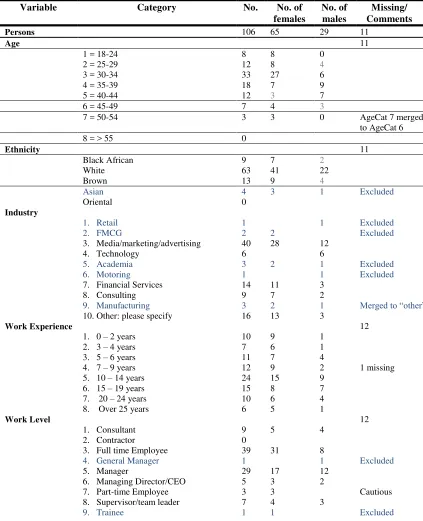
The variables, their coding and explanations are summarised in Table 1. The questionnaires suitable to study were subjected to various frequency analyses according to age, gender, ethnicity, industry, work experience, and work level.
The results were obtained by performing an analysis on the current state values (ANOVA), the gap between current and expected or desired future state values, and rank frequencies for questions 25-31. A confirmatory factor analysis, with Cronbach Alphas, was carried out on the value dimensions to analyze a posteriori whether the questions asked actually measured their intended dimension, in order to ascertain the validity and reliability of the questionnaire as a research instrument. Cronbach alpha‟s higher than 0.7 was considered valid, and p-values less than 0.05 were regarded as statistically significant. Statistical analyses were performed using Statistica 7.0 software. All distributions were assumed to be normally distributed and no non-parametric tests were conducted.
RESULTS
General Descriptive Statistics by Demographic Variables
TABLE 1: General descriptive statistics by demographic/background variables and breakdown by gender
Variable Category No. No. of females
No. of males
Missing/ Comments
Persons 106 65 29 11
Age 11
1 = 18-24 8 8 0
2 = 25-29 12 8 4
3 = 30-34 33 27 6
4 = 35-39 18 7 9
5 = 40-44 12 3 7
6 = 45-49 7 4 3
7 = 50-54 3 3 0 AgeCat 7 merged
to AgeCat 6
8 = > 55 0
Ethnicity 11
Black African 9 7 2
White 63 41 22
Brown 13 9 4
Asian 4 3 1 Excluded
Oriental 0
Industry
1. Retail 1 1 Excluded
2. FMCG 2 2 Excluded
3. Media/marketing/advertising 40 28 12
4. Technology 6 6
5. Academia 3 2 1 Excluded
6. Motoring 1 1 Excluded
7. Financial Services 14 11 3
8. Consulting 9 7 2
9. Manufacturing 3 2 1 Merged to “other”
10. Other: please specify 16 13 3
Work Experience 12
1. 0 – 2 years 10 9 1
2. 3 – 4 years 7 6 1
3. 5 – 6 years 11 7 4
4. 7 – 9 years 12 9 2 1 missing
5. 10 – 14 years 24 15 9
6. 15 – 19 years 15 8 7
7. 20 – 24 years 10 6 4
8. Over 25 years 6 5 1
Work Level 12
1. Consultant 9 5 4
2. Contractor 0
3. Full time Employee 39 31 8
4. General Manager 1 1 Excluded
5. Manager 29 17 12
6. Managing Director/CEO 5 3 2
7. Part-time Employee 3 3 Cautious
8. Supervisor/team leader 7 4 3
9. Trainee 1 1 Excluded
gender, male respondents amounted to less than 5 in sectors 7, 8, and 10 (Financial Services, Consulting and Other). All Work Experience categories consisted of more than 5 individuals, whereas Work Level categories „General Manager‟, „Part-time Employee‟, and „Trainee‟ comprised less than 5 individuals. The variable relating to number of direct reports did not show a statistical significance in TOTa/b/ c and were therefore not studied further.
Analysis of Variance and Factor Analysis
In order to establish a unique measure for each question/dimension, questions 1-24 were pooled together (averaged) so that new variables were formed: TOTa (total average of „Now/Current‟ questions, i.e., 1a, 2a, etc.), TOTb (total average of „Should be/Expected‟ questions, i.e., 1b, 2b, etc.), and TOTc (total average of „Importance‟ questions, i.e., 1c, 2c, etc.). Possible differences in these variables, caused by demographic variables, were then identified by subjecting these TOT variables to one- and two-factor ANOVAs.
The ANOVA analyses revealed several statistically significant differences in TOTa, TOTb, and TOTc variables (Appendix 3). Most notably, all TOT variables showed significant differences between „Black Africans‟ and „Whites‟, and among „Industries‟ whereas TOTb was only affected by „Age‟ (overall 40-44 year olds had lower expectations on the measured dimensions than 18-24 year olds, p-value < 0.05). TOTc was influenced by „Gender‟ (females averaged overall higher importance ratings than males), „Work Experience‟ (people with 7-9 years work experience rated lower than those respondents with 0-2, 3-4 and 20+ years of experience) and
„Work Level‟ (full-time employees rated lower than consultants).
A factor analysis was employed in order to test whether the intended grouping of questions (dimensions) matched with that of the experimental data (confirmative factor analyses), and in order to find other „hidden factors‟ which would explain the variation within the questions. Moreover, by using factor analysis, the total variation could be explained with a smaller number of variables, which simplifies the analysis.
By defining different cut-offs for the Eigenvalues, 5-7 factor solutions were identified. However, the 5-factor solution explained 69.5%, the 6-factor analysis 73.5%, and 7-factor analysis 77.2%. However, even though the 7-factor solution (Eigenvalues > 0.8) explained 77.2% of variation, it began to dilute questions into different dimensions as compared to 5-factor solutions (Eigenvalues > 1.0) or 6-factor solutions. Therefore the 6-factor solution (Eigenvalues > 0.9) was chosen, as on balance it explained the variation as well as provided an adequate number of dimensions.
The factor analysis (Principal component, Varimax normalised, Eigenvalues > 0.9, factor loadings > 0.58) for the current state (a) indicated six main factors, which are shown in Appendix 4 (6-Factor Solution). These six factors were in general accordance with the intended grouping of the questions/dimensions namely:
F1: Ubuntu values relating to the treatment of people F2: Shared vision and values
F3: Ceremonies and Rituals
F5: Growth and Development
F6: Diversity, learning and mentoring
These factors are, in order of importance (by Eigen value): Factor 1 explained 43.9% of the variation, Factor 2 explained 9.9%, and the remaining 4 factors from 3.9-6.0%. Together six factors explained 73.5% of the variation. The Cronbach‟s alpha measures the internal reliability and consistency of questions. It was determined both for the original set of questions, and sets obtained from factor analysis (Appendix 5). All values exceeded 0.7, which indicates a fair consistency between questions and their measured dimension.
The factor analysis was also carried out on the Expected (b) and Importance (c) question sets. While a slightly different grouping of questions emerged, similarities existed particularly in the dimensions relating to ubuntu Values, Shared Vision and Values and Growth and Development. The six factor values on the Expected question sets explained 66.7% of variation (Factor 1 explained 35.2% and Factor 6 explained 4.2%) and the Importance questions explained 73.7% of the variation (Factor 1 explained 41.8% to Factor 6 which explained 4.3%). The factors that emerged from the Current state questions (a) were therefore considered for the analysis.
Gap Analysis
The gap between the Expected and Current value was determined by subtracting the Current value from the Expected value in selected categories (ethnicity, age, gender and ethnic-gender). These questions were then ranked in order of gap size, so that the questions that resulted in the biggest and smallest gaps could be identified. These two groups of questions were then compared to identify similarities and differences.
DISCUSSION OF SURVEY RESULTS
The results of the survey will now be discussed. However, due to the nature of the random sampling methodology and the bias towards White female respondents, these results must be used with caution for inferential purposes, and serve rather to highlight possible future research areas. Further, the ethnicity of respondents proved to be an important variable where the most significant differences in perceptions among employees were measured. The section that follows will highlight these differences and discuss any possible obstacles these dimensions raise in terms of the integration or introduction of African modes of leadership in the South African workplace.
Section 1: Distinctive Differences
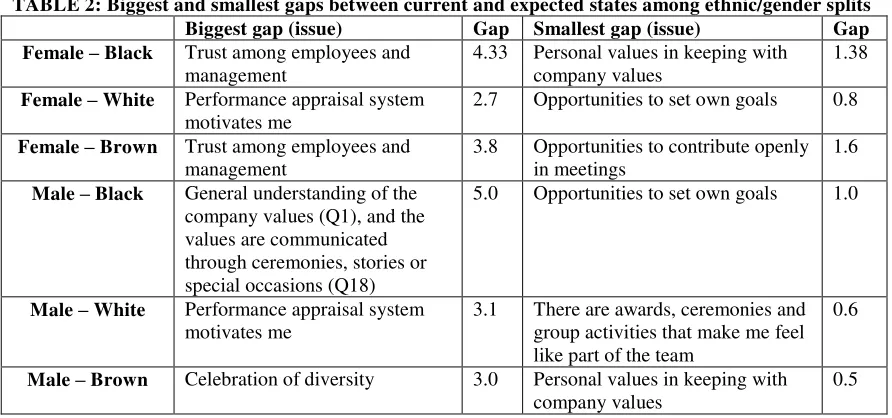
The largest gaps between the desired state (how much should there be) and the current state (how much is there now) were seen among „Black African‟ respondents, with the gap being an average of 3.2 points (on a seven point scale). The smallest gap was among the „White‟ respondents, where the average gap was only 1.9 points. However, similarities existed across groups only on question 4 (gap greater than 2.5 points), which relates to the level of trust among employees and management (see Factor 1). Larger gaps were also recorded among the „Black‟ and „Brown‟ respondents in terms of questions 11 and 23, which related to opportunities for advancement and promotion and alignment between individual, team and organizational goals respectively. Other significant differences from an ethnic point of view were in the areas relating to personal growth and development (see Factor 5), as well as ceremonies or group activities that make them feel like part of the team (Factor 3). The largest gap among the „White‟ respondents related to whether the performance appraisal system motivates them (2.8 – see Factor 4).
In terms of the areas where there was the smallest gap (i.e., the current state and expected state were closer), the question relating to the alignment of personal and company values (Q2) exhibited a consistent narrow gap, suggesting the importance of personal and organizational value alignment in job selection. Interestingly, „Black‟ females exhibited the largest gap of all ethnic-gender combinations on whether they have the opportunity to contribute openly and express their point of view in meetings, which was a generally smaller gap dimension in the other groups. This is perhaps indicative of the African cultural system which, while a matriarchal one, has a high power distance.
Factor 1: Ubuntu Values
Overall, the „Black‟ respondents in the sample scored generally lower than „White‟ respondents on all dimensions in the current state (how much is there now), with the exception of question 2 (my personal values are in keeping with the company values). „White‟ and „Brown‟ respondents mapped very similarly. As the survey was particularly designed to test values in keeping with more African or ubuntu principles, this suggests that there is a keener awareness of the lack of these values in the workplace by this group. However, all ethnic groups mapped very similarly in the importance state (how important is this to me) with „Black‟ respondents generally tending to score slightly higher (average 6.6 „Blacks‟ vs. 5.8 „Whites‟, p-value<0.05 and 6.2 „Brown‟, p -value 0.062), which indicates that there is a common view of the importance of these -values being represented in the workplace (Appendix 3).
Overall, the most important dimensions to all respondents also emerged in the factor analysis in, what we have termed Ubuntu values and, in particular, were related to the importance of people to the company (Q9) as well as fairness in dealing with employees (Q7), with a total average 6.6. This was followed by trust and respect among employees (Q4 + Q5) and opportunities for personal and professional growth and development (Q12 + Q13 – see Factor 5), which both had a total average 6.4. The largest overall gap between the current and expected states were related to trust (Q4), with an average 2.9 point gap.
A Question of Trust
The fact that the question relating to trust among employees and managers was rated as the most important dimension by all respondents, yet it was the one dimension with the biggest gap between a current and expected state, is both a triumph (in that it was an equally-rated dimension) and a tragedy (that the gap was so large). It therefore presents both challenges and opportunities for both individuals and organizations.
In his work on stewardship, in which the collective/common good is at the core, Block (1996) speaks of trust being the issue that credibility in leadership is most dependent on. Trusting and caring relationships have been identified as being central to the development of an ethos of honesty, integrity and fairness (Hurley 2006). Trust is acknowledged to be the root of success or failure in a relationship, particularly cross-cultural ones (Alves, Lovelace, Manz, Matsypura, Toyasaki & Ke. 2006) and has been described as the “emotional bank account between two people” (Covey 1990, p. 31) that enables them to have healthy, engaging relationships. When there is trust, people communicate openly and productively and with empathy and synergy. Trust can be said to be the basis of all social institutions and is also integral to the idea of social influence and is, therefore, a vital ingredient for clear communication (April 1999) and, while not explicitly mentioned in the ubuntu literature, is an assumption that stems from the humanistic perspective where there is a fundamental trust in human nature (Williams 2001).
Low levels of trust therefore, may present of one the largest individual and organizational obstacles for introducing AML into the South African workplace. This could result in employees being reluctant to openly express their ideas and opinions, or contribute their knowledge, expertise and creative thoughts openly as they will suspect others of being less receptive and cooperative, and viewing them through differential lenses. In addition, low levels of trust could lead to individuals being highly suspicious of the motives of the individual or organization if any new initiatives (such as AML) are presented. Consequently, these initiatives would not be embarked on with much enthusiasm, and the initiator may find it difficult to motivate employees as they question the true intent of the initiative.
Factor 2: Shared Vision and Values
across age, gender or ethnicity; however, differences were noted in the different work industries. Respondents from FMCG/Retail scored lower (2) than Consultants (5.4), with the gap being 3.3 for retail and -0.1 for Consultants. This is the only group, and dimension, where the current state and expected state have equal values. This could be due to the nature of consultancy work, or possibly due to the size of the consultants business (if they were independent consultants one would expect them to have set the company values and have a general understanding of them).
Factor 3: Ceremonies and Rituals
Statistically, differences were also apparent between ethnicities in the questions relating to ceremonies and rituals (Factor 3) in all three states (current, expected and importance). „White‟ respondents generally did not place a high value on ceremonies and stories (Q18 and Q19), which were two of the highest scoring dimensions for „Black‟ respondents in the sample, which merits further reflection.
Thiemann (2003) draws on earlier work by Senegalese psychiatrist Sow to explain the important role of symbolism and mysticism in the African thought system. She contends that, as mystical thinking is the major source of common-sense knowledge in African societies, “arguments that are supported with proverbs are automatically accepted as valid and true” (Thiemann, 2003, p. 21). The importance of communicating in this more symbolic way is prescribed by Nussbaum et al. (2010), April & Shockley (2007), Mbigi (2000), April (1999), Turner (1995) and Swidler (1986). They contend that the role of leadership is to affirm existing values and the identity of people through affirming ceremonies, rituals and language, and also to collectively create new, and aspirational, mythical rituals, dialogics and structures while showing the link to the old and trusted ones. In addition to the traditional Western approach of constantly displaying the values of an organization, organizations should also encourage practices, such as ceremonies, rituals and collective language development, to embody inclusive values, norms and social practices (not just present them), e.g., employees need to collectively paint them, dance them, sing them, create poetry and use poetic language to describe them, eat together to dialogue them, and mentor the new employees in them. It would seem therefore that communicating through ceremonies and rituals, within the workplace, is at once highly desired by „Black‟ people and deeply misunderstood by „White‟ people, which is a challenge in itself.
understand or wish to understand. This, however, does require the organization to think very differently about the way they work, communicate and garner the discretionary effort (April & Smit 2010; April et al. 2009) of its employees, and presents exciting opportunities. As Mbigi (2000, p. 29) states, “Collective creativity has a high degree of collective self-confidence and
cultural identity”. Co-producing, not only the larger organizational story but, everyday communication or strategic messages through drama, bodywork, artwork, symbols and metaphors has the potential to tap into the creative soul of the organization. Creating space for this to happen is perhaps the largest obstacle in this regard, and would probably be best initiated at an annual conference, also termed bosberaad (Afrikaans) or indaba (Zulu), where organizational stakeholders are out of their familiar routine and usual surroundings.
Factor 4: Performance Measurement Systems
The largest gap among the „White‟ respondents related to whether the performance appraisal system motivated them (2.8 – Appendix 2). Due to the unrepresentative nature of this sample, these differences were explored further from an ethnic-gender perspective. The largest gap between both „White‟ males and females existed around the performance management system, and whether it measures their whole value and whether it motivates. While a significant gap existed among both „Black‟ males and females in this regard, it was not one of the dimensions with the biggest gap, but does warrant further investigation as dimensions associated with performance management systems, such as opportunities for advancements and promotion, alignment between individual, team and organizational goals and personal growth and development, all showed significant differences when analyzed, and will be discussed in more depth later (see Factor 5). Also, this dimension scored consistently low across all industry types.
Performance management systems was developed from the performance appraisal system and popularized in the 1980s as part of the total quality management (TQM) wave. The focus of TQM was for continuous improvement of the system and, as such, continual improvement from a performance perspective would require development of both the context (organizational, group or team) and the individual employee (Hackman & Wageman 1995). The traditional performance appraisal systems therefore, in the context of TQM, did not provide an environment for continuous improvement and were too focused on past and individual performance (Powell 2006). One of the major criticisms of the performance appraisal system was that it destroyed team work, emphasizing the individual rather than the team and, in so doing, “denied the reality
of the team” (Spangenberg, 1994, p. 8). These criticisms eventually gave rise to performance management systems (PMS).
Several definitions of performance management exist, most of which concur that performance management systems employ a set of instruments or techniques to affect organizational performance. Fay (1990, p. 346) defines performance management as “a set of techniques used by a manager to plan, direct and improve the performance of subordinates in line with achieving
the overall objectives of the organization”, while DeNisi (2000, p. 121) defines it as “the range of activities engaged in by an organization to enhance the performance of a target person or
group.” Neely et al. (1995, p. 80) go a step further by defining a PMS as the “set of metrics used
As mentioned earlier, in the context of AML, the concept of rewarding individuals with only workplace rewards for individual performance is anathema to a value system based on the aggregated individual, the collective and the social community – even if it was practically possible. The imposition of traditional performance management systems into environments where different value sets are at play therefore requires further research, as while it is theoretically possible to reward team performance in a performance management system through rewarding individuals on their team performance or rewarding teams on their performance for competitive behaviour, rewarding individuals for being good team players, and doing so without regard for the need for collaboration by the individual and demonstrable broader social reward
for his/her „thick ties‟, additionally creates conflicting motivations and confusing identity and clan / community alliance dilemmas for individuals (Theimann et al. 2006; Theimann 2003; Lawler 2003). Such conflicts, within the individual, could lead to a lack of cohesive team behavior, a tendency for less risk, knowledge development and sharing – all crucial components of creativity and a foundation of trust or alternatively, in reaction to deal with such confusion and
„thin ties‟, pathways for potential destructive- and non-aligned, organizational action. To be true to the principles of African humanism therefore, the organization together with all of its stakeholders (individuals, teams and local community and clans) need to agree on standards and targets, as well as reward systems that work for all, after much collective dialogue and debate has taken place and consensus is reached (Mbigi 2000).
The inherent complexity and interdependency of the individual vs. team vs. community/clan conundrum is highlighted by Molleman & Timmerman (2003, p. 93) when they claim that the
“creation of innovation and highly complex products usually requires such a diversity of knowledge and abilities that it is not realistic to expect a single worker to have all the required
knowledge and to master all required skills”. In terms of performance management therefore, focusing on the individual when they are highly dependent on co-workers and their communities/clans may inhibit performance and make it difficult to attribute successes, in terms of innovation, knowledge creation, learning and growth, to individual workers. Equally, incorporating qualitative facets of performance (such as learning and development), as well as social facets (such as trust, power and politics), are becoming increasingly important and is an area that needs careful consideration (Price 1996).
Factors 5+6: Growth and Development, Learning and Mentoring
The dimensions relating to both personal and professional growth and development were among the highest rating dimensions on the Importance question (6.4). As mentioned earlier, larger gaps between the current and expected states were recorded among the „Black‟ and „Brown‟ respondents for these dimensions. It must be noted, however, that the ambiguity of Q11
It is interesting to note that the factor analysis separated the dimensions of personal and professional growth (Factor 5) from learning and mentoring (Factor 6), and suggests therefore that respondents may not consider learning and mentoring as a means to gaining personal or professional growth and development. Once again, this provides both a challenge and opportunity for organizations. While the importance of job-related skills training cannot be undermined, almost more importantly is personal development training or interventions. The African paradigm requires a deep sense of personal destiny or self-awareness (Mbigi 2002), and incorporating personal growth training strategies into the skills development plan would be a good first step (April & April 2007).
Mbigi (2000), as well as Gorelick et al. (2004), also writes about the concept of learning-by-doing, which involves reflective action learning, situated activity, and embodied knowledge and wisdom, and more fairly reflects in subjective, dynamic nature of African learning. This is akin to a more Heideggerian approach to being in the world, in which complex agency and reciprocal, interactive coping occupy centre stage. Allied to that is learning-by-teaching. Importantly, it is a practice that needs to be embedded in the fabric of the organization and needs to go beyond traditional formal mentor programmes. Creating mentoring circles, led by elders and storytellers, and an environment where each person in the organization gets to mentor and be mentored are approaches that could start to develop a stronger sense of relevant learning. The concept of transferring knowledge through teaching others is also a key principle to employ in the so-called knowledge-based economy, and a mainstay of the African oral tradition. From a Western perspective, Lawler (2003, p. 275) argues that knowledge-based organizations need to be able to
“attract and retain individuals with the right knowledge, motivate them to learn what is critical to their organization‟s competitive position, and motivate them to develop and use knowledge in
ways that create competitive advantage”. From an African perspective, Onyeozili (2002) encourages organizations to additionally draw on griots (African storytellers), praise singers and entertainers to help all employees, not just the “right ones”, memorize and embody critical knowledge and wisdom. This emphasis on learning and knowledge sharing, as one of the more intrinsic motivators, provides an opportunity for a more facilitative or coaching management system.
Additionally, in keeping with the principles of ubuntu, this system of learning and development
needs to extend beyond the direct workplace. There is an African proverb that says, “He who learns, teaches”, and it s important therefore to create opportunities for, and encourage, employees to mentor, coach and/or teach individuals in the broader community. Providing active support for these initiatives has the benefit of cementing the knowledge in the mind of the teacher, sharing the knowledge for the good of the organization and nurturing the future in the broader community. Organizations could be encouraged to nominate a community day per month, where the employee can take the day to go and teach, or learn, either within the organization or the broader community. The potential benefits of expanding the scope and horizon of employees is enormous, however getting organizational buy-in may be more problematic and would probably be best initiated in smaller groups or business units first.
(average 0.5), which is possibly due to the nature of the work where continuous learning is a feature of the job. However, this is an area that requires further research.
Gap Summary
[image:16.612.66.512.200.409.2]Below is a summary of questions with biggest and smallest gaps between current and expected states among ethnic/gender splits:
TABLE 2: Biggest and smallest gaps between current and expected states among ethnic/gender splits Biggest gap (issue) Gap Smallest gap (issue) Gap Female – Black Trust among employees and
management
4.33 Personal values in keeping with company values
1.38
Female – White Performance appraisal system motivates me
2.7 Opportunities to set own goals 0.8
Female – Brown Trust among employees and management
3.8 Opportunities to contribute openly in meetings
1.6
Male – Black General understanding of the company values (Q1), and the values are communicated through ceremonies, stories or special occasions (Q18)
5.0 Opportunities to set own goals 1.0
Male – White Performance appraisal system motivates me
3.1 There are awards, ceremonies and group activities that make me feel like part of the team
0.6
Male – Brown Celebration of diversity 3.0 Personal values in keeping with company values
0.5
Section 2: Key Motivators
The first two questions (Q25+Q26) in this section were open-ended, and attempted to take a more qualitative perspective on the factors people liked about their jobs and were important to them. Thirteen different dimensions emerged in the responses to the question, which was then coded for analysis (Appendix 6).
What They Like
In listing things that they liked about their jobs, the highest responses in the first rank related to the amount of challenge, as well as the people and relationship issues (whether with clients or colleagues). The highest responses on the second rank was also people and relationships, followed by the work environment and type of work, while the third rank valued people, the type of work and the respect for the contribution or the sense of adding value. Cumulatively, therefore, people and relationships was the most important issue, followed by the environment and type of work.
relationship-building in organizations, opportunities need to be created for conversations and dialogue (April 1999), as well as opportunities for reflection and personal growth (April & April 2007). Creating the space for people to contribute freely and openly in forums and meetings is an important first step, and can be achieved through a participative process of flexible agendas and skilled facilitation.
What Is Really Important?
On the question on what is important to people in their jobs, the overall rating for this question (aggregate of all ratings) was the need for honesty, trust, fairness and respect (9.7%), which further highlights the need for trust and respect as outlined earlier.
In terms of the individual ranking, ranked in the first position was responsibility or accountability (11.32%), followed by value, relevance, contribution or a sense of making a difference (10.37%). On closer inspection, an ethnicity breakdown revealed that this was the single most important dimension among „Black‟ respondents (18.2%), while „White‟ respondents quoted job satisfaction as the most important dimension (8.1%).
Founder of Southwest Airlines, Herb Kelleher, has been quoted as saying that deeply ensconced in our hearts is the need for significance. Realizing that it therefore takes more than money to attract, retain and motivate staff is key (April et al. 2009). Grobler et al. (2002) writes about the concept of quality of working life, and Hoggett & Thompson (2002) elaborates on „democracy of
emotions‟, both refer to the extent to which an employee‟s personal and social needs are met through their work – a concept that requires further consideration in organizations, particularly as it relates to AML. Organizations need to be aware of how the individual employees are finding meaning at work, as well as provide them with opportunities to “make a difference” within the broader community. Starbucks, for example, contributes $10 for every hour one of their employees (partners) volunteers to an organization, thereby encouraging their involvement in the larger community and supporting it financially.
In addition, the broader stakeholder interests need to be considered and ways of broadening the benefit system to include the extended family/community/clan investigated. This could be done through extending profit sharing, medical aid dependant rules, pension beneficiaries and training and development opportunities to the broader family unit/clan. As all benefits carry a financial cost to the company, individuals wishing to initiate such changes in an organization may be faced with obstacles relating to the financial implications. However, in the case of beneficiaries for medical aid or other benefits, if a beneficiary may be nominated, extending this beyond own child dependants could be done if a reasonable limit is imposed.
Individual Recognition vs. Leadership Living their Values
job challenge (ranked number 1) and in the second ranked position, salary and job challenge ranked highest. On further analysis, a significant difference was recorded between male and
female responses to the dimension “I am valued”. Overall it was more important for males that
they were valued than females (p-value 0.048). Further, when reviewing the responses from an ethnic perspective, a very interesting result emerges. While overall recognition was the most important dimension, from an ethnic perspective, the fact that the leadership lives the values was rated highest (44.4%) among „Black‟ respondents, followed by the fact that management could be trusted (25%) and recognition, job challenge and the fact that they are valued did not rate at all (0%).
Although these results are purely descriptive and cannot be used for inferential analysis, the stark contrast in the ranking of these values is a blatant reminder of the differing cultural values and the dimensions in relation to the collectivist constructs of the African paradigm vs. the individualist construct of the Anglo-Saxon one. „White‟ respondents rated recognition as most important (the attention on the „I‟), while the „Black‟ respondents rated the fact that leadership should live their values for the best interests of the greater group most highly. Individual recognition is not very important in the purest interpretation of ubuntu culture (I am only a person through you, so why recognize me?). This, once again, calls into question the efficacy of many HR systems that are designed to motivate and reward staff individually, and require serious reconsideration in the South African workplace.
Considering that no „Black‟ respondents rated the dimension “I am valued” as being important to them at work (i.e., in their top 3), probing as to what makes people feel valued at work (Q30-Q31), poses an interesting conundrum as to whether this is in fact relevant. The inclusion of this dimension could possibly be construed as researcher bias, and is an element that could potentially have been explored upfront if the research question could have been approached in a qualitative manner before a quantitative research instrument was designed.
Performance (Q27)
In terms of performance (Q27), the overall consensus was that it should be recognized by financial rewards (36.8%), followed by advancement/promotion (22.6%). Conversely, the least attractive option seemed to be via award ceremonies (0.9%). While this may be due to the
„White‟ female bias of the sample base, it is an important point to note as this may be a potential barrier to introducing more ceremonial type events into the workplace, as their value is not apparent in broader terms. In terms of gender differences, the only significant difference in responses to the variables was for the dimension of value, relevance, contribution, making a difference (p-value 0.026), with females rating this significantly higher than men.
Team (Q28)
respondents felt part of a team when they talked and listened to one another (44.3%). While the responses to this question showed a slight bias towards females, this was not significant. This is an important dimension to consider in the African Leadership Model, as conversation and dialogue, combined with an open expression of feelings are central to this paradigm (Mbigi 2000; April 1999). Interestingly, the desire for opportunities for open expression rated relatively highly in overall importance (6.2), but was a dimension where a large gap existed with „Black‟ females compared to the other groups. The other high rating dimensions also related to group discussions and inclusion in meetings, which further suggests the importance of conversation and dialogue to a genuine sense of team.
Ubuntu inspires us to expose ourselves to others, to encounter the difference of their humanness so as to inform and enrich our own (Sindane 1994). Conversation is the primal way that human beings have thought together and dreamt together for centuries. It is through this primal act of listening and talking that we react to what is going on in the world, and move towards a greater awareness of what we care about, what we are talking about or struggling with at a very personal level, which also contributes towards levels of self-awareness (Burns & Engdahl 1998; Townley 1995). However, African conversation additionally demands that, because of the deep respect of
others‟ humanity, we seek to listen deeply for the particularities of the beliefs and practices of others –seeking to extend the traditional definition to: “A human being is a human being through (the otherness of) other human beings”. For post-Apartheid South Africans of all colours, creeds and cultures, ubuntu dictates that, if we were to be fully human and mature, we need to recognize the genuine otherness of our fellow citizens.
Creating the space for all voices to be heard in an unthreatening and safe environment, without fear of retribution or reprimand, is vital for the necessary consensus-building and sense of team (Nafukho 2006). Providing opportunities for the youngest or most inexperienced to speak first in order not to have to contradict what an elder might say, as well as provide forums and platforms for them to reflect and sense-make, aids this process. Leaders, in this paradigm, have to learn the
difficult task of „stepping back‟, „allowing for immaturity to show itself in the younger, less experienced ones‟, „to allow for the outbursts and ramblings of youth‟, and „to nurture wider
awareness” (April & Shockley 2007; Young 2002, p. 248).
CONCLUSION
The purpose of this study was to explore ways in which African Modes of Leadership could be incorporated into the South African workplace. The underlying principles of this leadership paradigm are reflected through the lens of ubuntu, which is based on a fundamentally humanistic premise of respect and dignity for all. In exploring the issues that are important to people in the workplace and identifying what makes them feel valued, a strong correlation was drawn between the dimensions that made people feel valued and the principles of ubuntu.
particularly relating to dimensions of ceremonies and rituals, performance management and growth, development, learning and mentoring. These differences served to highlight areas where possible attitudinal obstacles could be encountered, and suggestions given on how these may be overcome. The research highlights the need for further work with regard to current HR systems and practices, particularly as they are based on a set of assumptions that focuses on the individual and do not consider the importance of the collective or broader community/clan.
REFERENCES
Ahiauzu, AI 1986, „The African thought-system and the work behaviour of the African industrial man‟, International Studies of Management and Organization, vol. 16, no. 2, pp. 37-58. Alves, JC Lovelace, KJ Manz, CC Matsypura, D Toyasaki, F & Ke, K 2006, „A cross-cultural
perspective of self-leadership‟, Journal of Managerial Psychology, vol. 21, no. 4, pp. 338-359.
April, K 1999, „Leading through communication, conversation and dialogue‟, Leadership & Organization Development Journal, vol. 20, no. 5, pp. 231-241.
April, K & April, A 2007, „Growing leaders in emergent markets: Leadership enhancement in the new South Africa‟, Journal of Management Education, vol. 31, no. 2, pp. 214-244. April, K & Blass, E 2010, „Ethical leadership required to lead a diverse Europe‟, in W Matiaske,
S Costa & H Brunkhorst (eds.), Contemporary perspectives on justice, Rainer Hampp Verlag, München, pp. 183-201.
April, K & Ephraim, N 2010, „Four step process to implement African leadership: An empirical evaluation‟, Effective Executive, vol. 13, no. 1, pp. 42-57.
April, K & Hill, S 2000, „The uncertainty and ambiguity of leadership in the 21st century‟, South African Journal of Business Management, vol. 31, no. 2, pp. 45-52.
April, K & Shockley, S 2007, Diversity in Africa: The coming of age of a continent, Palgrave Macmillan, Basingstoke.
April, K & Smit, E 2010, „Diverse discretionary effort in workplace networks‟, in J Syed & MF Ozbilgin (eds.), Managing cultural diversity in Asia: A research companion, Edward Elgar Press, Cheltenham, pp. 73-109.
April, K, Katoma, V & Peters, K 2009, „Critical effort and leadership in specialized virtual Networks‟, Annual Review of High Performance Coaching and Consulting, vol. 1, no. 1, pp. 187-215.
April, K, Peters, K & Allison, C 2010, „Stewardship as leadership: An empirical investigation‟, Effective Executive, vol. 13, no. 2, pp. 52-69.
Autry, J 2004, „Love and work‟, in L Spears & M Lawrence (eds.), Practicing servant leadership, Jossey-Bass Inc., San Francisco, pp. 47-70.
Bass, BM 1999, „Two decades of research and development in transformational leadership‟, European Journal of Work and Organizational Psychology, vol. 8, no. 1, pp. 9-32.
Bass, BM & Steidlmeier, P 1999, „Ethics, character and authentic transformational leadership behavior‟, Leadership Quarterly, vol. 10, pp. 181-217.
Block, P 1996, Stewardship: Choosing service over self-interest, Berrett-Koehler, San Francisco. Broodryk, J 1995, „Is ubuntuism unique?‟, in JG Malherbe (ed.), Decolonizing the mind,
Research Unit for African Philosophy, UNISA, Pretoria, pp. 31-37.
Burns, TR & Engdahl, E 1998, „The social construction of consciousness. Part 2: Individual selves, self awareness and reflectivity‟, Journal of Consciousness Studies, vol. 5, no. 2, pp. 166-184.
Covey, SR 1990, Principle-centred leadership, Summit Books, New York.
De Pree, M 2002, „Servant-leadership: Three things necessary‟, in L Spears & M Lawrence (eds.), Focus on leadership: Servant leadership for the 21st Century, John Wiley & Sons Inc., New York, pp. 89-100.
DeNisi, AS 2000, „Performance appraisal and performance management: A multilevel analysis‟, in KJ Klein & SWJ Kozlowski (eds.), Multilevel theory, research, and methods in organizations, Jossey-Bass, San Francisco.
Deresky, H 2000, International management: Managing across borders and cultures, Prentice Hall, New York.
Erez, M & Early, PC 1993, Culture, self-identity, and work, Oxford University Press, New York. Etzioni, A 1993, The spirit of community, Crown, New York, NY.
Fairholm, GW 1996, „Spiritual leadership: Fulfilling whole-self needs at work‟, Leadership & Organization Development Journal, vol. 17, no. 5, pp. 11-17.
Fay, CH 1990, „Performance management as a strategy to increase productivity‟, Compensation and Benefits Management, vol. 6, no. 4, pp. 346-353.
Friedman, M 2002, Capitalism and freedom (40th anniversary edition), The University of Chicago Press, Chicago.
Gergen, KJ, McNamee, S & Barrett, FJ 2001, „Toward transformative dialogue‟, International Journal of Public Administration, vol. 24, no. 7/8, pp. 679-707.
Ghoshal, S 2005, „Bad management theories are destroying good management practices‟, Academy of Management Learning and Education, vol. 4, no. 1, pp. 75-91.
Gorelick, C, Milton, N & April, K 2004, Performance through learning: Knowledge management in practice, Elsevier Butterworth-Heinemann, Burlington, MA.
Greenleaf, R 1977, Servant leadership, Paulist Press, New York, NY.
Grobler, PA, Wärnich, S, Carrell, MR, Elbert, NF & Hatfield, RD 2002, Human Resource Management in South Africa, Thomson Learning, London.
Hackman, JR & Wageman, R 1995, „Total quality management: Empirical, conceptual and practical issues‟, Administrative Science Quarterly, vol. 41, pp. 309-342.
Hamel, G 1996, „Strategy as revolution‟, Harvard Business Review, vol. 74, no. 4, pp. 69-83. Hofstede, G 1985, „The interaction between national and organizational value systems‟, Journal
of Management Studies, vol. 22, pp. 347-357.
Hoggett, P & Thompson, S 2002, „Toward a democracy of emotions‟, Constellations, vol. 9, no. 1, pp. 106-126.
Horwitz, F, Kamoche, K & Chew, IKH 2002, „Looking east: Diffusing high performance work practices in the Southern Afro-Asian context‟, paper presented at the 3rd African Regional Congress of the International Industrial Relations Association, Cape Town, pp. 1-19.
Howard, A 1995, „A framework for work change‟, in A Howard (ed.), The changing nature of work, Jossey-Bass, San Francisco, pp. 3-44.
Howard, S 2002, „A spiritual perspective on learning in the workplace‟, Journal of Managerial Psychology, vol. 17, no. 3, pp. 230-242.
Ilgen, DR & Pulakos, E 1999, „The changing nature of performance, Jossey-Bass, San Francisco.
Korac-Kakabadse, N Kouzmin, A & Kakabadse, A 2002, „Spirituality and leadership praxis‟, Journal of Managerial Psychology, vol. 17, no. 3, pp. 165-182.
Lawler, EE 2003, „Reward systems in knowledge-based organizations‟, in SE Jackson, MA Hitt & AS DeNisi (eds.), Managing knowledge for sustained competitive advantage, Jossey-Bass, San Francisco.
Lindholm, N 1999, „National culture and performance management in MEC subsidiaries‟, International Studies of Management & Organization, vol. 29, no. 4, pp. 45-66.
Louw, DJ 2001, „Ubuntu and the challenges of multiculturalism in post-apartheid South Africa‟, Quest: An African Journal of Philosophy, vol.15, no.1-2, pp.15-36.
Mbigi, L 1997, Ubuntu: The African dream in management, Knowledge Resources, Randburg. Mbigi, L 2000, „In search of the African business renaissance, Knowledge Resources, Randburg. Mbigi, L 2002, „Spirit of African leadership: A comparative African perspective, Journal for
Convergence, vol. 3, no. 4, pp. 18-23.
Mbigi, L & Maree, J 1995, Ubuntu: The spirit of African transformation management, Knowledge Resources, Randburg.
Molleman, E & Timmerman, H 2003, „Performance management when innovation and learning become critical performance indicators, Personnel Review, vol. 32, no. 1, pp. 93-113.
Nafukho, FM 2006, „Ubuntu worldview: A traditional African view of adult learning in the workplace‟, Advances in Developing Human Resources, vol. 8, no. 3, pp. 408-415. Neely, A, Gregory, M & Platts, K 1995, „Performance management system design‟,
International Journal of Operations & Production Management, vol. 15, no. 4, pp. 80-116. Nonaka, I 1991, „The knowledge-creating company‟, Harvard Business Review, vol. 69, pp.
96-104.
Nussbaum, B 2003, African culture and ubuntu: Reflections of a South African in America, Perspectives, vol. 17, no. 1, pp. 1-12.
Nussbaum B, Palsule, S & Mkhize, V 2010, Personal growth, African style, Penguin Books, Johannesburg.
Onyeozili, E 2002, The value of oral tradition in Africa, paper presented at the Third International Conference on African Languages, University of Maryland Eastern Shore, Maryland, pp. 193-196.
Parasuraman A, Zeithaml, VA, Berry, LL 1994, „Reassessment of expectations as a comparison standard in measuring service quality: Implications for further research, Journal of Marketing, vol. 58, no. 1, pp. 111-124.
Peters, T 2003, Re-imagine! Business excellence in a disruptive age, Dorling Kindersley, London.
Pillkahn, U 2008, Using trends and scenarios as tools for strategy development, Wiley-VCH, Hoboken, NJ.
Powell, TC 2006, „Total quality management as competitive advantage: A review and empirical study‟, Strategic Management Journal, vol. 16, no. 1, pp. 15-37.
Price, H 1996, „The anthropology of the supply chain: Fiefs, clans, witch-doctors and Professors‟, European Journal of Purchasing & Supply Management, vol. 2, no. 3, pp. 87-105.
Robins, N. 2007b, „African incite: Tradition, resistance and change‟, Mindshift, vol. 3, no. 4, pp. 12-13.
Shen, J 2004, „International performance appraisals: Policies, practices and determinants in the case of Chinese multinational companies, International Journal of Manpower, vol. 25, no. 6, pp. 547-563.
Sindane, J 1994, Ubuntu and nation building, Ubuntu School of Philosophy, Pretoria.
Spangenberg, H 1994, Understanding and implementing performance management, Juta, Kenwyn.
Swidler, A 1986, „Culture in action: Symbols and strategies‟, American Sociological Review, vol. 51, pp. 273-286.
Theimann, N 2003, „A cross-cultural perspective on management in Africa‟, Masters Dissertation, University of Oxford, Oxford.
Theimann, N & April, K 2006, „Cave canem! The art (or science?) of western management in an African context‟, in K April & M Shockley (eds.), Diversity in Africa: The coming of age of a continent, Palgrave Macmillan, Basingstoke.
Theimann, N, April, K & Blass, E 2006, „Context tension: Cultural influences on leadership and management practice‟, Reflections, vol. 7, no. 4, pp. 39-51.
Thiong‟o, N. 2009, Something torn and new: An African renaissance, Basic Civitas Books, New York.
Thomas, AB 2003, Controversies in management: Issues, debates, answers, Routledge, London. Townley, B 1995, „Know thyself: Self awareness, self-formation and managing”,
Organization,vol. 2, no. 2, pp. 271-289.
Trompenaars, F 1993, „Riding the waves of culture, Nicholas Brealey, London.
Trompenaars, F & Hampden-Turner, C 2004, Managing people across cultures, Capstone, Chichester.
Trompenaars, F & Voerman, E 2009, „Servant-leadership across cultures: Harnessing the strengths of the world’s most powerful management philosophy, McGraw-Hill, New York. Turner, VW 1995, The ritual process: Structure and ant-structure, Transaction Publishers,
Piscataway, NJ.
Van der Colff, L 2003, „Leadership lessons from the African tree‟, Management Decision, vol. 41, no. 3, pp. 257-261.
Williams, M. 2001, „In whom we trust: Group membership as an affective context for trust development‟, Academy of Management Review, vol. 26, no. 3, pp. 377-396.
APPENDICES
Appendix 1: African Modes of Leadership Summary
Ubuntu Value Organisational
system/structure/process
Impact
Love Dignity Unconditional Respect
Values Development of shared vision and values
On constant display: affirmed through ceremonies and symbols
Participative governance systems
Trust Leadership and Communication
Leaders live the values Open communication
Providing opportunities for open communication Transparency
Participation
Community Collective stewardship Awareness of broader stakeholder interests
Rewards and pay linked to the community/collective Benefit systems recognize importance of extended family/community, e.g., medical aid dependants, pension beneficiaries, training and develop opportunities for family, access to other perks
Collective Storytelling
Strategy and Scenario Planning
Co-creation of new ideas and new memories of the future
Sharing of information, knowledge and skills so that every employee is a strategic thinker and doer
Consensus/agreement / shared
understanding
Dialogue Decision-Making
Flexible agendas – allow space for individual issues
Broad inclusion in dialogue and meetings – facilitation skills Participative approach
Indabas
Connectedness Leadership style People orientation
Create a sense of belonging Group/team work
Social networks Recognise importance of social networks Collaboration
Use to provide social intelligence to assist with diversity Team Development of team spirit through rituals
Ceremonies and Rituals, e.g. Prize-giving
Gift giving
Oath taking (induction) Functions
Meetings
Conferences and get-togethers
Mass strategic forums Team building
Value-sharing Workshops
Be all-encompassing and inclusive Have strategic themes
Ceremonial aspects of sharing food, music, dancing Create a sense of togetherness
Telling and creation of myths
Rituals of renewal, bonding, conflict reduction
Performance Management systems
Pay/reward Individual vs. team Measuring or motivating
Understanding key motivators/drivers and building it into the PMS
Impacts on creativity and innovation
Diversity Recruitment and Selection Value differences
Access to equal opportunities Team composition
Interdependence and a learning
culture/spirit
Training and development Learning by doing (reflective action learning) Learning by teaching (mentoring circles)
Discovery of personal destiny (self-awareness) through personal growth training strategies
0.0 1.0 2.0 3.0 4.0 5.0 6.0 7.0
1 There is a general understanding of company values among employees
2 My personal values are in keeping with company values
3 Opportunities to participate in setting company values
4 Trust among employees and management
5 Respect of employees by managers
6 Respect of managers by employees
7 Fairness in dealings with employees
8 Openness and transparency in dealings with employees
9 People are important to the company
10 Celebration of diversity
11 Opportunities for advancement/promotion/recognition
12 Opportunities for personal growth
Opportunities for professional growth and development 13 Opportunities to develop shared vision and values 14
Opportunity to contribute openly and express your point of view in meetings 15
Opportunity to be mentored/learn from someone else 16 Opportunity to mentor/teach someone else 17 The values of the organization are communicated through
ceremonies, stories or special occasions 18
There are awards, ceremonies and group activities that make me feel like part of the team 19
The performance appraisal system measures my total value to the company 20
Opportunities to set my own performance goals/targets/measures 21 Opportunities to set the team/group performance targets/measures 22
Alignment between individual, team and organizational goals 23
The performance appraisal system motivates me 24
Appendix 3: Summary of Annovas
Summary table of ANOVA analysis of TOTa, TOTb, TOTb and 6 dimensions obtained from factor analysis by Current. All marked differences have p-value < 0.05. Gray highlighting indicates very low number of individuals in order to make statistically relevant conclusions.
ANOVA 6 Factor Current
Q2,4-10 Q1,3,22 Q18-19 Q20,24 Q11-13 Q10,16-17
TOTa TOTb TOTc F61a F62a F63a F64a F65a F66a
Age Ns 5<1 (5.6<6.2)
Ns 5<4 (3.5<4.7) (4-3;0.051)
Ns Ns (3-1;3.0-4.3;p-value 0.052)