THE INFLUENCES OF MONEY ATTITUDES TOWARD MATERIALISM AND ACHIEVEMENT VANITY-VIEW AMONG INDONESIAN YOUNG
CONSUMERS
THESIS
Presented as Partial Fulfillment of the Requirements for the Degree of Sarjana Ekonomi (S1) in Management Program Faculty of Economics
University of Atma Jaya Yogyakarta
Compiled by:
Juventius Willieyanto Rudmel Student ID Number: 07 12 16933
FACULTY OF ECONOMY
ACKNOWLEDGEMENT
I praise the Lord, Jesus Christ, for His blesses and guidance, so I can finish this thesis and my whole study in Atma Jaya University. There’s so many things
that I’ve been through since my first day in Atma Jaya University, and finishing
this thesis will be my second best thing in my whole study year here.
There are so many people that I must thanks to, for they have fulfill my day during my study with love, joy, happiness, even bitterness.
I would like to express my gratitude to:
Mr. Fandy Tjiptono, for the supervision, guidance, and patience. You are superb, Mister!
My parents, for the love, trust, and endless supports, especially during my hard time.
Juliana Wasiono, your care and support means a lot for me. I won’t have a spirit
to finish this thesis on-time without your desires for brighter future.
Mr. Parnawa Putranta, for his advice and encouragement to finish my thesis this semester.
All of the lecturers in Atma Jaya Yogyakarta University, for the knowledge you’ve given to me.
My friends in IBMP: Ryo Kodox and Chandra Positiva, for the making of tremendous video.
My other friends in IBMP and IFAP Yohan, Rai, Edwin, Albert, Benny, Yin2, Ayu, Niken, Yulia, Jacinda, Aska, Vera, everyone that I can’t mention one by one, thank you for all the happy time we’ve been through all this time.
KSPM UAJY 6th period, and Mr. Cosmas, for all the valuable experiences, and for everything.
APH boys: Irawan, Andry, A Jo, Stephen, Gepenk, David, Willy Pekok, Denny, Hendra, Ricky, Joy, Albert, Tony, Hadi, and semi-APH Robby for all the happiness and bitterness on the same roof for years.
Last but not least, for Lala, Happy, and Jimmy, as the companionship till the end. And everybody who has cheers my day.
TABLE OF CONTENTS
TITLE PAGE ... i
APPROVAL PAGE ... ii
COMMITTEE’S APPROVAL PAGE ... iii
AUTHENCITY ACKNOWLEDGEMENT ... iv
ACKNOWLEDGEMENT ... v
TABLE OF CONTENTS ... vii
LIST OF TABLES ... x
LIST OF FIGURES ... xi
LIST OF APPENDIXES ... xii
ABSTRACT ... xiii
CHAPTER I: INTRODUCTION ... 1
1.1. Research Background ... 1
1.2. Problem Statement ... 3
1.3. Research Scope ... 3
1.4. Research Objectives ... 3
1.5. Research Benefits ... 4
1.6. Thesis Structure... 4
CHAPTER II: THEORETICAL FOUNDATION ... 6
2.1. Introduction ... 6
2.2. Theoritical Background ... 6
2.2.2. Materialism ... 10
2.2.3. Achievement Vanity ... 14
2.3. Previous Research ... 15
2.4. Hypotheses Development ... 16
2.4.1. Money Attitudes toward Materialism ... 16
2.4.2. Power-prestige toward Achievement Vanity-view ... 18
CHAPTER III: RESEARCH METHODOLOGY ... 19
3.1. Introduction ... 19
3.2. Research Context ... 19
3.3. Research Method ... 19
3.4. Population, Sample, and Sampling Method ... 20
3.5. Variables and Variable Measurement ... 22
3.6. Reliability and Validity Analysis ... 23
3.7. Methods of Analysis ... 25
CHAPTER IV: DATA ANALYSIS ... 26
4.1. Introduction ... 26
4.2. Response Rate ... 26
4.3. Validity and Reliability Analysis ... 27
4.3.1. Validity Analysis... 27
4.3.2. Reliability Analysis ... 29
4.4. Demographic Analysis ... 29
4.4.2. Age... 31
4.4.3. Income ... 32
4.4.4. Race ... 34
4.5. Money Attitudes toward Materialism ... 35
4.6. Power-prestige toward Achievement Vanity-view ... 38
4.7. Comparison with Previous Research ... 39
4.8. Summary ... 40
CHAPTER V: CONCLUSIONS & IMPLICATIONS ... 42
5.1. Introduction ... 42
5.2. Conclusion ... 42
5.3. Managerial Implication ... 44
5.4. Limitations of Research ... 44
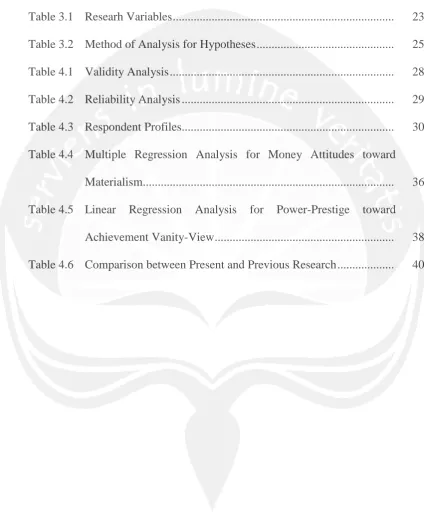
LIST OF TABLES
Table 3.1 Researh Variables ... 23
Table 3.2 Method of Analysis for Hypotheses ... 25
Table 4.1 Validity Analysis ... 28
Table 4.2 Reliability Analysis ... 29
Table 4.3 Respondent Profiles... 30
Table 4.4 Multiple Regression Analysis for Money Attitudes toward Materialism... 36
Table 4.5 Linear Regression Analysis for Power-Prestige toward Achievement Vanity-View ... 38
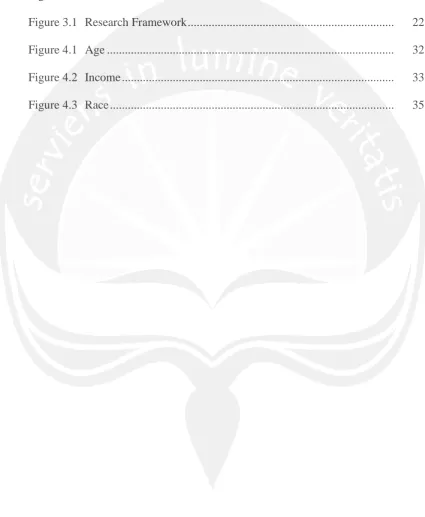
LIST OF FIGURES
Figure 2.1 Research Framework ... 17
Figure 3.1 Research Framework ... 22
Figure 4.1 Age ... 32
Figure 4.2 Income ... 33
LIST OF APPENDIXES
Appendix 1: Questionnaire of the Research (English and Indonesian) Appendix 2: Data of the respondents of Questionnaire
Appendix 3: Reliability and Validity analysis using SPSS
THE INFLUENCES OF MONEY ATTITUDES TOWARD MATERIALISM AND ACHIEVEMENT VANITY-VIEW AMONG INDONESIAN YOUNG
CONSUMERS
Compiled by
Juventius Willieyanto Rudmel Student ID Number: 07 12 16933
Supervisor Fandy Tjiptono, M.Com., Ph.D
ABSTRACT
These research objectives are to examine the influence of money attitudes toward materialism and achievement vanity-view. The data used in this study were gathered by distributing the questionnaires to young consumers in Yogyakarta city. Multiple regression and Simple regression were used to analyze the data.
The result showed that only distrust that does not show a significant influence toward materialism, while power-prestige and anxiety show significant influences. Another study about the influence of power-prestige towards achievement vanity-view also shows a significant influence.