Vol 3, No 3, July - September 1994 Observation with SVATE-3 Treatment 183
Clinical
and
Laboratory
Changes of Patients
with
Various
Diseases
Treated
by
SVATE-3.
Sjukri Karim
Abstrak
Snakc Venom Anti Thrombus Enzyme-3 (SVATE-3) telah dipalai secara luas dalam Hinik pada berbagai penyakit, dan dikntaknn memiliki efek samping yang ringan. Telah dilakulan penilaian efek SVATE-3 pada gejala Hinik, hemoreologi, l<adar lemak darah dan fungsi hati pada 12 penderita (11 laki-Iaki dan
I
wanita) yang semuanya memiliki gejala penyakit dan hemodinamik stabil, umur 42-70 tahun, semua mendapat pengobatan SVATE-3 selama2l
hari sesuai protokol. Selama pengobatan dengan SVATE-3 tidak ada perubahan obat-obatan yang sedang digunal<an oleh penderita. Hasil yang diperoleh menunjukkan bahwa efektivitas SVATE-3 berdasarlan perbail<an gejala klinik adalah 89.5%. Tidok terdapat perbedaan yang bermakna secara statistik sebelum dan sesudah pengobatan dengan SVATE-3 pada : hemoglobin (14+1.3 vs 13.9!1.3), trombosit (303!83 vs 3O1!85), fibrinogen (379!86 vs 353185), taatn urat (5.912.1 vs 5.6!1.9), kadar lenak dan agregasi darah. Terdapat satu penderita dengan peningkatan agregosi tronbosit sebelunt pengobatan yang ntenjadi nornal setelah penberian SVATE-1. Terdapat penurunan bernnkna pada kadar SGOT (20.5!3 vs 13.7!2) dan SGPT(25t4
vs
15.7!4) sebelunr dan sesudah pengobatan dengan SVATE-3. Selama pentberian SVATE-3, seorang penderita mengalami gejala alergi yang dapat diatasi dengan penberian antihistanin. Tidak ditemukan tanda-tanda perdarahan. Sehingga disùnpulkan bahwa pengobatan dengan SVATE-3 pada penderita yang kondisi penyakitnya stabil dapat nemperbaiki gejala penyakit tanpa menimbulkan efek samping yang berarti.Abstract
Snake Venon Anti Thronbus Enzyne-3 (SVATE-3) has already been widely used in the clinic
for
various diseases, and has beenclained to have less side-effects. We investigated the effect of SVATE-3 on the clinical syt,tptotns, hemorrheology, Iipid profile and liver function. Twelve patients (11 nale and l fenale) whowere synpto,natically and hentodynanically stable, aged 42-7Oyears, all of whon received
a 2l-day
SVATE-3 treatntent according to the protocol, were studied. During the treatnent, there were no alterationof
nedication whichhat
been used by these patients. The result showed that theffictiveness
of SVATE-3 treat,nent based on the intprovenent of slnryton is 89,5%.Therewere no statistically difference before andafier SVATE-3 treatmenr on haetnoglobin (14+1.3vs
13.9X1.3), thrombocyte (303!83 vs 301t85), fibrinogen (379!86 vs 353t85),uric
acid (5.9!2.3 vs 5.6!1.9), lipid profile and aggregation. Infact, one patient vrho had an increased lhronbocyte aggregation before treat,nent, which become nonnal after treat,nent. There were significant reduction of SGOT (20.5!3 vs 13.7!2) and SGPT (25!4 vs 15.7!4) Ievel before and after treat,,rcnt. During treat,ilent, onepatieil
suferedfrom allergy that was controlled by antihista,nin. There were no sign of bleeding reported. We concluded that SVATE-3 treatment in patients wifh stable condition nay intprove clinical symptonts without serious side effects.Key words: Snake Venom Anti Thrombus Enzyme, henorhoelogy, lipid profile, liverfunction.
INTRODUCTION
The purified
enzyme
extracted
from
snake venom
(Ancrod)
had been usedclinically
to
treadthrombotic
diseasesince
1968, and has beenincluded
in theBritish
Pharmacopeapublished
in
1973.1The
Snake Venom
Anti
Thrombus
Enzyme
(SVATE)
was later developed
in
China
by
Hao
Wen-Xue
et al.2This
drug has beenshown
to possessmany
functions
such as:anticoagulation, thrombolysis,
dilat-ing blood
vessels,lowering blood
fat,promoting
nervegrowth,
andanti senility. And
has beenreported
suc-cessful
in
treating
cerebralthrombosis,
acutemyocar-dial
infarction,
unstable
angina,
hypercholesterolae-mia,
diabetes
mellitus,
Raynaud disease
and
senile
diseases.r Themajor
sideeffect
of SVATE
isbleeding
r84 Karim
because
of
its
thrombolytic
effect, and
becauseit
con-tainsneurotoxin,
it
therefore can also
cause dizziness,fever, numbness
etc.SVATE-3
is
a new refined product
of
SVATE
extracted
from Agkistrodon Hyals
by
a better
tech-nological
process,
of
which
thefactory
has claimedto
have less side-effect
or
adverse
reaction
for
themajority
of patients.
Since
SVATE-3
has
gained popularity
in
our
community,
and has beenfrequently
usedby
doctors
in
Jakarta
in
treating various
diseases,we
therefore
would like
to investigate the effectivenessof
SVATE-3
treatment,
and more
importantly
if
there are
anyside-effects
of SVATE-3
occuring
in
patients.MATERIALS
AND METHODS
SVATE-3:
The
frozen-dry venine powder
of
Ag-kistrodon
Hyals
was provided by the Research Centerof
Prevention and Treatment
of
Senile
Diseases
of
China
Medical University. Each ampule
containing
10O
usp/ml (0.25
unit) of
arginine
esteraseactivity,
Subjects: Patients
who
came
to
the
Preventive
Cardiology
Unit,
National Cardiac Center,
Jakarta, seekingfor SVATE-3
treatment, had either heardfrom
their friend,
or
sent
by
doctors
will
be selected.The
diagnoseswere based on
history
taking, physical
andlaboratory examinations,
or data presented by patients themselve. Theinclusion
criteria
was
: the patiens had to bein
a stablecondition,
which
meant that they weresymptomatically
and hemodynamically stable (no onecritically
ill).
Sample selection: Twelve patiens were
randomly
selected
from
a
total
of
43
patient
who finished
a2I-day
course
of
SVATE-3
treatment during
lst-November-1993 to 31st-December-1993.
Because the study was designed to compare meansin paired
group,
in
which
subjects were
measuredor
observed twice,
the formula used to estimate sample size was based onDawson-Saunders and
Trapp (1990);
for
astudy
with
a P-value
of
0.05,
and
experiment
will
have
a
90% chanceof
detecting
an actualdifference
between the
two
groups, the sampleof
12patients should be
suffi-.4
crent.'
Study procedure:
All
patiens should
maintain
their
medication
until
the end
of
the
SVATE-3
treat-ment.
Blood
sample
for
examination
of
hemorrheol-ogy,
lipid
profile,
liver
and kidney functions
weretaken
at
the begining and
at
the end
of
SVATE-3
treatment. Before
SVATE-3
treatment, informed
con-sent
will
be
sought
after the
anticipated
benefit
andpotential
hazards
of
the
treatment and
discomfort
it
may
entail
were explained to the patiensby
thedoctor.
The questionaire was given to every patientfor
answer-MedJ Univ Indon
ing
about
their
health status, symptoms and
activity
before,
during
and afterSVATE-3
treatment.The effect
of
treatment
wasjudged by the
altera-tion of
symptoms,
which is
devided
into four
groups,that are : worse, no change,
improve
andmarked
im-proYo.
The
SVATE-3
treatment:
SVATE-3
wasgiven
asrecommended, that was
4
ampules a day
for
patientsweight under
6OKg,
and 8 ampules aday
for
patients
heavier than 60
Kg.
The drug
was disolvedin
normal
saline,
that
are
4
ampules
in
1Oml
administered
in-travenously
directly,
and another 4 ampulesin
250ml
of
normal saline and
administered intravenously
with
the rate
of
45 drops/minute.
All
patients received
a2l-day
courseof SVATE-3
treatment.Statistics: The data
were presented
as mean andstandard
deviation
of
the
mean.
The statistical
sig-nificance
of
difference
between
pairs
of
means was
determined
by
paired Student's t-test. The
analyseswere performed using
the computer programe
CSS(Statsoft, Tulsa, ESA)
run
under the MS-DOS
3.3operating
system.In all
cases,level
of probability
(P)of
less than 0,05were taken to indicate significance.
RESULTS
Twelve
patients
(28%)
of
a
total
of
43 patient
were enrolledin this study. Baseline characteristic of patients
was shown
in
table 1. Most
patients
suffered from
coronary artery
diseasewith
the additionof
other
dis-eases,After a 2l-day
course
of
Svate-3 treatment,
thetherapeutic effects
basedon clinical
symptoms were
determined.
Theoverall effectiveness rate was 89,5%
(Table
2).SVATE-3
treatment
did not
result
in
any
altera-tion
of
the principle biochemical
and hematological
data,in particular
the haemoglobin
level,
the platelet
count, haemotocrit,
andthe
kidney function
test.The
SGOT and SGPT level were lower after SVATE-3
treatment (Table
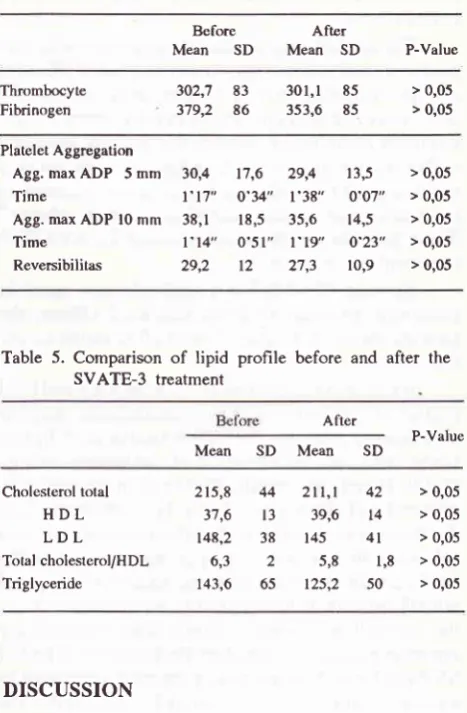
3).Table
4
summarizes
the result
of
platelets
ag-gregation;
there were nostatistically
difference
in
theextent
of
ADP-induced
aggregation before and after
SVATE-3
treatment. Onepatient who
had an increasedthrombocyte aggregation
before
treatment
becomenormal after treatment.
There were
not
any
changeson the lipid profile
before and
after
SVATE-3
treatment (Table
5).No patients
withheld
a2l-day
courseof
SVATE-treatment
becauseof
side-effects.
Vol 3, No 3, July - Septenber 1994
Table
l.
Demographic and clinical characteristic (n=12)Variable
Number
Mean
+ SDAge (years) 59,s
Male Sex
Female
HR (x/min)
Systolic (mmHg)
Diastolic (mmHg)
Observation with SVATE-3
Treat,nent
185Table
4.
Comparison of platelet aggregation in whole blood (n=12) before and after the SVATE-3 treâtmentBefore
AfterMean SD
Mean
SD
P-Valuell
ThrombocyæFibrinogen
302,7
83379,2
86301,1
85353,6
85> 0,05 > 0,05
Table 2. Comparison of symptoms before & after SVATE-3 treatment (n=12)
Note : some patients have more than
I
symptomPlatelet Aggregation
Agg. max ADP 5
mm 30,4 17,6 29,4 13,5
> 0,05Time
l'17" 0'34" l'38" O'O7"
> 0,05 Agg. max ADP l0mm 38,1 18,5 35,6 14,5
> 0,05Time
l'14" 0'51" I'19" 0'23"
> 0,05Reversibilitas
29,2 12
27,3 10,9
> 0,05Table 5. Comparison
of
lipid
profile
before and after theSVATE-3 treatment
After
P-Value
Mean SD
Mean SDCholesterol total
HDL
LDL
Total cholesterol/HDL Triglyceride
215,8
44
2tt,l
3't,6 13
39,6148,2
38
t456,3 2
5,8143,6
65
125,242
> 0,05L4
> 0,054l
> 0,051,8
> 0,0550
> 0,05DISCUSSION
Platelet
mediated
thrombus
is a main
patho-genetic
mechanism
that
limits
the efficacy
of
thrombolytic
agents
such as streptokinase
or
tissue
plaminogen
activ_ator, because these agents alsostimulate
coagula-tion.sAttempts
to isolate the more etTective antithrom-botic
agent
to
treat
or
to
prevent
platelet-mediated
thromboembolism
is
therefore
developed,
including
the use
of
aspirin, protagladin
E,
selective
throm-boxame
A2
receptor antagonsts,hirudin
and the latest,SVATE-3.
Svate-3 has been
widely
used
in
the
treatment
of
thromboembolic
diseases
in
China.
It
possessesseveral
anti
thomboembolic functions such as
an-ticoagulation, thrombolysis,
and
dilating blood
ves-sels.z'oIt
has beenshown that
Kistrin
obtained
from
the venom
of Agkistrodon Rhodostroma
is thespecific
human
platelet
GPrn/lrru receptor antagonist
that
in-hibit
platelet aggregation./ SVATE-3 which
is
alsoisolated
from
the venom
of
Agkistrodon may
haveplatelet
GPrm/uluantagonist
activity; on top
of
thethrombolytic
effect,
especially
for
old
thrombus,uSVATE-3
may
acceleratethe
lysis
aswell
asprevent
1174
t7
10
r32
83 BP
Coronary Artery Disease Non-haemorhagic Stroke Stenosis a. Carotic Communis Parkinsonism
History of Hypertension Diabetes Mellitus
l0
I
I
1
4 2
no. of case
changes after treatment effective
worse no
improve marketchange
improveAngina Paresthesia Insomnia Dyzzyness Short of breath Tremor Tolal
90t71
40t21
20020
10010
20020
r0010
1902152
88.8% 75% tm% 100% r00% 100% 8e.5%
Table 3. Comparison of haematological data before and aftçr treatment of SVATE-3 (n= 12)
Before After
P-Value
Mean
t
SDMean
t
SDHaemaglobin [æucocyte Haematocrite S
GPT
SGOT
Ureum Creatinine Uric Acid
T4
1,36370
108644
4,120,5
3254
33,3
131,38
0,35,9
2,313,9
1,36500
97542
3,7t3,7
215,7
433,9
L21,42
0,35,6
1,9 NS NS NS < 0,05 < 0,05 NS [image:3.595.66.303.95.764.2] [image:3.595.329.563.110.467.2]186 Karinr
the reocclusion
of
thromboembolism. Thus,
it
seemsreasonable
to use SVATE-3
in
treating
thromboem-bolic
diseases.The
clinical
presentation
of
thromboembolic
dis-ease is dependent on where the target organ is
affected;
cramps
or
muscle
pain
in
the
limb
may indicate
theocclution
of arterial circulation in
theextremities.
In-termitten neurological dysfunction usually
associatewith
cerebral thrombus.
Seventeen
percent
patients
with
coronary artery
disease had been demonstrated tohave thrombus
around
the
atherosclerotic
plaque.eThese
patients are therefore
selected
for
SVATE-3
treatment
in
our
clinic.
Because
SVATE-3
is
a relatively new
agent
in
Indonesia,
in
order
to
avoid untoward effects,
thepatients
chosenin this
study were
all in
stablecondi-tion.
It has been
reported
thathemorrheology
andlipid
profile
of
patients
with
cerebrothrombosis
droppedsignificantly after the SVATE-3
treatment.l0
In
inis
study, we found no alteration
of
the
hemorrheology
(Table
4)
and
lipid
profile (Table 5) in
patients who
received
a2l-day
courseof SVATE-3
treatment.This
discrepancy may be due to the
differebce
inpopulation
selection;
In
this study, the patients were
all in
thestable
condition,
while previous
studies investigated
with
ill
patients.In
the acute or subacute disease stage,the aggregation
processor
othersblood
biochemistry
are
more activated,l I therefore
theinhibitory
effect
of
SVATE-3
may
becomemore pronounce
compared to astable
condition.
Previous study
hasshown that
theintravenous
(I.V)
and intraperitoneal
(LP)
LD5s
of
SVATE-3 for
mousewere
1930+
177usp/KgBw,
and825
+
73
usp/KgBw,
respectively.
By
using
20usp/KgBw/day
of
SVATE-3
to treat rabbits
for
a-3-month period showed no differences
on
theability
of
movement,
the rateof
gaining weight,
the lastsurvival
rate and the hepatic function compared
to
control
group."
The
dosageof
SVATE-3
recommended
for
clinical
useis 2-10
usp/KgBw
eachtime which is
2OOtimes
lower
thanLD5s.
It
has beenreported
that therewere
no untoward reaction found
in
patients
treatedwith
large
doseof SVATE-3,
that was
1u
(4
am-pules) on
first
day,
thencontinued by.? u
(8 ampules)every day
for
one
and
half
months.t'
Based
on
this
result
and
clinical findings, SVATE-3
seemsto
be
a safe agent.This
isin
accordwith the
present study thatno
oneof
our patients had complained
of
side effect,
no
spontanous
bleeding
or
neurological symptoms
occured.
The
haemoglobin, platelet count, kidney
function
were unchangedbefore
andafter SVATE-3
treatment(Table
3).Med
J
Univ IndonThe decreased
SGOT
and SGPTlevel
isinterest-ing, further
research should
be
carried
out
to
seewhether
SVATE-3
would
decrease
the
SGOT
and SGPTlevel
in
patients
with
hepatic
disease.Nevertheless, present study showed that
SVATE-3
treatment
at the
recommended dosage
in
patients
with
stablecondition of thromboembolic
diseasesmay
improve symptom
andwithout
any serious sideeffect.
Further
large scaleexperiments
are needed tocomfirm
this
preliminary
result.
REFERENCES
1. Martindale. The Extra Pharmacopea. Twenty-sixth edition, Amendments, [.ondon,
The Pharmaceutical Press
1973; 866.2. Hao
W-X.
Effectof arginine lipidase extracted
from the Mamushi of snake island (She Dao) of China on blood indogs. The Snake
l98l;
13: 113-6.3. Chen Y-C. Comparison of refined Angkistrodon Hyals Anti Thrombus Enzyme-3 (SVATE-3) and Agkistrodon Hyals
Pallas Anti Thrombus Enzume-2 (SVATE-2). In: The com-pilation of achievements in scientific research of refined anti thrombus enzyme-3 (SVATE-3). China Medical University
1991: l-9.
4. Dawson-Saunders B & Trapp RG : Basic and clinical Bios-tatistic, chapter 7, ALange Medical Book, 1990: 99-123. 5. Gulba DC, Barthels M, Westhoff-Black M, Jost S,
Raffien-beul W
&
DanklWG.
Increased thrombin level during thrombolytic therapyin
acute myocardialinfarction.
Cir-culation l99l; 83: 93744.6. Hao W-X. The Development of Snake Anti Thrombus En-zyme Research. Dalian SVATE Pharmaceutical Bulletin 1991: 1-4.
7. Yasuda T, Gold HK, Leinbach RC et al.: Kistrin, a polipep-tide platelet
GP
tmIII" receptor antagonist, exchances andsustains coronary arterial thrombolysis
with
recombinant tissue-type plasminogen activatorin a canine preparation.
Circulation 1991; 83: 1038-47.8. Pan WM. Experimental research of the thrombolytic effect
of snake venom antithrombus enzyme
on
the coronary thrombus in dogs. In: The compilation of achievements inscientific
research of refinedanti
thrombus enzyme-3 (SVATE-3). China Medical University 1991: 10-43.9, Davies
MJ,
BlandIM, Hangartner
IRW,
AngeliniA
&
Thomas AC. Factor influencing the presence or absence of
acute coronary artery thrombi
in sudden
ischemic death.Eur. Heart
I
1989;l0:
203-8.10. Qu I-H
&
Lu Y-Y. Clinical observation on the treatmentof
667 cases of cerebro thrombosis with Svate-3. China medical University Press 1989;l8:
4l-50.11. Muller HS, Rao PS and Greenberg MA. Systemic and
transcardiac platelet activity in acute myocardial infarction
in man resistance
to prostacyclin.
Circulation t985; 72:1336-9.