Senior Design Reports (CBE) Department of Chemical & Biomolecular Engineering
4-2013
Propane to Acrylic Acid
Amanda CulpUniversity of Pennsylvania Kevin Holmes University of Pennsylvania Rohan Nagrath University of Pennsylvania Dan Nessenson University of Pennsylvania
Follow this and additional works at:htp://repository.upenn.edu/cbe_sdr Part of theBiochemical and Biomolecular Engineering Commons
Culp, Amanda; Holmes, Kevin; Nagrath, Rohan; and Nessenson, Dan, "Propane to Acrylic Acid" (2013).Senior Design Reports (CBE). 48.
Abstract
Acrylic acid is an essential polymer raw material for many industrial and consumer products. Currently, acrylic acid is manufactured from propylene, which is created as a by- product from fossil fuels manufacture and industrial cracking of heavy hydrocarbons. However, the discovery of new natural gas reserves presents new opportunities for the production of acrylic acid. A design feasibility study is presented to analyze the economics behind producing acrylic acid from the selective oxidation of propane to propylene over a mixed metal oxide catalyst, Mo1V0.30Te0.23Nb0.125Ox.
he proposed plant is located in the U.S. Gulf Coast and produces 200MM lb/yr acrylic acid. Since the catalytic oxidation process has low propane conversion per pass, the process recycles unconverted propane and propylene back to the reactor to increase overall conversion. he acrylic acid is then separated and puriied to the glacial-grade industrial standard for polymer raw material of 99.7% acrylic acid by mass. A major challenge of the separation process is the non-ideal behavior of the components, which produces three diferent azeotropes: water with acrylic acid, water with acetic acid, and acetic acid with acrylic acid. he separation process utilizes four distillation towers to navigate around the azeotropes.
Ater a thorough economic analysis, the proposed process is found to be economically viable. It has an estimated IRR of 84.9% and NPV of $384,963,400 at a 15% discount rate using an acrylic acid price of $1.75/ lb. he process is predicted to become proitable in year 3. If the product price decreases by 45% to $1.20/lb (the current market price of acrylic acid), the estimated IRR will be 45% with a NPV of $114,552,700 at a 15% discount rate. he process will then become proitable in year 4.
Disciplines
Department of Chemical & Biomolecular Engineering
Senior Design Reports (CBE)
University of Pennsylvania Year 2013
Propane to Acrylic Acid
Amanda Culp University of Pennsylvania
Kevin Holmes University of Pennsylvania
Rohan Nagrath University of Pennsylvania
Amanda Culp |Kevin Holmes| Rohan Nagrath |Dan Nessenson
School of Engineering and Applied Science
University of Pennsylvania
April 9, 2013
Advisor: Dr. John Vohs
220 South 33 Street Philadelphia, PA 19104
April 9th, 2013 Dear Dr. Vohs and Professor Fabiano,
Enclosed you will find the proposed process design for the industrial production of acrylic acid as a solution to the design problem presented by Bruce Vrana of DuPont. The proposed design uses a mixed metal oxide catalyst, Mo1V0.30Te0.23Nb0.125Ox, in a fixed bed
reactor to selectively oxidize propane to acrylic acid using propylene and acrolein inermediates. The product is separated using a flash distillation column from leftover starting materials, which are recycled back to the reactor. Then, the acrylic acid is purified from water, acetic acid, and trace amounts of unreacted materials using four distillation towers. The proposed plant will be constructed in the U.S. Gulf Coast and will produce 200 MM lb/year of industrial-grade acrylic acid.
This report contains a detailed process design, an economic analysis, and conclusions and recommendations for the implementation of the plant. The proposed process is found to be viable and economically profitable with an estimated IRR of 84.9% with a total NPV of $384,963,400 at a discount rate of 15%. The process was modeled using AspenTech Plus v7.3. Economic analysis and equipment sizing was conducted using Aspen IPE and Aspen Economic Evaluation v7.3 along with the equations spreadsheets contained in Process Design Principles, 3rd Edition, by Seider, Seader, Lewin and Widagdo.
Thank you for your assistance with this project.
Sincerely,
____________________________ Amanda Culp
____________________________ Kevin Holmes
____________________________ Rohan Nagrath
Table of Contents
Section 1: Abstract ... 1
Section 2: Introduction and Background Information ... 3
2.1 Introduction and Background Information ... 4
2.2 Project Charter ... 6
2.3 Technology-Readiness Assessment ... 7
Section 3: Concept Stage ... 9
3.1 Market and Competitive Analysis ... 10
3.2 Customer Requirements ... 11
3.3 Preliminary Process Synthesis ... 12
3.4 Assembly of Database ... 16
Section 4: Process Flow Diagram & Material Balance ... 17
4.1 Overall Process Outline ... 18
4.2 Mixing Section ... 20
4.3 Reactor Section ... 22
4.4 Separation Section ... 24
Section 5: Process Description... 27
5.1 Reactor Section ... 28
5.2 Separation ... 30
5.3 Other Assumptions ... 32
Section 6: Equipment List & Unit Descriptions ... 35
6.1 Unit Descriptions ... 38
6.2 Unit Equipment Sheets ... 48
Distillation Column ... 50
Flash Vessel ... 54
Heat Exchanger ... 55
Pump ... 70
Reactor ... 77
Storage Tanks ... 79
Work Integration Strategy ... 88
Section 8: Other Important Considerations ... 94
8.1 Plant Location & Start-Up ... 96
8.2 Transportation & Storage ... 97
8.3 Process Controllability ... 98
8.4 Maintenance and Emergency Procedures ... 99
8.5 Process Safety and Health Concerns ... 100
8.6 Environmental Considerations ... 101
Section 9: Cost Summaries ... 102
9.1 Fixed Capital Summary ... 104
9.2 Variable Cost Summary ... 106
9.3 Fixed Cost Summary ... 107
9.4 Pricing of Wastewater and Purge Streams ... 109
Section 10: Economic Analysis ... 109
10.1 Economic Analysis ... 112
10.2 Economic Sensitivities ... 114
Section 11: Conclusions & Recommendations ... 118
Section 12: Acknowledgements ... 122
Section 13: References ... 125
Section 14: Appendices ... 129
Appendix A: Problem Statement ... 130
Appendix B: Aspen Simulation Input/Report Summary ... 132
Input Summary ... 135
Block Summary ... 140
Appendix C: Design Calculations ... 172
Sample Catalyst Price Calculation ... 175
Dowtherm A Mass and Price Calculation ... 175
Sample Cooling Water Requirement Calculation ... 175
Sample Reaction Vessel Price Calculation ... 175
Tray Efficiency Calculation ... 177
Sample Heat Exchanger Size Calculation ... 178
Complete Heat Exchanger Size Calculation ... 179
Sample Reboiler Calculation ... 182
Sample Reflux Accumulator Calculation... 182
Sample Compressor/Turbine Calculation ... 183
Sample Pump Calculation ... 184
Sample Storage Tank Costing ... 185
Appendix D: Economic Analysis Results ... 186
Appendix E: Material Safety Data Sheets (MSDS) ... 193
Tables: Table 3.1: Mixed metal-oxide catalysts for propane oxidation to acrylic acid ... 13
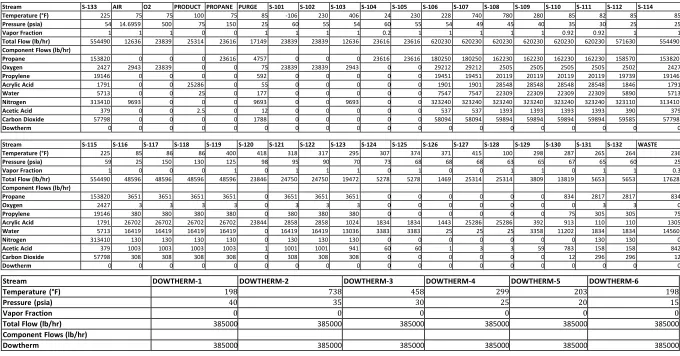
Table 4.1: Overall Process Stream Summary. ... 19
Table 4.2: Mixing Section Stream Summary ... 21
Table 4.3: Reactor Stream Summary.. ... 23
Table 4.4: Separation Process Stream Summary. ... 25
Table 5.1: Reactor Specifications ... 28
Table 6.1: Equipment List ... 36
Table 7.1: T-101 Electricity Savings ... 89
Table 7.2: Dowtherm Utilities Savings ... 91
Table 7.3: Dowtherm Cooling/Heating Loop ... 91
Table 7.4: Utility Requirements and Costs ... 92
Table 9.1: Fixed Capital Investment Summary... 104
Table 9.2: Total Capital Investment Summary ... 105
Table 9.3: Variable Cost Summary ... 106
Table 9.4: Fixed Cost Summary ... 107
Table 10.1: Cash Flow Summary ... 113
Table 10.2: Fixed Costs vs. Product Price ... 116
Table 10.3: Variable Costs vs. Product Price ... 116
Figures:
Figure 2.1: U.S. Acrylic Acid by End-Use………….………..………….4
Figure 2.2: Innovation Map ... 8
Figure 3.1: Proposed Oxidation Pathway on Diluted Mo-V-Te-Nb Mixed Oxide Catalyst ... 12
Figure 3.2: Azeotrope Diagram for Acetic Acid/Water/Acrylic Acid……….14
Figure 4.1: Overall Process Diagram. ... 18
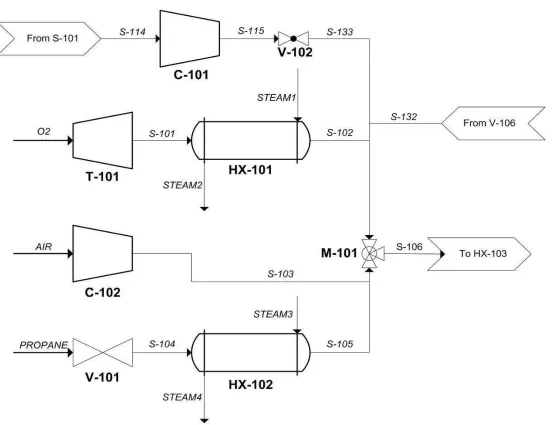
Figure 4.2: Mixing Section Process Diagram ... 20
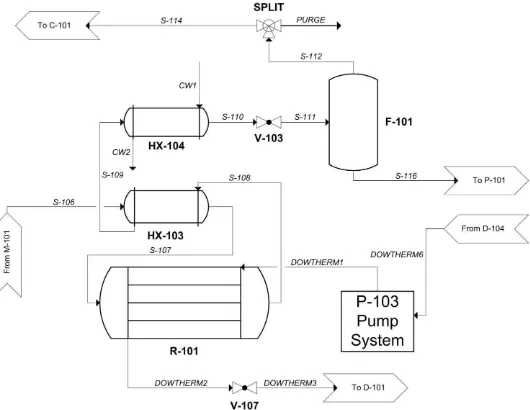
Figure 4.3: Reactor Process Diagram. ... 22
Figure 4.4: Separation Process Diagram. ... 24
Figure 5.1: Product Selectivity for Propane Oxidation Over Diluted MoVTeNb Oxide Catalyst……. 33
Figure 10.1: Sensitivity Analysis of IRR versus individual parameters ... 114
Figure B.1: Overall Aspen Simulation Process ... 132
Figure B.2: Preliminary separation process using liquid-liquid extraction techniques ... 133
Section 1
Abstract
Acrylic acid is an essential polymer raw material for many industrial and consumer products. Currently, acrylic acid is manufactured from propylene, which is created as a by-product from fossil fuels manufacture and industrial cracking of heavy hydrocarbons. However, the discovery of new natural gas reserves presents new opportunities for the production of acrylic acid. A design feasibility study is presented to analyze the economics behind producing acrylic acid from the selective oxidation of propane to propylene over a mixed metal oxide catalyst, Mo1V0.30Te0.23Nb0.125Ox.
The proposed plant is located in the U.S. Gulf Coast and produces 200MM lb/yr acrylic acid. Since the catalytic oxidation process has low propane conversion per pass, the process recycles unconverted propane and propylene back to the reactor to increase overall conversion. The acrylic acid is then separated and purified to the glacial-grade industrial standard for polymer raw material of 99.7% acrylic acid by mass. A major challenge of the separation process is the non-ideal behavior of the components, which produces three different azeotropes: water with acrylic acid, water with acetic acid, and acetic acid with acrylic acid. The separation process utilizes four distillation towers to navigate around the azeotropes.
Section 2
2.1 Introduction and Background Information
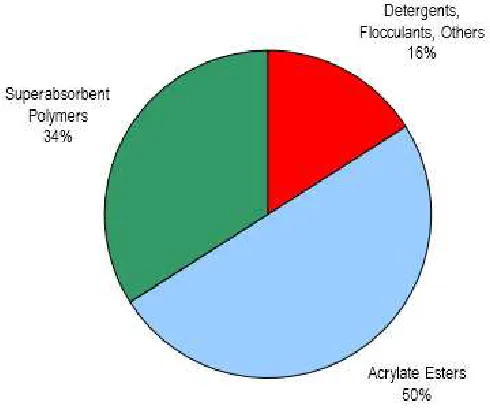
Acrylic acid is essential for the production of many consumer and industrial products. Two grades of acrylic acid are commercially available: technical-grade and glacial-grade. Technical, or crude, acrylic acid is approximately 94% purity by mass and is synthesized to acrylate esters. The esters are converted to co-monomers which, when polymerized, are used to make surface coatings, adhesives, sealants, textiles, and paints. Acrylate esters have many desirable qualities for polymeric materials such as color stability, heat and aging resistance, weather durability, low temperature flexibility, and resistance to acid and bases. 1 Glacial, or industrial, acrylic acid is generally 99.5% to 99.7% acrylic acid by mass and is polymerized to produce polyacrylic acid-based polymers.2 These polymers are used to make detergents, dispersants, super absorbent polymers (such as in diapers), and thickeners. The breakdown of U.S. acrylic acid consumption by end-use is displayed in Figure 2.1:
Acrylic acid is typically produced through a two-stage propylene-based oxidation process using acrolein as a fast-acting intermediate, as depicted below:
1
ICIS Chemical Business (2010). Acrylic Acid Uses and Market Data. Retrieved March 31, 2013, from 2 Nexant, Inc. (2010). Acrylic Acid. Retrieved March 31, 2013, from
Overall selectivities of 80% to 90% of acrylic acid based on propylene are obtained at conversions over 95%. However, there is room for optimization in this process by using a cheaper starting material, such as propane.
Hydraulic fracturing, commonly referred to as fracking, is a technique used to release petroleum and natural gas in a rock layer deep below the earth’s surface using a pressurized fluid. At such depth, natural gas and oil do not have enough reservoir pressure to flow at economically desirable rates from the well or bed. Creating fractures in the rock increases the permeability of the reservoir. Although there is controversy over the environmental impacts, these effects can be mitigated through best practices and strict legislation. As of 2010, it is estimated that 60% of all new oil and gas wells were hydraulically fractured.3 Fracking has a large economic impact because of its ability to extract vast amounts of formerly inaccessible hydrocarbons. As a result, prices for hydrocarbon liquids have fallen significantly. This development has made it economically advantageous to use propane as a starting material for acrylic acid production using the pathway described in U.S. Patent 8,193,387.
2.2 Project Charter produces competitive amounts of industrial-grade acrylic acid through oxidation of propane via a mixed metal oxide catalyst in a fixed bed reactor.
Project Scope:
In Scope:
Selecting an optimal mixed metal oxide catalyst
Estimating reaction kinetics of propane to acrylic acid via propylene intermediate
Creating a process design of a plant that produces 200 MM lb/yr acrylic acid
Completing approximate equipment sizing
Determining economic viability of the proposed plant
Determining profitability of the project if deemed to be economically viable
Initial process design completed by February 19th, 2013
Initial equipment sizing completed by March 12th , 2013
Initial economic analysis completed by March 26th, 2013
2.3 Technology-Readiness Assessment
The motivation behind this process design is driven by both advancements in technology and an increase in market size. Technologically driven aspects of the process include (1) the use of a mixed metal oxide catalyst, Mo1V0.30Te0.23Nb0.125Ox, (2) the use of a recycle stream to
Section 3
3.1 Market and Competitive Analysis
Due to acrylic acid’s use in a number of consumer and industrial applications (including adhesives, paints, plastics, hygiene products, and detergents), there exists an $11 billion market for the compound. The growth in Western Europe and the United States has slowed down to around 1.6% per year. However, because China and India have begun to adopt U.S. production techniques and strategies, the need for polymers and copolymers has increased, adding to the growing demand for acrylic acid. China, in particular, is the high-growth market for acrylic acid and is increasing its consumption by approximately 8% per year.4 The average world demand is growing at a rate of approximately 3% to 5% per year. Worldwide, the acrylic acid market is predicted to be worth $14 billion by 2018.
Because this proposed process uses a cheaper raw material and produces a higher yield of acrylic acid at the same purity, it should be competitive within the existing industrial market. However, the proposed acrylic acid plant may face a number of competitive challenges from renewable acrylic acid pathways. The selling price of acrylic acid is predicted to drop if bio-acrylic acid plants are able to scale-up their process to industrial production levels. OPX Biotechnologies, a leader in the fermentation process used to produce acrylic acid, is able to produce a $0.50/lb acrylic acid which is much cheaper than the price of acrylic acid ($1.75/lb) which was assumed in this project.5
4
ICIS Chemical Business (2010). Acrylic Acid Uses and Market Data. Retrieved March 31, 2013, from http://www.icis.com/Articles/2007/11/01/9074870/acrylic-acid-uses-and-market-data.html
5
3.2 Customer Requirements
Customer requirements for this process are standardized due to the high demand in the existing market. There are two grades of acrylic acid which are commercially available. Glacial, or industrial-grade, which is 99.7% acrylic acid by mass, is used for the production of super absorbent polymers for water treatment, disposable diapers, and detergents. Technical-grade, or crude acrylic acid, which is approximately 94% acrylic acid by mass, is mostly used for the production of surface coatings, adhesives, plastic additives, and paper treatment. Customer requirements for this process are based on the existing industry market standard for glacial-grade acrylic acid.
3.3 Preliminary Process Synthesis
Acrylic acid is typically produced through the catalytic partial oxidation of propylene:
Additionally, acrylic acid can also be produced through a one-step selective oxidation of propane over a selective catalyst:
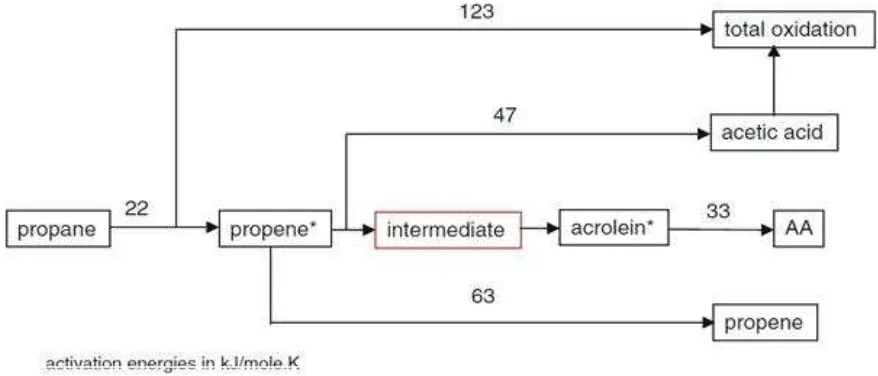
The proposed reaction network is displayed in Figure 3.1 (below) with the activation energies of the pathways shown and the asterisks indicating active intermediates.7 It is believed that propylene may pass through an σ-allyl radical intermediate before it reaches acrolein as displayed in red below.8
Side reactions of this process include total oxidation as seen in reactions (5)-(7) and the production of acetic acid through activated propylene or acrolein in reaction (8). The total oxidation side reactions can be minimized by maintaining the reactor temperature at the desired level by removing excess heat from the highly exothermic reaction. Additionally, the use of an
7
Widi, R. K., Hamid, S. B. A., & Schlogl, R. (2009). Kinetic investigation of propane oxidation on diluted Mo1-V0.3-Te0.23-Nb0.125-Ox mixed-oxide catalysts. Reaction Kinetics and Catalysis Letters, 98, 273-286.
8
Pudar, S., Oxgaard, J., Chenoweth, K., van Duin, A., & Goddard, W. (2007). Mechanism of Selective Oxidation of Propene to Acrolein on Bismuth Molybdates from Quantum Mechanical Calculations. Materials and Process
inert gas, such as water or nitrogen, may prevent excess oxidation of propylene by enhancing the desorption of acrylic and acetic acids from the catalyst surface.
Kinetics
Propane partial oxidation to acrylic acid over vanadium pyrophosphate (VPO) catalysts, heteropolyacids, and multi-component oxidic catalysts has been studied in great depth. Only recently has a catalyst system been developed that is active and selective enough to substitute for the existing industrial process.9 This is due to the difficulty in maintaining high reaction temperatures (so the reaction rate will be high) while preventing total oxidation reactions. A thorough review of mixed metal oxide catalyst literature was performed and the results are summarized in Table 3.1.10 The conversions listed are based on propane and the yield and selectivities are based on acrylic acid.
Table 3.1: Mixed metal-oxide Catalysts for Propane Oxidation to Acrylic Acid
Catalyst Feed Temp
(oC)
Conversion (%)
Yield (%)
Selectivity (%) Mo1V0.3Nb0.05Sb0.15Te0.06Ox Propane/O2/H2O/N2 380 21 12 54
Mo1V0.3Nb0.05Sb0.09Te0.09Ox Propane/O2/H2O/N2 380 19 12 60
Mo1V0.3Sb0.16Nb0.05Ox Propane/air/ H2O 380 50 16 32
Mo1V0.3Sb0.25Nb0.11Ox Propane/O2/H2O/N2 400 21 12 61
Mo1V0.3Te0.23Nb0.125Ox Propane/air/H2O 400 80 48 60
Mo1V0.3Te0.23Nb0.12Ox Propane/air/H2O 390 71 42 59
Mo1V0.3Te0.23Nb0.12Ox Propane/O2/H2O/He 350 23 14 61
Separation
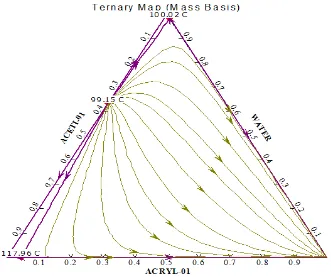
After acrylic acid is produced, it must be separated from the reactants (oxygen, nitrogen, and propane) and the by-products of the reaction (acetic acid, water, and propylene). While a simple flash drum will be able to separate the reactants from acrylic acid, the final product separation from acetic acid and water is difficult due to three separate azeotropes as seen in Figure 3.2:
In order to determine the most economic and efficient method of separation, three different processes were evaluated and the results compared. The first proposed method of separation, displayed in Figure B.2 (located in Appendix B, page 133), involved the use of a liquid-liquid extraction process to allow better separation of organic components from water. The product stream from the reactor was fed to a flash drum and a distillation column, which separated and recycled the gaseous components. The bottoms product was separated in an eight-tray column into a pure acrylic acid stream. The distillate contained water, acetic acid, and residual acrylic acid and was fed into a decanter. The decanter was operated with n-propyl
acetate, an extraction solvent recommended by U.S. Patent Number 5,315,037.11 The decanter succeeded in separating the mixture into a water stream containing 97% by mass water and the balance organic components and an organic stream. Through a series of two more distillation columns a majority of the solvent (which can be recycled), and 96% of the total acrylic acid were recovered. Ultimately, this method of separation was not selected because the additional costs associated with the decanter and the solvent feed of n-propyl acetate did not result in better acrylic acid separation.
The second method of separation proposed was an extractive distillation process performed in a distillation column, which eliminated the use of a decanter but still required an entrainer.12 An Aspen diagram of the separation process can be seen in Figure B.3 (located in Appendix B, page 134). The extractive agent is introduced near the top of the column and its presence alters the relative volatility of the compounds to allow a greater degree of separation. After a separation using different entrainers (based on suggestions from U.S. Patent 5,154,80012) was designed in Aspen, dimethylsulfoxide was selected as the optimal extractive agent. As with the decanter process, this method of separation was not selected because it did not result in higher acrylic acid separation despite the added cost of solvent and keeping the number of distillation towers (four) used the same.
3.4 Assembly of Database
Input Costs
The input cost for water, including pressurized steam, was taken from Aspen Economic Analyzer. Current pricing from Aspen is based on 2010 dollars, so a multiplying factor of 1.0447 (CE 2012/2010 = 575.4/550.8) was used. Input costs for liquid propane and compressed oxygen were specified in the problem statement found in Appendix A, page 130.
Aspen Simulation Specifications
In this project, Aspen Plus v7.3 was used. All simulations should be run in this version of Aspen to avoid compatibility issues. In order to accurately model the three azeotropes in the process, the non-random two-liquid (NRTL) activity coefficient model, along with the Redlich-Kwong (RK) equation of state model, was used in all simulations. RStoic was used over a PFR model reactor, as conversion, selectivities, and yield data was more easily available and more complete than kinetic models (which are needed for PFR models in Aspen). RStoic was used to model the conversion information taken from patented processes, and to model the heat rise in the reactor with given conversion data. MComp was used to model the two compressor blocks in the system. The compressors were designed to have the lowest possible outlet pressure conditions such that pressure conditions into the Flash block were as specified without doing extra work. Heat exchangers, including the reactor, were designed outside of Aspen.
Section 4
4.1 Overall Process Outline
Table 4.1: Overall Process Stream Summary. This table provides temperature, pressure, vapor fraction, and component flow rates for all streams in the process
Total Flow (lb/hr) 554490 12636 23839 25314 23616 17149 23839 23839 12636 23616 23616 620230 620230 620230 620230 620230 620230 571630 554490
Component Flows (lb/hr)
Propane 153820 0 0 0 23616 4757 0 0 0 23616 23616 180250 180250 162230 162230 162230 162230 158570 153820
Oxygen 2427 2943 23839 0 0 75 23839 23839 2943 0 0 29212 29212 2505 2505 2505 2505 2502 2427
Propylene 19146 0 0 0 0 592 0 0 0 0 0 19451 19451 20119 20119 20119 20119 19739 19146
Acrylic Acid 1791 0 0 25286 0 55 0 0 0 0 0 1901 1901 28548 28548 28548 28548 1846 1791
Water 5713 0 0 25 0 177 0 0 0 0 0 7547 7547 22309 22309 22309 22309 5890 5713
Nitrogen 313410 9693 0 0 0 9693 0 0 9693 0 0 323240 323240 323240 323240 323240 323240 323110 313410
Acetic Acid 379 0 0 2.5 0 12 0 0 0 0 0 537 537 1393 1393 1393 1393 390 379
Carbon Dioxide 57798 0 0 0 0 1788 0 0 0 0 0 58094 58094 59894 59894 59894 59894 59585 57798
Dowtherm 0 0 0 0 0 0 0 0 0 0 0 0 0 0 0 0 0 0 0
Stream S‐ S‐ S‐ S‐ S‐ S‐ S‐ S‐ S‐ S‐ S‐ S‐ S‐ S‐ S‐ S‐ S‐ S‐ WASTE
Temperature (°F) 225 85 86 86 400 418 318 317 295 307 374 371 415 100 298 287 265 264 236
Pressure (psia) 59 25 150 130 125 98 95 90 70 73 68 68 68 63 65 67 65 60 25
Vapor Fraction 1 0 0 0 1 0 1 1 1 0 1 0 0 1 1 0 1 1 0.3
Total Flow (lb/hr) 554490 48596 48596 48596 48596 23846 24750 24750 19472 5278 5278 1469 25314 25314 3809 13819 5653 5653 17628
Component Flows (lb/hr)
Propane 153820 3651 3651 3651 3651 0 3651 3651 3651 0 0 0 0 0 0 834 2817 2817 834
Oxygen 2427 3 3 3 3 0 3 3 3 0 0 0 0 0 0 0 3 3 0
Propylene 19146 380 380 380 380 0 380 380 380 0 0 0 0 0 0 75 305 305 75
Acrylic Acid 1791 26702 26702 26702 26702 23844 2858 2858 1024 1834 1834 1443 25286 25286 392 913 110 110 1305
Water 5713 16419 16419 16419 16419 0 16419 16419 13036 3383 3383 25 25 25 3358 11202 1834 1834 14560
4.2 Mixing Section
Table 4.2: Mixing Section Stream Summary. This table provides temperature, pressure, vapor fraction, and component flow rates for all streams in the mixing section of the process flowsheet.
Stream S‐114 S‐115 S‐133 O2 S‐101 S‐102 AIR S‐103 PROPANE S‐104 S‐105 S‐132 S‐106
Temperature (°F) 85 225 225 75 ‐106 230 75 406 75 24 230 264 228
Pressure (psia) 25 59 54 500 60 55 14.6959 54 150 60 55 60 54
Vapor Fraction 1 1 1 1 1 1 1 1 0 0.2 1 1 1
Total Flow (lb/hr) 554490 554490 554490 23839 23839 23839 12636 12636 23616 23616 23616 5653 620230
Component Flows (lb/hr)
Propane 153820 153820 153820 0 0 0 0 0 23616 23616 23616 2817 180250
Oxygen 2427 2427 2427 23839 23839 23839 2943 2943 0 0 0 3 29212
Propylene 19146 19146 19146 0 0 0 0 0 0 0 0 305 19451
Acrylic Acid 1791 1791 1791 0 0 0 0 0 0 0 0 110 1901
Water 5713 5713 5713 0 0 0 0 0 0 0 0 1834 7547
Nitrogen 313410 313410 313410 0 0 0 9693 9693 0 0 0 130 323240
Acetic Acid 379 379 379 0 0 0 0 0 0 0 0 158 537
Carbon Dioxide 57798 57798 57798 0 0 0 0 0 0 0 0 296 58094
4.3 Reactor Section
Table 1.3: Reactor Stream Summary. This table provides temperature, pressure, vapor fraction, and component flow rates for all streams in the reactor section of
Acetic Acid 379 12 537 1393 1393 1393 390 1003 537 1393
Carbon Dioxide 5779
Stream DOWTHERM‐1 DOWTHERM‐6 DOWTHERM‐2 DOWTHERM‐3
4.4 Separation Section
Table 4.4: Separation Process Stream Summary. This table provides temperature, pressure, vapor fraction, and component flow rates for all streams in the
Stream DOWTHERM‐3 DOWTHERM‐4 DOWTHERM‐5 DOWTHERM‐6
Temperature (°F) 458 299 203 198
Pressure (psia) 30 25 20 15
Vapor Fraction 0 0 0 0
Section 5
5.1 Reactor Section
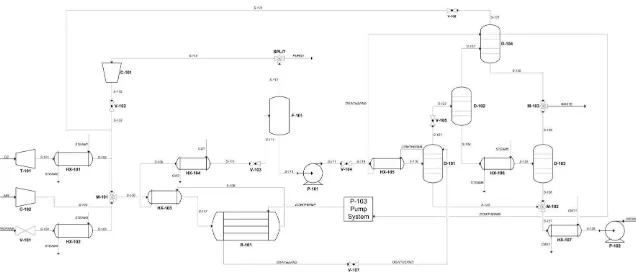
The conversion of propane to acrylic acid through propylene requires contacting the paraffin with a mixed metal oxide catalyst at approximately 750°F. Since the reaction is highly exothermic, a fixed bed reactor configured as a shell and tube heat exchanger was used, with Dowtherm A as the coolant. The flowsheet for the reactor section can be seen in Figure 4.3, page 22.
Reactor
The reactor dimensions were chosen to ensure both adequate volume for chemical conversion and adequate surface area for sufficient cooling. Based on patent data, the fixed bed reactor, R-101, needs 160 lb catalyst for a space velocity of 1662 hr-1. Given the required feed flow rate, the minimum reactor volume to ensure this space velocity is 670 ft3. The actual reactor volume is 700 ft3, allowing 30 ft3 to be used to adjust the reaction extent with inert ceramic beads or additional catalyst. These beads will also help ensure operating temperature conditions are more consistent with researched conditions. The minimum required surface area for cooling is 11,800 ft2, which is safely under designed reactor surface area of 16,755 ft2. The required cooling surface area is based on an estimated overall heat transfer coefficient of 100 Btu/ft2-hr and a log-mean temperature difference of 100°F.
Table 5.1: Reactor Specifications
Reactor Specifications
Number of Tubes 4000
Tube Length (ft) 8
Inner - Tube Diameter (in) 2
Pressure Drop (psi) 6
the fixed bed reactor is pre-heated to 740°F using the reactor effluent, at 780°F, as a heat source. In order to control the reaction, feed conditions are set such that oxygen is the limiting reactant.
Dowtherm Cooling
5.2 Separation
The separation scheme for this process involves one flash drum and four distillation towers. The flowsheet for the separation section of the process can be seen in Figure 4.4, page 24. The main challenge was to isolate acrylic acid from water and acetic acid since these three chemical species form three separate azeotropes: water/acrylic acid, water/acetic acid, and acrylic acid/acetic acid form an azeotrope. Rather than trying to break the azeotropes, this separation scheme avoided them by performing the separation in a specific order. The first tower (D-101) recovers a pure stream of acrylic acid. The second tower (D-102) removes most of the water and acetic acid from the remaining acrylic acid, which is recovered in the third tower (D-103). The fourth tower removes the remaining propane, which is recycled, from the water and acetic acid which exits as wastewater (in addition to the distillate from the third tower).
Flash Drum
The reactor effluent (S-111) was first sent to a flash drum (F-101), where virtually all the propane, oxygen, nitrogen, carbon dioxide, and propylene exits as vapor and the acrylic acid exits as liquid. About 70% of the water and acetic acid exits in the liquid phase and the balance exits in the vapor phase. The vapor from the flash drum is recycled back as reactor feed, while the liquid is fed to the first distillation tower (D-101).
Tower 1
D-101 separates acrylic acid from the reaction byproducts and leftover reactants. About 75% of the acrylic acid produced is recovered in the bottoms (S-120) of this tower. The propane, propylene, carbon dioxide, nitrogen, acetic acid, and water leaves in the distillate (S-121), along with the remaining 25% of the acrylic acid.
Tower 2
nitrogen leave this tower in the distillate. About 78% of the water leaves in the distillate along with 87% of the acetic acid, while the balance leaves in the bottoms.
Tower 3
D-103 separates acrylic acid from the remaining water and acetic acid. All the water and acetic acid entering this tower leaves in the distillate (S-129). About 85% of the acrylic acid entering this tower is recovered in the bottoms (S-126) and the balance leaves in the distillate.
Tower 4
D-104 separates the water and acetic acid, which leave as bottoms (S-130), from the propane, propylene, carbon dioxide, and nitrogen, which are recycled (S-131). About 90% of the acrylic acid that enters this tower leaves as bottoms. All the carbon dioxide and nitrogen leave this tower in the distillate (S-131). About 80% of the propane and propylene leave in the distillate, while the remaining 20% leave in the bottoms as wastewater. About 85% of the water and acetic acid that entered this tower leave in the bottoms and the balance leaves in the distillate.
Recovery of Acrylic Acid
About 28,550 lb acrylic acid exit the reactor (R-101) each hour and enter the flash drum (F-101), which is the first separation unit. The first product stream (S-120) has about 23,800 lb of acrylic acid and the second product stream (S-126) has about 1,450 lb acrylic acid. This gives an overall acrylic acid recovery of about 89%. About 5% exits the process in wastewater
5.3 Other Assumptions
Deriving Propane to Propylene Kinetic Expression
The reaction forming propylene from propane is the first step in forming all of the observed products. It is known that the rate-limiting step is the reaction between propane and an open site on the catalytic surface, as is evidenced by the observed kinetics.13 It is assumed that all subsequent reactions are rapid, and that the size of the pipe reactor required for the target of 10% conversion of propane can be estimated using the known kinetics of the propane to propylene reaction.
Widi et al. performed a kinetic study of propane over a diluted Mo1V0.30Te0.23Nb0.125Ox
catalyst. 14 By varying the feed composition, they were able to obtain the reaction rate for the formation of propylene as a function of propane and oxygen concentrations. They found that the rate expression was first order in propane and zero order in oxygen, and is be approximated by
(9) At 673°K, the rate of propylene formation was found to be 0.8 mol/h-g catalyst at a propane concentration of 0.3 mol/L. Assuming a catalyst loading of 1 g, this corresponds to a k value of 0.267 hr-1, or 7.41 x 10⁻⁵ s-1. Using the Arrhenius equation and solving for the pre-exponential factor (A):
(10) The pre-exponential factor was found to be 4.62 per gram of catalyst, and Widi et al. computed an activation energy value for the formation of propylene of 62.7 kJ/mol, allowing the estimation of a complete kinetic expression for the propane to propylene reaction.
(11)
Kinetics Simplification
Currently, no experimental rate law has been determined for the production of acrylic acid from propylene over a mixed metal oxide catalyst. Thus, selectivities and conversions from patents and journal articles were used to scale up the proposed design process as seen in Figure 5.1, page 33, from (Widi et al., 2009). It is observed that selectivity of propylene decreases as propane conversion increases and that the selectivity to acrylic acid increases as propane
13
Widi, R. K. (2012). Kinetic Investigation of Carbon Dioxid, Acetic Acid, Acrylic Acid Formation on Diluted and Leached MoVTeNb Catalyst. Indonesian Journal of Chemistry, 12(2), 131-134.
14
Mo1-conversion is increased. Selectivities of acetic acid and carbon dioxide remain relatively constant.15
Figure 5.1: Product Selectivity Profiled for Propane Oxidation Over Diluted MoVTeNb Mixed Oxide Catalyst
Aspen Plus Simulation
The APSEN Plus simulations use the NRTL-RK property method. Due to the complex interactions between acrylic acid, acetic acid, and water, three separate azeotropes form. In order to accurately model these azeotropes, 5 additional binary interaction databanks needed to be loaded. VLE-RK, VLE-HOC, VLE-IG, LLE-Aspen, and VLE-LIT were loaded to improve the complex interaction modeling.
Catalyst Assumptions
analysis of this process. It is also assumed that the catalyst needs to be replaced every two years. Additionally, it is estimated that the spent catalyst can be sold back to the supplier as raw material for 15% of the purchase price.
Propane Supply
Based on the proposed site location, it is assumed that propane will be supplied via pipeline for $0.213 per pound. It is further assumed that the propane is arriving in liquid form at standard ambient temperature (75°F), which sets its pressure at 150 psia.
Pure Oxygen Supply
Based on the proposed site location, it is also assumed that pure oxygen can be accessed via pipeline at 500 psig and standard ambient temperature (75°F) for $0.03 per pound.
Wastewater Treatment
It is assumed that a wastewater treatment system already exists on site (or nearby). Therefore, the economic analysis of this design does not include the installation of a wastewater treatment plant. Instead, the analysis includes the cost associated with wastewater treatment based on the hydro-loading and organic compositions of the wastewater streams.
Purge
It is assumed that a furnace for burning the purge gas stream already exists on site (or nearby). Therefore, this design does not include the installation cost of a furnace in the economic analysis. The heating value for this stream was calculated, as well as its dollar value should it be sold to another local facility. The heating value can be used as a credit to offset the utility demand of the plant.
Utility Usage
Section 6
Table 6.1: Equipment List
Storage Tank- Acrylic Acid Storage $291,705 $291,705
Catalyst Catalysts $5,576,741 $5,576,741
Dowtherm Other Equipment $699,530 $699,530
Of the $52,191,590 total bare module cost, approximately 27% comes from the large compressor. This is due to the large scale of the compressor, which compresses 3,926,000 ft3/hr of reactant by 24 psi (starting at 85°F).
6.1 Unit Descriptions
Pumps
Sample calculations for determining pump head and electricity requirements are provided in Appendix C, page 184. All pumps in the process have spares which were included in the calculation of total bare module costs. Each pump was assumed to have a single spare at equivalent purchase and bare module cost.
P-101 - Base Purchase Cost: $22,373
This is a centrifugal pump constructed of stainless steel that sends the liquid product of the flash vessel through the separation process. S-116 flows at a rate of 48,596 lb/hr and a temperature of 86°F. The pump has an efficiency of 0.537, a brake power of 13.8 hp, and a pump head of 301.8 ft. It raises the pressure of the stream from 24.7 psia to 150 psia.
D-101-P - Base Purchase Cost: $9,305
This is a centrifugal pump constructed of stainless steel that sends the liquid reflux of D-101 through the tower. The pump pushes liquid at a rate of 238 gpm and operates at 119.6 psia and 368°F. The pump has a brake power of 20 hp and a pump head of 225 ft.
D-102-P – Base Purchase Cost: $8,573
D-103-P – Base Purchase Cost: $6,377
This is a centrifugal pump constructed of stainless steel that sends the liquid reflux of D-103 through the tower. The pump pushes liquid at a rate of 29.9 gpm and operates at 75.3 psia and 348°F. The pump has a brake power of 3 hp and a pump head of 225 ft.
D-104-P – Base Purchase Cost: $6,586
This is a centrifugal pump constructed of stainless steel that sends the liquid reflux of D-104 through the tower. The pump pushes liquid at a rate of 60.4 gpm and operates at 75.3 psia and 315°F. The pump has a brake power of 5 hp and a pump head of 225 ft.
P-102 - Base Purchase Cost: $5,645
This is a centrifugal pump constructed of stainless steel that sends the liquid product to the storage tank. S-128 flows at a rate of 25,286 lb/hr and a temperature of 100°F. The pump has an efficiency of 0.437, a brake power of 0.785 hp, and a pump head of 26.8 ft. It raises the pressure of the stream from 63 psia to 75 psia.
P-103 - Base Purchase Cost: $53,504
This is a system of 20 pumps that pressurize the Dowtherm cooling/heating system. Dowtherm flows at a rate of 25,314 lb/hr and a temperature of 198°F through each pump. The pump has an efficiency of 0.83, a brake power of 15,764 hp, and a pump head of 1,037 ft. It raises the
pressure of the Dowtherm from 15 psia to 40 psia.
Flash Vessels
Flash Vessel calculations were based on Aspen simulations, which used an NRTL-RK
thermodynamic model, summarized in the input summary provided in Appendix B, page 156.
reactor at a rate of 571,634 lb/hr. The tower operates at 85°F and 25 psia. It has a diameter of 16.5 feet, a height of 12 ft, and a wall thickness of 0.3125 in.
Heat Exchangers
Sample calculations for determining the heat duty, heat transfer coefficient, heat transfer area, and utility requirements for these shell-tube heat exchangers are provided in Appendix C, page 178.
HX-101 - Base Purchase Cost: $19,864
This carbon steel shell and tube heat exchanger heats up stream S-100 using pressurized steam. S-100 enters at a temperature of -106°F and exits as S-102 at a temperature of 230°F. S-100 flows through the tube side of the heat exchanger at a rate of 23,839 lb/hr. Steam moves at a flow rate of 1,998 lb/hr and a temperature of 328°F through the shell side of the exchanger. The overall surface area of the exchanger is 172 ft2, and the overall heat duty is 1,775,817 BTU/hr. The tubes have an outer diameter of 1 in, are 20 ft long, and have a pitch of 1.25.
HX-102 - Base Purchase Cost: $21,641
This carbon steel shell and tube heat exchanger heats up stream S-104 using pressurized steam. S-100 enters at a temperature of 24°F and exits as S-105 at a temperature of 230°F. S-104 flows through the tube side of the heat exchanger at a rate of 23,615 lb/hr. Steam moves at a flow rate of 5,885 lb/hr and a temperature of 328°F through the shell side of the exchanger. The overall surface area of the exchanger is 207 ft2, and the overall heat duty is 5,230,767 BTU/hr. The tubes have an outer diameter of 1 in, are 20 ft long, and have a pitch of 1.25.
HX-103 - Base Purchase Cost: $668,045
118,783,845 BTU/hr. The tubes have an outer diameter of 1 in, are 20 ft long, and have a pitch of 1.25.
R-101 - Base Purchase Cost: $281,389
This carbon steel (shell)/stainless steel (tube) exchanger acts as the reactor system. The reactor is designed to have 4,000 eight-foot tubes that are filled with catalyst and that have a 2 in inner diameter (2.375 in outer diameter) and a pitch of 3 in. The space velocity of the reactor/flow system is 1662 hr-1, with a residence time of 2.17 sec. The bed porosity is estimated to be 0.4. The catalyst contains 30 ft3 inert (such as ceramic beads) for better heat transfer through the system. The U was assumed to be 100 BTU/hr-ft2-°F. S-107 enters at a temperature of 740°F at a rate of 620,230 lb/hr, and heats to 780°F. Dowtherm A is used to cool the reactor. It enters the reactor at 198°F at a rate of 385,000 lb/hr, and exits at 738°F. The overall surface area of the reactor is designed to be 16,755 ft2. The overall heat duty, as calculated from heat of reaction and conversion data, is estimated to be 120,000,000 BTU/hr.
HX-104 - Base Purchase Cost: $239,932
This carbon steel (shell)/stainless steel (tube) exchanger cools the product stream before it enters F-101. S-109 enters at a temperature of 280°F and exits as S-110 at a temperature of 85°F, at a rate of 620,230 lb/hr through the tube side. Cooling water enters at a temperature of 75°F and exits as 95°F, at a rate of 3,149,831 lb/hr through the shell side. The overall surface area of the exchanger is 6,368 ft2, and the overall heat duty is 63,053,511 BTU/hr. The tubes have an outer diameter of 1 in, are 20 ft long, and have a pitch of 1.25.
HX-105 - Base Purchase Cost: $113,536
D-101-C - Base Purchase Cost: $109,459
This stainless steel (tube)/carbon steel (shell) exchanger acts as the condenser for tower D-101. S-C-1 flows through the exchanger at a rate of 24,750 lb/hr. Cooling water flows at a rate of 2,931,977 lb/hr, heating from 75°F to 95°F. The surface area of the exchanger is 1,925 ft2, and has a heat duty of 58,692,479 BTU/hr. The diameter of the shell is 27 in. The tubes have an outer diameter of 1 in, are 20 ft long, and have a pitch of 1.25.
D-101-REB - Base Purchase Cost: $1,312,882
This stainless steel (tube)/carbon steel (shell) u-tube kettle acts as the reboiler for tower D-101. S-R-1 flows through the exchanger at a rate of 23,846 lb/hr. DOWTHERM acts as the heat source, and flows at a rate of 385,000 lb/hr, cooling from 738°F to 458°F, and has a heat duty of 54,062,820 BTU/hr. The diameter of the shell is 67 in, there are 7 shells total, and the surface area in each shell is 2,729 ft2. The tubes have an outer diameter of 1 in, are 13 ft long, and have a pitch of 1.25.
D-102-C - Base Purchase Cost: $112,282
This stainless steel (tube)/carbon steel (shell) exchanger acts as the condenser for tower D-102. S-C-3 flows through the exchanger at a rate of 19,472 lb/hr. Cooling water flows at a rate of 2,763,294 lb/hr, heating from 75°F to 95°F. The surface area of the exchanger is 2,003 ft2, and has a heat duty of 55,315,822 BTU/hr. The diameter of the shell is 27 in. The tubes have an outer diameter of 1 in, are 20 ft long, and have a pitch of 1.25.
D-102-REB - Base Purchase Cost: $766,632
D-103-C - Base Purchase Cost: $29,064
This stainless steel (tube)/carbon steel (shell) exchanger acts as the condenser for tower D-103. S-C-5 flows through the exchanger at a rate of 3,809 lb/hr. Cooling water flows at a rate of 470,853 lb/hr, heating from 75°F to 95°F. The surface area of the exchanger is 341 ft2, and has a heat duty of 9,425,587 BTU/hr. The diameter of the shell is 12 in. The tubes have an outer diameter of 1 in, are 20 ft long, and have a pitch of 1.25.
D-103-REB - Base Purchase Cost: $74,955
This stainless steel (tube)/carbon steel (shell) u-tube kettle acts as the reboiler for tower D-103. S-R-5 flows through the exchanger at a rate of 1,469 lb/hr. Pressurized steam at 400 psia and 445°F flows at a rate of 11,572 lb/hr. The exchanger has a heat duty of 9,030,477 BTU/hr. The diameter of the shell is 44 in and the surface area of the exchanger is 962 ft2. The tubes have an outer diameter of 1 in, are 13 ft long, and have a pitch of 1.25.
D-104-C - Base Purchase Cost: $36,695
This stainless steel (tube)/carbon steel (shell) exchanger acts as the condenser for tower D-104. S-C-7 flows through the exchanger at a rate of 5,653 lb/hr. Cooling water flows at a rate of 608,848 lb/hr, heating from 75°F to 95°F. The surface area of the exchanger is 507 ft2, and has a heat duty of 12,187,883 BTU/hr. The diameter of the shell is 14 in. The tubes have an outer diameter of 1 in, are 20 ft long, and have a pitch of 1.25.
D-104-REB - Base Purchase Cost: $21,327
HX-107 - Base Purchase Cost: $27,077
This carbon steel (shell)/stainless steel (tube) exchanger cools the product stream before it enters storage. S-127 enters at a temperature of 415°F and exits as S-128 at a temperature of 100°F, at a rate of 25,286 lb/hr through the tube side. Cooling water enters at a temperature of 75°F and exits as 95°F, at a rate of 123,738 lb/hr through the shell side. The overall surface area of the exchanger is 314 ft2, and the overall heat duty is 2,476,950 BTU/hr. The tubes have an outer diameter of 1 in, are 20 ft long, and have a pitch of 1.25.
Distillation Columns
Sample calculations for determining the height, diameter, reflux ratio, shell thickness for the distillation columns are provided in Appendix C on page 168-169. A tray efficiency calculation for the distillation column is provided in Appendix C on page 171.
D-101 - Purchase cost: $734,641
This stainless steel distillation column is used to easily separate a bulk of the acrylic acid
product. Stream S-119 enters on stage 6 at a rate of 48,596 lb/hr. The column has a reflux ratio of 3.5, a total of 19 stages, a distillate-to-feed ratio of 0.764, and uses a partial-vapor condenser. It is designed to be 50 ft tall with a diameter of 12 ft and 0.75 in shell thickness. The top tray has a temperature of 320ºF and a pressure of 95 psia. The distillate (S-121) flows through a partial-vapor condenser, D-101-C, and into a reflux accumulator, D-101-RA. The bottom tray has a temperature of 418ºF and a pressure of 98.3 psia. The bottoms go through a reboiler, D-101-REB. S-120 exits the bottom of the column at 23,846 lb/hr and is 99.9% acrylic acid by weight. S-121 exits the top of the reactor and is sent to D-102 at a rate of 24750 lb/hr.
D-102 - Purchase cost: $354,514
pressure of 73.4 psia. The bottoms go through a reboiler, D-102-REB. S-124 exits the bottom of the column at 5,278 lb/hr and is sent to D-103 and is 34.8% acrylic acid by weight. S-123 exits the top of the reactor and is sent to D-104 at a rate of 19,472 lb/hr and is 5% acrylic acid by weight.
D-103 - Purchase cost: $282,272
This stainless steel distillation column is used to purify the remaining acrylic acid. S-125 enters on stage 11. The column has a reflux ratio of 3, a total of 20 stages, a distillate-to-feed ratio of 0.9, and uses a partial-vapor condenser. It is designed to be 52 ft tall with a diameter of 5.5 ft and 0.25 in shell thickness. The top tray has a temperature of 298ºF and a pressure of 65 psia. The distillate (S-129) flows through a partial-vapor condenser, D-103-C, and into a reflux
accumulator, D-103-RA. The bottom tray has a temperature of 389ºF and a pressure of 68.4 psia. The bottoms go through a reboiler, D-103-REB. S-126 exits the bottom of the column at 1,469 lb/hr and is 98.2% acrylic acid by weight. S-129 exits the top of the reactor at a rate of 3,809 lb/hr and is a waste stream sent to a treatment plant (is 88.2% water by weight, rest is organic material).
D-104 - Purchase cost: $98,900
Reflux Accumulators
Discussion of the mean residence time to determine the volume of the reflux accumulators is provided in Appendix C on page 176.
D-101-RA - Base Purchase Cost: $37,636
The reflux accumulator is a horizontal vessel, with a diameter of 4.5 ft, a length of 13.5 ft, a shell thickness of 0.25 in, and a volume of 191 ft3. This is based on a residence time of 5 min.
D-102-RA - Base Purchase Cost: $28,645
The reflux accumulator is a horizontal vessel, with a diameter of 4 ft, a length of 12.5 ft, a shell thickness of 0.1875 in, and a volume of 157 ft3. This is based on a residence time of 5 min.
D-103-RA - Base Purchase Cost: $17,000
The reflux accumulator is a horizontal vessel, with a diameter of 3 ft, a length of 3.5 ft, a shell thickness of 0.1875 in, and a volume of 33 ft3. This is based on a residence time of 5 min.
D-104-RA - Base Purchase Cost: $19,863
The reflux accumulator is a horizontal vessel, with a diameter of 3 ft, a length of 6.5 ft, a shell thickness of 0.1875 in, and a volume of 61.3 ft3. This is based on a residence time of 5 min.
Storage Tanks
Sample calculations for determining the volume of the storage tanks are provided in Appendix C, page 185.
STOR-PROP - Base Purchase Cost: $168,131
STOR-PROD - Base Purchase Cost: $291,705
This stainless steel storage tank holds 7 day’s worth acrylic acid before shipping. It has a volume of 700,000 gallons. It holds acrylic acid at 15 psia and 75°F.
Compressors & Turbines
Sample calculations for determining the utility and space requirements are provided in Appendix C, page 183.
T-101 - Base Purchase Cost: $176,055
This is a carbon steel turbine used to decompress oxygen from 500 psia to 54 psia. The isentropic efficiency is assumed to be 0.72. Energy from the turbine is put into the grid as energy credits. The flow rate through the turbine is 23,839 lb/hr. The energy created by the turbine is 345 hp.
C-101 - Base Purchase Cost: $4,329,750
This is a stainless steel compressor used to compress S-114 (F-101 vapor) to 59 psia, in order to push the flow back through the reactor loop system. The isentropic efficiency is assumed to be 0.72. The flow rate through the compressor is 554,485 lb/hr. The brake power required for the compressor is 9,294 hp.
C-102 - Base Purchase Cost: $1,226,736
This is a carbon steel compressor used to compress ambient air to 54 psia. The isentropic
6.2 Unit Equipment Sheets
Compressor
Compressor
Identification Item: Single-Stage
Item No: C-101
No. Req'd: 1
Function Compresses recycle stream
Operation Continuous
Materials Handled:
Stream In: Stream Out:
S-114 S-115
Flow Rate (lb/hr) 554,485 554,485 Temperature (°F) 85 225 Pressure (psia) 25 59
Design Data: Number of Stages 1
Isentropic Efficiency 0.72
Total work (hp) 9,294
Material of Construction Carbon Steel
Purchase Cost: $ 4,329,750
Bare Module Cost $ 13,898,498
Compressor
Identification Item: Single-Stage
Item No: C-102
No. Req'd: 1
Function Compresses inlet air
Operation Continuous
Type N/A
Materials Handled:
Stream In: Stream Out:
AIR S-103
Flow Rate (lb/hr) 12,636 12,636
Temperature (°F) 75 406
Pressure (psia) 14.5 54
Design Data: Number of Stages 1
Isentropic Efficiency 0.72
Total work (hp) 400
Material of Construction Carbon Steel
Purchase Cost: $ 1,226,736
Bare Module Cost: $ 3,937,823
Distillation Column
Materials of Construction: Stainless Steel
Purchase Cost $ 734,641
Distillation Column
Identification Item: Distillation Column
Item No: D-102
No. Req'd: 1
Function Acrylic Acid purificatoin
Operation Continuous
Type N/A
Materials Handled: Stream In: Streams Out:
(Feed) (Distillate) (Bottoms)
S-121 S-123 S-124
Flow Rate (lb/hr) 24,750 19,472 5,278 Temperature (°F) 318 295 307 Pressure (psia) 95 70 73
Composition (mass frac)
Propane 0.148 0.188 0.000
Propylene 0.015 0.020 0.000
Oxygen 0.000 0.000 0.000
Water 0.663 0.670 0.641
Carbon Dioxide 0.013 0.016 0.000
Nitrogen 0.005 0.007 0.000
Acetic Acid 0.041 0.048 0.011
Acrylic Acid 0.116 0.053 0.348
Design Data: Actual Stages: 19
Diameter (ft): 7
Height (ft): 52
Shell Thickness (in): 0.31
Distillate-to-feed ratio (mole) 0.8
Reflux Ratio: 4
Tray Type: Sieve
Materials of Construction: Stainless Steel
Distillation Column
Materials of Construction: Stainless Steel
Purchase Cost $ 282,272
Distillation Column
Materials of Construction: Carbon steel
Heat Exchanger
Identification Item: Heat Exchanger
Item No: HX-103
No. Req'd: 1
Function Uses heat from reactor effluent to pre-heat reactor feed
Heat Exchanger
Identification Item: Heater
Item No: HX-104
No. Req'd: 1
Function Cools reactor effluent to enter flash drum F-101
Operation Continuous
Type Fixed Head Shell and Tube
Tube Side Shell Side
Stream In S-109 CW1
Stream Out S-110 CW2
Flow Rate (lb/hr) 620,230 3,149,831 Inlet Temperature (°F) 280 75 Outlet Temperature
(°F) 85 95
Design Data: Number of Tubes 1
Outer Tube Diameter (in) 1
Length (ft) 20
Surface Area (ft2) 6,368 Tube pitch (in) 1
ΔTlm (°F) 60
Heat Duty (Btu/hr) -63,053,511
Total weight (lb) 39,900
Construction Materials (Shell/Tube)
Carbon Steel/Stainless steel
Purchase Cost $ 239,932
Bare Module Cost $ 760,584
Heat Exchanger
Identification Item: Heat Exchanger
Item No: HX-107
No. Req'd: 1
Function Cools product stream before storage
Operation Continuous
Type Floating Head
Tube Side Shell Side
Stream In S-127 CW 11
Stream Out S-128 CW 12
Flow Rate (lb/hr) 25,286 123,734 Inlet Temperature (°F) 415 75 Outlet Temperature
(°F) 100 95
Design Data: Number of Tubes 1
Outer Tube Diameter (in) 4.5
Length (ft) 16
Surface Area (ft2) 314
Tube pitch (in) 5.6
ΔTlm (°F) 256
U (Btu/hr- ft2-oF)
Heat Duty (Btu/hr) 2,476,950 Total weight (lb) 2,900
Construction Materials
(shell/tube) Carbon Steel/Stainless Steel
Purchase Cost $ 27,077
Bare Module Cost $ 85,834
Heat Exchanger
Identification Item: Condenser
Item No: D-101-C
No. Req'd: 1
Function Condense distillate product at the top of D-101
Operation Continuous
Type Fixed Head Shell and Tube Partial Condenser
Tube Side Shell Side
Stream In S-C-1 CW3
Stream Out S-C-2 CW4
Flow Rate (lb/hr) 24,750 2,931,977
Design Data: Surface Area per Shell (ft2) 1,925
Number of Shells 1
Shell Diameter (in) 27
Shell Length (ft) 20
Tube Material/Shell Material Stainless Steel/Carbon Steel
Tube Outside Diameter (in) 1
Tube Length (ft) 20
Tube Pitch (in) 1.25
Shell Material Carbon Steel
Total Weight (lb) 14,000
Heat Duty (BTU/hr) 58,692,479
Purchase Cost $ 109,459
Bare Module Cost $ 351,363
Heat Exchanger
Identification Item: Reboiler
Item No: D-101-REB
No. Req'd: 1
Function Revaporize the bottoms product of D-101
Operation Continuous
Type U-Tube Kettle Reboiler
Tube Side Shell Side
Stream In S-R-1 DOWTHERM-3
Stream Out S-R-2 DOWTHERM-4
Flow Rate (lb/hr) 23,846 391,263
Design Data: Surface Area per Shell (ft2) 2,729
Number of Shells 7
Shell Diameter (in) 67
Shell Length (ft) 13
Tube Material/Shell Material Stainless Steel/Carbon Steel
Tube Outside Diameter (in) 1
Tube Length (ft) 20
Tube Pitch (in) 1.25
Shell Material Carbon Steel
Total Weight (lb) 211,400
Heat Duty (BTU/hr) 54,062,820
Purchase Cost $ 1,312,882
Bare Module Cost $ 4,214,351
Utilities (USD/yr): DOWTHERM
Heat Exchanger
Identification Item: Partial Condenser
Item No: D-102-C
No. Req'd: 1
Function Condense distillate product at the top of D-102
Operation Continuous
Type Fixed Head Shell and Tube Partial Condenser
Tube Side Shell Side
Stream In S-C-3 CW5
Stream Out S-C-4 CW6
Flow Rate (lb/hr) 19,472 2,763,294
Design Data: Surface Area per Shell (ft2) 2003
Number of Shells 1
Shell Diameter (in) 27
Shell Length (ft) 20
Tube Material/Shell Material Stainless Steel/Carbon Steel
Tube Outside Diameter (in) 1
Tube Length (ft) 20
Tube Pitch (in) 1.25
Shell Material Carbon Steel
Total Weight (lb) 14,300
Heat Duty (BTU/hr) 55,315,822
Purchase Cost $ 112,282
Bare Module Cost $ 360,425
Heat Exchanger
Identification Item: Reboiler
Item No: D-102-REB
No. Req'd: 1
Function Revaporize the bottoms product of D-102
Operation Continuous
Type U-Tube Kettle Reboiler
Tube Side Shell Side
Stream In S-R-3 STEAM5
Stream Out S-R-4 STEAM6
Flow Rate (lb/hr) 5,278 58,243
Design Data: Surface Area per Shell (ft2) 2,581
Number of Shells 5
Shell Diameter (in) 66
Shell Length (ft) 13
Tube Material/Shell Material Stainless Steel/Carbon Steel
Tube Outside Diameter (in) 1
Tube Length (ft) 20
Tube Pitch (in) 1.25
Shell Material Carbon Steel
Total Weight (lb) 103,000
Heat Duty (BTU/hr) 51,760,761
Purchase Cost $ 766,632
Bare Module Cost $ 2,460,889
Heat Exchanger
Identification Item: Partial Condenser
Item No: D-103-C
No. Req'd: 1
Function Condense distillate product at the top of D-103
Operation Continuous
Type Fixed Head Shell and Tube Partial Condenser
Tube Side Shell Side
Stream In S-C-5 CW7
Stream Out S-C-6 CW8
Flow Rate (lb/hr) 3,809 470,853
Design Data: Surface Area per Shell (ft2) 341
Number of Shells 1
Shell Diameter (in) 12
Shell Length (ft) 20
Tube Material/Shell Material Stainless Steel/Carbon Steel
Tube Outside Diameter (in) 1
Tube Length (ft) 20
Tube Pitch (in) 1.25
Shell Material Carbon Steel
Total Weight (lb) 3,200 Heat Duty (BTU/hr) 9,425,587
Purchase Cost $ 29,064
Bare Module Cost $ 93,295
Heat Exchanger
Identification Item: Reboiler
Item No: D-103-REB
No. Req'd: 1
Function Revaporize the bottoms product D-103
Operation Continuous
Type U-Tube Kettle Reboiler
Tube Side Shell Side
Stream In S-R-5 STEAM7
Stream Out S-R-6 STEAM8
Flow Rate (lb/hr) 1,469 11,572
Design Data: Surface Area per Shell (ft2) 962
Number of Shells 1
Shell Diameter (in) 40
Shell Length (ft) 13
Tube Material/Shell Material Stainless Steel/Carbon Steel
Tube Outside Diameter (in) 1
Tube Length (ft) 20
Tube Pitch (in) 1.25
Shell Material Carbon Steel
Total Weight (lb) 10,600
Heat Duty (BTU/hr) 9,030,477
Purchase Cost $ 74,855
Bare Module Cost $ 240,285
Heat Exchanger
Identification Item: Partial Condenser
Item No: D-104-C
No. Req'd: 1
Function Condense distillate product at the top of D-104
Operation Continuous
Type Fixed Head Shell and Tube Partial Condenser
Tube Side Shell Side
Stream In S-C-7 CW9
Stream Out S-C-8 CW10
Flow Rate (lb/hr) 5,653 608,848
Design Data: Surface Area per Shell (ft2) 507
Number of Shells 1
Shell Diameter (in) 14
Shell Length (ft) 20
Tube Material/Shell Material Stainless Steel/Carbon Steel
Tube Outside Diameter (in) 1
Tube Length (ft) 20
Tube Pitch (in) 1.25
Shell Material Carbon Steel
Total Weight (lb) 4,100
Heat Duty (BTU/hr) 12,187,883
Purchase Cost $ 36,695
Bare Module Cost $ 117,791