Chemical and sensory characteristics of low molecular
weight fractions obtained from three types of Japanese soy
sauce (shoyu)
–
Koikuchi, tamari and shiro shoyu
Hanifah Nuryani Lioea, 1, Koji Wadaa, Takayoshi Aokib and Masaaki Yasudaa, a
Department of Bioscience and Biotechnology, Faculty of Agriculture, University of the Ryukyus, 1 Senbaru, Nishihara-cho, Okinawa 903-0213, Japan
b
Department of Biochemical Science and Technology, Faculty of Agriculture, Kagoshima University, 1-21-24 Korimoto, Kagoshima 890-0065, Japan
Received 1 August 2005; revised 15 December 2005; accepted 15 December 2005. Available online 28 February 2006.
Abstract
Three typical forms of Japanese soy sauce (shoyu), koikuchi, tamari and shiro shoyu, can be differentiated, primarily due to their different compositions of soybeans and wheat used for their productions. To evaluate and compare the chemical characteristics of the low molecular weight (MW) fractions of three types of shoyu with their sensory data, gel filtration fractions of ultrafiltration products with MW less than 500 Da (F-500) were subjected to chemical and sensory analyses. The results showed that salty and umami tastes were characteristic of all F-500 fractions, however, the umami taste intensities of those of koikuchi and tamari shoyu were found to be twice as large as that of shiro shoyu. After separation by gel filtration, it was found that the tastiest fractions of the three types of shoyu were those containing sodium salt, free l-glutamic acid and most other free amino acids, especially sweet taste-eliciting amino acids, at concentrations above their thresholds. In some umami fractions of koikuchi and shiro shoyu, that predominantly contained salt and phenylalanine but had a relatively low free l-glutamic acid content, a potential synergistic effect among free l-glutamic acid, salt and phenylalanine was obvious. This first report offers new insights into soy sauce research.
Keywords: Ultrafiltration; Gel filtration chromatography; Koikuchi, tamari and shiro shoyu; Soy sauce; Umami taste
Article Outline
1. Introduction
2. Materials and methods
2.1. Materials
2.2. Methods
2.2.2. Gel filtration chromatography
2.2.3. Chemical analysis
2.2.4. Capillary zone electrophoresis (CZE) profiles
2.2.5. Taste dilution factors and taste descriptions
2.2.5.1. Training of the panellists
2.2.5.2. Determination of taste dilution factors and taste descriptions
3. Results and discussion
3.1. Characteristics of F-500 fractions from the three types of shoyu
3.2. Characteristics of gel filtration fractions from the three F-500 fractions Acknowledgements
References
1. Introduction
Shoyu is a traditional Japanese soy sauce that is made from a mixture of soybeans and wheat using a well-established two-step fermentation process, which involves koji-mold fermentation to yield koji and brine fermentation to yield moromi. The Japanese people recognize five distinct types of shoyu, based on specific physical and aroma characteristics, that result from differences in the soybean and wheat composition as well as differences in the fermentation processes that are used in their production (Fukushima, 1981 and Fukushima, 1989). Among these, three typical forms of shoyu – koikuchi, tamari and shiro shoyu – can be differentiated, primarily due to their different raw material compositions. These are thought to contribute to the different types and compositions of breakdown products that are released during fermentation, which consequently impart the characteristic tastes of these three types of shoyu.
Koikuchi shoyu, which has a strong aroma and a deep brown colour, is produced from equal amounts of soybeans and wheat. Tamari shoyu, which is characterized by greater viscosity and less aroma than koikuchi shoyu but has a darker brown colour, is produced using soybeans as the main ingredient with a relatively small amount of wheat. Shiro shoyu is made using a relatively high ratio of wheat to soybeans and has a light yellow to tan colour (Fukushima, 1981,
Fukushima, 1989 and Yokotsuka, 1986).
In shoyu fermentation, which commonly takes at least 6–8 months, 70–90% of the total soybean and wheat proteins are degraded into free amino acids (Chou and Ling, 1998,
1974a and Oka and Nagata, 1974b). Therefore, attempts were made to characterize shoyu fractions with a MW of less than 500 Da obtained by ultrafiltration, chemically and sensorially. These fractions were then separated further by gel filtration chromatography to characterize their taste-active fractions through evaluations of their chemical compositions in relation to their taste characteristics.
2. Materials and methods
2.1. Materials
Three types of shoyu – that is koikuchi, tamari and shiro shoyu – were purchased at a supermarket in Okinawa, Japan, and immediately stored in a refrigerator at 5–7 °C prior to use. Milli-Q water, which was used throughout this research, was obtained from a Milli-Q SP reagent water system (Millipore Corp., Bedford, MA, USA). All of the chemicals used in the analysis were of analytical grade.
2.2. Methods
2.2.1. Stepwise ultrafiltration
Each original shoyu sample was diluted 1:1 with Milli-Q water to enable it to be ultrafiltered under the conditions described below. Each diluted shoyu sample was then submitted to an ultrafiltration cell, using an Amicon model 202 ultrafiltration unit (Amicon Inc., Beverly, MA, USA) at 4 °C under 1.5–2.0 bar N2 pressure. Stepwise ultrafiltration was carried out to obtain fractions with a MW of less than 500 Da (F-500) for each type of shoyu using a 0.45 μm mixed cellulose ester membrane (Advantec, Toyo Roshi Kaisha Ltd., Japan), followed by Q0100 (MWCO 10,000 Da, Advantec), YM3 (MWCO 3000 Da, Millipore), and YC05 (MWCO 500 Da, Millipore) membranes. Each F-500 fraction was collected, freeze-dried and reconstituted to its original volume using Milli-Q water.
2.2.2. Gel filtration chromatography
2.2.3. Chemical analysis
Analyses of dry matters, total peptides, NaCl concentration, total sugars, total acids, pH and free l-glutamic acid concentration were performed for the three F-500 fractions and their resulting gel filtration fractions in duplicate. Dry matters of samples were analyzed by a gravimetric method and using a freeze dryer TAITEC model VD-80 (Taitec Corp., Saitama, Japan). Total peptides were determined by the Lowry method (Lowry, Rosebrough, Farr, & Randall, 1951) using a DC protein assay reagent kit (Bio-Rad Laboratories, CA, USA) and a Benchmark Plus Bio-Rad microplate spectrophotometer. The salt concentration was quantified by the Mohr method (Fischer & Peters, 1968). Total sugars were analyzed by the anthrone method (Clegg, 1956) using the anthrone reagent (Nacalai Tesque, Kyoto, Japan), d-glucose standard (Cica, Kanto Chemical Co., Tokyo, Japan) and a Shimadzu UV-160 spectrophotometer. Total sugars were measured as total glucose, because this monosaccharide constitutes 85% of the total carbohydrates in soy sauce (Fukushima, 1989). Total acids were determined by titrating 200 μl of the sample, which was combined with 20 ml of deionized water, with 0.10 N NaOH and using 0.1% phenolphthalein in ethanol as an indicator, according to the method described by the Association of Official Analytical Chemists (AOAC, 1990). The total acids were calculated, based on lactic acid, because it was abundant in shoyu, that is 70% of the total organic acids in soy sauce (Fukushima, 1989). pH was measured using a pH meter, model F.8L (Horiba, Japan) and Advantec pH test paper (that is, PB with a pH range of 3.2–5.6 and MR-BTB No. 20 with a pH range of 5.0–8.0). The free l-glutamic acid concentration was quantified using a Böehringer-Mannheim/R-Biopharm reagent kit (Böehringer Mannheim, Mannheim, Germany), following the enzymatic method described by Böehringer Mannheim (1995).
The total amino acid compositions of the F-500 fractions and their resulting gel filtration fractions were determined by HPLC-OPA precolumn derivatization (Harris, 1988) after hydrolysis with 6 N HCl (in a vacuum at 110 °C for 20 h). This analysis was performed on a Shimadzu LC-10A amino acid analyzer system using a Shim-pack Amino-Na column (i.d. 6.0 mm × 10 cm), OPA fluorescence detector and Na-form buffer solvents of amino acid analytical grade (Shimadzu).
2.2.4. Capillary zone electrophoresis (CZE) profiles
CZE profiles were obtained for the F-500 fractions of the three types of shoyu, in order to recognize their characteristic patterns. The profiles were obtained using a Photal CAPI-3300 System (Otsuka Electronics Co., Japan) on an uncoated fused silica column (i.d., 50 μm, l 50 cm,
leff, 37.8 cm) under the following conditions: voltage, 15 kV; hydrodynamic injection time, 30 s; running time, 25 min; room temperature; buffer, phosphate 50 mM (pH 2.5); and detection at 190–400 nm (photodiode array detector/PDAD). Sample solutions were filtered through a 0.45 μm membrane (Advantec) prior to analysis.
2.2.5. Taste dilution factors and taste descriptions
2.2.5.1. Training of the panellists
triangle test, according to the method of Carpenter, Lyon, and Hasdell (2000), to respond to the five basic tastes with the following taste solutions: NaCl (12 mM) for a salty taste; monosodium glutamate (MSG; 4 mM; pH 5.6) for an umami taste; saccharose (40 mM) for a sweet taste; lactic acid (10 mM) for a sour taste; and caffeine (1.5 mM) for a bitter taste. Each panellist examined three sets of each taste solution per session, which were served in a triangle test with Milli-Q water. The training was conducted through two separate sessions. In this training and the subsequent evaluation of samples, retasting was not allowed. Sensory evaluation was done in a room at a temperature of 25 °C.
2.2.5.2. Determination of taste dilution factors and taste descriptions
In order to determine the taste dilution factors that best described the taste intensities of the F-500 fractions and their gel filtration fractions, taste dilution analysis was conducted, following the procedures of Frank, Ottinger, and Hofmann (2001), as well as Ottinger and Hofmann (2003). Exactly 1.0 ml of each of the shoyu fractions was diluted stepwise 1:1 with Milli-Q water (pH 5.6). Each 0.5 ml dilution was then evaluated by the eight trained panellists in a triangle test, in order of increasing concentration. The dilution at which a taste difference between the diluted fraction and two blanks of Milli-Q water could just be detected was determined as the taste dilution (TD) factor. Once a taste could be detected, the panellists were asked to describe it in terms of the five basic tastes that had been examined in the training sessions.
3. Results and discussion
3.1. Characteristics of F-500 fractions from the three types of shoyu
The chemical compositions and sensory data of the ultrafiltration fractions with a MW of less than 500 Da (F-500) from koikuchi, tamari and shiro shoyu are shown in Table 1. It is clear that salty and umami tastes were the dominant tastes of the three F-500 fractions. Comparing to shiro shoyu, umami taste occurred at higher intensities in both koikuchi and tamari shoyu, even though the free l-glutamic acid contents, the well-known key compound of umami taste, of the three F-500 fractions, were considerably similar. It is noted that the major components quantified in the three fractions were 84% to 94% of the total dry matters in F-500 fractions or 68% to 77% of those in original shoyu (Table 1). This indicated that most of the Japanese soy sauce components have been quantified. Among the major components that were observed in the three shoyu samples (Table 1), free amino acids seem to be the most responsible for the intense umami tastes of both koikuchi and tamari shoyu, because their concentrations in these two samples were much higher than that observed in shiro shoyu.
Table 1.
Chemical composition, taste dilution (TD) factor and sensory analysis results of the ultrafiltration fractions with MW less than 500 Da (F-500) obtained from three types of shoyu
Fraction F-500 (% w/v) Koikuchi Tamari Shiro Threshold
value
Fraction F-500 (% w/v) Koikuchi Tamari Shiro Threshold
Free amino acids calculated by difference between the total amino acids (determined by HPLC-OPA derivatization after acid hydrolysis) and the total peptides (Lowry method). c
Determined as l-Glu(Na) by Kato et al. (1989).
d
Stahl (1978) cited by Salles et al. (2000).
e
Following the methods of Frank et al. (2001) as well as Ottinger and Hofmann (2003).
Fig. 1 shows that the three types of shoyu had different CZE profiles of their F-500 fractions. As these profiles were observed at 214 nm – that is, at the high absorption range of most peptides and some free amino acids (Belitz and Grosch, 1999, Cliffe et al., 1993, Frazier, 2001 and
Frazier et al., 1999) – these conditions indicate that the three shoyu samples contained different varieties of low MW nitrogenous compounds, and this is assumed to be a result of the different ratios of soybeans to wheat, as explained above. Those varieties are thought to correlate to the taste differences among the three shoyu samples and led to further characterization below.
Full-size image (18K)
Fig. 1. CZE electropherograms of the ultrafiltration fractions with a MW of less than 500 Da (F-500) obtained from the three types of shoyu, detected at 214 nm. CZE was performed on an uncoated fused silica column, leff, 37.8 cm, at room temperature using 50 mM phosphate buffer at pH 2.5 as an eluting buffer and a photodiode array detector.
3.2. Characteristics of gel filtration fractions from the three F-500 fractions
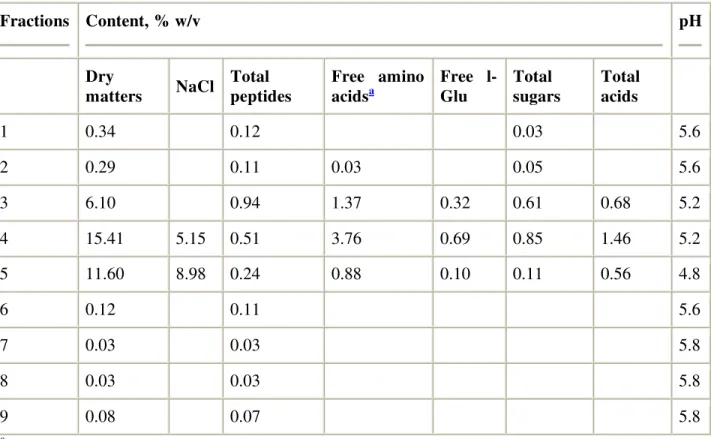
To more precisely evaluate the above-mentioned characteristics of the low MW fractions from the three types of shoyu, further separations were performed by Sephadex G-25 SF gel filtration chromatography. The separation profiles of the three F-500 fractions are shown in Fig. 2. Each F-500 fraction was separated further into nine fractions (fractions 1–9). In the fractionations of koikuchi and tamari shoyu, the profiles of the earlier runs (as shown by fractions 1–6) were similar, but were notably different from that of shiro shoyu, as illustrated by the 214 and 280 nm absorbance profiles. However, all of the separations had a similar pattern of salt peak; that is, the sodium salt that was contained in each F-500 fraction was separated into only one peak. It should also be noted that all of the salt fractions were collected in fractions 4 and 5.
Fig. 2. Gel filtration chromatograms of the F-500 fractions of the three types of shoyu. Fractionation was performed on a Sephadex G-25 SF column (2.6 × 90 cm) at 4 °C using Milli-Q water as the eluant.
The chemical compositions of the gel filtration fractions from the three types of shoyu are presented in Table 2, Table 3 and Table 4, and their total amino acid compositions are shown in
Table 5, Table 6 and Table 7. In the total amino acid analysis, tryptophan and cysteine could not be measured, because the former was destroyed during acid hydrolysis and the concentration of the latter was too low to be detected as it was partially oxidized (Harris, 1988).
Table 2.
Chemical compositions of the Sephadex G-25 SF gel filtration fractions obtained from the F-500 fraction of koikuchi shoyu
Fractions Content, % w/v pH
Dry
matters NaCl
Total peptides
Free amino acidsa
Free l-Glu
Total sugars
Total acids
1 0.34 0.12 0.03 5.6
2 0.29 0.11 0.03 0.05 5.6
3 6.10 0.94 1.37 0.32 0.61 0.68 5.2
4 15.41 5.15 0.51 3.76 0.69 0.85 1.46 5.2
5 11.60 8.98 0.24 0.88 0.10 0.11 0.56 4.8
6 0.12 0.11 5.6
7 0.03 0.03 5.8
8 0.03 0.03 5.8
9 0.08 0.07 5.8
a
Calculated by difference between the total amino acids (determined by HPLC-OPA derivatization after acid hydrolysis) and the total peptides (Lowry method).
Chemical compositions of the Sephadex G-25 SF gel filtration fractions obtained from the F-500 derivatization after acid hydrolysis) and the total peptides (Lowry method). b
Trace (<0.005% w/v).
Table 4.
Fractions Content, % w/v pH
Dry
matters NaCl
Total peptides
Free amino acidsa
Free l-Glu
Total sugars
Total acids
5 10.05 7.51 0.35 0.06 1.93 0.23 4.8
6 0.10 0.08 0.01 5.6
7 0.09 0.03 5.6
8 0.03 0.01 5.6
9 0.05 0.02 5.6
a
Calculated as the difference between the total amino acids (determined by HPLC-OPA derivatization after acid hydrolysis) and the total peptides (Lowry method).
Table 5.
Total amino acid compositions of the gel filtration fractions of the F-500 fraction of koikuchi shoyu
Amino acids (AA)
(%w/v) Fractions
Threshold value of free AAa
Taste of free AAa
1 2 3 4 5
Asp 0.04 0.04 0.14 0.20 0.05 0.10 Umami
Glu 0.04 0.06 0.59 1.19 0.19 0.03 Umami
Ala 0.09 0.46 0.06 0.06 Sweet
His 0.07 0.11 0.02 Bitter
Lys 0.01 0.36 0.13 0.02 0.05 Sweet, bitter
Arg 0.10 0.26 0.07 0.05 Bitter
Gly 0.01 0.01 0.07 0.20 0.08 0.13 Sweet
Thr 0.01 0.06 0.22 0.01 0.26 Sweet
Ser 0.01 0.05 0.29 0.10 0.15 Sweet
Amino acids (AA)
(%w/v) Fractions
Threshold value of free AAa
Taste of free AAa
1 2 3 4 5
Met 0.03 0.07 0.03 0.03 Bitter
Val 0.20 0.24 0.03 0.04 Bitter
Tyr 0.01 ndb
Phe 0.01 0.01 0.03 0.05 0.34 0.09 Bitter
Ile 0.15 0.22 0.03 0.09 Bitter
Leu 0.16 0.34 0.06 0.19 Bitter
a
Kato et al. (1989), Glu and Asp were determined as their sodium salts. b
Not determined.
Table 6.
Total amino acid compositions of the gel filtration fractions of the F-500 fraction of tamari shoyu
Amino acids (AA)
(%w/v) Fractions
Threshold value of free AAa
Taste of free AAa
1 2 3 4 5
Asp 0.12 0.08 0.33 0.79 0.02 0.10 Umami
Glu 0.09 0.08 0.73 1.56 0.01 0.03 Umami
Ala 0.01 0.01 0.09 0.38 0.06 Sweet
His 0.01 0.21 0.20 0.02 Bitter
Lys 0.01 0.01 0.47 0.16 0.01 0.05 Sweet, bitter
Arg 0.01 0.09 0.49 0.06 0.05 Bitter
Gly 0.01 0.01 0.10 0.30 0.01 0.13 Sweet
Thr 0.01 0.01 0.04 0.36 0.26 Sweet
Ser 0.01 0.01 0.08 0.48 0.01 0.15 Sweet
Amino acids (AA)
(%w/v) Fractions
Threshold value of free AAa
Taste of free AAa
1 2 3 4 5
Met 0.04 0.09 0.03 Bitter
Val 0.01 0.01 0.31 0.25 0.04 Bitter
Tyr 0.03 ndb
Phe 0.01 0.01 0.21 0.36 0.09 Bitter
Ile 0.01 0.01 0.22 0.25 0.09 Bitter
Leu 0.01 0.01 0.25 0.36 0.19 Bitter
a
Kato et al. (1989), Glu and Asp were determined as their sodium salts. b
Not determined.
Table 7.
Total amino acid compositions of the gel filtration fractions of the F-500 fraction of shiro shoyu
Amino acids (AA)
(%w/v) Fractions
Threshold value of free AAa
Taste of free AAa
1 2 3 4 5
Asp 0.02 0.11 0.01 0.10 Umami
Glu 0.01 0.03 0.42 0.94 0.09 0.03 Umami
Ala 0.01 0.07 0.01 0.06 Sweet
His 0.01 0.04 0.02 Bitter
Lys 0.05 0.03 0.05 Sweet, bitter
Arg 0.02 0.05 0.01 0.05 Bitter
Gly 0.01 0.06 0.02 0.13 Sweet
Thr 0.01 0.04 0.01 0.26 Sweet
Ser 0.01 0.07 0.02 0.15 Sweet
Amino acids (AA)
(%w/v) Fractions
Threshold value of free AAa
Taste of free AAa
1 2 3 4 5
Met 0.01 0.03 Bitter
Val 0.04 0.05 0.01 0.04 Bitter
Tyr ndb
Phe 0.01 0.02 0.09 0.09 Bitter
Ile 0.02 0.04 0.09 Bitter
Leu 0.04 0.08 0.01 0.19 Bitter
a
Kato et al. (1989), Glu and Asp were determined as their sodium salts. b
Not determined.
The fractionation results shown in Table 2, Table 3 and Table 4 indicate that fractions 3–5 were the major F-500 fractions, which contained notably more components than the other fractions. Their taste intensities, which are described by the value of the TD factors, as well as their taste descriptions, are shown in Table 8. The results revealed that the umami taste was predominant in all of the major fractions at various taste intensities. The highest umami taste intensity was found in fraction 4 of koikuchi and tamari shoyu, which contained sodium salt, free l-glutamic acid and total free amino acids at relatively high concentrations (Table 2 and Table 3). The concentrations of free l-glutamic acid in these fractions were known to be 21–23 times higher than the umami taste threshold value (Kato, Rhue, & Nishimura, 1989). Because the tastiest fractions contained sodium salt and it is known that the acidic amino acid can exhibit a synergistic effect with the salt (Lioe, Apriyantono, Takara, Wada, & Yasuda, 2005), the potential interaction between free l-glutamic acid and salt in the fractions is thought to play an important role in the intense umami taste. In addition, the high concentrations of other umami taste-eliciting amino acids, such as aspartic acid, along with sweet taste-eliciting amino acids, such as alanine, serine and glycine, above their threshold values (Kato et al., 1989), that were present in fraction 4 of koikuchi and tamari shoyu (Table 5 and Table 6) might also contribute to the intense umami taste of the fractions and, certainly, their F-500 fractions because of the possible interaction between umami and sweet stimuli (Heyer, Taylor-Burds, Tran, & Delay, 2003). This fact is consistent with the result reported previously in the umami fractions of Indonesian soy sauce (Lioe et al., 2004). Table 8.
Fractions Koikuchi shoyu Tamari shoyu Shiro shoyu
(Table 3 and Table 6), and therefore had a low intensity of umami taste (Table 8). However, the interaction was also likely to be present in fraction 5 of shiro shoyu and strongly considered to contribute to the relatively high umami taste intensity of this fraction (Table 8). Therefore, the same interaction as found in Indonesian soy sauce was also present in this work. On the basis of our knowledge, the possible occurrence of the significant interaction among the three major components in shoyu has not been reported previously in a number of Japanese soy sauce studies; therefore it represents a new insight in the current study.
Free l-glutamic acid, which is as a umami taste-contributing amino acid, was also found to be abundant in fraction 3 of the three types of shoyu, i.e., the content is around half that of the corresponding fraction 4, in contrast, most of these fractions had very low umami taste intensities (Table 8). This effect was thought to be caused by the dominant sour taste of free l-glutamic acid (Kato et al., 1989) in the absence of sodium salt (Table 2, Table 3 and Table 4), even though the fractions had relatively high concentrations of lysine (Table 5, Table 6 and Table 7), which can also taste salty, as found in a cheese fraction reported by Molina, Ramos, Alonso, and López-Fandiño (1999). In addition, the presence of sweet taste-eliciting amino acids in fraction 3, which could contribute to the perceived umami taste, was mostly lower than their thresholds (Table 5,
Table 6 and Table 7). Therefore, it can be inferred from these results that the presence of the other major components, such as sodium salt and sweet amino acids, together raised synergistic interactions that were important for the tastiness of shoyu.
Finally, in this study, peptide fractions were found in the early (fractions 1 and 2) and late (fractions 6–9) gel filtration runs (Fig. 1 and Table 2, Table 3 and Table 4). However, these either had no taste or tasted bitter with low taste intensities or TD factors (Table 8). These results imply that the peptide fractions made no significant contribution to the umami taste of shoyu. Nevertheless, peptides were also present comparably in some umami fractions, i.e., fraction 4 of koikuchi shoyu (Table 2) and fractions 3 and 4 of tamari shoyu (Table 3). The precise contribution of these peptides has been investigated further by screening the peptide subfractions using the RP-HPLC/taste dilution analysis method developed by Frank et al., 2001 and Ottinger and Hofmann, 2003. The results showed that there was no significant contribution of peptides to the umami taste of any shoyu. Also, in this investigation, it was clearly found that free glutamic acid, as well as several sweet amino acids and sodium salt, were the key contributors of the high intensity of umami taste perceived in fraction 4 of koikuchi and tamari shoyu, which is consistent with that explained above.
Acknowledgements
We thank Anton Apriyantono of Bogor Agricultural University (Bogor, Indonesia) and Kensaku Takara of University of the Ryukyus (Okinawa, Japan) for their helpful advice.
References
Apriyantono et al., 2004 A. Apriyantono, D. Setyaningsih, P. Hariyadi and L. Nuraida, Sensory and peptides characteristics of soy sauce fractions obtained by ultrafiltration. In: F. Shahidi, A.M. Spanier, C.-T. Ho and T. Braggins, Editors, Quality of fresh and processed foods, Kluwer Academic/Plenum Publishers, New York (2004), pp. 213–226.
Belitz and Grosch, 1999 H.D. Belitz and W. Grosch, Food chemistry (2nd ed.), Springer, New York (1999).
Böehringer Mannheim, 1995 Böehringer Mannheim, Methods of enzymatic bioanalysis and food analysis (pp. 56–59), Boehringer Mannheim GmbH-Biochemicals, Mannheim, Germany (1995).
Carpenter et al., 2000 R.P. Carpenter, D.H. Lyon and T.A. Hasdell, Guidelines for sensory analysis in food product development and quality control (pp. 43–44), Aspen Publishers, Gaithersburg, MD (2000).
Chou and Ling, 1998 C.-C. Chou and M.-Y. Ling, Biochemical changes in soy sauce prepared with extruded and traditional raw materials, Food Research International 31 (1998), pp. 487– 492. Article | PDF (187 K) | View Record in Scopus | Cited By in Scopus (8)
Clegg, 1956 K.M. Clegg, The application of the Anthrone reagent to the estimation of starch in cereals, Journal of the Science of Food and Agriculture 7 (1956), pp. 40–44. Full Text via CrossRef
Cliffe et al., 1993 A.J. Cliffe, J.D. Marks and F. Mulholland, Isolation and characterization of non-volatile flavours from cheese: peptide profile of flavour fractions from Cheddar cheese, determined by reverse-phase high-performance liquid chromatography, International Dairy Journal3 (1993), pp. 379–387. Abstract | PDF (368 K) | View Record in Scopus | Cited By in Scopus (43)
Fischer and Peters, 1968 R.B. Fischer and D.G. Peters, Quantitative chemical analysis (pp. 375– 396) (3rd ed.), W.B. Saunders, Philadelphia (1968).
Frank et al., 2001 O. Frank, H. Ottinger and T. Hofmann, Characterization of an intense bitter-tasting 1H,4H-quinolizinium-7-olate by application of the taste dilution analysis, a novel bioassay for the screening and identification of taste-active compounds in foods, Journal of Agricultural and Food Chemistry49 (2001), pp. 231–238. Full Text via CrossRef | View Record in Scopus | Cited By in Scopus (50)
Frazier, 2001 R.A. Frazier, Recent advances in capillary electrophoresis methods for food analysis, Electrophoresis 22 (2001), pp. 4197–4206. Full Text via CrossRef | View Record in Scopus | Cited By in Scopus (23)
Frazier et al., 1999 R.A. Frazier, J.M. Ames and H.E. Nursten, The development and application of capillary electrophoresis methods for food analysis, Electrophoresis 20 (1999), pp. 3156– 3180. Full Text via CrossRef | View Record in Scopus | Cited By in Scopus (42)
Fujiwara, Tanaka, et al., 1962 K. Fujiwara, S. Tanaka and E. Fujita, Studies on amino acids in Japanese soy sauce. (I) The contents of amino acids in soy sauces of various types, Hakko Kogaku Zasshi (in Japanese)40 (1962), pp. 321–327.
Fujiwara, Tokuda, et al., 1962 K. Fujiwara, M. Tokuda and A. Nanba, Studies on amino acids in Japanese soy sauce. (II) Changes in the amounts of the main amino acids during ordinary mash process, Hakko Kogaku Zasshi (in Japanese) 40 (1962), pp. 327–332.
Fukushima, 1981 D. Fukushima, Soy proteins for foods centering around soy sauce and tofu,
Journal of the American Oil Chemists Society 58 (1981), pp. 346–354. Full Text via CrossRef |
View Record in Scopus | Cited By in Scopus (0)
Fukushima, 1989 D. Fukushima, Industrialization of fermented soy sauce production centering around Japanese shoyu. In: K.H. Steinkraus, Editor, Industrialization of indigenous fermented foods, Marcel Dekker, New York (1989), pp. 1–88.
Harris, 1988 E.L.V. Harris, Amino acid analysis by precolumn derivatization. In: J.M. Walker, Editor, New protein techniquesVol. 3, Humana Press, Clifton, NJ (1988), pp. 33–47.
Heyer et al., 2003 B.R. Heyer, C.C. Taylor-Burds, L.H. Tran and E.R. Delay, Monosodium glutamate and sweet taste: generalization of conditioned taste aversion between glutamate and sweet stimuli in rats, Chemical Senses 28 (2003), pp. 631–641. Full Text via CrossRef | View Record in Scopus | Cited By in Scopus (27)
Kato et al., 1989 H. Kato, M.R. Rhue and T. Nishimura, Role of free amino acids and peptides in food taste. In: R. Teranishi, R.G. Buttery and F. Shahidi, Editors, Flavor chemistry: trends and developments, American Chemical Society, Washington (1989), pp. 158–174. Full Text via CrossRef
Lioe et al., 2004 H.N. Lioe, A. Apriyantono, K. Takara, K. Wada, H. Naoki and M. Yasuda, Low molecular weight compounds responsible for savory taste of Indonesian soy sauce, Journal of Agricultural and Food Chemistry 52 (2004), pp. 5950–5956. Full Text via CrossRef | View Record in Scopus | Cited By in Scopus (7)
Lioe et al., 2005 H.N. Lioe, A. Apriyantono, K. Takara, K. Wada and M. Yasuda, Umami taste enhancement of MSG/NaCl mixtures by subthreshold l-α-aromatic amino acids, Journal of Food Science70 (2005), pp. S401–S405. View Record in Scopus | Cited By in Scopus (5)
Lowry et al., 1951 O.H. Lowry, N.J. Rosebrough, A.L. Farr and R.J. Randall, Protein measurement with the Folin phenol reagent, Journal of Biological Chemistry 193 (1951), pp. 265–275. View Record in Scopus | Cited By in Scopus (64472)
Molina et al., 1999 E. Molina, M. Ramos, L. Alonso and R. López-Fandiño, Contribution of low molecular weight water soluble compounds to the taste of cheeses made of cows’, ewes’ and goats’ milk, International Dairy Journal9 (1999), pp. 613–621. Article | PDF (197 K) | View Record in Scopus | Cited By in Scopus (30)
Oka and Nagata, 1974a S. Oka and K. Nagata, Isolation and characterization of neutral peptides in soy sauce, Agricultural and Biological Chemistry 38 (1974), pp. 1185–1194. View Record in Scopus | Cited By in Scopus (5)
Oka and Nagata, 1974b S. Oka and K. Nagata, Isolation and characterization of acidic peptides in soy sauce, Agricultural and Biological Chemistry 38 (1974), pp. 1195–1202. View Record in Scopus | Cited By in Scopus (8)
Ottinger and Hofmann, 2003 H. Ottinger and T. Hofmann, Identification of the taste enhancer alapyridaine in beef broth and evaluation of its sensory impact by taste reconstitution experiments, Journal of Agricultural and Food Chemistry 51 (2003), pp. 6791–6796. Full Text via CrossRef | View Record in Scopus | Cited By in Scopus (24)
Salles et al., 2000 C. Salles, C. Hervé, C. Septier, D. Demaiziéres, I. Lesschaeve and S. Issanchou et al., Evaluation of taste compounds in water-soluble extract of goat cheeses, Food Chemistry68 (2000), pp. 429–435. Article | PDF (151 K) | View Record in Scopus | Cited By in Scopus (22)
Solms, 1969 J. Solms, The taste of amino acids, peptides and proteins, Journal of Agricultural and Food Chemistry17 (1969), pp. 686–688. Full Text via CrossRef | View Record in Scopus |
Cited By in Scopus (30)
Takeuchi et al., 1962 T. Takeuchi, H. Kato and H. Yoshii, Studies on the peptides in miso and soy sauce. (II) On the peptide composition of soy sauce, Hakko Kogaku Zasshi (in Japanese) 40 (1962), pp. 379–384.
Yokotsuka, 1983 T. Yokotsuka, Soy sauces. In: K.H. Steinkraus, Editor, Handbook of indigenous fermented foods, Marcel Dekker, New York (1983), pp. 437–451.