The 2nd International Conference on Science, Technology, and Humanity ISSN: 2477-3328
Lap Joint Carbon Steel ST 37 and Aluminum 6061 with
Friction Stir Welding (FSW)
Widia Setiawan1, Djarot B. Darmadi2,WahyonoSuprapto3,
Rudy Soenoko4
1Lecturer at Sekolah Vokasi University of Gadjah Mada, he is currently taking Doctorate Degree at
University of Brawijaya.
2, 3, 4Senior Researcher at University of Brawijaya.
1[email protected], [email protected] 2
B.darmadi [email protected]
Abstract
In this research, Aluminum 6061 and Carbon steel ST 37 sheet were lap joined by friction stir welding. A hardened medium carbonese steel (EMS 45) was used as rotary Probe. The microstructures of the joining inter-metallic compounds were observed by scanning electron microscopy, microstructure photograph, and micro-hardness tests. The joint strength was evaluated by shear stress tests. The experiment was performed with varied length of pin probe 6, 7, and 8 mm, equal rotational speed of 2500 rpm, and welding speed (15 mm/minutes). The Inter-metallic compounds of aluminums sheet was cut off the pin probe and the mixture on the Carbon steel ST 37. Intermetallic compounds were analyzed on its micro sructure in this region aluminum and carbon steel mixed, the value joint tensile shear 6.2KN.
Keywords: Friction Stir welding, Intermetallic compounds, Lap joint.
1.
Introduction
Friction Stir Welding (FSW) is a solid phase joining technique on fabrication industry. Good quality single sided and double sided butt, “T”, and lap joints. It was invented in 1λλ1 and was originally used to produce butt joints of aluminum alloys[1]
Fig. 1. : Friction Stir Welding Process [1a]
The 2nd International Conference on Science, Technology, and Humanity ISSN: 2477-3328
contact with the top surface of the work-piece. Heat generated by friction at the shoulder and to a lesser extent at the pin surface softens the material being welded [1a]. During FSW, heat is generated by friction between the tool and the work-piece and via plastic deformation. A fraction of the plastic deformation energy is stored within the thermo mechanically processed region in the form of increased defect densities.[1a]
Fig. 2. Schematic cross-section a typical FSW weld: (A) base metal, (B) heat affected zone, (C) thermo mechanically affected zone, and (D) nugget Zone [1a]
Friction Stir Welding (FSW) is new technique for aluminum alloys joining. This technique utilizes non-consumable electrode and Heat generated from the rotating welding tool. It can trigger deformation at the welding zone, thereby affecting the joint formation of material that is in solid state [2].
The FSW has become an efficient option of welding method for the same or dissimilar aluminum alloys, especially those which are difficult or impossible to be welded by the conventional fusion welding without any hot crackings, blowholes or distortions [3,4].
Lap joints are widely used in the assembly of parts and products in the transportation industry. Common examples include ship decks, railway tankers and goods wagons, and stringer to skin in aircraft fuselages. For these applications, panels are often straightened with stringers and profiles, which are mechanically or fusion welded joined in a typical lap joint configuration [5].
Fig. 3. Schematic of lap Joint [5]
The 2nd International Conference on Science, Technology, and Humanity ISSN: 2477-3328
Fig. 4. Geometry and technical details of the investigated tools [5].
The base materials for welding were AA6063 (Al–0.7%Mg–0.4%Si) aluminum alloy and AA5052 (Al–2.5%Mg) aluminum alloy. The thicknesses of the AA6063 plate and the AA5052 plate were 4 mm and 2 mm, respectively. The plates were friction stir welded vertical to their rolling directions. The so-called lap–butt joint of dissimilar to AA6063/AA5052 aluminum alloys consisting of three plates [6].
Fig. 5 .Sketches of the so-called lap–butt composite joint (a) and its applications on some engineering structures (b and c) [6].
The 2nd International Conference on Science, Technology, and Humanity ISSN: 2477-3328
Fig.6. Macroscopic overviews of the FSW joint cross sections at constant tool rotational speed of 1180rpm and welding speeds of (a) 30, (b) 60, (c) 95, (d) 118, and (e) 190 mm/min [7].
The base materials examined during friction stir welding were Al 5754 alloy with a thickness of 2.1 mm, dual phase DP600 steel with a zinc coating and thickness of 3.0 mm, and 1.5 mm thick 22MnB5 alloy steel with a 9 lm coating of Al–12Si alloy [8].
Fig. 7.Schematic illustration of FSW setup used in this study [8].
In this paper, Aluminum 6061 and Carbon steel ST 37 were joined by friction stir welding (FSW) with lap joint. The relationship welding parameters, some length of Pin Probes, micro hardness, micro structure and shear stress testing were previously investigated to evaluate the joint. The benefits of lap joint of dissimilar metal aluminum 6061 and Carbon steel ST 37 might be connected.
2. Experimental Procedures
The 2nd International Conference on Science, Technology, and Humanity ISSN: 2477-3328
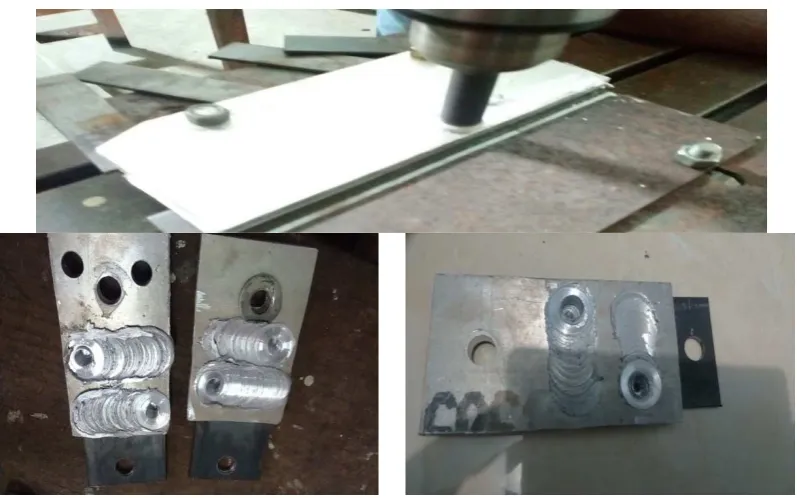
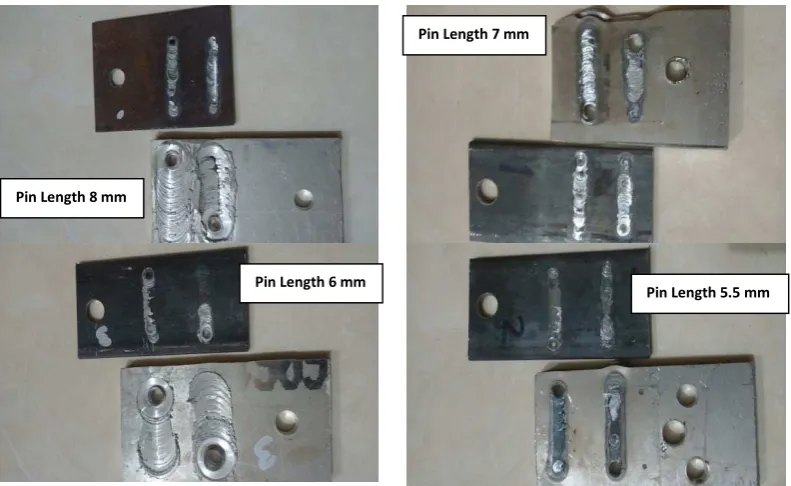
Fig. 8. Variation length pin probes
Fig. 9. The material research Aluminum 6061 and Carbon steel ST 37
Table 1
Chemical composition (wt%) of the materials used for this study.
Material Chemical Compositions
Al 6061 0.9 Mg 0.6 Si 0.25 Cu 0.086 Mn 0.18 Fe 0.1Cr 0.192 Ti 0.01 ZnAl (bal)
The 2nd International Conference on Science, Technology, and Humanity ISSN: 2477-3328
Table 2
FSW Parameter used in this study
FSW parameters
Rotation speed (rpm) 3000 rpm Travel speed (mm/s) 15 mm/min Pin diameter (mm) 6 mm Tool shoulder diameter (mm) 15 mm
Pin length (mm) 5.5 mm 6 mm 7 mm 8mm
3.
Results and Discussion
3.1 Micro structure
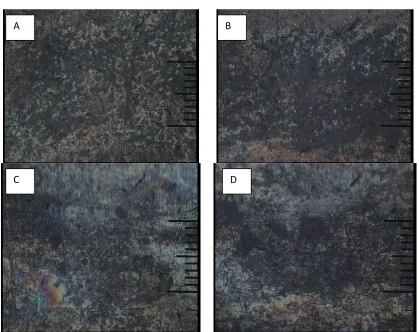
Fig. 10. Microstructure welding lap (A) 8 mm long pin, which is good weld, (B) 7 mm long pin, which is good weld, (C) 6 mm long pin, the welded joint is not good, (D) 5.5 mm long pin, welded joint very
bad.
Fig. 10 showed the metallographic cross sections of welds produced by using different length of pin probes. Extremely good welding was presented in the work with 7 mm and 8 mm
D C
The 2nd International Conference on Science, Technology, and Humanity ISSN: 2477-3328
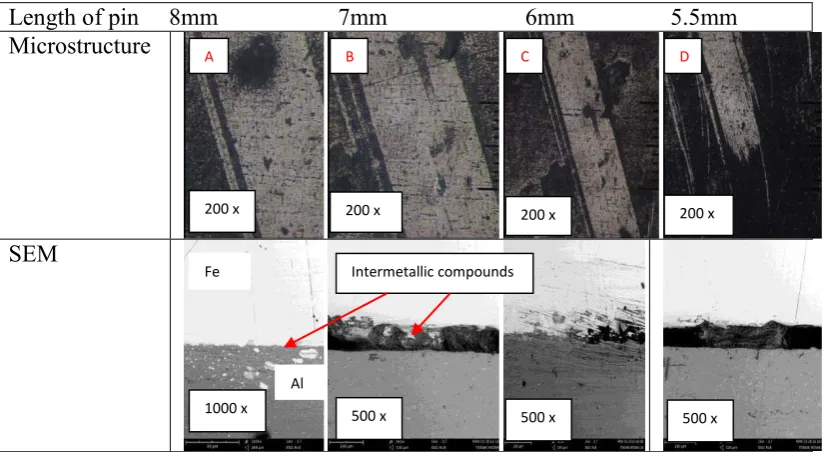
that long pressure pin had the tendency to produce good intermetallic compounds. On pin short, in order to produce intermetallic compounds welding was not achievable. The particular explanation was supported by Fig 11.
Length of pin 8mm 7mm 6mm 5.5mm Microstructure
SEM
Fig. 11. The Microstructure Intermetallic compounds length of pin (A) 8 mm, (B) 7 mm , (C) 6 mm, (D) 5.5 mm
From Fig 11. we were able to be see the relationship of length of pin to metallic compounds of the welds aluminum 6061 and Carbon steel ST 37. This might be connected as pressure for the length of pin probe. In the picture of a microstructure, it could be seen that the length of aluminum pin was connected the surface Steel ST 37, as it was also indicated on the SEM.
3.2 Micro Hardness
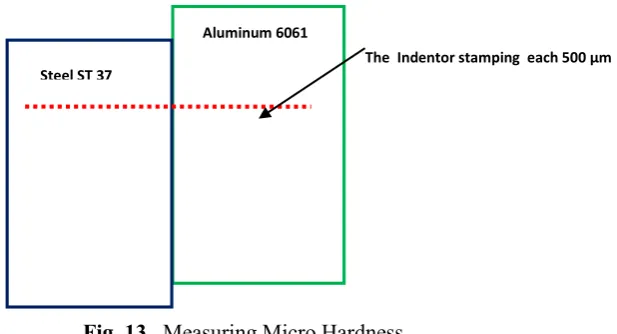
The value of microhardness tests on the length of pin probe 5.5 mm could not be tested because it was unconnected. At length of 8, 7, 6 mm, the pin had high possibility for hardness tests on intermetallic compound. This was caused by the fact that aluminum 6061 plastic pressed on surface the Carbon steel ST 37. It was shown on Fig.12.
The 2nd International Conference on Science, Technology, and Humanity ISSN: 2477-3328
Fig. 12. Microhardness Vickers Number
F
Fig. 13. Measuring Micro Hardness
For long pin probe of 6, 7, 8 mm on Carbon steel ST 37, the value hardness same was 150 HV, intermetallic compound value hardness was also almost the same which was between 40 – 150 HV, and on aluminum 6061 value hardness was 50 HV.
3.3 Shear Stress
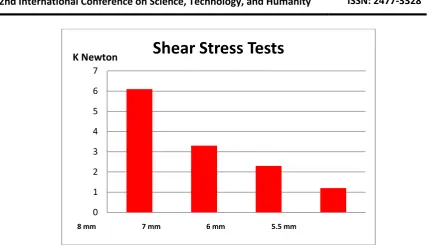
The shear stress value of Friction Stir welded joints was measured. It was presented and was shown on Fig 14, and the result tensile tests Fig 15.
0
Hardness carbonese Steel ST 37 and Al 6061
The 2nd International Conference on Science, Technology, and Humanity ISSN: 2477-3328
Fig. 14.Shear Stress tests
Fig. 15. Texture of Shear stress tests
Pin Length 8 mm
Pin Length 5.5 mm Pin Length 7 mm
The 2nd International Conference on Science, Technology, and Humanity ISSN: 2477-3328
Fig. 15. Result Shear stress tests
It was found that the Shear Stress value 6.1 KNewton at length pin was 8 mm; therefore, at length pin 7 mm value was 3.3 KNewton. The average value Shear stress was 3.225K Newton. The highest stress shear was on the longest pin, which was 8 mm supported microstructure Fig. 10 and Fig. 11 because aluminum plastic pressed onto the surface of the metal in the 3000 rpm. The evidence on Ferro could be welded to Aluminum with solid welding (FSW), which was shown on Fig 10 and Fig. 11.
4. Conclusions
From the experiment of new surface preparation on Friction Stir welding, it could be summarized that:
1. Carbonize Steel ST 37 and Aluminum 6061 can welded with solid welding
2. On pin long connection produced was strong and the inter-metallic compounds were thick.
3. The ShearStress value 6.1 KNewton at pin length was 8 mm, and the average Shear stress was 3.225 KNewton.
Reference
[1] W.M. Thomas, E.D. Nicholas, J.C. Needham, M.G. Murch, P. Templesmith, C.J. Dawes, G.B Patent Application No. 9125978.8 (December 1991).
[1a] R. Nandan , T. DebRoy , H.K.D.H. Bhadeshia Recent advances in friction-stir welding – Process, weldment structure and properties, Department of Materials Science and Engineering, Pennsylvania State University, University Park, PA 16802, USA Department of Materials Science and Metallurgy, University of Cambridge, Cambridge CB2 3QZ, UK, 2008
[2] Padgett PN, Paglia C, Buchheit RG. Characterization of corrosion behavior in friction stir weld Al–Li–Cu AF/C458 Alloy. Friction stir welding and processingII. Warrendale (PA,
The 2nd International Conference on Science, Technology, and Humanity ISSN: 2477-3328
[3] Kazi SH, Murr LE. Complex flow phenomena associated with friction-stir welding of aluminum alloys. In: Mishra RS, et al., editors. Friction stir welding and processing, Warrendale (PA): TMS; 2001. p. 139–151.
[4] McNelley TR, Swaminathan S, Su JQ. Recrystallization mechanisms during friction stir welding/processing of aluminum alloys. Scripta Mater2008;58:349–54.
[5] Emad Salari , Mohammad Jahazi , Alireza Khodabandeh , Hadi Ghasemi-Nanesa, 2014, Influence of tool geometry and rotational speed on mechanical properties and defect formation in friction stir lap welded 5456 aluminum alloy sheets Science and Research Branch, Islamic Azad University, 1477893855 Tehran, Iran Department of Mechanical Engineering, École de Technologie Supérieure, 1100 rue Notre-Dame Ouest, Montréal, QC H3C1K3, Canada.
[6] Bo Li, Yifu Shen, 2011, A feasibility research on friction stir welding of a new-typed lap– butt joint of dissimilar Al alloys College of Materials Science and Technology, Nanjing University of Aeronautics and Astronautics, 29 Jiangjun Road, Nanjing 210016, PR China
[7] T. Saeida, A. Abdollah-zadeh, B. Sazgari,2009, Weld ability and mechanical properties of dissimilar aluminum–copper lap joints made by friction stir welding Faculty of Materials Engineering, Sahand University of Technology, Tabriz, Iran Department of Materials Engineering, Tarbiat Modares University, P.O. Box 14115-143, Tehran, Iran
![Fig. 1. : Friction Stir Welding Process [1a]](https://thumb-ap.123doks.com/thumbv2/123dok/802412.603220/1.595.93.505.549.685/fig-friction-stir-welding-process-a.webp)
![Fig. 2. Schematic cross-section a typical FSW weld: (A) base metal, (B) heat affected zone, (C) thermo mechanically affected zone, and (D) nugget Zone [1a]](https://thumb-ap.123doks.com/thumbv2/123dok/802412.603220/2.595.96.499.509.603/schematic-section-typical-affected-thermo-mechanically-affected-nugget.webp)
![Fig. 4. Geometry and technical details of the investigated tools [5].](https://thumb-ap.123doks.com/thumbv2/123dok/802412.603220/3.595.191.443.382.489/fig-geometry-technical-details-investigated-tools.webp)
![Fig.6. Macroscopic overviews of the FSW joint cross sections at constant tool rotational speed of 1180rpm and welding speeds of (a) 30, (b) 60, (c) 95, (d) 118, and (e) 190 mm/min [7]](https://thumb-ap.123doks.com/thumbv2/123dok/802412.603220/4.595.154.441.334.426/macroscopic-overviews-sections-constant-rotational-speed-welding-speeds.webp)