ABSTRACT
The Language in Conversational Writing and Interactional
Speaking
Gilang Adittama
This research investigates some factors that make writing looks and feels like speaking. A database of 200 utterances taken from two subjects (100 utterances from each) in conversational writing (50 utterances per subject) and interactional speaking (50 utterances per subject) during the 6 months of data elicitation period is used. The data were analysed manually based on certain guidance such as The Oxford 3000TM (used for analysing vocabularies), lexical density formula (Halliday, 1985), and Parker’s (1986) classification of speech act. The major planning, the other one says that he directly uses the words he has ever used when writing or reading and remembered. In conclusion, there is no real difference between the language in conversational writing and interactional speaking in vocabulary, lexical density, and speech acts. This also implies that both of them can be used as techniques for developing one another. Therefore, it is suggested that the teachers and students of English use one of them, or even both, to strengthen any required area of productive skills.
ACKNOWLEDGEMENT
As the very first of everything on this page, let me express my most sincere thank and gratitude to those who have been involved in a life I lived during my being in this campus. Personally, I feel that living in this campus has become somewhat like living in Hogwarts, school of witchcraft and wizardry (hope I do not become the heir of Tom Riddle). Many great people with their great specialities and incomparable uniqueness are here.
The first man I have to thank is my advisor, Dr. Sukirlan. Since the time I first met him, he has always been a father-like man with a shoulder to cry on and words of comfort during the mad times I went through. I just could not find a way to thank him.
It is not complete to have a figure of father without a figure of mother. I therefore have to mention Bu Ari Nurweni, my ‘spicy’ second advisor. Exactly the same as before, I have no idea about how to put my thanks for her in words. If a study is a dish, then her comments and teachings are the spices.
Along with the countless praising for the parents-like lecturers, I also attribute my deepest appreciation and greatest admiration to my dearest professor. Pak Raja with the smell of coffee and cigarette in his room was another shape of Severus Snape and his potion room in Hogwarts. The one who taught me to be critical, that he is.
Another professor is the one I troubled most often, who else if not Pak Cucu ? I hope that he can forgive my bad attitude when I was undergoing the learning process under his wings. I certainly learnt the meaning of patience and good life from him and Mr. Ujang Suparman.
I would also like to thank Pak Bambang Setiyadi who helped me understand what lies behind the teaching process. Pak Sudirman and Pak Basturi are also great men. Both of them gave me enough lesson of academic life. I may never forget Bu Editha when talking about teaching. In our first meeting she told me, “When you come to the classrooms, make your students happy.” In our last meeting before her retirement, she told me, “You remember what I said, keep that, okay ?”. They taught me the philosophy of teaching and being a teacher. Also I thank Mr. Hery Yufrizal who gave me chance to assist him in teaching. Without their help, I might have grown to be a knowledgeable teacher with no manner at all.
Lastly, I thank a few friends such as Rohmat and Luki. I personally thank them for being the subjects in my research. The next ones are Anwar, Ria, Fitri, Bang Rudy, Sist. Fista, madam Bunny supervisors (Ms. Lela Mulyani my ex English teacher) with the rest of my ex teachers and, Emak kantin ceria and the dwellers and guests of The Noble Asrama 45. They have been my talking partners (sometimes I abuse them and I now feel sorry for that) during the mad times. Some juniors are also counted as people I worth to give thank to. I also hope that Bagus and Unggul who supported me during my seminar would kindly accept my sincere thank.
CURRICULUM VITAE
The writer was born in Bandar Lampung on December 31st, 1992 as the first son in a family of Wahidun and Levi. He was named Gilang Adittama. His only brother in the family is M. Rangga Awafi who was born in 2003.
He was enrolled to TK Kartini in the age of five. After finishing the study in kindergarten for a year, he continued to SDN 2 Rawa Laut and graduated in 2003. The latter stage of his education was spent in SMPN 2 Bandar Lampung and SMAN 10 Bandar Lampung that he finished in 2010. During the school years, he actively participated in some internal organisations (OSIS and extracurricular activities), national organisation (PFI, the Indonesia Philatelic Society), and also international organisation (World Population Foundation Indonesia) as a delegation to ICAAP 2009.
MOTTO
“Go ye forth, (whether equipped) lightly or heavily, and strive and struggle (jeehad), with your goods and your persons, in cause of Allah. That is best for you, if ye (but) knew.”
(at Taubah : 41)
“Acquire knowledge and teach it to people. Do not be an arrogant scholar, for scholarship cannot subsist with arrogance.”
(Umar ibn Al Khattab)
“No teacher should get mad in the classroom. The one who gets mad in the classroom is, perhaps, only a crazy man.”
(Prof. Patuan Raja)
“Reading brings me passions, collecting stamps teaches me about patience, cooking sharpens my senses, and teaching engraves them on my spirit.”
CONTENTS
ABSTRACT...iii
ACKNOWLEDGEMENT...iv
MOTTO...v
CONTENTS...vi
TABLES AND APPENDIXES...vii
I. INTRODUCTION 1.1. Background...1
1.2. Problems...3
1.3. Objectives... ...3
1.4. Uses...4
1.5. Scope...4
1.6. Definitions of Terms...5
II. LITERATURE REVIEW 2.1. The Concept of Language...6
2.2. The Nature of Writing...7
2.3. The Nature of Speaking...10
2.4. Writing-Speaking Relationship...12
2.5. Interactional Speaking...14
2.6. Conversational Writing...16
2.7. Review of Relevant Research...17
2.9. Theoretical Assumptions...22
III. METHOD 3.1. Design...24
3.2. Subjects...26
3.3. Data...28
3.4. Data Collection...29
3.5. Data Analysis...30
IV. RESULT AND DISCUSSION 4.1. Result...36
4.2. Discussion...56
V. CONCLUSION 5.1. Conclusion...59
5.2. Suggestions...60
TABLES AND APPENDICES
TABLES
1. Table of General Similarities... 13-14
2. Table of Words and Expression... 38
3. Table of Tokens and Lexical Items... 39
4. Table of Words Distribution... 40
5. Table of Lexical Density... 42
5. Table of Speech Acts... 51
6. Table of Subjects’ Perceptions... 52
7. Table of Language Summary... 54
I. INTRODUCTION
In this chapter, the discussion concerning the background, objectives,
scope, and definitions of terms will be discussed in order to provide an insight
into the research and justify the significance of this research.
1.1. Background
Speaking is basically a process of building and sharing meaning through
the use of verbal and non-verbal symbols, in a variety of context (Chaney, 1998).
Everyone uses this skill for several purposes, pretty much depending on the need.
Some people speak only to get something or to get their goals achieved, while
some others speak to build a more personal closeness among people. The
speaking activity that is intended to exchange information in order to get the job
done belongs to transactional speaking, while the interactional speaking is
intended to establish and maintain social relation (Brown and Yule 1983a in
Hedge, 2000 : 264). However, the process of sharing meanings, communicating
with others, is not only through sounds and verbal symbols. In some cases and
situations, the communication is done indirectly by creating an effort to create
dialogue with readers in much the same way as we explore our relationship to
2
The linguists, up to now, have been focusing on the differences between
the two skills. One opinion stated by Halliday was that writing does not
incorporate all the meaning potential of speech, writing and speaking are in
practice used in different context for different purposes, and they impose different
grids on experience (Halliday, 1985 : 92). Another comparison proposed by van
Lier showed that speaking is auditory, temporary, prosody, involves immediate
feedback, and its planning and editing is limited by channel. It is totally different
from writing that is visual, permanent, involves punctuation, delayed, and
unlimited in terms of planning, editing, and revision. (van Lier : 1995).
In further consideration, Harmer states that speaking and writing are both
productive skills (Harmer, 2001). So, rather than being separate manifestation of
language, writing and speaking should exist as a continuum (Nunan, 1991 : 84).
Nunan also stated that some spoken text will be more like written text than others,
while some written text will be more like spoken text than others. However, the
transcriptions of spoken language look less structured because they represent ‘unedited’ language. If we could examine all the draft of a piece of writing, it may
also look as unstructured (Nunan, 1991 : 85). As the two belong to the same
category of skill, there must be a close relationship between them that needs to be
analysed and characterised. According to Hammond (1987), it is important to
understand the relationships between writing and speaking for providing helps to
the development of effective pedagogy in teaching. The analysis and
characterisation would probably show more details that may be useful for
integrating both skills for many purposes that may benefit language users and
3
1.2. Problems
Based on the background above, the problems in this research are
formulated as follows :
1. What are the similarities between participants’ utterances in conversational
writing and interactional speaking in words ?
2. What are the similarities between participants’ utterances in conversational
writing and interactional speaking in utterances ?
3. What are the similarities between participants’ utterances in conversational
writing and interactional speaking in speech acts ?
4. What perceptions do the participants have of how the conversational writing is
related to the interactional speaking ?
1.3. Objectives
In relation with the problems above, some objectives of this research are
explained below :
1. To find out the similarities between participants’ utterances in conversational
writing and interactional speaking in words.
2. To find out the similarities between participants’ utterances in conversational
4
3. To find out the similarities between participants’ utterances in conversational
writing and interactional speaking in speech acts.
4. To find out the participants’ perceptions of how the conversational writing is
related to the interactional speaking.
1.4. Uses
In accordance with the previously explained objectives, this research is
intended to have some uses as follows :
1. This research is expected to provide a support to the development of
linguistics, especially in the field of spoken and written language study. It is
expected that the findings may enrich the available theories and trigger further
research on related field.
2. More practically, as the interactional speaking and conversational writing are
closely related to English teaching, this research is intended to give ideas for
education practitioners to develop teaching activities and materials.
1.5. Scope
As there is no research that can cover anything, some limitations for this
research were also set. This research mainly deals with interactional speaking and
conversational writing in informal settings. In the setting, the two primary
5
academic background, were engaged in some talks in both interactional speaking
and conversational writing.
From the talks, some similarities on word, utterance, and speech acts level
were expected to be elicited. Therefore, this research focuses on the similarities
that appear between interactional speaking and conversational writing, not on
those that are influenced by the other skills.
Other data in form of primary subjects’ perceptions were also taken into
account. The elicitation of these data was done through informal interviews.
1.6. Definitions of Terms
Considering the presence of the non-general terms in this research that
may cause misunderstanding, some definitions of such terms are provided below :
1. Language : the medium for communication that contains meaningful words,
utterances, and speech acts.
2. Conversational Writing: the writing activity that is not for transactional purpose
but for social or interactional purpose
3. Interactional Speaking : the speaking activity that is done in daily life situation
for the purpose of social interaction
II. LITERATURE REVIEW
In this chapter, the literature review for the research is provided. The
discussion will cover writing, speaking, writing-speaking relationship,
conversational writing, interactional speaking, review of relevant research, and
theoretical assumption.
2.1. The Concept of Language
In their lives, humans always intend to share what they have and influence
one another. Sharing and influencing might mean conveying the intended
meanings through certain medium. Goldstein (2008) suggests that language is a
system consists of two media, sound and symbol, for expressing feelings,
thoughts, ideas, and experiences. In addition to that, a definition from Weiten
(2007) that language contains symbols that convey meanings, plus rules for
combining them that are used for generating infinite variety of messages.
However, the symbols in language are purely human and non-instinctive
and produced voluntarily (Sapir, 1921). They are often used by social groups for
cooperating (Bloch and Trager, 1942). Such symbols are often regarded and
understood not exactly as they are. Searle (1979) believes that there are some
7
An example he provided was the statement ‘Can you reach the salt ?’ that is not
produce by means of asking about someone’s ability, but it brings a force that
turns it into a request (Searle, 1979).
In conclusion, language is a system of human communication that consists
of sound and symbols that are expressed and perceived in various ways.
2.2. The Nature of Writing
Writing is a skill in which we express the ideas, feelings, and thoughts
arranged in words, sentences, and paragraph using eyes, brain, and hand (Raimes,
1983). It is a difficult skill to teach as it requires not only of grammatical devices
(dealing with the devices used to create writing based on the correct grammar; the
set of structural rules that govern the composition of clauses, phrases, and words
in language), and the rhetorical or cohesive devices used to manipulate the language to effectively transmit the author’s message to the reader; such the using
of analogy that compares two pairs which have the same relationship, but also of
conceptual and judgmental elements (Heaton, 1991 : 135).
When someone is writing, s/he is actually creating an effort to create a
dialogue with the readers, and it involves exploring our relationship to our readers
in much the same way that we explore our relationship to people we talk to
(Gould, 1989 : 3) that is why writing involves rational thinking or commonly
8
To create a good piece of writing that can bring writer’s idea into readers’
minds, there are some elements for the writer to pay a close attention to. An
effective composition should meet the qualities in some terms proposed by Jacobs
(1981 : 90) below :
1. Content :
The substance of writing, the experience of the main idea, i.e., groups of related
statements that a writer presents as unit in developing a subject. Content
paragraph do the work of conveying ideas rather than fulfilling special function of
transition, restatement, and emphasis.
2. Organization :
The logical organization of contents. It is scarcely more than an attempt to place
together all condition of fact and jumble ideas. Even in early drafts it may still be
searching for order, trying to make out patterns in its materials and working to
bring particulars of its subject in line with what is still only a half-formed notion
of purpose.
3. Vocabulary :
The selection of words that are suitable with the content. It begins with the
assumption that the writer wants to express the ideas as clearly and directly as
he/she can. As a general rule, clarity should be his/her prime objective. Choosing
words that express his/her meaning is precisely rather than skews it or blurs it.
9
The use of correct grammatical form and synthetic pattern of separating,
combining, and grouping ideas in words, phrases, clauses, and sentences to bring
out logical relationship in paragraph writing.
5. Mechanic :
The use of graphic conventional of the language, i.e., the steps of arranging
letters, words, paragraphs by using knowledge of structure and some other related
to one another.
Therefore, writing can be seen as a fluency activity, because in writing,
someone tries to use cohesive device, choose various structures to develop
meaning, and raises his awareness of parallelism (Hedge, 2000). In short, writing
can be sort of preparation for facing the speaking situation in which everything is
fast and direct. Writing is also a good activity for improving language accuracy.
According to Raimes (1983), writing reinforces grammar, structures, idioms, and
vocabulary; it is a unique way to reinforce learning.
In writing, the language used is, by some linguists, believed to be different
from the language spoken in some terms. Writing is permanent, clearly delineated,
and readily available for inspection (Hughes, 1996). van Lier (1995) also argues
that writing is visible, permanent, and delayed. When it comes to the matter of
structure, Halliday (in Nunan, 1991) implies that the written language is more
complex compare to the spoken language that is, according to him, more basic.
The written language is also indirect, considering that writing is distant and
writers have to make inferences about the relevant knowledge possessed by the
10
To sum up, writing involves many similar components and also different
components to speaking. Despite the way they are different, the writing may
produce characteristics of utterances which are similar to those in speaking.
2.3. The Nature of Speaking
Speaking is encoding process whereby, we communicate our ideas,
thought, and feeling through, one or the other forms of language (Harris, 1974 :
9). Very often people talk in order to tell people things they do not know, or to
find things out from other people (Doff, 1987) or maybe to express oneself in life
situation, or converse, to report acts or situation in practice words or the ability to
express ideas fluently (Lado, 1961).
Speaking is also one of the four basic skills of language and it has an
important role in daily life, because it is the main skill in communication (Welty
and Welty, 1976). Whenever we need something, we interact with others through
language as a medium. In short, when we speak, we have an interactive process of
constructing meaning that involves producing and receiving and processing
information (Burns and Joyce, 1997).
Therefore, in speaking, it is suggested that the speaker deals with some
aspects (Harris, 1974 : 75) :
1. Pronunciation : Person’s way of pronouncing words. One who learns English
as a foreign language must be able to use English pronunciation as well as the
11
2. Grammar : A study of rules of language inflection. It is a system of units and
patterns of language (Lado, 1970).
3. Vocabulary : The words used in language. Phrase, clauses, and sentence are
built up by vocabulary. In short, vocabulary is very important because without
words we cannot speak at all (Wilkins, 1972 : 111).
4. Fluency : Language production and it is normally reserved for speech. It is the
ability to link units of speech together with facility and without strain or
inappropriate slowness, or undue hesitation (Hedge, 2000 : 54).
5. Comprehension : The ability of understanding the speakers’ intention and
general meaning (Heaton, 1991 : 35).
6. Accuracy : The use of correct forms where utterances do not contain errors
affecting the phonological, syntactic, semantic, or discourse features of a language
(Byrne, 1988).
The language used in speaking situation can be somewhat similar to the
written language especially in places where a language is learnt through
textbooks. The language learners, who will turn into language users, who are
exposed to the book language rather than the authentic language would often use
the language which resembles the features of written language in speaking
situation as they are lack of language awareness and repertoire. This may happen
because what get included in materials largely defines what may count as ‘legitimate’ knowledge (Young, 1971 in Nunan, 1991). Therefore, learning
materials’ organisation, presentation, content, and activities will shape the
12
In conclusion, the way people speak always provides some possibilities, a
talk breakdown or an agreement. The directness of speaking may become the
main cause of someone gets hampered when he is about to express his intended
meanings due to the lack of experience in using the forms.
2.4. Writing-Speaking Relationship
Speaking, together with writing, belongs among productive skills (Harmer,
2001). Writing is simply a way of preserving speech and may be referred to methaporically as ‘frozen speech’ (Moxley, 1990 : 127). Although language and
writing are two distinct systems of signs; the second exists for the sole purpose of
representing the first (de Saussure, 1915/1966 : 23 in Moxley, 1990).
Writing is an effort to create a dialogue with readers, and it is when
exploring our relationship to our readers in much the same way that we explore
our relationship to people we talk to (Gould, 1989 : 30.) While in speaking, we do
not merely know how to assemble sentences in the abstract: we have to produce
them and adopt to the circumstances. This means making decisions rapidly,
implementing them smoothly, and adjusting our conversation as unexpected
problems appear in our path (Bygate 1987, 3). There are also several differences
in language structure: the grammar and vocabulary of writing is by no means the
same as that of speech, nor do the contrasts available in the writing system
13
Once a visual word code makes contact with the phonological word code
in reading, we assume that the meaning of the word can be elicited by means of a
direct associative connection between the phonological unit...and the semantic
meaning unit (LeBerge & Samuels, 1985 : 703 in Moxley, 1990). When someone
writes something, he deals with written words by, at least, comprehending the
meanings. As the result of that process, someone can enrich his knowledge on
meanings. With the acquisition of new words, the breadth and depth of semantic
knowledge also increases (Landauer and Dumais, 1997 in Gleason, 2005).
Following the increase, he will somehow be able to use the same forms in a
speaking action, because words spoken are symbols or signs of affection or
impressions of the soul; written words are the signs of words spoken (Aristotle,
1938 : 115 in Moxley, 1990).
The table of comparison below might clearly show how writing is similar
to speaking up to certain extents.
Writing Speaking
Promotes fluency in : using cohesive
device, choosing various structures to
express meanings. (Hedge, 2000 : 326)
Is communicating ideas through forms
of language. (Harris, 1974 : 9)
Gives writers chance to try to
communicate with readers in similar way
to spoken situation. (Gould, 1989 : 30)
Means attempting to get understood or
to give permission to communicate.
14
rapidly, implement them smoothly,
and adjust conversation. (Bygate,
1987 : 3) Speaking is a medium for
output.
It can be simply concluded that writing and speaking is influencing each
other and therefore, the influences should be defined and characterised by finding
the similarities between the products of both and by analysing the perception of
someone who uses the language in writing and speaking evenly.
2.5. Interactional Speaking
Interactional speech is communicating with someone for social purpose
(Bailey, 2006). It is something different from the transactional speaking in which
someone only speaks in order to get what he wants to get. Nunan (1991) states
similar opinion that transactional speaking will usually contain highly predictable
pattern and very restricted in kinds, while interactional speaking is more fluid and
unpredictable. Considering that interactional speaking is intended for social
purpose, there must be a need for providing more expressions and different ways
to use them. The language that is used would be very rich, a lot more dynamic,
15
transactional speaking, because the most important is that the purpose is achieved,
nothing to do with the social relationship.
In interactional speaking, the speaker needs to be aware of the factors that
make the talk effective and interactive. Someone needs to know not only
linguistic knowledge, but also the culturally acceptable ways of interacting with
others in different situations and relationships (Hymes, 1971). Following that
statement, there are things to be taken into account.
The first thing to deal with is grammar and structure, simply say, accuracy.
Dealing with accuracy, a thing to think about is that irritating errors can result in
impatience (Why can't s/he get it right?) or negative judgements about the
intelligence or social class of the speaker. Another consequence could be that the
listener decides not to make the extra effort required to interpret non-standard
forms (Allen & Waugh, 1986).
The next thing to get on with is discourse matter. In a talk for interaction,
the language used by both speakers must cover a wide range of repertoire as there
are need to choose which form to use and which one not, based on the situation in
which the talk takes place. To make the speech effective, the speakers should
acquire a large repertoire of structures and discourse markers to express ideas,
show relationships of time, and indicate cause, contrast, and emphasis (Scarcella
& Oxford, 1992).
The last thing to discuss is the sociolinguistic matter. The required
language is the one that meets the rules and norms governing the appropriate
16
2002). Understanding the sociolinguistic side of language helps learners know
what comments are appropriate, how to ask questions during interaction, and how
to respond nonverbally according to the purpose of the talk (Shumin, 2002 in
Richards & Renandya, 2002).
As a conclusion, interactional speaking requires at least three aspects, the
grammar, discourse, and sociolinguistics. The three are really essential as they
play an important role in keeping the continuity of a talk for maintaining the
social relationship.
2.6. Conversational Writing
Conversational writing was actually the term proposed by Thornbury
(2005) as paper conversation in which writing can be an attempt to slow down the
process from learning to using the language. In this activity, learners have a ‘conversation’ with their classmates, but instead of speaking, they write the
conversation on a shared sheet of paper (Thornbury, 2005 : 68).
In the real life setting, this activity can be found on chat rooms as what has
been a trend among people nowadays. Thornbury also used a term
computer-mediated chat. Many people do this activity on their cell phones (like messenger
and short message service), computers (on websites). There is a study with an
interesting finding related to this matter. The result shows that people who spend
two hours in a week in chat rooms get their oral fluency increased (Payne &
17
However, an emphasis here should be on the product of the activity itself.
The increase of fluency in oral communication that is affected by the
conversational writing must cover some areas of similarities, and therefore, how
the product of this practice is similar to the spoken product must be an interesting
thing to analyse.
2.7. Review of Relevant Research
Previously, there were three studies focusing on writing-speaking and
speaking-writing relationship found by the writer :
The first one is an undergraduate research done by Rizki Amalia from
University of Muhammadiyah Gresik. The research was focused on providing an
empirical evidence in support of a theory of foreign language acquisition and
development addressing the correlation between writing and speaking
proficiencies in foreign language learners. The approach taken was a descriptive
quantitative and therefore there were four kinds of data : nominal, ordinal, interval
and ratio. The collected data were then analysed by using Pearson Product
Moment Formula with SPSS 17.00. The result shows a significant positive
correlation between writing and speaking skill at the secondary year at SMA NU
1 Gresik (Amalia, 2011).
The next one is a dissertation of Ph.D program conducted by Michael
David Hubert from Purdue University that was focused on characterizing the
18
speaking proficiencies. Native speakers of English who were learning Spanish as
foreign language at beginning, intermediate, and advanced levels were involved as
participants in the research. The findings show a weak correlation between
speaking and writing at beginning levels of study, and a much stronger correlation
at the intermediate and advanced levels. Also, writing was found to be the
modality in which more newly-presented grammatical forms were produced at the
beginning and intermediate levels. Lastly, almost all subjects self-reported as not
engaging in Spanish writing outside the classroom (Hubert, 2008).
And last, the research done by Utami Widiati and Sri Widayati that was
presented at SEAMEO RELC 1997 indicates a presence of a chance for further research on the effect of increased oral skills on students’ writing or vice versa
(Widiati & Widayati, 1997).
Some older research, as cited in Chafe and Tannen (1987), shows that
there are no big difference between the language in speaking and writing. Lull
(1929) recorded both spoken and written language of children in grades one to
eight then classified the data into : content, grammar, and diction. The conclusion
is that children start to write better than speaking i the first half of fifth grade. A
minor conclusion here is that children under fifth grade are unaware of the spoken
and written language.
Blankenship in the early 1960s research recorded a campus lectures by
Allan Nevits, Margaret Mead, Frances Perkins, and Adlai Stevenson then
compared the recording with that of their writings. Only little difference was
19
A more unique finding is found when the speed and ways of writing are
compared. Horowitz & Newman (1964) compared the handwriting, typing, and
stenotyping and they found that the faster the mode of writing, the more
spoken-like the language. This phenomenon might have something to do with the writing
strategies. ‘Basic writers’ rely on oral strategy in writing (Cayer and Sacks, 1964).
It was proven in their research when the record of discussion on a controversial
topic among eight college freshmen was compared to their written composition
about the same matter. Ochs (1979) also states that certain communicative
strategies used by children are retained by adults in their unplanned
communication situation (typically spoken language).
A clearer evidence was found by Hidi and Hillyard (1983) when they
asked children in grade three to five to talk or write about whether children should
be allowed to choose what they watch on TV, and to complete a narrative for
which the researchers provided an introduction. Their findings are : no clear
difference between genre (opinion and narratives), no difference between spoken
and written language in terms of semantic well-formedness, cohesion, and
discourse structure. This result is in line with Biber’s (1984) findings. He applied
a factor analysis to the very large data base from London-lund (spoken) and
Lancester Oslo-Bergen (written corpora) in terms of the distribution of 67
different syntactic and lexical features in several hundred text samples
representing 23 genres. The result shows that there is no single absolute difference
20
2.8. Direct and Indirect Speech Acts
The last thing to deal with is the speech acts used in both speaking and
writing, because speech act exists in every utterance. Austin (1962, in Geis 1995)
implies that speech act is kinds of meaning in utterances. When someone says
something, there are three kinds of act s/he produces : locutionary (literal
meaning), illocutionary (social function), and prelocutionary (the effect).
In addition, Searle (in Geis, 1995) provides an example of indirect speech,
which is a part of illocutionary act, as follows :
Student X : “Let’s go to the movies tonight.”
Student Y : “I have to study for an exam.”
By using this example, Searle suggests two illocutionary acts. The first
one is that student Y rejects the invitation, and the second one is that student Y
has to study (Searle in Geis, 1995). Levinson (1983) also provides an example,
that he says beyond theories, of speech act in classroom interaction :
Teacher : “What are you laughing at ?” Child : “Nothing.”
By using this example, Levinson explains that the illocutionary force
behind the literal meaning of the teacher’s utterance is a command for the child to
21
More classification was promoted by Parker (1986 in Nadar, 2009). It is
said that an utterance can be literal or non-literal, direct or indirect. Based on the
theories, some examples are made by the writer as follows :
1. Literal and direct act
An utterance “Close the door. I do not want to have any visitor now.” that is said
by a lecturer to an office boy has a literal meaning. It is also an imperative
sentence that is directly addressed to the office boy.
2. Non literal and direct act
An utterance “We have a full house tonight, break a leg.” said by a backstage
staff to the play artists does not mean an order to really break a leg, rather than
that, the true meaning is ‘good luck’ that has a telling function directly addressed
to the stage actors.
3. Literal and indirect act
An utterance “Can you bring me a lunch ?” said by a boy to his roommate has a
literal meaning that he wants a lunch. But the indirectness here lies on the use of
an interrogative sentence with an illocutionary force that means ‘bring me my lunch’ rather than only asking for the roommate’s ability to do so.
4. Non literal and indirect act
An utterance “Can you close the door from the outside ?” said by a teacher to a
student is not a literal utterance as the teacher does not actually have a problem
22
interrogative sentence that brings a command for the student to leave the class
rather than a real question about the student’s ability.
2.9. Theoretical Assumptions
In the practice of conversational writing, the language used is closer to the
spoken one because the communication required is the direct one, but not too
direct as the there is always plenty of time can be used for typing and thinking.
However, for some non-native speakers of English who are more accustomed to
having contacts with fabricated language in text books, there is no big gap
between their spoken and written language.
Conversational writing also gives chances for people to deliver the
meanings in a more planned and slower way, the subjects involved in that practice will be able to ‘play’ with some language features they have learnt, generate more
ideas, provide further elaboration for certain topic, select a more appropriate way
of expressing meanings by using speech acts.
As interactional speaking has many elements that are related to those in
conversational writing, there is a possibility that people use the language with
similar features in both writing and speaking, somewhat like restating what they
have written previously.
In terms of speech acts, there could be something sort of habit in using the
23
those in their conversational writing when they want to express similar meanings
III. METHOD
In this chapter, the method of the research will be discussed. The parts of
methodology such as : design; subject; data; and data analysis will be explained
further.
3.1. Design
The present study is an observational case study as the objectives can be
achieved through observation. An observational case study is a study that focuses
on a particular organisation or some aspect of the organisation, like a specific
group of people (Bogdan and Biklen, 1982).
In this research, the group of people who are counted as subjects shares
the same characteristics: age; educational background; ethnicity; and capability to
use English in daily life communication. From the observation that was done
among the subjects, the spoken and written utterances from the subject were
elicited. However, for the conversational writing situation, it was impossible to
observe the subjects actions. In short, the observation stood only for collecting
spoken utterances in interactional speaking.
As the data were obtained through observation, the researcher took a role
25
interacting with his subjects. The interactions took place in informal situations
with the natural setting, because the data were elicited in any possible situation in
the daily life.
This research was a longitudinal study. Based on the term proposed by
Ingram (1989 in Raja, 2003) that in a longitudinal study, a definitely particular
goal has been decided in advance before data collection which may last for quite
long period of time. In this research, the goals were set and limited to the
similarities based on the previously formulated research questions. The data
collection also took quite a period of time. Two months before the proposal of this
research was presented in the seminar, the data collection began. The process of
data collection was then extended up to four months after the seminar. In total, six
months were spent for data collection.
In practice, the researcher was frequently engaged in a conversation with
the two subjects. There was no specific timing for data elicitation, so this process
went pretty straightforward as how the subjects usually interact in campus life. In
the beginning, the researcher wanted to elicit the data as often as possible, but
such way was found to be ineffective. Then the elicitation went more steadily, not
more than three conversations were done in a week. The basic reason for this is
avoiding fabricated language, which is regarded as non-natural language. As hard
as possible, the researcher attempted not to elicit the data when the subjects were
found to have just read a book or watched a movie in order to avoid utterances
26
In conclusion, this study was planned and done as an observational case
study and longitudinal study that aimed at finding the similarities, in the level of
words, utterance, and speech acts, between subjects’ written and spoken
utterances in daily informal interaction.
3.2. Subjects
There were two types of subject in this research, the primary and
secondary subjects. The primary subjects involved were students of English
Language Education Department of Lampung University with sufficient level of
fluency and accuracy in both written and spoken language and actively using
English in daily life. The secondary subject in this research was the researcher
himself who acted as a participant-observer. Those subjects were chosen through
homogenous purposive sampling method that focuses, reduces variation,
simplifies analysis, and facilitates group interviewing (Patton, 1990).
3.2.1. Primary Subjects
The first primary subject in this research was a twenty-one-year-old man
named L. He had been well known for his well-balanced capability in using
English in both spoken and written situation, and importantly, he never hesitates
to use the language in every possible situation.
His first language is ‘ngoko’ Javanese, and his second language was
27
currently a student of English Education Department, together with R (another
primary subject) and G (secondary subject, participant-observer), the three are in
one class. Another primary subject was R. He acquired the same languages as L.
Similar to the first primary subject, this subject also speaks English in every
possible situation.
Therefore, the two of them were taken as primary subjects because they
shared similarities in backgrounds and capability in using English as foreign
language.
3.2.2. Secondary Subject
The secondary subject in this research was the researcher himself. G was
born on December 31st, 1992. He is a Chinese-Javanese descendant, but he does
not speak Chinese. This subject speaks ‘ngoko’ Javanese as his foreign language
and informal Bahasa Indonesia as his first language. Another language he has is
English which he got when he was placed in an English course when he was
twelve of age. No real problem for him in using this language in both written and
oral.
As he had a role to play, as a participant-observer, he was involved in
interactions with subjects. He played the role by becoming a talking partner for
the primary subjects. Both primary and secondary subjects were involved in
many conversations, in canteen, campus, and dorms, also on social media and cell
28
3.3. Data
The primary data in this research were subjects’ written and spoken
utterances. Any components in the utterances that were out of words, average
lexical density, phrase, clause, and direct and indirect, literal and non-literal
speech acts as response to secondary subject’s utterances were not regarded as
data. The data were considered to have shown similarities when there have been
some patterned and frequent similarities in both written and spoken products
during the six month period.
As how people make sense out of their lives is a major concern to
qualitative researcher (Fraenkel and Wallen, 2006 : 431), subjects’ perceptions of
the influence of the conversational writing on their interactional speaking
performance were also taken as secondary data. The perceptions stood for the sake
of providing a clearer picture that shows the motive behind subjects’ tendency or
habit in producing utterances.
Another importance was that the subjects’ perceptions might show what
makes their language in interactional speaking and conversational writing similar.
The similarities between written and spoken utterances probably came from two
factors, the inability to differ the language or the influence of the settings.
In brief, the similarities covered the grammatical, vocabulary, and speech
acts aspects. The perceptions were regarded as valuable additions to support the
29
3.4. Data Collection
In relation to data collection, the setting, instruments, and procedures for
collecting the data will be discussed below.
3.4.1. Setting
The data were collected in informal situations because the subjects were
more often involved in informal situation and also to avoid the fabricated
unnatural (bookish) language that was produced during the formal situation.
3.4.2. Instruments
The main instrument in present study was the researcher himself. The
presence of researcher as a participant observer made his presence regarded as the primary subjects’ friend, not known and as natural as possible according Fraenkel
and Wallen (2006). He was also supported by some more instruments, the
fieldnotes and the informal interview.
The fieldnotes were used for collecting and recording the data for
answering the first, second, and third research questions. The first type of
fieldnote is the descriptive fieldnote, in which there will be condensed accounts to
30
The interview was used for collecting the data related to the perceptions.
Some informal interviews with spontaneously given questions were done with the
subjects in order to get the most natural result as the subjects were not aware that
they were being interviewed (Setiyadi, 2006 : 243). Although the questions were
given quite spontaneously, there were still some guides used. The questions given
were related to subjects’ awareness of settings and their planning before
producing the utterances.
3.4.3. Procedure
The data were collected in approximately six months. There were no
specific procedures as the data elicitation and collection took place in any possible
setting.
3.5. Data Analysis
There are some important things to discuss regarding the data analysis :
in-field analysis, stages of data analysis, and matrix analysis.
3.5.1. In-field Analysis
In a qualitative research, the data should be analysed during and after the
31
should analyse the data simultaneously and the collected data should later be once
again analysed or verified by collecting more data.
3.5.2. Stages of Data Analysis
The data analysis consists of four stages : selection which was done in the
very beginning, recording of the selected utterances, transcribing the spoken
utterances, and codification. In the beginning, every utterance that was considered
to be able to constitute data, the meaningful and comprehended ones, was
recorded on cell phone, laptop, paper sheets, online message boxes and voice
recorder device. The recorded utterances were transcribed. The utterances that do
not constitute data such as grumbling and humming were discarded, while the
useful ones were put into fieldnotes. The utterances placed in the fieldnotes were
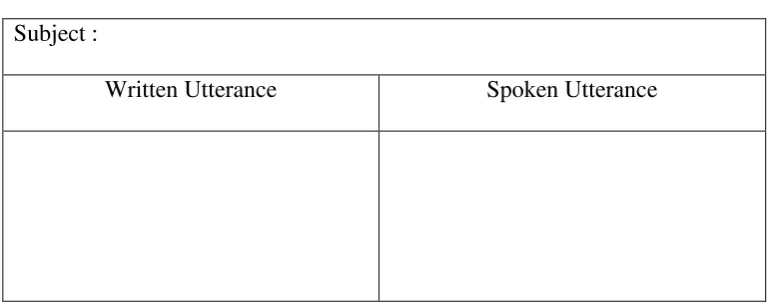
coded based on the developed categories and placed on classified cards (see the
figure below), however, the number of categories were not increased during the
process of data analysis.
The data were put into the table below :
Subject :
32
From the tables, the data were several times coded. In analysing the
grammar, every utterance was put into the tables. The token and lexical items
were counted for finding out the lexical density by using the formula based on Halliday’s (1985) theory, lexical density is the number of lexical items as a
proportion of the number of running words, below :
Lexical Density = Lexical Items : Tokens
In analysing the vocabulary, no specific formula was applied. The
researcher only looked thoroughly at the data, trying to find the frequently used
words, phrase, or clause.
In analysing the speech act, font changing was applied. Bold font was for
the illocutionary act used for refusing, italic for agreeing. Blue colour was used
for marking the locutionary act used for refusing, and red was for the same act
used for agreeing.
3.5.3. Matrix Analysis
The very essential principle underlying the matrix analysis was actually a
need to provide visualisation. The very process of preparing a visual
representation often can help a researcher crystallise his or her understanding of
an area, a system, a location, or even an interaction (Fraenkel and Wallen, 2006 :
522).
There are actually two types of matrix, the first is single description and
33
analysing and interpreting the data from a single observation (Setiyadi, 2006), this
type is the one used in present study as there was no intention to compare any
collected data from one group to another.
The utterances from the classified cards will first be placed into the
descriptive matrix in order, for the researcher, to find out the average lexical
density, phrase, and clause of every utterance, as follows :
Written Spoken
U W L I L D P C U W L I L D P C
The utterances were also analysed in order to find out the frequently used
words and expression. Those components are considered to be parts of
vocabulary. The following matrix was used for analysing vocabulary :
Subject
Frequently Used
Spoken Written
Word Expression/Chunk Word Expression / Chunk
U : Utterance W : Words LI : Lexical Item LD : Lexical Density P : Phrase
34
Act Meaning Frequency Act Meaning Frequency
Direct
above were placed into the last matrix (see the sample below).
35
For the result of the interview, subjects’ perceptions, a descriptive matrix
below is used for the same purpose as the previous matrix.
Subject Perceptions
This is the end of discussion in this chapter. Anything related to the
methodology of this research such as design, subject, data, data collection, and
data analysis were discussed. In the next chapter, the findings and discussion will
V. CONCLUSION AND SUGGESTIONS
This chapter contains the conclusion of the study. There are also some
suggestions provided here. The suggestions are expected to be beneficial for linguists, English teachers, education practitioners, and the next researchers.
5.1. Conclusion
Based on the results of the observation and data analysis, the discussion
was made in the previous chapter. Here, based on the result and discussion there are some conclusion can be taken.
The first concluding statement is that the languages in conversational writing and interactional speaking are not really different, both are spoken-like.
From the average lexical density, number of phrase and clause, the utterances are all closer to spoken language.
Essentially, what was done in the chat rooms and short messages was still considered as writing. The issue here is not just the setting, but also the subjects’
ways of getting their English as a language. The setting made the language turn into less formal. In further consideration the subjects, who are English learners who did not get the language through acquisition, are not aware of the difference between written and spoken language, therefore they used the same language in
any situation, despite the speed of producing utterances and settings.
60
used when speaking. Considering that, it is quite safe to say that even adult learners can still improve their language in oral performance up to the native-like level when they are provided with enough writing practice with authentic language to help the form the schemata.
No matter how proficient a writer is, the context and settings always have
a power to determine the characteristics of the language used. The strategies used in writing, however, are relative, no exact rule that governs the mind for this matter. The only one thing that may control the mind is the cultural awareness that defines the way someone says something depending on the communication
setting.
5.2. Suggestions
Based on the findings, discussions, and conclusions, the researcher here
would like to propose some suggestions. The first one is for the linguists and researchers. It is suggested that the role of schemata in determining the language production, whether written or spoken-like, is investigated further. It is also interesting to collect a larger database for investigating whether there are more
tendencies in choosing and using the same words, phrase, expressions, and rhetorical pattern in writing and speaking.
A more interesting study on the difference or similarities between spoken and written language of native and non-native speaker is also suggested to be taken into account. For those who are interested in Second Language Acquisition,
61
In regard to education, the English teachers and education practitioners are suggested to try utilising the text message and chat rooms for introducing the ‘new language’ while avoiding a real life contact that might cause students get
nervous. Still on this matter, the applied linguists are also suggested to analyse
further the impact of writing on the development of oral proficiency.
REFERENCES
Allen, W, and Waugh, S. 1986. Dealing With Accuracy in Communicative Language
Teaching. TESL Canada Journal.
http://www.teslcanadajournal.ca/index.php/tesl/article/view/1005/824. Last time retrieved : September 30th, 2013
Amalia, R. 2011. The Correlation Between Writing Skill and Speaking Ability of The
Secondary Year Students at SMA NU 1 Gresik. Gresik : Digilib Universitas
Muhammadiyah Gresik.
http://digilib.umg.ac.id/gdl.php?mod=browse&op=read&id=jipptumg--rizkiamali-1050. Last time retrieved : September 30th, 2013
Bailey, K.M. 2006. Issues in teaching speaking skills to adult ESOL learners. In J. Comins, B. Garner, and C. Smith (eds.) Review of Adult Learning and Literacy, Volume 6:
Connecting Research, Policy, and Practice. Mahwah, NJ: Lawrence Erlbaum
Associates, pp. 113-164.
Burns, A, and Joyce, H. 1997. Thumbnail on Focus on Speaking. Sydney : National Centre for English Language Teaching.
Bogdan, R.C. & Biklen, S.K. 1982. Qualitative Research for Education. Boston, Massachusetts : Allyn & Bacon, Inc.
Bygate, M. 1987. Speaking. Oxford : Oxford University Press. Byrne, D. 1988. Teaching Writing Skills. Essex : Longman.
Chaney, A. L, and Burk, T.L. 1998. Teaching Oral Communication in Grades K-8. Boston : Allyn & Bacon.
Crystal, D. 2005. Speaking of Writing and Writing of Speaking.
http://www.pearsonlongman.com/dictionaries/pdfs/Speaking-Writing-Crystal.pdf. Pearson Education. Last time retrieved : September 30th, 2013
Doff, A. 1987. Teaching English. Cambridge : Cambridge University Press.
Fraenkel, J. R. & Wallen, N. E. 2006. How to Design and Evaluate Research in Education. New York. McGraw-Hill International.
Gleason, J.B. 2005. The Development of Language. Massachusetts : Pearson.
Goldstein, B. E. 2008. Cognitive Psychology : Connecting Mind, Ressearch, and Everyday
Experience 2nd edition. Thomson. http://grammar.about.com/od/il/g/languageterm.htm. Last time retrieved : April 3rd, 2014.
Gould, E. 1989. The act of Writing. New York : Random House.
Hairston, M. 1986. Successful Writing. New York : W.W. Norton & Company.
Halliday, M.A.K. 1985. Spoken and Written Language. Hong Kong : Oxford University Press.
Hammond, J. 1987. Oral and Written Language in The Educational Context. A Paper presented at the 8th World Congress of Applied Linguistics, Sydney University, August 1987.
Harmer, J. 2001. The Practice of English Language Teaching. London : Longman.
Harris, D. 1974. Testing English. Bombay : Tata McGraw Hill.
Heaton, J.B. 1991. Writing English Language Test. New York : Longman.
Hedge, T. 2000. Teaching and Learning in the Second Language Classroom. Oxford : Oxford University Press.
Hubert, M. D. 2008. The Relationship Between Writing and Speaking in The U.S University
Spanish Language Classroom. http://docs.lib.purdue.edu/dissertations/AAI3330267/.
Last time retrieved : September 30th, 2013.
Hymes, D. 1971. On Communicative Competence. Philadelphia : University of Pennsylvania Press.
Jacobs, H.L, et al. 1981. Testing ESL Composition : A Practical Approach. Massachusetts : Newbury House.
Jespersen, O.1894. Progress in language, with special reference to English. London[etc]: Swan Sonnenschein.(New edition with an introduction by James D. McCawley. Amsterdam & Philadelphia: Benjamins 1993).
Lado, R. 1961. Language Testing : The Construction and Use of Foreign Language Tests.
New York : McGraw Hill Book Company.
Lado, R. 1970. English Pattern Practices: Establishing the Patterns as Habits. Ann Arbor : University of Michigan Press.
Levinson, S. C. 1983. Pragmatics. Cambridge : Cambridge University Press. Miles, M.B. & Huberman, A.M. 1984. Qualitative Data Analysis. London : SAGE
Publications.
Moxley, R.A. 1990. On the Relationship Between Speech and Writing With Implications for
Behavioral Approaches to Teaching Literacy. West Virginia University.
Ostler, N. 1985. Empires of the Word – A Language History of the World. California : Stanford University Press.
Raimes, A. 1983. Techniques in Teaching Writing. New York: Oxford University Press. Raja, P. 2003. The Linguistic Productions of An Indonesia Child Named Mika in Telgraphic
and Simple Sentence Stage. Malang : Universitas Negeri Malang.
Richards, J.C & Renandya, W. A. 2002. Methodology in Language Teaching. United States: Cambridge University Press.
Sapir, E. 1921. Language : An Introduction to the Study of Speech. Harcourt : Brace and Company. http://grammar.about.com/od/il/g/languageterm.htm. Last time retrieved : April 3rd, 2014.
Scarcella, R.C., & Oxford, R.L. 1992. The Tapestry of Language Learning : The Individual in
The Communicative Classroom. Boston, M.A : Heinle & Heinle.
Searle, J.L. 1979. Expression and Meanings: Studies in The Theory of Speech Acts. New York : Cambridge University Press.
Setiyadi, Ag. B. 2006. Metode Penelitian Untuk Pengajaran Bahasa Asing. Yogyakarta : Graha Ilmu.
Spradley, J. P. 1979. The Ethnographic Interview. New York : Holt, Renihart & Winston. Thornbury, S. 2005. How to Teach Speaking. Essex : Longman.
van Lier, L. 1995. Introducing Language Awareness. London : Penguin.
Weiten, W. 2007. Psychology : Themes and Variations 7th edition. Thomson Wadsworth.
http://grammar.about.com/od/il/g/languageterm.htm. Last time retrieved : April 3rd, 2014.
Welty, D. A., & Welty D. R. 1976. The Teacher Aids in the Instruction Team. New York : Mc. Graw Hill.
Widiati, U & Widayati, S. 1997. Out of Writing Conference : Speaking Writing Connetion. A Paper Presented at the 1997 SEAMEO RELC, Singapore.