NB! This is a post-print of an article published in Hermes 55. To cite the article, please use the following reference:
Hiippala, T. (2016) Individual and collaborative semiotic work in document design. Hermes – Journal of Language and Communication in Business 55. 45–59.
Individual and collaborative semiotic work in
document design
Tuomo Hiippala
Centre for Applied Language Studies
University of Jyv¨askyl¨a
Abstract
This article examines the concepts of agency, transformation and trans-duction in the context of document design. These concepts have been pre-viously used to describe communicative actions and sign-making among in-dividuals: whereas agency focuses on the individual’s capabilities as a sign-maker, transformation and transduction describe how individuals transform meanings within one mode of communication or from one mode to another. Organizational communication, however, is rarely an individual effort, par-ticularly in corporate settings: producing multimodal documents that com-municate on behalf of entire organizations, such as annual reports, consti-tutes a collaborative effort involving a variety of specialists, such as concept planners, copywriters and graphic designers.
1
The need to interrogate the design process
When it comes to analyzing documents and other multimodal artefacts, researchers are often content to examine the concrete outcome of the design process, that is, how written language, photographs, illustrations and other modes of communica-tion co-operate and interact on the selected material canvas. Understanding these kinds of semiotically-charged organizations and their ways of doing communica-tive work on different materialities is a core issue within the field of multimodal research (Bateman, 2011, 20). Moreover, given the wealth of questions about mul-timodality that remain unanswered, the decision to focus on the concrete artefact at hand is understandable, as tracing its entire life-cycle would add considerably to the workload. Consequently, the design process often remains shrouded to the analyst. As Kress (2014, 144) observes:
“In looking at a website, I have access only to theproduct of the design. Any descriptions or analyses about specifications of the design, about initial conceptions, or the design process are, necessarily, hypotheses.”
Yet multimodal researchers are often keen to form hypotheses about the moti-vations behind a particular design. This obviously presents a situation in which additional “data is needed to complement, to ‘fill out’, data which one theory by it-self cannot produce” (Kress, 2011, 240). In short, our hypotheses about the design process need to be tested, and given the shortcomings of multimodal theories in this area, other fields of study may need to be brought in to support the analysis. Previous research has, in fact, suggested that investigations targeting the de-sign process should be pulled much closer towards the heart of multimodal re-search. Bateman (2008), for instance, argues that an improved understanding of the design process is ultimately necessary for a realistic appraisal of multimodal documents. He argues that neglecting the design process “opens up the danger of over-interpretation because more design freedom, and hence more controllable re-sources for making meaning, are assumed than are actually available” (Bateman, 2008, 18). As Kress (2011) points out, ethnographic methods come across as a natural candidate for exploring how multimodal artefacts are designed (see also Rowsell, 2013).
forms of visual expression alongside written language (de Groot, 2008, 18–19). These multimodal features, together with the constraints affecting their content, make the annual report a prime target for a study combining multimodal analysis and ethnography.
Corporations frequently outsource the design of annual reports to external communications agencies (Stanton and Stanton, 2002). From the perspective of multimodal analysis, outsourcing the design process raises several questions: How do concept planners, copywriters, graphic designers and other specialists contribute to the annual report? How are their respective contributions negotiated during the design process? What drives the decision to invest in a specific semiotic mode? The involvement of multiple professionals is particularly interesting in terms ofagency,
transduction and transformation, which are concepts that multimodal researchers have used to examine an individual’s capability to draw on different semiotic modes and to transform meanings between them (Mavers, 2011; Newfield, 2014; Archer and Breuer, 2015). As such, these concepts relate directly to the aforementioned issues of design freedom and to the control over resources available for making meaning.
To identify areas of multimodal research in which the risk of over-interpreting the outcome of the design process is particularly high, I subject the concepts of agency, transduction and transformation to a critical examination in a context that involves multiple individuals performing highly specialized roles. To do so, I complement the multimodal analysis of the annual report with insights about the design process gained by interviewing the professionals responsible for creating the report.
The article itself is structured as follows: I begin by considering the notion of agency in the context of document design, while simultaneously paying attention to the kinds of semiotic work undertaken by the participating individuals, and by examining the constraints that limit their capability to engage in such actions. I then continue with an exposition of the methods and data, before proceeding to the analysis, which contrasts the findings from the interview with the results of the multimodal analysis. Finally, I conclude the article with a discussion of the results and their implications.
2
What constrains document design?
(2005, 169) argue that within many approaches to linguistics and social sciences, agency is often discussed in terms of autonomous individuals, who are completely in control of their actions. MDA, in contrast, presupposes that agency is never unrestricted, but always subject to constraints arising from socio-cultural setting and social practice. In this aspect, MDA largely agrees with the anthropological definition provided by Hearn (2001), but also extends it by proposing that agency is always distributed among human actors. To put it simply, agency is constantly negotiated between individuals (Jones and Norris, 2005, 170).
To narrow down the broad concepts of social setting and practice in order to enable a move towards document design, a useful parallel may be drawn here be-tween MDA and the Genre and Multimodality model (hereafter GeM; Bateman, 2008), a framework developed for the description of multimodal documents. The GeM model defines multiple sources of constraints that affect document design, and therefore, all agencies involved in the design process. These include canvas constraints, which relate to how some materiality, such as a printed page, can be manipulated to carry various types of documents, while production and consump-tion constraints describe how the producconsump-tion technologies and the planned use of the document influence its form and structure. Finally, the available semiotic modes and their established patterns of use for achieving specific communicative goals present a major constraint to any multimodal document (Bateman, 2008, 18).
I will provide detailed examples of these constraints later: what needs to be attended to at this point are the available modes of expression. Theories of mul-timodality work with the assumption that all communication is multimodal, that is, communication involves multiple modes of communication that interact and co-operate with each other. These modes can make and convey meanings, and for this reason, they are often ascribed the epithetsemiotic. Not surprisingly, given its prominent position among theories of multimodality, the definition of what consti-tutes mode continues to be debated in the field. For current purposes, I will draw on the definition proposed by Bateman (2011, 2014a), due to its compatibility with the GeM model. In short, Bateman’s definition acknowledges that the underlying materiality determines the kinds of expressive resources available to the semiotic mode, while also emphasizing that the modes must be structured in a way that supports their interpretation in a given context.
set out extensively by de Groot (2008). These genre patterns are flexible enough to admit the kind of variation naturally encountered among the wealth of annual reports in circulation, but they must not be broken in order to meet the audience’s genre expectations. In this way, the genre sets constraints to the agencies: unless they adhere to the genre constraints that affect the use of semiotic modes, the annual report may fail to meet its communicative goals.
This is also the context in which the concept of agency becomes contested: document design is often a joint effort, which is likely to involve various pro-fessionals ranging from concept planners to copywriters, art directors and many others, and each professional brings their own expertise to the table (Hiippala, 2015b, 32–33). To put it simply, the annual report is not the product of a soli-tary, omnipotent and autonomous agent, but the outcome of the collaboration of multiple (and potentially conflicting) agencies, which all wield influence over the document in question. For this reason, I argue that the design process deserves far more attention in multimodal research than it has received so far: as pointed out above, without a proper appraisal of this process, there is a considerable risk of over-interpreting the selections made in the document.
Initial work in exploring the relationship between agency and multimodality was pursued by Kress et al. (2001), who distinguished between designing repre-sentations and messages. They proposed that designing reprerepre-sentations involves identifying the semiotic modes suitable for the task at hand, whereas designing a message involves combining these selections into larger wholes, for instance, into a multimodal document such as the annual report in a way that corresponds to the expectations directed towards the genre:
“With design, the agency of the individual as designer/sign-maker has become central: interest is that which finds its realization in the de-sign, modulated of course by an awareness of the audience and the con-straints which its expectations bring. Agency is present in the trans-formative aspect of sign-making and in the designing of the message for communication.” (Kress et al., 2001, 7)
the design process: their differing skill sets constrain their capability to draw on different semiotic modes – a project manager is unlikely to be able to stand in for the graphic designer, who in contrast should not be expected to take up writing copy (cf. Hiippala, 2015b, 57–58).
The degree of specialization in contemporary document design also raises ques-tions about the transformative aspects of meaning-making to which Kress et al. (2001, 7) allude in the quote above. Transmodal remaking of meaning, or trans-duction, as it is traditionally understood in social semiotic approaches to mul-timodality, refers to the individual’s capability to transform meanings from one semiotic mode to another (Newfield, 2014). Mavers (2011, 106) provides a succinct definition of transduction as an “agentive act of shifting semiotic material across modes.” The concept has been frequently used to describe individual sign-makers, particularly in educational contexts, either as participants in classroom interaction and as producers of multimodal artefacts (see e.g. Archer and Breuer, 2015).
To draw on a simple example, students may choose to manipulate different materials and to write, draw or do both in response to an assignment, thus ex-pressing the intended meanings in more than one semiotic mode. These kinds of transductions are completely natural, but the concepts remain analytically valid only as long as a specific individual can be held responsible for the agentive act of making meaning. As Jones and Norris (2005, 170) point out, “agency seems much easier to attribute to individuals when considering moment-by-moment ac-tions.” In the analysis of organizational communication and document design, however, these concepts rapidly lose their explanatory power, as transductions are negotiated between multiple agencies over longer periods of time.
A similar problem emerges with the concept of transformation, which describes rearrangements within a specific semiotic mode, as opposed to carrying over mean-ings from one semiotic mode to another as a part of a transduction (Bezemer and Kress, 2008, 175–176). Observing that transformations can occur both within individual semiotic modes and their combinations, Bezemer and Kress (2008, 188– 189) illustrate their point by using the layout of a page from an elementary school biology textbook. They contrast the original version with their own redesign, which adopts the principles of information value zones proposed in Kress and van Leeuwen (2006). This transformation, however, is not motivated by commu-nicative needs that drive the formation of genres, but guided by the exceedingly abstract concept of information value zones, which has drawn considerable criti-cism in research on information design and multimodality (Waller, 2012; Thomas, 2014).
expec-tations and the agencies participating in the design process. These constraints would likely work against the abrupt switch between a two- and a three-column layout and leaving empty space around the lower diagram to conform to the pro-posed information value zones (Bezemer and Kress, 2008, 189). In contrast, valid transformationsmotivated by communicative needs in professional communication could be more accurately described as moves in the space of possibilities offered by the genre (Bateman, 2008, 224). As I will show in the subsequent analysis, these moves are indeed jointly negotiated by the participating agencies (cf. Norris and Jones, 2005).
Overall, the example discussed above emphasizes why considering professional document design as an individual effort warrants caution. A more appropriate appraisal of the design process might entail considering how multiple agencies ne-gotiate their contribution towards a common communicative goal, while operating within constraints set by the genre selected to do the communicative work – in this case, an annual report. In the following sections I propose one possible way of pursuing research in this area, beginning with a presentation of the methods and data, and followed shortly by the analysis of an annual report.
3
Methods and data
In order to investigate how individuals participating in the design of an annual report negotiate their contributions in terms of agency, transformations and trans-ductions, I adopted a mixed method approach combining multimodal and ethno-graphic analysis. This involved two steps, which are described below.
First, I organized a semi-structured interview with a project manager (Master’s degree in French; four years of work experience) and a graphic designer (Bache-lor’s degree in graphic design; 15 years of work experience) working for Miltton, a Helsinki-based communications agency, which was hired to create the annual report for Finnair – the national flag carrier of Finland. The report for the year 2014, which constituted the main data for the study, was thoroughly examined in preparation for the interview. Based on the preliminary examination, I presented several guiding questions to the interviewees, which are provided in Table 1, in order to lay the groundwork for discussing specific parts of the annual report to-gether. I recorded the interview, which lasted for one hour and five minutes. The recording was later transcribed by a third party.
1. What is your educational background?
2. How many years of work experience you have in the field of professional communication?
3. Do you re-use parts of the annual report from the previous year for designing a new report?
4. How many people participate in creating the annual report? What are their roles?
5. How much content does the client supply?
6. Does the client have influence over the structure and organization of the content in the annual report?
7. Does the client have its own image bank?
8. Is the report intended to be read on screen or on paper?
Table 1: Guiding questions presented to the interviewees
and diagrams, while also representing their logical organization, that is, identifying which elements belong together. The resulting description was stored into a file in XML markup language, using the annotation schema provided by the GeM model. I then visualized this description using computational tools developed for working with GeM-annotated multimodal corpora (Hiippala, 2015a).
Finally, the findings from the semi-structured interview were considered to-gether with the description of the annual report’s multimodal structure. In the following sections, I report on these findings, extending the description to other analytical layers of the GeM model as necessary.
4
Analysis
4.1
Collaborative planning and production
Miltton’s employees characterized the production of an annual report as a hectic process. The content is received in quick bursts and rushed into the annual report as the fiscal year comes an end and reporting begins. Yet the annual report consists of much more than just numbers: as noted above, financial information cannot be used to position a corporation in relation to its competitors. This establishes non-financial information as a ground for competition, and corporations regularly benchmark their annual reports against those of their competitors (cf. de Groot, 2008, 81–82). The annual report may thus be considered a form of strategic communication, which is carefully planned according to the current and anticipated operational situation of the company (Erickson et al., 2011).
Outsourcing strategic communications naturally requires close cooperation be-tween the client and the customer. During the planning stage, the client and the communications agency meet face-to-face to discuss the forthcoming report. The communications agency proposes a plan for its layout and visual appearance, and upon the client’s approval, this plan is put into effect by designing multiple templates for individual page layouts, into which the content may be fed as it becomes available. Naturally, the client and the communications agency stay in touch throughout the design process to discuss its progress.
used in previous annual reports are also provided for reuse. Photographs are made available through Finnair’s image bank – a standard tool for establishing and maintaining a unified visual image for a corporation (cf. Machin, 2004).
The communications agency then proceeds to
1. organize and paginate the content using the layout templates previously agreed upon with the client;
2. to highlight the content that Finnair requests to be emphasized;
3. to create illustrations, diagrams and tables to accompany the written con-tent.
In the following sections, I consider these tasks from the perspectives of agency, transduction and transformation, by using the GeM model as an analytical frame-work to explore the annual report.
To establish a point of departure for this discussion, the communications agency is essentially responsible for shaping the content provided by Finnair into an arte-fact that corresponds to the definition of the annual report as a multimodal genre. What defines this genre is naturally negotiated within a community of users and subject to internal and external influences, as developments in other genres may exert pressure on the annual report. De Groot (2008, 81–82) identifies several in-fluences, such as obligatory content demanded by the law, competitors’ reporting strategies and the corporation’s own reporting traditions.
This constitutes a crucial issue, because at any given moment, the notion of genre is largely responsible for determining the available semiotic modes and their preferred configurations (Hiippala, 2015b, 37). As I will show below, genre expec-tations wield considerable influence on the design of an annual report. Moreover, these expectations do not only correspond to those that are assumed for the in-tended audiences, but also include those held by the agencies involved in the design process.
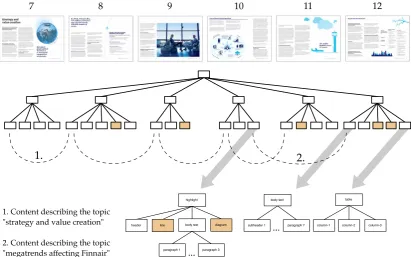
In preparation for a closer analysis of the annual report, Figure 1 shows the general organization of the sequence spanning a total of six pages discussed with Miltton’s employees. The pages in this sequence are represented as thumbnails in the upper part of Figure 1. Below the thumbnails, a tree diagram represents the hierarchical organization of the content, as defined using the GeM model’s layout layer, which is hereafter referred to as thelayout structure (Bateman, 2008, 115–129).
7 8 9 10 11 12
1. Content describing the topic "strategy and value creation"
2. Content describing the topic "megatrends affecting Finnair"
diagram highlight
paragraph 1 body text line header
paragraph 3
column-3 column-2 column-1
table paragraph 7
subheader 1 body text
...
...
1. 2.
Figure 1: The layout structure of pages 7–12 in Finnair’s annual report. Graphic elements, such as photographs, maps and illustrations are marked using colour in the tree diagram.
instance, text paragraphs, photographs, headers, captions and page numbers. Al-ternatively, the units in the diagram may stand for composite nodes that join pieces of content together: several composite nodes on pages 10–12 have been expanded in the lower part of Figure 1 as an example.
4.2
Agencies and their influence
The first step in performing a more detailed analysis of the sequence presented in Figure 1 involves identifying the deployed semiotic modes. To avoid estab-lishing under-differentiating dichotomies such as ‘language’ and ‘image’, I char-acterize each page using abstractions geared specifically towards describing the multimodality of page-based documents. One proposal for this kind of abstraction is put forward by Bateman (2009), who introduces the semiotic mode of text-flow
to describe multimodal documents organized around written language.
As with unfolding written language, the organizing principle underlying text-flow is linearity, but this does not rule out non-linguistic contributions: text-text-flow may be (and often is) interrupted or accompanied by other semiotic modes, such as photographs, diagrams and illustrations, to name but a few examples. Moreover, despite its apparent visual simplicity, text-flow can naturally draw on various dis-course structures to support its expression, which may be uncovered using more fine-grained linguistic analyses, as de Groot (2008) has convincingly shown. In short, the immense meaning potential of text-flow is based on its capacity to draw on written language, which may be further augmented by embedding other semi-otic modes into its linear organization as a part of a document.
Continuing with the example in Figure 1, the first topic focusing on strategy and value creation is realized using text-flow on pages 7–11. Various types of multimodal discourse structures, such as cohesion and coherence, may be found supporting the underlying linear organization as the text flows across the pages (Bateman, 2014b; Hiippala, 2016). These discourse structures may be assumed to hold across the two topics, which are visualized using the dashed lines in Figure 1, although they are not expanded in the diagram.
What is worth observing here is that not a single page in this sequence consists purely of paragraphed text-flow, that is, text-flow is always accompanied by some other semiotic mode. Whereas page 7 includes a map and highlighted text, page 8 features another highlight and an illustration, and a photograph occupies two-thirds of page 9. Pages 10 to 12, in turn, feature a diagram, a table and additional illustrations. Despite the contributions from other semiotic modes, which may be roughly characterized as cartography, illustration, photography and diagrams, the overall organizing principle of these pages remains linear and governed by text-flow. This argument is supported by the observation that text-flow establishes discourse relations across the entire sequence of pages: no other semiotic mode deployed in the annual report does the same.
par-ticularly in relation to the “attention span” of the report’s intended audience. This is a recurring argument, as several media have been accused of impairing the cognitive abilities of contemporary audiences by shortening their attention span (Newman, 2010). Over time, the culprits have included television, cinema, video games, and most recently, the internet.
Newman (2010, 582–583) argues that media professionals are particularly keen on circulating discourses about attention spans, which results in a feedback loop between the professionals and the artefacts they design. This is also the case for the annual report: the representatives of the communications agency do not expect pages consisting exclusively of paragraphed written text to be able to hold the readers’ attention: they assume that photographs and illustrations are required to ‘liven up’ the page and to entertain the reader.
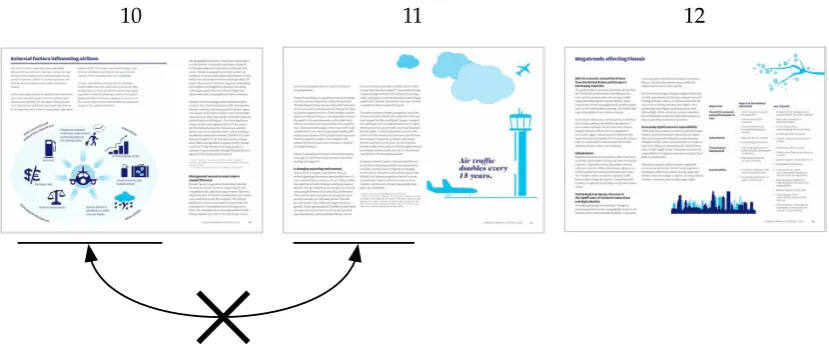
Within the GeM framework, this preconception about the readers’ attention span may be considered anassumed consumption constraint, which is subsequently projected on the genre structure by the agencies involved (cf. Bateman, 2008, 18). Pages 10–12, on which the two topics identified above overlap as indicated by the dashed lines in Figure 1, exemplify how this constraint affects the annual report. It may be argued that the organizing principle behind text-flow – linearity – and the discourse structures that guide its interpretation demand support in the form of topical continuity across pages.
As Martin (1994) has shown, the operation of these discourse structures relies on the continuity of written language. Yet the assumed consumption constraint works against providing the necessary continuity by denying the inclusion of entire pages to dedicated text-flow in the artefact, because pure text-flow is assumed to overburden the reader. Consequently, as each page is required to deploy some other semiotic mode besides paragraphed written text, the continuity of text-flow must be negotiated within this constraint, which governs the placement of content across pages.
10 11 12
Figure 2: Visualizing the layout constraint that prevents topical continuity. By not allowing pages consisting of pure text-flow, the constraint creates an overlap between two topics discussed in the annual report (cf. Figure 1).
which can occasionally enforce design choices that actually work against support-ing the communicative goals defined for the annual report, that is, maintainsupport-ing topical continuity across the artefact.
To sum up, individual agencies operate within limits set by other agencies in professional document design. Moreover, design choices are negotiated within the communicative goals set for the annual report as a multimodal genre. What is essential for multimodal analysts to understand is this: although the choices made in the semiotic modes appear to be highly coordinated, this does not mean the choices reflect the communicative intentions of a single agency. In contrast, it is entirely natural for well-formed multimodal artefacts to exhibit cohesion across the content and coherence across their structure, as multiple agencies will strive towards these goals as well. This is precisely why the studied phenomenon must be circumscribed carefully, separating the production of the artefact from the analyst’s interpretation of the final product. With this distinction in mind, in the following discussion I proceed to consider transformations and transductions in the annual report.
4.3
Transductions and transformations
and the airline industry (see Figure 1). More specifically, I focus on transduc-tions and transformatransduc-tions of meaning – in this order – while also considering the constraints imposed by various agencies on these processes.
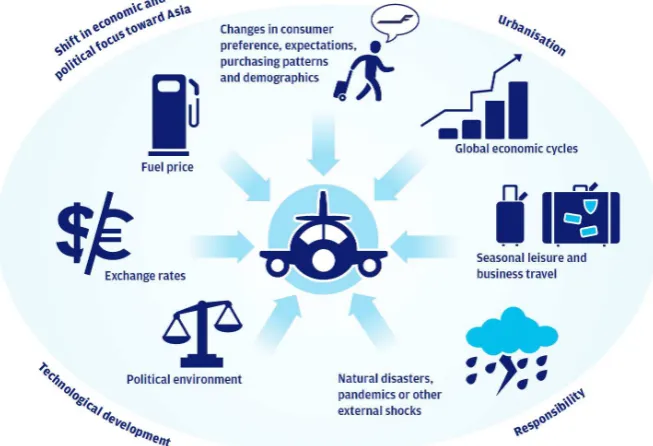
Figure 3: The diagram on page 10 of the annual report
As pointed out above, the ‘megatrends’ topic is discussed on pages 10 and 12 of the annual report. Within these two pages, there is one clear candidate for an example of a transduction – the diagram on page 10. This diagram, which I will now subject to a closer examination, is reproduced in Figure 3. The first step is to establish its context of occurrence, as the diagram is preceded by a header and four paragraphs. This text introduces the topic by specifying external factors that influence the airline business, which are also presented in the diagram below. I take this diagram as an example of a transduction from text-flow to the diagrammatic mode.
To provide a brief recap of the diagram, the megatrends – ‘shift in economic and political focus towards Asia’, ‘urbanisation’, ‘technological development’ and ‘responsibility’ – are positioned on the outer edge. The inner circle, in turn, features examples of the external factors influencing the airline business, which are represented by combinations of written language and two-dimensional, computer-drawn illustrations. The diagram’s centre is occupied by arrows that point towards another illustration of an aircraft, which represents the airline industry.
result of a transduction between these semiotic modes. This is evident in the shift that occurs in the multimodal structure of the annual report. Whereas text-flow may be accompanied by other semiotic modes, as the entire six-page sequence ex-emplifies by including a map, a photograph, a diagram and several illustrations alongside text-flow within just six pages, the diagrammatic mode integrates ver-bal and visual inputs more tightly into organizations that can convey a multitude of different text-image relations, and begins to make use of the layout space (for research in this area, see Engelhardt, 2002).
In other words, here the diagrammatic mode draws on written language, two-dimensional illustrations and line drawings (arrows), and composes them into a meaningful organization in the layout space (cf. also Bateman, 2014b, 158–159). What this shows is that the diagrammatic mode has access to an equally wide range of semiotic resources as text-flow: the difference, then, emerges in how the modes organize the available resources to support their contextual interpretation. This is the responsibility of a specific component: discourse semantics.
Because the discourse semantic stratum, which Bateman (2011) conceptualizes as an essential component of a full-blown semiotic mode, is crucial for identifying the transduction from text-flow to diagrammatic mode, the stratum deserves closer attention. As a part of a semiotic mode, the discourse semantic stratum helps to form and resolve hypotheses about discourse structure by providing a set of can-didate interpretations. Such discourse structures may be described, for instance, by defining rhetorical relations between clauses and larger parts of text, as well as written language and graphic elements (see e.g. Taboada and Habel, 2013).
To draw on an example from Figure 3, the illustrations in the inner circle are likely to be interpreted as elaborating the written labels due to their position in the layout. Although some illustrations (such as the fuel pump) can stand in for the written labels (‘fuel price’), but generally, the written labels are needed to determine the factors that affect the airline business. To reiterate, their posi-tioning signals that they are meant to be interpreted together: in this way, the discourse semantics of diagrammatic mode instruct the reader to resolve the text-image relations holding between the labels and the illustrations. Contrastingly, the positioning of the labels (megatrends) on the outer circle is not meaningful, that is, the examples in the inner circle (e.g. ‘political environment’) are not in-tended to exemplify the megatrend placed closest to them on the outer circle (e.g. ‘technological development’).
the labelled illustrations, pointing from one illustration to another, the arrows would be likely interpreted as indicating some kind of causal relation between the external factors represented using the illustrated labels.
To sum up, the discourse semantics of diagrammatic mode are fundamentally different than those of paragraphed text-flow, particularly for text-image relations, which can exploit the two-dimensional layout space to make additional meanings. Text-flow, in contrast, is largely organized around the principle of linearity. In other words, the differences in discourse semantics suggest that the shift from text-flow to the diagrammatic mode is indeed a transduction, as opposed to a mere transformation within the semiotic mode of text-flow. At the same time, the transduction into a diagram is clearly something the genre can easily accom-modate, as the annual report features various types of diagrams. Handling such transductions is also demanded from the reader, who needs to apply the appropri-ate discourse semantic interpretations to make sense of the page. For the entire page, they are provided by text-flow; for the diagram, by the diagrammatic mode. Finally, it is necessary to consider what motivated the transduction on page 10. According to the communications agency, the client requested the transduction by providing a sketch of the diagram, which the graphic designer then adapted to the visual identity of the annual report. Although the interview revealed that the client provides most of the content in written language, a request for a transduction should not be considered extraordinary as a part of a collaborative design process. Most importantly, what should be noted here is that the transduction does not arise from the actions of a single agency, but multiple agencies collaborating with each other. Moreover, in terms of the topic structure, the diagram appears to serve a specific purpose, which may explain the client’s request. By summarizing the megatrends, the diagram prepares the reader for the more detailed description of the same topic on page 12, which is realized using text-flow.
cannot be traced back to specific content realized using the mode of text-flow. Identifying actual transformations within the semiotic mode of text-flow, how-ever, requires a closer examination of its properties. I argue that this may be achieved by drawing on the work of Twyman, who presents a model for describing how various “modes of symbolization” are configured in page-based documents (1979, 120). Of particular interest is the category of “linear-interrupted” text, which Bateman (2009, 61) acknowledges as bearing close resemblance to his defi-nition of text-flow as a semiotic mode.
Twyman (1979, 121) observes that very few instances of written text are truly linear: flowing text is often organized into lines, which are interrupted at specific points to produce paragraphs. From linear-interrupted text, Twyman’s categories move progressively towards non-linear configurations of written language, which ultimately begin to exploit the available layout space in its entirety. Two configu-rations within this continuum, lists and tables, warrant further attention, as both are featured on page 12 of the report. Whereas lists are rather self-explanatory, tables may be either numerical or verbal (Twyman, 1979, 125). Because lists and tables draw primarily on written language to make meanings, I argue that these configurations represent alternatives available within the semiotic mode of text-flow. Although tables gradually abandon linear organization for a spatial one, their semiotic potential is largely founded on the discourse structures provided by written language.
In the case of the table on page 12 of the annual report, these structures may be made explicit using Rhetorical Structure Theory (RST). RST is an established theory of discourse structure, which proposes a set of rhetorical relations that are taken to hold between discourse elements (Taboada and Mann, 2006). Whereas ‘classical’ RST is typically used to draw relations between linguistic units, the GeM model extends RST to cover discourse relations that hold between differ-ent semiotic modes, such as instances of text-flow, photographs and many more (Bateman, 2008, 146–149).
In principle, RST assigns discourse elements into two categories, nuclei and satellites, which stand for the primary and ancillary information in a given rhetor-ical relation (Taboada and Mann, 2006, 426–427). The application of RST is best illustrated using an example: Table 2 describes the relation holding between two items in the table on page 12. Here the relation holding between the nucleus and the satellite is assumed to be that of solutionhood, whose criteria are given at
the bottom of the table (for relation definitions, see Bateman, 2008, 149).
A variety of rhetorical relations, such as solutionhood in Table 2, can
or-Traffic between Asia and Eu-rope grows
solutionhood Renewal of the new
genera-tion long-haul fleet from 2015 onwards
Satellite Relation Nucleus
Constraints on the satellite: a question, request, prob-lem, or other expressed need.
Constraints on the nucleus: a situation or method support-ing full or partial satisfaction of the need.
Table 2: A solutionhood relation holding between two items in the table
ganization, which involves embedding another rhetorical relation into the satellite of a relation positioned ‘above’, requires maintaining coherence across the entire passage (Hiippala, 2015b, 137–139). Tables, however, are largely exempted from this requirement, because they do not need to knit together multiple rhetorical relations to establish a coherent unit of discourse. Their spatial organization takes care of this need.
That being said, if linear-interrupted text, lists and tables are taken to repre-sent different configurations of text-flow as a semiotic mode, it may be proposed that the shift from paragraphed written text to a table is a transformation rather than a transduction from one semiotic mode to another. To conclude, the combi-nation of a table and a bulleted list represents just one alternative among several configurations available for text-flow. Teasing out the possible configurations will undoubtedly require extensive empirical research, which is nevertheless ultimately necessary for identifying any transformations within a semiotic mode, as I argue in the following section, which presents the concluding remarks.
5
Conclusion
In terms of agency, I showed that the process of designing an annual report is a collaborative effort involving multiple agencies, which affect the concrete outcome – the multimodal artefact – in different ways. In particular, assumptions concern-ing the consumption of the annual report play a significant role in determinconcern-ing its multimodal structure. These consumption constraints (cf. Bateman, 2008, 18) included, for instance, layout choices supporting the intended medium of the arte-fact, that is, whether the annual report is read on screen or printed out on paper. In addition, the interview revealed that the professionals avoid pages consisting solely of written language, because such pages are assumed to be unable to hold the reader’s attention. This view bore close resemblance to discourses of reduced “attention span” presumably caused by new media, which have been suggested to be particularly popular among communication professionals (Newman, 2010).
For transductions and transformations, I emphasized the need to determine and characterize the semiotic modes active in the artefact. This is necessary for identifying any transduction or transformation between/within semiotic modes. In other words, without a sufficient understanding of the semiotic modes, the distinction between a transduction – a shift from one mode to another – and a transformation – a reshaping of meaning within a single semiotic mode – remains elusive. By drawing on the definition of a semiotic mode proposed by Bateman (2011, 2014a), I proposed that distinguishing between semiotic modes is best pur-sued by considering their discourse semantics, that is, how they combine written language, graphic elements and other resources for making meaning into struc-tures that support their contextual interpretation. I illustrated this approach by contrasting the diagrammatic mode with text-flow – a foundational semiotic mode organized around linear-interrupted written text (Hiippala, 2016).
References
Archer, Arlene and Breuer, Esther (eds.) (2015): Multimodality in Writing: The State of the Art in Theory, Methodology and Pedagogy. Leiden: Brill.
Bateman, John A. (2008): Multimodality and Genre: A Foundation for the Sys-tematic Analysis of Multimodal Documents. London: Palgrave Macmillan. Bateman, John A. (2009): Discourse across semiotic modes. In Renkema, Jan
(ed.), Discourse, of course: An overview of research in discourse studies, Ams-terdam: Benjamins. 55–66.
Bateman, John A. (2011): The Decomposability of Semiotic Modes. In O’Halloran, Kay L. and Smith, Bradley A. (eds.), Multimodal Studies: Multiple Approaches and Domains, London: Routledge. 17–38.
Bateman, John A. (2014a): The Constitutive Role of Semiotic Modes for the Theory and Practice of Multimodal Analysis. In DeCoursey, Christina (ed.),
Language Arts in Asia 2: English and Chinese through Literature, Drama and Popular Culture, Newcastle: Cambridge Scholars Publishing. 8–33.
Bateman, John A. (2014b): Multimodal coherence research and its applications. In Gruber, Helmut and Redeker, Gisela (eds.), The Pragmatics of Discourse Coherence: Theories and Applications, Amsterdam: Benjamins. 145–177. Bezemer, Jeff and Kress, Gunther (2008): Writing in multimodal texts: A social
semiotic account of designs for learning. InWritten Communication 25(2), 166– 195.
de Groot, Elizabeth B. (2008): English annual reports in Europe: a study on the identification and reception of genre characteristics in multimodal annual reports originating in the Netherlands and in the United Kingdom. Ph.D. thesis, Radboud University Nijmegen / LOT, Nijmegen and Utrecht.
Engelhardt, Yuri (2002): The Language of Graphics: A Framework for the Analysis of Syntax and Meaning in Maps, Charts and Diagrams. Ph.D. thesis, Institute for Logic, Language and Computation, University of Amsterdam.
Erickson, Sheri L./ Weber, Marsha/ and Segovia, Joann (2011): Using communi-cation theory to analyze corporate reporting strategies. InInternational Journal of Business Communication 48(2), 207–223.
Hearn, Laura M. (2001): Language and agency. InAnnual Review of Anthropology
30, 109–137.
Hiippala, Tuomo (2015a): gem-tools: Tools for working with multimodal corpora annotated using the Genre and Multimodality model. doi:10.5281/zenodo.33775. Hiippala, Tuomo (2015b): The Structure of Multimodal Documents: An Empirical
Approach. New York and London: Routledge.
Education, Leiden: Brill. 53–78.
Jones, Rodney H. and Norris, Sigrid (2005): Introducing agency. In Norris, Sigrid and Jones, Rodney H. (eds.), Discourse in Action: Introducing Mediated Dis-course Analysis, London: Routledge. 169–171.
Kress, Gunther (2011): Partnerships in research: multimodality and ethnography. In Qualitative Research 11(3), 239–260.
Kress, Gunther (2014): Design: The Rhetorical Work of Shaping the Semiotic Work. In Archer, Arlene and Newfield, Denise (eds.), Multimodal Approaches to Research and Pedagogy: Recognition, Resources, and Pedagogy, New York and London: Routledge. 131–152.
Kress, Gunther/ Jewitt, Carey/ Ogborn, Jon/ and Tsatsarelis, Charalampos (2001): Multimodal Teaching and Learning: The Rhetorics of the Science Class-room. London and New York: Continuum.
Kress, Gunther and van Leeuwen, Theo (2006): Reading Images: The Grammar of Visual Design. London: Routledge, second edition.
Machin, David (2004): Building the World’s Visual Language: The Increasing Global Importance of Image Banks in Corporate Media. InVisual Communica-tion 3(3), 316–336.
Martin, James R. (1994): Modelling big texts: A systemic functional approach to multi-genericity. In Network 21, 29–52.
Mavers, Diane (2011): Children’s Drawing and Writing: The Remarkable in the Unremarkable. London and New York: Routledge.
Newfield, Denise (2014): Transformation, transduction and the transmodal mo-ment. In Jewitt, Carey (ed.), The Routledge Handbook of Multimodal Analysis, London and New York: Routledge. second edition, 100–113.
Newman, Michael Z. (2010): New media, young audiences and discourses of atten-tion: from Sesame Street to ‘snack culture’. In Media, Culture & Society 32(4), 581–596.
Norris, Sigrid and Jones, Rodney H. (2005): Discourse in Action: Introducing Mediated Discourse Analysis. London: Routledge.
Rowsell, Jennifer (2013): Working with Multimodality: Rethinking Literacy in a Digital Age. New York and London: Routledge.
Stanton, Patricia and Stanton, John (2002): Corporate annual reports: research perspectives used. InAccounting, Auditing & Accountability Journal 15(4), 478– 500.
Taboada, Maite (2005): Discourse markers as signals (or not) of rhetorical rela-tions. In Journal of Pragmatics 38(4), 567–592.
Taboada, Maite and Habel, Christopher (2013): Rhetorical relations in multimodal documents. In Discourse Studies 15(1), 65–89.
look-ing back and movlook-ing ahead. In Discourse Studies 8(3), 423–459.
Thomas, Martin (2014): Evidence and circularity in multimodal discourse analysis. In Visual Communication 13(2), 163–189.
Twyman, Michael (1979): A Schema for the Study of Graphic Language. In Kolers, Paul A./ Wrolstad, Merald E./ and Bouma, Herman (eds.), Processing of Visible Language, New York: Plenum Press, volume 1. 117–150.