ETHNOGRAPHY OF COMMUNICATION IN THE FIRST OF THE 2012 PRESIDENTIAL DEBATE BETWEEN PRESIDENT BARACK OBAMA
AND GOVERNOR MITT ROMNEY
THESIS
Submitted in partial fulfillment of the requirements for the Degree of SarjanaSastra (S.S) in English Language.
By
Rizkia Prabandini Rahmanita C11.2009.01027
FACULTY OF HUMANITIES DIAN NUSWANTORO UNIVERSITY
PAGE OF APPROVAL
This thesis has been approved by Board of Examiners, Strata 1 Study Program of English Language, Faculty of Humanities, Dian Nuswantoro University on September 23, 2013.
Board of Examiners
Chairperson First Examiner
Sunardi, SS., M.Pd. Achmad Basari, SS., M.Pd.
Second Examiner Advisor
Setyo Prasiyanto Cahyono, SS., M.Pd. Nina Setyaningsih, M.Hum.
Approved by: Dean of
Faculty of Humanities
STATEMENT OF ORIGINALITY
I hereby certify that this thesis definitely my own work. I am completely responsible for the content of this thesis. Opinion or findings of others included in this thesis are quoted or cited with respect to ethical standard.
Semarang, 19 September 2013
MOTTO
Religion without science is lame, Science without religion is blind. (Albert Einstein)
Life as if you were to die tomorrow. Learn as if you were to life forever. (Mahatma Gandhi)
In the middle of difficulty lies opportunity. (Albert Einstein)
Do what you can, with what you have, where you are. (Theodore Roosevelt)
DEDICATION
I dedicate this thesis especially to : 1. ALLAH SWT
2. My beloved Parents 3. My dear brothers
ACKNOWLEDGEMENT
In this happiest moment, I wish a prayer to Allah SWT the Almighty, who has blessed me during writing this thesis.
Furthermore, I would like to express my sincere thanks to:
1. Mr. Achmad Basari,S.S.,M.Pd., Dean of Faculty of Humanities of Dian Nuswantoro University, who gave permission to conduct this thesis;
2. Mr. Sarif Syamsu Rizal, M.Hum., Head of English Department of Strata 1 Program, Faculty of Humanities of Dian Nuswantoro University, who gave me permission to conduct this thesis;
3. Ms. Nina Setyaningsih, M.Hum.,as my thesis adviser for your continuous and valuable guidance, advice and encouragement in completing this thesis
4. Mrs. Rahmanti Asmarani,M.Hum., thesis coordinator of English Department of Strata 1 Program, Faculty of Humanities of Dian Nuswantoro University, who gave permission to me to conduct this thesis;
5. All lecturers at the English Department, Faculty of Humanities for the guidance, advice, and support;
6. All librarians of the Central Library of Dian Nuswantoro University, Self Access Center (SAC) for their permission for me to use some valuable references in writing this thesis;
7. ALLAH SWT who has blessed me in completing this thesis;
8. My beloved Mom and Dad,with their endless love, and a lot of prayer for me to get the bachelor degree.
10.My beloved boyfriend, thank you so much for your patience and support; 11.All my lovely family who members care and pray for me;
12.My best friends in UDINUS, thanks for togetherness , your support and help. Finally, I do realize that due to my limited ability this thesis must have shortcoming. For this, I welcome any suggestions and criticisms.
The Researcher
TABLE OF CONTENTS
PAGE OF TITLE ... i
PAGE OF APPROVAL ... ii
STATEMENT OF ORIGINALITY ... iii
MOTTO... iv
DEDICATION ... v
ACKNOWLEDGEMENT ... vi
TABLE OF CONTENTS ... viii
LIST OF TABLE ... xi
LIST OF APPENDIXES ... xii
ABSTRACT ... xiii
CHAPTER I INTRODUCTION ... 1
1.1 Background of the Study ... 1
1.2 Statement of the Problem... 4
1.3 Scope of the Study ... 4
1.4 Objective of the Study ... 4
1.5 Significance of the Study ... 5
1.6 Thesis Organization ... 5
CHAPTER II REVIEW OF RELATED LITERATURE ... 7
2.1 Language as means of communication ... 7
2.2 Speech Community ... 8
2.4 Ethnography of Communication (SPEAKING) ... 20
2.5 A Presidential Debate ... 23
CHAPTER III RESEARCH METHOD ... 25
3.1 Research Design ... 25
3.2 Unit of Analysis ... 26
3.3 Source of Data ... 26
3.4 Techniques of Data Collection ... 26
3.5 Techniques of Data Analysis ... 27
CHAPTER IV DATA ANALYSIS ... 28
4.1 Findings... 28
4.2 Elements of Ethnography of Communication ... 31
4.2.1Setting and Scene ... 31
4.2.2 Participant ... 33
4.2.3 Ends ... 36
4.2.4 Act Sequence ... 51
4.2.5 Key ... 63
4.2.6 Instrumentalities ... 64
4.2.7 Norm ... ... 68
4.2.8 Genre ... 69
CHAPTER V CONCLUSION AND SUGGESTION ... 81
5.1 Conclusion ... 81
LIST OF TABLE
LIST OF APPENDIXES
ABSTRACT
This thesis entitled Ethnography of Communication in the First of the 2012 Presidential Debate between President Barack Obama and Governor Mitt Romney. This thesis is aimed to find the elements of ethnography of communication in the debate among Jim Lehrer (the moderator), President Barack Obama (a president candidate from Democratic Party) and Governor Mitt Romney (a president candidate from Republican Party) by using descriptive qualitative method.
In collecting the data, the researcher used two stages. First, she searched the data on first Presidential debate and the transcript. Second, she downloaded the data on http://edition.cnn.com/election/2012/debates/first-presidential-debate, transcript on http://debates.org/index.php?page=october-3-2012-debate-transcript.
The elements of ethnography of communication are setting and scene, participant, end, act sequence, key, instrument, norm and genre. Setting of time is at night and setting place is Magness Arena at the University of Denver in Denver, Colorado. Scene of the situation in the debate is serious and quiet. Participants of the debate are Jim Lehrer (the moderator), President Barack Obama (a president candidate from Democratic Party) and Governor Mitt Romney (a president candidate from Republican Party). The end of this debate is discussing on differences about domestic issues. The act sequence of the debate is divided into opening stage, middle stage and closing stage. The key of the debate is serious. The instrumentalities is spoken text, that consists of turn taking, standard grammar, filler, reparation, repetition, colloquialisms, incomplete clause, and closing statement. The norm of the debate uses positive politeness, because the is social status difference between the speakers and the relationship is not intimate. The genre of the text is debate. The genre consists of definition motion, idea development, and rebuttal, and the linguistic features are the use of question and answer, present tense, future tense, past tense, modal verbs, hedging utterances.
CHAPTER I INTRODUCTION
1.1Background of the Study
People need a language to communicate each other. Language is believed as a tool to communicate. It plays an important role in life, because all people use language to communicate with each other. As a function of language, communication is defined as a process of transferring and exchanging ideas, information from one person to others in order to get feedback as the result of the communication itself. It is always used in social interaction to make relation with other people, because it is the way to the social life works. To be able to interact, somebody needs to have communicative competence. Communicative competence is human ability to use the language of everyday life in real situation for example to argue, to warn, to deliver, to express, to show his messages of ideas, to wishes, and even to know when to be silent.
of communication. Ethnography of communication is a study of language influenced by the culture and society inside.
The ethnography of communication aims at describing the form and functions of verbal and non- verbal communicative behavior in particular cultural or social setting. Ethnography of communication is based on the premise, that the meaning of an utterance can be understood only in relation to the ‗speech event‘ or ‗communicative event‘ in which it embedded. Formal
descriptions in the ethnography of communication focus on linguistic units above the sentences and the character of such communicative events, i.e., speech situation (e.g. ceremonies), speech event (e.g. greetings, compliments) is culturally determined. Studying ethnography can give more knowledge of other aspects of culture, communicative situations and event of the organization. In the ethnographic research, there are several kinds of speech event: talk show, debate, ceremony, news, gossip, interview, etc.
Debate is a formal discussion on a particular matter in a public meeting or legislative assembly, in which opposing arguments are put forward and which usually ends with a vote. An ethnographic research of presidential debate in this thesis seeks to describe the meanings of central themes in the life word of the subjects. The main task in presidential debate is to understand the meaning of what the participants say.
The debate that analyzed in this thesis was held in the Magness Arena at the University of Denver in Denver, Colorado. The debate was participated by two presidential candidates, they are governor Mitt Romney and president Barack Obama. The debate was lead by a panelist, Jim Lehrer of the PBS News Hour. The debate can determine appreciation and valuation of the people, because they can vote one of both candidates after the debate is over. The debate can be watched in around the world because it was broadcasted live on TV or internet.Whoever wins the polling of the debate shows that his missions or ideas are accepted well by the people in the U.S. The polling was surveyed by some U.S surveyer institutes.
From the explanation above, the researcher chose U.S presidential debate as the data in this study because the researcher is interested in analyzing ethnography of communication in the presidential debate, and analyzing the way two candidate presidents tried to state their mission and vision they want to apply to the country and to know the way both candidates struggle to maintain their ideas in order to get many votes from the people in the U.S through the debate. Based on the explanation above, this study is entitled: Ethnography of Communication of the First Presidential Debate between Governor Mitt Romney and President Barack Obama 2012.
1.2Statement of the Problem
ethnography of communication in the Presidential Debate. The statement of the problem in this study can be stated as follows: What are the elements of ethnography of communication found in the First Presidential Debate between Governor Mitt Romney and President Barack Obama?
1.3Scope of the Study
This study concerned on ethnography of communication in the Presidential Debate between Governor Mitt Romney and President Barack Obama. The study also just concerned with the utterances produced by President Barack Obama, Governor Mitt Romney and Jim Lehrer (as a moderator).
1.4Objectives of the Study
This study is aimed at describing the elements of ethnography of communication found in the Presidential Debate between Governor Mitt Romney and President Barack Obama by using Hymes‘ SPEAKING Grids.
1.5Significance of the Study
The researcher hopes that this study would be able to:
1. Give knowledge about linguistics studies, especially ethnography of communication.
2. Give advantage and knowledge for all students or everybody in learning ethnography of communication.
4. Give interesting and good knowledge about the culture and custom especially of US presidential debate.
1.6Thesis Organization
To make this thesis systematic and easy to read, the organization of the thesis may firstly be explained in general. This thesis is organized in the following chapters.
Chapter I is Introduction. The thesis begins with introduction as the first chapter. This chapter consists of background of the study, statement of the problem, scope of the study, objective of the study, significance of the study, and thesis organization.
Chapter II is Review of Related Literature. In this chapter, the researcher tries to strengthen her thesis by putting forward several underlying theories.
Chapter III is Research Method. It covers the discussion of research method, unit of analysis, source of data, method of collecting data, and method of analyzing data.
Chapter IV is Data Analysis. In this chapter, the researcher presents the result of data analysis, including the elements of Ethnography of Communication in the First Presidential Debate between Barack Obama and Mitt Romney.
CHAPTER II
REVIEW OF RERLATED LITERATURE
In this part, the researcher presents some theories used in this study. The theories are: Communication, communicative competence, speech community, levels of communication, ethnography of communication and presidential debate.
2.1Language as means of communication
The main function of language is communication. Communication is needed by all people to make an interaction to each other. Communication is used to get new information and share ideas, feeling, etc, because it is the way to the social life works. Communication also becomes an important thing in life, because it can extend the identity in a certain person. It can be seen from the culture and sociality of that person.
Communication is used a medium to show ideas namely language. Language is the most important element for creating a communication between two people or more. The scientific study of language is linguistics. From the explanation above, it is correlated with (Schiffrin, 1994:138)
To begin with, the main function of human language is communication, and since linguistics is the scientific study of language, it goes without saying that the study of communication is one of the major goals of linguistics. On the other hand, the "understanding of communication is ... important for anthropologists: the way we communicate is part of our cultural repertoire for making sense of -and interacting with -the world."
further, it is essential to define some of basic concepts associated with Hymes‘s work, particularly those associated with the ethnography of
communication. Two important concepts are central to this approach, namely: speech community and communicative competence.
2.2Speech community
A speech community is a group of people who share rules for using and interpreting at least one communication practice. A communication practice might involve specific events, acts, or situations, with the use and interpretation of at least one essential for membership in a speech community. The term "speech" is used here to stand in for various means of communication, verbal and nonverbal, written and oral; the term "community," while minimally involving one practice, in actuality typically involves many, and is thus used to embrace the diversity in the means and meanings available for communication.
evaluative behavior, and in the uniformity of abstract patterns of variation in respect in particular level of usage.
In this sense, ethnographers of communication explore various ways of communicating, the situated variety in the events, acts, and situations of communicative life.
Hymes (1986:83) describes speech community as a group which share rules for the conduct and interpretation of speech and rules for the interpretation of at least one linguistic variety. For Hymes one can participate in speech community without being a member of it. But the lines of demarcation are not fixed or universal e.g, accent, ways of speaking, grammar, etc in different communities or at different times in one community.
Gumperz (1986:83) defines a speech community as ―a group that has regular and frequent interaction that is characterized by shared patterns of interactional and communication‖. Both Hymes and Gumperz state that
speech community can happen when the participants active to communication. So that, it can be extend the characteristic of the community for example from the accent and pattern that used by the member. To identify it, Saville-Troike (1989:63) suggests the criteria of speech community, these includes:
1. Shared language uses,
2. Frequency of interaction by a group of people,
5. Shared socio-cultural understanding and presuppositions with regard to speech.
In order to study the communicative behavior within a speech community, it is necessary to work with units of interaction. Hymes ( 1972b:58-9) suggests a nested hierarchy of units called the speech situation, speech event, and speech act that would be useful.
1. Speech Event
Speech event is the happening interaction in the form of speaking that consists of parties, thase are: speaker and hearer, topic of speaking, time, place and situation. The same event can happen in discussion speaking on telephone, chatting on internet and e-mail.
Hymes (1974a:52) describes speech event as ―what other researchers might term genres―. Those are activities which are directly
governed by rules or norms for the use of speech.
Hymes distinguishes between speech events and speech acts. He further argues that speech events occur in a non-verbal context. He refers to this non-verbal context as the speech situation. Below are the definitions of these three notions.
Speech Situation:
Context of language use such as ceremonies, fights, hunts, classrooms, conferences, parties.
Speech Events:
A speech even can be defined by a unified set of components throughout:
1) Same purpose of communication. 2) Same topic.
3) Same participants. 4) Same language variety.
2. Communicative competence
Communicative competence becomes very important for people to do an interaction within the society. It is human ability to use the language of everyday life in real situation.
Communicative competence can also indicate how people use grammatically correct sentences. Hymes (1966a) observes that speakers who could produce any and all of the grammatical sentences of a language
speak and when to remain silent, to whom one may speak, how one may talk to persons of different statuses and roles, what nonverbal behaviors are appropriate in various contexts, what the routines for turn-taking are in conversation, how to ask for and give information, how to request, how to offer or decline assistance or cooperation, how to give commands, how to enforce discipline, and the like – in short, everything involving the use of language and other communicative modalities in particular social settings.
The term of communicative competence is sometimes used to describe this kind of ability. In such competence, conversational inferences play a key role: participants link the contents of an utterences and verbal, vocal and non-vocal cues with the background knowledge in other to come to an understanding about the apecific interchange. Gumperz (1972:205) explains the communicative competence as follows:
Whereas linguistic competence covers the speaker‘s ability to produce grammatically corret sentences, communicative competence describes his ability to select, from the totality of grammatically correct expressions available to him, forms which appropriately reflect the social norms governing behavior in specific encounters.
Hymes (1972:64) proposes four criteria which are four facets of a speaker‘s competence in communication. they are:
1. Whether the utterance is formality possible (grammatically correct), 2. Whether the utterance is feasible (manageable in the sense of being
neither too long nor too complex),
4. Whether the utterance is actually done (whether it is accepted regardless of unorthodox grammar or, for instance, rejected as archaic regardless of its perfect grammar).
Canale and Swain (1980:47) explain the above-mentioned Hymes‘ four types of communication competence in the following way. The first type, ‗what is formally possible‘ is the interaction of grammatical system
of competence, for the example: ‗the was cheese green‘ is not grammatical. The second types, ‗what is feasible‘ is the psycholinguistic
system of competence, for the example: the cheese the rat the cat chased ate was green‘ is grammatical but not acceptable in that is multiple center-embedded clause difficult to comprenhend in terms of human information processing. The third types, ‗what is the social meaning or value of a given
utterance‘ the socio-cultural system of competence, for example: if one says good-bye in greeting someone, it is inappropriate in particular social context. The last type, what actually occurs‘ is the probabilistic of
occurance that something is in fact done, actually performed.
various speech acts, namely, the cultural values, norm, and other socio-cultural conventions in social contexts. They are the context and topic of discourse, the participants‘ social status, sex, age, and other actors which
influence styles and register of speech. Discourse competence is the knowledge of rules regarding the cohesion (grammatical links) and coherence appropriate combination communicative functions) of various types of discourse. Strategic competence is to do with knowledge of verbal and non-verbal strategies to compensate for breakdowns such as self-correction and at the same time to enhance the effectiveness of communication such as recognizing discourse structure, activating background knowledge, contextual guessing, and tolerating ambiguity.
Communication competence is necessary when people want to discuss an oral conversation. Communication is the exchange and the negotiation of information between at least two individuals through the use of verbal and non- verbal symbols, oral and written form, production and comprehensive processes. In oral communication, the knowledge of the language rules and the vocabulary are the basic possibility to communicate. In other words, they should have communicative competence of the language we use. Hymes in Paltridge (2000 : 67) argues that there are eight components qualifying people‘s communicative
The goal of ethnography of communcation is to study communicative competence of a specific speech community by discovering and analyzing of communication that organize the use of language in particular communicative activities.
The communicative units frequently used in ethnographic studies (Hymes, 1972 :369) are situation, event, and act :
1. The communicative situation is the context within which communication occurs. For examples includes a religion service, a court trial, a holiday party, an auction, a train ride, or a class on school. The situation may remains the same even with a change of location, as when a committee meeting or court trial reconvenes in different setting, or it may changes in the same location if very different activities go on there at different times. The same room in university building may successively serves at the site of a lecture, committee meeting, or a play practice, and a family dwelling may provide the venue for a holiday party. A single situation maintains a consistent general configuration of activities, the same overall ecology within which communication takes place, although there may be diversity in the kinds of interaction which occur there.
same language variety, maintaining the same tone or key, and using the same rules for interaction, in the same setting. An event terminates whenever there is a change in the major participants, their, role relationships, or the focus of attention. In the context of a communicative event, even silence may be an intentional and conventional communicative act used to question, promise, deny, warn, insult, request, or command (Tannen & Saville-Troike, 198 :37).
3. The communicative act is generally coterminous with a single interactional function, such as : a referential statement, a request, or command, and may be either verbal or non verbal. The term communicative competence is sometimes used to describe this kind of ability. In such competence, conversational inferences play a key role that participants link the content of an utterance an verbal, vocal and non- vocal cues with background knowledge in order to come to an understanding about the specific interchange.
2.3Ethnography of Communication
Ethnography is the study of social interactions, behavior, and perceptions that occur within groups, teams, organizations, and communities. Its roots can be traced back to anthropological studies of small, rural (and often remote) societies that were undertaken in the early 1900s and applied to a variety of urban settings in their studies of social life.
An ethnographic approach provides an analysis of language as one part of a complex pattern of actions and beliefs that give meaning to people lives. Consistent to this assumption, our sample analysis does not only focus on questions within different types of debate, but also goals, settings, participants, and other acts that constitute the speech events.
Ethnography of communication is most concerned with the function of language at a societal level, such as its function in creating or reinforcing boundaries which unify members of one speech community while excluding outsiders from intergroup communication
The aim of the ethnography of communication is to explore the means of speaking available to members of particular community. This includes the examination of formal, informal, and ritual events within a particular group of speakers. It also explores language use in particular social and cultural settings, drawing together both anthropological and linguistic views on communication. This examination includes the varieties of language used within the community as well as the speech act and genre available to the members of the community.
―the ethnography of communication examines speech events within the social and cultural context in which they occur and in particular examines patters of language used in specific group, community, institution, and societies. A particular feature of ethnography of communication is that is has been discourse-centred since inception.‖ (Sherzen in Paltrige, 2000:61).
Ethnography of communication can be used as a means by which to study the interactions among members of various cultures: being able to discern which communication acts and/or codes are important to different groups, what the types of meanings group apply to different communication event, and how group members learn these codes providing insight to particular communities.
Hymes (2000:p.312) suggests that ―cultures communicate in
communicators who know and use the code, a channel, a setting, a message form, a topic, and an event created by transmission of the message ‖
The intrinsic relationship of language and culture is widely recognized, and the ways in which system the patterning of communicative behavior and that of other cultural system interrelate are interest both to the description of general theories of communication and to description and analysis of communication within specific speech communities. Hymes‘s ―SPEAKING― formula is a very necessary remainder that talking is a complex activity, and that any part of talk is a piece of skilled.
2.4Ethnography of Communication (SPEAKING)
Hymes creates a framework which is intended to be used to look at any naturally occurring speech to discover the rules for speaking (modes of speaking, topics message forms within particular settings and activities). Hymes (1972a, b:55-57). Hymes uses the word SPEAKING as an acronym for the various factors that he deems to be relevant. The key elements of Hymes‘ speaking grids are stated as follows:
psychological setting, or the cultural definition of the social situation. The important aspects of setting are the time and place in which people interact and their influence on the kind of communication that may occur - or whether communication is permitted at all. In institutionalized settings, such as a church, home, café, office, classroom, the effect on language use is clear enough. But in many everyday social situations, and especially in foreign cultures, the relationship between setting and language can be very difficult to discover. In different times and places the quality and quantity of the language we use will be subject to social evaluation and sanction. The extent to which people recognize submit to, or defy these sanctions is an important factoring any study of contextual identity.
2. The participants (P) refer to the actors in the scene and their role relationship, including personal characteristics, such as: age, sex, social status, and relationship. The participants include various combinations of speaker-hearer, addresser-addressee, or sender-receiver. It generally fills certain socially specified roles. It generally fills certain socially specified roles. A two person conversation involves a speakers and listener whose roles change. For instance a political speech involves an addressor and addressee (audience), a telephone speech involves sender and receiver and etc.
personal goals. That participant seeks to accomplish on particular occasion. A trial in courtroom has a recognizable social end in view, but the various participant, i.e., the judge, jury, prosecution, defend, accused and witnesses, have different goals. Likewise, a marriage ceremony serves a certain social end, but each of the various participants may have his or her own unique goals in getting married or seeing a particular couple married.
4. Act sequence (A) (message form and content) refers to the actual form and content of what is said: the precise word used, how they are used, and the relationship of what is said to the actual topic at hand.
5. Key (K) refers to the tone, manner, or spirit in which a particular message in conveyed: light-hearted, serious, mocking, sarcastic, etc. The key may also be marked nonverbally by certain kinds of behavior, gestures, postures, or even department.
6. Instrumentalities (I) refer to the choice of particular channel, e.g. oral, written, or telegraphic, and to the actual forms of speech drawn from community repertoire, such as: the language, dialect, code, or register that is chosen. Formal, written. Legal language is one of instrumentality.
8. Genre (G) (textual categories) refers to the clearly demarcated types of utterance, such as: poems, proverbs, riddles, sermons, prayers, lectures, and editorials, the cultural category of thought (e.g. in such, complements, apologies).
2.5A Presidential Debate
Debate (North American English) or debating (British English) is a formal method of interactive and position representational argument. Debate is a broader form of argument than logical argument since it includes persuasion which appeals to the emotional responses of an audience, and rules enabling people to discuss and decide on differences, within a framework defining how they will interact. In Oxford Advanced Learner‘s Dictionary of Current English, (Hornby, 1995:299) debate is defined as a formal argument or discussion of a question, e.g. at a public meeting or in parliament or congress, with two or more opposing speakers, and often ending with a vote. He also defines it as argument or discussion general.
CHAPTER III RESEARCH METHOD
In conducting this study, it is important for the researcher to determine the research method that used. This method includes: research design, unit of analysis, source of data, technique of data collection, and technique of data analysis.
3.1Research Design
In this study, the researcher used qualitative descriptive method. Isaac and Michael (1987:42) state that: ―The purpose of descriptive
method is to describe systematically situation or area of interest factually and accurately‖. The researcher used descriptive qualitative method
because this research cannot be counted by the numbers but it is only based on the quality of the presidential debate. Then, this research is not to compare and identify relations between two variables or more.
This research used qualitative descriptive method which is aimed at finding out the elements of ethnography of communication and also describing all aspects that found in the Presidential Debate between President Barack Obama and Governor Mitt Romney.
3.2 Unit of analysis
Obama, Governor Mitt Romney, and Jim Lehrer (as a moderator). The utterances can also differentiate meaning of language that is used in society.
3.3Source of Data
The data of this research are utterances. The data were transcript and video of Jim Lehrer (as a moderator), President Barack Obama, and Governor Mitt Romney in first presidential debate 2012. The researcher used not only transcript but also video as the data in this research in order to get the real information and situation in the presidential debate. It is hoped that the video and transcript support this study well.
3.4Techniques of Data Collection
The data of this study were obtained by doing the following steps. 1. Searching for the transcript and video.
In this step, the researcher collected the data from the websites:
http://debates.org/index.php?page=october-3-2012-debate-transcript and http://edition.cnn.com/election/2012/debates/first-presidential-debate
2. Downloading the data.
In this step, the researcher downloaded the data to find out the real video of the first presidential debate that used to be analyzed. 3.5Techniques of Data Analysis
1. Analyzing the data to find out the elements of ethnography of communication in the First Presidential Debate between Governor Mitt Romney and President Barack Obama.
2. Classifying the elements of the ethnography of communication which occur in the debate.
3. Interpreting the data. 4. Drawing conclusion
CHAPTER IV
DATA ANALYSIS
This chapter covers the data analysis of the elements of ethnography of communication proposes Hymes‘ speaking grids (1972a, 55-57). They are: setting and scene, participant, ends, act sequence, key, instrumentalities, norms, genre in first of the 2012 presidential debate between President Barack Obama and Governor Mitt Romney, dated October 3, 2012. Detailed finding and discussion of each elements of ethnography of communication are presented in the following sections.
4.1 Findings
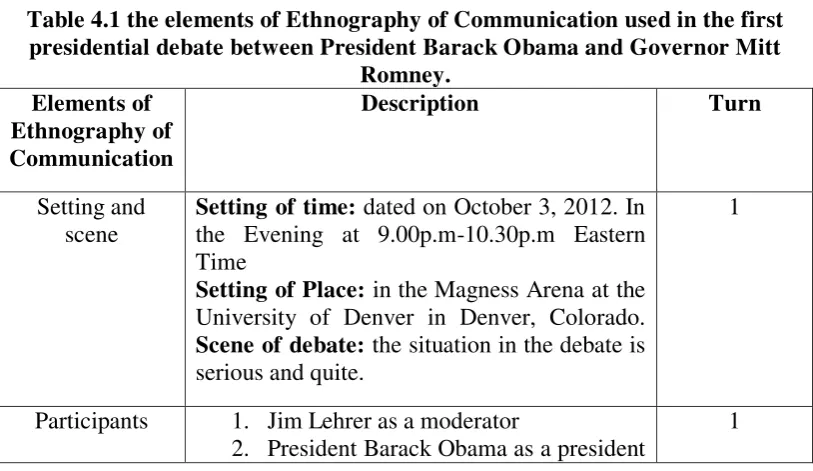
[image:39.595.109.516.525.760.2]Table 4.1 shows the findings of Ethnography of Communication in the first Presidential debate between President Barack Obama and Governor Mitt Romney. The theory of Ethnography of Communication used belongs to Hymes (1972a, 55-57).
Table 4.1 the elements of Ethnography of Communication used in the first presidential debate between President Barack Obama and Governor Mitt
Romney. Elements of
Ethnography of Communication
Description Turn
Setting and scene
Setting of time: dated on October 3, 2012. In the Evening at 9.00p.m-10.30p.m Eastern Time
Setting of Place: in the Magness Arena at the University of Denver in Denver, Colorado. Scene of debate: the situation in the debate is serious and quite.
1
Participants 1. Jim Lehrer as a moderator
2. President Barack Obama as a president
candidate from Democratic Party 3. Governor Mitt Romney as a president
candidate from Republican Party Ends The ends of the presidential debate is
to discuss on differences about domestic issues in United States between the candidates.
1
The ends of Jim Lehrer in the debate is to give topic discussion (how to create new job, to tackle the deficit problem, in social security, in Health Care, in the Role of Government and in the governing) and control the debate (control the time management in the debate)
1, 52, 99, 168, 198, 226
The end of President Barack Obama in the debate is to explain his mission and give argumentation in domestic policy particularly in economy, health care, the role of government, and governing to people in the United States.
2, 57, 102, 171, 201, 231
The end of Governor Mitt Romney in the debate is to explain his mission and give argumentation in domestic policy particularly in economy, health care, the role of government, and governing to people in the United States.
4, 53, 114, 118, 169,
203, 229
Act Sequences 1. Opening stage: The opening stage can be shown in the beginning of the debate when Jim Lehrer (moderator) greeted to the people in the entire world especially in United States.
2. Middle stage: The middle stage is shown from the discussion among Jim Lehrer (moderator), President Barack Obama (first candidate) and Mitt Romney (second candidate). The discussion about domestic issue in United States, specifically in economy, health care, the role of government, and governing. It starts from the economy, divided into three segments, such as to create new jobs, to tackling deficit problem and to Social Security, and the other segment each in one segment. 1,2,4; 52,53,57; 99,102, 114,118; 168,169,171; 198,201,203; 226, 292,231
3. Closing stage: The closing stage is known when Jim Lehrer said thank you to both candidates and everybody who has joined in the first of the 2012 presidential debate.
236
Key The key of the presidential debate is serious, but occasionally, the participants make jokes and laugh.
53, 168, 231
Instrumentalities The instrument of this presidential debate is spoken text.
1
Turn taking 100-102
Standard grammar 2
Filler 99-100
Reparation 235
Repetition 127-130
Colloquialisms 17-18
Incomplete clause 88-90
Closing statement 233,235
Norms The speakers use positive politeness, because there is social status difference between them.
74-76, 138-140.
Ideas Development 1, 52, 99, 168, 198, 226
Rebuttal 106-111
Linguistic features:
The use of question and answer 63-66
The use of present tense 210,211
The use of future tense 22
The use of Past tense 2
The use of Modal Verbs 53
The use of Hedging Utterances 211, 233, 55, 10, 26, 233
4.2 Elements of Ethnography of Communication
The elements of Ethnography of Communication consist of Setting and scene, Participants, Ends, Act sequence, Key, Instrumentalities, Norms, and Genre.
4.2.1 Setting and Scene
Setting refers to the time and place, the concrete physical circumstances in which speech takes place. Setting of time in this analysis is at night. The setting of time can be seen in the opening of the debate, reported by Jim Lehrer from PBS News Hour. It can be shown in the utterance below:
Turn speaker utterance
first of the 2012 presidential debates between President Barack Obama, the Democratic nominee, and former Massachusetts Governor Mitt Romney, the Republican nominee. …‖
Based on the utterance above, the researcher can see that the debate occurred at night. It can be seen when Jim Lehrer says ‗good evening‘ in the beginning of his opening. The time signal also mentioned at U.S. presidential schedule from commission on presidential debate shows that it was held accurately on October 3, 2012 at 9.00p.m-10.30p.m Eastern Time.
Regarding to the setting of place of the debate, it happened in Magness Arena at the University of Denver in Denver, Colorado. It is appropriate with what Jim Lehrer says in the opening of the debate.
Scene refers to the abstract psychological setting or the cultural definition of occasion. Scene in this debate is the situation that only focuses on the situation in the debate. The situation in the debate is serious and quiet. It is because the candidate needed quiet situation to concentrate in delivering their mission in domestic policy, so that the purpose of their plans can be received by people in America clearly. It can be shown in the utterance below:
Turn speaker utterance
4.2.2 Participant
Participant refers to the actors in the scene and their role relationships, including personal characteristics, such as: age, sex, social status, and relationship. The participant includes various combination of speaker-hearer, addresser-addressee or sender-receiver. It generally fills certain social specified roles. The participants in the debate are Jim Lehrer (the moderator), President Barack Obama (the president candidate from Democratic Party), and Governor Mitt Romney (the president candidate from Republican Party). The participants of the debate can be seen in the utterance below:
Turn speaker utterance
1 Lehrer ―Good evening from the Magness Arena at the University of Denver in Denver, Colorado. I'm Jim Lehrer of the "PBS NewsHour," and I welcome you to the first of the 2012 presidential debates between President Barack Obama, the Democratic nominee, and former Massachusetts Governor Mitt Romney, the Republican nominee.…‖
4.2.2.1 Jim Lehrer
the notion of Barack Obama and Mitt Romney in domestic policy specifically in economy, health care, the role of government and governing clearly. Jim Lehrer is very dominant in giving topic discussion in the debate, because he tries to get more information about missions of both candidates. He also wants to convey the messages of their missions in the debate to the people in the world especially in the U.S.
4.2.2.2 President Barack Obama
President Barack Obama, 52 years old, is a president candidate from Democratic Party. He served as president of United States in the previous period. In this debate, Obama becomes the first debate candidate. He came in the presidential debate to deliver his mission in domestic policy in U.S., and to respond the argumentation from another candidate. His relationship with the other participants is not intimate. In the debate, Obama as a president and the partner of debate is a governor that has the same status in this debate. Obama uses formal language in giving argumentation to the moderator and the other candidate to respect each other. As a candidate, Obama has to give an argumentation very clearly to the other candidate and even people in the whole U.S.
4.2.2.3 Governor Mitt Romney
is not intimate. In this debate, Romney and Obama have the same status as the president candidates. In giving argumentation, Romney always uses formal language. The social statuses among the participant of the debate can be seen in the following excerpt:
Turn speaker utterances
58 Lehrer ―Mr. President, I'm sorry —‖
59 Obama ―And that isnot a right strategy for us to move forward.‖ 60 Lehrer ―Way over the two minutes.‖
61 Obama ―Sorry.‖
From, the utterances above, it can be seen that Lehrer has a high social status than both candidates. He can interrupt and stop Obama, because the two minutes of Obama to respond the discussion has finished. So that, Lehrer interrupted and stopped Obama in giving argumentation
4.2.3 Ends
4.2.3.1 The end of the Presidential Debate
The debate aims to discuss on differences about domestic issues in United States between the candidates. It is very important for people in U.S who want to know about vision and mission that will be carried of both candidate. The candidates delivered their plan about domestic policy particularly in economy, health care, the role of government, and governing. So, people in America have a view about their own candidate and their plans. It can be seen from Lehrer‘s utterance:
Turn speaker utterance
1 Lehrer ―… Tonight's 90 minutes will be about „domestic issues‟, and will follow a format designed by the commission. There will be six roughly 15-minute segments, with two-minute answers for the first question, then open discussion for the remainder of each segment. …‖
4.2.3.2 The end of Jim Lehrer (the moderator)
Jim Lehrer has aim to give topic discussion and control the debate. He gives topic discussion about domestic issues in the U.S especially in economy, health care, the role of government, and governing. He asks the candidate to tell their plans specifically. It can be seen from this utterance below:
Segment 1
Turn speaker utterance
In this segment, Jim asked about both candidates‘ plans on how to create
new jobs in America. Jim wanted to know what different views the candidates had.
Segment 2
Turn speaker utterance
52 Lehrer ―All right. Let's talk — we're still on the economy. This is, theoretically now, a second segment still on the economy, and specifically on what do about the federal deficit, the federal debt. And the question — you each have two minutes on this — and, Governor Romney you go first because the president went first on segment one. And the question is this: What are the differences between the two of you as to how you would go about tackling the deficit problem in this country?”
Segment two of the debate is still on economy issue, but on different topic. Jim asked both candidates to explain their plans about how to tackle the deficit problem in America. The main is in federal deficit and federal debt in America.
Segment 3
Turn speaker utterance
99 Lehrer ―All right? All right, this is this is segment three, the economy, entitlements. First answer goes to you. It's two minutes. Mr. President, do you see a major difference between the two of you on Social Security?”
Segment three is also still on economy, but has different segment subject, in this segment Jim wants to know a major difference in both candidates‘ view in
Segment 4
Turn speaker utterance
168 Lehrer ―All right, I think we have another clear difference between the two of you. Now let's move to health care, where I know there is a clear difference — (laughter) — and that has to do with the Affordable Care Act, "Obamacare." And it's a two-minute new segment, and it's — that means two minutes each. And you go first, Governor Romney. You wanted repeal. You want the Affordable Care Act repealed. Why?”
Segment four is about health care. It talks about Affordable Care Act ―Obamacare‖. Jim asked Governor Romney about this program, because he
knows that Romney wanted to repeal it, and he also asked Obama‘s argument
about the reason of Romney‘s plan.
Segment 5
Turn speaker utterance
198 Lehrer ―That is a terrific segue to our next segment, and is the role of government. And let's see, role of government and it is — you are first on this, Mr. President. The question is this. Do you believe — both of you — but you have the first two minutes on this, Mr. President — do you believe there's a fundamental difference between the two of you as to how you view the mission of the federal government?”
Segment five talks about the candidates‘ missions of the federal
Segment 6
Turn speaker utterances
226 Lehrer ―Oh, well, no. But the fact is, government — the role of government and governing, we've lost a (pod ?), in other words, so we only have three minutes left in the — in the debate before we go to your closing statements. And so I want to ask finally here — and remember, we've got three minutes total time here. And the question is this: Many of the legislative functions of the federal government right now are in a state of paralysis as a result of partisan gridlock. If elected in your case, if re-elected in your case, what would you do about that?Governor?‖
228 Lehrer “Well, what would you do as a president?”
In last segment, Jim asked both candidates about what they would do if they were elected as a president, from the first day.
Jim as a moderator also plays role to give turn in the debate by choosing who was telling the plans first in every segment. Besides that, he also stopped the speaker when the time to speak is up. The example can be seen from this utterance below:
Turn speaker utterance
1 Lehrer ―… Let's start the economy, segment one. And let's begin with jobs. What are the major differences between the two of you about how you would go about creating new jobs? You have two minutes — each of you have two minutes to start. The coin toss has determined, Mr. President, you go first.‖
Besides that, Lehrer also plays role to organize the time in the debate, when the candidate must start and finish the discussion. It can be seen in the utterances below:
Turn speaker utterances 172 Lehrer Two minutes— 173 Obama — before —
174 Lehrer Two minutes is up, sir. 4.2.3.3 The end of President Barack Obama
In the debate, Barack Obama as the first president candidate from democratic party has aim to explain his mission and give argumentation in domestic policy particularly in economy, health care, the role of government, and governing to people in the United States. It can be shown in his utterance below: Segment 1
Turn speaker utterance
2 Obama ―… I've got a different view. I think we've got to invest in education and training. I think it's important for us to develop new sources of energy here in America, that we change our tax code to make sure that we're helping small businesses and companies that are investing here in the United States, that we take some of the money that we're saving as we wind down two wars to rebuild America and that we reduce our deficit in a balanced way that allows us to make these critical investments.…‖
improving how to train teachers. The purpose of this program is to train people in Unites States in order to get a job. His second plan is to develop new sources of energy production in America. He wants to make the investment to the wind, solar, and biofuel. Third, is to change the tax code and help small business. It is because he realized that the tax rate in United States is too high, so that he wants to lower it with taking down to 25% and provide tax break for companies that want to invest in America. He also wants to balance budget by reducing the deficit.
Segment 2
Turn speaker utterance
57 Obama ―… Now, we all know that we've got to do more. And so I've put forward a specific $4 trillion deficit-reduction plan.
It's on a website. You can look at all the numbers, what cuts we make and what revenue we raise. And the way we do it is $2.50 for every cut, we ask for a dollar of additional revenue, paid for, as I indicated earlier, by asking those of us who have done very well in this country to contribute a little bit more to reduce the deficit. …‖
very important. He also asked Romney to give specific number of average to reduce deficit.
Segment 3
Turn speaker utterance
102 Obama ―… So my approach is to say, how do we strengthen the system over the long term? And in Medicare, what we did was we said,we are going to have to bring down the costs if we're going to deal with our long- term deficits, but to do that, let's look where some of the money is going. Seven hundred and sixteen billion dollars we were able to save from the Medicare program by no longer overpaying insurance companies, by making sure that we weren't overpaying providers.
And using that money, we were actually able to lower prescription drug costs for seniors by an average of $600, and we were also able to make a — make a significant dent in providing them the kind of preventive care that will ultimately save money through the — throughout the system. …”
In segment three, Obama wanted to criticize about the values behind social security and also Medicare, because it is very important to deficit in America. His plan is to strengthen the system. He didn‘t need a major structural change in
future Social Security.
Segment 4
Turn speaker utterance
171 Obama ―… And let me tell you exactly what "Obamacare" did. Number one, if you've got health insurance it doesn't mean a government take over. You keep your own insurance. You keep your own doctor. But it does say insurance companies can't jerk you around. They can't impose arbitrary lifetime limits. They have to let you keep your kid on their insurance — your insurance plan till you're 26 years old. And it also says that they're — you're going to have to get rebates if insurance companies are spending more on administrative costs and profits than they are on actual care.
Number two, if you don't have health insurance, we're essentially setting up a group plan that allows you to benefit from group rates that are typically 18 percent lower than if you're out there trying to get insurance on the individual market.
Segment four, Obama explains how Obamacare works, because in the turn before, Romney‘s plan is to repeal Obamacare. First, if people have their own
health insurance it doesn‘t mean that government takes over their insurance. They
can keep in their own insurance and the doctor, but the insurance companies must keep for them and their kids until 26 years old. They also should get rebates if insurance companies are spending more on administrative costs and profits than actual care. Second, if people don‘t have health insurance, government will set up
a group plan that allows people to get benefit around 18% lower than if they try to get insurance themselves.
The fact is that when ―Obamacare‖ is repealed, 50 million people are
Segment 5
Turn speaker utterance
201 Obama ―The first role of the federal government is to keep the American people safe. That's its most basic function. And as commander in chief, that is something that I've worked on and thought about every single day that I've been in the Oval Office.
But I also believe that government has the capacity — the federal government has the capacity to help open up opportunity and create ladders of opportunity and to create frameworks where the American people can succeed. Look, the genius of America is the free enterprise system, and freedom, and the fact that people can go out there and start a business, work on an idea, make their own decisions. …‖
In this segment, Obama responds the question about the role of government. He tells that the main function of federal government is to keep American people safe. He also believed that federal government has a responsibility to help open up opportunity and create ladders of opportunity and to create frameworks to make American people successful. As a president he has tried to apply the principles, and when it comes to education, he has a plan named Race to the Top that will reform schools in 46 states around the country. He also wanted to hire another hundred thousand math and science teachers to make sure that the government supplied the people with skilled workforce are able to success. He takes it, because he thinks that it is the kind of investment if federal government can help.
Segment 6
Turn speaker utterance
231 Obama ―Well, first of all, I think Governor Romney's going to have a busy first day, because he's also going to repeal "Obamacare," which will not be very popular among Democrats as you're sitting down with them.
(Laughter.)
But look, my philosophy has been I will take ideas from anybody, Democrat or Republican, as long as they're advancing the cause of making middle-class families stronger and giving ladders of opportunity into the middle class. That's how we cut taxes for middle-class families and small businesses. That's how we cut a trillion dollars of spending that wasn't advancing that cause. That's how we signed three trade deals into law that are helping us to double our exports and sell more American products around the world.…‖
In the last segment, it talked about what the president will do if they are elected starting from the first day. Obama responded that question by giving argument to make middle-class families stronger and giving ladder of opportunity by giving them cut taxes and also to small businesses which works in export and sell American product around the world. The other opinion in this segment is to fight for the security in health insurance that is needed by people in America.
In contrast with Obama‘s plans, Romney as the second candidate has a
different view in domestic policy. He will explain his mission specifically.
4.2.3.4 The end of Governor Romney
particularly in economy, health care, the role of government, and governing to people in the United States. It can be shown in his utterance below:
Segment 1
Turn speaker utterance
4 Romney ―…My plan has five basic parts. One, get us energy independent, North American energy independent. That creates about four million jobs. Number two, open up more trade, particularly in Latin America; crack down on China if and when they cheat. Number three, make sure our people have the skills they need to succeed and the best schools in the world. We're far away from that now. Number four, get us to a balanced budget. Number five, champion small business. …‖
In the first segment, about how to create new jobs in America, Romney has five basic parts for his plans. His plan is to reduce the tax in middle-class, but not on high-income people, because he thinks that the middle-income have been buried under president‘s policies. So that, how to get them going again, first by
making America energy independent. Contrary to Obama, who increases the natural gas and oil in private land, Romney will give double permit and license in government land to get oil from offshore and Alaska. He also wanted to continue to burn clean coal, so that America and North America become energy independent and can create those as a land for jobs. Second, is to open up more trade especially in small business. He wanted to cut taxes to make sure that small business can hire worker more.
their own pathways to get training that they need for jobs. Forth, his plan is to balance budget. He wanted to bring down rates, lower deduction, exemption, and credits at the same time, to create more jobs, so that he can keep getting the revenue that he needs. The last is to champion in small business, his plan is to open up greater opportunities for business people who will go their business in America.
Segment 2
Turn speaker utterance
53 Romney ―… So how do we deal with it? Well, mathematically there are — there are three ways that you can cut a deficit. One, of course, is to raise taxes. Number two is to cut spending. And number three is to grow the economy because if more people work in a growing economy they're paying taxes and you can get the job done that way.…‖ In segment 2, Romney responds about how to tackle the deficit problem in America by three ways plans. One is to raise taxes. He has a different view with Obama, who prefer raising taxes. In Romney‘s opinion, raising taxes can slow
down the rate of growth, so he wanted to lower spending and encourage economy growth at the same time. Next, he will spend the cut, he doesn‘t want to borrow money from China again to pay the government‘s program that not efficient. He
Segment 3
Turn speaker utterance
114 Romney ―What I support is no change for current retirees and near-retirees to Medicare and the president supports taking $716 billion out of that program.”
118 Romney ―Number two is for people coming along that are young. What I'd do to make sure that we can keep Medicare in place for them is to allow them either to choose the current Medicare program or a private plan — their choice. They get to — and they'll have at least two plans that will be entirely at no cost to them. So they don't have to pay additional money, no additional $6,000. That's not going to happen. They'll have at least two plans.…‖ Segment three is still on economy, but has a different segment subject. It discusses about Social Security. Romney responds Obama‘s statement that it will
take $716 billion out of Medicare program. Contrary to his opinion, Romney supported no change in Medicare for current retiree and near-retirees, and for young people he also wanted to keep in Medicare for them and they can choose the current Medicare and private plan. They will have at least two plans that will be entirely at no costs to them. So they don‘t have to pay $6000 for additional money. From his experience private sector can be more efficient than government, and he suggests people to have a private plan, because they can get rid of the insurance company when people don‘t like them and find the other insurance
Segment 4
Turn speaker utterance
169 Romney ―… And unfortunately, when — when you look at "Obamacare," the Congressional Budget Office has said it will cost $2,500 a year more than traditional insurance. So it's adding to cost. And as a matter of fact, when the president ran for office, he said that by this year he would have brought down the cost of insurance for each family by $2,500 a family. Instead, it's gone up by that amount. So it's expensive. Expensive things hurt families. So that's one reason I don't want it.
Second reason, it cuts $716 billion from Medicare to pay for it. I want to put that money back in Medicare for our seniors.
Number three, it puts in place an unelected board that's going to tell people, ultimately, what kind of treatments they can have. I don't like that idea.
Fourth, there was a survey done of small businesses across the country. …‖
Segment four talks about health care, especially in Affordable Care Act ―Obamacare‖. When the question comes to Romney, his plan is to repeal it. He
has a different view with Obama, because in his view, ―Obamacare‖ will spend
costs $2500 a year more than traditional insurance, it is very expensive for each family, and he doesn‘t agree with that plan. Second reason is because Obama
wants to take $716 billion from Medicare to pay it, and his plan is to put back that money in Medicare for the senior. He also does not agree if that money is put in an unelected board to know what kind of treatment that people can have, and he doesn‘t want the president to fight the ―Obamacare‖ whereas 23 million people in
Segment 5
Turn speaker utterance
203 Romney ―… The role of government is to promote and protect the principles of those documents. First, life and liberty. We have a responsibility to protect the lives and liberties of our people, and that means the military, second to none. I do not believe in cutting our military. I believe in maintaining the strength of America's military.
Second, in that line that says, we are endowed by our Creator with our rights — I believe we must maintain our commitment to religious tolerance and freedom in this country. …‖
In segment five about the role of government, due to ―the Constitutional
and the Declaration of Independence‖, the role of government is one, life and
liberty. The government has a responsibility to protect the liberties of people in America, particularly in military, therefore Romney doesn‘t want to cut the
budget in order to make the military in America stronger. Two, is to maintain the commitment to religious tolerance and freedom in America. People in America have a freedom to make their own happiness.
Segment 6
Turn speaker utterance
229 Romney ―… And the challenges America faces right now — look, the reason I'm in this race is there are people that are really hurting today in this country, and we face — this deficit could crush the future generations. What's happening in the Middle East? There are developments around the world that are of real concern. And Republicans and Democrats both love America, but we need to have leadership —
The last segment is about the government and governing, and the question is what the candidate will do if elected as a president. Romney responded that his plan is to bring the people together and get the job done. He will get income up again, by helping 12 million new jobs in America with rising incomes, getting the cost health care down, and keeping America stronger and getting America middle class to work again.
4.2.4 Act sequence
Act sequence refers to the actual form and content of what is said: the precise words used, how they are used and relationship of what is said to the actual topic at hand. The presidential debate consists of three stages such as, opening stage, middle stage and closing stage.
4.2.4.1 Opening Stage
The opening stage can be shown in the begi