Industrial Applications of E-Manufacturing
Mohd Razali Muhamad and Wan Hasrulnizzam Wan Mahmood
Faculty of Manufacturing Engineering, Kolej Universiti Teknikal Kebangsaan Malaysia, Locked Bag 1200, Ayer Keroh, 75450 Melaka, Malaysia.
Abstract
E-manufacturing is one of the approaches that had been considered important in improving the performance and competitiveness of manufacturing organization. The results of the survey carried out on thirty companies that had received funds for e-manufacturing implementation show that e-manufacturing tools that are more frequently used are the internet and local area network. They are mostly used in product design, demand and inventory management, as well as quality management. The electrical and electronic sector appears to be the bigger user of e-manufacturing in fulfilling the e-manufacturing strategy criteria.
Keywords:. e-manufacturing, manufacturing performance, e-manufacturing communication device.
1. Introduction
With the emergence of new concepts and approaches such as ‘e-manufacturing’ there is a need to look at how decisions on investment and implementation of IT-based technologies such as the virtual design and manufacturing, collaborative design and Enterprise Resource Planning (ERP) are carried out. This is important in so far as ensuring the successful adoption of such technologies. The problem with research in such area within the local manufacturing scene is the lack of data on such implementation and/or the unstructured manner in which the technologies are approached.
The paper describes part of a study that has been carried out:
1. to investigate the SMI companies’ understanding and implementation of e-manufacturing applications, and
2. to identify the related issues in e-manufacturing applications.
2. E-Manufacturing
E-Manufacturing is a transformation system that enables the manufacturing operations to achieve predictive performance such as near zero downtime as well as to synchronize with the business systems through the use of web-enabled and tether-free (i.e. wireless, web, etc.) infotronics technologies. It integrated information and decision making among data flow (of machine/process level), information flow (of factory and supply system level), and cash flow (of business system level). E-manufacturing is a business strategy as well as a core competency for companies to compete in today’s e-business environment. It is aimed to complete the integration of all the elements of a business including suppliers, customer service network, manufacturing enterprise and plant floor assets with connectivity and intelligence brought by the web enabled and tether-free technologies and intelligent computing to meet the demands of business / e-commerce practices that had gained great acceptance and momentum over the last decade.
E-manufacturing is concerned with the use of the Internet and e-business technologies in manufacturing industries. It covers all aspects of manufacturing (sales, marketing, customer service, new product development, procurement, supplier relationships, logistics, manufacturing, strategy development) and so on. The Internet also affects products as well since it is possible to use Internet technologies to add new product functions and to provide new services. Application of the Internet is not a one-off project, but a journey that involves dealing with technologies, strategies, business processes, organization and people. Success will come to those firms adopting an integrated approach driven by business needs and opportunities.
3. Technical Devices And Resources For E-Manufacturing
E-manufacturing is more of a software issue regarding the technology involved than hardware. It is also a system issue regarding implementation. This system refers to supply chain, or partnership among customers and suppliers/vendors. There is a generic list of several enterprise software packages that meet specific business issues for broad applicability in e-manufacturing based on main e-manufacturing activities. Table 1 shows the e-manufacturing activities that are suitable to be considered for e-manufacturing application.
Table 1: Manufacturing Activities For E-Manufacturing [1-13].
MANUFACTURING ACTIVITY E-MANUFACTURING APPLICATIONS
1. Product design Computer-Aided Design (CAD)
Design For Manufacturability (DFM)
2. Demand management Online Marketing (OM)
Make-to-stock Demand Management (MTS) Assemble-to-order Demand Management (ATO) Make-to-order Demand Management (MTO) Customer-Relationship Management (CRM)
3. Capacity planning Capacity Planning Using Overall Factors (CPOF)
Capacity Bills Procedure (CBP) Resource Profiles (RP)
Capacity Requirements Planning (CRP)
4. Inventory management Materials Requirement Planning (MRP)
5. Shop floor systems Assembly Line Balancing (ALB) Sequencing/ scheduling (seq/sched)
6. Quality management Quality Planning (QP)
Quality Control (QC)
Quality Engineering (Taguchi Methods) (QE) Quality Function Deployment (QFD)
7. Distribution Distribution Requirements Planning (DRP)
Q,R Continuous Review (Q,R) E-Procurement
Product-Life-Cycle Management (PLM)
8. Work management Business Intelligence, Analysis and Reporting (BIAR)
Knowledge Management (KM) Online Training
4. Research Methodology
In order to achieve the objectives of the research, the data gathering was carried out using postal survey and structured interview with suitably identified companies. Based on the survey data, descriptive statistics will be carried out. The main variables or factors from the survey will be used to conduct the structured interview. The interview will not only dwell on the past implementation, but it will also focus on the future plans and developments.
5. Results and Discussions
5.1 E-Manufacturing Applications
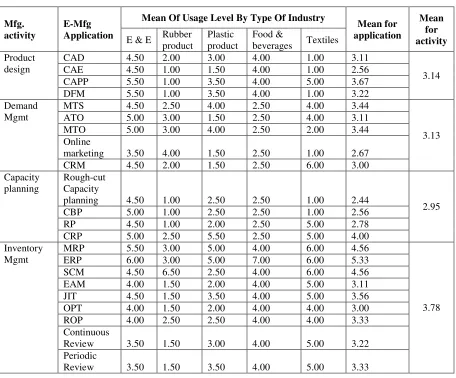
The respondents were asked the extent to which they were using the application of e-manufacturing in e-manufacturing activities. There are eight criteria were subjected to manufacturing activities. i.e., base on the usage level and variety parameters. The results are shown in Table 2.
The mean score in Table 2 verify that overall level of usage in e-manufacturing applications is relatively low. However, the respondents were more familiar with ERP programming. A high degree of usage in ERP programming by respondents was recorded since the companies received grant for ERP Programming from SMIDEC and they were considered to be authority in that application. In addition, the results show the other applications which are considered average such as MRP, SCM and QC.
Automatic identification, online training, rough-cut capacity planning and automated material handling systems are considered least used by respondents. These applications show the overall mean score below 2.50. In other words, these applications were not contributing significantly towards structural aspect of manufacturing strategy. As can be seen in Table 2, the applications of e-manufacturing were highly visible in inventory management, quality management, product design and demand management. Less applications of e-manufacturing was observed in shop floor systems, work management, capacity planning and distribution especially for respondents from rubber products and plastic product. The results were expected because the SMI companies are more familiar with the conventional approaches.
marketing. In terms of capacity planning, the CRP was highly used in plastic product industry followed by electric and electronic and textiles industries. The tool is least use in rubber product and food and beverages industries. Other applications used by respondents are RP, CBP and rough-cut capacity planning. For inventory planning, the majority of respondents used ERP, MRP and SCM. It was followed by JIT, ROP, periodic review, continuous review and OPT. In order to achieve high performance in inventory management, rubber products industry has used SCM instead of other applications.
For shop floor systems, there are nine e-manufacturing applications that can be used. However, three of them are highly used by respondents such as CAM, ALB and seq/sched particularly in the electric and electronic and textiles industries. In addition, there are less companies that had implemented advanced manufacturing mechanism like CNC, FMS and automated material handling systems. For quality management, the results show that the electric and electronic industry was more frequent users of e-manufacturing applications compared to other industries. QC was highly used by respondents in the electric and electronic and plastic products industries with mean score of more than 5.00. The e-procurement and PLM are the highly used techniques of distribution in textiles and electric and electronic industries. The DRP and C, P are only used in the electric and electronic industry. In terms of work management, textiles industry highly used business intelligence analysis and reporting and knowledge management. The electric and electronic and food and beverages industries used moderately the technique.
Mean Of Usage Level By Type Of Industry
Shop floor
Note: 1.00=Least Used (considered not use); 7.00=Highly Used
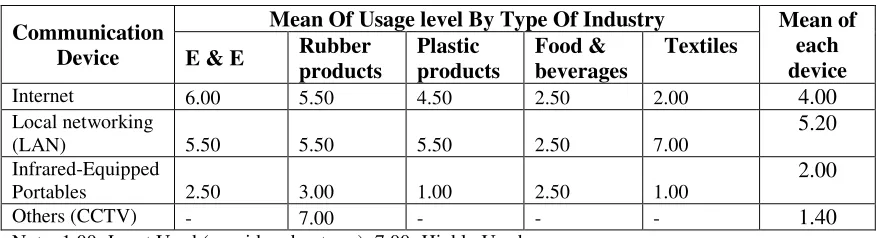
5.2 E-Manufacturing Communication Device
Table 3: E-Manufacturing Communication Device
Communication Device
Mean Of Usage level By Type Of Industry Mean of each device E & E Rubber
products
Plastic products
Food & beverages
Textiles
Internet 6.00 5.50 4.50 2.50 2.00 4.00
Local networking
(LAN) 5.50 5.50 5.50 2.50 7.00
5.20
Infrared-Equipped
Portables 2.50 3.00 1.00 2.50 1.00
2.00
Others (CCTV) - 7.00 - - - 1.40
Note: 1.00=Least Used (considered not use); 7.00=Highly Used
5.3 E-Manufacturing Performance
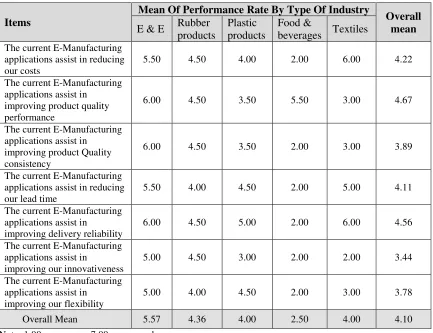
A measure of success in implementation of e-manufacturing can be defined along a few performance parameters. The companies were requested to indicate the performance of their manufacturing related and manufacturing specific criteria (cost, quality, time, delivery, flexibility and innovativeness). The measures used were: 1 for very poor and 7 for very good. The results were summarized in Table 4. It can be deduced from the table that, in general, the respondents were average satisfied with the achievement of the most of the current e-manufacturing applications in e-manufacturing strategy. On average nearly half of the respondents considered the performance on the current e-manufacturing application to be good. For quality consistency, flexibility and innovativeness, the respondents felt that the performance to be poor.
In order to rank the performance, the mean for very good is multiplied by 7, the next one by 6 and so on until the mean for very poor is multiplied by 1. The multiplications are added for each performance base on difference industries. The overall mean gives a measure of ranking of the performance achievement.
Table 4: Performance Of E-Manufacturing
Items
Mean Of Performance Rate By Type Of Industry
Overall manufacturing activities such as product design, demand management and inventory management. The techniques within e-manufacturing appeared to be more widely used in the electrical and electronic sector of the industry. Internet and local area network are the two most commonly used e-manufacturing devices. E-manufacturing plays important role in the achievement in the achievement of manufacturing strategy criteria such as cost, quality, time and delivery reliability.
References
[1] Buffa, E.S. and Miller, J.G. 1979. Production & Inventory Systems: Planning and Control, Irwin, Homewood, IL.
[2] Groover, M. 1987. Automation, Production Systems, and Computer Integrated Manufacturing, Prentice-Hall, Englewood Cliffs, NJ.
[3] Wallace, T.F. 1992. Customer Driven Strategy: Winning Through Operational Excellence, Oliver Wight, Brattleboro, VT.
[4] Vollman, T.E., Berry, W.L. and Whybark, D.C. 1992. Manufacturing Planning and Control Systems, Irwin, Homewood, IL.
[5] Cerveny, R.P. and Scott, L.W. 1989. “A survey of MRP implementation”, Production and Inventory Management Journal, Vol. 30 No. 3, pp. 31-4.
[7] Monden, Y. 1981. “What makes the Toyota production system really tick?”, Journal of Industrial Engineering, January 1981, pp. 36-46.
[8] Ptak, C.A. 1991. “MRP, MRP II, OPT, JIT, and CIM – succession, evolution, or necessary combination”, Production and Inventory Management Journal, Second Quarter 1991, pp. 7-11.
[9] Juran, J.M. and Gryna, F. Jr. 1993. Quality Planning and Analysis, McGraw-Hill, New York, NY.
[10] Barker,T.B. 1986. “Quality engineering by design: Taguchi’s philosophy”, Quality Progress, December 1986, pp. 32-42.
[11] Day, R.G. 1993. Quality Function Deployment: Linking a Company with its Customers, ASQC Quality Press, Milwaukee, WI.
[12] Akao, Y. 1990. Quality Function Deployment: Integrating Customer Requirements into Product Design, Productivity Press, Cambridge, MA.
![Table 1: Manufacturing Activities For E-Manufacturing [1-13].](https://thumb-ap.123doks.com/thumbv2/123dok/700871.86760/2.595.83.521.521.777/table-manufacturing-activities-for-e-manufacturing.webp)