Diagnostic test of endometrial cytobrush in cases of perimenopausal and
postmenopausal hemorrhage
Andrijono*, Gunawan Dwi Prayitno*, Chairil Hamdani**
Abstrak
Perdarahan perimenopause dan perdarahan menopause dapat disebabkan karena berbagai penyebab. Salah satu penyebab yang berbahaya adalah hiperplasia atipik dan karsinoma endometrium. Terdapat beberapa faktor risiko terhadap kemungkinan timbulnya karsinoma endometrium. Kelompok yang mempunyai risiko ini termasuk pada kelompok risiko tinggi. Pada kelompok risiko tinggi ini diperlukan suatu metode untuk mengetahui perubahan kelainan endometrium. Salah satu alternatifnya adalah pemeriksaan sitologi endometrium. Tujuan penelitian ini adalah untuk menguji sensitifitas, spesifitas serta uji kesesuaian antara sitologi endometrium dibandingkan dengan histologi endometrium. Penelitian merupakan penelitian uji diagnostik dengan membaningkan pemeriksaan sitologi endometrium dengan histologi endometrium. Sitologi endometrium dilakukan dengan modifikasi cytobrush dan selongsong IUD. Spesimen dilarutkan dalam NaCI, yang disentrifus, endapan diproses untuk pemeriksaan sitologi dengan pewarnaan Papanicolaou dan Giemsa. Setelah pengambilan sitologi, dilanjutkan dengan kuretase endometrium, spesimen diproses untuk pemeriksaan histologi. Keduanya diperiksa oleh spesialis patologi anatomi. Analisa statistik menggunakan uji diagnostik dengan baku emas pemeriksaan histologi spesimen kuretase. Dalam kurun waktu penelitian terkumpul 45 sampel penelitian, 12 (26.66%) adenokarsinoma endometrium, 6 (13.33%) dengan hiperplasia atipik, 11 (24.44%) hiperplasia nonatipik, 15 (33.33%) sampel tanpa kelainan dan 1 sampel dengan endometritis. Nilai kesesuaian nyata 57.8%, kesesuaian karena peluang 3.38%, kesesuaian bukan karena peluang 54.42%, potensi kesesuaian bukan karena peluang 96.62% dan Kappa 0.56. Disimpulkan bahwa pemeriksaan endometrial cytology dengan cytobrush dapat digunakan sebagai metoda screening pada kelainan ketebalan endometrium, dengan sensitivitas 62.5% dan spesivisitas 62.2%. (Med J Indones 2005; 14: 87-91)
Abstract
Perimenopausal menopausal hemorrhage can be due to by a variety of causative factors. One of its dangerous causes is atypical hyperplasia and endometrial carcinoma. There are a number of risk factors for the occurrence of endometrial carcinoma. The group that has this risk belongs to high-risk group. In this high-risk group, it is necessary to have a method to identify the changes in endometrial abnormality. One of the alternatives is the examination of endometrial cytology. The objective of this study was to evaluate the sensitivity, specificity and correlation test between endometrial cytology and endometrial histology. This study was a diagnostic test of cytological examination of the endometrium as compared with endometrial histology. Endometrial cytology was performed with a modification of cytobrush and IUD shell. Specimen was dissolved into the centrifuged NaCl, and its deposits were then processed for cytological examination with Papanicolaou and Giemsa staining. After the taking of cytology, the process was continued with curettage of the endometrium, and the specimens were processed for cytological examination. Both of them were examined by anatomic pathologist. Statistical analysis used diagnostic test using histological examination of curettage specimens as gold standard. During the period of study 45 study samples were collected, among which 12 (26.66%) were endometrial adenocarcinoma, 6 (13.33%) with atypical hyperplasia, 11 (24.44%) with non-atypical hyperplasia, 15 (33.33%) were samples without abnormality, and one sample with endometritis. Actual correlation value was 57.8%, correlation because of possibility 3.38%, and correlation notbecause ofpossibility 54.42%, potential correlation not because of possibility 96.62%, and Kappa value 0.56. It was concluded that cytological examination of the endometrium with cytobrush could be employed as a screening method in the abnormalities of endometrial thickness, with sensitivity of 62.5% and specificity of 62.2%. (Med J Indones 2005; 14: 87-91)
Keywords:Endometrial cancer, endometrial cytology
Perimenopausal and postmenopausal hemorrhage may be due to a variety of causative factors, among them are hormonal imbalance, endometritis, endometrial hyperplasia, and endometrial carcinoma. The onset of bleeding is a symptom indicating the presence of endometrial abnormality which may be due to atypical
* Department of Obstetrics and Gynecology, Faculty of Medicine, University of Indonesia / Dr. Cipto Mangunkusumo Hospital, Jakarta, Indonesia
** Department of Anatomic Pathology, Faculty of Medicine, University of Indonesia / Dr.Cipto Mangunkusumo Hospital,
hyperplasia lesion, which is an endometrial pre-cancerous lesion or endometrial carcinoma.1,2,3 Several risk factors responsible for the incidence of endometrial carcinoma include genetic factor, obesity, and nulliparity/infertility. By identifying these factors, a group of high risk for endometrial carcinoma can be selected. This high risk group constitutes the group that should receive particular attention for the possibility of suffering endometrial carcinoma. For that reason, it is necessary to have a method which is useful in detecting the presence of endometrial abnormality, especially in high risk group, either accompanied or not accompanied by the symptom of bleeding.
Diagnosis of endometrial abnormality is confirmed through histological examination for which the specimen is taken by endometrial curettage. The incidence rate of endometrial carcinoma ranged between 2 and 3%.1 While curettage intervention was an invasive intervention with a high cost because it requires anesthetic intervention, along with its facilities. In addition, for several reasons, curettage intervention frequently couldnot be performed in the abnormality of endometrial thickness. The thickness of endometrium is a sign of endometrial hyperplasia or endometrial cancer. Because of the low incidence rate of endometrial carcinoma, curettage intervention frequently becomes redundant. For that reason, it is necessary to have a bridging diagnostic intervention which can be performed in out-patient procedures.
One of the alternatives is cytological examination of the endometrium. Endometrial cytology is a bridge of diagnosis. When in cytology a suspicion of atypical hyperplasia or endometrial carcinoma is present in cytology, this can be followed by curettage intervention whose histology is the confirmed diagnosis of endometrial abnormality. Endometrial cytology can also be used as a tool for early detection of endometrial abnormalities because it can be employed in out-patient care. The instrument of endometrial cytology has not yet been popular in Indonesia. In addition, this instrument is relatively expensive for the standard diagnostic test in developing countries such as Indonesia.4 For this reason, we attempted a modification using cytobrush and used IUD shell. We chose cytobrush to be used in this study primarily because this tool is readily available and relatively inexpensive. With this modification, we hoped that endometrial cytology can be carried out at a very low cost. This study was aimed to identify the sensitivity and specificity of this modified instrument, such that
we may be able to identify the possibility of using this instrument for detecting endometrial abnormalities.
METHODS
This study was a diagnostic test trial. Samples of the study were patients with complaints of hemorrhage at perimenopausal and postmenopausal age. Sample size by P 92.5%, Z 1.962 and d 7.5%, we need saples were 48. Each of the study samples underwent endometrial cytology, which was followed by curettage of the uterine cavity. Curettage was employed as a comparing factor because it represents a standard intervention for diagnosis of endometrial abnormalities. Dilatation and curettage have a reasonably good accuracy, approximately 78%, compared with specimen of hysterectomy.5 The results of both examinations were compared with each either. Endometrial cytology was carried out using cytobrush, which was put into IUD shell (this shell was aimed to protect cytobrush from the false positive possibility because of contamination of abnormality in the endocervix.). Next, the shell which contained cytobrush was put into the uterine cavity after uterine sounding has been performed. The shell was then slightly pulled and cytobrush was rotated 3600 clockwise for five times. After the rotation had been completed, cytobrush was reinserted into the shell, and then this shell was withdrawn. After being outside of the uterine cavity, cytobrush was inserted into \reaction tube containing 0.9% NaCl. This reaction tube was then centrifuged at a speed of 25 rpm for five minutes. After being re-centrifuged, the deposit was taken and smeared on the object glass. The object glass was fixated into 95% alcohol for a minimum of 30 minutes. Part of the deposit was processed again using Cytospin II at a speed of 10 x 110 rpm for 15 minutes. Further, the specimen was stained with Giemsa, while the first specimen was stained with Papanicolau. The results of cytological examination were compared with paraffin specimen from the curettage. Statistical analysis used diagnostic test, with gold standard of histological examination of curettage specimens.
RESULTS
Table 1. Relationship between age and histology of endometrium
Table 2. Relationship between endometrial thickness and histology of endometrium
Endo-It is evident from this table that cases with endometrial thickness at ultrasonography less than 10 mm were found with no endometrial carcinoma or atypical hyperplasia.
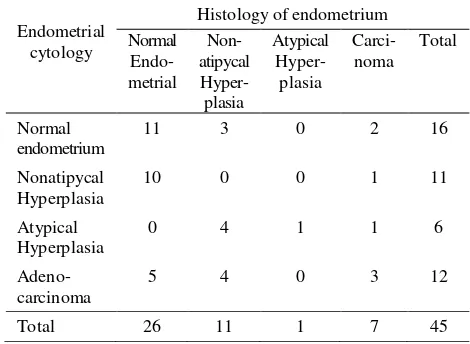
As many as 11 cases with normal endometrium, 1 case with atypical hyperplasia, and 3 cases with endometrial adenocarcinoma showed a similarity in endometrial cytology and histology of endometrial curettage ( Table 3 ). It proved that at histology two cases with normal endometrium in cutology were found to have carcinoma. Conversely, of 12 cases that were declared carcinoma at endometrial cytology, there were only 3 (25%) cases proved to be carcinoma at the histology of curettage specimens.
The table 4 showed that sensitivity of endometrial cytology was 62.5%, specificity 62.2%, positive predictive value 26.3%, and negative predictive value 88.5%, and likelihood ratio 2.29
Table 3. Comparison of the results between histology of endometrial and histology of endometrial curettage
Endometrial
Table 4. Comparison between the results of endometrial cytology and those of endometrial histology
Endometrial
Table 5. Degree of correlation (kappa) between endometrial cytology and endometrial curettage correlation not due to probability 96.62%, and Kappa 0.56.
DISCUSSION
in these obstacles is the unavailability of the apparatus of endometrial cytology, and the relatively expensive price of cytology instrument. Thus, in this study, the investigator attempted to make out a modification of endometrial cytology by using cytobrush which was combined with IUD shell, and with this modification it is hoped that the examination of endometrial cytology can be carried out in Indonesia. In addition, this is due to the reason that diagnostic criteria of endometrial cytology have not yet been established. Endometrial histology is a gold standard of our study. We had histology from endometrial curettage. However, the intervention of endometrial cytology which can be performed in out-patient care may be used in assessing the suspected abnormality of endometrium, even though it is not accompanied by the complaint of bleeding. Table 1 on the relationship between age and endometrial histology demonstrates that in this study the majority of cases (95.5%) aged less than 55 years. However, of two cases at the age above 60 years, one suffered from endometrial carcinoma. On the other hand, in the cases at the age lower than 55 years, 6 (13.9%) cases were found to suffer from endometrial carcinoma. Although the samples of this study were relatively few in numbers, it seems that the risk of endometrial cancer is higher in patients ( ½ ) above 60 years of age. In view of the fact that the endometrial thickness in both these patients had endometrial thickness greater than 10 mm, both had experienced menopause, there was a strong indication to perform assessment of endo-metrium in postmenopausal hemorrhage (age > 60 years).Endometrial thickness is one of the parameters indicating the presence of endometrial abnormality that may lead to endometrial hyperplasia and endometrial carcinoma. Endometrial thickness was considered to be normal in premenopausal women if it was less than 15 mm, and in postmenopausal women when it is less or equal to 5 mm. By using endometrial thickness less than 15 mm for premenopausal women and less than 5 mm for postmenopausal women as a standard, sensitivity of 83.3%, specificity of 75.8%, positive predictive value of 23.8%, and negative predictive value of 98% were found. In the present study no case of endometrial carcinoma with endometrial thickness less than 10 mm was found. As many as 7 cases out of 24 cases (29.16%) with endometrial thickness greater than 10 mm were endometrial carcinoma, and one case was atypical hyper-plasia, while 4 cases had not experienced menopause and another 4 had experienced menopause. Therefore,
in the present study the incidence of atypical hyperplasia and endometrial cancer with endometrial thickness greater than 10 mm was 33.3%. Data from this study also provided an opportunity for a study on differences in endometrial thickness between endometrial hyperplasia and endometrial carcinoma. There is a probability that there is a difference in endometrial thickness in both these abnormalities in Indonesian population. These data demonstrated a consistency with a report from Patai et. al. that stated that the factor of endometrial thickness was an important indication for the possibility of endometrial ab-normalities, such as endometrial hyperplasia and endometrial carcinoma.6
or endometrial cacer based on histology. Cytology examination just for screening of hish risk women or abnormal endometrial thickness. Curettge as an invasive procedure could not be used as a screening of endometrial hyperplasia or endometrial cancer. However, the examination of endometrial cytology could be used as a screening or in the condition of abnormal endometrial thickness without or with complaint of hemorrhage. Examination of endometrial cytology is performed for screening purposes, because it can be carried out with low cost and in out-patient care. Curettage intervention frequently experienced difficulties if only abnormalities such as endometrial thickness without complaint of hemorrhage are found.
CONCLUSION
Examination of endometrial cytology by using cyto-brush can be used as a screening method in abnormalities of endometrial thickness, with sensitivity of 62.5% and specificity of 62.2%.
REFERENCES
1. Kaku T, Tsukamoto N, Hachisuga T, etal. Endometrial carcinoma associated with hyperplasia. Gynecol Oncol 1996;60:22-5
2. Duggan B, Felix J, Muderspach L, Tsao J, Shibata D. Early mutational activation of the c-Ki-ras oncogene in endometrial carcinoma. Cancer Res 1994;54:1604-7 3. Sasaki H, Nishii H, Tada A, Furusato M, Terashima Y,
Siegal GP, et al. Mutation of the Ki-ras protooncogene in human endometrial hyperplasia and carcinoma. Cancer Res 1993; 53:1906-10
4. Masem JA, Kensel E. Liquid fixation of endometrial brush cytology ensure. well-preserved, representative cell sample with frequent tissues correlation. Diagnostic Cyto-pathology 1996;14:367-74
5. Obermair A, Geramou M, Gucer F, Denison U, et al. Endometrial cancer : accuracy of the finding of a well differentiated tumor at dilatation and curettage compared to the findings at subsequent hysterectomy. Int J Gynecol cancer 1999;9:383-6