Recent
advances
in
the
rapid
serodiagnosis
of
Tlphoid
fever
INTRODUCTION
Typhoid
fever
remains
a
public
health problem in
most developing countries.
The
available
conven-tional
methods
remain unsatisfactory
since
they
aretoo
slow
to
allow quick
decision
by
the clinician.
Culture method may show specificity but
it
lacked
sensitivity and
speed.
It
produced
results
within
2-7
days and
casesof culture
negative
typhoid
were
well
recognisedl'z.
The
antibody detection resr (Widal
test) although widely
used,
lacked
speed,
sensitivity
and specificity. For meaningful interpretation
of
the test,demonstration
of
4fold
rise
in
antibody titers
be-tween acute and convalescent sera
10-14
days
later
was essential.
Dept. of Medical Microbiology and Parasitology and
Depart-ment of Paediatrics, School of Medical Sciences, IJniversiti
Sains Malaysia 16150 Kubang Kerian, Kelantan, Malaysia
s3-1
An
ideal diagnostic
test
for
typhoid should
be rapid,
easyto
perform,
sensitive
aswell
asspecific. Neither
of
the methods mentioned satisfied the
criteria.
Thus
there
is
a
need
to
develop a rapid and specific
test.Combined
with
sensitive diagnosis,
the
test would
provide
for
prompt
and
effective
management
of
ty-phoid
fever.RATIONALIZATION
TOWARDS
DEVELOP.
MENT
OF
A RAPID ANTIBODY
DETECTION
TEST FOR TYPHOID
The availability
of a
specific anrigen
for
S.
typhi
would allow
for
thedevelopment
of
aspecific
test fortyphoid. We
have
previously determined that the
50
kD
outer
membrane
protein
is
antigenic as
well as
specific
for S.
typhi
sinceit only
reacted
immunologi-cally with typhoid
sera3.Further evaluation of
the
an-tigen using the dot
EIA
method
revealed
that the
50
kD
antigen
could
detect the
presenceof
specific
IgM
and
IgG
in
sera
from
patients
with
acute
typhoid4.
A. Ismail, T.A.
Tuan
Ibrahim,
K.E.
Choo,
W.N. Wan Ghazali
Abstrak
Pengembangan suatu tes diagnosis spesffik untuk tifoid memerlukan penggunaan antigen qtesifik Penemuan antigen spesifik 50 kDa pada membran luar Salmonella typhi membawa kepada pengembangan sua.îI', tes cepat Dot EIA (Typhido{M) mtuk mencleteksi
adanya IgM dan IgG antibodi spesffik anti bakteri. Tes ini mempunyai sensivitas 957o, nilai duga negatif yang tinggi clan dapat
mem-berikan hasil dalam waktu 3 jam. Deteksi IgM saja atau dengan IgG akan memberiknn kesan tifoid akut, setnentara deteksi IgG saja memberikan beberapa interpretasi seperti ktnvalesen atau kemungkinan ùtfeksi uLang. Disebabkan tidak adanya kekebalan terhadap
demam tifoid, pasien pada daerah endemisitas tinggi sering mengalami infeksi ulang. Pada kejadian infeksi ulang akan terjadi tanggap kebal sekunder dengan suatu efek peningkatan tajam IgG yang bermakna, melebihi IgM yang pada akhimya ticlak dapat dideteksi.
Ke-mungkinan strate7i untuk memecahknn masalah ini adalah mendeteksi adanya IgM yang tersentbunyi dengan ntenyingkirkan IgG total.
Pengembangan suatu tes deteksi IgM 3 jam (Typhittot-MrM ) telah memberikan cliagnosis demam tifoid akut secara tepat dan dapat digu-nakan untuk membedaknn kasus akut dari kanvaLesen. Data penelitian unhtk mengevaLuasi sensitivitas, spesifitas clan keuntungan dari berbagai tes dibanlingkan dengan metode konvensional memperlihatkan bahwa tes tersebut memberikan suatu tes aLternatif yang dapat diandalkan seLain tes Widal.
Abstract
Development of a specific diagnostic test
for
typhoid requires the use of a specific antigen. The cliscovery of the specific 50kD antigen in the outer membrane of Salmonella typhi led to the developtnent of a rapid dot EIA test (TyphidotrM ) to cletectfor
the presence of specffic IgM and IgG antibodies to tlrc bacterict. Tlrc test has a sensitittity of 95Vo, a high negative predictive value and co4Ld produceresults within 3 hours. The detection of IgM alone or with IgG wouLd suggest acute typhoid while the detection of IgG only posed several interpretations such as convalescence or possible re-infection. Due to the lack of immunity to typhoitl feve4 patients
in
higttly endemic areas often have re-infections. In the event ofcurrent re-infectian., there wiLI be a secondary immune response with a signfficant "boosting"effect of IgG over IgM such that the latter could not be detected. A possible strategy to resolue this problem is to "unmask" the presence of IgM by removing total IgG. The development of a 3 hour IgM detection test (Typhidot-MN) is useful in areas of high enclemicity since
40
Typhoid Fever and other SalmonellosisThis discovery
led
to
the development
of Typhidot, a
dot enzyme
immunoassay
for
the rapid detection
of
specific
IgM
and
IgG
antibodies
to
S.typhi.
In
designing an antibody detection test,
several
fac-tors
need
to be
considered.
A test
that
detected
IgM
alone
would reveal
acute
typhoid while detection
of
both
IgM and
IgG would
also suggest acute
typhoid
but
in the middle-phase
of infection.
On
the
other
hand,
atest
that
detected
either total antibody or IgG
alone posed several
interpretations
such
as convales-cenceor re-infection.
The
long
presenceofIgG after
an infectioncombined
with
excessive exposure to
theorganism
in highly
endemic
areaswould significantly
contribute towards
apparent false
positive
results
for
such
atest.
In the
event
of current re-infection,
therewill
be a
secondary
immune
response with
asignif,r-cant "boosting" effect
of
IgG over
IgM
suchthat
thelatter could
not
be detected.A
possible strategy to
re-solve
this problem is to
remove the
IgG
so asto
"un-mask"
the presence of IgM.
Creation
of such
adiag-nostic test would differentiate new
from
past
infec-tions.
This
paper described the use
of the
specific
antigen
for
S.typhi
in
the development
of a rapid dot
enzyme immunoassay test named
Typhidot-M to
de-tect
for
the presenceof specific IgM in
acutetyphoid.
The test
could
produce results
in 3
hours.Retrospective studies
were
performed
to
evaluate
both dot enzyme immunoassays (Typhidot
andTyphi-dot-M ) with
regard
to
their
sensitivity, specificity,
Med
J
Indonespositive
and negative
predictive
values
compared to
Widal
andculture
method. Usefulness
of
both
testsin
the
various clinical
settings were also
discussed.MATERIALS AND METHODS
Development of
arapid IgM
detection
testfor typhoid
In an
antibody detection
test,in
order
to
detect
for
thepresence
of a specific
IgM, total IgG
in the
serum
sample must be
removed or inactivated. Inactivation
of IgG would
remove
competitive binding
and
allow
accessibility of
theantigen to the
specific IgM,
if
pre-sent.Prior
to
thedevelopment
of
the test, the bacteria
was grown,
harvested
and
its
antigens prepared
aspreviously
described3.
Following this,
the patient's
seraand
control
serawere IgG inactivated
ând
incu-bated
with
nitrocellulose
that
had been previously
predotted with the specific antigen.
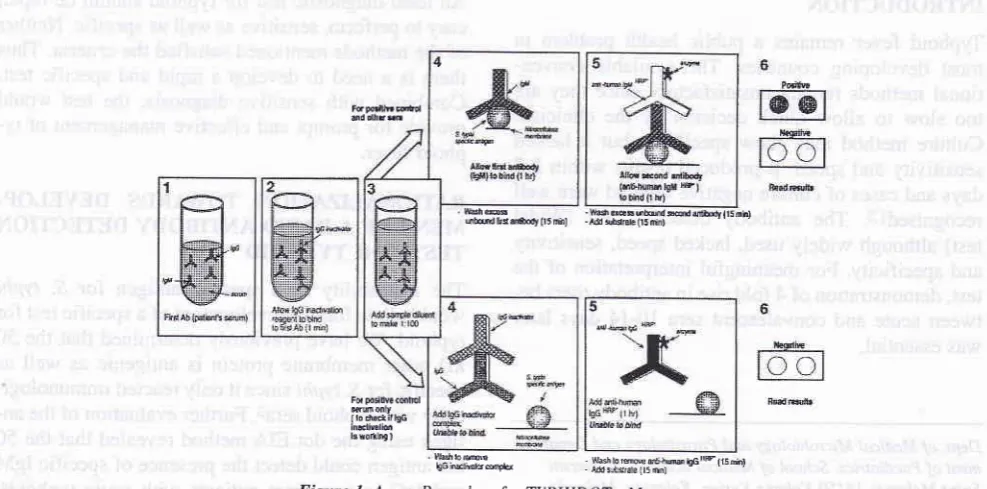
A
period
of
onehour was given
for
the antibody-antigen reaction to
form
a complex.
To
visualise
the
antigen-antibody
complex,
the strips were incubated
with
peroxidase
conjugated
anti-Human IgM. After
a reaction timeof
one hour, a chromogenic substrate was added
for
positive
antigen-antibody reaction, indicated
by colour
development. The results were
readvisually. positive
results were indicated by the development
of
a blue
colour as intense
or
more intense than
that
of
thepositive control.
The
total
assaytime for
the test
is 3
hours.
A
detailed mechanism
of
the
rapid
IgM
detec-tion
test
called
Typhidot-M is
shown
in Figure
1.FqFdllF dC ûd olfrrnr
bhffi -hûcs6Mdddùfyll5nh) ubdfr es ùttudy (t5 mh) - M !bd6tê 05 dnl
Fd poslNa c@hol Ëffi only ilo ddirbG inætirolion lsroillng )
Il,rsh
rseh;ii"Ë:*Fu
to rmrÉ [image:2.595.48.542.485.729.2]. ffij8jil3i
Figure 1. Assay Procedure
for
TYPHIDOT -M
5
Retrospective studies to evaluate the usefulness
of
T!-phidot
and
Tfphidot-M
In
order
to
evaluate
the performance
of
both
assays,retrospective studies were done
in
an endemic
areaamong
febrile
children
admitted
into the
General
Hospital, Kota Bharu, Kelantan,
Malaysia and
among
the outpatients (comprising
of
patients
of all
ages )that
attended
the outpatient
clinic
or from the
Acci-dent and
Emergency
Unit at the Universiti Sains
Ma-laysia Hosçital. Kubang Kedan,
Ketantan,, Mala.gsia.The aim was to evaluate the performance
of the
testscompared
to
Widal
and the culture method
among
febrile patients
in
a usualhospital setting.
The study among
135 febrile children were divided
into 2 groups;
i)
those who were culture positive
andhad clinical
features suggestive
of typhoid fever
(n=
62)
andii)
those
who were culture
negative and had
clinical
evidence
of
another diagnosis (n=73). The
list
of non typhoid included malaria, dengue,
paraty-phoid, scrub typhus, hepatitis, gram-negative
septi-caemia, and
viral
fevers. The criteria
for
clinical
ty-phoid
was
asdescribed
int.
To evaluate the
perform-ance of the tests used amongst adults
and children, a secondretrospective study was
performed. The study
comprised
of
103
patients
of
all
ages attending the
outpatient and accident and emergency
clinics.
The
criteria
for
division into the
two groups
were similar
to those used for the febrile children.
RESULTS
Table
1.
Comparison of culture, Widal, Typhidot and Typhidot-M to clinical diagnosis among febrile children admitted to a hospital in an endemic area.Category
No
Culture
Widal
TyphidotTyphidot-M
Clinically typhoid
Clinically non-typhoid
The
results
obtained
for
the
retrospective
study
among febrile children were summarised
in
Tâble
1.The results showed
very little difference in diagnostic
sensitivity
between Widal, Typhidot
and Typhidot-M
when used amongst
febrile
children
(>90Vo).
How-ever, sensitivity
shown
by the culture technique was
markedly
low
(45.2Vo).
In
terms
of
specificity,
the
culture technique showed I00Vo accwacy. Typhidot
and Typhidot-M
gave better results (>90Vo
specific-ity)
compared to the Widal test (817o).
Despite
being
useôin
an enàemrc
area, the useol'Wiàa\,\ypÏràot
andTyphidot
-M
amongst children
showed
compara-bte high negative
predictive
values (>907o)
while the
culture method remained
low
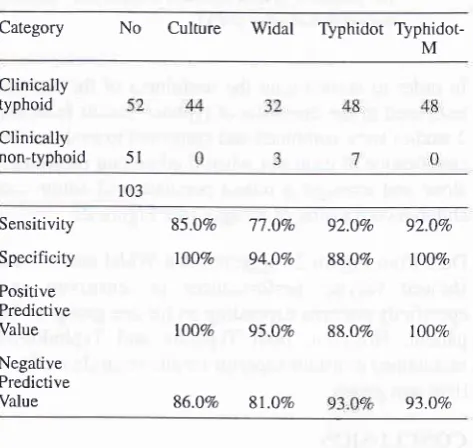
(68Vo).Table
2.
Comparison of culture, Widal, Typhidot andTyphidot-M to
clinical diagnosis among outpatients of all ages attending a hospital in an endemic area.Category No
Culture
Widal Typhidot TyphidorM
Clinically typhoid
Clinically non-typhoid
Sensitivity
Specificity
Positive Predictive
Value
Negative Predictive
Value
85.0Vo 77.0Vo 92.0Vo
92.0Vo100%
94.0Vo
88.O%
IOOVo100%
95.0Vo 88.OVo
100Vo86.0Vo
8l.0%o 93.OVoWhen
testedamong outpatients
of all
ages,the results
summarised
in
Table 2 showed
Typhidot and
Typhi-dot-M to
have the best sensitivity profiles
amongst
the tests used but
with little
difference
in
sensitivity
pattern between
them (both
at
92Vo).
The
culture
technique showed
an
improved sensitivity
of
85Vocompared
to
that
obtained
for
the
children
group,
while Widal
showed the least sensitivity (77Vo).In
terms
of
specificity, Typhidot-M proved
to
be equal
to
the culture technique
at
l)}Vo.'Widal
showed
ahigh
specificiry
result of
(94Vo)
while
Typhidor
dropped
to
88Vo.However, in predicting
negative
ty-phoid
in
an endemic area,
both dot
EIA
tests were
equally superior (both
at
93Vo) when compared to
Widal (8lVo) and culture
(86Vo).5I
103
57
t4
28
135
Sensitiviry Specificity
Positive Predictive
Value
Negative Predictive
Value
45.2%
91.17o
9O.3Vo
9A3Vo100Vo
80.8Vo
9l.7Vo
93.lVo100%
80.3Vo 90.3Vo
91 .8Vo [image:3.595.44.282.263.728.2] [image:3.595.305.542.327.551.2]42 Typhoid Fever and other Salmonellosis Med
J
Indones@o
zulI
tllÈÈ
[image:4.595.49.541.86.304.2]<t) a
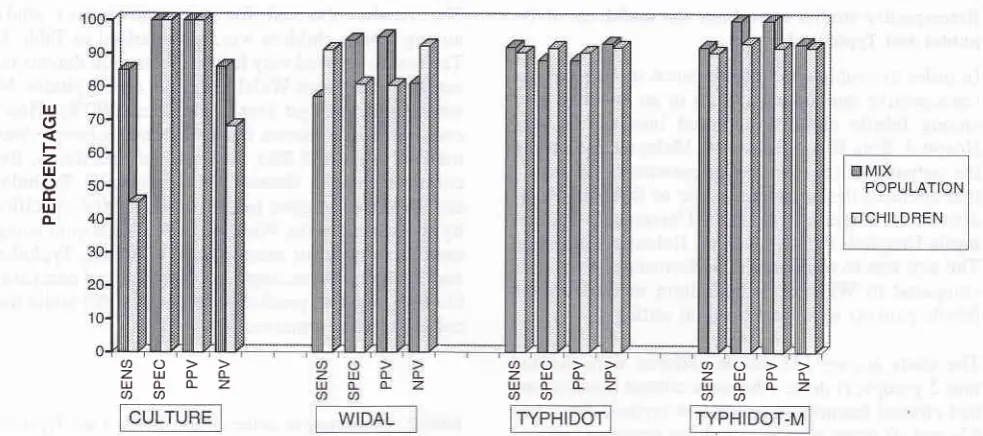
Figure 2, Comparatitte usefulness of the Widal, culture, Typhidot and Typhùlot-M among the paediatric patients antl patients of all ages.
The various tests were shown in terms of their sensitivity (SENS), specificity (SPEC), positive predictive value (PPV) and
negct-tive predictive value (NPV). lrJ
o
F
z
IJJ
o
É.
uJ
o-ao
Zr.llÀrL I.IJLÈZ aaÈ
z
ao
zul(LÀ
ulÈ(Lz
aU)
In
order
to
demonstrate
the
usefulness
of
the
various tests usedin
the diagnosis
of typhoid,
resultsfrom
the2
studieswere combined
and comparedto
evaluate thesignificance
of
eachtest when
used among paediatricsalone and amongst
a mixed population
of
adults
andchildren comprising
of all
ages (seeFigure
2).Data
from Figure 2
suggestedthat
Widal
andculture
showed
varying
performances
in
sensitivity
andspecificity
patterns depending
onthe
agegroup
of
thepatient. However,
both
Typhidot and
Typhidot-M
maintained constant superior results regardless
of
pa-tient
agegroup.
CONCLUSION
It
was
the intention
of
the
study
to
compare culture,
Widal, Typhidot
andTyphidot-M
to
clinical
diagnosis
since
all four
methods tested
were simply
diagnostic
tools used
to confirm clinical
suspicion
of
typhoid.
In
the laboratory diagnosis
for
typhoid fever, a
testregarded
asthe
gold
standard should approach
1007oin
terms
of
its
sensitivity, specificity
,
positive
andnegative
predictive
values when
usedin
patients,
re-gardlessof
the
agegroup. Results
of
theretrospective
study showed that
Typhidot
andTyphidot-M
were
su-perior
to
the culture method. Although culture
wasregarded as
the gold
standard,
it
could not
compete
with Typhidot
and
Typhidot-M
tests
in terms
of
sen-sitivity,
negative
predictive value
aswell
as speed.Despite
problems
of
accurate diagnosis
associatedwith
the
Widal
test,
our
studies showed
that the
test
may
beuseful
among paediatric patients.
Other
stud-ies on the Widal
test used among
febrile children in
endemic areas have
also
reported
similar
conclu-sions5.
Our
studies showed
that Typhidot
and
Typhi-dot-M
satisfied
thecriteria
for
anideal diagnostic test
for
typhoid and
hence
could be
used
to
replace
the
Widal
test.Both
testswhich
hadthe
addedadvantage
of
diagnosis
using
asingle
serum specimen
could
beused
in
conjunction
with
the culture method
for
therapid and
accurate
diagnosis
of
typhoid
fever.
The
culture
method despite
shortfalls
in
speedand
sensi-tivity
is
still
useful
for
antibiotic sensitivity
testing.
The lack
of
special equipment needed
to
perform
both dot
EIA
tests allowed them
to
be used
in
thefield
andin the small district hospitals
where
culture
facilities
may not
beavailable.
Another
addedadvan-tage
of
the testsis its
stability. Antigens
predotted
andpreblocked on the nitrocellulose strips
are stable
for
at
least
I
year when
kept
at4"C.
It
is interesting to note that
Typhidot
andTyphidot-M
have comparable
high
diagnostic performances when
tested
in
Malaysia.
This may be
due
to
the fact
that
Malaysia
hasa
low incidence of typhoid.
In
apopu-lation of high endemicity
where
incidence
aswell
asrelapse
cases arerampant,
Typhidot-M is
anticipated
to
perform
better over
Typhidot in providing
anavailability
of
highty
specific rapid diagnostic
testsfor
typhoid provides the
avenue
for
clinicians to
de-cide
on
prompt
and
effective
management.ACKNOWLEDGEMENTS
We thank the
Ministry
of
Science,
Technology
andEnvironment, Malaysia,
for
the
funds
to
conduct
the study.REFERENCES
1.
KE Choo, SJ Oppenheimer, IsmailA,
OngKH.
Rapidse-rodiagnosis of typhoid fever by dot enzyme immunoassay in
an endemic area. Clin Infect Dis 1994; 19: 172-6.
Ross IN, Abraham T. Predicting enteric fever without
bacte-riological culture results. Trans R Soc Trop Med Hygl987; 81: 374-7.
Ismail A, Ong KH, Abdul Kader Z. Demonstration of an
an-tigenic protein specific for Salmonella rypài. Biochem Bio-phys Res Comm 1991; 181:301-5.
Ismail A, Abdul Kader Z, Ong KH. Dot enzyme immunosor-bent assay for the serodiagnosis of typhoid fever. Southeast
Asian J Trop Med Pub Hlth 1992;22: 563-6.
KE Choo, Razif AR, Oppenheimer SJ,
Ariffin
WA, Lau J, Abraham T. Usefulness of the Widal test in diagnosing child-hood typhoid feverin
endemic areas.J
Paediatric Child Healthl993; 29:36-9.2
3
4