ORIGINAL PAPER
Ag and Cu loaded on TiO2/graphite as a catalyst
for
-contaminated water disinfection
Fitria Rahmawati*, Triana Kusumaningsih, Anita M. Hapsari, Aris Hastuti
Department of Chemistry, The Faculty of Mathematics and Natural Sciences, Sebelas Maret University, Jl. Ir. Sutami 36 A Kentingan Surakarta, Indonesia
Received 13 October 2009; Revised 11 February 2010; Accepted 12 February 2010
TiO2 film was synthesized by means of the chemical bath deposition (CBD) method from TiCl4 as a precursor and surfactant cetyl trimethyl ammonium bromide (CTAB) as a linking and assem-bling agent of the titanium hydroxide network on a graphite substrate. Ag and Cu were loaded on the TiO2 film by means of electrodeposition at various applied currents. Photoelectrochemical testing on the composite of Ag–TiO2/G and Cu–TiO2/G was used to define the composite for
Escherichia coli-contaminated water disinfection. Disinfection efficiency and the rate of disinfection
of E. coli-contaminated water with Ag–TiO2/G as a catalyst was higher than that observed for Cu–TiO2/G in all disinfection methods including photocatalysis (PC), electrocatalysis (EC), and photoelectrocatalysis (PEC). The highest rate constant was achieved by the PEC method using Ag–TiO2/G,k was 6.49×10⁻² CFU mL−1 min−1. Effective disinfection times of 24 h (EDT24) and 48 h (EDT48) were achieved in all methods except the EC method using Cu–TiO2/G.
c
2010 Institute of Chemistry, Slovak Academy of Sciences
Keywords:Ag–TiO2/G, Cu–TiO2/G,Escherichia coli, disinfection
Introduction
Waste produced by humans and animals signif-icantly contributes to the contamination of surface water and ground water. Contaminants of concern include nutrients (nitrate-nitrogen and phosphorus) and bacteria. Escherichia coli is a well-known indi-cator bacterium (Cho et al., 2004). If the environment is conducive to the survival of E. coli, it may also be conducive to supporting other potentially harmful pathogens.
Chlorine, chlorine dioxide, ozone, and ultraviolet radiation are used as disinfectants in water treatment facilities around the world. Among them, chlorine is widely used to disinfect drinking water because of its low cost and wide range of available information on it. However, it can form toxic by-products such as car-cinogenic trihalomethanes (THMs). Increasing chlo-rine dosage and residence time can improve disinfec-tion levels. Yet, this can lead to increased THM
for-mation; therefore, the reduction of organic pollutants is required prior to chlorine disinfection (Kabir et al., 2003). Ultraviolet radiation studies on E. coli have been carried out since the mid-20th
century (Kantor & Deering, 1966; Barner & Cohen, 1956). Doubleday et al. (1977) studied the ultraviolet-induced mutation in E. coli, and the evaluation of E. coli cells damage has been studied in recent years (Sinha & Häder, 2002; Kappke et al., 2005; Friedberg, 2003).
Over the recent years, much attention has been di-rected to heterogeneous photocatalytic detoxification, where water pollutants are degraded by irradiation of an aqueous suspension of pollutants with powdered semiconductor oxides, primarily focusing on TiO2 as
a highly active and durable photocatalyst (Xu et al., 2008; K¨or¨osi et al., 2007; Chu et al., 2008; Akurati et al., 2007; Rincón et al., 2001).Escherichia coli in-activation in the photocatalytic treatment using TiO2
has been extensively studied (Wei et al., 1994; Kikuchi et al., 1997; Ohno et al., 1998; Dunlop et al., 2002).
*Corresponding author, e-mail: [email protected]
Study on the killing mechanism of bacteria by pho-tocatalytic treatment was carried out by Maness et al. (1999). However, the quantum efficiency of photo-catalytic degradation on bare titania is relatively low as this process, which involves the transfer of pho-togenerated electrons and holes created within the semiconductor particles, competes with the recombi-nation of these charge carriers. A potentially promis-ing route to improve photocatalytic efficiency is to separate and hence reduce the recombination using an applied potential. A research conducted by But-terfield et al. (1997) produced photoelectrochemical disinfection not only forEscherichia coli but also for
Clostridium perfringensandCryptosporidium parvum
(Christensen et al., 2003). Other studies on photoelec-trochemical disinfection were conducted by Harper et al. (2001), Christensen et al. (2003), and Egerton et al. (2006). Many studies have been devoted to increas-ing the photocatalytic activity of TiO2. In particular,
Ag deposition on thin film of TiO2 on an ITO
(in-dium tin oxide) substrate (TiO2/ITO) was found to
improve the photocatalytic activity of TiO2 because
migration of photogenerated electrons into metal par-ticles can increase the lifetime of holes and reduce the possibility of recombination (He et al., 2003).
TiO2 powder is commonly used in the laboratory
in the form of a suspension. This method yields a high catalyst surface area to volume ratio for pollu-tant hydroxyl radical interaction. However, the cata-lyst must be removed by a post-treatment separation stage, which may not be cost effective in large scale (Li et al., 2008). An effective way to avoid the need for a post-treatment separation is to load TiO2 on a
substrate, such as activated carbon (Hammer et al., 2007; Li et al., 2008), titanium plate (Harper et al., 2001), titanium mesh cylinder (Egerton et al., 2006), titanium foil (Dunlop et al., 2002), and titanium metal mesh (Christensen et al., 2003).
In the research reported in this paper, photocat-alytic, electrocatphotocat-alytic, and photoelectrocatalytic in-activation of Escherichia coli was examined over Ag and Cu loaded on a TiO2film on a graphite substrate.
The graphite substrate was used in this research due to its cheapness, inertness, and good electronic conduc-tor properties. Regarding the conducconduc-tor properties, it is possible to improve photo catalytic efficiency by the application of a small positive potential to a UV irra-diated TiO2/G electrode. Meanwhile, the TiO2 film
was deposited by chemical bath deposition due to the ease of the process, and the fact that there is no re-quirement for special equipment and high tempera-ture. Here, surfactant molecules were used as linking and assembling agents of the titanium hydroxide net-work on the graphite substrate. The titanium hydrox-ide network was transformed into titanium oxhydrox-ide films by an annealing process (Rahmawati et al., 2006). This research paid particular attention to investigat-ing disinfection effectiveness, rates of inactivation,
ef-fectiveness of disinfection times of 24 h (EDT24), and
48 h (EDT48) in E. coli-contaminated water
disinfec-tion with Ag and Cu loaded on TiO2 film.
Experimental
All solutions and reagents were prepared with deionized distilled water and analytical grade chem-icals (Merck Chemchem-icals, Indonesia) were used. All glassware used was washed with distilled water and then autoclaved at 121◦C for 15 min.
Escherichia coli bacteria were cultured in a steril-ized lactose broth in a shaking unit at 37◦C for 24 h. The approximate formulae per litre of lactose broth medium (pH 6.9 ± 0.2) are beef extract 3.0 g, pep-tone 5.0 g, and lactose 5.0 g. The model of E. coli -contaminated water was prepared by pouring 1 mL of
E. coli suspension into 99 mL of sterilized deionized water, and was then twice diluted to 100 mL. Tripli-cate dilution produced Escherichia coli with average colonies of 261±6, equal to 1.04×10⁵
±2263 CFU
mL−1. Bacterial colonies counts were usually between 30 and 300, fewer than 30 are inaccurate because a single contamination can cause an at least 4 % error and over 300 the colonies are difficult to count (Chris-tensen et al., 2003). Measurement of the E. coli pop-ulation in contaminated water was done by pouring 1 mL of contaminated water into a Petri dish and adding sterilized EMBA (eosin methylene blue lactose sucrose agar) medium at 45◦C. After the medium was solidi-fied, it was incubated at 37◦C for 24 h. Colonies were counted using a colony counter (Stuart Scientific, UK) and the number of surviving cells in the sample was calculated according to Eq. (1). In all counts, three replicate experiments were carried out.
N
CFU mL−1
=nd
v (1)
where n is the number of colonies per plate, dis the dilution factor,vis the plated volume (mL), and CFU is the colony forming unit.
Synthesis of TiO2/G was carried out by means of
chemical bath deposition (CBD). Synthesis solution was prepared in a pyrex glass vessel by dissolving 1.1 mL of TiCl4(99 %) into 100 mL of 1 M HCl, then 0.58
g of cetyl trimethyl ammonium bromide was added into this solution. The solution was stirred for 5 min using a magnetic stirrer. A graphite plate was hung on a wire, dipped into the synthesis solution, and kept at 60◦C without stirring for 4 days in an incubator (Se-lecta, Spain, Hot-Cold M). Then, the plate was washed with deionized water and heated to 450◦C. Deposi-tion of Ag onto TiO2/graphite was done by
electrode-position of 0.4 M AgNO3 solution at 0.01 A, 0.015
Meanwhile, 0.4 M CuSO4solution and current of 0.01
A, 0.015 A, 0.02 A, 0.025 A, and 0.03 A, and time of 30 min were used for Cu electrodeposition. XRD (Shi-madzu 6000, Japan) analysis was used to identify the prepared materials, while the microstructure analysis was carried out using a scanning electron microscope (Philips XL-20, Japan).
Optimization of the applied current variation is based on % of incident photon to current ef-ficiency (%IPCE) of Cu–TiO2/G and Ag–TiO2/G.
The %IPCE measurement was carried out in the 200– 700 nm wavelength range. The Cu–TiO2/G or Ag–
TiO2/G electrode was dipped into 0.1 M
tetraethy-lammonium iodide and 0.1 M I2 in acetonitrile, and
connected to a microamperemeter, with a standard calomel electrode (SCE) as the reference electrode. The samples were illuminated with monochromatic light (diffraction grating C-T monochromator of UV-VIS spectrophotometer Seiki Ogawa, Japan, was used) from a deuterium lamp (100 mA, 10 mV) as a UV light source, and a wolfram lamp (100 mA 10 mV) as a visible light source. The incident photon to cur-rent efficiency (%IPCE) was calculated according to the following equation
whereIsc is the measured current under short circuit
conditions, Pinc is the incident light power, and λis
the incident photon wavelength.
Inactivation ofE. coliwas done by means of photo-catalysis (PC), electrophoto-catalysis (EC), and photoelec-trocatalysis (PEC) methods in a pyrex glass vessel. Photolysis (Lys), photon irradiation without a semi-conductor material as a catalyst, was carried out for control purposes. An ultraviolet lamp, 254 nm, 6 W (Cole–Palmer 9815-series, France), located 12 cm from theEscherichia colisuspension, was used as a photon source. The light intensity was 0.3 mW cm−2
, which was determined by a UVC-254 short wave UV meter 254 nm,±2 % F.S. The UVC lamp was used based on the research result of Zelle and Hollaender (1954) who found that the highest quantum yield for 37 % survival ofE. coliin quanta incident per cm2
was obtained by UVC with 265 nm. The most conventional UV lamps used for disinfection are low-pressure UV lamps. Their monochromatic emission at the wavelength of 254 nm is most efficiently absorbed by DNA bases and there-fore has one of the greatest germicidal effects among UV wavelengths (Harm, 1980). In addition, the use of low power aiming to minimize the heat released by the lamp into the disinfection cell while keeping the cell at room temperature (25–28◦C). Meanwhile, a 3 V and 0.5 A power source was used as an electron source in the EC and PEC processes. A study conducted by Egerton et al. (2006) showed that UV irradiation on 0.1 atom % Fe-doped TiO2 sol–gel electrode for 25
min killed 60 % of bacteria in open circuit conditions providing 95 % of bacteria were killed at 1.3 V poten-tial and 99.5 % at 3 V. Christensen et al. (2003) also found that application of 3.0 V on the sol–gel TiO2
electrode with UV irradiation has better results than the application of 1.3 V. This was the reason for us-ing the potential of 3 V in this research. The cathodic cell in the EC and PEC methods was a graphite rod dipped into a 0.1 M KCl solution, and the anodic cell was a disk of Ag–TiO2/G or Cu–TiO2/G dipped into
E. coli-contaminated water. A salt bridge connected the two cells, and an Ni wire allowed electrons to flow into an external circuit. Each experiment was repeated twice and the results were reproducible within the rel-ative error of<5 %.
Inactivation ofEscherichia coliwas determined by measuring the number of surviving cells after a defi-nite time, and presented as % of inactivation by Eq. (3), where N0/(CFU mL−
1
) is the initial population andNt/(CFU mL−1) is the population after timetof
disinfection
% inactivation = N0−Nt
N0
×100 (3)
EDT24and EDT48were investigated by storing the
samples after disinfection in dark conditions for 24 h and 48 h under rest condition; then, 1 mL of the sam-ple was poured into 12 mL of sterilized EMBA, solidi-fied, and incubated at 37◦C for 24 h. The Escherichia coli population was then counted by the plate count method. In all counts, triplicate experiments were used and the results were reproducible within the relative error of 5 %. Bars representing typical error were in-cluded in Figs. 6 and 7. EDT24or EDT48was achieved
if the E. coli population was lower than or the same as the population at the time after disinfection. If the population was greater, the % of re-growth were de-termined by the following equation
% of re-growth = Nt∗−Nt
Nt
×100 (4)
where N∗
t is the E. coli population after storage for
24 h or 48 h.
A disinfection kinetic model was used to compare the results obtained under different experimental con-ditions. In this study, the Chick–Watson model was used as a reference. This model assumes that the pho-tocatalytic reaction of microorganisms using a semi-conductor follows the first order reaction kinetics. In this research, the Chick–Watson model was tested by plotting the logarithm of the number of surviving colonies after disinfection vs. the disinfection time. If the linear regression coefficientR2
≥0.9, we preferred
the Chick–Watson model with the rate law presented by the following equation
lnNt=−kt+ lnN0+c1 (5)
2 0
3 0
4 0
5 0
6 0
7 0
is the rate constant,t/min is time, and
c1is a constant.
Results and discussion
A difractogram of synthesized TiO2/G is presented
in Fig. 1. The difractogram shows that TiO2deposited
on a graphite substrate by the CBD method is present in rutile and anatase phases. A study of the influ-ence of the sintering temperature on the TiO2 film
is needed due to the effect of sintering temperature on the phase transformation to anatase, which is well known as the most effective phase for catalysis. The peaks of Ag are present at 2θof 38.15◦, which matches the ICSD database #44387, and at 2θof 52.45◦, which matches ICSD #56269. Meanwhile, the peaks of Cu are present as new peaks found at 2θ of 43.38◦ and 50.53◦, which matches ICSD # 43493. The difrac-togram of Ag–TiO2/G and Cu–TiO2/G is presented
in Fig. 1.
The %IPCE curves of Cu–TiO2/G are shown in
Fig. 2. Cu loaded on the TiO2 film enhances the %
conversion of incident photons to current efficiency. This parallels the effect of metal deposition on the enhancement of the surface recombination reduction due to the actions of photogenerated electron col-lection by metal. Migration of photogenerated elec-trons into metal particles can increase the lifetime of holes (He et al., 2003) and activate the oxidation zone. The general pattern is that there is a %IPCE rise with the increasing applied current of electrode-position. Gravimetric analysis found that Cu loaded on TiO2/G was 6.3 mass % at 0.03 A of the applied
current, and also for Cu loaded at 0.01 A. However,
200 300 400 500 600 700 0
trodeposition of CuSO4at 0.01 A (b), 0.015 A (c), 0.02
A (d), 0.025 A (e), and 0.03 A (f).
Table 1.Amount of metal deposited on TiO2film
Applied current Metal load/mass % A Cu Ag
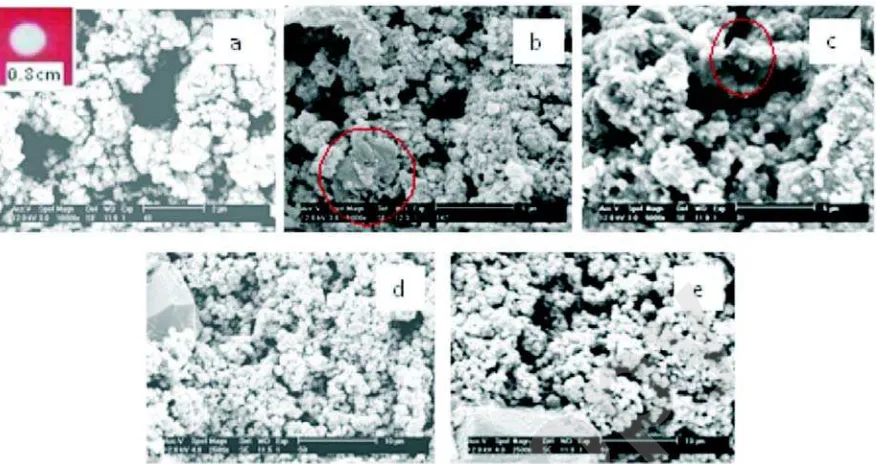
their %IPCE are significantly different. Data on metal loaded (mass %) are listed in Table 1. SEM analysis showed that the cluster size of Cu loaded at 0.03 A was 1.18µm, smaller than that of Cu loaded at 0.01
A which was in the range of 2.56–3.2 µm. Clusters
produced at 0.03 A have a more regular form than those produced at 0.01 A, Therefore, it can be con-cluded that a small percentage of loaded metal with small cluster size and more regular form provides a better performance in the photogenerated electron col-lection. However, this explanation may not be appli-cable to Ag loaded on TiO2 film. SEM micrographs
of TiO2/graphite and TiO2/graphite-supported metal
surfaces are given in Fig. 3. Fig. 3a shows that TiO2
coating of the graphite plate is created by a porous film. The pores are the result of a release of surfactant molecules during the heating of the graphite plate with chemically deposited titanium salt at 450◦C. Pho-toelectrochemical testing on Ag–TiO2/G found that
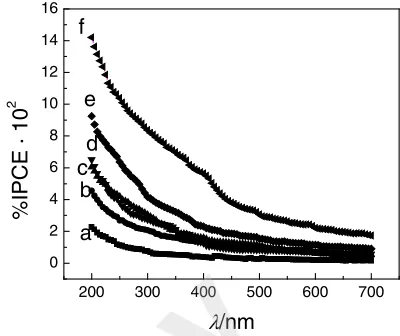
the %IPCE values of this composite produced at 0.025 A and 0.03 A are similar in the measurement wave-length range (Fig. 4). Table 1 shows that the amount of Ag loaded at these applied currents is 4.1 %, the same as that observed applying the current of 0.01 A. However, the %IPCE value of Ag–TiO2/G deposited
Fig. 3.Micrograph of TiO2/G (a) (insert: the disc of TiO2/G), Cu–TiO2/G obtained by electrodeposition of CuSO4 at 0.01 A
(b) and at 0.03 A (c), and Ag–TiO2/G obtained by electrodeposition of AgNO3at 0.01 A (d), and at 0.03 A (e).
200 300 400 500 600 700 0
2 4 6 8 10 12 14 f
e d
c
b
a
%IPC
E ·
1
0
2
λ
/nm
Fig. 4.%IPCE of TiO2/G (a), Ag–TiO2/G produced by
elec-trodeposition of 0.4 M AgNO3 at 0.01 A (b), 0.015 A
(c), 0.02 A (d), 0.025 A (e), and 0.03 A (f).
at 0.01 A is significantly lower. The SEM micrograph in Fig. 4 shows that the cluster size of Ag produced at 0.01 A is 7.19µm. This value is lower than the
clus-ter size produced at 0.03 A, which is 26.52µm. The
pattern of the changes in % of metal loaded, listed in Table 1, can be explained by the fact that the per-centage of metal loaded is not linearly dependent on the applied current as declared by the Faraday’s law. This subject is discussed in Rahmawati et al. (2008). Photoelectrochemical data were used as reference for the material selection for disinfection. In this re-search, the disinfection experiment was carried out with a disk of composite TiO2 which has an average
mass of 2.55 ×10⁻³ mg. The composite was dipped
into 100 mL of anEscherichia colisolution with an av-erage of colonies of 261±6, equal to (1.04×10⁵
±
2263) CFU mL−1. Cu was loaded using the 0.03 A ap-plied current while Ag was loaded using the 0.025 A applied current since it had almost the same %IPCE value as when loaded at 0.03 A.
Escherichia coli inactivation can occur in an irra-diated photon without a catalyst (photolysis process, Lys). The data on surviving cells in CFU mL−1after the treatment are presented in Table 2. The data in Table 2 were plotted in Eq. (2) to calculate the % in-activation with the initial colony number of 1 ×10⁵
CFU mL−1
. The calculation shows that in 30 min, 40.6 % ofE. coliare inactivated by the UV light (254 nm). DNA is certainly one of the key targets of UV-induced damage in a variety of organisms ranging from bacteria (Peak & Peak, 1982; Peak et al., 1984) to hu-mans (Stein et al., 1989; Kripke et al., 1992). UV ra-diation induces two of the most abundant mutagenic and cytotoxic DNA lesions: cyclobutane–pyrimidine dimmers (CPDs), and 6-4 photoproducts (6-4 PPs) and their Dewar valence isomers. After the UV irradi-ation, the CPDs are the most abundant and probably most cytotoxic lesions but the 6-4 PPs may have more serious, potentially lethal, mutagenic effects (Sinha & Häder, 2002). The lesions inhibit normal replication of the genome and result in the inactivation of the mi-croorganisms. Besides genomes, proteins and enzymes with unsaturated bonds are known to absorb UVC and UVB radiation which may also result in signifi-cant damage to the organisms (Oguma et al., 2002).
Escherichia coli inactivation by means of the PC method has higher success rate than photolysis. In 30 min, Ag–TiO2/G application on PC under UV
Table 2.Number of surviving cells after treatment and % of inactivation after 30 min of disinfectiona
Surviving cells/(CFU mL−1) %inactivation
Method
Cu–TiO2/G Ag–TiO2/G Cu–TiO2/G Ag–TiO2/G
Lys (without catalyst) 62000±2000 62000±2000 40.6±2.00 40.6±2.00
PC 59600±400 21200±400 42.9±0.38 79.7±0.38
EC 43600±1600 17600±400 58.2±1.53 83.1±0.38
PEC 33600±400 10800±400 67.8±0.38 89.7±0.38
a) Initial concentration of cells is (1.0×10⁵±
2263) CFU mL−1. Table 3.Rate constants ofEscherichia coliinactivation
Ag–TiO2/G Cu–TiO2/G
Method
k/min−1 R2 k/min−1 R2
Photolysis 0.0156 0.896 0.0156 0.896 Photocatalysis 0.0467 0.958 0.0220 0.932 Electrocatalysis 0.0510 0.954 0.0272 0.998 Photoelectrocatalysis 0.0649 0.942 0.0320 0.986
radiation is capable of inactivating 79.7 % of the E. colipopulation. Meanwhile, Cu–TiO2/G only achieves
42.9 %, see Table 2. The value of the rate constant calculated by the first order kinetics, compares the re-action rate of different processes and using different catalyst materials. The rate constant values are listed in Table 3. In a photocatalytic reaction, the energy of photons is absorbed by a semiconductor to gener-ate an electron-hole pair in the TiO2matrix. The hole
in the valence band can react with H2O or hydroxide
ions adsorbed on the surface to produce hydroxyl rad-icals (OH.), and the electron in the conduction band can reduce O2to produce superoxide ions (O−2). Both
holes and OH.are extremely reactive in contact with organic compounds. Detailed mechanism of the TiO2
photochemical reaction and the various reactive oxy-gen species (ROS) such as OH., O−
2, and H2O2
pro-duced are well-documented (Blake et al., 1999; Hoff-mann et al., 1995; Mills & Le Hunte, 1997). Maness et al. (1999) found the ROS generated on the irradi-ated TiO2surface to attack polyunsaturated
phospho-lipids inEscherichia coli. The lipid peroxidation reac-tion that subsequently causes a breakdown of the cell membrane structure and therefore its associated func-tion is the mechanism underlying cell death. Sunada et al. (1998) reported that endotoxin, an integral compo-nent of the outer membrane ofE. coli, was destroyed under photocatalytic conditions when TiO2was used.
The calculation of %inactivation by plotting the data in Table 2 into Eq. (2) shows that the EC method has a better performance than the PC one. This con-clusion is supported by the rate constant data (Ta-ble 3). The potential application to TiO2 reduces the
Fermi level and forms an electric field near the
semi-conductor interface which is called the depletion layer. Every electron promoted by photon excitation or ex-ternal potential application in the depletion layer is accelerated into the bulk of the semiconductor and re-leased to the external circuit through graphite as a conductive substrate. Conversely, the holes produced near the depletion layer by photon illumination are accelerated into the semiconductor surface and move freely before being recombined with electrons in the bulk phase of the semiconductor. It is clear that the electric field significantly increases the charge separa-tion and thus enhances the hydroxyl radical formasepara-tion. This is called the electric field enhancement effect.
The PEC method is the combination of PC and EC. Based on the reduction of the colony number (Ta-ble 2) and the comparison of the rate constant value (Table 3), it can be concluded that the PEC method has the best performance inEscherichia coli inactiva-tion. The E. coli population decreases up to 89.7 % (equal to about 1-log reduction) by PEC under UV irradiation on Ag–TiO2/G in 30 min, and 67.8 % on
Cu–TiO2/G. In this study, inactivation ofE. coliusing
the Ag–TiO2/G has reached the lag stage in 30 min.
This is the reason the 30 min disinfection time was used as the purpose of this research was to compare disinfection efficiency of different methods and differ-ent materials. This is in accordance with the correct application of the Chick–Watson equation requiring that the disinfection rate does not vary at all during the process. Consequently, this model is only valid for the description of the second region (log-linear). How-ever, the model is capable to compare the efficiency of different disinfection methods through the values of the kinetic constantk(Marugán et al., 2008).
Christensen et al. (2003) found that applying the potential of 3 V to the sol–gel electrode of TiO2, 95 %
(equal to 1.3-log reduction) ofE. coli were destroyed in 25 min. However, there are differences in the type of the lamp and the electrode surface area. Christensen et al. (2003) used a tubular UV source (two 8 W black lamps) located within the electrode cassette of a cylin-drical TiO2 diamond mesh with the 100 mm length
a
b
c
d
Fig. 5.Escherichia colipopulation during PEC degradation using Ag–TiO2/G: initial population (a), and population after 10 min
(b), 20 min (c), and 30 min (d) of treatment.
Lys PC EC PEC
0 10000 20000 30000 40000 50000 60000 70000
E.co
li
po
pu
la
ti
on
/(
C
F
U
m
L¯
1 )
Method
Fig. 6.Variation of E. coli population with the disinfection method used in the presence of Ag–TiO2/G: after
dis-infection ( ), after storage for 24 h ( ), and for 48 h ( ).
(equal to 1.3-log reduction) at 1.3 V and 99.5 % ofE. coli(equal to 2.3-log reduction) at 3 V. The electrode used by Egerton et al. (2006) had the same dimensions as the one used by Christensen et al. (2003) with the surface area of 22 cm2
. In this study, the surface area of the electrode was only 0.504 cm2
, however, high-energy UVC lamp was used.
Fast reduction of the E. coli population by the PEC disinfection is promoted by the formation of ex-cited electron-hole pairs by photon irradiation and separation of excited electron-holes applying an ex-ternal potential. This allows the holes to move freely in the semiconductor surface and to oxidize the species on the interface of the semiconductor, which results in the formation of hydroxyl radicals that are the main contributors to cell degradation. Reduction of the E. colipopulation is shown in Fig. 5.
Although it is well known that both Ag and Cu have antimicrobial properties, the antimicrobial activ-ity of these two metals is still far below the antimi-crobial activity of the PEC method using composite materials. Yoon et al. (2007) found that for the disin-fection of water contaminated withE. coli(initial con-centration 200 CFU), the 90 % antimicrobial efficiency was obtained using 58.41 µg mL−1 of Ag
nanoparti-Lys PC EC PEC
0 10000 20000 30000 40000 50000 60000 70000
E.co
li
po
pu
la
ti
on
/(
C
F
U
m
L¯
1 )
Method
Fig. 7.Variation of E. coli population with the disinfection method used in the presence of Cu–TiO2/G: after
dis-infection ( ), after storage for 24 h ( ), and for 48 h ( ).
cles (particle size of 40 nm) or 33.49 µg mL−1 of Cu
nanoparticles (100 nm). Calculations using the data in Table 1 show that 1.046 µg mL−1 of Ag or 1.607 µg mL−1of Cu is sufficient to reduce theE. coli
pop-ulation by 89.7 % or 67.8 %, respectively. The initial
E. coliconcentration used in this study was 1.0×10⁵
CFU mL−1
. However, this is only a rough comparison, given the differences in some parameters of the exper-iment including the particle size of metal and the time of disinfection.
EDT24 and EDT48 were achieved when applying
Ag–TiO2/G in all disinfection methods. It is shown in
Fig. 6 that the Escherichia coli population after the storage for 24 h and 48 h decreased compared to the population at the time after the disinfection. However, when applying Cu–TiO2/G, EDT24 and EDT48 were
not achieved using the EC method (Fig. 7). The % of re-growth ofE. colicalculated by Eq. (4) was 36.17 % for EDT24 and 110.64 % for EDT48. This confirms
that the catalysis by electrons using Cu–TiO2/G as
main factor driving the decline inE. colisurvival after their storage for 24 h or 48 h; instead, the result of the EC disinfection showed an increase in the number of colonies ofE. coli.
These results clearly show that the deposition of Ag on the TiO2/G film has better performance in
en-hancing catalytic activity of TiO2 compared to the
Cu deposition. Based on the data in Table 2, it can be concluded that Ag–TiO2/G as a catalyst for the PEC
disinfection ofEscherichia coli-contaminated water is by 21.9 % more efficient than Cu–TiO2/G.
Conclusions
Deposition of Ag and Cu on TiO2/G is capable
of enhancing the effectiveness ofEscherichia coli in-activation. Ag deposition has a better performance than Cu. EDT24 and EDT48 can be achieved in
all catalytic methods using Ag–TiO2/G and
photon-assisted catalytic methods using a Cu–TiO2/G
elec-trode, however, they cannot be achieved in electro-catalytic methods using a Cu–TiO2/G electrode.
Acknowledgements. This research was partially supported by the DIPA project program of the Sebelas Maret University and the HIBAH Bersaing project program of the Directorate General for Higher Education. The support was greatly appre-ciated.
References
Akurati, K. K., Vital, A., Fortunato, G., Hany, R., Nueesch, F., & Graule, T. (2007). Flame synthesis of TiO2nanoparticles
with high photocatalytic activity.Solid State Science,9, 247–
257. DOI: 10.1016/j.solidstatesciences.2006.12.004.
Barner, H. D., & Cohen, S. S. (1956). The relation of growth to the lethal damage induced by ultraviolet irradiation in
Escherichia coli.Journal of Bacteriology,71, 149–157.
Blake, D. M., Maness, P.-C., Huang, Z., Wolfrum, E. J., Huang, J., & Jacoby, W. A. (1999). Application of the photocatalytic chemistry of titanium dioxide to disinfection and the killing of cancer cells.Separation & Purification Reviews,28, 1–50.
DOI: 10.1080/03602549909351643.
Butterfield, I. M., Christensen, P. A., Curtis, T. P., & Gun-lazuardi, J. (1997). Water disinfection using an immobilized titanium dioxide film in a photochemical reactor with elec-tric field enhancement. Water Research,31, 675–677. DOI:
10.1016/S0043-1354(96)00391-0.
Cho, M., Lee, Y., Chung, H., & Yoon, J. (2004). Inacti-vation of Escherichia coli by photochemical reaction of ferrioxalate at slightly acidic and near-neutral pHs. Ap-plied and Environmental Microbiology,70, 1129–1133. DOI:
10.1128/AEM.70.2.1129–1134.
Christensen, P. A., Curtis, T. P., Egerton, T. A., Kosa, S. A. M., & Tinlin, J. R. (2003). Photoelectrocatalytic and pho-tocatalytic disinfection of E. coli suspensions by titanium dioxide. Applied Catalysis B: Environmental, 41, 371–386.
DOI: 10.1016/S0926-3373(02)00172-8.
Chu, D., Yuan, X., Qin, G., Xu, M., Zheng, P., Lu, J., & Zha, L. (2008). Efficient carbon-doped nanostructured TiO2
(anatase) film for photoelectrochemical solar cells.Journal of Nanoparticle Research, 10, 357–363. DOI:
10.1007/s11051-007-9241-7.
Doubleday, O. P., Green, M. H. L., & Bridges, B. A. (1977). Spontaneous and ultraviolet-induced mutation in Es-cherichia coli: Interaction between plasmid and tif-I mutator effects.Journal of General Microbiology,1977, 163–166.
Dunlop, P. S. M., Byrne, J. A., Manga, N., & Eggins, B. R. (2002). The photocatalytic removal of bacterial pollutants from drinking water. Journal of Photochemistry and Pho-tobiology A: Chemistry,148, 355–363. DOI:
10.1016/S1010-6030(02)00063-1.
Egerton, T. A., Kosa, S. A. M., & Christensen, P. A. (2006). Photoelectrocatalytic disinfection of E. colisuspensions by iron doped TiO2.Physical Chemistry Chemical Physics,8,
398–406. DOI. 10.1039/b507516e
Friedberg, E. C. (2003). DNA damage and repair.Nature,421,
436–440. DOI: 10.1038/nature01408.
Hammer, N., Kvande, I., Xu, X., Gunnarsson, V., Tøtdal, B., Chen, D., & Rønning, M. (2007). Au–TiO2 catalysts on
carbon nanofibres prepared by deposition-precipitation and from colloid solutions.Catalysis Today,123, 245–256. DOI:
10.1016/j.cattod.2007.03.001.
Harm, W. (1980).Biological effects of ultraviolet radiation(pp. 31–39). New York, NY, USA: Cambridge University Press. Harper, J. C., Christensen, P. A., Egerton, T. A., Curtis, T.
P., & Gunlazuardi, J. (2001). Effect of catalyst type on the kinetics of the photoelectrochemical disinfection of water in-oculated withE. coli.Journal of Applied Electrochemistry,
31, 623–628. DOI: 10.1023/A:1017539328022.
He, C., Xiong, Y., Zha, C., Wang, X., & Zhu, X. (2003). Ap-proach to a pulse photoelectrocatalytic process for the degra-dation of organic pollutants.Journal of Chemical Technology and Biotechnology,78, 717–723. DOI:10.1002/jctb.851.
Hoffmann, M. R., Martin, S. T., Choi, W., & Bahnemann, D. W. (1995). Environmental application of semiconduc-tor photocatalysis. Chemical Reviews, 95, 69–96. DOI:
10.1021/cr00033a004.
Kabir, M. F., Haque, F., Vaisman, E., Langford, C. H., & Kantzas, A. (2003). Disinfecting E. coli bacteria in drink-ing water usdrink-ing a novel fluidized bed reactor. International Journal of Chemical Reactor Engineering,1, 1–10.
Kantor, G. J., & Deering, R. A. (1966). Ultraviolet radiation studies of filamentousEscherichia coliB.Journal of Bacte-riology,92, 1062–1070.
Kappke, J., da Silva, E. R., Schelin, H. R., Paschuk, S. A., Pashchuk, A., de Oliveira, A., Filho, N. C., Szanto, E. M., Takahashi, J., & Calvacante de Souza, J. (2005). Evalua-tion ofEscherichia colicells damages induced by ultraviolet and proton beam radiation.Brazilian Journal of Physics,35,
805–807. DOI: 10.1590/S0103-97332005000500022.
Kikuchi, Y., Sunada, K., Iyoda, T., Hashimoto, K., & Fujishima, A. (1997). Photocatalytic bactericidal effect of TiO2 thin
films: dynamic view of the active oxygen species respon-sible for the effect. Journal of Photochemistry and Pho-tobiology A: Chemistry, 106, 51–56. DOI:
10.1016/S1010-6030(97)00038-5.
K¨or¨osi, L., Papp, S., Bertóti, I., & Dékány, I. (2007). Surface and bulk composition, structure, and photocatalytic activity of phosphate-modified TiO2.Chemistry of Materials,19, 4811–
4819. DOI: 10.1021/cm070692r.
Kripke, M. L., Cox, P. A., Alas, L. G., & Yarosh, D. B. (1992). Pyrimidine dimmers in DNA initiate systemic suppression in UV-irradiated mice.Proceedings of the National Academy of Sciences of the USA,89, 7516–7520.
Li, Y., Ma, M., Wang, X., & Wang, X. (2008). Inactivated prop-erties of activated carbon-supported TiO2 nanoparticles for
bacteria and kinetic study. Journal of Environmental Sci-ence,20, 1527–1533. DOI: 10.1016/S1001-0742(08)62561-9.
Maness, P.-C., Smolinski, S., Blake, D. M., Huang, Z., Wol-frum, E. J., & Jacoby, W. A. (1999). Bactericidal activity
of photocatalytic TiO2 reaction: Toward an understanding
of its killing mechanism.Applied and Environmental Micro-biology,65, 4094–4098.
Marugán, J., van Grieken, R., Sordo, C., & Cruz, C. (2008). Kinetics of the photocatalytic disinfection ofEscherichia coli
suspensions.Applied Catalysis B: Environmental,82, 27–36.
DOI: 10.1016/j.apcatb.2008.01.002.
Mills, A., & Le Hunte, S. (1997). An overview of semicon-ductor photocatalysis.Journal of Photochemistry and Pho-tobiology A: Chemistry, 108, 1–35. DOI:
10.1016/S1010-6030(97)00118-4.
Oguma, K., Katayama, H., & Ohgaki, S. (2002). Photoreac-tivation of Escherichia coli after low- or medium-pressure UV disinfection determined by an endonuclease sensitive site assay. Applied and Environmental Microbiology, 68, 6029–
6035. DOI: 10.1128/AEM.68.12.6029-6035.2002.
Ohno, T., Tanigawa, F., Fujihara, K., Izumi, S., & Matsumura, M. (1998). Photocatalytic oxidation of water on TiO2-coated
WO3particles by visible light using iron(III) ions as electron
acceptor. Journal of Photochemistry and Photobiology A: Chemistry,118, 41–44. DOI:
10.1016/S1010-6030(98)00374-8.
Peak, M. J., & Peak, J. G. (1982). Single-strand breaks induced inBacillus subtilisDNA by ultraviolet light: Action spectrum and properties.Photochemistry and Photobiology,35, 675–
680. DOI: 10.1111/j.1751-1097.1982.tb02628.x.
Peak, M. J., Peak, J. G., Moehring, M. P., & Webs, R. B. (1984). Ultraviolet action spectra for DNA dimer induction, lethality, and mutagenesis in Escherichia coli with emphasis on the UVB region.Photochemistry and Photobiology,40, 613–620.
DOI: 10.1111/j.1751-1097.1984.tb05349.x.
Rahmawati, F., Wahyuningsih, S., & Handayani, N. (2008). Surface modification of semiconductor thin film of TiO2 on
graphite substrate by Cu electrodeposition.Indonesian Jour-nal of Chemistry,8, 331–336.
Rahmawati, F., Wahyuningsih, S., & Windu, P. A. (2006). Syn-thesis of thin film of TiO2on graphite substrate by chemical
bath deposition.Indonesian Journal of Chemistry,6, 121–
126.
Rincón, A. G., Pulgarin, C., Adler, N., & Peringer, P. (2001). In-teraction betweenE. coliinactivation and DBP-precursors— dihydroxybenzene isomers—in the photocatalytic process of drinking-water disinfection with TiO2. Journal of Photo-chemistry and Photobiology A: Chemistry, 139, 233–241.
DOI: 10.1016/S1010-6030(01)00374-4.
Sinha, R. P., & Häder, D.-P. (2002). UV-induced DNA dam-age and repair: a review.Photochemical & Photobiological Sciences,1, 225–236. DOI: 10.1039/b201230h.
Stein, B., Rahmsdorf, H. J., Steffen, A., Litfin, M., & Her-rlich, P. (1989). UV-induced DNA damage is an intermediate step in a UV-induced expression of human immunodeficiency virus type I, collagenase, c-fos, and metallothionein. Molec-ular and CellMolec-ular Biology,9, 5169–5181.
Sunada, K., Kikuchi, Y., Hashimoto, K., & Fujishima, A. (1998). Bactericidal and detoxification effects of TiO2 thin
film photocatalysts. Environmental Science & Technology,
32, 726–728. DOI: 10.1021/es970860o.
Wei, C., Lin, W. Y., Zainal, Z., Williams, N. E., Zhu, K., Kruzic, A. P., Smith, R. L., & Rajeshwar, K. (1994). Bactericidal activity of TiO2 photocatalyst in aqueous media: Toward a
solar-assisted water disinfection system.Environmental Sci-ence & Technology,28, 934–938. DOI: 10.1021/es00054a027.
Xu, J., Ao, Y., Fu, D., Lin, J., Lin, Y., Shen, X., Yuan, C., & Yin, Z. (2008). Photocatalytic activity on TiO2-coated
side-glowing optical fiber reactor under solar light. Journal of Photochemistry and Photobiology A: Chemistry,199, 165–
169. DOI: 10.1016/j.jphotochem.2008.05.019.
Yoon, K.-Y., Byeon, J. H., Park, J.-H., & Hwang, J. (2007). Sus-ceptibility constants ofEscherichia coliandBacillus subtilis
to silver and copper nanoparticles.Science of the Total Envi-ronment,373, 572–575. DOI: 10.1016/j.scitotenv.2006.11.007.
Zelle, M. R., & Hollaender, A. (1954). Monochromatic ultravio-let action spectra and quantum yields for inactivation of T1 and T2Escherichia colibacteriophages.Journal of Bacteri-ology,68, 210–215.