Pengesahan penyelia
“Saya akui bahawa saya telah membaca karya ini dan pada pandangan saya karya ini adalah memadai dari segi skop dan kualiti untuk tujuan penganugerahan Ijazah
Sarjana Muda Kejuruteraan Mekanikal (Rekabentuk dan Inovasi)”
Tandatangan :……….
Nama Penyelia :……….
PROCESS DESIGN FOR MASS MANUFACTURING OF POWDER
FORMED SOLID FUEL FROM DRIED FIBROUS GARDEN
LEAVES
MUHAMAD KHAIRUL IKHWAN B. MUHAMAD ATAN
Laporan ini diserahkan kepada Fakulti Kejuruteraan Mekanikal
sebagai memenuhi sebahagian daripada syarat penganugerahan
Ijazah Sarjana Muda Kejuruteraan Mekanikal (Rekabentuk & Inovasi)
Fakulti Kejuruteraan Mekanikal
Universiti Teknikal Malaysia Melaka
ii
Pengakuan
“Saya akui laporan ini adalah hasil kerja saya sendiri kecuali ringkasan dan petikan yang tiap-tiap satunya saya jelaskan sumbernya”
Tandatangan :……… Nama Penuh :………
iii
ACKNOWLEDGEMENT
In the name of Allah, the most Gracious and most Merciful,
Thanks to Allah, for giving permission to complete this draft of thesis. I would like to acknowledge and express my gratitude to all these people:
Prof. Dr. Md. Razali Bin Ayob (Dekan, Fakulti Kejuruteraan Mekanikal)
Ir. Abdul Talib Bin Din
( Penyelia Projek Sarjana Muda,Fakulti Kejuruteraan Mekanikal) for all his a lot of supports and advices
All the Lecturers and Technicians in Fakuti Kejuruteraan Mekanikal That give any kind of helps while realize this project
iv
ABSTRACT
v
2.1 Mechanical Reduction Methods 7
2.1.1 Impact 7
2.1.2 Attrition 8
2.1.3 Shear 9
2.1.4 Compression 10
2.2 Types of Crusher 12
2.2.1 Bradford Breakers 12
2.2.2 Roller Mounted Bradford Breaker 13
2.2.3 Tri-Mounted Bradford Breaker 13
vi
CHAPTER DESCRIPTION PAGE
2.2.5 Cage Mills 15
2.2.6 Granulators 16
2.2.7 Hammermills 17
2.2.8 Reversible Hammermills 18
2.2.9 Non-Reversible Hammermills 19
2.2.10 Non-Clog Hammermills 20
2.2.11 Coalpactors 21
2.2.12 Aluminium Dross Impactors 22
2.2.13 Metallic Slag Crushers 22
2.2.14 Reversible Impactors 23
2.2.15 Small Reversible Impactors 24
2.2.16 Twin Rotor Impactors 25
2.2.17 Jaw Crushers 26
2.2.18 Clinker Crushers 27
2.2.19 Single Roll Crushers 27
2.2.20 Double Roll Crushers 29
2.2.21 Frozen Coal Crackers 30
2.2.22 Mountaineer Sizers 31
2.2.23 Posimetric Feeders 32
2.3 Definitions of Material Characteristics 33
2.4 Power Requirements 34
2.5 Closed-Circuit Crushing 35
3 METHODOLOGY
3.0 Introduction 37
3.1 Concept Development 37
vii
CHAPTER DESCRIPTION PAGE
3.3 Flow Chart 39
3.4 Product Design Specification 41
3.5 Concept Development 42
5.1 Recommendation for Further Design 66
REFERENCES 67
ix
FIGURES DESCRIPTION PAGES
2.25 : Closed-Circuit Crusher Systems 36
3.1 : Proposed Project Methodology 38
x
LIST OF TABLES
TABLES DESCRIPTION PAGES
2.1 : Physical Characteristics of Materials 33
3.1 : Product Specifications 41
3.2 : Morphological Chart for Sub-function 42
3.3 : Morphological Chart for Shape 42
3.4 : Morphological Chart for Material 42
3.5 : Morphological Chart for Jointing 43
3.6 : Advantage and disadvantage of the concept 49
4.1 : Material properties for blade 1 55
4.2 : The equilibrium forced applied for blade 1 55
4.3 : The properties of material for blade 2 57
4.4 : The equilibrium forced applied for blade 2 57
4.5 : The material properties for blade 3 59
4.6 : The equilibrium forced applied for blade 3 59
4.7 : The material properties for blade 4 61
4.8 : The equilibrium forced applied for blade 4 61
xi
LIST OF ABREVIATIONS
DESCRIPTION ABS : Acrylo-nitrile Butadine Styrene BASS : Break Away Support System CAD : Computer Aided Design
CAM : Computer Aided Manufacturing RPM : Revolution per Minute
HP : Horsepower
LAN : Local Area Network
LOM : Laminated Object Manufacturing
PC : Programmable Computer
3D : Three-Dimensional
kg : Kilogram
m : Mass
s : Second
1
CHAPTER 1
INTRODUCTION
In engineering field latest, a lot of new technology is used by manufacturer to make certain part in manufacturing process become easier. In this case, the most important criteria are the methods that we used to make the process simpler than before. This needs us to make continuous improvement by modification the common method with another method that proved more efficient in all aspects. This is what we called updated technology that helps our engineering field expanding from day by day.
Design as applied to mineral processing is similar in concept to that applied in many other industries. The basic requirement is that a safe, efficient, sustainable design should deliver the desired results. The desired results vary, but again the essentials are that the basics are covered, with the other main drivers being the optimisation in terms of minimum capital, minimum operating cost and maximised return on investment.
2
in the synthesis, but rather it should develop and modify the search to reach the best solution. Crushers are critical components of the comminuting process; they provide a relatively simple means of crushing raw material into smaller sizes. The performance of a crusher is governed by many factors, Bearman (1994).
1.1PROJECT SCOPE
This project consists to develop a Design of crusher machine for mass manufacturing of powder formed solid fuel from dried fibrous garden leaves. These projects need to perform the best way to make a powder formed from dried leaves for human requirement. Other than that, this project report covers the design of the crusher machine. The design do must archive the objective for this project. Literature review and other research by inventor before use as a guide line to develop this project. The scopes of this study are:
1. The completed design of leaves crusher machine that used to make a powder formed from dried leaves. Needs to go through one by one of components.
2. The study of materials that used for crusher machine from the old until the latest technology of its.
3. Choose one set of crusher machine that suitable to crush the dried leaves.
4. Study of crushing process step by step.
5. Study the basic of mechanical reduction methods that will be used in this project.
3
1.2OBJECTIVE
The objectives of study are:
1. To make a prototyping of dried fibrous garden leaves crusher machine.
2. To study and understand the crusher machine especially the suitable type of crusher that want to use in this project.
3. Understand the components of crusher machine.
4. To redesign each component of crusher machine and completed drawing using design software (CATIA).
5. To use the application of CAD (CATIA) that has been studied in course.
1.3PROBLEM STATEMENT
The problems occur is when:
1) To determine the design of the crusher machine. The design must be able to crush the dried leaves into the powder or near state.
4
1.4THESIS OUTLINE
In this part will summarize all the chapters contain in this first draft.
Chapter 1:
This chapter contains the introduction, problem statement, objective, and scope of project. It summarizes the basic information about the project which will be performed and the objective of this project.
Chapter 2:
This chapter concludes all the research that has been done to provide ideas and specification as a guideline to produce the design. Beside that it also covered the study of the wind condition that can influence the performance of the project development.
Chapter 3:
5
CHAPTER 2
LITERATURE REVIEW
6
One type of intermediate crusher consists of a pair of horizontal cylindrical rollers through which material is passed. The two rollers rotate in opposite directions, "nipping" and crushing material between them. A similar type of intermediate crusher is the edge runner, which consists of a circular pan with two or more heavy wheels known as mullers rotating within it; material to be crushed is shoved underneath the wheels using attached plow blades.
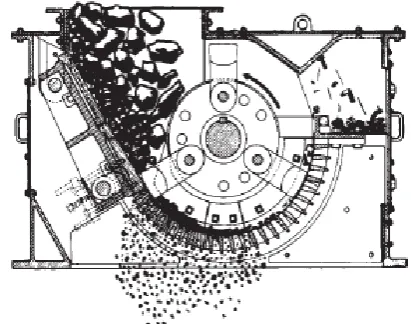
Hammer mills involve the use of impact rather than pressure to crush material. They utilize heavy metal bars attached to the edges of horizontal rotating disks by hinges, which repeatedly strike the material to be crushed. The material is contained within a cage, with openings on the bottom of the desired size to allow pulverized material to escape. This type of crusher is usually used with soft material such as coal. A typical type of fine grinder is the ball mill. A slightly inclined or horizontal rotating cylinder is partially filled with balls, usually stone or steel, which grinds material to the necessary fineness by rubbing and impact with the tumbling balls. The feed is at one end of the cylinder and the discharge is at the other. Ball mills are commonly used in the manufacture of Portland cement. Another type of fine grinder commonly used is the Buhrstone mill, which is similar to old-fashioned flour mills.
7
2.1 MECHANICAL REDUCTION METHODS
There are four basic ways to reduce a material by impact, attrition, shear or compression and most crushers employ a combination of all these crushing methods.
2.1.1 IMPACT
Figure 2.1 Impact Diagram
In crushing terminology, impact refers to the sharp, instantaneous collision of one moving object against another. Both objects may be moving, such as a baseball bat connecting with a fast ball, or one object may be motionless, such as a rock being struck by hammer blows.
There are two variations of impact: gravity impact and dynamic impact. Coal dropped onto a hard surface such as a steel plate is an example of gravity impact. Gravity impact is most often used when it is necessary to separate two materials which have relatively different friability. The more friable material is broken, while the less friable material remains unbroken. Separation can then be done by screening. The Pennsylvania Bradford Breaker employs gravity impact only. This machine revolves so slowly that for all practical purposes, gravity is the only accelerating force on the coal.
8
When crushed by gravity impact, the free-falling material is momentarily stopped by the stationary object. But when crushed by dynamic impact, the material is unsupported and the force of impact accelerates movement of the reduced particles toward breaker blocks and/or other hammers.
Dynamic impact has definite advantages for the reduction of many materials and it is specified under the following conditions:
when a cubical particle is needed
when finished product must be well graded and must meet intermediate sizing specifications, as well as top and bottom specifications
when ores must be broken along natural cleavage lines in order to free and separate undesirable inclusions (such as mica in feldspars)
when materials are too hard and abrasive for hammermills, but where jaw crushers cannot be used because of particle shape requirements, high moisture content or capacity
Dynamic impact is the crushing method used by Pennsylvania Impactors.
2.1.2 ATTRITION
Figure 2.2 Attrition Diagram
9
Though attrition consumes more power and exacts heavier wear on hammers and screen bars, it is practical for crushing the less abrasive materials such as pure limestone and coal.
Attrition crushing is most useful in the following circumstances: When material is friable or not too abrasive.
When a closed-circuit system is not desirable to control top size.
2.1.3 SHEAR
Figure 2.3 Shear Diagram
Shear consists of a trimming or cleaving action rather than the rubbing action associated with attrition. Shear is usually combined with other methods. For example, single-roll crushers employ shear together with impact and compression. Shear crushing is normally called for under these conditions:
when material is somewhat friable and has a relatively low silica content for primary crushing with a reduction ratio of 6 to 1
10
2.1.4 COMPRESSION
Figure 2.4 Compression Diagram
As the name implies, crushing by compression is done between two surfaces, with the work being done by one or both surfaces. Jaw crushers using this method of compression are suitable for reducing extremely hard and abrasive rock. However, some jaw crushers employ attrition as well as compression and are not as suitable for abrasive rock since the rubbing action accentuates the wear on crushing surfaces. As a mechanical reduction method, compression should be used as follows:
if the material is hard and tough if the material is abrasive if the material is not sticky
where the finished product is to be relatively coarse, i.e., 11/2" (38mm) or larger top size
11
Examples of mechanical reduction method in crusher machine:
12
2.2 TYPES OF CRUSHER
2.2.1 BRADFORD BREAKERS
These machines are used for crushing, sizing, band cleaning of run-of-mine coal and other friable materials. They are used to produce a product that is relatively coarse, with minimum fines, and that is 100% to size. Bradford Breakers crush by gravity impact only. A large cylinder made of perforated screen plates is fitted with internal shelves. As the cylinder rotates, the shelves lift the feed and, in turn, the feed slides off the shelves and drops onto the screen plates below, where it shatters along natural cleavage lines.
The size of the screen plate perforations determines the product size. Sized product falls through these perforations but oversized pieces will again be lifted and dropped by the shelves until they too pass through the screen plates.
Tramp iron, lumber, or other uncrushable debris that enters the breaker along with the feed is transported to the discharge end of the cylinder. There, these uncrushables are scooped out continuously by a refuse plow which channels this debris out of the cylinder and into a disposal bin. Often a Bradford Breaker is used merely to clean debris from coal that has already been sized. This gives some indication of the economy of operation and versatility of this machine.