Phytotaxa
159
(2014)159
(4):
241 -
300 (18 February
2014)
Article
Phytotaxa 159
(4):
241 - 255 (18 February 2014)A phylogenetic analysis and new delimitat.io11
ofCrepU/iastrum (Asteraceae, tribe Cichorieae)YU-LAN PENG, YU ZHANG, XlN-FEN GAO, LIN-JING
TONG, LIANG LI, REN-YUAN LI, ZHANG-MING ZffiJ
&
JUN-REN XIAN
Preview
(PDF;
150KB)I
Full
article(PDF;
950KB) OrderArticle
Phytotaxa 159 (4): 256 - 268 (18 February 2014)
Revision of
Hygrochilus (Orcbidaceae:Epidendroideae: Aeridinae) and
a
molecular phylogenetic analysis.MING-HE
LI,
GUO-QIANG
ZHANG, ZHONG-TIAN LIU
&SI-REN LAN
Preview
(PDF;
150KB)I
Full anicle (PDF;
3200.K.B) OrderArticle
Phytotaxa 159 (4): 269 - 278 (18 February 2014) A
new endemic Ramalina species from the Canary
Islands (Ascomycota, Lecanorales)ISRAEL PEREZ-VARGAS
&SERGIO PEREZ-ORTEGA
Preview (PDF;
l50KB)I
full article (PDF;
2800.KD)Order PDF
Article
Phytotaxa 159 (4): 279 - 286 (18 Febmary 2014) Astragalus wulingensis (Lcguminosae), a new
species from Hunan CbioaTIAXIANG LI & XUNLIN YU
Preview (PDF;
150Kll)I
Full article (PDF;
2500KB) Order PDFArticle
Phytota..w 159 (4): 287 - 290 ( 18 February 2014) Salacca acehensis (Arecaceae), A New Species from
Sumatra, lndonesiaZUMATDAR, TATIK ClllKMA WATI, ALEX HARTANA, SOBIR, JOIIANIS P.
MOGEA
&
FINN BORCHSENfUS
pイ ・カゥ・セ@
(PDF;
l50KB)I
Full art icle(PDF;
1100.KB)mJMfid
C,orresponcience
Phytotaxa 159
(4):
291 - 294 (18 February 2014)Buddleja jinsixiae11sis
(Scrophulariaceae), a new
species from Shaanxi, ChioaRENBIN ZHU, BING KANG, IlMIN CHENG, BAOQUAN ZHANG
&XINYUZHAO
Preview (PDF;
150KB)I
Fullarticle (PDF;
2100KB)Order PDF
Correspondence
Phytotaxa 159
(4): 295 -
297 (18 February 2014) Megalastrum oppositum and Ctenitis canacae (Dryopteridaceae): A new com bination and a new synonym, respectively, for Mascarene fernflora YI-FAN DUAN
&LI-BING ZHANG
Full article (PDF;
200KB)ldlf41IUkWii
Correspondence
I'hytotaxa 159
(4): 298 -
300(18 February 2014)
Two new combinations in the genus Bornmuellera
(Brassieaceae)IVANA
RESETNIK,GERALD M. SCHNEEWEISS
&ZLATKO UBER
セ。ョ。ァ ゥョァ@
editor
&
Founder
Zhi Qiang Zhang
(Auckland)
Editors for General subjects
International Editorial Team
• African Flora: Gabriel Ameka (Ghana)
• Andean Flora: Federico Luebert (Bonn)
• South American Flora: Manuel Belgrano (Buenos Aires), Brazil: Ana Maria Giulietti Harley (Feira de Santana)
• North Temperate F lora: Federico Luebert (Berlin)
• Australasian flora : Peter IL Weston (Sydney)
• Southeast Asian Flora: Hajo Esser (Munich)
• East Asian Flora: Libing Zhang (St. Louis), Jinshuan MA (Shanghai)
• Central Asian F lora: Alexander Sennikov (Helsinki)
• Mediterranean Flora: Lorenzo Peruvj (Pisa)
• Island endemics: Mark Carine (London), Maarten Christenhusz (Helsinki)
• Checklists: Alex Monro (London)
• History of taxonomy: Piero Delprete (Cayenne), Jinshuan MA (Shanghai)
•
Latin
dia3nosis: Cassio Van den Derg (Feira de Santana), Hajo Esser (Munich)• German language: Hajo Esser (Munich)
• Nomenclature: Hajo Esser (Munich), Den van Ee (Spearfish)-( on leave), Werner Greuter (Palenno),
Jim L. Reveal (lthaca): Plant nomenclature
• Pbylogeoetics, Systematics and Evolution: Mark Chase (Kew), Samuli Lehtonen ( l'Urku), Ben van
Ee
(SpearfishXon leave)• Biogeography: Peter 11. Weston (Sydney)
The order classification of Angiosperms follows APG ffi (see also Reveal
&
Chase2011,Phytotaxa
19: 71 134. http://mapress.com/r>hytoiaxa/content/2011/f/ptOOO l 9p134. pdf).Editors for Monocots:
• Acorales: Samuli Lehtonen (furku)
• Alismatales: Samuli Lehtonen (Turku)
• Petrosaviales: Mark Chase (Kew)
• Dioscorcales:
•
Asparagales: Orcbidaceae: Cassio Van den Berg (Feira de Santana), Mark Chase(Kew)
•
Asparagales (other) Lorenzo Peruzzi (Pisa)
•
Arecales: Bill Baker (Kew)
•
Commelinales: Timothy Evans (Allendale)
•
ZingiberaJes: Joao Marcelo Alvarenga
Braga
(Brazil)
•
Dasypogonales:
•
Poales: Bromeliaccae: Eric Gouda (Utrecht)
•
Poales (Paoicoid grasses, Old World, and others): Maria Vorontsova (Kew)
•
Poales (pbylogenetics, Pooid grasses, and New World grasses): Jeff Saarela (Ottawa)
•
Poales: Cyperaceae: Muthama Muasya (Cap Town)
Editors for Eudicots:
•
Ceratophyllales: Mark Chase (Kew)
•
Ranunculalcs:
•
Sabiales:
•
Protea
Jes:
Peter
H.
Weston (Sydney)
•
Trochodendrales: Maarten Christenhusz (Helsinki)
•
Buxales:
•
Guonerales:
•
DiUcniales: James Hom (Washington DC)
•
Saxifragales: Federico Luebert (Bonn)
•
Cyoomorialcs:
•
Vitalcs:
•
Zygophyllales: Dirk Bellstedt (Stellenbosch)
•
Fa bales (Asia): Ruth Clark (Kew)
•
Fa bales (South American
&
African): Vidal
Mansano
(Rio de Janeiro)
•
Rosales: Urticaceae:
AlexMonro (London)
•
Rosales (other):
•
Fagales: Min Deng (Shanghai)
•
Cucurbital!s: Manuel Belgrano (Buenos Aires)
•
Celastrales: Jinshuan
MA (Shanghai)•
Oxalidales: Federico Luebert (Bonn)
•
Malpigbialcs: Hajo Esser (Munich)
•
Malpighiales: Podostemaceae: Gabriel Ameka (Ghana)
•
Gcraniales: Federico Luebert (Bonn)
•
Myrtales (except Melastomataceae): Marcos Sobral (Curitiba -
Paran6)•
Myrtales: Melastomataceae: Renato Goldenberg (Curitiba)
•
Crossosomatales: Maarten Cbristenhusz (Helsinki)
•
Picramnialcs:
Mark Chase (Kew)
• Hoerteales: Maarten Cbristeohusz (Helsinki)
• Malvalcs: Christopher Davis (Phoenix, Arizona)
• Brassicales: Karol Marhold (Bratislava/Prague)
• Berberidopsidalcs :
Maarten
Christeohusz (Helsinki)• Santalales:
• Caryopbyllalcs: Duilio Iamonico (Rome)
• Comalcs:
• Cornalcs: Hydrostacbyaceae: Gabriel Amcka (Ghana)
• Ericalcs:
Tim
Utteridge (Kew)• Garryales: Mark Chase (Kew)
• Gentianales: Rubiaceae and Gentiaoaccac: Piero Delprete (Cayenne)
• Gentianales: Rubiaceac (Tim Motley Festschrift): Steven Dessein (Meise)
• Gentianales: Apocynaceae: Apocynoideae, Periplocoideae and Secamonoidcae: Mary
Endress (Zurich)
• Gentianales: Apocynaceae: Asclepiadoidae: Alexander Krings (Raleigh)
• VabJiales: Mark Chase (Kew)
• Boraginales: Federico Luebert (Bonn)
• Solanales: Maria Vorontsova (Kew)
• Solanales: Convolvulaceae: Mark Carine (London)
• Solanales (other): Alex Monro (London)
• Laroiales: Bignoniaecae: Lucia Lohmann (Sao Paulo)
• LamiaJes: Orobancbaccae: Andreas Fleischmann (Munich)
• Lamiales: Lentibulariaceae Lorenzo Peruzzi (Pisa), Andreas Fleischmann (Munich)
• Lamiales: Lamiaceae
Barry
J. Conn (Sydney)• Lamiales: Lamiaceae (especially) Jesus
G.
Gor1z6lez-Gallegos (Guadalajara)• Lamialcs (other): Peter Heenan (Lincoln)
• Aquifolialcs: Mark Chase (Kew)
• Asterales: Asteraceae : Alexander Sennikov (IIelsinki)
• Asterales: Campanulaccac: Alexandre Antonelli (Gothenburg)
• Asterales (other): Marco Duretto (Sydney)
• EscaUoniales: Federico Luebert (Bonn)
• BruniaJcs: Mark Chase (Kew)
• Paracryphialcs: Mark Chase (Kew )
• Dipsacales: Marco
Durctlo
(Sydney)• Apiales: Hajo Esser (Munich), Den-Erik van Wyk (Johannesburg) F.ditor for Magnoliid' :
• Amborellales: Mark Chase (Kew)
• Nympbacalcs: John II. Wiersema (Deltsville)
•
Canellales: Mark Chase (Kew)
•
Piperales: Christoph Neinhuis (Dresden)
•
Magnoliales: Mark Chase
(Kew)•
Laurales: Jens Rohwer (Hamburg)
•
Chlorantbales: Alexandre Antonelli (Gothenburg)
F.llitor for
Gymnosperm s:
•
Maarteo Cbristenhusz (Helsinki)
fclitor for Pteridonhytes:
•
Maarten Christenhusz (Helsinki)
•
Marcus Lehnert (Stuttgart)
•
Libing Zhang (St. Louis)
1"1litt11"" for
Brvophytes.
•
Bryophyta: Lars Soderstrom (Trondheim)
•
Marchantiophyta : Matt Von Konrat (Chicago),
Chris
Cargill (Canberra)
•
Anthocerotophyta : Karen Renzaglia (Carbondale)
•
Saul Blanco Lanza (Le6n)
•
Diatoms: (Cocinodiscophyccae, Bacillariophyceae):
J.
Patrick Kociolek (Boulder)
•
Diatoms: (Cocinodiscophyceae, Fragilariophyceac):
David Williams (London)
•
Marine Macroalgae: Rafael Riosmena-Rodrigue (La Paz)
l.!!i101
f<'r
Lichens .
• T horsten
Lumbsch
(Chicago)• Mohammad Sohrabi (Tehran, IR.OST)
Editor.' fc11
Fungi:
•
Ascomycota: Wen-Ying Zhuang (Beijing), Kevin
D.
Hyde (Muang, Chiang
Rai),Gareth Jone
(UK)•
Basidiomycota: Masoomeh Ghobad-Nejhad (Tehran), Genevieve Gates (Australia)
•
Hypbomycota : Eric McKenzie (Auckland)
..
,
.
Pltytotaxa 159 (4)' 287- 290
www mapress.comJphytotaxa/
Copyri&ht 0 2014 Magnolia Press
Article
http:l/dx.doi.orr/I0. 11646/'phytotaxa.159.4.5
Salacca acehensis
(Arecaceae), A New Species from Sumatra, Indonesia
ZUMAIOAR'·1
, TATIK CHlKMAWATl', ALEX HARTANA5
·4,
SOBIR', JOHANIS P. MOGEA'& FINN BORCHSENIUS1'Planl Biology Gratmate Program. DepartmtnJ of Biology. Faculty of MaJ!wmaJiC3 a.nd NaJural &itllCU, Bogar Agricultwal Uniwr8ity, Darwtaga C-.pu.r, Bogar 16680, lndoniula.
1Dq>artmen1 of Biology. MaJlwlffaJIC3 and &ittttt8 FacWJy. SyUJh Kuala Uniwnily. JI. Sy«ch Abdvr Rauf. DarausalOlfl Banda Actis,
lndonnia. Email: ZWMidar@yahoo com
'DepartmenJ of Biology, Faculty ofMathemaJicw and Natural Sciences, Bogar Agricultural Univtrsity. Darmaga Campu.r, Bogor
16680, Indonesia. Email: [email protected] 'Email: [email protected]
'DepartllWnJ Agronomy and HortlcultwY, Bogar Agricu/1W'O/ Univtr:tlty. Darmaga CampuJ, Bogar 1668(), lndontsla Email· [email protected]
'Herbarium Bogoritrut, Botaff}' Division, Rtstarcn Ctn/tr for Biology, Jnd!Jnt.Tian ln.vtitutt of Scitncu, JI Raya Jafcana Bogor Ktrl
47, Cibinong, Indonesia.
1Scienct Mu.t11um.t, Aarhu.r U11IYl!rslty, Building 1J3 7 Universitelsparltl!n, DK-8000 Aarhu.v C, Denmarlc.
Email: jiM [email protected] die.
Abstract
A new species of Sa/acca sect. Sa/acca from Sumatra is described and illustrated. Jt is characterized by dwarf habit, with leaves to 2.S m long; erect and slender staminate inflorescences to 7 cm long; and small infiuctescence!, to 10 cm loog, with up to 3 branches The most similar species, S. rupicola from Bomeo, is different in having the apical leaflets composed CL 8 united segroents versus 2 in the new species, and in having larger inflorescences, the staminate to 15 cm long and the pistillate to 40 cm long.
Key キ ッ イ 、セZa」」ィL@ dwarf salalc, Ounung Leuscr National Parle, section Salacca
Introduction
Salacca Relnwardt (1825: 3; Arecaceae, subfamily Calamoideae, tribe Calameae) comprises 22 species (Gova.erts
et aL 2013) distributed from Burma and Indochina south and eastwards to Borneo, Java and the southern most part of the Philippines (Dransfield et al. 2008) with the largest number of species and the greatest morphological diversity found in the Malay Peninsula and Borneo. Although. there are widespread species, such as S. alfini.t
Griffith (1845: 9) and S. ralacca Voss ( 1895: 1152), most of the species are restricted to very small areas (Dransfield 2009).The genus is neatly d ivisible into two sections (Beccari 19 18; Dransfield et al. 2008): section
Sa/acca with strigose ovary, hispid subspinous fruit, and pistillate rachillac bearing dyads of one fertile pistillate
and one sterile staminate flower; and section Leiosalacca with ovaries and fruits covered in smooth scales, and pistillate rachillae bearing solitary pistillate flowers. Of the 22 species currently recognired, 20 belong to section
Salacca and two to section Leiosalacca (Dransfield et al. 2008).
In this paper we describe a new species first collected by J. Dransfield and D. Saerudin at Ounung Kemiri , Southeast Aceh Regency, Aceh Province in 197 1. The species was later recollected by one of the authors of this paper (JM) who annotated the specimens with the name S. aceheruis. However, the name remained unpublished. In this paper we describe the new species and compare it to other small species of section Salacca.
Accepted by Timothy Ewms: 19 Dec. 2013; p11blished: 18 Feb. 2014
287
Tiuonomic treatment
Salacca acehensis Mogea & Zwnaidar sp.nov.
Type:- INDONESIA. Sumatra: Aceh Province, Southeast Aceh Regency, Gunung Kemiri, hillslope of diptcrocarp forest, 900 m elevation, 18 November 1975, J.P .Mogea 568 (holotype BO!, isotypes Kl, L!).
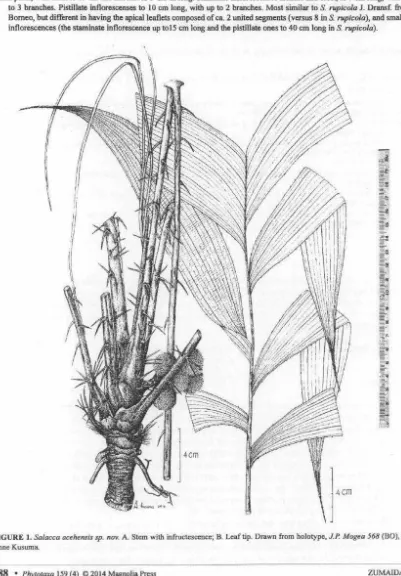
[image:10.614.84.485.151.727.2]Small palm, with stem to 15 cm tall and leaves 1- 2.5 m long. Staminate inflorescences slender and erect, to 7 cm long, with up to 3 branches. Pistillate inflorescenses to 10 cm long, with up to 2 branches. Most similar to S. TUpicola J. Dransf. from Borneo, but different in having the apical leaflets composed of ca. 2 united segments (versus 8 in S. rupicola), and smaller inflorescences (the staminate inflorescence up to15 cm long and the pistillate ones to 40 cm long in S. TUpicola).
FIGURE J. Salacca acehensis sp. nov. A Stem with infructescence; B. l-eaftip. Drawn from bolotype, J.P. Mogea 568 (BO), by Anne Kusuma
288 • Plrytotaxa 159 (4) 0 2014 Magnolia Press ZUMA ID AR
..
.
,
.
Small, pleonanthic, dioecious palm. Stems clustering, ca. I 0-15 cm long, 3 5 cm in diameter, somewhat stilt rooted, obscured by persistent leaf bases. Leaves 5-12 per stem, 1- 2.5 m long; sheath 5-6 cm wide at the base, densely covered abaxially with dark brown indumentum, armed in the middle part with comb-shaped groups of spines, each group consisting of 4-5 stout, triangular, yellowish spines, to 25 mm long and 2 mm wide at the base, smaller spines present between the groups; all spines covered in indumentum, especially on adaxial side; petiole slender, 75 125 cm long, ca. 9 mm in diameter at the base, 5 mm in diameter in the middle, triangular, covered in pale brown to dark brown indumentum, especially in abaxial side, armed with scattered groups of short horizontal and reflexed spines arranged in three longitudinal rows; rachis to 60 cm long. Leaflets 10-12 on each side of the blade, irregularly arranged in groups of 2- 3 near the base, spreading in several planes, sigmoid to lanceolate, acuminate, margins armed with small curved spines ca. O.S
mm
long inserted at distances of 3 -5 mm, pointing upwards, adaxial surface dark green with sparse brown indumentum, abaxial surface yellowish grey, with dark brown indumentum at the base and the margins; middle leaflets to 32 cm long and 6 cm wide, with 3 main longitudinal veins separated by 1- 2 cm and 4-7 minor veins in between. adaxially with transverse veinlets conspicuous; apical leaflet I 0 cm wide on each side, with ca. 2 main folds.Inflorescences axillary, piercing the subtending leaf sheath. Staminate inflorescence to 7 cm long, slender and
erect, simple or with up to 3 branches to 5 cm long, with flowers borne in dyads, each subtended by a short bracteole. Staminate flowers with sepals 3, membranous, ca. 3 mm long and 2 mm wide, basally united and with a dense indumentum; petals 3, connate in the basal half: pink outside, basally white inside, ca. 2 mm long and 1 mm wide; stamens 6, ca. I mm long, filament red, anther ca. I mm long with yellow pollen. Pistillate inflorescence and flowers not seen. Young infructescences to 10 cm long, simple or with up to 2 branches, closely sheathed by several peduncular bracts. Developing fruits globose, ca. 7 mm long and 8 mm wide (in dry condition), densely covered with ascendent scales, ca. 3.5 mm long and I mm wide.
Paratypes:- INDONESIA. Sumatra; Aceh Province, Southeast Aceh Regency, Gunung Kemiri, near junction of hill dipterocarp forest and lower montane forest, steep valley side, 1200 m elevation, 27 August 1971, J.
Dransfield and D. Saerudin 1983 (K!, K YO); same locality, hill slope of dipterocarp forest, 900 m elevation, 18
November 1975, J.P. Mogea 569 (BO!), 570 (BO!), 572 (BO!), 573 (BO!), 574 (BO!); North Sumatra Province, Bukit Lawang Bahorok, Langlcat, hill dipterocarp forest, 200 m elevation, 25 February 1973, J Dransfield 3310
(BO!).
Discussion:-Sa/acca acehensis has the epicarp covered in spine-like scales and thus clearly belongs to section
Salacca. Among the species of that section it mostly resembles S. rupicola Dransfield (1980: 36), with which it
shares the small size, pinnate leaves and slender, erect, staminate inflorescences. However, S. rupicola has a narrow, bluish green leaves with Oabellate apical leaflets composed of ca. 8 united segments while ins_ acehensis
they are composed of ca. 2. Furthermore, inflorescences of S. rupicola are larger: the staminate ones are up to 15 cm long (versus 7 cm in S. acehensis) and the pistillate up to 40 cm (versus I 0 cm in S. acehensis). Salacca
rupicola also occurs in limestone habitats in Borneo. Of the remaining species of section Salacca with leaves less
than 2.5 m long, two species from Borneo, vii. S. drarufieldiana Mogea (1980: 463) and S. sarawakensis Mogea (1980:473), and three species from Peninsular MaJaysia, viz. S. jlabel/aJa Furtado (1949: 387). S. minuta Mogea (1984: 11) and S. m11/tiflora Mogea (1984: 13), have bifid, flabellate leaves. The remaining small species, S
bakeriana Dransfield (2009: 168) from Borneo, S. graciliflora Mogea (1984: 6) from Peninsular Malaysia and S
stolonifera Hodel (1997: 35) from Thailand, all have relatively long male inflorescences, up to 0.7- 1.2 m long,
depending on the species, that are held along the surface of the ground and sometimes produce new shoots at the tip - a character also found in S. jlabellata). This has not been observed in S. acehensis where male inflorescences are small and erect
A duplicate of the paratype collection J . Dransfield and D Saerudin 1983 キ。Nセ@ distributed to BO (J. Dransfield pers. comm.) but was not found there in spite of thorough search.
Conservation status:- Gunung Kemiri, where this new species was first discovered, is part of the large, 1.09 milL ha. Ounung Leuser National Park in northern Sumatra and hence protected area. The second known locality is located at the eastern edge of that park, some 65 km E ofGunung Kemiri. The habitat is hill dipterocarp forest up to
an
elevation of ca. 1200 m and Salacca acehensis may occur in large parts of the park. Dataare
insufficient toperform a proper evaluation of ゥエセ@ conservation status according to the IUCN criteria, but given the apparently small total extent of the species' range, and the high rates of deforestation outside protected area_, it may be vulnerable or even endangered.
Acknowledgements
We are grateful to John Dransfield, William J. Baker, and Lauren Gardiner al the Royal Botanic Gardens, Kew for their help and advice in connection with this study.The first author would like to thank Dikti (the Directorate General of Higher Education, Indonesia) for sponsoring her study and her Sandwich Program 2012 at Aarhus University, Denmark; Mien A. Rifai as her supervisors at Bogor Agricultural University for his wise guidance, advice, attention, patience and support during her study; Peter van Welzen,
a
Thijsse, and P.A.J. Audiffred at Leiden Herbarimn for malcing specimens available; Himmah Rustiami at Herbarium Bogoriense for kind help with her study. Thanks are also due to Anne Kusuma for malcing the drawing.References
Beccari, 0. (1918) Asiatic palms Lepidocaryeac. Part Jn. Annal.J ofthtJ RoyoJ Botanic Garden 12(2). The Bengal Secretariat Boole Depot, Calcutta. 231 pp.
Dransfield, J. ( 1980) A new species of Salacca Reinw. from the limestone of the Gunung Mulu National Park. .Botanical
Jownal of Linnean Society 81: 36-37.
Dransfield, J. (2009). A new species of Salacca from Sarawak. Palms 53: 167- 170.
Dransfield, J.., Ubl, N.W., Asmussen-Lange, C.B., Baker, W.J.., Harley, M.M. & Lewis, C.E. (2008) Genera Palmanott. TIN
E11olulfon and Clasiflcatlon of Palms. Royal Botanical Gardens, Kew, UK.732 pp. Furtado, C. X.., 1949. The Malayan species of Solocca. Gardens Bulletin Singap<Jn 12: 378-403.
Oovaerts, R., Dransfield, J., Zona, S.F., Hodel, D.R. & Henderson, A. (2013) World checlclist of Arecaceae. Facilitated by the Royal Botanical Gardens, Kew. Published on the internet; http://apps.lcew.org/wcsp/ Retrieved 04 June 2013 .
Griffith, W. (1845) The palms of British East India. Calcutta journal of natural history. and miscellany of the arts and sciences In India 5: 1- 103.
Hodel, D.R. (I 997) New species of palms from Thailand. Palm Journol 134: 28- 37.
Mogea, J.P. (1980) The tlabellate-leaved species ofSalacca (Palmae). Reinwardlia 9: 461-479.
Mogea, J.P. ( 1984) Three new species ofSalacca (Palmae) from the Malay Peninsula. Federation Museums JournaJ (Kuala Lumpur) 29: 1-19.
Reinwardt, C.GC. (1825) In C. F. Homschuch, Sy/loge Plantarum Novarum /temque Minus Cognllarum a l'raestantissimis Botanlcis adhvc Viventibus Collecta et a SocietaJe Regia Botanica Ratisbonens/ Edita. Vol. 2. Societatc Regia Botanica, Regensburg.
Voss, A. (1895) Yilmorin's Blumengllrtnerel Beschnllbung. KullMT und Ytrw•ndung des Gesamlen Pflanunmaterials
far
DeutschtJ Garten. Dritte, oeubearbeitc Auflage. Part I. Berlin. http://d.x.doi.mg/10.5962/bhl.title.67392
- -- -- -- - -
----
--·--- -