THESIS
Submitted as a Partial Fulfillment of Requirements For the Sarjana Sastra Degree in English Department
Faculty of Letters and Fine Arts Sebelas Maret University
By
Marya Mujayani
C.0300040
ENGLISH DEPARTMENT
FACULTY OF LETTERS AND FINE ARTS
SEBELAS MARET UNIVERSITY
SALEH
By
MARYA MUJAYANI C0300040
Has been approved by the thesis consultants
First Consultant
Ida Kusuma Dewi, S.S., MA. NIP 132 206 605
Second Consultant
Dra. Diah Kristina, MA. NIP 131 569 260
The Head of English Department
AN ANALYSIS OF SWEARING WORDS
TRANSLATION IN SIDNEY SHELDON’S
A STRANGER
IN THE MIRROR
INTO INDONESIAN
SOSOK ASING
DALAM CERMIN
BY HIDAYAT SALEH
By
MARYA MUJAYANI C0300040
Accepted and Approved by the Board of Examiners Faculty of Letters and Fine Arts, Sebelas Maret University
On April, 26th 2006
Position Name Signature
Chair person Drs. Djatmika, MA _____________ NIP 132 044 363
Secretary Drs. Agus Hari Wibowo, MA _____________ NIP 132 044 364
First Examiner Ida Kusuma Dewi,S.S., MA _____________ NIP 132 206 605
Second Examiner Dra. Diah Kristina, MA _____________ NIP 131 569 260
The Dean of Faculty of Letters and Fine Arts Sebelas Maret University
PRONOUNCEMENT
Name : Marya Mujayani NIM : C0300040
Pronounce truthfully that the thesis entitled An Analysis of swearing words translation in Sidney Sheldon’s A Stranger in the Mirror into Indonesian Sosok
Asing dalam Cermin by Hidayat Saleh is originally made by the researcher. It is neither a plagiarism, nor made by others. The things related to other people’s works are written in quotations and included within bibliography.
If this pronouncement is proven incorrect in the future, the researcher is ready to accept academicals sanction in the form of the withdrawal of academic title.
Surakarta, April, 2006 The Researcher
MOTTOS
Two roads diverged in a wood
And I took the one less traveled by
And that has made all the difference
(The Road Not Taken by Robert Frost)
If you would seek to find yourself
Look not in a mirror
For there is but a shadow there,
A Stranger…
DEDICATION
I wholeheartedly dedicate this thesis to:
Allah SWT, The Almighty God and The Lord of the Universe
My Beloved Father and Mother
My Beloved Brothers and Sister
ACKNOWLEDGEMENT
Alhamdulillahirobbil’alamin.All praise and thanks are just for Allah SWT the Almighty God and the Lord of the Universe, because of His mercy and guidance, finally I can finish my thesis. Thanks to Muhammad SAW, thanks for Him who spread the guidance.
However, this work cannot also be achieved without encouragement and helps from everybody around me. Therefore, I would like to express my gratitude to those who contribute to the completion of this thesis.
1. Prof. Dr. Maryono Dwirahardjo, S.U., the Dean of Faculty of Letters and Fine Arts, for approving this research.
2. Drs. Riyadi Santosa, M.Ed., the Head of English Department, for his permission to conduct this research.
3. Ida Kusuma Dewi, S.S., M.A., the first consultant, for her attention and guidance during finishing the research.
4. Dra. Diah Kristina, M.A., the second consultant, for her support and advice. 5. Dra. Nani Sukarni,M.S., my academic consultant, for her advice and care. 6. All lecturers in the English Department, who have given many lessons and
experiences to me.
7. Herianto S.S., Donald J. Nababan S.S., and Tiara Dewi Andarastuti S.S….thanks for the time and comments in completing the questionnaire. 8. My beloved mother and father, thanks for understanding me, being there when
Brother Toer, Sister Rie and my naughty nephew Nanda thanks for coloring my life. Thanks to Brother Fatah and Cholis for always supporting and helping me in finishing this thesis.
9. All of my uncles, aunts, and my cousins: finally I can finish my thesis… 10.All my friends in English Department 2000, thanks for sharing bad and good
experience together especially Murni (nice to have such friend like you), Annys (thanks for advising me when I’m loosing control,he.he..), Heny (don’t be afraid hen, U can do it!!) Galih (nice to have such funny conversation with you), Silvie (thanks for the advice and support), Triyandari, ipunk, santi, diah, wahyu, nia, mia , shinta, widya, Tomy, parji, nanang. Yanti 01 (thanks for sharing the idea..)
11.All girls in MAWAR: Pramexs (thanks for your helps, nice to have such neighbour like you..), Tia (come on gals, chayo…), Rina (everything happens for a reason, right!), Nora (How’s Cilacap,he.he..), Dyah+Nita (girl next door), Puput (rom ir mania…),Ayu, Siska, Riri and Anis.
12. Doney, Dan, and Aryo, thank you for motivating me to finish my thesis. 13. Anyone else who supports me directly or indirectly, if I have forgotten any
names, I am deeply sorry.
Eventually, I realize that this thesis is still far from being perfect. Nevertheless, I hope this thesis will be useful for those who are interested in similar studies.
TABLE OF CONTENTS
APPROVAL OF THE THESIS CONSULTANTS……… I
LEGITIMATION OF THE BOARD OF EXAMINERS………... Ii
PRONOUNCEMENT……… Iii
MOTTO……….. Iv
DEDICATION……… V
ACKNOWLEDGMENT……….. Vi
TABLE OF CONTENTS………... viii
ABSTRACT………... ABBREVIATION……… LIST OF TABLES……… X xi xii CHAPTER I: INTRODUCTION………... 1
A. Research Background……….. 1
B. Problem Statements……….. 5
C. Research Objectives ……….. 5
D. Problem Limitation ………. 5
E. Research Significance………. 6
F. Research Methodology………. 6
G. Thesis Organization………. 7
CHAPTER II: LITERATURE REVIEW………... 8
A Definition of Translation ……….……….. 8
B. Types of Translation………... 10
C. Process of Translation……….. 17
D. Principles of Translation……… 19
E. Translation strategy……… F. Accuracy of Translation……… G. Swearing Words………. 21 24 26 CHAPTER III: RESEARCH METHODOLOGY………... 30
B. Data and Source of Data…..………. 31
C. Sample and Sampling Technique………. 32
D. Instrument of The Research……… 32
E. Research Procedure……….. F. Technique of Collecting Data……… 33 34 F. Technique of Analyzing Data………. 35
CHAPTER IV : ANALYSIS……… 36
A Introduction ……….. B Data Analysis………..…………...……….. 36 37 C Discussion……… 66
CHAPTER V : CONCLUSION SUGGESTION………. 70
A. Conclusion……….. 70
B. Suggestion…….………. 71 BIBLIOGRAPHY
ABSTRACT
MARYA MUJAYANI, C0300040. 2006. An analysis of swearing words translation in Sidney Sheldon’s A stranger in the Mirror into Indonesian Sosok Asing dalam Cermin by Hidayat Saleh .Thesis: English Department, Faculty of Letters and Fine Arts, Sebelas Maret University, Surakarta.
This research is conducted to describe the strategies employed by the translator in translating swearing words in Sidney Sheldon’s A Stranger in the Mirror into Sosok Asing dalam Cermin, and to identify the accuracy level of translation in the novel.
This research is a descriptive qualitative research and it employs purposive sampling as the sampling technique. The data in this research are sentences containing swearing words in the novel A Stranger in the Mirror and its translation Sosok Asing dalam Cermin and the result of the questionnaire.
In this case, there are 63 data found. The results of the analysis can be seen as follows:
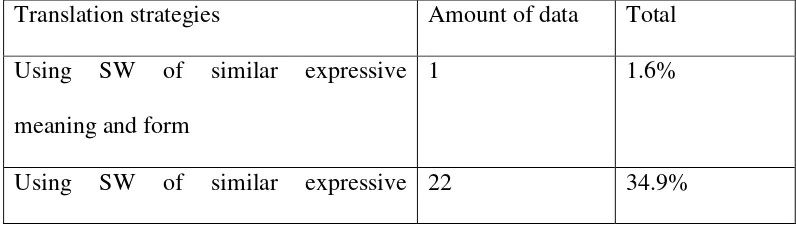
First, there are seven strategies employed in the translation. They are using swearing words of similar expressive meaning and form (1.6 %), using swearing words of similar expressive meaning but dissimilar form (34.9 %), using swearing word of less expressive meaning (3.17 %), translation by neutral word (15.8 %), translation by omission (31.7 %), using loan swearing word (1.6 %) and using interjection (11.1 %).
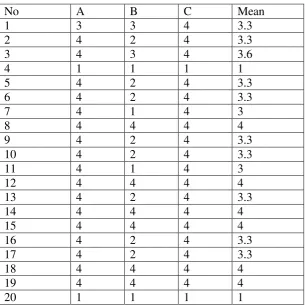
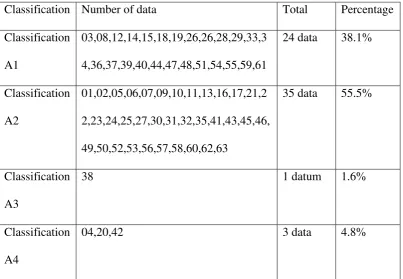
Second, the result of the questionnaire administered to three respondents show that in terms of translation accuracy, most of the data are less accurate (35 data or 55.5% of data). Moreover, the score mean of all data given by respondent is 3.29. It means that the swearing word’s translation in A Stranger in the Mirror
into Sosok Asing dalam Cermin is less accurate.
Based on the results above, it shows that the translator dominantly translates English swearing words in A Stranger in the Mirror by using swearing words in the same expressive meaning but dissimilar form. Besides, the result of the translation of swearing words is less accurate. It suggests that there are many translation of swearing words in the novel of A Stranger in the Mirror into Sosok Asing dalam Cermin convey the different referential meaning but express the same expressive meaning.
ABBREVIATIONS
SL: Source Language
ST: Source Text
TL: Target Language
TT: Target Text
LIST OF TABLES
Table 1. The second translation strategy……… 41
Table 2. Third translation strategy………. 44
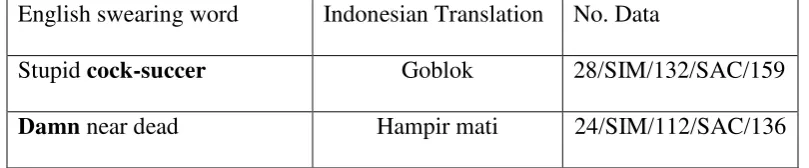
Table 3. The fourth translation strategy………..46
Table 4. The fifth translation strategy……… 48
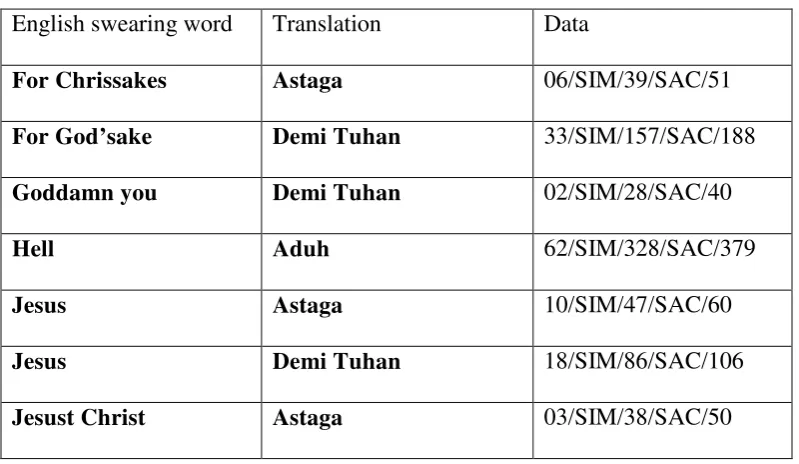
Table 5. Translation using interjection……….. 53
Table 6. Scale of accuracy………. .. 54
Table 7. Translation accuracy……… 55
Table 8. Classification of translation accuracy……… ... 56
CHAPTER 1
INTRODUCTION
A. Research Background
In this globalization era, language plays an important role in our life. People always use it in everyday conversation. Machali (2000) in Pedoman bagi Penerjemah adds that language is a vital tool in communication. As a means of communication, language has a role to convey or to get information from other people. Nowadays, people can no longer just interact with people of one language but also with people of different languages. Therefore, people need to learn foreign language in order to expand their social intercourse and gain more information. By studying foreign language, it is possible for the people to keep up with the development of science and technology comes from other countries. Another function of studying foreign language is to learn the culture of other nation.
English. This causes difficulties in communicating with people coming from other countries, in getting information, in studying science and technology, and in learning other cultures. One of the ways to solve the problem is by translating English written materials into Indonesian. Translation can bridge the problem across language interactions. Moreover, there are an increasing number of books or other information that are presented in English. Therefore, translation plays a very important role.
Basically, in translating a text, a translator has to master languages, either the SL or TL. Etine dollet in Nida (1964:15) states that ”the translator should have the perfect knowledge of the language into which he is translating”. Both of the SL and TL already have different systems such as sound, structure, and also meaning which can not always be applied to each other.
in translating a text, it is necessary to pay attention to the meaning and style either the source language or target language.
Therefore, besides knowing the system of the SL, a translator has to master the system of the TL as well. By comprehending the system of TL a translator can produce an accurate translation, and the result of her/his translation can express the appropriate content of the SL text in an acceptable expression for target reader.
Nevertheless, translation is not easy to do since there are many problems and difficulties found in translation. One of the difficulties in translation is that of translating swearing words.
Trudgill and Andersson confirm that swearing is a bad language. It can be defined as “a type of language use in which the expression:(a) refers to something that is taboo and/or stigmatized in the culture;(b) should not be interpreted literally;(c) can be used to express strong emotions and attitudes.” (1990: 53). From the definition above, it could be clearly seen that swearing refers to something that is taboo to be uttered. It is considered as bad language that some people decide to avoid using these words. It is obvious that swearing can be used to show strong emotions. “Swearing reflects speaker’s wrath towards a person or an object” (Asher,1994:4512). Generally, the use of swearing words are associated with strong emotions, but now it is also possible to use swearing words in every kind of speech, not just when the speakers are angry.
It is also more often used in the novel. The frequent swearing words uttered are four-letter words i.e. fuck, shit and damn. The words are so commonplace that its shock value seems quite lost.
There are so many western novels which are translated to Indonesian. This can raise problems because of the cultural differences between two languages. It is proved by the fact that there have been misinterpretations in reader’s mind since the swearing words translation fails to find out a suitable equivalence for certain terms for other cultures.
Here are the examples of translating swearing words in the novels: Example 1:
Context: At Knee High, when showtime came and the comic had not appeared, the owner of the club began to rage and curse.
“That bastard’s through this time, you hear? I won’t have him near my club again.”
“Bangsat itu kupecat, kalian dengar? Jangan sampai ia kutemukan di dekat kelab ini lagi.”
Example 2:
Context: In the location of making a movie, one of the crew asked whether the director wants him to change the sheets. Then the director said:
“What the fuck do you think we are, MGM?” ”Kau pikir kita apa, MGM?”
In example 1, the translator translated the English swearing word bastard
Meanwhile in example 2, the translator omitted swearing word fuck. This of course makes the statement more polite. Actually, the fuck here functions as an intensifier. However, this expression is lost in the translation. Based on the fact above, the researcher is interested to analyze the translation of swearing words used in the novel.
The researcher is interested to analyze the translation of Sidney Sheldon’s novel A Stranger in the Mirror because the novel is an interesting novel which has become so popular among the readers. In Sidney Sheldon’s novel A Stranger in the Mirror, it can be found many swearing words. Thus, the researcher proposes to analyze the translation of swearing words in Sidney Sheldon’s novel A Stranger in the Mirror translated into Indonesian by Hidayat Saleh.
B. Problem Statements
This research is carried out to answer problems as follows:
1. What are the strategies of translation applied in translating swearing words in A Stranger in the Mirror by Sidney Sheldon?
2. How is the accuracy of the translations of the English swearing words found in A Stranger in the Mirror by Sidney Sheldon?
C. Research Objectives
1. To find out the kind of translation strategy employed in translating swearing words in A Stranger in the Mirror by Sidney Sheldon.
2. To know the accuracy of the translation of swearing words in A Stranger in the Mirror by Sidney Sheldon.
D. Problem Limitation
The research is limited on the analysis of the swearing words in the novel A Stranger in the Mirror and their translation. The researcher will focus the analysis on the strategies of translation applied by translator in translating the swearing words and the accuracy of the translation of swearing words in A Stranger in the Mirror by Sidney Sheldon.
E. Research Significance
The researcher hopes that this research will give input to students and lecturers of English Department in their attempts of learning and developing translation study. The researcher also hopes that this research will give additional knowledge to the professional translator who has duty to provide a good and enjoyable novel for Indonesian reader. Besides, the result of the translation can be applied as a guide to organize the other researches about swearing words.
F. Research Methodology
metode-metode deskriptif tidak hanya tertuju sampai pada pengumpulan data tetapi meliputi analisa dan interpretasi tentang arti data itu” (1994: 139). It is a descriptive study in which the writer collects, classifies, analyzes and interprets the data.
The data of this research are sentences containing swearing words in Sidney Sheldon’s novel A Stranger in the Mirror and its translated version and the result of questionnaires of accuracy assessments. Whereas the technique of sampling employs in this research is purposive sampling. Further details of this research methodology will be discussed in chapter III.
G. Thesis Organization
This thesis will be organized into five chapters. They are as follows: CHAPTER I: INTRODUCTION
It consists of Research Background, Problem Statements, Research Objectives, Problem Limitation, Research Significance, Research Methodology, and Thesis Organization.
CHAPTER II: LITERATURE REVIEW
In chapter II the researcher discusses some theories and references that are related to this research. It explains about the definition of translation, types of translation, process of translation, principles of translation, translation strategy, Accuracy of translation and ended by swearing words.
CHAPTER III: RESEARCH METHODOLOGY
research procedure, technique of collecting data, and the last is technique of analyzing data.
CHAPTER IV: DATA ANALYSIS
Chapter IV is the most important part of the research because here the researcher processed the data by analyzing and classifying them.
CHAPTER V: CONCLUSION AND SUGGESTION
This is the last chapter in which the researcher concludes the result of the analysis and gives some suggestions.
CHAPTER II
LITERATURE REVIEW
A. The Definition of Translation
There are many translation theorists who give definitions about translation. They have different opinions in defining the term. In The Theory and Practice of Translation, Nida and Taber (1974: 12-13) give the definition of translation as follows: ”Translating consist in reproducing in the receptor language the closest natural equivalent of the source language message, first in terms of meaning and secondly in terms of style”. Here, the emphasis is in the equivalence which is natural in terms of meaning and style.
is rendering the meaning of a text into another language in the way that the author intended the text.”(1988: 5). Moreover, in Approaches to Translation
he states, “Translating is a craft consisting in the attempt to replace a written message and/or statement in one language by the same message and/or statement in another language” (1981: 7). It is very clear that the emphasis of that statement is on transferring message.
Another opinion is stated by Bell. He defines that “translation is the expression in another language (or target language) of what has been expressed in another, source language, preserving semantic and stylistic equivalences.”(1991: 5). In this definition, the equivalences of meaning and style are very important. A translator should maintain the message and also the style of the Source Language. It means that translation should give to the reader the same effect of what have been stated by source language.
Susan-McGuire Bassnett defines translation as: “What is generally understood as translation involves the rendering of a Source Language (SL) text into the Target Language (TL) so as to ensure that (1) the surface meaning of the two will be approximately similar and (2) the structures of the SL will be preserved as closely as possible but not so closely that the TL structures will be seriously distorted.” (1991:2). This definition explains that the meaning of the SL must be transferred to the TL closely, but the structure can change because each language has different structures.
transferring idea or message from the source language to the target language. In translation, the most significant thing is the meaning. Then, the translator should also consider the style of the text he translates, so that he will produce the most appropriate style in the target language text.
B. The Types of Translation
There are several types of translation that is given by some expert. Catford (1974: 25) divides the types of translation into: word for word translation, free translation and literal translation.
1. Word for word translation
About this translation, Catford (1974: 25) states that “Word-for-word translation generally means what it says: i.e. is essentially rank-bound at work rank (but many may include some morpheme- morpheme equivalences)”.
In word for word translation, the translator only transfers the meaning of every word from the SL into TL without paying any attention to the structure of the TL. This type of translation can only be applied on the sentences of SL which have the same structure as the TL.
For example:
SL-English : I have a big red apple
English structure is different from Indonesian structure. Generally, English structure uses modifier before the noun. In example, big red
(modifier) apple(noun). On the other hand, generally, Indonesian structure uses modifier after the noun. Apel is a noun- merah yang besar is modifier. In this case, the result of the translation is not good. The sentences Saya punya sebuah besar merah apel is structurally incorrect and not understandable because it does not follow the Indonesian grammar and structure. In this example, the word-for-word translation is difficult to apply because SL and TL structure are not the same.
2. Free translation
Dealing with this type of translation, Catford states that “A free translation is always unbounded-equivalences shunt up and down the rank scale, but tend to be at the higher ranks- sometimes between larger unit than the sentence” (1974: 25).
In this type of translation, the translator must understand the whole sentences as one unity whether in paragraph or the whole texts. In free translation, the messages and ideas of the text in the source language must be the translation priority. The translator can expresses the messages and ideas into the target language by making his own words without changing the main idea of the source language text.
For Example:
TL-Indonesian : Aku haus
3. Literal Translation
In connection with literal translation, Catford states that “Literal translation lies between these extremes; it may start, as it were, from a word-for-word translation, but make changes in conformity with TL grammar (e.g. inserting additional words, changing structures at any rank, etc.)”.(1974:25)
In this type of translation, the translator still maintains its original form in the SL since she wants to give a great respect to the SL. Although literal translation still depends on the structure of the SL, it is possible for the translator to make some adjustments, such as giving expansion or reduction of information.
For Example:
TL-English : There is no use crying over spilt milk.
TL-Indonesian : Tiada gunanya menangisi air susu yang telah tumpah.
Newmark (1988: 45-47) gives other opinion about types of translation. He explains that translation methods are divided into: Word for word, literal, faithful, semantic, adaptation, free, idiomatic and communicative translation.
1. Word-for-word translation
preserved and the words translated singly by the most common meanings, out of context. Cultural words are also translated literally” (1988: 45)
For example: John eats rice John makan nasi
2. Literal translation
In connection with literal translation, he states that “the SL grammatical constructions are converted to their nearest TL equivalents but the lexical words are again translated singly, out of context. As pre-translation process, this indicates the problems to be solved”. (1988:45)
For example:
It is raining cats and dogs Hujan kucing dan anjing.
(Machali,2000: 51)
3. Faithful translation
For example:
Ben is too well aware that he is naughty. Ben menyadari terlalu baik bahwa ia nakal.
(Machali,2000: 51-52)
4. Semantic translation
Semantic translation gives more attention on the aesthetic value (that is, the beautiful and natural sounds) of the SL text, compromising on ‘meaning’. Semantic translation is used for ‘expressive’ text. Semantic translation tries to translate the contextual meaning of the source language as close as possible to the semantic and syntactic structure of the target language, as stated by Newmark (1981:39) as follows: “ Semantics translation attempts to render as closely as possible the semantic and syntactic structure of the second language, allow the exact contextual meaning of the original.”
For Example: He is a book-worm
Dia (laki-laki) adalah seorang yang suka sekali membaca
(Machali,2000: 52)
5. Adaptation
culture and the text is rewritten.”(1988:46). The example of this method is translation of Shakespeare’s play Macbeth adapted by W.S Rendra and played in TIM Jakarta, 1994. Rendra took all of character in source text either of the plots. However, the dialogue have been adapted and adjusted to Indonesian culture (Machali, 2000: 53).
6. Free translation
“Free translation reproduces the matter without the manner, or the content without the form of the original. Usually it is a paraphrase much longer than the original, a so-called ‘intralingual translation’, often prolix and pretentious, and not translation at all. (Newmark, 1988:46-47)
For Example:
SL: (Time, May 28, 1990): “Hollywood Rage for Remakes”
TL: (Suara Merdeka, 15 Juli 1990): “Hollywood Kekurangan Cerita: Lantas Rame-rame Bikin Film Ulang”
(Machali, 2000: 54) 7. Idiomatic translation
Newmark explains that “Idiomatic translation reproduces the ‘message’ of the original but tends to distort nuance of meaning by preferring colloquialism and idioms where these do not exist in the original.” (1988:47) For Example:
Tsa: I’ll shout you a beer.
(Machali, 2000 : 55) 8. Communicative translation
About this translation, Newmark states that “Communicative translation attempts to render the exact contextual meaning of the original in such a way that both content and language are readily acceptable and comprehensible to the readership”(1988:47). Further, he also explains that “Communicative translation attempts to produce on its readers an effect as close as possible to that obtained on the readers of the original.”(1981: 39). It is clear that in communicative translation, the translator tries to produce an effect as close as possible between the readers of the source language and the readers of the target language. So the most important thing in this kind of translation is the transfer of feeling and emotion. The example of this translation is the word spine in phrase thorns spines in old reef sediments. If it is translated to biologist, the equivalence is spina. But if it is translated to public, the translation is duri.
C. Process of Translation
Zuchridin Suryawinata (2003: 19) develops the process of translation given by Nida and Taber. He tries to make the clear description about this process by using deep structure and surface structure concept of TGT (Tata Bahasa Generatif Transformasi). In further explanation, Suryawinata gives a scheme of translation process as follows:
Teks asli dalam Bsu evaluasi dan revisi Teks terjemahan dlm Bsa
Analisis/ Proses eksternal Restrukturisasi/ Pemahaman Proses internal penulisan kembali
Konsep,makna, transfer Konsep,makna, Pesan dari teks Bsu padanan pesan dalam Bsa
(2003: 19)
1. Analysis and comprehension
In this step, surface structure (or the statement) is analyzed according to grammatical relationship, word meaning, textual meaning and even contextual meaning. It is back transformation process.
2. Transfer
After analyzing and understanding the meaning of the SL, the translator processes the material in his mind. Then he transfers the material from SL to TL. Everything happens just in the translator’s mind.
3. Restructuring
In this step, the translator tries to find out the equivalences of words, phrases or sentences structure in TL. Translator needs to restructure the grammar of the SL into TL so that the meaning and message of source text can be transferred fully to Target Language.
4. Evaluation and Revision
After the translator gets the equivalence of translation in TL, then this translation is evaluated and checked again to the source text. If it is still not equivalent, the translator will revise the translation.
D. Principles of Translation
Savory in his book entitled The Art of Translation clarifies that there are some principles of translation, as follows:
1. A translation must give the words of the original. 2. A translation must give the ideas of the original. 3. A translation should read like an original work. 4. A translation should read like a translation.
5. A translation should reflect the style of the original. 6. A translation should posses the style of the translator. 7. A translation should read as a contemporary of the original. 8. A translation should read as a contemporary of the translator. 9. A translation may add to or omit from original.
10. A translation may never add to or omit from the original. 11. A translation of verse should be in prose.
12. A translation of verse should be in verse.
(1969: 50) It is clear that the important thing in translation is transferring the content, the meaning or message correctly and completely from the SL into the TL. No matter how the translator translated the source text, it should convey the entire message of source text clearly.
Etinne Dolet in Nida(1964: 15-16) summarized the fundamental principles of translation under headings:
2. The translator should have a perfect knowledge of the language from which he is translating and an equally excellent the knowledge of the language into which he is translating.
3. The translator should avoid the tendency to translate word-for-word, for to do so is to destroy the meaning of the original and to ruin the beauty of the expression.
4. The translator should employ the forms of speech in common usage. 5. Through his choice and order of words the translator should produce a
total overall effect with appropriate “tone”.
From the description above, it can be concluded that a translator has to pay attention to the significant criteria in translation. That attention is required by a translator, it is due to the fact that he is a person who has responsibility toward his own translation. He has to catch the idea from SL and then transfer them to TL naturally.
E. Translation Strategy
Mona Baker gives the strategies used by professional translators for dealing with various types of non-equivalence at word level, as follows:
1. Translation by a more general word (super ordinate)
2. Translation by more neutral/less expressive word
This strategy is used by translator when there is no equivalent of such word in target language or when translator thinks it will be more appropriate using more neutral or less expressive word.
3. Translation by cultural substitution
This strategy involves replacing a culture-specific item or expression with target language item, which does not have the same propositional meaning but is likely to have similar impact on the target reader. The main advantage of using this strategy is that it gives the reader a concept with which s/he can identify something familiar and appealing.
4. Translation using loan word plus explanation
Following the loan word with an explanation is very useful when the word in question is repeated several times in the text. Once explained, the loan word can then be used on its own; the reader can understand it and is not distracted by further lengthy explanations.
5. Translation by paraphrase using a related word
6. Translation by paraphrase using related words
If the concept expressed by the source item is not lexicalized at all in the target language, the paraphrase strategy can still be used in some contexts. Instead of a related word, the paraphrase maybe based on modifying a super ordinate or simply on unpacking the meaning of the source item, particularly if the item in question is semantically complex. 7. Translation by omission
If the meaning conveyed by a particular item or expression is not vital enough to the development of the text to justify distracting the reader with lengthy explanations, translators can and often do simply omit translating the word or expression in question.
8. Translation by illustration
This is a useful option if the word, which lacks an equivalent in the target language, refers to a physical entity, which can be illustrated, particularly if there are restrictions on space and if the text has to remain short, concise, and to the point.
(1992: 26-42) Baker also propounds some strategies dealing with how to translate idioms. Further she explains that there are four strategies used to translate idiom:
The strategy involves using an idiom in the target language, which conveys roughly the same meaning as that of the source language idiom and, in addition, consists of equivalent lexical items. This kind of match can only be occasionally achieved.
2. Using an idiom of similar meaning but dissimilar form
It is often possible to find an idiom in the target language which has a meaning similar to that of the source idiom, but which consists of different lexical items.
3. Translation by paraphrase
This strategy is the most common way of translating idioms when match cannot be found in the target language or when it seems inappropriate to use idiomatic language in the target text because of differences in stylistic preferences of the source and target languages.
4. Translation by omission
As with the single words, an idiom may sometimes be omitted altogether in the target text. This maybe because it has no close match in the target language, its meaning cannot be easily paraphrased, or for stylistic reasons.
(1992: 72-77)
F. Accuracy
translation depends on three components; accuracy, communicability and naturalness. Accuracy means that the translation is reproducing as exactly as possible the meaning of source text. Communicability means that the translation is expressing all aspect of the meaning so it is understandable to the intended audience. Naturalness means that the translation is using natural forms of the receptor language in a way that is appropriate to the kind of text being translated
In terms of accuracy, Toury states “Accuracy is translating all semantic content (meaning) from the SL text into the TL one” (www.snunitk12.il/projects/tirgum/main2.html). It is clear that there is meaning which is transferred. A translation is considered to be accurate if it covers the equivalence of meaning.
Accuracy is also related to choose the correct words in order to reveal the same idea in the Target Language. Mustakim explains further that “Ketepatan dalam pemilihan kata berkaitan dengan kemampuan memilih kata yang dapat
mengungkapkan gagasan secara tepat dan gagasan itu dapat diterima secara
tepat pula oleh pembaca/pendengarnya”(1994:42). Choosing the right word is very important. If the translator chooses the right words, the text will be accurate because it can convey the meaning of the Source Language to the Target Language properly. Choosing the right word should consider some factors, such as target readers, context and socio-cultural.
translation. The main aspect is to check the equivalence of meaning. Person with bilingual competence and also translation competence, or at last having both the SL and TL knowledge will be regarded to evaluate the accuracy.
G. Swearing Words
There are many definitions of Swearing Words. In Longman Language activator dictionary, it is explained that swear is:
1) To use offensive language, especially because you are very angry. 2) The words that people use when they swear
3) Words for describing someone who swears a lot
(1993: 1354) Montague in Sjahriati rohmah (2002: 19) gives opinion about swearing that “it is the act of verbally expressing the feeling of aggressiveness that follows up on frustration in word possessing strong emotional associations”. It is clear than that swearing is words that someone uttered to express her/his strong emotions.
Further, In the Cambridge Encyclopedia of the English Language
either at a people or at object. For example is when our head makes inadvertent contact with a low roof beam, we often utter swearing words to express our annoyance.
Along with the definition above, Asher in The Encyclopedia of Language and Linguistics (1994: 4512-4513) states that swearing words are “those which invoke damnation, misfortune or degradation of the targeted person or object”. Swearing reflect a speaker’s anger or frustration towards a person or an object. It is used as a way to vent a strong emotion. ‘Damn it’, ‘God damn it’, ‘damn you’, and ‘go to hell’ are frequently used swearing expression.
Andersson & Trudgill confirm that swearing is bad language, which is tabooed to be said. “One of the most obvious forms of ‘bad’ language is, of course, bad language-in other words, swearing.” (1990:14). Further, they define swearing as a type of language use in which the expression:
(a) refers to something that is taboo and/or stigmatized in the culture; (b) should not be interpreted literally;
(c) can be used to express strong emotions and attitudes.
directed toward others. The examples of expletive are Hell! , Shit! , God damn it!. While abusive is used to express emotions but it is directed towards others. It is derogatory includes name-calling and different types of curses. The examples are you asshole! , You bastard! , Go to hell!. Apart from these two major types, there are other uses of swearing words that is humorous and auxiliary. Humorous is directed towards others but not derogatory. It often takes the form of abusive swearing but has the opposite function and it is playful rather than offensive. The example is Get your ass in gear!.
Meanwhile, auxiliary is an expression of emotion that is not directed towards a person or situation. It is a kind of swearing as a way of speaking (‘lazy swearing’). It is often or always non-emphatic.
For Examples: this fucking X, bloody Y.
and emotive sound. Often these insults accuse the subject of something deemed socially unacceptable like masturbation (wanker), incest (motherfucker), and legitimate family background (bastard), or sexual deviance (bugger). These terms are rarely intended to be taken literally, but their unpleasant connotations may help to preserve their emotive nature. (http://www.Andrewgray.com/essay /swearing.htm)
In the book entitled Bad Language, Andersson and Trudgill explain that swearing words has its specific grammatical rules. The grammar is the same for swearing as for ordinary language. Further, they explain that it may intrude intro grammatical patterns, as follows:
1) As separate utterances (expletives and abusives):
Shit! Jesus Christ! You Bastard! God damn you!
2) As’adsentences’. (loosely tied to a sentence, before or after):
Shit, I forgot all about it.
You have to tell me, for God’s sake!
3) As major constituents of a sentence (subject, verb, adverb, etc.):
That stupid bastard came to see me.
He fucks up everything.
He managed-God damn it-to get his degree.
4) As part of a constituent of a sentence (adjective, adverb):
this fucking train
5) As part of a word (compound or derivational, as prefix, suffix or infix)
Abso-bloody-lutely
Tenne-goddamn-see
(1990: 62-63) Swearing words that are considered indecent and inappropriate in polite contexts exist in most languages and culture (http://www.Andrewgray.com/essay /swearing.htm). In almost all cultures, swearing involves filth, the forbidden like incest, and the sacred. Most cultures use swearing whether it is relatively mild or highly profane.
Nowadays, the frequent swearing words uttered are four letter words. Bryson explains that “Today the worst swear words in English are probably fuck,
E. Problems in Translating
It is realized that translating a text is not an easy work. The duty of a translator is actually not as simple as we imagine: besides he has to comprehend the meaning of each sentence, he also has to master the systems of the SL and the TL because English has its own systems that are different from the Indonesian language. In the process of translation, translator may face many problems. Richard in Brislin states that “Translating is probably the most complex type of events yet produced in the evolution of cosmos”(1996,p.1). Translator should produce the translation that cause target reader to respond as equally as source reader does.
Concerning to the translation’s problem, some experts such as Nida Taber (1974), and Sumarno (1990) classify those problems into linguistic and extra-linguistic problems:
a. Linguistic problem
Nida and Taber (1974, p.6) say that “ linguistic problems are related to the difference of linguistic features, such as word building capacities, unique patterns of phrase order, techniques of linking clauses into sentences, and markers of discourse”. In similar tone, Sumarno says:
setiap unsur atau kata yang menyusun struktur, makna gabungan kata, makna kalimat maupun makna textual secara keseluruhan” (1990,p.30)
b. Extra linguistic problem
Nida (1974,p.14) explains that “extra linguistic problem are those which are related to extra linguistic aspects of the message, whether they are in form, for example the number of syllables in a verse, patterns of rhyming in a song or in content”. For example temporal-spatial aspects of an ancient drama, socio-cultural aspects of Javanese comedy of the message.
F. Classification of Translation
During the process of transferring message from SL to TL, the translator, with certain consideration sometimes makes some changes of meaning. Those changes, as discussed by Brislin (1976,p.10) are reduction (omission), addition, and substitution of meaning.
a. Reduction
2). To reduce repetition, 3). To eliminate conjunction, 4). To reduce formula, 5). To extent ellipsis in SL.
b. Addition
Addition refers to the change of meaning done by the translator in which the translator adds new unit of meaning, which originally does not exist, to his translation. Here the translator explores everything in SL. He may want to explain meaning and message from SL to TL explicitly. This is done usually to make the message more understandable in TL.
c. Substitution
Substitution refers to the change of meaning in which the translator substitutes a literally different unit of meaning for a unit of meaning in the original text. Substitution is usually done to make the original meaning more acceptable in TL. Those changes of meaning in translation are acceptable and are quite important on condition that the purpose is to obtain the closest equivalence and to obtain the proper and natural translation
E. Problems in Translating
comprehend the meaning of each sentence, he also has to master the systems of the SL and the TL because English has its own systems that are different from the Indonesian language. In the process of translation, translator may face many problems. Richard in Brislin states that “Translating is probably the most complex type of events yet produced in the evolution of cosmos”(1976,p.1). Translator should produce the translation that cause target reader to respond as equally as source reader does.
Concerning to the translation’s problem, some experts such as Nida Taber (1974) classify those problems into linguistic and extra-linguistic problems:
a. Linguistic problem
Nida and Taber (1974, p.6) say that “ linguistic problems are related to the difference of linguistic features, such as word building capacities, unique patterns of phrase order, techniques of linking clauses into sentences, and markers of discourse”.
b. Extra linguistic problem
There is a widespread public association between swearing and social class, and many of those who criticize the habit most strongly do so because they believe it to be a ‘common’ and unrefined habit. It maybe fair to say that many regular swearer come from anarchic or lower class backgrounds, and that they swear primarily as a means of distancing themselves from mainstream society and affirming their position as a member of a particular social group.
The more recent liberation of sexual attitudes has also been accompanied by a more relaxed attitude to the accompanying swear words, although this liberation has not yet proceeded as far as with blasphemy.
Today the worst swear words in English are probably fuck, shit, and cunt.
By far the most common function of swearing is a descriptive one, a role filled mainly by two words: bloody and fucking (this is undoubtedly the more severe). Descriptive swearing usually conveys one or both of two impressions, emphasis or contempt.
Accuracy rating instrument, adapted from Nagao, Tsuji and Nakamura in Nababan (2004:61), is based on scale 1 to 4 as shown below:
Scale Definition
4 The content of the source sentence is accurately conveyed into the target sentence. The translated sentence is clear to the evaluator and no rewriting is needed
3 The content of the source sentence is accurately conveyed into the target sentence. The translated sentence is clearly understood by the evaluator, but some rewriting and some change in word order are needed.
sentences elements.
1 The source sentence is not translated at all into the target sentence, i.e. it is omitted or deleted.
Thompson in Geoffrey Hughes (1998, p.9) divides swearing words according to situation into two categories as follows:
1. Organized swearing
Organized swearing consists of two distinct types. One is obscenity pure and simple, consisting more or less stereotyped references to the pudenda. Certain relatives are also permitted to snatch playfully at one’s another genitalia, and even to handle these organ in public. The other is termed bad language, consisting chiefly of references to the anus and to excrement.
2. unorganized swearing
In this category, swearing falls under no sanction and is used by both sexes in quarrels, and as taunts to goad an enemy of fight.
Meanwhile Mildred L. Larson in his book Meaning–Based Translation gives the definition of translation as follows:
source language is replaced by the form of the receptor (target) language. (1984: 2). It is clear that the form of first language is changed into the form of second language by way of semantic structure. There is the meaning which is transferred. This meaning must be held constantly.
in Noviandari (2005:34)
A translation is considered to be accurate if it conveys the meaning of the Source Language to the target language properly
CHAPTER III METHODOLOGY
In this research, the researcher uses descriptive qualitative method. Surakhmad states that “pelaksanaan metode-metode deskriptif tidak hanya tertuju sampai pada pengumpulan data tetapi meliputi analisa dan interpretasi tentang arti data itu” (1994, p.139). It is a descriptive study in which the writer collects, classifies, analyzes and interprets the data. Concerning the descriptive method, Allison points out that “descriptive research sets out to seek accurate and adequate descriptions of activities, objects, processes, and person” (1996, p.14). By using this method, the researcher tends to describe the facts concerning the object of the research. Wiersma gives a statement that “qualitative researh has its original in descriptive analysis, and essentially in inductive process, reasoning from the specific situation to a general conclusion”. (2000, p.12)
In descriptive qualitative method, one is doing an investigation by analyzing the selected data and drawing an interpretation of his analysis. The interpretation will finally lead the researcher to a conclusion.
The data in this research are sentences containing swearing words in Sidney Sheldon’s “A Stranger in the Mirror” and its translation and the result of questionnaires of accuracy assessments. These data will be observed to find out the strategies of translation used by the translator. Besides, the analysis is also aimed at determining accuracy of translation. In order to do this, the analysis will be implemented based on theories of translation.
B.
Data and Source of Data
Data source is the media from which the data are taken for the research. As Arikunto states that the data source is the object from which data are obtained (1993,p.162). From this data source, the data are taken. In this research, the source of data is the novel entitled A Stranger in the Mirror written by Sidney Sheldon, published by Charnwood, Leichester in 1976 and its translated version Sosok Asing dalam Cermin by Hidayat Saleh. Another data source on this research is three peoples who have both Indonesian and English competence and translation competence, who will provide data in relation to the accuracy of the translation.
The researcher takes the novel as data source based on the following consideration:
1. The novel is popular among the reader.
2. The writer has a good reputation in literature. He achieved Nobel
rewards for literature from New York
Times.(http://en.wikipedia.org//wiki/sidney )
3. The novel contains a lot of swearing words.
C. Sample and Sampling Technique
The samples of this research are the sentences in A Stranger in the Mirror and its translated version containing swearing words.
The researcher uses purposive sampling to get the samples. This technique takes all data focusing on sentences containing swearing words. The researcher collects 63 sentences containing swearing words as the samples.
D. Instrument of the Research
Moleong states that “dalam penelitian kualitatif, peneliti sendiri atau dengan bantuan orang lain merupakan alat pengumpul data utama” (1990,p.4). It clarifies that the researcher himself or with other’s help is the main instrument of the research.
E.
Research Procedure
Research procedure is a series of activity that a researcher does in stages in implementing his investigation. The research procedure that is applied by the researcher is as follows:
1. Collecting the data. The data are the sentences containing swearing words in A Stranger in the Mirror and its translation.
2. Coding the data in order to make the data classification and the data analysis clear to understand.
In giving code of the data, five points are used. They are the number of the data, the SL, the page from which the data are taken, the TL (Target Language) and the page from which the data are taken.
Example: Datum 01/SIM/023/SAC/034
“Answer him you little son of a bitch!” Eileen’s father bellowed. “Jawab, bangsat!” ayah Eileen menggeram.
· 01: the first part of the code is to show the sequence number of
the datum
· SIM: the second part of the code is to show the original novel
title in English
· 023: the third part of code is to show the page of the original
novel where the datum is taken from
· SAC: the fourth part of code is to show the title of the
· 034: the fifth part of the code is to show the page of the
Indonesian translation novel where the datum was found. 3. Analyzing the data. The data are analyzed based on the problem statement in this research. The data are classified based on their translation strategies. They are further determined into the questionnaire of accuracy.
4. Drawing conclusion based on the results of analysis.
F.
Technique of Collecting Data
Concerning with the data, a technique is applied in order to collect or to select them. It was mentioned before that in this research, the data include sentences containing swearing words in the novel A Stranger in the Mirror and the translated version in Indonesian. The data are collected by reading the original text and its Indonesian version. It is aimed to identify the data containing swearing words. The researcher then writes the sentences containing swearing words.
The second step of collecting data is in term of assessing the accuracy. In this step, the researcher asks three people who have at least competency on both English and Indonesian and on translation knowledge to evaluate the data and to complete the questionnaire.
G.
Technique of Analyzing Data
In analyzing the data, the researcher uses the steps as follows:
2. The researcher compares the swearing words in the English version to their equivalence in Indonesian.
3. The researcher analyzes each category of data to find out the strategies of translation.
4. The researcher gathers and classifies the questionnaire according to the accuracy of the translation of swearing words.
5. The researcher reports what she has found in detail.
CHAPTER IV
DATA ANALYSIS
A. Introduction
This chapter describes the result of data analysis, which is expected to be the answer of problems in this research. This analysis will answer the question of how the texts in the Source Language are transferred into Target Language. In this case it is related to the strategies of translation used and how far the translation is accurately transferred into Target Language.
respondents. It is conducted to determine the accuracy of Swearing Words translation in each datum.
Based on the aspects above, the data will be presented in following section.
B. Data Analysis
1. Data Analysis of Strategies of Translation
This category refers to the way Swearing Words translated into Target Language. Based on the analysis, there are seven strategies used by the translator in translating English swearing words into Indonesian in A Stranger in theMirror. It includes using swearing words of similar expressive meaning and form, using swearing words of similar expressive meaning but dissimilar form, using swearing words of less expressive meaning, translation by neutral word, translation by omission, using loan swearing words and using interjection.
Further, those strategies of translation are explained as follows:
a. Swearing words of similar expressive meaning and form
Example 1:
“Are you guilty of trafficking with Satan? Then you shall burn eternally in Hell, damned for ever, because Lucifer is coming to get you!”
“Apakah kalian telah bersekutu dengan setan? Bila demikian kalian akan terbakar selamanya dalam neraka, terkutuk selamanya, sebab Lucifer akan datang mengambil kalian!”
12/SIM/54/SAC/69 The example above represents the translation using swearing word of similar expressive meaning and form. The swearing word damned forever is replaced by terkutuk selamanya. Lexically, damned forever means condemn someone else to spend perpetuity in hell or acquire eternal punishment after death. The conversation above occurs in the church. Jill’s mother always takes Josephine to the revival meeting. The preacher stirs up the spirit of congregation by intensifying that they will be damned forever if they traffic with Satan. From the explanation, it clarifies that the translation uses the same lexical item like source language swearing word. In addition, it also uses the same expressive meaning.
b. Swearing words of similar expressive meaning but dissimilar form.
The researcher finds some data which belong to this group. The examples of this translation can be seen as follows:
Example 1:
“That bastard’s through this time, you hear? I won’t have him near my club again.”
“Bangsat itu kupecat, kalian dengar? Jangan sampai ia kutemukan di dekat kelab ini lagi.”
05/SIM/039/SAC/051 The English swearing word bastard is translated into bangsat. Lexically, a bastard is a child of unwed parents (Johnson, 1995:61). Bangsat is someone who has bad attitudes (TPKP3B, 1999:89). However in this sentence, bastard is used to imply that the person is a generally mean-spirited or despicable person. It is abusive that is addressed to the comic who does not come into view. The owner of the club gets angry and utters this swearing word. The lexical meaning of
bastard is quiet different to bangsat. However, Bangsat has the similar expressive meaning to bastard. Besides, the context of this sentence shows that bastard is used to express anger. The swearing word bangsat is commonly used in Indonesian to express the same idea.
Example 2:
“Answer him you little son of a bitch!” Eileen’s father bellowed. “Jawab bangsat!” ayah Eileen menggeram.
Lexically, son of a bitch is a baby of a dog (Johnson, 1995:62). However in this statement, a son of a bitch is just a mean spirited and despicable person. That expression is stated by Eileen’s father to show anger. This swearing word reflects Father’s wrath towards Toby. Hence it is a kind of abusive that is directed to Toby. Her father gets angry to Toby because he makes Eileen pregnant. It is translated into bangsat in Indonesian. Bangsat is used as a swearing word, which means someone who has bad attitudes (TPKP3B, 1999:89). Although there is different lexical item in this translation, this swearing word expresses the same idea which is showing anger to someone.
Example 3:
“Shit! I wish I’d known about the earlier Sam. I’ve made a deal at MGM.”
“Sial! Kalau saja aku tahu sebelumnya, Sam. Aku sudah membuat kontrak dengan MGM.”
39/SIM/190/SAC/225 The English swearing word shit is translated into sial in Indonesian. Shit
knew it before, he would get that deal. It makes him feel annoying. The lexical meaning of Shit is quiet different to Sial.Sial means unlucky or misfortune or bad luck (TPKP3B, 1999:934). However, the context of this sentence shows that Shit
is used to express annoyance. Sial shows annoyance too. Thus it expresses the same idea.
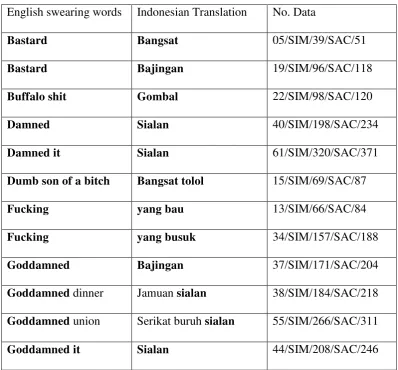
[image:62.595.112.511.385.755.2]There are 22 data (34.9%) showing this strategy of translation. The following table presents the English swearing words translated using this strategy of translation, they are:
Table 1
The second translation strategy
English swearing words Indonesian Translation No. Data
Bastard Bangsat 05/SIM/39/SAC/51
Bastard Bajingan 19/SIM/96/SAC/118
Buffalo shit Gombal 22/SIM/98/SAC/120
Damned Sialan 40/SIM/198/SAC/234
Damned it Sialan 61/SIM/320/SAC/371
Dumb son of a bitch Bangsat tolol 15/SIM/69/SAC/87
Fucking yang bau 13/SIM/66/SAC/84
Fucking yang busuk 34/SIM/157/SAC/188
Goddamned Bajingan 37/SIM/171/SAC/204
Goddamned dinner Jamuan sialan 38/SIM/184/SAC/218
Goddamned union Serikat buruh sialan 55/SIM/266/SAC/311
Goddamn you Keparat 59/SIM/310/SAC/360
Hell Sialan 47/SIM/221/SAC/259
Horseshit Sialan 08/SIM/39/SAC/52
Prick Bajingan 36/SIM/158/SAC/188
Poor bastard Bangsat malang 26/SIM/127/SAC/154
Pygmy sons of bitches Bangsat-bangsat kerdil 14/SIM/66/SAC/84
Shit Sial 39/SIM/190/SAC/225
Shit Sialan 51/SIM/240/SAC/281
Son of a bitch Bangsat 01/SIM/23/SAC/34
Son of a bitch Bajingan 48/SIM/221/SAC/260
c. Translation using swearing word of less expressive meaning
It means that the translator translates swearing word in swearing word too, but it conveys less expressive meaning. The emotive effect of the translation is less than the source language swearing word. Baker states that “There may be target-language words which has the same propositional meaning as the source language word, but it may have a different expressive meaning” (Baker,1992:23).
Here is the datum that employs this strategy of translation: Example 1:
“It’s a load of horseshit,” Sam said. “Memang omong kosong,” kata Sam
There is an obvious difference in the expressive meaning of horseshit
and omong kosong. The level of expressiveness of omong kosong is less than
horseshit although they have the same propositional meaning. Horseshit lexically means horse faeces. In this context, horseshit means nonsense or fakery. Sam says to Tessy that all of their friend’s statement is lie. This word is translated into
omong kosong. Omong kosong means boasting or big talk. The translator expresses the same idea to the Source Text which shows fakery although it uses less expressive meaning. The reader can not feel the same emotive effect as in the Source Text swearing word. It is clear that horseshit is used to express strong emotion. However translation of omong kosong is uncommonly used to express strong emotion (anger).
Example 2:
“I have a German shepherd that can fart better dialogue than this shit” “Aku punya anjing herder yang bisa mengentutkan dialog lebih bagus
dari sampah ini.”
41/SIM/206/SAC/243 In the example above, the translator translates the swearing word shit
into sampah. Shit means excrement or what was emptied by the bowel. While
The translator translates that English swearing word using less expressive one.
Sampah has the less level of expressiveness compared to shit.
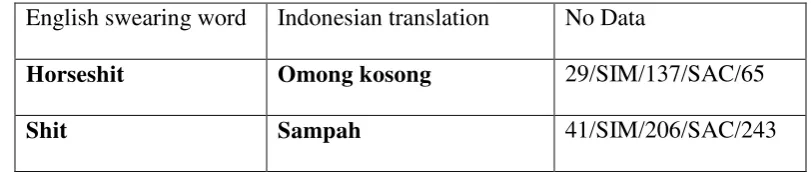
[image:65.595.106.512.333.419.2]There are 2 (3.17 % of total data) that are translated using swearing words of less expressive meaning:
Table 2
Third translation strategy
English swearing word Indonesian translation No Data
Horseshit Omong kosong 29/SIM/137/SAC/65
Shit Sampah 41/SIM/206/SAC/243
d. Translation by using neutral word
Sometimes, a translator does not translate swearing word into swearing word too. He replaces English swearing word into neutral word in Indonesian. There are some reasons why translator does not translate English swearing word into swearing word too. One of the reasons can be due to different stylistic preferences of the source and target language. For that reason the translator prefers to use neutral word. The data below will be one of the examples:
Example 1:
52/SIM/260/SAC/304 There is an equivalence for hell in Indonesian, but it is mostly associated with religion. Hell is the place where bad people are supposed to go after they die (Johnson, 1995:60). The translator felt that it would be wrong to use it in this context. Hell is used to intensify question words. The translator replaces this English swearing word by using neutral word, gerangan. Gerangan is adverbial, which is an expression of wondering or doubt. There is no intensifying force in the Target Text. It is clear that the expressive meaning of ST swearing word is not retained in the translation.
Example 2:
“Very much. It’s a damned good show. But the sponsors-“
“Suka sekali. Benar-benar tontonan yang bagus. Tapi para sponsor…” 17/SIM/71/SAC/8 The example above represents translating swearing word by means of using neutral words. Translator translates swearing word damned into benar-benar. Bill Hunts utters this swearing word. It is aimed to give intention that the show is good. The translator translates it into benar-benar. It is expected that the target reader will understand the intended meaning. However, the reader cannot feel the strong emotive effect as in the source text swearing word.
Example 3:
“I honesly ca