THE ADOPTION OF LEAN AND CLEANER PRODUCTION – A
PRELIMINARY STUDY FOR MALAYSIA MANUFACTURING INDUSTRY
Muhamad Zaki Yusup
1, 2, a, Wan Hasrulnizzam Wan Mahmood
1, b,
Mohd Rizal Salleh
1, cand Azrul Shahimy Mohd Yusof
3, d1Sustainable and Responsive Manufacturing Research Group, Faculty of Manufacturing
Engineering, Universiti Teknikal Malaysia Melaka, 76100 Hang Tuah Jaya, Melaka, Malaysia
2Department of Quality and Productivity, Kolej Kemahiran Tinggi MARA Kuantan, Km 8, Jalan
Gambang, 25150 Kuantan, Pahang, Malaysia
3Department of Language Studies, Universiti Teknologi MARA Cawangan Kedah, P.O.Box 187,
08400 Merbok, Kedah, Malaysia
a[email protected], b[email protected], c[email protected], d[email protected]
Keywords: Lean Production, Cleaner Production, Manufacturing Industry, Malaysia
Abstract
Adoption of lean production in managing the production operations with a cleaner production due to of environmental concerns positively drive new manufacturing paradigm in the manufacturing environment. This leads to this study being carried out, in order to investigate the extent of which these practices has been adopted in Malaysia’s manufacturing industry. The finding revealed that good performance in environmental practice in tandem with the appraisal of labour safety in material handling has helped the respondents to successfully sustain the quality and durability of products, improves the operation efficiency, as well as production’s productivity. Aside from that, the correlation test results between all items in LP and CP have a significant positive relationship with each other where the appraisal in the selection of equipment from CP practices have a very strong relationship with the improvement of working conditions that resulted from the adoption of LP practices. These potentially make both practices as the best approach that has potential to be integrated together to support the development of a sustainable manufacturing practice principally in Malaysia’s manufacturing industry.
Introduction
The ability of adapting the Lean Production (LP) and Cleaner Production (CP) in managing production operations was a substantial proactive action in improving the performance of manufacturing sustainability. As a multi-dimensional approach that aim to eliminate waste in the operations, a high focus in LP evidently improves the productivity and cost reduction strategies [1, 2]. Meanwhile, as a radical improvement strategy in managing the environmental concern, CP potentially able to be integrated with LP practice in achieving high economic performance, as well as increase the management of environmental care, starting from the earliest stage in product development, until how the waste are managed at the last stage of the manufacturing process [3]. The ability to adapt these practices can boost the capability of the manufacturer as to continually improve its competitiveness in the global market [4].
The implementation of LP and CP is seemed timely in enhancing the degree of management efficiency, while reducing the barriers in continuous improvement activity, especially in dealing with the increase of cost of production that is caused by the increase of price in the production input [5, 6]. The ability to adopt both practices may lead to optimal economic development as well as reduce the environmental impact through efficient resource utilisation. Therefore, this preliminary study is used to measure the current adoption of LP and CP in Malaysia’s manufacturing industry.
This can potentially be used in the transformation of the economic and environmental performance in Malaysia’s manufacturing industry, in achieving sustainable development, which is the basis to realize a new economic circular. The following sub-titles explain the research methods, findings, and conclusion from this preliminary study. The findings in this study may be referred by academician and manufacturers, in improving the performance and sustainability in the manufacturing operations.
Research Method
A total of 340 questionnaires were mailed out to various manufacturing industries in Malaysia. The questionnaire, comprising of 25 items, were created to measure the current performance of LP practice and 26 items related to CP practice. The development of this questionnaire was based on the review on several research papers in LP and CP. The questionnaires were mailed out to the company’s senior management staffs, who is have working experience of more than 2 years at same manufacturing industry. Each respondents were asked to rate the current performance of their LP and CP practice based on seven Likert’s scales (e.g.: 1 = strongly disagree until 7 = strongly agree). Initially, a total of 40 questionnaires or 11.7 percent were returned. However, only 38 were considered valid to be used to evaluate the performance from the adoption of LP practice, while only 37 were valid to be used in evaluating the current performance of CP practice.
Result and Discussion
The highest percentage of the respondents in this study are from the mechanical product group (47.5%), followed by electrical or electronic products group (20%), automotive product group and chemical or scientific product groups (15%), and lastly, the other product group (2.5%). The respondents are mainly from companies with less than 150 employees (34.2%), less than 300 employees (23.7%) and more than 750 employees (18.4%). Meanwhile, 47.5% of the respondents experienced with the ISO14001 management system in which 63.1 % have more than 10 years of experience. Furthermore, 80% of the respondents possess certified management certification in other disciplines where 90.6% of them possess a certification in ISO 9001.
Lean and Cleaner Production Performance
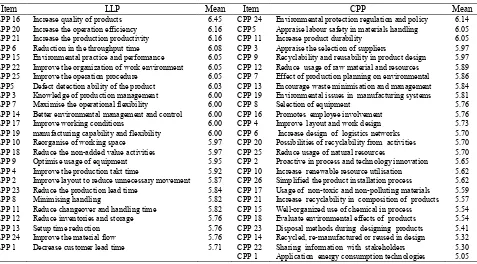
The internal consistency test shows that all of the items in the questionnaire used were reliable for analysis where the measurement of Cronbach’s alpha coefficient for the LP and CP practices were 0.988 and 0.975 respectively. This means that every question modelled to measure the current performance in production practices correlated with both practices at a higher internal consistency level. The mean score of respondents’ performance for both practices are arranged in rank from high to low, as shown in Table 1.
For LP practice, Table 1 shows that the respondent agreed that all 25 items meet their current practice in adopting LP, where the intention to increase the quality of products (LPP16) has the highest mean score of 6.45, followed by the concentration to increase the operation efficiency (LPP20) and production productivity (LPP21) at a mean score 6.18 respectively. However, the focus to decrease the customer lead time (LPP1) has the lowest mean score of 5.71. As for the standard deviation, the analysis of this practice shows that the action taken to decrease customer lead time (LPP1) has the highest value of 1.227, and the action taken to increase the quality of products (LPP16) has a smaller variance at the lowest value of 0.891.
(CPP1) was the lowest rated item with a mean score 5.05. As for the standard deviation, there was a large variance of answers from the respondents that agreed to consider recycled, re-manufactured or re-used product design (CPP14) at a score value 1.547. However, the respondents have similar opinion in considering increase of product durability (CPP11) where this element has the lowest value at 0.911.
Table 1: Performance of Lean (LPP) and Cleaner Production Practices (CPP)
Item LLP Mean Item CPP Mean
LPP 16 Increase quality of products 6.45 CPP 24 Environmental protection regulation and policy 6.14 LPP 20 Increase the operation efficiency 6.16 CPP5 Appraise labour safety in materials handling 6.05 LPP 21 Increase the production productivity 6.16 CPP 11 Increase product durability 6.05 LPP 6 Reduction in the throughput time 6.08 CPP 3 Appraise the selection of suppliers 5.97 LPP 15 Environmental practice and performance 6.05 CPP 9 Recyclability and reusability in product design 5.97 LPP 22 Improve the organization of work environment 6.05 CPP 12 Reduce usage of raw material and resources 5.89 LPP 25 Improve the operation procedure 6.05 CPP 7 Effect of production planning on environmental 5.86 LPP5 Defect detection ability of the product 6.03 CPP 13 Encourage waste minimisation and management 5.84 LPP 3 Knowledge of production management 6.00 CPP 19 Environmental issues in manufacturing systems 5.81 LPP 7 Maximise the operational flexibility 6.00 CPP 8 Selection of equipment 5.76 LPP 14 Better environmental management and control 6.00 CPP 16 Promotes employee involvement 5.76 LPP 17 Improve working conditions 6.00 CPP 4 Improve layout and work design 5.73 LPP 19 manufacturing capability and flexibility 6.00 CPP 6 Increase design of logistics networks 5.70 LPP 10 Reorganise of working space 5.97 CPP 20 Possibilities of recyclability from activities 5.70 LPP 18 Reduce the non-added value activities 5.97 CPP 25 Reduce usage of natural resources 5.70 LPP 9 Optimise usage of equipment 5.95 CPP 2 Proactive in process and technology innovation 5.65 LPP 4 Improve the production takt time 5.92 CPP 10 Increase renewable resource utilisation 5.62 LPP 2 Improve layout to reduce unnecessary movement 5.87 CPP 26 Simplified the product installation process 5.62 LPP 23 Reduce the production lead time 5.84 CPP 17 Usage of non-toxic and non-polluting materials 5.59 LPP 8 Minimising handling 5.82 CPP 21 Increase recyclability in composition of products 5.57 LPP 11 Reduce changeover and handling time 5.82 CPP 15 Well-organized use of chemical in process 5.54 LPP 12 Reduce inventories and storage 5.76 CPP 18 Evaluate environmental effects of products 5.54 LPP 13 Setup time reduction 5.76 CPP 23 Disposal methods during designing products 5.41 LPP 24 Improve the material flow 5.76 CPP 14 Recycled, re-manufactured or reused in design 5.32 LPP 1 Decrease customer lead time 5.71 CPP 22 Sharing information with stakeholders 5.30 CPP 1 Application energy consumption technologies 5.05
The result on LP shows that an improvement on the quality of products is the main priority of the respondents. It is not surprising as this is in line with the awareness of customers on the product purchased, as well as high competitiveness in the market [7]. Although the reduction of customer lead times is in the last position, it still needs to be considered. This possibly depends on the nature of the business, and group of products produced. Meanwhile, the result of the CP showed that the respondents have the commitment to comply with environmental regulations, and the laws and policy of environmental management. This indirectly promotes the proactive action in dealing with issues related to the environment. Even though a number of the respondents that agree that the use of energy conservation equipment is low, it is still considered necessary by several respondents. This requirement has contrasting values possibly due to the use of equipments and technology that might vary by the category of products. Besides that, the implementation of new technology is not always profitable for certain business nature [8]. This result also shows that the manufacturing sector in Malaysia has a high tendency to adopt LP and CP practices. In fact, the analysis result also shows that these practices have worked together in increasing the quality and durability of the products, in a comprehensive manufacturing environments.
Spearman Rho Correlation Test
that the ability to take action in improving manufacturing efficiency positively influence the improvement of productivity in production operations [2].
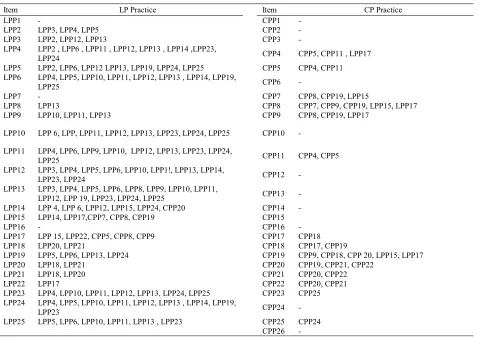
Table 2: Spearman correlation coefficient of Lean (LLP) and Cleaner Production Practices (CPP)
Item LP Practice Item CP Practice
LPP5 LPP2, LPP6, LPP12 LPP13, LPP19, LPP24, LPP25 CPP5 CPP4, CPP11 LPP6 LPP4, LPP5, LPP10, LPP11, LPP12, LPP13 , LPP14, LPP19,
LPP25 CPP6 -
LPP7 - CPP7 CPP8, CPP19, LPP15
LPP8 LPP13 CPP8 CPP7, CPP9, CPP19, LPP15, LPP17 LPP9 LPP10, LPP11, LPP13 CPP9 CPP8, CPP19, LPP17
LPP10 LPP 6, LPP, LPP11, LPP12, LPP13, LPP23, LPP24, LPP25 CPP10 -
LPP11 LPP4, LPP6, LPP9, LPP10, LPP12, LPP13, LPP23, LPP24,
LPP25 CPP11 CPP4, CPP5
LPP12 LPP3, LPP4, LPP5, LPP6, LPP10, LPP1!, LPP13, LPP14,
LPP23, LPP24 CPP12 -
LPP13 LPP3, LPP4, LPP5, LPP6, LPP8, LPP9, LPP10, LPP11,
LPP12, LPP 19, LPP23, LPP24, LPP25 CPP13 - LPP14 LPP 4, LPP 6, LPP12, LPP15, LPP24, CPP20 CPP14 - LPP15 LPP14, LPP17,CPP7, CPP8, CPP19 CPP15
LPP16 - CPP16 -
LPP17 LPP 15, LPP22, CPP5, CPP8, CPP9 CPP17 CPP18 LPP18 LPP20, LPP21 CPP18 CPP17, CPP19
LPP19 LPP5, LPP6, LPP13, LPP24 CPP19 CPP9, CPP18, CPP 20, LPP15, LPP17 LPP20 LPP18, LPP21 CPP20 CPP19, CPP21, CPP22
LPP21 LPP18, LPP20 CPP21 CPP20, CPP22
LPP22 LPP17 CPP22 CPP20, CPP21
LPP23 LPP4, LPP10, LPP11, LPP12, LPP13, LPP24, LPP25 CPP23 CPP25 LPP24 LPP4, LPP5, LPP10, LPP11, LPP12, LPP13 , LPP14, LPP19,
LPP23 CPP24 -
LPP25 LPP5, LPP6, LPP10, LPP11, LPP13 , LPP23 CPP25 CPP24 CPP26 -
As for CP, the highest significant value of 0.881 appears between the actions in evaluation of environmental effects of products (CPP18) and the practice in evaluating the environmental issues in the selection of manufacturing systems (CPP19). This indicates that the selection of manufacturing system should be considered parallel with the impact on the environment that could potentially arise from the product produced. This fact has proven that CP is able to be streamlined in all stages of the manufacturing process [3]. Besides, there are 3 items in LP and 6 items in CP that have a very strong relationship with each other, with a correlation value of 0.807 to 0.835, whereas the appraisal in selection of equipment’s in producing the products (CPP8) with the improvement of working conditions (LPP17) has a very strong correlation at valued at 0.847.
Conclusion
As a conclusion, the study found that the current manufacturing practice by the respondents in Malaysia’s manufacturing industry has met the items in the adoption of LP and CP practices. In addition, the correlation results also show that all items used in evaluating the current practices related in each LP and CP has a significant correlation with each other where majority of the items have a strong relationship with the adoption of both practices. Moreover, both practices are also seen to have a strong relationship, if they are implemented simultaneously. The result of this preliminary study has provided basic information for next research level, primarily in formulating the best approach that integrates both practices in Malaysia’s manufacturing industry.
Acknowledgement
This research was co-funded by Universiti Teknikal Malaysia Melaka (UTeM) under an ERGS Grant (ERGS/1/2013/TK01/UTEM/02/08/E00029).
References
[1] J.P. Womack and D.T. Jones, Lean Thinking-Banish Waste and Create Wealth in Your Corporation, United Kingdom: Simon & Schuster, 2003.
[2] M.Z. Yusup, W.H. Wan Mahmood, M.R. Salleh, and M.N.H. Mohd Rosdi, The Trigger Signal For Lean Production Practices : A Review, Global Engineers & Technologists Review, vol. 3, no. 6, (2013) 23–32.
[3] M.Z. Yusup, W.H. Wan Mahmood, M.R. Salleh, and M.R. Muhamad, The Influence Factor for the Successful Implementation of Cleaner Production : A Review, Jurnal Teknologi, vol. 67, no. 1, (2014) 89–97.
[4] M.G. (Mark) Yang, P. Hong, and S.B. Modi, Impact of lean manufacturing and environmental management on business performance: An empirical study of manufacturing firms, International Journal of Production Economics, vol. 129, no. 2, (2011) 251–261.
[5] V. Dobes, New tool for promotion of energy management and cleaner production on no cure, no pay basis, Journal of Cleaner Production, vol. 39, (2013) 255–264.
[6] M.Z. Yusup, W.H. Wan Mahmood, M.R. Salleh, and T. Rahayu, A Review on Optimistic Impact of Cleaner Production on Manufacturing Sustainability, Journal of Advanced Manufacturing Technology, vol. 7, no. 2, (2013) 79–99.
[7] S. Aguado, R. Alvarez, and R. Domingo, Model of efficient and sustainable improvements in a lean production system through processes of environmental innovation, Journal of Cleaner Production, vol. 47, (2013) 141–148.
[8] I. Kliopova and J.K. Staniskis, The evaluation of Cleaner Production performance in Lithuanian industries, Journal of Cleaner Production, vol. 14, (2006) 1561–1575.
[9] E. Szmidt and J. Kacprzyk, The Spearman rank correlation coefficient between intuitionistic fuzzy sets, 2010 5th IEEE International Conference Intelligent Systems, (2010) 276–280. [10] S. Hajmohammad, S. Vachon, R.D. Klassen, and I. Gavronski, Lean management and supply
The Adoption of Lean and Cleaner Production – A Preliminary Study for Malaysia Manufacturing Industry