3
MORPHOLOGY AND CONDUCTIVITY FILM IN
POLYANILINE DOPED ZnO
Eva Marlina Ginting1*, Sri Wahyuni Batubara1, Nurdin Bukit1, Erna Frida2
1Department of Physics , Faculty of Mathematics and Natural Sciences ,University State of Medan ,Indonesia 2Quality University Medan , Indonesia
*email : [email protected]
AbstractThis study aims to determine the conductivity and the morphology of the film Polyaniline doped with ZnO. The method of making
the film of polyaniline / HCl / ZnO done using Galvanostat. Aniline monomer solution of 25 ml, 75 ml of HCl mixed with 1 g ZnO glass.dan beaker and 10 ml H2O2 disetirer, the sample results is polymerized with nickel as a partner electrode (anode / CE) and carbon as working
electrode (cathode / WE). The mixture will be polymerized with nickel electrodes shaped thin plates and thin beam-shaped carbon electrode. Flow synthesis given by 4 mA with synthesis time for 30 minutes. PANI/ HCl formed will be attached to the carbon electrode in the form of a layer having a thickness of tens of micrometers formed layer is a thin film PANI / HCl / ZnO.The test results obtained by the morphology of the fibers intersect to form a porous structure looks homogeneous ZnO particles, whereas to determine the value of conductivity using the LCR-Meter, the value of orders 10-4 / m, which meets the conductivity value as a semiconductor material.
Keywords.Polyaniline, HCl, ZnO, morphology, conductivity
I. INTRODUCTION
Polymers in general is a material with the ability to conduct electricity is low and does not have a response to the magnetic field from the outside. But through several studies conducted, some polymer material turns electrical conductivity can be improved by adding an acid causing a second phase that is conductive. One polymeric material electrical conductivity can be improved is polyaniline (PANi).
Conductive polymer materials of concern because it is conductive can be applied as an electronic material such as capacitors, pH sensors and transistors [1]
Electroactive conductive polymers and new materials that are highly in demand by researchers due to electrical and magnetic properties of the unique and easy way to synthesis. One type of conductive polymer is polyaniline widely studied because it has a higher environmental stability and ease of synthesis process, compared to other conductive polymers
Polyaniline can be synthesized electrochemically produce products in the form of films and the usual chemical synthesis will produce polyaniline in powder form. Synthesis of polyaniline chemically ordinary is often done because the interfacial polymerization
method is relatively easy in the provision of doping.
Polyaniline-based composites research has been done,including by[2-4].
Fe3O4@PANI nanocomposites [ 5]
ZnO is is a relatively soft material with a hardness of about 4.5 Mohs. Elastic constants smaller than the III-V semiconductors, such as GaN. Heat capacity and high thermal conductivity, low thermal expansion and high melting temperature ZnO is beneficial for ceramics. Among the tetrahedral semiconductors, ZnO has the highest piezoelectric tensor or at least comparable with GaN and AlN. These properties make this material is an important technology for many piezoelectric applications, which require a large electromechanical clutch.
ZnO has a relatively large band gap of ~ 3.3 eV at room temperature, because it is pure ZnO is colorless and transparent. Advantages associated with a large band gap, including a high voltage, the ability to sustain large electric fields, high temperatures and large operating power
4
II. EXPERIMENTAL PROCEDURES
Material
Aniline monomer (C6H5NH2), Purity 15%, Merck
Germany, Mr: 93.13 g / mol, 25% purity HCl GR Merck Germany, Mr: 36.46 g/mol, H2O2,Zn
(CH3COO)2.2H2O Mr: 219 Merck Darmstadt
Germany, Mr NH4OH:42Merck Darmstadt
Germany, Darmstadt Germany Merck Ethanol.
Instrument.
SEM - EDX JEOL5310 LV. LCR Meter
Synthesis of ZnO Particles with Coprecipitation Method
Zn (CH3COO) 2.2H2O as much as 5 ml of 0.2 M
NH4OH mixed with about 45 ml. Then add 25 ml
of ethanol, the solution distirer and heated to a temperature of 80o C for 2 hours. After the cooling
the solution at room temperature for a few minutes, then wash with a solution of water and ethanol to remove impurities to produce a white precipitate. Then dry in the oven for 24 hours.
Synthesis of Polyaniline Film / HCl / ZnO
H2O2 solution of 10 ml and 1 g of ZnO in the
stirrer for 2 hours on a glass beaker. Mix 25 ml of aniline, and 50 ml of HCl in the solution of H2O2
and ZnO. And then the mixture was polymerized using galvanostat with nickel as the partner electrode (anode / CE) and carbon as working electrode (cathode / WE). The mixture will be polymerized with nickel electrodes shaped thin plate and a thin beam-shaped carbon electrode. PANI / HCl / ZnO were formed to be attached to the carbon electrode in the form of a layer having a thickness of tens of micrometers formed layer is a thin film PANI / HCl / ZnO .
III.RESULTS AND DISCUSSIONS
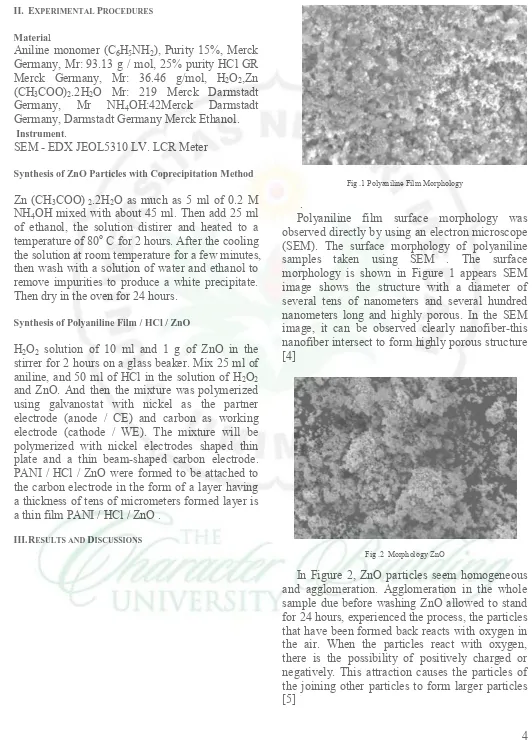
Fig .1 Polyaniline Film Morphology
.
Polyaniline film surface morphology was observed directly by using an electron microscope (SEM). The surface morphology of polyaniline samples taken using SEM . The surface nanofiber intersect to form highly porous structure [4]
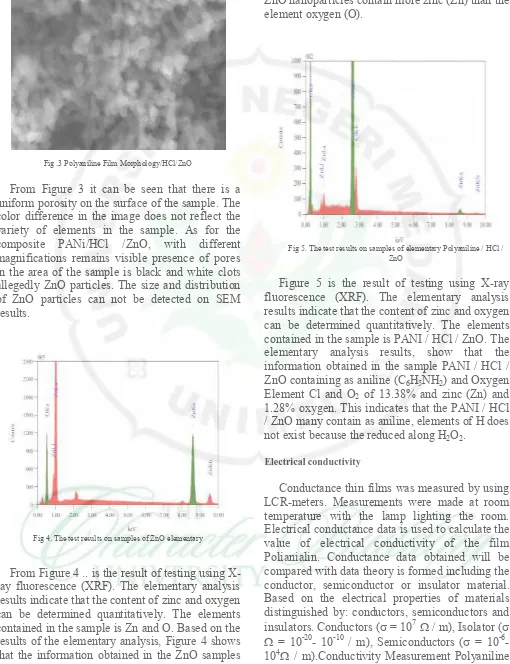
Fig .2 Morphology ZnO
5
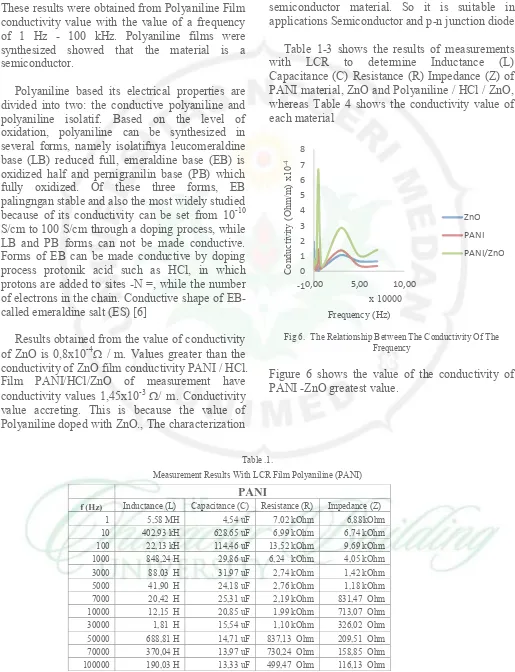
Fig .3 Polyaniline Film Morphology/HCl/ZnO
From Figure 3 it can be seen that there is a uniform porosity on the surface of the sample. The color difference in the image does not reflect the variety of elements in the sample. As for the composite PANi/HCl /ZnO, with different magnifications remains visible presence of pores in the area of the sample is black and white clots allegedly ZnO particles. The size and distribution of ZnO particles can not be detected on SEM results.
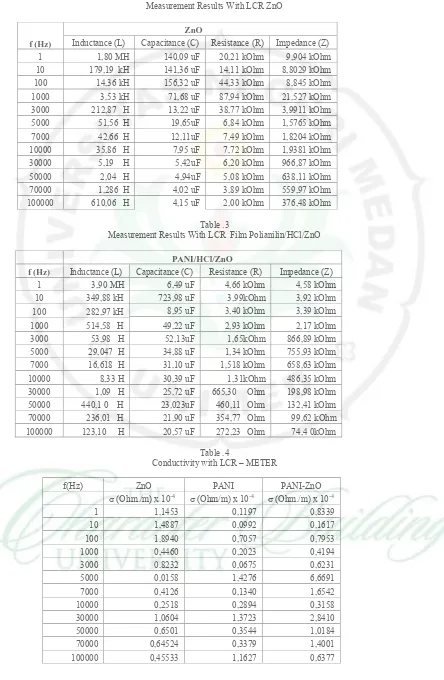
Fig 4. The test results on samples of ZnO elementary
From Figure 4 .. is the result of testing using X-ray fluorescence (XRF). The elementary analysis results indicate that the content of zinc and oxygen can be determined quantitatively. The elements contained in the sample is Zn and O. Based on the results of the elementary analysis, Figure 4 shows that the information obtained in the ZnO samples containing zinc (Zn) amounted to 77.77% and
oxygen (O) of 22.23 %. This indicates that the ZnO nanoparticles contain more zinc (Zn) than the element oxygen (O).
Fig 5. The test results on samples of elementary Polyaniline / HCl / ZnO
Figure 5 is the result of testing using X-ray fluorescence (XRF). The elementary analysis results indicate that the content of zinc and oxygen can be determined quantitatively. The elements contained in the sample is PANI / HCl / ZnO. The elementary analysis results, show that the information obtained in the sample PANI / HCl / ZnO containing as aniline (C6H5NH2) and Oxygen,
Element Cl and O2 of 13.38% and zinc (Zn) and
1.28% oxygen. This indicates that the PANI / HCl / ZnO many contain as aniline, elements of H does not exist because the reduced along H2O2.
Electrical conductivity
Conductance thin films was measured by using LCR-meters. Measurements were made at room temperature with the lamp lighting the room. Electrical conductance data is used to calculate the value of electrical conductivity of the film Polianialin. Conductance data obtained will be compared with data theory is formed including the conductor, semiconductor or insulator material. Based on the electrical properties of materials distinguished by: conductors, semiconductors and insulators. Conductors ( = 107 / m), Isolator ( = 10-20- 10-10 / m), Semiconductors ( = 10-6
6 Film / HCl obtained konduktivisnya value of 0.52
x 10-3 / m.
These results were obtained from Polyaniline Film conductivity value with the value of a frequency of 1 Hz - 100 kHz. Polyaniline films were synthesized showed that the material is a semiconductor.
Polyaniline based its electrical properties are divided into two: the conductive polyaniline and polyaniline isolatif. Based on the level of oxidation, polyaniline can be synthesized in several forms, namely isolatifnya leucomeraldine base (LB) reduced full, emeraldine base (EB) is oxidized half and pernigranilin base (PB) which fully oxidized. Of these three forms, EB palingngan stable and also the most widely studied because of its conductivity can be set from 10-10
S/cm to 100 S/cm through a doping process, while LB and PB forms can not be made conductive. Forms of EB can be made conductive by doping process protonik acid such as HCl, in which protons are added to sites -N =, while the number of electrons in the chain. Conductive shape of EB-called emeraldine salt (ES) [6]
Results obtained from the value of conductivity of ZnO is 0,8x10⁻⁴ / m. Values greater than the conductivity of ZnO film conductivity PANI / HCl. Film PANI/HCl/ZnO of measurement have conductivity values 1,45x10⁻³ / m. Conductivity
value accreting. This is because the value of Polyaniline doped with ZnO., The characterization
of the electrical properties of Polyaniline Film / HCl / ZnO obtained that polyaniline and ZnO is a semiconductor material. So it is suitable in applications Semiconductor and p-n junction diode.
Table 1-3 shows the results of measurements with LCR to determine Inductance (L) Capacitance (C) Resistance (R) Impedance (Z) of PANI material, ZnO and Polyaniline / HCl / ZnO, whereas Table 4 shows the conductivity value of each material
Fig 6. The Relationship Between The Conductivity Of The Frequency
Figure 6 shows the value of the conductivity of PANI -ZnO greatest value.
Table .1.
Measurement Results With LCR Film Polyaniline (PANI)
PANI
f (Hz) Inductance (L) Capacitance (C) Resistance (R) Impedance (Z)
7
Table .2.
Measurement Results With LCR ZnO
f (Hz)
ZnO
Inductance (L) Capacitance (C) Resistance (R) Impedance (Z)
1 1,80 MH 140,09 uF 20,21 kOhm 9,904 kOhm
10 179,19 kH 141,36 uF 14,11 kOhm 8,8029 kOhm 100 14,36 kH 156,32 uF 44,33 kOhm 8,845 kOhm 1000 3,53 kH 71,68 uF 87,94 kOhm 21,527 kOhm 3000 212,87 H 13,22 uF 38,77 kOhm 3,9911 kOhm
5000 51,56 H 19,65uF 6,84 kOhm 1,5765 kOhm
7000 42,66 H 12,11uF 7,49 kOhm 1,8204 kOhm
10000 35,86 H 7,95 uF 7,72 kOhm 1,9381 kOhm 30000 5,19 H 5,42uF 6,20 kOhm 966,87 kOhm
50000 2,04 H 4,94uF 5,08 kOhm 638,11 kOhm
70000 1,286 H 4,02 uF 3,89 kOhm 559,97 kOhm 100000 610,06 H 4,15 uF 2,00 kOhm 376,48 kOhm
Table .3
Measurement Results With LCR Film Polianilin/HCl/ZnO
PANI/HCl/ZnO
f (Hz) Inductance (L) Capacitance (C) Resistance (R) Impedance (Z)
1 3,90 MH 6,49 uF 4,66 kOhm 4,58 kOhm
10 349,88 kH 723,98 uF 3,99kOhm 3,92 kOhm
100 282,97 kH 8,95 uF 3,40 kOhm 3,39 kOhm
1000 514,58 H 49,22 uF 2,93 kOhm 2,17 kOhm
3000 53,98 H 52,13uF 1,65kOhm 866,89 kOhm
5000 29,047 H 34,88 uF 1,34 kOhm 755,93 kOhm 7000 16,618 H 31,10 uF 1,518 kOhm 658,63 kOhm
10000 8,33 H 30,39 uF 1,31kOhm 486,35 kOhm
30000 1,09 H 25,72 uF 665,30 Ohm 198,98 kOhm 50000 440,1 0 H 23,023uF 460,11 Ohm 132,41 kOhm 70000 236,01 H 21,90 uF 354,77 Ohm 99,62 kOhm 100000 123,10 H 20,57 uF 272,23 Ohm 74,4 0kOhm
Table .4
Conductivity with LCR – METER
f(Hz) ZnO PANI PANI-ZnO
(f(Hz)Hz) (Ohm./m) x 10-4 (Ohm/m) x 10-4 (Ohm./m) x 10-4
1 1,1453 0,1197 0,8339
10 1,4887 0,0992 0,1617
100 1,8940 0,7057 0,7953
1000 0,4460 0,2023 0,4194
3000 0,8232 0,0675 0,6231
5000 0,0158 1,4276 6,6691
7000 0,4126 0,1340 1,6542
10000 0,2518 0,2894 0,3158
30000 1,0604 1,3723 2,8410
50000 0,6501 0,3544 1,0184
70000 0,64524 0,3379 1,4001
8
IV.CONCLUSION .
Film Morphology PANI/ HCl / ZnO, with different magnifications remains visible presence of pores in the area of the sample is black and white colored blobs allegedly ZnO particles. Based on the results of the elementary analysis by XRF show that the information obtained in the sample PANI / HCl / ZnO containing aniline (C6H5NH2) and Oxygen, Element Cl and O2 of
13.38% and Zn and 1.28% oxygen. This indicates that the PANI / HCl / ZnO many contain aniline.The existence of an element of H is not due to reduced joint H2O2. Conductivity Measurement
Results Polyaniline Film/HCl obtained conductivity values of the order of 10-4/m.
These results were obtained from Polyaniline Film conductivity value with the value of a frequency of 1 Hz - 100 kHz. Film Polyaniline synthesized showed that the material is a semiconductor. The conductivity of ZnO value is 10-4 / m. Values
greater than the conductivity of ZnO film conductivity PANI / HCl. Film PANI / HCl / ZnO of measurement have conductivity values of the order of 10-4 / m.Nilai Conductivity accreting.
This is because the value of Polyaniline doped with ZnO.
REFERENCES
[1] Varela, H., Torresi, R.M., Buttry, D.A., “Study of Charge Compensation During the Redox Process of Self-Doped Polyaniline in Aqueous Media”, J. Braz. Chem. Soc. 11: 32- 38,2000.
[2] Xiao, Qi, Xiaoke Tan, Lingling Ji, Jing Xue, PreparationMagnetic Properties of the Fe3O4/PANI Nanocomposites”, Journal of Magnetism and Magnetic Materials, 314. 2007
[3] Liu G, Freund, M.S.,” New Approach for the Controlled Cross-Linking of Polyaniline” , Synthesis and Characterization”, Macromolecules, 30: 5660-5665..1997
[4] Maddu, A.., Wahyudi, S. T., dan Kurniati, M., Sintesis dan Karakterisasi Nanoserat Polianilin. Jurnal Nanosains & Nanoteknologi : 1 No.2, Juli 2008.
[5] Sanjeev Kumar and Sapna Jain, One-Step Synthesis of Superparamagnetic Fe3O4@PANINanocomposites , Hindawi Publishing Corporation Journal of Chemistry Volume 2014, Article ID 837682, 6 pages
http://dx.doi.org/10.1155/2014/837682