Solar-UV doses in Indonesia and Japan 123 Vol 9, No 2, APriI - June 2000
Biologically effective
doses
of ambient
solar-Uv radiation in
Indonesia and
Japan
Nnh'o Munakatar. Santoso comain2, Ketut Mulyadil, Masamitsu lchihashia, Joedo Prihartonos, Yoshiyuki ohno6,
ilrio.ii;'ilffir':
-Ë"
**à;,
Ë""u
p""ri-'-"1,d"iv"*"ti
Budiningsihs, AchmarJ rjarta2, Masato uedaa, f"rrnun CiptoT, Arman Mukhtar8Abstrak
r ultraviolet dari matahari dalam kondisi sehari-hari ditetapkan
.C00 diTolqo, Jaknrta dan Denpasar'
Abstract
seasonal changes in Indonesia and Japan' Estimatedvalues of S 5 3 ,000 at Tokyo, Jakarta and Denpasar, respectively'
Keywords
:
solar ulffaviolet, spore dosimeter, biological methodVarious types of evidence indicate that the exposure
to
solar-UV radiationis
the
major to
solar-UV radiation is the major causefor
skin carcinogenesis' Molecular studies of p53 and patched gene mutationssubstantiated that the majority
of
the cancer cells canies siqnature mutations ofUV
exPosure from the *un.t't Thir"fore, the skin cancer epidemiology needsto
be basedon
the quantificationof
ambient UV radiation. However, the studies correlating the skin cancer incidence and[fV
intensity have been focused mainly on Caucasian populations migrating from low to high intensity environtment.'higher incidence in Indonesia
than
in
Japan as reierenced in the Progress Report on Japan-Indonesia Joint Study. One of the purposes of this work is to see what portionof this
differencein
the skin cancer incidence could be explained by the difference in the environmentalUV intensity
between Japan and Indonesia.1 Radiobiology Division, National Cancer Center Research
Medicine, Kobe 650-0017, JaPan
of Indonesia, Jakarta I 0430, Indonesia
124
Munakata et alThere are several ways to approach the measurement
of
ambientUV
radiation. Comprehensive physical description could be provtded by spectroradiomenters.However, the instruments are bulky and expensive,
and
require careful
and
perpetual
handling, maintenance and calibraticn to produce accurate andconsistent data. In Japan, the Metereological Agency installed
four
Brewer-type spectrometersand the
hourlv measurements have been carried out sincetggO.o As we know, a similar monitoring system has
not been materialized in Indonesia.
There are several devices that measure the UVB irradiance, i.e. the integral of irradiance in the range
of 280
to 320
nm (or 290 to 315 nm)' Difficulties in establishing the accuracy and standardization are also the problenr wiih these bloadbanC meters. In addition,all
physical measurements requirea
method of conversions to biclogically effective doses. There issatisfactory way for this conversion in the case with
broadband rneasurements.
Biodosimetry
of
solar-UV radiation
has
beendeveloped and employed to ovcrcome these problems.
In
this
case,the
observed effect, such as cellularlethality
and
mutagenesis, representsthe
final outcomeof
incident radiation, naturally integrating the effectsof all
the pertinent wavelengths. Major causesof
cellular lethality areDNA
photoproducts inducedby
radiation. Thus,the
assayof
lethality could be considered to be the measurementsof
theyields of DNA photoproducts. However, in practice,
ihe usable biological systems are limited because
of
the adversities encountered outside the laboratory. In any fields work (or working by mail),
it
is important that the materials can be dried to ease the handling. The only types of mrcrobial cells that could be safelydried alive for a long time are bacterial spores. One
prototype biodosimeter is the spore dosymetry using
UV-hypersen-sitive spores of Bacillus subtilis dried on
a membrane.t
The strain originated from the genetic analyses of UV-resistance of B. subtilis spores carried out since 1960s.6 The major photoproducts produced
in
sporeDNA
are
"spore photoproducts (5{hyminyl-5'6-dihydrothymine)". They are repairedby
two
repairmechanisms, one is nucleotide excision repair, which also functions uPon cyclobutane pyrimidine dimers
and 6,4-photoproducts produced
in
vegetative cellsand the other
is
spore-specificrepair'
Mutants deficientin
either oneof
the two mechanisms still exhibit levelsof UV
resistance not much differentMed J Indones
from
itr"
wild-type
ones. However,when
two mutations are combined to produce double mutants,the
resultant sporesexhibit
the
extreme UV sensitivity, while retaining all the resistance to various physical and chemical assaults.It
is also notable that these spores exhibit strictly exponential inactivation,in
contrastto
the
wild-type spor"es exhibiting amoderate shoulder in survival curves.'
These features of mutant spores, hyper-sensitivity and
straight
lethal
kinetics are exploitedto
develop thespore dosimetry. The characterization culminated in
the first experimental validation of the concept of the
solar effective spectrum,
originally
proposed by Setlow (lg7q.8 Under the assumption of wavelengthindependence, the spectral irradiance and the action
spectra can be multiplied to produce the effectiveness
spectrum. The convolution
of
the spectrum through whole wavelength range providesthe
estimate of biological effect and can be compared with the realexperimental values.e
In
this work, the system was further adapted to beused
for
direct comparisonsat
several localities in Indonesia and Japanwith
regardto
dose rates,cumulative daily and monthly doses of solar rariiation.
MATERIALS AND METHODS
Samples
of
spore dosimetry have been describedbefoies' r0' I
I
anda
brief descriptionis
given here'Suspension
of
the sporesof
repair-deficient strainTKJ63I2
(uvr
spl) was mixedwith
rnolten low-melting agarose (A.6 Vo. SeaPlaque) and blue dextran(0.04 %). Four
5
pl
spots each carrying about 106spores are made on membrane filter (pore size = 0. 1
pm, A0110A025, Advantec) under a weak vacuum'
After
drying,the filter with
four-spore spots issnapped in a slide mount with a plastic back. Two spoiJ
*"."
covered with piecesof
white and blackpaper serving as unexposed controls.
Samples
for
dose rate measurements were exposedwithout covering materials. Those for longer exPosure required filter sheets to reduce the dose and to protect
samples from rain. Two types
of
blue polyethylenesheet with different thick-ness were used: one (BPS04)
wrth a thickness of 0.04 mm and the other (BPS07)
with a thickness of 0.07 mm. The optical properties of
these two types of filter sheet have been describes"' The BPS04 and BPS07 sheet reduces the effective
Vol 9, No 2, APril - June 2000
determination,
the
reductionof
29.1 times was
affected by a combination of eech oire sheet of BPS04
and BPS07 with or without the addiction
of
one ortwo sheets of BPS04 affecteri ihe reduction
of
196,408 and 848 times, respectively.
The
exposure was pe.rformedby
placing samples horizorrtally cn unshaded surface. The sites were on the roof of National Cancer Center in Tokyo (35.680N,
139.760E),
Universiryof
Indonesiain
Jakarta(6.180
S,
106.830E)
and Udayana University in ù"npurur (8.580s,
115.170 E). Comparative monthly measurements are ongoing at five sites in Japan and two sites in Europe since January 1999 and the resultswill
be presentedin
rts. In the case of dose rate measurementa
,
the rate @/m2) andcumulative
LryB
gk*)
were
alsodetermined with a portable
UV
monitor (MS-2ll-I,Eiko Seiki, Tokyo).
After the exposure, the colony-forming survival was determined and used to obtain the spore inactivation dose (SID) from a relationship. SID
=
-In (NeÀ{c), where NE and NC stand for the number ofcolony-forming units obtained
from
exposed and controlsamples, respectively. Since the spores are dormant
and exhibit
no
metabolic activity including DNArepair, these values of SID represent the amounts of
cumulated
DNA
photoproductsin
the spores. Totalrecovery of unexposed samples was confirmed from
the fact that the deviation of the numbers of colony
formers was viithin the allowance of microbiological
manipulation (less than + 15 Vo).
RESULTS
Noontime dose rates at Denpasar
On
August2,
1997 and September3,
1998, thenoontine dose rates were determined on the roof of Udayana University rvhere
following
daily
and monthly exposures have also been performed. Eachsample was exposed
for
l0
or
15 minutes between11.00 and 13.00. By divi<iing the resulting value of SID
by
the lengthof
exposure, the dose rate was obtainedin
a unitof
SID per minute (SID/min). Asshown in Figure 1, the values fluctuated between 0.38 and 0.60. As expected, these values were quite high in
comparison
to
previous dataat
Tokyo, where thehighest
value
recordedwas 0.42,''
but
not extraordinary high in comparison to summer dose in southem parts of Japan as seen in the DISCUSSION.Solar-UV doses in Indonesia and Japan t25
{.a l.t la ,-3 < t.a ?
r.r 3
ta
4.5
[image:3.557.277.527.66.249.2]0.t
Figure
I.
Noontime UVB dose rates measuredfor
I0 -
15 minutes at Udayana University, DenpasarSynchronous
weekly
measurementsat
Tokyo, Jakarta and DenpasarOne of biologically relevant modalities
of
solar-UVdosimetry is the cumulative daily dose from sunrise to
sunset. In order to determine the daily dose with spore
dosimetry
in
the
original method, however,it
is necessary to change samples frequently, because ofthe limltation for the maximum dose each sample can determine. Since the initial number
of
the spores in each spot is about 106, no viable spores are left whenthe survival declines below 10-o corresponding to about 12 SID. For example, the maxirnum dose rate at
Denpasar
in
the
above irradiation was about0.6
|SID/min
at
noontime, therefore,it
would
haveexceeded
the
measurable range after20
minutes.Though
it is
possibleto
perform
total
dailymeasurements occasionally,
it
demandstoo
muchlabor and resources and not practical for monitoring and comparisons. A combination of two sheets of blue
polyethylene
filter,
BPS04 and BPS07, are found useful for the reduction of the irradiance.The next question was how often and when these daily comparisons should be done. For this, we have
adapted
the
protocol usedfor
the
monitoring ofschoolchildren and aduits
in
Japan,lr choosing oneweek in each-three months.
We have started the comparisons since August 1997
at Jakarta and Tokyo, and since February 1998 at
Denpasar.
The
resultsof
daily
doses for sevenconsecutive days are shown irr Figure 2. As
it
standsnow, there are six weeks to compare between Jakarta
and Tokyo and four weeks
to
compare among the three sites, including Denpasar.The maximum weekly doses at Tokyo, Jakarta and
Denpasar were 298, 825 and 924 SID, respectively,
126
Munaknta et alweather
of
the particular dayor
week at any place'They also suggest larger, mainly seasonal changes at Tokyo in comparisoii to two sites in Indonesia'
[image:4.576.59.298.109.271.2]0 200 400 600 t00 I 000 SPorc. lnncllvlllorr l)osc
Figure 2. Daily (JVB dose measured during
I
week every 3 mànths synchronously at Tolcya, Jakarta and DenpasarContinual
measurementof
monthly
doses at Tokyo, Jakarta and DenpasarThough the previous results provide some information
on
th;
claily and weekly doses of ambient UVB, thesedaia are inevitably affected by v;eather conditions
of
particular week of the measurements and it can not be ascertained that they are representative or exceptional'On
the other hand,it
is
prohibitableto
carry out continualdaily
measurementsat
places other than Tokyo where the production and assays of the sporedosimeters have been performed' To circumvent this'
it
was thought that further reduction of the irradiance with additional filters might allow the extension of themeasurement period. Thus, as the
initial trial,
twosamples, one covered with four sheets of filters, two
BPSb4 and two BPS07, were used. From experience
of
one year measurements, these two combinations are appropriate in all months in Indonesia, whereas atTokyo
in
low
incident months. (from October to April), the former one needs to be replaced with twosheets of BPS07 onlY.
The initial exposure from September 1998 and as
it
[image:4.576.319.559.496.688.2]stands now, a whole year was covered as shown in
Figure 3. There are several mishaps that prevented the
anàlysis. The most crucial one occulred
in January
1998 at Jakarta, when the samples were totally spoiled
by heavy rainfall. This alerted us to make tighter seals over thà wrapping
of
thefilter
sheets and after this month, all samples apparently survived the rain' Onthe
other hand, the January samplesat
Denpasardisappeared with unknown reason' Also, due
to
theMed J Indones
delay in mail, the February samples at Denpasar were exposed only the
last
10 days and the value was multiplied by 2.8 to provide the monthly estimate'At
Tokyo,
characteristic seasonal changes areobserved, a rapid decline from September (1,162 SID)
to
October (389SID)
anda
rapid incidence from March (122 SID) toApril
(1,058 SID). The bottom value (102 SID) wasin
February,while
the peakvalue (102 SID) was
in
February,while
the peak value (2,214 SID) was in July' The reason for a dropin June is likely is likely to be rainy weather in this
month.
At
Jakarta,the
monthly doses were similar from September to December and declined steeply to theminimum value (718 SID)
in
February (the data in January are missing)- After this, a sharp increase tothe
maximumvaluc
(,4,210SD)
in
April
was followedby a
small decreasedto
July' Out
of 11
months, seven stayedwithin
a
relatively
small' interval between 2,400 and 3,100 SID'At
Denpasar, the monthly doses were always higher than Jakarta and Tokyo. From Septemberto
March' they exhibiteda
parallel changesto
those seen at Jakarta,relatively
stable months (September toDecember) were followed
by
a declinein
February (the January data are missing) anda
recovery inlvtarctr. Inteiestingly, here the minimum value (2,927
SID)
in
February was followedby
the
maximumvalue (6,229 SID) in March. After this, more or less
stable months were foilowed.
I llrrt 6 D.ta
! Drts
I D.ra
a D.t! E Drtl I D.rl
o
a
6
U cn É ll)
oL o
È a
o
.-
l0
SopOc ts NovDe citarrF'bMÀ rÀD rMÀy'runitu lÀug
1998-r999
-{-'l'okyo ".<]r-Jlklrlrr JÈDdtrPlsrr
Figure
3.
Monthly UVB dose during September 1998 toSolar-UV doses in Indonesia and
Japan
127 Vol 9, No 2, APriI - June 20000 .lt
0 l0 20 30 40 50 60 70
80 [image:5.557.18.272.63.231.2]Sollr
Zcnilh Ânglc (degrcc)Figure
4.
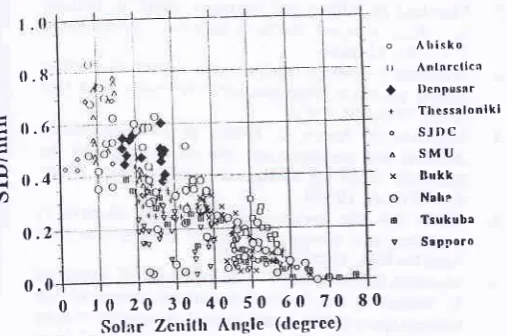
Distribution of UVB dose rates according to Solar Zinith Angte at Denpasar, as compared to various places at the globeDISCUSSION
that this system could be used anywhere on the earth
from polar or tropical regions.
The dose rates of ambient UV are dependent primarily on solar zenith angle, cloudiness, ozone concentration
and
air
opacity.To
place the noontime dose ratemeasurem;nts
in a
global perspective,the values
obtained at Denpasar were plotted against solar zenith angles in Figure 4. There are several comparable data
obiained at Naha in Okinawa Island in southernmost
Japan. The highest value (SID/min) was observed at
Naha, when
the
soiar zenith angle was 7'90' The values at Denpasar are within a line which connectsthis value und
,ero
at 700. However, the dose ratemeasurements under
high
solar altitudes have notbeen canied out syst€matically and it would be highly
desirable extend these rheasurements in Indonesia'
In
additionto
the
solar altitude, there are many confounding and contributing factors affecting the irradiance.Major
ones
are
cloudiness, ozoneconcentration and air transparency,
all of
which arevariable
in
complex ways.The daily
and weeklymeasurements were particularly dependent
on
theweather. To perform quantitative comparisons a lot
of
measurements seem requred, whichis
not possibleu nder cunent circumstances.
The
measurementsof
cumulativemonihly
dosesbecome possible for the first time and we believe this
is
a major achievement' Except a few months with missing clata, the results have demonstrated that thecontinious monitoring
of
solar-UV
radiation ispossible with the spore dosimetry under variable and àften harsh tropicai environment such as burning heat
and torrential
rain.
Whenwe
makeup
for
the estimates of missing months (January 1998 at Jakartaand Denpasafl
by
the
mean valuesof
flankingrnonths, we can provide the estimates doses
for
an entire yearat
the three sites; 10,000, 29,000 and53,000
SID at
Tokyo,
Jakartaand
Denpasar'respectively. This means that there are less than 3
folàs
UV âoses
at Jakarta in comparison to those atTokyo. These differences tre particularly conspicuous
throughout the late auturnn and early spring months
(from-October to March) in Tokyo' In July 1999' the
value of SID at Tokyo exceeded that at Jakarta' this
was the only month when the dose in Indonesia was
lower than in JaPan'
There are significant differences (about 1'8 times)
of
UV doses
at Jakarta and Denpasar' This differences also depend on the season that large differences in February and March are followedby
small ones in April and May, and relatively constant ones throughthe
other months' One contributing factorof
the difference couldbe
lower air-transparency due tourban air pollution in Jakarta. The climatic differences of cloudiness and precipitation might be also involved and at this point,
*"
at" not certain how much of the difference might be explained by the air opacity'It
isworthwhile to extend the measurements to other sites
in
Indonesia as the multicenter projectin
order to analyze the causes for the variability of anrbient UV doses'Acknowledgement
We are grateful to the Deans of Faculty of Medicines'
University of Indonesia and Udayana University' also the Heads of the Departments of Pathologies, for the o Âhisko
u Ânlarcllca a l)cnpusar
+ Thcssalonlkl
o S.IDC
a SMU
x llnkk
o Noh?
a Tsukuba v Sspporo
.I
(l.rr€
F tl.l
(t
ll.2
128
Mwnkata et alarrangements of the UVB measurement at Jakarta and Denpasar.
This work
has been supportedby
the
grant No'9}O42OO4 under
Ministry
of
Education, Science'Sports and Culture, Government of Japan and partly
,uppor,"d by the Indonesian Cancer Foundation' the
fui.à.to Intemational Cancer Conference Fund and the
Central General tlosPital.
REFERENCES
l.
H' Gailani M'B, Bale A and
ght in the P53 . Natl Acad Sci
1999; 96: 5ll'l-22.
3.
IARC Monographs on the Evaluation of CarcinogenestsRisks to Humans. Solar and Ultraviolet Radiation' IARC
Med J Indones
Munakata M. Killing and mutagenic action of sunlight
upon Bacillus subtilis spores: a dosimetric system' Mutat
Res, 1981; 82 263-8.
Munakata N. Genetic analysis of a mutant of Bacillus
subtilis producing ultraviolet sensitive spores' Mol Gen
Genet, 1996; 104: 258-63.
Munakata N, Rupert C. Effects
of
DNA-polymerasedetective and recombination deficient mutations on the
ultraviolet sensitivity of Bacillus subtilis spores' lvlutat
Res, 1975; 27:157-69.
Setlow RB. The wavelengths
in
sunlight effective inproducing skin cancer: a theoriticâl analysis' Proc Nat
Acad Sci USA, 1974; 'l\:3363-6.
Munakata N. Moroboshi F, Hieda K, Suzuki K' Furusawa
Y, Shimura H and Ito H. Experimental conespondence
between spore dosimetry and spectral photometry -of solar
ultraviotei radiation. Photochem Photobiol, 1996; 63l-7 4-8'
Munakata N. Biologically effective dose of solar
ultra-violet radiation estimated by spore dosimetry in Tokyo
ll.
12.
ev I,
13.
akita K, Bolsee D, Cillotay D' Horneck G'y of solar UV radiation: applications to
aily irradiance and personal exposure' A'dv
press).
14.
ComParative
UVsPore
dosimet
two. J
Photochem
53:7-l l.
.:
.i
.*
e ]E
té is È
,Ê 6.
'l
8
9