building
syndrome
headache among
Abstrak
Gedung-gedung perkantoran umumnya dilengkapi dengan sislim sirkulasi udara atau pendingin secara buatan untuk menciptakan kondisi lingkungan kerja yang nyaman. Namun, masih terdapat gejala-gejala sindrom gedung sakit (SGS). Salah satu gejala SGS adalah nyeri kepala SGS (NK SGS) Oleh karena itu perlu dikaji diidentiJikasifaktor-faktor risiko terhadap timbulnya N,K,SGS. Kasus dan kontrol diidentifkasi melalui
sunei
terhadap seluruh pekerjadi
kantor tersebut pada bulanMei
-
Agustus 2002 di suatu perkantoran di Jakctrta. Kasus adalah subjek dengan Ni( ,tGS, kontrol adalah subiek tanpa keluhan NK SCS selama satu bulan terakhir. Subjek penelitian berjumlah 240 orang, dan yang menderita NKSGS sebanyak 36 orang (15%o). Bila dibandingkan dengan kecepatan gerakan udara yang normal, maka kecepatan gerakan udara yang cepat memperkecil risiko timbulnya NK SG'S sebesar 57oÀ [(rasio odds (OR) suaian:
0,43; 95% interval kepercayaan (CI): 0,19-0,95].Bila dibandingkan dengan pekerja laki-laki,
pekerja perempuan mempunyai risiko NK SGS hampir 3 kali lipat lebih besar (OR suaian:
2,96; 95%q:
1,29-6,75). Pekerja dengan kebiasaan kadang-kadang sarapan, mempunyai risiko terkena NK SGS lebih kecil dibandingkan dengan yang biasa sarapan (ORsuaian:0,27;
95% CL'0,10-0,96) Faktor suhu, kelembaban dan kebiasaan merokok tidak terbukti berkaitan dengan l/KSGS Pegawai perempuan mempunyai risikoNK
SGSjika
dibandingkan dengan laki-laki. Di samping itu, kecepatan gerakan udara yang lambat mempertinggi risiko NK SG.t Oleh karena itu perlu menambah kecepatan gerakan udara untuk mengurangi risiko timbulnya Nr( SGS terutama terhadap tempat kerja perempuan. (Med J Indones 2003; 12: 171-7)Abstract
Even though offce buildings are usually equipped with ventilation system or air conditiontng
to creale
a comfortable working
environment,yet there is still
founda number of sick building syndrome
(SBS) symploms. Oneof the symptoms
o/ SB,l ts SBS headache. Therefore,it
is
crucialto
identify risk factors related to SBS headache. Cases were subjects who have suffered SBS headache, and controls were subjects who did not suffered headachefor the last one month. Cases and conlrols were selected through a survey onall
of employeesin the said olfce during
the period of May to August 2002. Total respondents were 240 employees including 36 people suflered SBS headache (15%"). Compared lo the normal air movement, faslerair
movemenl decreased the riskof
SBS headache by 57% [adjusted odds ratio (OR) = 0.43; 95% confidence intervals (CI): 0.19-0.95]. Female employees, compared to the males ones, had a higher risk of getting SBS headache by almost three times (adjusted OR = 2.96: 95?6 CI: I .29-6.7 5). Employees who had breakfast irregularly, had a lower risk to SBS headache than lhose who have brealcfast regularly (adjusted OR=O.31; 95% CI: 0 09-0.84). Temperature, humidity and smoking habits were no! noted correlated to SBS headache. Female workers had greater risk of utffering SBS headache. In addition slower air movement increased the risk of SBS headache. Therefore, it is recommended to inprove the progress of air in order to reduce the
isk of
SBS headache, especiallyforfemale worlqlace. (Med J Indones 2003; 12: 171-7) Keywords: sick building syndrome headache, gender, air movementVol 12, No 3, July
-
September 2003Air
movement, gender
and
risk
of sick
employees
in a Jakarta
offÏce
Margaretha
Winarti',
BastamanBasukii, Abdulbar Hamidi
Tall
buildings
are usually closed struchlres,which are
equipped and circulated
with air conditioning system
'
Medical OlJicer,Pi'"-,..rarta Lloyd, Jakarta,
Indonesiar
Department of Community Medicine, Faculty of Medicine,University of [ndonesia, Jakarta, Indonesia
''
DeparTment of Neurologt, Facalty of Medicine, Universityof
Indonesia / Dr. Cipto lvlangunhtsumo Hospital, Jakarta, IndonesiaSick building syndrome
headache
l7
|in
orderto
create a comfortableworking condition
for
its occupants.l-3 Comfortable
working condition
will
have an
effect on
working
productivity.
A
1984 telephonesurvey
of
600 office workers
in the United
States
estimated
that their
productivities
were hampered bypoor Indoor
air
Quàlity
(IAQ)."
Inadequate
IAQ
will
cause discomfort
phenomenon andmedical symptoms to building
occupantssuch
asI72
Winarti et al(BRI), Legionnaires' disease,
Pontiac fever, et cetera. I-aOne
of
SBS symptoms
that
often found
in
theworkplace
is
headache.l-5Previous study
associated headachewith
absenteeism,increasing medical
costs,productiviry
loss, and
decreased
work
qualiry.6However, no sludy has
investigated
the
relationshipbetween
SBS
headacheand
physicat
factors
of
IAQ
among
office
workers.
This
paper
presents
the prevalenceof
SBS headache amongworkers
and SBSheadache
related
risk factors in
particular
air
movement, temperature,humidiry
and gender.METHODS
The sludy was
in a
four-storey
office building
in
Jakarta. Subjects
of
this study were
administration,computing,
andnon-skilled workers
who
hadworked
in
the building
for at
least
I
year, and not
having
respiratory
tract infection. Data collection was
doneby
first
author
and a medical doctor
every
working
day from
8.00
AM
to
5.00
PM during
the
period
of
May
toAugust
2002Data was collected by interviewing and
physicalexamination
the
subjects.
Air
quality
measurements wereperformed
at thework
sites.Interviews
based ontwo
questionnaires.The first
questionnaire
regardingdemography characteristics, psycho-sociaI
factors,convenience
of
workplace,
eating,
sleeping
andsmoking
habits,
nutrition
status,precipitating
factors(medical, surgical, family, and allergy history),
andusage
of
medicines.
The
second questionnaire
wasdesigned
specifrcally
to
find
data
of
headache and other symptomsof
SBS.Air
qualiry measurements
within working
environment consistedof
air movement,
temperature andhumidity.
We
have used Metrosonics heat stressmonitor
(recentcalibrated
September2001) and
Sibata-psychrometer(recent calibrated
September2001)
for drylwet
bulb
air
temperahrre,
air
movement; and air humidily
measurement, respectively.
First of all,
one measrrrementspot
of
mostpoor
IAQ
was determined.Then,
it
was measuredevery hour, starting
from
9.00AM
up
till
5.00PM to
get thepeak time
of
the worstair qualiry.
Furthermore,
measurementcontinued
to other spots, once each, according to the peak time.Air
movement
is
stated
in
meter
per
second.
Air
temperatures measured
with
dry bulb
temperahrre (db)using Celsius
scale.Relative
humidiry (RH) is
statedMed J Indones
in
percentaget to e^prers
theamount
of
moisture
in
agiven
sampleof air in
comparison
with
the amountof
moisture the
air would hold
if
totally
saturatedat the
temperatureof
the sample.The SBS
headache casewas defined
as
the
worker
who
suffered
headachefor
the last one month
andfulfill
the
following criteria:
occurred during working
hours
in
the office building at
least fwice
a
week,followed by
oneor
more symptoms
in
theconcurring
lwo
to
four
weeks,
which then gradually
disappearafter leaving the building,
and re-emerge
once
they areback at
work
in
the
building.t'o't
The
control
wasworker who
have neversuffered
anytype ofheadache
for
the last one month.Socio-demographic characteristic factors
consistedof
age and
gender.
Work
characteristic
factors:workload, rvorking
tenure, Iengthof
work
in
theoffice
building
(hour per day), number
of working
days per rveek, numberof
people perworking
space. Breakfast andsmoking habit
factors.Prior to
the study
subjects
were informed about
theobjective, procedure,
and benefit of the study,
in
addition that confidentiality
would
be
guaranteed. Subjects signed theinformed
consent document.For
this analysis,
risk
factors and subject characteristicswere classified
asfollow: Age (19-29, 30-39,
4M9,
5G-57 years); gender(male, female); rype
of work
inthe last
1
month
(administratron,
oomputlng,
non-skilled
work);
occupation (staffs/clerks, sub-unit head,
unit
head, division head).
Workload
classification based on thequality
andquantity
work
speed, and wecategorized into
three
groups:
iight,
moderate, and
heary. Those
who
hadlight
workload
such as secretaryand
office boy;
moderate
workload
such as research
and
development,
internal
control
persorulel;
heavyworkload such as
accounting, hafi-rc
and
marketingpersonnel
who
has
to
monitor
the ships
rnovements around the clock.Average length
of work
per day (8,
9-10, l0
hours ormore). Worker density
is
working
area
per
worker
(34-60, l6-33, 6-15
-t;.
Body
massindex,
based onMinistry
of
Health
of
Indonesia grouping
(1966)consisted
of
four
sLrbgroups(tack
of
nutrition
:
<I8.5, normal
=
18.5-24.9, overweight
=
25.0-21.0,
obese:
27.1
or more). Smoking habit in the
past
3 months (never smoked, past smoker, current smoker).Vol 12, No 3, July
-
September 2003Temperature,
humidity,
and
air
movement
wereclassified as
suggestedby Ministry
of
Manpower
of
the
Republic
of
Indonesia
(1978)
as
followed.
Temperànrre (comfort
:
210-30bC,*u.rn
=
>300C;;humidity
(normal
:
65-950/o,
low
:
<65Yo);
air
movement (fast
:
>0,2
m/second,
slow
:
<0.005m/second).1
Statistical analysis
Statistical
analyses
were
done
using STATA
6.0software.e
A
number
of
risk
factors
were
examined whetherthey
werepotential
confounders and/oreffect
modifiers. Unconditional logistic
regression analysisl0was
used
in
order
to
determine
the
confounding
effects and
to
determine
the
risk
factors
for
hyper-tension.A
risk factor
was consideredto
be apotential
confounder
if
in the univariate
testit
had aP-value <
0.25
which
would
be considered as a candidatefor
themultivariate model along with
all
known risk
factorsfor
hypertension.tl
Confounders
were estimated by
the
method
of maximum
likelihood.
Ninety-five
percent confidence intervals
were
based
on
thestandard
error
of
coefficient
estimates.Relative
risks representedby
oddsratios (OR)
were estimatedby
themethods
of maximum likelihood.
Sick building syndrome
headache
173RESULTS
The
office
employeesworking
atthat olfice
were 292.A
number
of
42 employees were not eligible
to
besampled
since they were
not
working
in
the
headoffice. In addition,
l0 employees were excluded
sincethey worked
in
the office
for less
than
I
month, or
have respiratory
tract infection,
or
other illness
thatcause
headache,
or
absent
during
the
medicalassessment, or not
willing
toparticipate in this
survey.As
a result, thetotal
respondents become 240 people.The medical
findings showed that 56
employees hadunclassified
headache,
and
another
26
employeessuffered
other lypes
of
headache
(e.g.:
migraine,tension-muscle and,/or
mixed
of both).
Subjectssuffering from
these 2 lypesof
headache were excludedfrom the
analysis.This
leaved36
subjects(15%)
whosuffered
SBS
headacheand 122 people who did
not suffer any headache.The air
measurementsat the workplace ranged from
0.13
until
0.53 m per second, temperature rangedfrom
23.00to
31.00Celsius,
andhumidity
level
was rangedfrom
46.5to
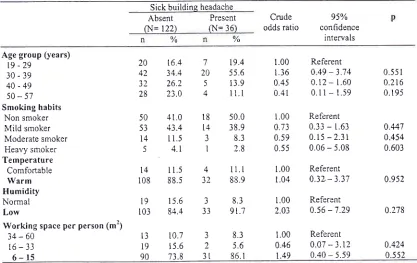
81.0%.Table
I
exhibits that the age
of
employees
rangesfrom
19to 57
years.The majority
of
employees wasTable 1. Age, smoking habits and risk of sick building headache
Sick buitding headache
Absent
PresenttN=
122)
fN= 36)Crude odds ratio
95o/o confidence
intervals o/
o//o
Age group (years)
19-29
30-39
40-49
50-57
Smoking habitsNon smoker
Mild smoker Moderate smoker Hearry smoker Temperature Comfortable Warm Humidity Normal Low
Working space per person (m2)
34-60
l6-33
6-r5
20
t6.442
34432
26.228
23.050
4l .051
43.4t4
11.55
4.114
l 1.5108
88.519
15.6103
84.4 7 20 5 4 19.4 55.6 13.9 r1.t 50.0 3 8.9 8.3 2.8 11.1 88.9 8.3 9t.'7 8.3 5.6 86.l
l.00 1.36 0.45 0.41 1.00 0.13 0.59 0.55 1.00 L04 1.00 2.03 1.00 046 t.49 l8 l4 J 1 J 2 3t 4 32 3
ll
Referent 0 49 -3.'74 0.12-
1.60 0.1I
-
1.59Referent 0.33
-
1.63 0.15-2.3r
0.06-
5.08Referent 0.32.- 3.37
Referent 0.56
-
7 .29Referent 0.07
-
3.t20.40
-
5.59 [image:3.612.63.480.466.729.2]174
Ll'inarti et almales.
Age
group
and
smoking
habit
did
notcorrelated
with
the risk of
SBS
headache symptom. Compared to the agegroup of
19-29
years, the olderemployees
of
30
-
39
and
40
-
57 years
hadmoderately higher
risk
exposure
to SBS
headachesymptom. The
temperafure,humidity,
and employeesdensiry
were noted not
to
instigate
the risk
of
SBS headache.Table
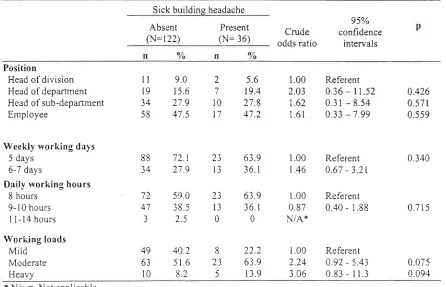
2
shows that
job
position,
occupation
factor,number
of
working
days
per week, and
number
of
working hours per day were verified not
to
trigger
SBS
headache.
However,
workload
had
a
moderatecorrelation
with
SBS headache.In addition,
those who hadsmoking habits
had a moderatelower
risk of
SBS headacherelative
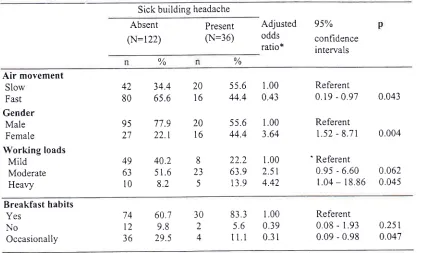
to non smokers.The
final
model (Table
3)
demonstratesthat
from
theair
movement
point
of view,
employeeswho
worked
in
an areawith
fast
air
movement
has alower
risk
of
SBS
headache
by
57%
(adjusted
odd ratio
0.43) comparedwith
the employeeswho
worked
in
an areawith
slow
air
movement.
In
addition, from
the genderpoint of view,
female workers
hadalmost
three times higherrisk of having
SBS headache comparedto
male ones.Med J Indones
Furthermore,
the
breakfast
habit
observance showed that employeeswho
hadinegular
breakfast hadlower
risk
of
getting
SBS
headacheby
69%
(adjusted
oddratio
0.31)relative to
thosewho
had regular breakfast.Nevertheless,
the employees
who
did not
havebreakfast
habit had
a
m.oderatelylow
risk
(adjusted oddratio
0.35).DISCUSSION
There are some
limitations
in
this
study.
Subjectsof
this
study
camefrom limited
population. The
resultsof
the study
would
illustrate the condition
of
the
saidpopulation
or
other similar population. In
addition,
there
might
be
recall
bias exist.
In
order
to
eliminate
the
this
constraint, the study used a standardizedform,
and
interviews were
conductedby
thefirst
author
and a doctorswho
werespecifically
trainedfor this
study.This
study found the prevalence of SBS
headacheof
I5%. A
number
of
SBS headache occurredduring
thesurvey
was
higher than
the previous
study
in
Singapore.r2
This might
be dueto
several differencesin
respondents' characteristics and betterair
flow
in
theworking
environmentin
Singaporeanoffice
buildings.Table
2. Position,working
load and risk of sick building headacheSick
buildine
headacheAbsent
(N:122)
(N:36)
Present95%
Crude
confidence oddsratio
intervalsPosition
Head of
division
Head of department Head of sub-department Employee
Weekly
working
days 5 days6-7 days
Daily
working
hours8 hours
9-10 hours
I
l-14
hoursWorking
loadsMitd
Moderate Heavy
1l
l9
3458
9.0 I 5.6 27.9 47 .5
12.1 27.9
59.0
i
8.525
402
51 68.2
5.6
t9.4
21.8 47.2
63.9 36.1
639
3 6.1 022.2 63.9
ll.9
1.00 2.03 1.62
1.61
0.426
0
571 0.5590.340
0.715 2
1
10 t7
Referent 0.36
-
I 1.52 0.31-
8.54 0.33-
1 .9988
34
23
rl
1.00
1.46
Referent0.67 - 3.2tt.00
Referent0.87
0.40-
1.88N/A*
t.00
Relerent2,24
0.92 - 5.433.06
0.83-11.3
23
li
08
23
5
12
J
49
63
10
[image:4.612.100.546.428.715.2]Vol I 2, No 3 , July
-
September 2003 Sick building syndromeheadache
I75
Table
3.
Relationship between air movement, gender, breakfast habits and riskof sick
building
headacheSick building headache
Absent
(N:122)
Present
(N:36)
Adjusted
95%odds
confidenceratio*
intervals %%
Air
movementSlow
Fast
Gender Male
Female
Working
loadsMild
ModerateHeavy
42 80
95 27
49 63
l0
34.4 65.6
77.9 22.1
40.2 51.6 8.2
20
l6
20
t6
8 23
5
55.6
1.0044.4
0.4355.6
1.0044.4
3.6422.2
1.0063.9
2.5113.9
4.42Referent
0.19 -
0.97
0.043Referent
t.52
-8.7r
0.004'
Referent0.95 -
6.60
0.062 1.04-
18.86
0.045Breakfast habits
YesNo
Occasionally
14
l2
3660.1 9.8 29.5
30 2 4
83.3
l .00s.6
0.39 I1.1
0.3 IReferent
0.08
-
1.93
0.2510.09 -
0.98
0.047*
Odds ratio adjusted each other for risk factors on this table.Our sludy tried to
relate several factors relatedto
SBSheadache
such as hot working environment,
fatigue,stress,
job
stress/psychosocial,
and
stress
orfamily/friend problems outside
the office. This
in
accordance
with the
previous
report
which
emphasized
the
important
role
of
psychosocialfaciors,
stress,
and
gender
which trigger
SBS.4Psychosocial
in
the
job
has caused stress, such
aswork organization, payroll
system,behavior
problem,employee and supervisor relationship,
dissatisfactionagainst supervisor,
and
workload
that
hinder job
satisfaction.
Psychosocial stressmight
cause a personto
be more susCeptible to therisk
factors.a'llWhile
ahot working
environment could contribute
to stress andfatigue
amongthe workers. Previous
studyon the
existenceof
SBS symptoms along
with
work
stress has predicted that environment
pressure
andpermanent
SBS
symptoms
lead
to
the
growing
èxisting work
stress.taIn
this sludy, otherpossibiliry
of
SBS headachewas
causedby other
factors such aspsychosocial
factors
within
the
job,
physical
factor(dusfy environment), and chemical
(unpleasant odors atworking
area and smoke).In this
sh-rdy, themajoriry
of
the employees were male(1%),
andthe remaining
of 29% were
females'This
study found
that
females
had
almost three
timeshigher risk in gelting
SBS headache than males.This
isiimilar
with
the previous
studies.12'15This may
bedue
to
femalesbeing often more
exposedto
cigarette smoke (passivesmoker), marital
status and numberof
children, having lower job position in the office,
tendto have inferior
psychosocial and physical
condition
than males.
Psychosocial factor or
stressitself
would
cause a personto
bemore
susceptibletoward risks
of
SBS
headache.On the other hand,
male
employees had more resistance to cigarette smoke and more oftenwork
outside the room.Job position,
type
of
work,
number
of
working
daysper
week, number
of
working hours
per
day
andworkload were verified not
to
stimulate
the
risk
of
SBS
headache.Medium
to
heavy workload
in
theunivariate analysis results indicated a fair conelation
with
the risk
of
a headache. However,
in
the final
model, workload
was
no longer a threat
to
the
saidheadache.
This may be due
to the
three
dominant
factors
which
areoverlapping
with
theworkload
such as gender,air
movement, and breakfast habit. [image:5.612.52.484.96.349.2]176
ll'inarti et althe
age
group
demonstrated
that
employees
who seldom had breakfastwere mostly
of older
age,which
was probably due to older workers having better selfcontrol than the younger
ones.Smoking employees had
slightly lower risk
of
SBS headache(p:
0.171)
asshown in the univariate
table.However, this was not statistically confirmed
in
thefinal model. This result was different to the previous
study
in
1989,r3which discovered
that smoking
habitof
more
than
10 gram tobacco
per
day correlated
significantly
with
the
symptom of -SBS
headachecompared
to
those
who
were
not
smoking.'' Th.
smokers in this survey were
probably those
who
arerelatively strong and had better
resistance
to
SBSheadache
which
is
probably due
to
healthy worker
ettect.
'"
Sick
building
syndrome
is
caused
by
physical,chemical, biological, psychosocial
and
ergonomicfactors.
The study office building
has reside
in
thebuilding
since
1994
and
used
the
central
air-conditioning system
set
up
back
in
1975. The
maintenance
of
the central
AC
was
not
sufficient,
which creates
an inconvenient
working
environment.Many
employeesinstalled
additional fan within their
working
area.The measurement
of
air
movement
was around
ol
0.13
-
0.53
m/second. Some surveyed spots
hadreached L.:yond comfort zone of 0.05
-
0.2 m/second.The high
air
movement
was
probably
due
toemployees often opening the window
to
reduce
thetightness and hot temperature.
Previous studyr2 involving 2,826 employees
from
126offices in 56 government and
private
office buildings
in
Singapore
(in
1992-1995).
The subjects consisted
of fifty
percent
were female employees.
The study
verihed
the
correlation belween
the
lack
of
air
movement
and
the emerge
of
SBS symptoms
risk.This
may be due
to
larger sample size
andthe
samenumber
of female
and male employees.The
measurement
of
this
shrdv indicated
that
the temperah-lre ranged belweenZl .e0-Zl0C. In
Indonesia,the comfort zone temperafure ranged belween
240-260C,
which
means the temperatureln the sh-rdyoffice
building had
exceeded
the
limit of
comfort
zone temperah-rre.However, the
said temperahrre wasstill in
compliance
with
the weighted
limit
point
of
working
environment
temperahrre as per the recommended byMinistry of Manpower
1978 i2l0-300C;.1'lMed J Indones
The measurement
of
humidify using psyhcrometer
showed a rangeof humidity
level
berween 46.5-81%.Most floors in
the studied office (51 measured
spots)has humidity less than normal as
per the
Ministry of
Manpower suggestion
in
1978.1However,
they were
still within
the normal zone according tothe
comfort
zone standard of the Western bibliography (30-60%).3't7
Low
humidity
(dry)
may cause irritation
in
cornea,upper respiratory
tract
and
skin
problems.2'I7This
study
demonstrates
that
temperature
and humidity
levels were proven
not
to
trigger the
risk
of
SBSheadache,
which might
be
caused
by
the
moredominant
effect
from the air movement
factor. This
sludy result was different
to
the previous
on"s,l2''8which found
the
relationship between
theinconvenient temperature and
humidity level to higher
risk
ofSBS
headache.In conclusion, slow air movement
andfemale gender
were
verified
to
increasethe
risk
of
SBS
headache.Therefore, it is recornmended
to improve the progress
of air in
order
to
reduce
the
risk
of
SBS
headache,especially
for female workers.
REFERENCES
1.
Sukar
A,
TugaswatiT,
Athena
A,
Kasnodihardjo,Heryanto,
Hanato
M.
Sick building
syndrome in environment epidemiology perspective. Indon J Public Health 2000; 28;3:260-6.Morey PR, Singh J. Indoor air quality in non industrial occupational environments.
In:
Clayton GD, Clayton FE editors. Patfy's industrial hygiene and toxicology, General principles. VolumeI,
part A. 4th ed. NewYork:
John Wiley&
Sons, Inc; 1991. p. 531-94.Holrna
B.
Indoor air pollution. In'. Zenz C. Occuparional medicine. 3'ded. NY: Mosby- Year Booh 1997; p.1061-75.Redlich
CA,
Sparer
J,
Cullen
MR.
Sick-buitding syndrome. The Lancet 1997April 5;349:1013-6.Citterio
A,
Sinloriani E, VerriA,
Cristina S, Gerosa E,Nappi G. Neurological symDtoms
of the sick
building syndrome: Analysisof
a
questionnaire. Funct Neuro1998;13:225-30.
Schwartz BS, Stewart WF, Lipton RB. Lost workdays and
decreased work efflectiveness associaled with headache in the
"vorkplace. J Occup Environ Med. 1997;39:320-7. Althouse
AD, Tumquist
CH,
BraccianoA,ç.
Modem refrigecation and air con<iitioning. 3d edition. South l{otland, Illinois: The Goodheart-Willcox Company, Inc; t979. Stenberg B, ErikssonN,
Hôôg J, Sundell J, Wall S. The sick building syndrome in office workers. A Case-referenl studyof
personal, psychosocial and building-related risk indicators. Intl J Epidemiol 1994;21:1190-7.4.
9. 14
l5
l6
t7
l0
It
t2
Vol 12, No 3, July -September 2003
t3
StataCorp Stata statistical software: Release 6.0. Texas:
College station; 2000.
Breslow
NE,
Day
NE.
Statisticat Methodsin
CancerResearch.
Vol
I.
The analysisof
case-control studies.IARC Sci
Pubt No.32. Lyon: Intemational Agency for Research on Cancer; 1980.Hosmer DW, Lemeshow S. Applied logistic regression.
New York: John Willey & Sons; 1989.
Ooi
PL,Goh
KT, Phoon MH,
Foo
SC,Yap
HM.Epidemiology
of
sick
building
syndromeand
itsassociated risk factors in Singapore. Occup Environ Med 1998;55:188-93.
Skov
P,
Valbjam
O
dan PedersenBV.
Influence ofpersonal
characteristics,job
related lactors
andpsychosocial lactors on the sick buitding syndrome. Scand
J Work Environ Health 1989;15:286-95.
Sick building syndrome
headache
177Apter A, Bracker A, Hodgson M, Didman J, Leung W-Y.
Epidemiology of the sick building syndrome. Supplement
to J Atlergy Clin Immunol 199494(2 Pt 2):275-88.
Stenberg B, Wall S. Why do women report "Sick building
symptoms" more often than men ? Soc Sci
Med
1995;40491-502.
Anighi HM,
Hertz-PiciottoL
The evolving conceptsof
the healthy worker survivor effect. Epidemiol
1994;5:t86-96.
Catleja
AH.
Ventilation
criteria
for
non
industrialbuitdings.
In:
StellmanJM,
editor.
Encyclopediaof
occupational health and safety.4'h ed. Geneva: ILO; 1998.
p.45.13-7.
Bachmann
MO,
Myers JE. Influences on Sick buildingsyndrome symptoms in the buildings. Soc Sci Med 1995;
4n( ) \')
4.\-\)