LECTURER DECLARATION
“I declare that I have already read this thesis entitle “W-shape Beam Subject to Quasi-static Loading” and the point of my view that this report is quality for its
scope and quality to fulfill the award for Bachelor Degree of Mechanical Engineering (Structure & Material).”
Signature : ……….
Name of Supervisor : ……….
W-SHAPE BEAM SUBJECT TO QUASI-STATIC LOADING
MOHD FARIQ BIN MOHAMAD
This Thesis is Submitted to Faculty of Mechanical Engineering as Partial Fulfillment of Requirement for the Award of the Bachelor Degree of Mechanical
Engineering (Structure & Material)
Faculty of Mechanical Engineering Universiti Teknikal Malaysia Melaka
ii
STUDENT DECLARATION
“I hereby declare that this thesis entitle “W-shape Beam Subject to Quasi-static Loading” is my own work and results except for the work that had clearly stated
the sources.”
Signature : ……….
Name : Mohd Fariq Bin Mohamad
iii
iv
ACKNOWLEDGEMENT
All praises to Allah S.W.T, the most merciful and gracious, and my peace
and blessings of Allah be upon his messenger, Muhammad S.A.W. First of all, I would
like to express my gratitude to his greatness, with whose indulgence has given me
strength and convenience to complete this report successfully.
I would like to express my sincere appreciation and admiration to my final year
project supervisor at Universiti Teknikal Malaysia Melaka, Professor Dr. Md Radzai bin
Said, for his continuous support, guidance and hard work. He is very friendly, have an
optimistic attitude, always brightened any experimental challenge and provided that
extra boost to keep forging ahead. Besides, he also has given me lots of advice about
how to prepare this report, which assisted me in many ways throughout my final year
project successfully.
Without a doubt, my family members have been the largest supporters
throughout my academic career. I must say a special “thank you” to my parents, Mr.
Mohamad Bin Mat Ali and Mrs. Halimah Binti Harun, and my siblings for their
continuous love and words of encouragement. The successes I have achieved did not
come without certain sacrifices, which they all endured in some form. Also many thanks
to all other parties that I have not mentioned their names here, whose have helped me
v
ABSTRACT
This project is entitle ‘W-shape Beam Subject to Quasi-static Loading’.
Nowadays, most people used main road and expressway for commuting transport.
Roadside safety is important to reduce the number of fatalities and serious injuries
resulting from run-off-road crashes. W-beam barrier may be the most widely used type
of roadside safety hardware. Various methods used to test and improve the efficiency of
this hardware. In this project, W-shape barrier material properties and behaviors were
obtained by performing the tensile and Rockwell hardness tests. Then, W-shape barrier
with 50 mm width was applied with various rate of compression, ranging from 5
mm/min to 30 mm/min to observe the deforming mode. The deforming mode was
captured by digital and video cameras. The energy absorbed was calculated by
measuring the area under the load-displacement curve obtained from Instron Universal
Testing Machine. The W-shape beam absorbed approximately 250 J of energy in 69 mm
vi
ABSTRAK
Projek ini bertajuk ‘Beban Statik yang dikenakan terhadap Rasuk Berbentuk W’.
Pada masa kini, kebanyakan orang menggunakan jalan raya dan lebuh raya untuk
berulang alik pengangkutan. Keselamatan tepi jalan adalah penting untuk mengurangkan
jumlah kematian dan kecederaan parah diakibatkan oleh kemalangan yang melibatkan
kenderaan terbabas. Perintang berbentuk W merupakan jenis perintang yang paling
banyak digunakan untuk keselamatan tepi jalan.Pelbagai kaedah digunakan bagi
menguji dan meningkatkan kecekapan perkakasan ini. Dalam projek ini, ciri-ciri bahan
perintang berbentuk W diperolehi dengan menjalankan ujian tegangan dan ujian
kekerasan Rockwell. Kemudian, perintang berbentuk W dengan lebar 50 mm
diaplikasikan dengan kelajuan mampatan yang berbeza, meliputi 5 mm/min hingga 30
mm / min untuk membuat pemerhatian mod kecacatan. Mod kecacatan perkakasan ini
dirakam menggunakan kamera digital dan perakam video. Tenaga serapan diperolehi
dengan kaedah mengira luas bawah graf beban-sesaran yang diperolehi daripada Mesin
Ujian Universal Instron. Tenaga yang diserap oleh peralatan ini dianggarkan sebanyak
vii
TABLE OF CONTENTS
CHAPTER CONTENT PAGE
SUPERVISOR APPROVAL
DECLARATION ii
DEDICATION iii
ACKNOWLEDGEMENT iv
ABSTRACT v
ABSTRAK vi
TABLE OF CONTENTS vii
LIST OF TABLES xi
LIST OF FIGURES xii
viii
CHAPTER CONTENT PAGE
CHAPTER 1 INTRODUCTION 1
1.1 Background of the Study 1
1.2 Objectives of Study 2
1.3 Scope of Study 2
1.4 Problem Statement 3
CHAPTER 2 LITERATURE REVIEW 4
2.1 Crash Barrier 4
2.2 Crash Barrier Design 5
2.3 Types of Crash Barrier 7
2.3.1 Rigid Concrete Barrier 8
2.3.2 Temporary Barrier System 9
2.3.3 Steel beam Barrier 10
2.4 Crash Test 11 2.5 General Requirement of Roadside Safety 12
2.6 Tensile Test 13
2.7 Rockwell Hardness Test 15
ix
CHAPTER CONTENT PAGE
CHAPTER 3 METHODOLOGY 18
3.1 Tensile Test 19
3.1.1 Tensile Test Specimen 19
3.1.2 Tensile Test Equipment 21
3.1.3 Tensile Test Procedure 22
3.2 Rockwell Hardness Test 23
3.2.1 Rockwell Hardness Test Specimen 23
3.2.2 Rockwell Hardness Test Equipment 24
3.2.3 Rockwell Hardness Test Procedure 25
3.3 Quasi-static loading Test 26
3.3.1 Quasi-static loading Test Specimen 26
3.3.2 Quasi-static loading Test Equipment 27
3.3.3 Quasi-static loading Test Procedure 28
CHAPTER 4 RESULT 29
4.1 Tensile Test 29
4.2 Rockwell Hardness Test 31
4.3 Quasi-static loading of W-beam 31
x
CHAPTER CONTENT PAGE
4.3.2 Quasi-static loading at 10mm/min 35
4.3.3 Quasi-static loading at 20mm/min 37
4.3.4 Quasi-static loading at 30mm/min 39
4.3.5 Summary of Quasi-static loading test 41
CHAPTER 5 DISCUSSION 42
5.1 Tensile Test 42
5.2 Rockwell Hardness Test 45
5.3 Quasi-static Loading 45
CHAPTER 6 CONCLUSION AND RECOMMENDATION 50
6.1 Conclusion 50
6.2 Recommendation 51
REFERENCES 52
xi
LIST OF TABLE
NO. TITLE PAGE
2.1 Symbol and Designation Associated with Figure 2.8. 17
4.1 Summary of tensile test. 30
4.2 The Rockwell C hardness number for W-beam. 31
4.3 Summary of quasi-static loading test. 41
xii
LIST OF FIGURE
NO TITLE PAGE
2.1 Standard W-Beam Barrier Design 6
2.2 Types of Guardrail According To Rigidness 7
2.3 Concrete Barrier 8
2.4 Water Filled Barrier 9
2.5 W Beam Barrier 10
2.6 Tensile Test Specimen 13
2.7 Stress-Strain Curve 13
2.8 Rockwell Hardness test with Diamond Indenter 16
3.1 A CNC Turning machine 19
3.2 Tensile test dimension 20
3.3 Tensile test specimen 20
3.4 Instron model 8802 21
3.5 Close-up of the tensile machine extensometer. 22
3.6 Hardness test specimen 23
xiii
NO TITLE PAGE
3.8 Specimen on Rockwell hardness tester machine. 25
3.9 Quasi-static test specimen 26
3.10 Instron model 5585 27
3.11 Quasi-static test setup 28
4.1 Load against displacement for W-beam in tension 30
4.2 Load against displacement for specimen 1 32
4.3 Mode of deflection related to figure 4.2 33
4.4 Load against displacement for specimen 1(A) 33
4.5 Load against displacement for specimen 1(B) 34
4.6 Load against displacement for specimen 2(A) 35
4.7 Load against displacement for specimen 2(B) 36
4.8 Load against displacement for specimen 2(C) 36
4.9 Load against displacement for specimen 3(A) 37
4.10 Load against displacement for specimen 3(B) 38
4.11 Load against displacement for specimen 3(C) 38
4.12 Load against displacement for specimen 4(A) 39
4.13 Load against displacement for specimen 4(B) 40
5.1 Stress-strain curve for W-beam 43
xiv
NO TITLE PAGE
5.3 Load against displacement for rate 10 mm/min 47
5.4 Load against displacement for rate 15mm/min 48
5.5 Load against displacement for rate 30 mm/min 49
5.6 Comparison of load against displacement for
xv
LIST OF APPENDICES
NO TITLE PAGE
A Hardness Conversion Table 58
B Quasi-static Specimen 60
1
CHAPTER 1
INTRODUCTION
1.1 Background of the study
One of the major problems in road transportation is to assure adequate safety
level for road users. To maintain and improve road safety, it is often necessary to install
certain devices that are intended to restrain vehicles and pedestrians from entering
dangerous areas. The road safety barriers that are designed according to the European
EN 1317 standard provide certain levels of vehicle containment; properly redirect errant
vehicles back on the road and provide guidance for pedestrians and other road users. To
provide appropriate safety levels for impacting vehicle occupants, the safety barriers
should be designed so as to absorb as much impact energy as possible through their
2
1.2 Objective of Study
There are two main objectives of this study. One of the objectives of this study is to
obtain the experimental data for W-shape beam. Furthermore, the objective of this study
is to study the pattern of load-displacement curve from compression test.
1.3 Scope
This study is to observe the W-shape beam (crash barrier) subject to quasi-static
loading. The specimen is cut from crash barrier, W-shape with 50mm width as available
in laboratory. The total specimen is 11. The lateral loading is applied with various speed
of compression, ranging from 5mm/min – 30mm/min. The deforming modes are
captured by digital \and video cameras. The load-displacement is obtained from Instron
Universal testing Machine will be compared for various rate of loading. The energy
absorbed is calculated by measuring the area under the curve.
The material properties and behaviors are obtained by performing a tensile test as
well as the hardness test. The tensile coupon specimen is cut from W shape according to
3
1.4 Problem Statement
The crash barriers have to sustain impact of different vehicle types (from
passenger cars to trucks) under different impact conditions regarding the vehicle
velocity, impact angle and road conditions. In case of a lower-weight vehicle
(passenger car) impact, the restraint system should possess the ability to deform, so
that the kinetic energy of an impact is absorbed mostly by the barrier and vehicle
deformation. This significantly reduces deceleration levels experienced by vehicle
occupants and increases their safety. However, in a case of higher-weight vehicle
(truck, bus) impact, the system should contain and redirect the vehicle back on the
road without complete breakage of the principal longitudinal elements of the system.
Thus, the crash barrier design is a compromise between its stiffness (deformability)
and strength.
The crash barrier must be able to absorb the impact energy from vehicle in order
to fulfill the roadside safety requirement. In this project, the specimen is preparing
from the W-shape barrier. Three type of specimens needs to be preparing for three
different experiments use in this study. There are three experiment needs to be done,
4
CHAPTER 2
LITERATURE REVIEW
2.1 Crash Barrier
Crash barrier is one of the impact energy absorption devices. Crash barriers are
located in places where a vehicle may accidentally leave the carriageway and be
subjected to considerable danger. These crash barriers can be in the form of safety
fences. Road was designed and constructed to require guardrail. The location of posts,
bridge piers, steep ditch slopes, or some other feature of the road creates a hazard to
drivers who get off their lane.
The design of the road barrier is generally such that a vehicle hitting the barrier is
steered back onto the road and absorbs the impact energy. This may be achieved by
designing the supports so that they break off on impact, allowing the barrier to deform
and push the vehicle back on track. In some cases cost cutting has led to a failure of this
mechanism, with so-called "duck-nesting" (after the shallow nature of a duck nest) of
barrier support bases. When this happens the supports tilt over at the base instead of
breaking off, allowing the barrier to collapse and the vehicle to go over the barrier.
Motorcycles are very vulnerable to crash barriers. Large vehicles with a high centre of
gravity, such as sport utility vehicles, are also vulnerable to going over barriers on
5
If the highway location is considered potentially very dangerous, a crash barrier
safety fence may be required which will physically prevent vehicles from continuing in
the undesirable direction.
2.2 Crash Barrier Design
Ideally a crash barrier fence should present a continuous smooth face to an
impacting vehicle, so that the vehicle is redirected, without overturning, to a course that
is nearly parallel to the barrier face and with a lateral deceleration, which is tolerable to
the motorist. The standard W-beam barrier design is shown in Figure 2.1.
To achieve these aims the vehicle must be redirected without rotation about both
its horizontal or vertical axis (that is, without’ spinning out’ or overturning), and the rate
of lateral deceleration must be such as to cause the minimum risk of injury to the
passengers.
In practice the happenings at a barrier fence are so complicated that it has not yet
been possible to devise a theoretical treatment which represents what actually does
occur. As a result safety barrier research is usually carried out in full-scale road tests.
The following discussion must therefore be regarded as a theoretical description based
on a greatly simplified model of what occurs during an actual collision.
Barriers typically go through an experimental phase in which a barrier that has
passed crash test evaluation is subjected to an in-service evaluation, and an operational
phase in which a barrier that has proven acceptable in the in-service evaluation is used
while its performance is further monitored. Barriers are also considered operational if
they are used for extended periods and demonstrate satisfactory performance in
7
2.3 Types of Crash Barrier
The multitude of crash barriers available can be divided into three main types:
i. Rigid concrete barriers
ii. Temporary barrier system
iii. Steel beam barrier
Figure 2.2 shows different kinds of median barriers and guardrails. Barriers are
tested and certified to perform to specific Federal criteria (a specific level of anti-ram
protection). In selecting barriers, it is important that transit agency security engineers
consider the capabilities of these systems to protect against the threats specific to the
facility. The different design of crash barrier was used depend on the weight and speed
of crashing vehicle upon impact. There is a wide range of weights and speeds based on
[image:23.612.133.566.436.610.2]anticipated threat and physical approach.
Figure 2.2: Types of guardrail according to rigidness
8
2.3.1 Rigid Concrete Barriers
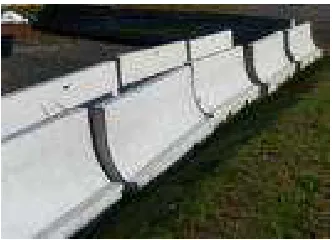
Concrete barriers have been used for a considerable length of time, although now
their usage is generally being phased-out on high-speed roads, primarily because the
rigidity of the concrete results in peak deceleration rates which can result in (otherwise
avoidable) fatalities. Figure 2.3 shows an example of concrete barrier.
Another disadvantage of concrete barrier is that even minor scrapes can result in
extensive damage to the vehicle bodywork. Limited success has been achieved in
introducing greater flexibility into concrete barriers by the incorporation of reinforcing
steel. However, it also created a problem of how to repair the barrier after impact.
In general, concrete barriers are now being limited to low speed roads where the
high risk associated with a vehicle crossing the central reservation outweighs the
probable rise in the cost of damage-only accidents. They should never be used on high
speed roads unless it is absolutely essential to prevent a vehicle encroaching, whatever
[image:24.612.254.420.460.580.2]the effect on the vehicle's occupants.