Decompression sickness among Moroami diving ishermen in Jakarta
Chichi Wahab,1 Setyawati Budiningsih,2 Muhammad Guritno3
Abstrak
Indonesia merupakan kepulauan dengan jutaan nelayan, namun belum banyak penelitian mengenai penyakit dekompresi (PD). Tujuan penelitian ialah mengidentiikasi prevalensi dan beberapa faktor dominan yang berkaitan dengan kenaikan risiko PD setelah penyelaman. Penelitian dilakukan antara Oktober – November 2007 pada seluruh nelayan peselam Moroami di Kepulauan Seribu Jakarta. Anamnesis dan pemeriksaan dilakuan sebelum dan tiga kali setelah menyelam. Subjek menderita PD jika mengalami salah satu gejala: nyeri sendi, nyeri otot, atau gatal-gatal, lemah tungkai, gangguan buang air besar (obstipasi, melena, diare) atau kecil, pendengaran, penglihayan, sakit kepala, vertigo, sesak napas, nyeri dada, kejang, pingsan, mual, muntah (biasa atau darah). Dari 123 subjek yang potensial, 5 subjek sedang menderita penyakit pernafasan atas, sehingga sebanyak 117 berpartispasi dalam penelitian ini. Sebanyak 62 orang (53%) menderita PD. Model akhir menunjukkan bahwa mouthpice, valsava bila telinga sakit, peselam perlu kursus menyelam untuk menghindari kecelakaan, dan kecepatan naik merupakan faktor-faktor dominan yang berkaitan dengan PD. Kecepatan naik merupakan faktor risiko yang tertinggi. Peselam yang naik 18 meter per menit atau lebih dibandingkan dengan yang naik kurang dari 18 m per menit mempunyai risiko dua kali lipat menderita PD [risiko relatif suaian (RRa) = 2.2; 95% interval kepercayaan (CI) = 1,11 – 3,56]. Di samping itu peselam yang menderita dibandingkan dengan yang tidak PD sebelum menyelam mempunyai risiko 20% lebih banyak (95% CI = 0,86-1,68; p = 0,285). Di samping penggunaan mouthpice yang baik, cara valsava yang benar, para nelayan tradisional terutama perlu diberikan latihan supaya naik ke permukaan laut kurang dari 18 m per menit untuk mengururangi risiko PD. (Med J Indones 2008; 17: 197-202)
Abstract
Indonesia is an archipelago with many traditional divers, however research on decompression sickness (DCS) has not yet elaborated. The aim of the study was to identify the prevalence of DCS and factors related to it. The study was conducted on October-November 2007 among isherman moroami divers in Seribu Island Jakarta. Anamnesis and physical examination was taken before and three times after diving. Subject was diagnosed as having DCS if experienced one of these symptom or sign: myalgia, muscle pain, skin rash, ankle weakness, bowel movement & bladder dysfunction, visual disturbances, headache, vertigo, dyspnoe, chest pain, convulsion, unconsciousness, nausea and vomiting. Among 123 potential divers, ive were having upper respiratory infection, so only 117 divers participated in this study. Final model analysis showed that regulator, valsava when having ear pain, ascending speed to surface, and lack of training were risk factors to obtain DCS. Divers whose ascending speed more than 9 m per minutes had two times risk to get DCS [adjusted ratio = 2.2; 95% conidence interval (CI)= 1.11 – 3.56]. Having DCS before diving, increased risk 20% (RRa = 1.20; 95% CI = 0.86-1.68; P=0,285). Beside knowledge to use regulator correctly and valsava, isherman Moroami divers need to be trained to ascend speed to sea level surface less than 9 m per minute. (Med J Indones 2008; 17: 197-202)
Keywords: decompression sickness, ascending speed, regulator, valsava
Indonesia is the biggest archipelago in the world, consist of 17.508 islands which two third was covered by sea.1 Seribu Island is a part of Jakarta province, lies in Jakarta Bay and Jawa Sea. Consisted of 110 islands
1 Mintohardjo Navy Hospital, Jakarta, Indonesia
2 Department of Community Medicine, Faculty of Medicine University of Indonesia, Jakarta, Indonesia
3 Indonesian Navy Health Ofice, Jakarta, Indonesia
and has 19.593 population mostly lived in only eleven islands.2 Eighty percent are ishermen, which composed
of common isherman and diver-isherman. There are
two clusters in the latest group, the Moroami divers and divers who used spear.3
Moroami divers are natural isherman who used net for catching ishes.1 Natural divers meant that they never received formal training, the diving skill was descended
from their father or grandfather. They also still used
Diseased pattern and morbidity rate based on health
center 2005-2006 data, was still dominated by
respiratory tract infection, skin disease and diarrhea, yet no decompression sickness (DCS) was reported.
There were eighteen DCS type II cases referred to
Mintohardjo Navy Hospital in Jakarta. According to yearly report from Hyperbaric Center Navy Hospital Mintohardjo, 309 cases were referred from Seribu
island. Two hundred four (66%) cases were isherman
moroami divers where as 175 diagnosed as DCS type II and 29 DCS type I.
Decompression sickness is an occupational hazard,
common among isherman divers and was caused
or related with several factors. Low knowledge of diving risk and diving procedure, using simple diving
equipment and motivation to catch more ishes were
factors increasing the risk of DCS.4
Even though Indonesia has many isherman communities, however, research on hyperbaric among ishermen has
not been elaborated. A survey by Hyperbaric Study Program Medical Faculty of Universitas Indonesia in
one village in Seribu island discovered that 64 natural divers (58%) used conventional compression, 46 (41,8%) held their breath.5 Another survey reported that
51.8% from 58 divers experienced decompression.4
METHODS
A cross sectional study was conducted in Seribu island Jakarta during period of August till September 2007.
The research population was all moroami isherman
divers who dived around Seribu island and work since morning until evening. Inclusion criteria were 1) lived in Seribu island; 2) dive around Seribu island from morning until evening; 3) using conventional compression; 4) agree to involve in this study.
Data was collected by the irst author. Subjects were
informed written and orally and signed informed consent if agreed. Data were collected through 1) interview by using questionnaire, 2) physical examination before and after diving, bubble gas examination using Doppler Bubble Detector before & after diving; 4) compressor level of CO2 by using Kitagawa Gas Detector; 5) Dive
Com for diving proile.
Risk factors collected were age, education, duration of
work, compressor’s CO2 level, diving proile (depth,
length of time, frequency and interval between diving),
alcohol consumption, diving equipment, knowledge - attitude - practice of diving.
Moroami divers are traditional divers and ishermen by profession. They received no formal training to be
divers and used conventional equipment, comprised of a mask and pipe for air supply to inhale the air though a regulator
Decompression sickness were diagnosed if one symptom or sign was found: joint pain; muscle pain; malaise; sleepy; skin rash; neurological dysfunction; visual disturbances; bowel movement dysfunction, headache; vertigo; dyspnoe; chest pain; nausea; vomit; or convulsion.
For analysis, data were categorized as follows: age (< 30/>30 years); education (≤ junior high school / senior high school); length of work using conventional
compressor (< 1 year / ≤ 1 year), onset of symptom (< 6
hours / > 6 hours); body mass index - BMI (underweight ≥ 18.5 / normal = 18.5 - 24.9 / obese ≥ 25).
Level of CO2 was measured from regulator and
categorized into < 0.04% and > 0.04%. Diving proile
were categorized as follows: depth (< 18m / ≤ 18m);
length of diving (< 50 minutes / > 50 minutes); speed of ascending to sea level (18m per minute / > 18m per minute); frequency of diving (<3 per day / > 3 per day).
The overall diving proile was categorizes as good = >3
and bad = <3. Knowledge and attitude were categorized as good (> 3) and bad (≤ 3) while good behavior valued ≥ 3 and bad is valued is <3.
Data were analyzed using Cox regression with Stata program released 9. Ethical clearance was obtained from Ethical Committee of Medical Faculty, University of Indonesia.
RESULTS
Among 123 potential divers, ive were having upper
respiratory infection, so only 117 divers participated in
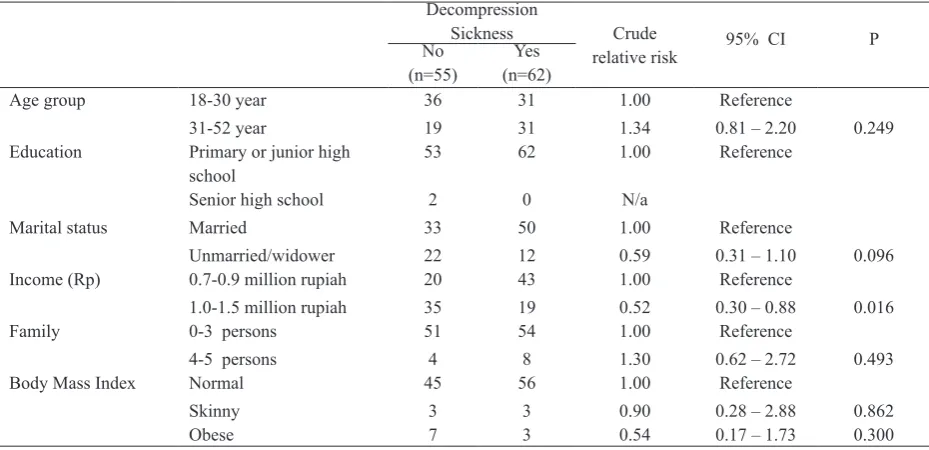
this study. Table 1 shows the prevalence of post diving DCS was 53%. Most of the subjects were low educated.
Subject who had DCS and without DCS were similar in terms of family burden, and body mass index (BMI). It is less likely that those who are unmarried or widower and has income one to one and halve million rupiah did have DCS than the respective reference risk factor.
However, those who age 31-52 age were more likely
Table 1. Several demographic characteristics, body mass index and risk for decompression sickness (DCS)
Decompression
Sickness Crude
relative risk 95% CI
P No
(n=55)
Yes
(n=62)
Age group 18-30 year 36 31 1.00 Reference
31-52 year 19 31 1.34 0.81 – 2.20 0.249
Education Primary or junior high
school
53 62 1.00 Reference
Senior high school 2 0 N/a
Marital status Married 33 50 1.00 Reference
Unmarried/widower 22 12 0.59 0.31 – 1.10 0.096
Income (Rp) 0.7-0.9 million rupiah 20 43 1.00 Reference
1.0-1.5 million rupiah 35 19 0.52 0.30 – 0.88 0.016
Family 0-3 persons 51 54 1.00 Reference
4-5 persons 4 8 1.30 0.62 – 2.72 0.493
Body Mass Index Normal 45 56 1.00 Reference
Skinny 3 3 0.90 0.28 – 2.88 0.862
Obese 7 3 0.54 0.17 – 1.73 0.300
N/a= Not applicable
Table 2 shows that subjects who did and did not have
DCS were similarly distributed in terms of knowledge about the need for physical examination before diving, examination by a hyperbaric’s specialist, prevention of accident, divers may dive alone and not panic in danger situation. Furthermore, it seems that less likely to have
DCS were those who knew the cause of accident, diving trainer must know the danger of diving, may use dysfunction diving equipment. However, those who agreed that divers need to attend diving course were more likely to be DCS.
Table 2. Some knowledge concerning physical examination, accident, trainer and attitude of divers to decompression sickness
Decompression
sickness Crude
relative risk
95% CI
P No
(n=55)
Yes
(n=62)
Physical examination needed before diving Yes 47 52 1.00 Reference
No 8 10 1.06 0.54 – 2.08 0.871
Physical examination has to be done by a submarine specialist
Yes 26 30 1.00 Reference
No 29 32 0.98 0.60 – 1.61 0.934
Accident can be prevented Yes 31 38 1.00 Reference
No 24 24 0.91 0.54 – 1.51 0.711
Divers needed to be trained Yes 49 32 1.00 Reference
No 6 30 2.11 1.28 – 3.47 0.003
Divers may diving alone Yes 48 53 1.00 Reference
No 7 9 1.07 0.56 – 2.17 0.847
May use dysfunction diving equipment Yes 12 31 1.00 Reference
No 43 31 0.58 0.35 – 0.96 0.033
Not panic in danger situation Yes 46 50 1.00 Reference
No 9 12 1.09 0.58 – 2.06 0.773
Performing valsava when ear pain Yes
No
10 45
24 38
1.00
0.65
Reference 0.89 – 1.08
Table 3 shows that subjects who did and who did not
have DCS were similarly distributed in terms of physical
examination and consultation every 6 months and may drink alcohol before/after diving. Those who knew that
it was forbidden to dive when one’s has headache / stress were more likely to have DCS. While diver, who knew that he need to rest 10 minutes if diving more than 1 per day and may dive 3 times per day in diving less than 30 meters, were less likely to have DCS.
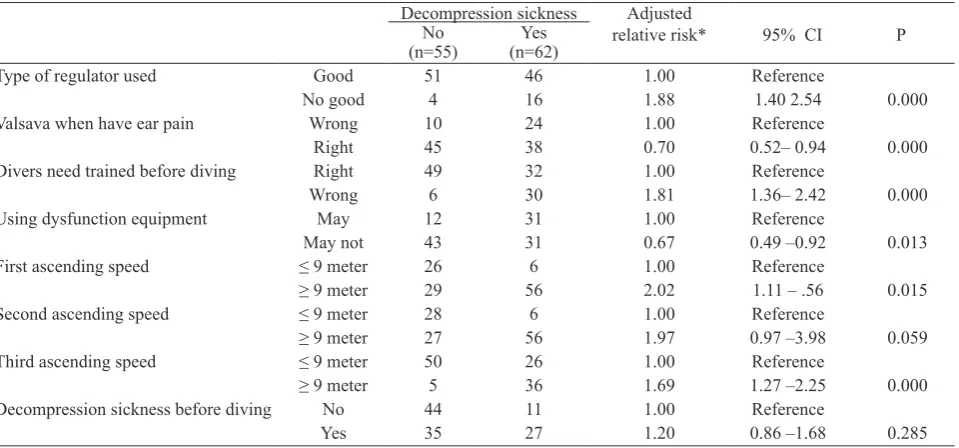
Our inal model (Table 4) shows that regulator, valsava
when there is an ear pain, divers need training to avoid accident, ascending speed to sea level were related to DCS. Ascending speed was the greatest risk factor for
having DCS. In the irst diving, diver who ascended
9 meters or more per minute will have two times risk compare to divers who ascend less than 9 meters.
Table 3. Some behavior of divers concerning physical examination, frequency of diving and attitude toward risk in having
decompression sickness
Decompression sickness Crude
relative risk
95% CI P No
(n=55) (n=62)Yes
Physical examination & consultation
minimally 6 mos YesNo 514 566 1.001.14 0.49 –2.66Reference 0.750
Not diving if having stress or headache No 45 26 1.00 Reference
Yes 10 36 2.14 1.29 –3.54 0.003
May drink alcohol before and after diving Yes 11 10 1.00 Reference
No 44 52 1.14 0.58 –2.24 0.709
May diving as much as possible No 53 62 1.00 Reference
Yes 2 0 N/a
Need to rest ≥10 minutes if diving
> 1 kali
Yes 15 26 1.00 Reference
No 40 36 0.75 0.45 –1.24 0.257
May diving >3 times per day in depth >20 meters
No 37 48 1.00 Reference
Yes 18 14 0.77 0.43 –1.40 0.401
N/a = Not applicable
Table 4. Relationship among equipment, knowledge, speed ascending, and risk of having decompression sickness
Decompression sickness Adjusted
relative risk* 95% CI P
No Yes
(n=55) (n=62)
Type of regulator used Good 51 46 1.00 Reference
No good 4 16 1.88 1.40 2.54 0.000
Valsava when have ear pain Wrong 10 24 1.00 Reference
Right 45 38 0.70 0.52– 0.94 0.000
Divers need trained before diving Right 49 32 1.00 Reference
Wrong 6 30 1.81 1.36– 2.42 0.000
Using dysfunction equipment May 12 31 1.00 Reference
May not 43 31 0.67 0.49 –0.92 0.013
First ascending speed ≤ 9 meter 26 6 1.00 Reference
≥ 9 meter 29 56 2.02 1.11 – .56 0.015
Second ascending speed ≤ 9 meter 28 6 1.00 Reference
≥ 9 meter 27 56 1.97 0.97 –3.98 0.059
Third ascending speed ≤ 9 meter 50 26 1.00 Reference
≥ 9 meter 5 36 1.69 1.27 –2.25 0.000
Decompression sickness before diving No 44 11 1.00 Reference
Yes 35 27 1.20 0.86 –1.68 0.285
DISCUSSION
There are limitations in this study. Among others, the population were only ishermen moroami diver who works daily, therefore not represent the ishermen as
well as Seribu island population. Secondly, potential bias which could occurred in the interview as questionaire was used in this study, even though a guideline has been used.
Prevalence of DCS in this study was 53%. The
prevalence was lower compared to prevalence found at
Mintohardjo Navy Hospital in Jakarta (62%).This may
be due to the difference source of population. Cases
at Mintohardjo hospital came from all ishermen diver
population in Seribu island, while this study covered
Moroami divers only. A previous similar study (1996)
in Panggang island (the biggest) in Seribu island shows a slight difference in DCS prevalence after diving
(52%).5
There was an increased percentage of DCS after
compare to before diving. Divers who had DCS before
diving, have a 20% increase for having DCS than divers
who had no history of DCS.
In this study, divers with age 30 years or more had a higher risk to be DCS than divers age less than 30 years. Other study5 shows different result, 93% among divers
aged 30 year or more had DCS, while 6.9% among
aged less than 30 year. Another study6 found that 38%
DCS among divers age >30 years and 62 % among
age <30 year. Differences among these study could be due to degeneration process at age > 30 year. With length of work >10 years as a diver, result in having DCS before this study due to the formation of core
bubble. Therefore, if he dived not according standard
operational procedure, a higher risk of DCS will occur because bubble core was already formed.7
Furthermore, in our study noted that obese reduced the
risk of having DCS even though not signiicant. The
previous study5 did not provide similar information because the BMI was not well distributed. While the other study6 showed that 59.3% divers with abnormal
BMI had DCS. This difference was based on theory that N2 has 4-5 times higher dilution rate in fat tissue
than in other tissue.7-9
Statistical analysis found a signiicant increasing risk
to and have DCS after diving and with having diving 3
times or more. Three times diving were safe procedures,
however ishermen moroami dived more than 3 times
due to the need to have enough income. Overall, this study shows similar result concerning knowledge of procedural for diving.4
A signiicant relationship was also found between
compressor condition before diving. A cared compressor reduced DCS risk, many factors caused this situation. In this study, eventhough the compressor was not well cared however some factors as using a standard oil for diving, length between outlet – inlet more than 1 m and
level of CO2 < 0.04% due to the wind low, explained
this situation.
Before diving, knowledge on diving procedure concerning (not perform valsava when have ear pain)
had a signiicant increased risk for DCS. This means
that knowlwdge for performing valsava is an important information needed by the divers. Moroami divers who
did not perform valsava had 30% higher risk to be DCS
compare to other knowledge. Not performing valsava
when had an ear pain will caused barotrauma. This
condition will caused vertigo if the ascending speed is > 9m per minute.7,10,11
In this study it was also proved that the irst, second and
third ascending speed in diving less than 9 m per minute
increased the risk of having DCS. This is similar with
the previous study.6
Conclusion. More than 50% on ishermen Moroami
diverhad DCS after diving. Dominant factors related to DCS were using regulator, performing valsava, uncared compressor, ascending speed to sea level more than 9
m per minit, and previous DCS. Training on diving
procedure is needed especially concerning ascending speed to sea level.
REFERENCES
D. Pramono. Nusantara maritime,
1. maritime culture
[Indonesian]. Jakarta. Gramedia. 2005.
B. Bahar. Fishery products in Indonesian [Indonesian]. 2.
Bogor. Buana Printing. 2004.
Clarke D. Decompression sickness, theory and treatment. 3.
Deep diving. Best Publishing Co. 1995.
Department of Community Medicine of Univ Indonesia. 4.
Survey on isherman divers in Panggang Island [Indonesian]. Jakarta. The Department. 1994.
Susan Simanungkalit. Analysis on decompression sickness 5.
I Bagus Nyoman Banjar. Several risk factors related to
6.
decompression sickness among traditional divers in Panggang Island Jakarta [thesis]. Jakarta. Univ Indonesia. 2005.
Jain KK. Decompression Sickness. Textbook of Hyperbaric
7.
Medicine. Toronto. Hogrefe & Huber Publisher. 1999.
Elliot DH. Decompression sickness. Hyperbaric Medicine 8.
Practice. Best Publishing; 1994.
Edmonds C, Lowry C, Pennefather J. Decompression sickness. 9.
Diving and sub aquatic Medicine. Oxford. Oxford Univ Press. 2002.
Dutka AJ, Francis TJ. Pathophysiology of decompression
10.
sickness. Diving Medicine. London. Saunders. 1997.
Gorman DF, Francis TJR. Pathogenesis of the Decompression
11.