Chlorhexidine-alcohol versus povidone-iodine as preoperative skin preparation to
prevent surgical site infection: a meta-analysis
Keywords: chlorhexidine-alcohol, povidone-iodine, skin antisepsis, surgical site infection
pISSN: 0853-1773 • eISSN: 2252-8083 • http://dx.doi.org/10.13181/mji.v26i1.1388 • Med J Indones. 2017;25:54–61
• Received 22 Feb 2016 • Accepted 29 Jan 2017
Corresponding author: Aditya Wardhana, [email protected]
Copyright @ 2017 Authors. This is an open access article distributed under the terms of the Creative Commons Attribution-NonCommercial 4.0 International License (http://creativecommons.org/licenses/by-nc/4.0/), which permits unrestricted non-commercial use, distribution, and reproduction in any medium, provided the original author and source are properly cited.
Tasya Anggrahita, Aditya Wardhana, Gentur Sudjatmiko
Department of Surgery, Faculty of Medicine, Universitas Indonesia, Cipto Mangunkusumo Hospital, Jakarta, Indonesia
Rev i ew A r t i c l e
ABSTRAK
Latar belakang: Infeksi luka operasi menjadi suatu masalah yang penting bagi ahli bedah dan pasien karena dapat menaikkan angka morbiditas, mortilitas, jangka waktu perawatan, biaya rumah sakit, kemungkinan dirawat kembali, dan kemungkinan pembedahan berulang. Karya tulis ini bertujuan untuk membandingkan penggunaan chlorhexidine-alcohol dengan povidone-iodine sebagai antisepsis sebelum pembedahan untuk mencegah infeksi luka operasi.
Metode: Pencarian kepustakaan dilakukan melalui database PubMed pada bulan November 2015. Kriteria inklusi adalah RCT yang dipublikasikan hingga tahun 2015 yang membandingkan penggunaan chlorhexidine-alcohol dengan povidone-iodine dalam keefektifannya untuk mengurangi risiko infeksi luka operasi pada pasien dewasa. Kualitas dari literatur dianalisa dengan menggunakan Jadad Score. Meta-analisis dilakukan untuk memperoleh estimasi dari effect size. Adanya heterogenitas dan bias publikasi juga dinilai.
Hasil: Enam studi RCT dengan total 2.080 pasien dimasukkan dalam studi meta-analisis. Pada meta-analisis didapatkan bahwa penggunaan chlorhexidine-alcohol menyebabkan lebih sedikit terjadinya infeksi luka operasi (pooled risk ratio=0,60 (95% CI=0,45-0,79)) dan lebih sedikit munculnya hasil kultur jaringan kulit yang positif (pooled risk ratio, RR=0,38 (95% CI=0,28-0,51)) dibandingkan dengan povidone-iodine.
Kesimpulan: Preparasi area operasi dengan cairan antisepsis chlorhexidine-alcohol lebih efektif dibandingkan dengan povidone-iodine dalam mencegah infeksi luka operasi.
ABSTRACT
Background: Surgical site infection remains substantial problems to surgeons and patients as it increases the morbidity, mortality, length of stay, hospital cost, rate of re-admission, and rate of re-surgery. This study aims to compare the use of chlorhexidine-alcohol versus povidone-iodine for preoperative skin preparation to prevent surgical site infection.
Methods: The literature search was conducted through the PubMed database on November 2015. Included studies were RCTs with the year of publication up to 2015 which compared the use of chlorhexidine-alcohol versus povidone-iodine in its effectiveness reducing surgical site infection in adult patients. The quality of the study was assessed using Jadad Score. A meta-analysis was conducted in the included study to obtain a pooled estimate of the effect size. The evidence of heterogeneity and publication bias was also assessed.
Results: Six RCTs with a total of 2,080 patients were included in the meta-analysis. It showed that the use of
chlorhexidine-alcohol was associated significantly with fewer SSIs (pooled
risk ratio=0.60 (95% CI=0.45-0.79)) and fewer positive skin culture results (pooled risk ratio, RR=0.38 (95% CI=0.28-0.51)) compared with povidone iodine.
Surgical site infection (SSI) is the third most frequently reported nosocomial infection, accounting for 14% to 16% of all nosocomial infections among hospitalized patients as reported by The Centers for Disease Control and Prevention (CDC). Despite the advances in infection control practices such as improved operating room ventilation, sterilization methods, barriers, surgical technique, and availability of antimicrobial prophylaxis, SSI remains substantial problems to surgeons and patients as it increases the morbidity, mortality, length of stay, hospital cost, rate of re-admission, and rate of re-surgery.1,2
The selection of antiseptic skin solution prior to the surgery is an important step to prevent surgical site infections. Povidone-iodine (PVI) has a broad-spectrum antimicrobial activity against gram-positive and gram-negative bacteria, viruses, fungi, and protozoa. Its low-price and its broad-spectrum antimicrobial activity of this preparation made this solution remain the most widely used antiseptics. However, several studies
indicated fibroblast and keratinocyte cytotoxicity,
as well as delayed in collagen maturation and in epithelization by the use of PVI and thus, impaired wound healing.3 The use of PVI in a
large open wound also contraindicated because PVI could induce systemic toxicity; therefore, special caution was needed when this agent used for patients with preexisting thyroid and renal disease.4,5 Based on literature, PVI has been shown
to be inactivated by blood and protein serum, and it has been associated with skin staining and irritation.1 Moreover, it needs an average three
minutes drying time for optimal function.6
On the other hand, chlorhexidine has a board spectrum bactericidal effect by disrupting the cell membrane potential, causing imbalance of osmotic equilibrium, and leading to cell death.7 Some studies highlight its rapid onset in
certain bacteria with maximum effect within 20 seconds against S. aureus, E. coli, and yeast. The antibacterial effect could last up to 48 hours on the skin.8 In topical application, chlorhexidine
shows the ability to bind the proteins in human tissue (skin and mucous membranes) with limited systemic and bodily absorptions, and not affected
by the presence of body fluids such as blood.9,10
However, it should be noted that chlorhexidine is not sporicidal, and mycobacteria are highly
resistant.10 Moreover, as chlorhexidine has no
colour, it is difficult to identify on the patient’s
skin after application. Its high-price compared to PVI also caused the potential disadvantage of this preparation. Its alcohol content, futhermore, made the preparation of chlorhexidine-alcohol
became highly flammable although there was a
very rare case documenting such hazards in the operating theatre.11 To prevent such events, a
precaution should be carried out such as three minutes waiting time for the solution to evaporate and wiping the skin with a cotton swab before draping the surgical site. Nevertheless, low rate of skin irritation and its effective interaction with non-sporulating bacterial made this preparation promising to use.6 The CDC already recommends
the use of >0.5% concentration of chlorhexidine-based preparation for cleansing vascular catheter site of insertion.Chlorhexidine-alcohol is a newly introduced antiseptic preparation in health care facility in Indonesia. Thus, it provides alternative for healthcare practitioner to choose despite the commonly use antiseptic (povidone iodine).
A meta-analysis study was conducted to examine whether povidone-iodine or chlorhexidine is a preferred skin antiseptic before a surgery in order to reduce the rate of surgical site infection.
METHODS
adding or containing the isoprophyl-alcohol. In addition, studies evaluating the preparations that have another mixture added to the povidone-iodine (such as iodine with mixture of any concentration of alcohol) were also excluded from the meta-analysis.
The quality of each study was evaluated using the Jadad score. It calculates the score of the following items for evaluating RCT: randomization, double blind, and dropouts. The total score ranges from 0 to maximum of 5.16
The primary outcome for the meta-analysis is the present of surgical site infection. Moreoever, the secondary outcome is the present of positive cultures after the application of skin antisepsis. Data were entered and analyzed in Microsoft Excel spreadsheet and RevMan version 5.3. A
meta-analysis was conducted to obtain a pooled estimation of the effect size, which was reported as risk ratio (RR) using fixed effect model, with a 95% confidence interval (CI). Heterogeneity was assessed using the I2 test (≥50% was
considered substantial heterogeneity) and c2 test (p≤0.10 was considered significant
heterogeneity).17 The publication bias was
assessed by visual inspection of the funnel plots.18 All statistical analysis of the result were
performed by the RevMan version 5.3 (Nordic Cochrane Centre).19
RESULTS
Of 881 studies identified for title and abstract
screening, 19 articles underwent the full text reviews, and only six RCTs were included in our
final analysis (Figure 1). The quality of the RCT
was evaluated using the Jadad Score giving a varying score of one to three point. None of the studies showed the Jadad Score above of three point (Table 1).
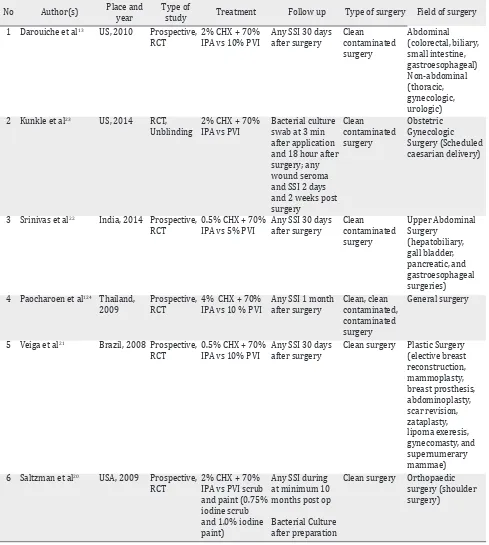
The six trials included in this study had a total of 2,080 patients.13,20–24 Two trials reported
on patients who had a clean surgery,20,21
three trials included patients underwent clean contaminated surgery,13,22,23 and one
trial on mixed surgery patients (clean, clean contaminated, and contaminated surgery) as shown in Table 2.24 The experiment group used
chlorhexidine scrub and/or paint in varying concentrations (from 0.5% to 4%) with a mixture or addition of 70% isoprophyl-alcohol. The comparison group used povidone-iodine scrub and/or paint with varying concentrations (0.7% to 10%). One study reported a positive skin culture for multiple sampling sites (axilla Figure 1. Flow diagram of article screening for meta-analysis
No Study Jadad Score Total
Randomization Blinding Description of withdrawals/dropouts
1 Darouiche et al13 2 0 1 3
2 Kunkle et al23 1 0 1 2
3 Paocharoen et al24 1 0 0 1
4 Saltzman et al20 2 0 0 2
5 Srinivas et al22 2 0 1 3
6 Veiga et al21 1 0 0 1
Table 1. Jadad score evaluation of the study
881 publications identified by initial
search
Studies screened
19 studies assessed for
eligibility
862 studies excluded the title and abstract review
13 full text studies failed to meet the inclusion
criteria (did not assessing the outcome of
surgical site infection)
6 studies included in
and shoulder antero-posterior),20 so the result
of each site (made the number of patients doubled) was combined. The surgical site infection rates for statistical analysis were obtained by adding all types of SSI presented
No Author(s) Place and year
Type of
study Treatment Follow up Type of surgery Field of surgery 1 Darouiche et al13 US, 2010 Prospective,
RCT
3 Srinivas et al22 India, 2014 Prospective, RCT 4 Paocharoen et al124 Thailand,
2009
5 Veiga et al21 Brazil, 2008 Prospective, RCT
0.5% CHX + 70% IPA vs 10% PVI
Any SSI 30 days after surgery
Clean surgery Plastic Surgery (elective breast 6 Saltzman et al20 USA, 2009 Prospective,
RCT
Clean surgery Orthopaedic surgery (shoulder surgery)
Table 2. Characteristics of eligible studies
RR= relative risk; CHX= chlorhexidine; IPA= isoprophyl alcohol; PVI= povidone iodine; RCT= randomized controlled trial; SSI= surgical site infection
Surgical site infection
Three trials reported significant decreases in
SSIs with Chlorhexidine and Isoprophyl Alcohol compared to PVI.13,21–24 One trial showed
non-significant decreases in the number of SSIs with
chlorhexidine use,22 one trial found out
non-significant increases in the number of SSIs with
chlorhexidine use,23 and one trial reported no
SSIs in either study groups.20
All six studies reported the post-operative SSI rates. The SSI occurred in 63 out of 1,009 (6.24%) patients who received CHX-IPA and 117 out of 1,071 (10.92%) patients received PVI as skin antisepsis before surgery. The meta-analysis
showed that CHX-IPA significantly decreased the
risk for SSI, compared to the use of PVI (pooled
RR=0.60 (95% CI=0.45-0.79) (Figure 2). No significant study of heterogeneity was found (I2
=0%; x2 test, p=0.776). Furthermore, no evidence
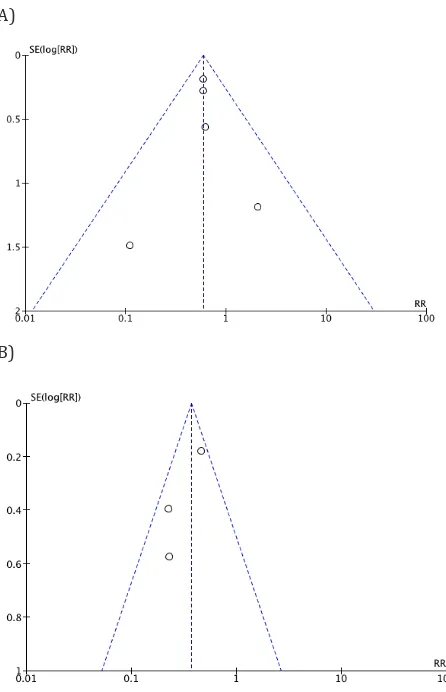
of publication bias was found from a visual
inspection of funnel plots (Figure 3).
Positive cultures after skin antisepsis
Two trials reported significant reduced positive
culture results after the use of CHX-IPA as a pre-operation skin antisepsis compared with the use of PVI.23,24 One trial reported insignificant
reduction of positive cultures in the number of positive cultures when CHX-IPA was used compared with the use of PVI.20
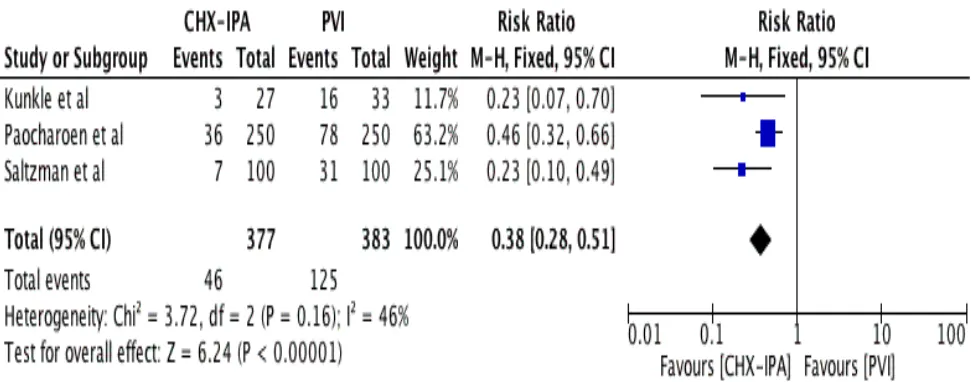
The meta-analysis of the three studies showed
that the use of CHX-IPA significantly decreased
Figure 2. Forest plot comparing the incidence of surgical site infection following skin preparation with chlorhexidine-isopro -pylalcohol (CHX-IPA) versus povidone-iodine (PVI)
A)
B)
Figure 3. Funnel plots for surgical site infection (A) and for
positive culture result (B) after application preoperative skin antisepsis of CHX-IPA versus PVI
the risk for a positive culture result after application, compared with PVI (pooled RR=0.38
was found (I2 =46%; x2 test, p=0.165) (Figure 4).
Potential publication bias for positive culture result from a visual inspection of funnel plots was
found as shown in Figure 3.
DISCUSSION
This meta-analysis showed superior result to the use of chlorhexidine in combination with isoprophyl-alcohol for antisepsis solution before surgery compared to the use of povidone-iodine in reducing the number of surgical site infection and the positive skin culture after application.
There was a 40% reduction in the risk of SSIs among patients received preoperative skin antisepsis of chlorhexidine compared to those who received povidone-iodine. This estimated number is similar in all of the studies, except three studies that had different estimation points from the pooled estimation.20–23 However,
these studies only weighted less than 5% of the total studies, and had only a few events (total of 7 from 180 cumulative SSIs). Another review from Lee, et al25 also stated that chlorhexidine
application as a skin antisepsis gave a reduction of 36% in the risk of SSIs compared to PVI. Meanwhile, a study from Noorani et al14 showed
a slightly similar result from this study, which was a reduction of 42% in the risk of SSIs when using chlorhexidine as a presurgical antisepsis compared to PVI. However, Noorani et al14 also
stated that there was no clear benefit in the favor
Figure 4. Forest plot comparing the positive cultures of bacterial growth following skin preparation with chlorhexidine-isopro -pyl-alcohol (CHX-IPA) versus povidone-iodine (PVI)
of either agents in preventing intra-abdominal sepsis.
This study also supports the use of chlorhexidine for pre-surgical skin antisepsis. It shows that the use of chlorhexidine can reduce positive culture after skin antisepsis by 62%. This estimated number is similar in all of the included studies. Another meta-analysis also provides a slightly different rate of 56% reduction in positive skin culture results after skin preparation compared with PVI.25
Nevertheless, there were several limitations
in this study. First, we found only six relevant
studies. More relevant studies might be found if other sources such as other database (e.g.: excerpta medica database (EMBASE), Cochrane database of systematic review, cumulative index to nursing and allied health literature (CINAHL), etc.), conference proceedings, books, unpublished literature, and literature other than English language were included. Second, there were two studies that contributed more than 60% of the patients included in the meta-analysis.13,24
However, through the I2 and x2 test conducted, we
found no evidence of significant heterogeneity in
this meta-analysis, though the secondary outcome had borderline heterogeneity (I2=46%). Third,
used 0.5%,21,22 and another one trial used 4%.24
However, this study follows the CDC guideline which suggests that any concentration of chlorhexidine greater than 0.5% with alcohol can be used as a skin antiseptic before the insertion of intravascular catheter to decrease contamination.
Another meta-analysis with specific concentration
of chlorhexidine was needed to determine which concentration of chlorhexidine was preferred to
reduce the surgical site infection. Fourth, in this
study the type of surgery was varied from clean to clean-contaminated surgery with different
types of specializations (Table 2). Further study in specific field of surgery and type of surgery is
recommended.
This meta-analysis showed a superior result in chlorhexidine-isoprophylalcohol preparation as skin antisepsis. The high cost and the availability of this preparation became potential drawbacks
to Indonesian surgeons. A study on cost-benefit
model comparing the economic value of using chlorhexidine compared to PVI concludes that although chlorhexidine is more costly than iodine, the dramatic reduction of SSIs will likely result in greater overall cost savings with chlorhexidine use.25
Conflict of interest
The authors affirm no conflict of interest in this
study.
REFERENCES
1. Mangram AJ, Horan TC, Pearson ML, Silver LC, Jarvis WR. Guideline for prevention of surgical site infection, 1999. Hospital infection control practices advisory committee. Infect Control Hosp Epidemiol. 1999;20(4):250–78. 2. Yeung LL, Grewal S, Bullock A, Lai HH, Brandes SB. A
comparison of chlorhexidine-alcohol versus
povidone-iodine for eliminating skin flora before genitourinary
prosthetic surgery: a randomized controlled trial. J Urol. 2013;189(1):136–40.
3. McKenna PJ, Lehr GS, Leist P, Welling RE. Antiseptic
effectiveness with fibroblast preservation. Ann Plast
Surg. 1991;27(3):265-8.
4. Welch JS. Efficacy and safety of povidone-iodine
underscored. J Emerg Nurs. 1992;18(3):191–2.
5. Shetty KR, Duthie EH Jr. Thyrotoxicosis induced by topical iodine application. Arch Intern Med. 1990;150(11):2400–1.
6. 3m.com [Internet]. DuraPrep surgical solution (iodine povacrylex [0.7% available iodine] and isopropyl alcohol, 74% w/w) patient preoperative skin preparation. [cited November 2015].
Available from: http://solutions.3m.com/wps/ p o r t a l / 3 M / e n _ U S / S H / S k i n H e a l t h / p r o d u c t s /
catalog/? PC_7_RJH9U5230GE3E02LECFTDQG207_ nid=GSF83Z3YYXbeJLRV63SXXBgl.
7. Hibbard JS. Analyses comparing the antimicrobial activity and safety of current antiseptics: a review. J Infus Nurs. 2005;28(3):194–207.
8. who.int [Internet]. WHO guidelines on hand hygiene
in health care: first global patient safety challenge
clean care is safer care [update: 2009; cited: 2015]. Available from: http://www.who.int/gpsc/5may/ tools/9789241597906/en/
9. Saaiq M, S Zaib, S Ahmad. Electrocautery burns:
experience with three cases and review of literature.
Ann Burns Fire Disasters. 2012;25(4):203–6.
10. McDonnell G, Russell AD. Antiseptics and disinfectants: activity, action, and resistance. Clin Microbiol Rev. 1999;12(1):147–79.
11. Lim KS, Kam PC. Chlorhexidine--pharmacology and clinical applications. Anaesth Intensive Care. 2008;36(2):502–12.
12. Sibbald RG, Leaoer DJ, Queen D. Iodine made easy.
Wounds International. 2011; 2(2):s1–6.
13. Darouiche RO, Wall MJ Jr, Itani KM, Otterson MF, Webb
AL, Carrick MM, et al. Chlorhexidine-Alcohol versus Povidone-Iodine for Surgical-Site Antisepsis. N Engl J Med. 2010;362(1):18–26.
14. Noorani A, Rabey N, Walsh SR, Davies RJ. Systematic review and meta-analysis of preoperative antisepsis with chlorhexidine versus povidone-iodine in clean-contaminated surgery. Br J Surg. 2010;97(11):1614–20.
15. O’Grady NP, Alexander M, Burns LA, Dellinger EP,
Garland J, Heard SO, et al. Guidelines for the prevention of intravascular catheter-related infections. Clin Infect Dis. 2011;52(9):e162–93.
16. Jadad AR, Moore RA, Carroll D, Jenkinson C, Reynolds DJ, Gavaghan DJ, et al. Assessing the quality of reports of randomized control trials: is blinding necessary? Control Clin Trials. 1996;17(1):1–12.
17. Higgins JP, Thompson SG, Deeks JJ, Altman DG. Measuring inconsistency in meta-analyses. BMJ. 2003;327(7414):557–60.
18. Egger M. Under the meta-scope: possibilities and limits of meta-analyses. Schweiz Med Wochenschr. 1998;128(48):1893–901. Germany.
19. community.cochrane.org [Internet]. Review Manager (RevMan) [Computer program]. Version 5.3. Copenhagen: The Nordic Cochrane Centre, The Cochrane Collaboration, 2014. Available from: http:// community.cochrane.org/tools/review-production-tools/revman-5
20. Saltzman MD, Nuber GW, Gryzlo SM, Marecek GS, Koh
JL. Efficacy of surgical preparation solutions in shoulder
surgery. J Bone Joint Surg Am. 2009;91(8):1949–53.
21. Veiga DF, Damasceno CA, Veiga-Filho J, Figueiras RG, Veira RB, Florenzano FH, et al. Plast Reconstr Surg.
2008;122(5):170e–1e.
22. Srinivas A, Kaman L, Raj P, Gautam V, Dahiya D, Singh
G, et al. Comparison of the efficacy of chlorhexidine
23. Kunkle CM, Marchan J, Safadi S, Whitman S, Chmait RH. Chlorhexidine gluconate versus povidone iodine at cesarean delivery: a randomized controlled trial. J
Matern Fetal Neonatal Med. 2015;28(5):573–7.
24. Paocharoen V, Mingmalairak C, Apisarnthanarak A. Comparison of surgical wound infection after preoperative skin preparation with 4% chlorhexidine [correction
of chlohexidine] and povidone iodine: a prospective randomized trial. J Med Assoc Thai. 2009;92(7):898–902.
25. Lee I, Agarwal RK, Lee BY, Fishman NO, Umscheid CA.