TOURISM AFFAIR MANAGEMENT WITH COLLABORATIVE GOVERNANCE
APPROACH: TOURISM AFFAIRS MANAGEMENT STUDIES IN SLEMAN REGENCY,
YOGYAKARTA
Muchamad Zaenur i, Sumar tono, Soesilo Zauhar& Andy Fefta Wijaya Depar tment of Public Administr ation,
Faculty of Administr ative Science,
Univer sity of Br aw ijaya Malang, East Java, Indonesia e_zaenur [email protected]
Abstr act
This paper descr ibes t he consequences of t he decent r alizat ion policy in Indonesia t owar ds t he for m of t our ism affair s which is implement ed by t he Local Gover nment of Sleman Regency. The fundament al t heor y of t he t our ism affair s division is an ar ea wit h a division of power -shar ing appr oach. Tour ism affair s cannot be car r ied out only by t he local gover nment s t hemselves. They have a limit ed capacit y t hat need co-oper at ion wit h t he pr ivat e sect or and t he communit y. For mal t our ism affair s in Sleman wer e fair ly well implement ed. However , it st ill has some t r eat ies. Thus, t hey need an alt er nat ive solut ion t o t he const r aint s by using collabor at ive gover nance model which pr oposed by t he r esear cher in t his paper .
INTRODUCTION
Decentr alized gover nance becomes an attr active option of gover nance system for all countr ies. By using the fr amew or k of political economy, Rondinelli et al. (1989) r evealed that decentr alization w ill impr ove the effectiveness and efficiency of the national policy-making. Specifically Davey (1988) identified tw o r easons that demand the need for decentr alization. Fir st, the incr easing demands of social ser vices w hich capable of r eaching all cor ner s of the r emote aspects that can only be done by the local gover nment. Second, the dissemination of ideas such as community ser vice pr ogr ams in pr oviding needs (basic needs) w hich r eceived incr easing attention fr om the inter national community. Decentr alization policy is a mechanism to impr ove public ser vices and the w elfar e of society. With decentr alization, the goods and ser vices pr oduced at a distance w ould be closer to the consumer (Smith, 1985). Decentr alization is also necessar y to make local gover nment mor e cr eative, effective and efficient in impr oving public functions for the w elfar e of the people in the ar ea (Rondinelli and Cheema, 1983).
Ther e ar e sever al advantages for adopting decentr alized countr y, e.g. political sector giving gr eater space to the community to par ticipate and str engthen their political skills, accountability and national integr ation (Oentar to, 2004). Tools to accommodate plur alism in a countr y ar e moder n and democr atic system (Loughlin, 1981), w hile the administr ative w or kload r educe the density of the centr al gover nment (Rondinelli and Cheema, 1984), incr easing the capacity of gover nment officials and obtain infor mation about the state of the r egion, to develop r egional pr ogr ams to be mor e r esponsive and anticipate quickly w hen pr oblems ar ise in pr actice (Maddick, 1983). An under standing of decentr alization concept cannot be separ ated fr om the initial concept of state pow er thr ough the pr actice of centr alized gover nance. Centr alized gover nance r egulates all aspects, by the centr al gover nment. Along w ith the demands and needs in democr atization, effective and efficient gover nance then this needs to be cor r ected, fr om centr alized to decentr alized, even though they both have the potential to succeed and fail (Oentar to, 2004). Decentr alization does not mean centr alization because basically str ipped of decentr alization and centr alization is in a continuum line (Rondinelli et al., 1989). Although ther e is the notion that decentr alization and centr alization is a dichotomy (Slater , 1989) but most exper ts ar gue that decentr alization and centr alization basically not mutually exclusive but complementar y as a configur ation useful in achieving the objectives of gover nment (Muluk, 2009). Lar ge cur r ent management led to the decentr alization of gover nment author ity as much as decentr alization is believed by many countr ies as a pow er ful instr ument to impr ove the w elfar e of the community. Ther e is no single gover nment of a countr y w ith a vast ter r itor y can effectively deter mine the policy or can implement its pr ogr ams efficiently thr ough a centr alized system (Bow man and Hampton, 1983). The main issues in the policy of decentr alization in many countr ies ar e usually on the dist r ibution and pow er shar ing. Since the time of Ar istoteles and suppor ted by his disciple alw ays str essed the impor tance of dist r ibution and pow er -shar ing in gover nance. In the context of decentr alization, emer ged conceptual debate that began in the 1950s, par ticular ly in developing countr ies (Maas, 1959). The emer gence of conceptual debate on decentr alization is a for m of r esponse to the pr oblems that occur r ed dur ing the time and last until now , thus the up and dow n of the debate can be explained in sever al per iodizations (Conyer s, 1984; Hidayat, 2010). The fir st per iod began in the 1950s, could be called “the w ave of decentr alization”. In this fir st wave per iod pr ominent issue is on the r elationship betw een decentr alization and dem ocr acy (decent r alizat ion for democr acy). The concept of decentr alization w ass consider ed most r elevant to str engthen and empow er local gover nments. Democr acy in developing countr ies can gr ow and be implemented if a local gover nment has a str ong and pow er ful w ill.
The second wave of decentr alization movement in developing countr ies took place in the late 1970s. It is one of the cor r ection of the w eaknesses or even failur e of the decentr alization concept applied pr eviously. Wave of decentr alization movement has sever al key char acter ist ics that distinguish it fr om the fir st w ave. One of these concepts pr esented decentr alization looks mor e var ied w ith a theme of "decentr alization for development", and ther efor e not sur pr ising that the main emphasis is on the function of decentr alization as a tool for achieving the goals of national development.
The per iodization can be know n that the conceptual debate decentr alization has been going since the
1950s and continuing to the pr esent. The last issue in the 1990s r elated to the development and gover nance w er e ver y closely r elated to the r ecent developments in public administr ation par adigm. Gover nment in the 1990s had begun to develop new public management (NPM) in w hich one of the cr eed of the NPM is a need for decentr alized gover nment (Osbor ne and Gaebler , 1995), and then continued until the beginning of 2003 in w hich the public administr ation par adigm has begun to shift to the New Public Ser vice (NPS) (Denhar dt and Denhar dt, 2003) and the New Public Gover nance (NPG) (Osbor ne, 2010). At NPS par adigm, the concept of decent r alization is ver y r elevant to explain that the community is consider ed as a citizen and gover nment closest to the citizen is the local gover nment as the implementer of the policy of decentr alization. Other w ise, the par adigm of NPG sees that the concept of decentr alization facilitates the oper ation of the thr ee pillar s of gover nance w hich includes public, pr ivate and civil society to establish cooper ation in gover nance and public ser vices.
Decentr alization policies ar e char acter ized by division of pow er , tool, or instr ument to achieve the values or goals of society (Muluk, 2009); w her ein the values and goals of society in ter ms of economy lead to pr osper ity w hile politically means the pr ocess of democr atization w hich mater ialized their liber ty and equality (Smith, 1985; Muluk, 2002). In Indonesia's decentr alization policy discour se and the division of pow er distr ibution know n as the division of author ity and stipulated in Law No. 32 of 2004 on Local Gover nment and Gover nment Regulation No. 38 of 2007, standar dized into division of affair s.
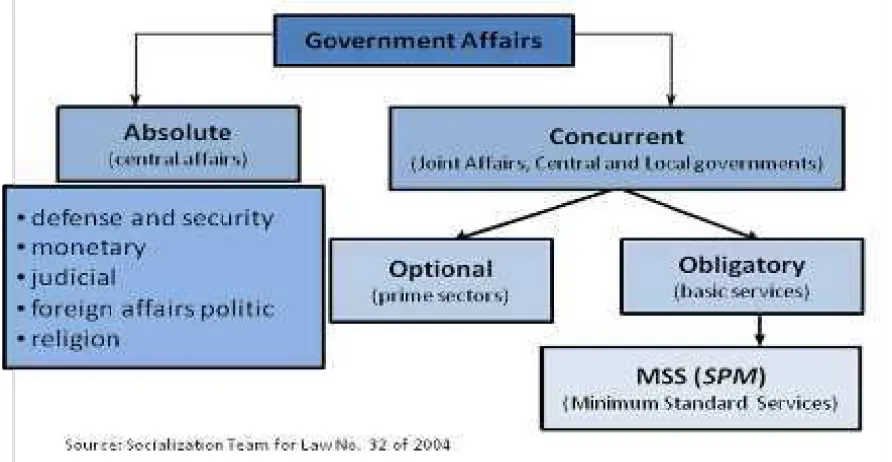
Decentr alization policies w er e deter mined in the legislation, on the pr inciple autonomy of the system and pr inciples in Republic of Indonesia (Sjamsuddin, 2008). The law clear ly stated that the implementation of decentr alization r equir es the gover nment affair s division betw een the centr al gover nment (Gover nment) w ith the autonomous r egional gover nment (Pr ovincial Gover nment and Regency/ City). Gover nment affair s divisions ar e based on the pr emise that ther e is alw ays a var iety of gover nment affair s w hich r emain a gover nment author ity (absolute) and ther e ar e matter s that ar e concur r ent (Fig 1). It means that the handling of gover nment affair s in par ticular ar eas can be implemented jointly by the centr al gover nment and local gover nments. Affair s under the author ity of local gover nment include the obligator y functions and options. Obligator y function is a gover nment affair s r elated to basic ser vices such as pr imar y education, health, minimum livelihood, basic envir onmental infr ast r uctur e. Other w ise, the options affair s ar e closely r elated to the choice of super ior potency and r egional par ticular ities, such as tour ism.
Pr oblems ar ise because until r ecently, the Law No. 32 of 2004 and Gover nment Regulation No. 38 of
2007 as the implementation of the r ules in the affair s of the r egional division, has not succeeded in for mulating a clear division of gover nmental functions betw een centr al, pr ovincial and r egency/ city gover nment. Sour ce of the question lies in the use of national, pr ovincial and r egency/ city level to deter mine the dist r ibution of gover nment affair s. The ter m scale in Gover nment Regulation of 38/ 2007 is not applicable and ver y confusing in many w ays (Dw iyanto, 2011). Another pr oblem on the application of the Regulation is a lot of gover nment affair s and management ar r angements made by all gover nment levels thus the implementation of gover nment affair s become ver y complex and fr agmented, w her eas a clear division of affair s is str ongly needs in a democr atic local gover nance and public w elfar e.
One affair that becomes pr oblematic ar ea is the business of tour ism, w her e tour ism is a ver y impor tant matter for the people. In the context of gover nance in Indonesia, tour ism affair s ar e also matter for the centr al, pr ovincial and r egency/ city gover nments. In accor dance w ith Gover nment Regulation No. 38 of 2007 on the coor dination betw een the Centr al, Pr ovincial and Local Gover nment of r egency/ city, the affair s of tour ism w hich w as or iginally only a matter for the centr al gover nment is divided into the affair s of the pr ovincial gover nment and r egency/ city. Accor ding to the Head of Tour ism Development in Sleman Regency (Inter view , Apr il 19, 2013), the pr oblems faced in tour i sm w as r elated to the dist r ibution of affair s w ith the centr al gover nment over the follow -up of the administ r ation affair s. The centr al gover nment has handed the assignment but not balanced w ith the fulfill facilities such as guidance, instr uctions, standar ds, human r esour ce tr aining and super vision. While the fr ictions that ar ise in conjunction w ith the pr ovincial gover nment r egar ding the concept of r elationship and benchmar ks about cr oss r egency/ city and hier ar chy, because the r egency/ city is not a subor dinate of the pr ovince. Besides, the main issue concer ns the type of business tour ism w as also submitted, that tour ism is a matter of choice, not obligator y, thus ther e is a miss per ception that makes tour ism is not consider ed as an impor tant ar ea compar ed to other fields such as education, health, public w or ks, etc.
As a r esult of unclear division in the management of objects and tour ist attr action (ODTW) in Sleman, it is also still occur r ing obscur ity of r esponsibility in the pr ovision of tr avel ser vices. One example of Kaliur ang ODTW managed by many par ties, i.e. Sleman Regency, Yogyakar ta Pr ovince, Local Gover nement Cor por ate, Mount Mer api National Par k, and the community ar ound ODTW. Pow er s, duties and functions in managing the ar ea among these par ties w er e also unclear , even seems to r un separ ately (Inter view , May 20, 2013). Not to mention less concer ns for the tour ism industr y to jointly pr omote tour ism in Sleman, to impr essed tour ism industr y mor e in r esponding to any mar ket demand (mar ket dr iven).
Refer r ing to the r ecent par adigm of public administ r ation in par ticular NPG, tour ism affair is not only car r ied out by the local gover nment but also r equir es the suppor t of the pr ivate and the public. It needs to be made syner gistic collabor ation among the thr ee actor s. It is clear ly that tour ism is matter s that divided to the pr ovince and r egency/ city, and the Distr ict of Sleman is still having difficulties in doing so, our r esear ch w as aimed to: 1) theor etically assess the division of affair s that r elated to the pr oblems, 2) collect the suppor ted facts and aspects on tour ism affair s w hich managed w ith gover nance appr oach, 3) evaluate the Local Gover nment of Sleman management on tour ism affair s; and 4) estimate the capability of collabor ative gover nance as an alter native mode to impr ove the per for mance of tour ism affair s in Sleman.
CONCEPT OF AFFAIRS DIVI SION, LOCAL GOVERNANCE AND COLLABORATIVE GOVERNANCE Concr ete manifestation of the decentr alization policy needs for the division of pow er (power shar ing), namely the division or distr ibution of aut hor ity made by the centr al gover nment to local gover nments. This pow er shar ing is depth discussed in Maas (1959), and r econstr ucted by Muluk (2009) on Division of Pow er s to the Regional (Ar ea Division of Pow er ). It cl ear ly descr ibed that pow er -shar ing can be done in thr ee w ays.
higher levels of gover nment (national) and ther e ar e low er levels of gover nment (local). Thir d, the division of
pow er is betw een the gover nment and non-gover nment know n as the Non-Gover nment Division of Pow er (NDP).
In the discussion of the decentr alization theor y, the basic concept of pow er shar ing per spective adopted in Smith (1985) is the natur e ar ea of division of pow er . Muttalib (1982) r efer r ed to the dist r ibution of pow er , w hich in this w ay should be no r estr ictions on the ar ea and the delegation of author ity including bur eaucr atic author ity. Fur ther mor e Hoessein in Muluk (2009) r evealed that decentr alization includes tw o main elements, namely the for mation of autonomous r egions and deliver y of gover nm ent affair s for the autonomous r egion. The most cr ucial thing r elated to this autonomous r egion is the pr oblem of deter mining the limits and the number of autonomous ar ea, boundar y and the amount of economic efficiency and effectiveness on democr acy (Nor ton, 1994).
The division of pow er s is also know n by the pr ocess, function and constituency (Muttalib, 1982; Muluk, 2009) that can be applied to the concept of CDP, ADP or NDP division. If using a ver tical pow er -shar ing (ADP), the legislative pr ocess of the l aw can be assigned to the centr al gover nment, w hile the administ r ation of law enfor cement can be assigned to the pr ovincial gover nment or low er . Meanw hile, based on gover nment functions or activities, ther e ar e centr al and local gover nments; as w ell as constituents based assignment to differ ent gover nment units w ith r esponsibilities r epr esenting differ ent constituencies.
Division of pow er can also be done exclusively and shar ed. Exclusive means that the division of pow er over the pr ocess, function or cer tain constituents into the absolut e pow er of a par ticular gover nment agency or levels that ar e not ow ned by a par ticular agency or level of gover nment that is not ow ned by the agency or other gover nment levels. Shar ing means that pow er over the pr ocess, funct ion, or constituency to cer tain institutions or levels of gover nment ar e shar ed or r un alongside other agencies or levels of gover nment (Muluk, 2009). In gener al, the descr iption can be illustr ated in the follow ing matr ix for m (Table 1).
Table 1. Division of Pow er s Matr ix ( 1) Process ( 2) Function ( 3) Constituency
( a) Exclusive ( b) Shared Sour ce: Muttalib (1982); Muluk (2009).
Ar ea Division of Pow er (ADP) popular ly know n as the division w hich based on the function that is often r efer r ed to the division of affair s. The centr al gover nment as an or ganizer in the field of tour ism is also faced w ith the issue of decentr alization. Gover nance in the field of tour ism is the consequence of CDP especially executive function, w ith consider ation of the effectiveness and efficiency of tour ism should be shar ed w ith the gover nment of the autonomous r egions ( ADP). In the context of the division of pow er s, the tour ism business w as constituted r esult of the division divided by funct ion and shar ed not exclusive. Tour ism concept w hich w as or iginally explain the phenomenon of a per son tr aveling to a specific place for r ecr eation pur poses (Muljadi, 2009; Pitana, 2009) developed into a system of tour ism that involves a lot of both centr al and local gover nment, industr y (pr ivate) and public ( Suw ena, 2010; Zaenur i, 2012), thus it is r elevant to the concept of pow er shar ing. System in the development of tour ism can also r efer to the concept of NDP and once using NPG par adigm for tour ism affair s w hich is not only pur e matter s of gover nment but al so involve industr y and the public domain (Damanik, 2005). Indeed, if the affair s of tour ism in the ar ea managed by the local gover nment, it cer tainly does not have enough capacity to manage it.
The concept of gover nance is applicable to all levels of gover nment, both at centr al and local levels
(Wasistiono, 2005). At the local gover nment level, the concept is r efer r ed as local gover nance. The inter action betw een these thr ee domains must be syner gic and lead to the same goal. The concept of gover nance emphasize most on the pr inciples of cooper ation in the implementation of gover nment affair s and ser vices developed by some exper ts w ith the ter ms collabor ative gover nance (Sink, 1998; Fosler , 2002; Ansell and Gash, 2007) and par tner ships gover nance (Bovair d, 2004; Munr o, 2008; Dw iyanto, 2012).
Sink (1998) explained the collabor ative par tner ship as a pr ocess w her e or ganizations that have an inter est in a par ticular issue tr ying to find a solution that is deter mined jointly in or der to achieve goals w hich they cannot achieve it solely. Fosler (2002) explained in mor e detail that collabor ative par tner ship involv ed intensive cooper ation among the par ties, including the exist ence of a conscious effor t to do alignment in goals, str ategies, agendas, r esour ces and activities. Both institutions that basically have a differ ent pur pose build a shar ed vision and tr ying to make it happen together . Bovair d (2004) defined a par tner ship as setting w or k by r ecipr ocal commitments, over and above that set in each contr act, betw een the or ganizations in the public sector w ith or ganizations outside the public sector . Both appr oaches (collabor ative and par tner ship) in pr actice is ver y difficult to distinguish so gener ally Cooper (2006) called it citizens-based gover nment or ganization.
IMPLEMENTATION OF TOURISM AFFAIRS I N SLEMAN REGENCY
Implementation of tour ism affair s w ill nor matively distr ibute betw een the centr al gover nment, pr ovincial and r egency/ city. Gover nment Regulation No. 38 of 2007, especially in the appendix is clear ly r egulates the affair s division. In gener al, the centr al gover nment car r ies out the affair s of cultur e and tour ism in the sub-sector including cultur al policy, the cultur al implementation, tour ism policy, tour ism implementation, and cultur e and tour ism policies. Autonomous local gover nments car r y out the functions as implementing national policies and the establishment of policies scales pr ovincial and r egency/ city.
Sleman Regency Gover nment as one of the autonomous r egions that r eceive affair s division of the centr al gover nment in the sector of tour ism. In accor dance w ith the scale, affair s ar e gener ally divid ed into policy and implementation (Table 2).
Table 2. Policies of Tour ism Sector Affair s in Sleman Regency
NO. POLICIES
1. The implementation of national, pr ovincial and distr ict/ city policy a. Pr epar ation of Regional Tour ism Development Master Plan
b. Implementation of national, pr ovincial and distr ict policy; policy deter mination in the development of tour ism infor mation system
c. Implementation of national and pr ovincial policies and the deter mination of the dist r ict policy in the application of standar dization in tour ism
d. Implementation of national and pr ovincial policies and establishing guidelines for the development of distr ict-scale tour ism destination
e. Implementation of national and pr ovincial policies and the establishment of policies in the development and oper ation of tour ism enter pr ises business distr ict scale
f. Deter mination and implementation of dist r ict -scale mar keting planning guidelines
g. Deter mination and implementation guidelines and par ticipation in exhibitions/ events cultur e and tour ism distr ict scale
h. The establishment and implementation of the guidelines and the implementation of distr ict -scale tour ist
i. Deter mination and implementation of guidelines on dist r ict scale mar keting cooper ation 2. The pr ovision per mits the distr ict scale tour ism enter pr ises
3. Implementation of inter national cooper ation in distr ict scale tour ism destination development 4. Implementation of joint development in dist r ict scale tour ism destination
5. Monitor ing and evaluation of distr ict -scale tour ism development
Development of infor mation systems has been car r ied out but not in the for m of electr onic data yet. Data about the potential tour ism has been ar r anged in the for m of w r itten documents and some ar e alr eady electr onic. Tour ism sector has been standar dized, e.g. tour ist guides must have a license for language skills, and entir e tour guide as much as 161 per sons enlisted in Disbudpar . The development of tour ist destinations conducted by r efer r ing to the existing master plan and thr ough the mechanism of budget r evenues and expenditur es (budget). Business development and oper ation of tour ism enter pr ises car r ied out in accor dance w ith the levels. Disbudpar r outinely guide the tr avel community thr ough ASITA, IHRA, PPI, etc. Tour ism mar keting is done either thr ough independent activities or cooper ation w ith the pr ovincial gover nment and other stakeholder s. Specifically Sleman Regency alr eady has Java Pr omo w ith joint mar keting par tner ship in thr ee distr icts, i.e. Sleman, Klaten and Boyolali. Tour ism development pr ovides dir ection for community par ticipation and has defined guidelines and exhibit par ticipation/ cultur al events and tour ism, tour ist guidance and implementation, and mar keting cooper ation guidelines.
Disbudpar pr ovide dist r ict-scale tour ism business license, w hich includes the per mit for tr avel agents, tour guides, etc. Implementation of inter national cooper ation is in coor dination w ith the pr ovincial and centr al gover nments. Development of dist r ict -scale tour ism destination conducted by r elying on local r evenues and their assistance is not binding on the par ties w ho ar e committed to the development of destination. Disbudpar also per for m the functions of monitor ing and evaluation of the distr ict scale tour ism development.
tour ism after the er uption. These ar e difficulties that should be or ganized by Di sbudpar Sleman. Matter s
concer ning the implementation of the tour ism pr omotion conducted by infor mation systems.
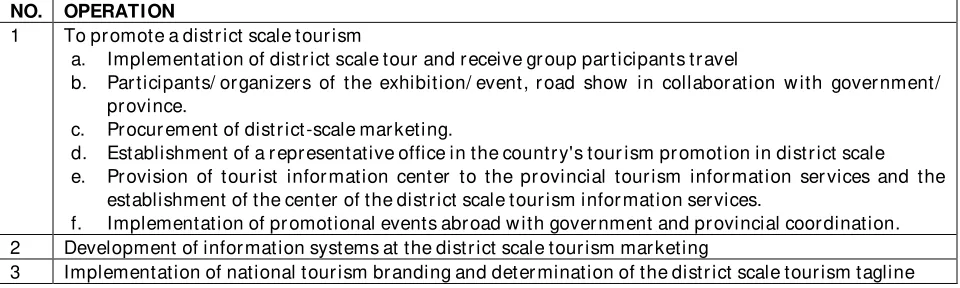
Pr omotion in the distr ict level is done by cr eating a cheap and effective design thr ough media pr omotion in Yogyakar ta (Table 3). The pr omotion w as conducted by involved all stakeholder s. Establishment of a r epr esentative office for tour ism pr omotion in collabor ation w ith the Depar tment of Tr ade and Industr y is mainly associated w ith the or iginal pr oduct of society. Tour ist infor mation center pr ovided by the pr ovincial tour ism and the infor mation ser vices center established on the distr ict scale. Pr omotional events implemented abr oad w ith gover nment and pr ovincial coor dination. Development of infor mation systems at the distr ict scale tour ism mar keting has been done by making sever al infor mation center s in var ious destinations and major center s. Disbudpar implement national tour ism br anding and establish distr ict-scale tour ism tagline; tagline w as taken thr ough long discussions w ith var ious par ties in focus gr oup discussion (FGD) intensively and for mulated "You w ould not see Sleman Yogyakar ta if you do not stop".
Table 3. Oper ation of Tour ism Sector Affair s in Sleman NO. OPERATION
1 To pr omote a dist r ict scale tour ism
a. Implementation of dist r ict scale tour and r eceive gr oup par ticipants tr avel
b. Par ticipants/ or ganizer s of the exhibition/ event, r oad show in collabor ation w ith gover nment/ pr ovince.
c. Pr ocur ement of dist r ict-scale mar keting.
d. Establishment of a r epr esentative office in the countr y's tour ism pr omotion in dist r ict scale e. Pr ovision of tour ist infor mation center to the pr ovincial tour ism infor mation ser vices and the
establishment of the center of the dist r ict scale tour ism infor mation ser vices.
f. Implementation of pr omotional events abr oad w ith gover nment and pr ovincial coor dination. 2 Development of infor mation systems at the dist r ict scale tour ism mar keting
3 Implementation of national tour ism br anding and deter mination of the distr ict scale tour ism tagline
Constr aint for the pr omotion and development of infor mation systems is in the per spective of pr epar ing the submission of matter s r elating to the inability of abr oad pr omotion independently. By r eason of coor dination and to secur e national inter ests, Disbudpar must coor dinate to align the content and substance of pr omotion mater ial. Development of infor mation systems and available budget w er e affected to make r eliable infor mation system (Inter view , Apr il 12, 2013).
In gener al, the per for mance of tour ism in the per spective of affair s implementation consider ed w ell enough for the business. How ever , fr om another point of view , tour ism per for mance still encounter ed many obstacles. In accor dance w ith Gover nment Agencies Accountability Repor ts (LAKIP) in 2012, all pr ogr ams and activities alr eady car r ied out and on tar get, and judging fr om indicator s such as the number of tour ists, length of stay and the contr ibution of tour ism to the r evenue fr om year to year exper ience, the per for mance is incr ease. Fur ther explor ation show ed that tour ism actually needs to be questioned because the incr ease w as due to the contr ibution of domestic tr aveler s and tour ists’ MICE (meeting, incentive, convention and exhibition), w hich uses funds fr om the state budget and the budgets of other ar eas.
APPLICATION OF COLLABORATIVE GOVERNANCE I N MANAGING TOURISM AFFAIRS IN SLEMAN Refer to the business conducted by Disbudpar , tour ism business is alr eady r unning and meets the tar get, but fr om the constr aints and pr oblems, tour ism system is mor e complex thus it is still far fr om the expectation of society. Regulation on tour ism sector is still not optimal, lack of community's par ticipation and it still char acter ized by bur eaucr atic r igidity. Fr om inter view s w ith tour ism stakeholder s (May 27, 2013), it is know n that the bur eaucr acy is still limited to pr ovide r egulation, thus less in encour aging and empow er ing the community and tour ism stakeholder s. Enfor cement of r ules w hich ar e not accompanied by an explanation and socialization still occur in var ious tour ist ar eas. Collected fees tend to be mor e impor tant than pr oviding facilities and empow er ment.
the w or k w ith pr ivate institutions as a vendor or contr actor . This cooper ation is nothing mor e than buying
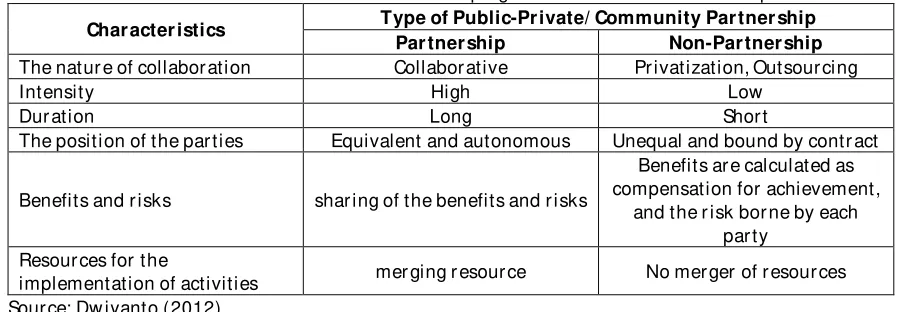
and selling goods and ser vices betw een gover nment and the pr ivate sector as the agent. Position betw een the tw o ar e not equal, the gover nment as the pr incipal has the author ity to choose the appr opr iate agency w ith its cr iter ia for car r ying out the w or k. Cooper ation tends to be shor t ter m w ith limited intensity of the r elationship, as stipulated in the contr act. The usefulness of cooper ation is calculated as compensation or per for mance and r isks bor ne by each par ty. Cooper ation that is built does not involve r esour ces fr om the agency; ther e is no mer ging of r esour ces. Par ties w or ked by ter ms of r efer ence (TOR) as deter mined by the local gover nment. It seems that the cooper ation par tner ships alr eady existing betw een gover nment and non -gover nment, but in fact ther e is no par tner ship (Dw iyanto, 2012).
For tour ism r efor m not only implemented contr actual cooper ation, Sleman Local Gover nment has made the communication among tour ism stakeholder s. One of the pr ogr ams is to meet r egular ly ever y thr ee (3) months to coor dinate and simultaneously monitor ing multiple activities or pr ogr ams that have been implemented. Any possible w or k pr ogr am on tour ism affair s w ill alw ays be communicated in the for um. Dur ing this time, the meeting alr eady r unning r outinely, but the initiation and pr ogr ess alw ays comes fr om the local gover nment. Local industr y and society ar e alw ays only w aiting for pr ogr ams and activities that initiated by the local gover nment.
Looking at these conditions, Sleman Regency Gover nment should tr y har der to r efor m the under standing of cooper ation as a par tner ship betw een local gover nments and the pr ivate and the public. Each par ty tr ies to for m an alliance, equal vision, unification of goals, str ategies and activities in or der to achieve common goal. Even so, each r etains the author ity to make decisions independently. Relationships built w ith collabor ative community, the pr incipal agent r elationship is not applicable because the cooper ation that occur s is the cooper ation betw een the pr incipal to pr incipal. The collabor ating par ties ar e the pr incipal and also act as an agent for themselves. Par tner ship involves both par ties to shar e r esour ces, r isks, r esponsibilities and benefits. The natur e of this kind of cooper ation that makes the par tner ship or iented to the long-ter m inter ests because it r equir es endur ance and inter action ar e quit e high on both sides (Dw iyanto, 2012). The differ ence can be seen in the follow ing Table 4.
Ther e ar e still many encounter ed obstacles that can be attr ibuted to the absence of a r eliable collabor ative management and still in the for m of non cooper ation par tner ship. Gover nance pr actices still conducting conventional affair although the instr uments used is moder n. Institut ional usage still clear ly shades r igid Weber ian bur eaucr acy, hier ar chy, and r ely on a mer e for mality. This r esult cannot be optimally mobilizing the community par ticipation. Besides, the implementation of tour ism affair s still using the per spective of a single or ganizational ar r angements, not plur al, w her eas the challenges of gover nance today is complex and multi-dimensional.
Table 4. Differ ences of Par tner ship Agr eements and Non Par tner ship Char acter istics Type of Public-Pr ivate/ Community Par tner ship
Par tner ship Non-Par tner ship
The natur e of collabor ation Collabor ative Pr ivatization, Outsour cing
Intensity High Low
Dur ation Long Shor t
The position of the par ties Equivalent and autonomous Unequal and bound by contr act
Benefits and r isks shar ing of the benefits and r isks
Benefits ar e calculated as compensation for achievement,
and the r isk bor ne by each par ty
Resour ces for the
implementation of activities mer ging r esour ce No mer ger of r esour ces Sour ce: Dw iyanto (2012)
can w or k together if ther e is a mutual inter action among stakeholder s w ith the same goals and mission. The
inter action w ill enhance r egional capacity in conducting the affair s of tour ism. Implementation of gover nment affair s can be acceler ated mor e, as stated by Vigoda (2002) that the r esponsiveness is not enough, it needs to change the or ientation of r esponsiveness to collabor ation, it is thought as the next gener ation of public administ r ation.
COLLABORATION WITH COMMUNITY
Tour ism management based on collabor ation w ith the community give a str onger r ole to the community to pr ovide tour ism ser vices to visitor s. Tour ism management especially at Mer api volcano tour ism should be used as a case in conducting the affair s of tour ism that involves the community.
Fr om the r esults it can be seen that the implementation of tour ism affair s can not be done by the gover nment itself, cer tainly need the help of community par ticipation and involvement of the pr ivate sector in suppor ting the tour ism industr y. Sleman is one of the dist r icts that r esponsible on tour ism cannot be separ ated fr om pr oblematical obstacles. By taking the case in the ar ea of Mer api volcano tour ther e that indicated how the public and pr ivate sector par ticipation cannot be ignor ed. Models that happened so far in conducting the affair s of tour ism in Sleman by taking the case of Mer api volcano tour as in the follow ing illustr ation (Fig 2).
Figur e 2. Affair s Tour ism in Thr ee Pillar s of Gover nance
Communities ar e act ively involved in the pr ovision of tour ism ser vices in the ar ea of the volcano tour ism. The findings show ed that people still pr ovide less pr ofessional ser vices and thus, the tour ist w as not impr essed. It is notew or thy that they ar e mostly the victims of t he er uption of Mount Mer api, thus to pr ovide tr avel ser vices to some extent ther e is an element of compulsion. Tr aining pr ovided by the local gover nment may be sufficient but the inter nalization pr ocess still takes time.
Initiatives to make the impact of Mer api disaster ar ea as a tour ist ar ea ar e der ived fr om the gover nment but because of its location in the populated ar ea, the community involvement is inevitable. Until now ther e has been no clear r egulation on the ar ea management of Mer api volcano tour ism. The r elationship that is built betw een the public and the gover nment limited on the coaching r elationship in the pr ovision of tour ism ser vices. The gover nment cannot pr ovide maximum guidance because the Mer api volcano tour ism is included in disaster -r isked ar eas. As a consequence, to constr uct per manent buildings that incr ease tour ism facilities in the ar ea is impossible.
Figur e 3 show ed that the r elationship betw een gover nment and society in the for m of tr aining
because people still need to be guided and dir ected to pr ovide maximum ser vice. Other w ise, the r elationship betw een the public to the gover nment w as to pr ovide the latest infor mation on the existing pr oblems in pr oviding ser vices and to make cor r ections on the Mer api volcano management of the upcoming tour .
Figur e 3. Relationship betw een Gover nment and Society COLLABORATION WITH PRIVATE SECTORS
The pr ivate sector 's r ole in the pr ovision of tour ism ser vices is pr imar ily per for med by tr avel agents and accommodation (pr imar y st akeholder s) w hich w as per ceived to be mor e pr ofessional. Wher eas mar keting activities car r ied out by the utilization of the latest infor mation technology and suppor ted by sufficient data. Tr avel ser vices conducted in a tr anspar ent manner by making tour packages w ith clear pr ices. The association of tr avel agents suppor ts all activities and pr ovides better guidance to impr ove the quality of ser vice. Fr om the r esults, w e made illustr ation model of the r elationship betw een gover nment and the pr ivate sector as Fig. 4.
Figur e 3. Relationship Betw een Gover nment and Pr ivate
The r elations betw een the gover nment and the pr ivate sector ar e mor e likely to pr ovide motivation and the pr ovision of favor able business climate. It can be r eached by making r egulations that ar e not bur densome and inhibiting pr ivate sector to develop. While the r elationship betw een the pr ivate sector , the gover nment is pr oviding accur ate data for the next policy decision or to make r egulations that pr otect the inter ests of tour ism entr epr eneur s ser vices.
community and the pr ivate sector can not be avoided. The r oles of both par ties still r ely on gover nment
r egulation.
CONCLUSION
REFERENCES
[ 1] . Ansell, Chr is and Alison Gash, 2007. “Collabor ative Gover nance in Theor y and Pr actice”, in Jour nal of Public Administ r at ion Resear ch and Theor y, 18, 543-571.
[ 2] . Bovair d, T and Loffler E (eds), 2009. Public Management and Gover nance, London: Routledge.
[ 3] . Bovair d, T, 2004. “Public Private Par tner ship fr om Contested Concept to Pr evalent Practice”,
Int er nat ional Review of Administ r at ive Science, 70 (2): 199-215.
[ 4] . Bow man, M and Hampton, 1983. Local Democr acies: A St udy in Compar at ive Local Gover nment, Melbour ne: Longman.
[ 5] . Conyer , Diana, 1984, “Dicentr alization and Development: a Review of the Liter atur e”, Public Administ r at ion and Development, Vol. 4, p.188-189.
[ 6] . Cooper , Ter r y L, Thomas A. Br yar , and Jack. W. Meek, 2006. “Citizen-Center ed Collabor ative Public Management”, Public Administ r at ion Review, 66,S1,Pr oQuest, pg.76.
[ 7] . Damanik, Janianton, 2005. “Kebijakan Publik dan Pr aksis Democr atic Gover nance Di Sektor Par iw isata”, Jur nal ISIP, 8 (2), Juli.
[ 8] . Davey, Kenneth, 1988, “The Development impact of fiscal tr ansfer to local and r egional gover nments” in Pr antilla, B, (ed), Financing local and r egional development in developing count r ies: select ed count r y exper ience, Nagoya: UN Center for Refional Development. Or ganizat ions Can Achieve Public Pur pose t hr ough Cr oss Sect or Collabor at ion, Alience and Par t ner ship, Washington DC: Independent Sector .
[ 15] . Gover nment Regulation No. 38 Year 2007 on the Division of Gover nmental Affair s betw een gover nment, Pr ovincial Gover nments and Local Gover nment Regency/ City.
[ 16] . Hidayat, Syar if, 2010, “Mengur ai Per istiw a Mer entas Kar sa, Refleksi Satu Dasaw ar sa Refor masi Desentr alisasi dan Otonomi Daer ah”, Pr isma, Vo. 29, No.3.p.5-6
[ 17] . Law No. 32 of 2004 on Local Gover nement
[ 18] . Loughlin, M, 1986, Local Gover nment in t he Moder n St at e, London: Sw eet and Maxw ell.
[ 19] . Maas, A.A, 1959, “Division of Pow er s: an Ar eal Analysis”, in A.A. Maas, (ed), Ar ea and Power : a Theor y of Local Gover nment, New Yor k: The Fr ee Pr ess.p.9.
[ 20] . Maddick, H, 1983, Democr acy, Decent r alizat ion and Development, Bombay: Asian Publishing House. [ 21] . Maw hood, P, 1983, Local Gover nment in t he Thir d Wor ld, Chichester : John Wiley and Sons.p.8-10.
[ 26] . Muttalib and Ali Khan, 1982, Theor y of Local Gover nment, Bombay: Asian Publising House.p.93,99-101.
[ 27] . Nor ton, A. 1994, Int er nat ional Handbook of Local and Regional Gover nment : a Compar at ive Analysis of Advanced Democr acies, Cheltenham: Edw ar Elgar .p.46-47.
Depan, Jakar ta: Samitr a Media Utama. p. 7, 20.
[ 29] . Osbor ne, David and Ted Gaebler , 1995, Reinvent ing Gover nment, Ter jemahan, Jakar ta: PPM. p.281-310
[ 30] . Osbor ne, Stephen P, 2010. The New Public Gover nance ? Emer ging Per spect ive on t he Theor y and Pr act ice of Public Gover nance, London & New Yor k: Routledge.
[ 31] . Oyugi, Walter O, 2000, “Decentr alization for Good Gover nance and Development: Concepts and Issues”, in Regional Development Dialogue, 21 (1):3-22.
[ 32] . Pitana, I Gde, dan I Ketut Sur ya Diar ta, 2009. Pengant ar Ilmu Par iwisat a, Yogyakar ta : Andi Offset.p.36.
[ 33] . Rondinelli, Dannis A, James S. McCollugh, and Ronald W. Johnson, 1989, “Analysing Decentr alization Policies in Developing Countr ies: a Political Economy Fr amew or k”, Development and Change, 20 (1): 57-87.
[ 34] . Rondinelli, David and G. Shabbir Cheema, 1983, Implement ing Decent r alizat ion Policies, London: Sage Publication.
[ 35] . Rondinelli, Nellis and G. Shabbir Cheema, 1984, Decent r alizat ion in Developing Count r ies, Wor ld Bank. [ 36] . Sink, David W, 1998. “Inter or ganizational Collabor ation”, in Jay M. Shafr itz, The Int er nat ional
Encyclopedia of Public Policy and Administ r at ion, 1188-91, Boulder CO: Westview Pr ess. [ 37] . Sjamsuddin, Sjamsiar , 2008. Administ r asi Pemer int ahan Lokal, Malang: Agr itek YPN.p.50.
[ 38] . Slater , David, 1989, “Ter r itor ial Pow er and the Per ipher al State: the Issue of Decentr alization”,
Development and Change, Vol. 20, 501-503.
[ 39] . Smith, B.C. 1985. Decent r alizat ion: The Ter r it or ial Dimension of t he St at e, London: Geor ge Allen & Unw in.p.4-5.
[ 40] . Supriyono, Bambang, 2010, “Sistem Pemer intahan Daer ah Ber basis Masyar akat Multikultur al", Pr ofessor ’s Speech, Br aw ijaya Univer sity, Malang, Unpublished.
[ 41] . Suw ena, I Ketut dan I Gusti Ngr Widyatmaja, 2010, Penget ahuan Dasar Ilmu Par iwisat a, Denpasar : Udayana Univer sity Pr ess.p.30-32.
[ 42] . Vigoda, Er an, 2002. “Fr om Responsiveness to Collabor ation: Gover nance, Citizens, and the Next Gener ation of Public Administr ation”, Public Administ r at ion Review, Vol.62. No.5.
[ 43] . Wasistiono, Sadu, 2005, “Desentr alisasi, Demokr atisasi Dan Pembentukan Good Gover nance”, dalam Syamsudin Har is (ed), Desent r alisasi Dan Ot onomi Daer ah, Jakar ta: LIPI Pr ess.p.62.