Biodegradation of coffee husk substrate during the mycelia growth
of
Pleurotus ostreatus
and the effect on in vitro digestibility
Irma Badarina1, D. Evvyernie1, T. Toharmat1, E. N. Herliyana2& L.K. Darusman3
1Department of Nutrition and Feed Technology, Faculty of Animal Science, Bogor
Agricultural University, Bogor 16680 Indonesia, Email: [email protected]
2Department of Silviculture,Faculty of Forestry, Bogor Agricultural University 3Departement of Chemistry, Faculty of Mathematics and Natural Science, Bogor
Agricultural University.
Abstract
The aim of this studies were conducted to evaluate culturing of mushroom P.ostreatus on coffee husk in solid state fermentation as means of improving the nutritive value of coffee husk for ruminant animals. The influence of P.ostreatus on coffee husk biodegradation was investigated. The dry matter and composition changes of coffee husk substrate for P.ostreatus cultivation were analysed on day 0, 30 and 60 after seeding. The profile of cellulose, hemicellulose and lignin were changed when it was used by P.ostreatus. Meanwhile their rate of change varied at different growing day. The increase of protein content and the reduction of lignocellulose content increase dry matter digestibility of coffee husk substrate. This fact could provide an alternative of biofermentation product based on coffee husk substrate which is safe for environment.
Keywords: biodegradation, coffee husk, digestibility, substrate, P. ostreatustion
Introducton
Pleurotus ostreatus s one of the popular cultvated mushroom. It can be cultvated on a wde range of lgnoselulosc substrates such as wheat straw, cocoa husk and cotton stalks (Fazael et al., 2004; L et al., 2001; Alemawor, 2009). Pleurotus ostreatus belongs to whte rot fung whch are able to degrade lgnn because produce lgnnolytc extracellular enzymes, such as laccases, lgnn peroxdases and Mn peroxdases (Kerem et al., 1992; Chang and Mles, 2004).
medcnal propertes, transformaton of wastes nto anmal feed and other benefcal effects (Hadar and Araz, 1986; Gregor et al. 2007; Adamovc et al., 1998).
Coffee husk s the major byproducts produced durng the operaton of coffee cherry to get coffee gran by sun dryng (Fan et al., 2004). In coffee-producng re-gons, coffee husk s barely utlzed. Therefore, t s consdered the most abundant pollutant materal. Coffee husk has potency as a source of rumnant feed. The pro-ten conpro-tent s 9.2-11.3% equally to rce bran propro-ten (±10.4%) and has metabolc energy around 3.356 Kcal/kg (Zanudn and Murtsar, 1995). The content of lgnn s 35.0-40.0% (Fan and Soccol, 2005). The dgestblty of these materals are lm-ted by the presence of lgnn whch prevents access of hydrolytc enzymes to cel-lulose and hemcelcel-luloses.
Applcaton of Pleurotus ostreatus s worth consderng for mprovng the nu-trtve value of coffee husk. Ths study was carred out to asses the effect of a sold state fermentaton nvolvng Pleurotus ostreatus on the nutrton composton of cof-fee husk and to evaluate n vtro dgestblty. In addton, fermentaton perod on the process was evaluated.
Materals and Methods
Coffee husk were obtaned from coffee hullng plant at Rejang Lebong Resdence Bengkulu Provnce. Coffee husks were ar-dred to mosture content 10-15%. The sold state substrate were prepared wth the composton adopted from sawdust standard medum (Herlyana et al. 2008). The mushroom substrate may be defned as a knd of lgnocellulosc materal supports the growth, development and frutng of mushroom. The substrate were conssted of 82,5% coffee husk, 15% rce bran, 1,5%gps and 1,0% CaCO
3. The clean water were added to the substrate as
much as 60-65% (v/w). All these components were placed n polypropylene bag n amount 400 gram per bag. Each bag was closed wth a small cotton plug nserted n the mddle of ts openng. The bags were sterlzed at 121oC for 30 mnutes. After
cool, each of bag was seeded wth 15 gram (3,75%) of Pleurotus ostreatus spawn. All spawned bag were placed n growng room wth the temperature was 22-28oC
and relatve humdty 60-80%. After 30 days, the substrate was fully colonzed, and on 60 days prmordal started to appeared.
The content of proten was analyzed usng Kjeldahl method. The cell wall components (NDF, ADF, Lgnn, cellulose and hemcelluloses) were analyze usng deterjent analyze method as descrbed by Goerng and Van Soest (1970). In vitro dry matter dgestblty was evaluated accordng to Tlley and Terry method (1963).
Sgnfcant dfferences were calculated usng Duncan’s multple range test followng analyss of varance.
Result and dscusson
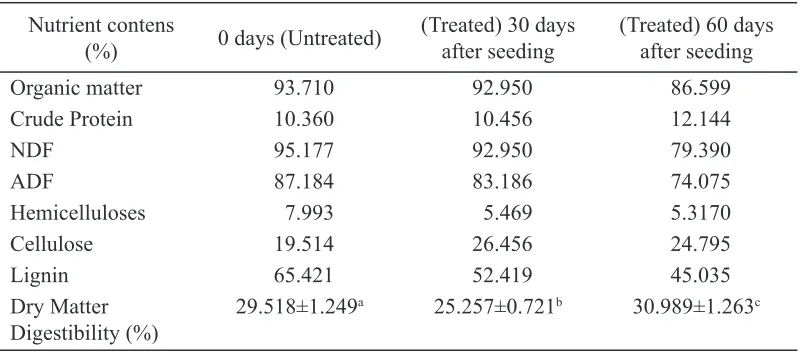
The celluloses, hemcelluloses and lgnn are the man sources of carbon and energy for P.ostreatus growth, whle proten serves as the ntrogen source. Ther degradaton and utlzaton can greatly affect P.ostreatus growth and resultng feed value of the substrate. The change of nutrent composton contents durng the P.ostreatus mycela growth perod are shown n Table 1.
There were ncreasng of proten content and decreasng of fber fracton (lgnn, NDF and ADF) produced by bofermentaton. The decreasng of fber fracton s the ndcaton that Pleurotus ostreatus can degrade the cell wall component of coffee husk.
The decreasng of NDF and ADF from coffee husk suggested that these fung could utlze the cell wall component as carbon source and energy for growth. The decreasng of NDF and ADF contents of treated coffee byproduct has been reported by Penaloza et al., (1985). The decreasng of NDF, ADF and ADL n the frst 30 days of mycela growth were 2.339%, 4.586% and 19.874%, respectvely. Meanwhle n 60 days, the decreasng of NDF, ADF and ADL were 16.587%, 15.036% and 31.161%, respectvely from the ntal value.
The fermentaton tme was mportant to mprove the nutrtve value of straw. The longer fermentaton perod led greater depleton of carbohydrate source of coffee husk by fung. Ths condton could mprove the dgestblty of coffee husk as result of the changes n non structural carbohydrate to structural carbohydrate rato. Decreasng of lgnn n coffee husk could be a result of lgnn degradng enzymes produced by Pleurotus (Hong et al., 2003). These result are supported by the report from Wdastut et al. (2008) who noted lgnnoltyc enzyme actvtes followed the pattern of lgnn dsappearance from substrate and drectly corrected wth tme of ts dsappearance. Plat and Hadar (1983) noted that durng the mycela growth perod, P.ostreatus mycela were more capable to degrade lgnn, and the degradaton of lgnn played an mportant role n mycela development.
The rapd decreasng of hemcellulosc component n 30 days fermentaton showed that hemcelluloses were the frst substrate utlzed by mycela as the carbon and energy sources at the begnnng phase of growth. The decreasng of hemcel-luloses was 31,578% from ntal value n 30 days fermentaton. Ths suggest that hemcellulose s more easly degraded than cellulose and lgnn. Pleurotus ostreatus mushroom secreted enzym to demolsh the easer used compound. Pleurotus ostrea-tus needs a carbon source whch s easer to metabolze (Crawford, 1981). Hemcel-luloses were degraded easer than cellulose and lgnn (Perez, 2002).
Bofermentaton broke the lgnocelluloses bond. Delgnfcaton has mportant role n mycela growth whch cleavage polysaccharde component (cellulose and hemcelluloses) (Agosn and Oder, 1985). Ths component wll be utlzed by fung as substrate for ther growth (Hatakka, 2004).
Durng the mycela growth, the proten content ncreased 0.927% n 30 days and 17.220% n 60 day fermentaton. Mycela n 60 days were thcker than 30 days. Fungal cell n mycela contrbuted the proten content of subtrate because 60 and 70% of ntrogen present n the fungal cell s proten (Chang and Mles 2004). The hgher proten content n 60 days n the substrate were prepared to transferable ntrogen nto frut bodes. The extensve formaton of prmorda n 60 days ndcated the end of the vegetatve growth phase of P.ostreatus. As coffee husk substrate was degraded and nutrent used by P.ostreatus, the total organc matter of substrate decreased (Table 1).
The ncreasng of proten content and the decreasng of lgnocelluloses of coffee husk after fermentaton showed that Coffee husk could be used as substrate P.ostreatus cultvaton. The mprovng nutrton value after fermentaton especally on 60 days ndcated that the substrate can be used as a product feed.
In vitro dry matter dgestblty tests for rumnant were conducted for the dgestblty of untreated and treated coffee husk. Four replcaton were conducted and the result are shown n fgure 1. Average dry matter dgestblty (Table 1) n-creased sgnfcantly 4.983% n 60 days fermentaton and den-creased 14.435% n 30 days fermentaton from untreated coffee husk. The possblty of ths condton s that n 30 days fermentaton the hgher level of cellulose made dgestblty lower.
Table 1. Changes of nutrent contents and average in vitro dry matter dgestblty of coffee husk substrate durng Pleurotus ostreatus mycela growng (0, 30, and 60 days
It suggested that on 30 days, the degradaton of lgnocellulosc component was not optmal yet. Therefore, t could be acceptable to use the coffee husk substrate after P.ostreatus cultvaton on 60 days fermentaton as rumnant feed.
Fgure 1. In vitro dry matter dgestblty of coffee husk durng Pleurotus ostreatus mycela growng
Concluson
It was concluded that proten content and cell wall components n coffee husk substrate changed durng Pleurotus ostreatus mycela growng perod. In 60 days of fermentaton tmes, cellulose, hemcelluloses and lgnn contents n the substrate were decreased and proten content ncreased as compared wth the untreated coffee husk. Ths could contrbute to the ncreasng n dry matter dgestblty of the substrate. It s suggested to use the coffee husk substrate as a rumnant feed especally n 60 days fermentaton.
Acknowledgement
Ths research was funded by DP2M Dkt through HIBAH BERSAING wth research agreement no: 256/h30.10/pl/2011 on date Aprl 20th 2011.
References
Adamovc, M., G. Grubc, I. Mlenkovc, R. Jovanovc, R. Protc, L.Sretenovc and Lj.Stocevc. 1998. The bodegradaton of wheat straw by Pleurotus ostreatus mushrooms and ts use n cattle feedng. Anim. Feed. Sci. Tech. 71:357-362. Agosn, E. and E. Oder. 1985. Sold- state fermentaton, lgnn degradaton and
resultng dgestblty of wheat straw fermented by selected whte-rot fung. Appl. Mcrobol. Botechnol. 21:397-403.
Effect of Pleurotus ostreatus fermentaton on cocoa pod husk composton : n-fluence of fermentaton perod and Mn++ supplementaton on the fermentaton
process. Afrcan Journal of Botechnology. Vol 8 (9) : 1950-1958.
Chang, S.T. and P.G. Mles. 2004. Mushrooms: Cultvaton, Nutrtonal Value, Me-dcnal Effect and Envronmental Impact. Boca Raton: CRC Press.
Fan, L and C. R. Soccol. 2005. Coffee resdues. http://www.fungfun.org/mush- world/shtake-mush-room-cultvaton/mushroom-growers-handbooks2-mushworld-com-chapter04-02-p.92.pdf 26 Maret 2010
Fazael H., H.Mahmodzadeh, A.Azz, Z.A. Jelan, J.B. Lang, Y. Rouzbehan and A.Osman. 2004. Nutrtve value of wheat straw treated wth Pleurotus fung. Asan-Aust. J. Anm. Sc. Vol 17 (12) :1681-1688.
Goerng, H.K., and P.J. Van Soest. 1970. Forage Fber Analyses. ARS, USDA Agr. Handbook. No.379.
Gregor A., Mrjan Svagelj and J. Pohleven. 2007. Cultvaton technque and me-dcnal propertes of Pleurotus spp. 45(3):236-247
Hadar Y. and E.P-Araz. 1986. Chemcal composton of edble mushroom Pleuro-tus ostreaPleuro-tus produced by fermentaton. Appled and Envronmental Mcrob-ology 51(6):1352-1354.
Hatakka, A. 1994. Lgnn-modfyng enzymes from selected whte rot fung:pro-ducton and role n lgnn degradaton. Fems Mcrobol. Rev.13:125-135. Herlyana EN, Nandka D, Achmad, Sudrman LI, Wtarto AB. 2008.
Bodegrada-ton of sengon-wood sawdust substrate by Pleurotus group fung from Bogor. J. Tropcal Wood Scence and Technology 6:75-84.
Hong, S.H., B.K. Lee, N.J. Cho, S.S. Lee, S.G. Yang and J.K. Ha. 2003. Effect of enzyme applcaton method and levels and pre-treatment tmes on rumen fer-mentaton, nutrent degradaton n goat and steers. Asan-Aust. J. Anm. Sc. 16 (3):389-393.
Kerem, Z., D. Fresem and Y. Hadar. 1992. Lgnocellulose degradaton durng sold state fermentaton:Pleurotus ostreatus versus Phanerochaete chrysosporum. Appled and Envronmental Mcrobology. Vol.58(4):1121-1127.
L Xujn, Y. Pang and R. Zhang. 2001. Compostonal changes of cottonseed hull substrate durng P.ostreatus growth and the effects on the feedng value of the spent substrate. Boresources Technology 80 : 157-161.
Penaloza, W., M.R. Molna, R.G. Brenes and R. Bressan. 1985. Sold state Fer-mentaton: An alternatve to mprove the nutrrve value of coffee pulp. Ap-pled and Envronmental Mcrobology. Vol 49(2): 388-393.
Perez, J., J. Munoz-Dorado. T. De la Ruba and J. Martnez. 2002. Bodegradaton and bologcal treatments of cellulose, hemcellulose and lgnn:an overvew. Int. Mcrobol 5: 53-63
Tlley, J.M.A and R.A. Terry. 1963. A two stage technque for the n vvo dgeston of forage crops. J. Brt. Grassl. Soc. 18:104.