APPRAISALS USED IN THE DIALOGUES OF
OSCAR WILDE’S DRAMA
“THE IMPORTANCE OF BEING EARNEST”
THESIS
Submitted in fulfillment of the requirements
for the degree of Master in Applied Linguistics
by
Selnistia Hidayani
2201504015
APPLIED LINGUISTICS STUDIES
ENGLISH DEPARTMENT OF GRADUATE PROGRAM
STATE UNIVERSITY OF SEMARANG
ii
ADVISER’ APPROVAL
This thesis has been approved by the advisers to be examined by the board of examiners on:
Day : Thursday
Date : 9 March 2006
Semarang, March, 2006
First Adviser Second Adviser
iii
APPROVAL
This thesis has been examined and defended before the board of examiners
in the English Department of the Graduate Program of the State University of
Semarang (UNNES) and has been decided acceptable on the ninth of March Two
thousand and six.
BOARD OF EXAMINERS
Chairman Secretary
Prof. Mursid Saleh, Ph. D Dra. C. Murni Wahyanti, M. A.
NIP 130354512 NIP 130805077
First Examiner Second Examiner/Second Adviser
A. Maryanto, Ph. D Drs. Warsono, M. A.
NIP 130529509 NIP 130350484
Third Examiner/First Adviser
Helena IR Agustien, Ph. D
iv STATEMENT
I certify that this thesis is definitely my own work. I am completely responsible
for its contents. Other writers’ opinions or findings included in this thesis are
quoted or cited in accordance with ethical standard.
Semarang, 9 March 2006
Selnistia Hidayani
v
MOTTO AND DEDICATION
“O you who believe! Seek help in patience and
the prayer. Truly! Allah is with the patience”
(Qs. Al-Baqarah: 153)
This thesis is dedicated to:
1.
My Beloved Parents
2.
My Beloved Husband, Abi Mujahid
vi
ACKNOWLEDGEMENTS
First and foremost, the writer wishes to express her high gratitude to Allah
SWT, the Most Gracious and the Most Merciful, for blessing and leading her to
complete this thesis.
The writer wishes to extend her deepest love and gratitude to her parents
and her husband who always support her in finishing this thesis. May Allah give
us His Guidance and blessing.
The writer thanks Mr. Maryanto, her lecturer who has corrected her work
carefully. She wishes to extend her gratitude to Helena I.R. Agustien, Ph. D, her
first adviser who has guided and encouraged her from the beginning until this
thesis was completed.
The writer also extends her gratitude to Drs. Warsono, M. A., her second
adviser who has suggested her carefully for the completion of this thesis.
Then, she also thanks all friends in Banyumanik who have motivated her
in completing this thesis.
vii
ABSTRACT
Hidayani, Selnistia. 2006. Appraisals Used in The Dialogues of Oscar Wilde’s Drama “The Importance of Being Earnest”. Thesis. Applied Linguistics Study Program, English Department of Graduate Program of the State University of Semarang. Advisers I: Helena IR Agustien, Ph. D., II: Drs. Warsono, MA.
Keywords: Appraisal devices, affect, judgment, appreciation, amplification, source of attitudes, power
Appraisal is a system of interpersonal meaning (Martin and Rose, 2003). People use appraisal to negotiate their experiences, feelings, and thoughts in a social relationship with others. It is concerned with the linguistic recourses by which texts come to express, negotiate, and naturalize their inter-subjective and ideological positions. It has five devices: Affection, Judgment, Appreciation, Amplification, and Source of Attitudes. Drama that is performed by its characters draws human being’s interaction through its dialogues and settings. The characters may use one or more of those appraisal devices. Therefore, the dialogues of the drama can be the media to know the intentional use of language throughout the characters’ negotiating attitudes.
This thesis was intended to analyze what appraisal devices are employed in the dialogues of Oscar Wilde’s Drama “The Importance of Being Earnest” and to find out the power of the drama and of the author based on the appraisal devices used in the dialogues.
My research design was a qualitative one with Eggins and Slade’s (1997: 138-140) data analysis model: identifying, classifying, summarizing, and interpreting. The data are the dialogues that were broken down into some clauses. Then I identified the clauses whether they employed appraisal devices or not. While collecting the data, I encoded the speaker and the clauses by numbering them. After that, I identified and classified the encoding data in accordance with the appraisal devices: affection, judgment, appreciation, amplification, and source of attitudes. I calculated the classified data into a summarization table. It contains total number of clauses and total number of appraisal devices per character. Last, I interpreted the classified data and the table in order to discover the ideology or the relation between the characters in the drama.
After applying Eggins and Slade’s model, I found 1.187 total appraisal devices and 1.659 total clauses. The largest numbers of appraisal devices are amplification (489 words) and appreciation (336 words). The characters use 196 words of judgment and 53 words of source of attitudes. These show that generally the characters are more concerned with evaluating things than with evaluating human behavior.
Algernon, Jack, and Lady Bracknell have the largest number of appraising words; therefore they tend to be the most expressive speakers of all. Through the characters’ dialogues, Oscar Wilde tries to explore the Victorian custom and society of that time. Hopefully, the readers can understand and know how to interact interpersonally to their environments.
viii
TABLE OF CONTENTS
PAGE OF TITLE……… i
ADVISER’ APPROVAL……… ii
PAGE OF APPROVAL……….. iii
STATEMENT……… iv
MOTTO AND DEDICATION………... v
ACKNOWLEDGEMENT………... vi
ABSTRACT……….... vii
TABLE OF CONTENT……….. viii
CHAPTER I. INTRODUCTION Background of the study……….. 1
Reasons for choosing the topic………. 3
Statement of the problem………. 5
Objectives of the study……… 5
Significance of the study………. 5
Limitation of the study………. 5
Unit of analysis……… 5
Definition of terms……….. 6
II. REVIEW OF RELATED LITERATURE 2.1 Text and Context………. 7
2.2 Concept of Clause……… 10
2.2.1 Clause as Message……….. 11
ix
2.2.3 Clause as Representation……… 12
2.3 The Mood Element……….. 14
2.3.1 Structure of the Mood……… 14
2.3.2 Meaning of Subject and Finite………... 16
2.4 Appraisal as A Discourse System……….. 17
2.4.1 Appraisals – Negotiating attitudes………. 19
2.4.2 Kinds of Attitudes………. 20
2.4.2.1 Affect………. 21
2.4.2.2 Judgment……… 22
2.4.2.3 Appreciation……….. 23
2.4.3 Amplifying Attitudes………... 24
2.4.4 Sources of Attitudes………. 25
2.5 Dialogues in Drama………... 27
2.6 Theoretical Framework……… 28
III. METHODOLOGY AND RESEARCH METHOD 3.1 Research Design……….. 29
3.2 Source of the Data………... 29
3.3 Methods of the Study………. 30
3.3.1 Method of Data Collection……….. 30
3.3.2 Method of Data Analysis……… 30
IV. FINDINGS AND THEIR INTERPRETATION Affection………. 33
Judgment………..………. 40
Appreciation…………..……… 47
x
Source of Attitudes……… 55
V. CONCLUSIONS AND PEDAGOGICAL IMPLICATION
5.1 Conclusions……… 60
5.2 Pedagogical Implication………. 60
BIBLOGRAPHY
APPENDIX
APPENDIX 1 – 47 : Identification of the Appraisal Devices
APPENDIX 48 – 52 : Classification of the data for Affection
APPENDIX 53 - 60 : Classification of the data for Judgment
APPENDIX 61 - 73 : Classification of the data for Appreciation
APPENDIX 74 – 92 : Classification of the data for Amplification
APPENDIX 93 – 94 : Classification of the data for Source of the Attitudes
TABLE
TABLE 1 : Summarization of the Appraisal Devices
TABLE 2 - 3 : Appraisal Analysis for Jack
TABLE 4 - 5 : Appraisal Analysis for Algernon
TABLE 6 - 7 : Appraisal Analysis for Cecily
TABLE 8 : Appraisal Analysis for Gwendolen
TABLE 9 - 10 : Appraisal Analysis for Lady Bracknell
TABLE 11 : Appraisal Analysis for Miss Prism
TABLE 12 : Appraisal Analysis for Dr. Chasuable
1 CHAPTER I INTRODUCTION
1.1 Background of the study
Language is a tool for construing an experience to be a meaning so that it can be
communicated. People construe their experiences to be meanings using language.
Therefore, they could share information and communicate their experiences to
others. Their interaction can be direct or indirect. If people say something
indirectly, it means that they imply something. To do this, they may use one or
both of language forms: spoken and written to communicate their experiences.
They try to achieve mutual understanding in their communities. As Eggins and
Slade (1997) said that interaction/communication is not just a process of taking
turn in producing sounds and words but it is a semantic activity, a process of
making meanings.
People elaborate their own political, philosophical, and existential posture
in a continuous and changing negotiation with their social environment through
language. They have to be in one-cultural boundaries while negotiating their
experiences since language cannot be separated from its culture. This situational
context is the one that makes an utterance, expression, or clause intelligible.
People live in a context that can be thought of as their culture or society so that
their linguistic representation will be meaningful while they are in their contexts,
context of situation or context of culture.
Each text has its own context. The context could be situational or cultural
context. A literary text that is a kind of text also has cultural context. In fact,
different issues/themes. The text of drama as part of our world has its immediate
context to express the writer’s experience about life through the dialogues and the
settings taken. People can refer differently to words like "liberty," "love,"
"democracy," "vice," "illness," "wealth" and "justice," depending on their
contexts.
According to Eggins and Slade (1997: 116), appraisal as one of the
semantic systems that expresses attitudes in casual talk is an important device for
constructing and signaling degrees of solidarity and intimacy in relationship. It
focuses on the attitudes which interactants express towards each other and
towards the world. Appraisal helps the interactants to negotiate their experience
interpersonally to other people.
Drama as one of people’s creations shows us bits of human life, thought,
and world through the characters’ dialogues. The characters express the writer’s
ideology and tendency within stage performance. They perform the dialogues in
order to negotiate the writer’s idea to the audience. They present language forms
in the dialogues as clause or clause complex. Halliday and Matthiessen (1999:
512) emphasize that the fundamental element of grammar is clause. Clause
presents the parameter within which the processes may unfold. Thus, this study
presents the dialogues of drama that are broken down into several
chunks/clauses/sentences as the data. The writer analyzed each chunk to see
whether there are appraisal devices found in the drama. Then, I interpreted the
data to discover power of the drama.
I limit this study on all dialogues of the drama in order to know its power
and how the author presents his ideas through the dialogues he creates. Power
3
to analyze the power of the drama. By applying appraisals, we can feel and
understand well what the author may intend beyond the story he made.
The drama I chosen, The Importance of Being Earnest is one of the
greatest comedies so that it was possibly influenced by people’s customs living at
that time. It may contain negotiating attitudes.
1.2 Reasons for Choosing the Topic
There are many researches in discourse field, especially in appraisal systems.
Why are many people interested in analyzing appraisals? The answer is because
this field talks a lot about the nature of the participants. Appraisal as a discourse
system has an important role to interpret people’s attitudes towards their society.
It concerns on evaluating and negotiating attitudes. It relates to the power of a
text and makes the text meaningful. Consequently, we can feel and understand
the ideas of the text, including a drama. So, it is very important for us to use
appraisal while reading and speaking a text.
In this thesis, I took drama as a media to know the power of the drama
itself and the power of its author. Why I took drama? The reason is that the drama
is one of literary texts performing real life. It consists of dialogues being
supported by context of culture so that it becomes meaningful. It draws human
beings’ interaction. Therefore, drama as part of our life cannot be separated from
its situation and culture. The societal system indirectly will influence what kind
of drama is being produced. Serayawati (2000: 1) asserts that a good dialogue
isn’t only such a transcript of sentences, but it is a language that reveals
characters so that it has a context describing times, places, and themes. Grolier in
his Academic Encyclopedia (1983: 257) defines that drama refers to actions or
I use Oscar Wilde’s drama, The Importance of Being Earnest. It is one of
the English stage’s finest comedies written in 1895. I am interested to analyze it
since comedy is rooted more in the events of our daily lives, such as the way we
live together in communities. David L Sill (International Encyclopedia of the
Social Science vol. 3, 1968: 210) asserts that in comedies of manners, the action
is based on the observation of the ways of life of the characters in the play.
Comedy deals with the lighter side of life.
Comedy is also usually used as a medium to criticize social phenomena.
For instance, drama that was written in 1960 must be different from the one
written in 2000. It is produced in order to draw people’s powers at that time. We
can know and understand the power of a drama from the characters’ dialogues.
Hopefully, we could use these findings to communicate interpersonally to others
in real-life situation. We also could understand the characteristics of people
through their ways of speaking. Therefore, this study is very important for
researchers, teachers, or students to understand the power of the drama through
the appraisal devices used.
1.3 Statement of the problem
This thesis is meant to address the following issue: What appraisal devices are
used in the dialogues of Oscar Wilde’s Drama “The Importance of Being
Earnest”.
1.4 Objectives of the study
This thesis is intended to find out what appraisal devices are used in the
dialogues, and to find out the power of the drama and of the author through the
5
1.5 Significance of the Study
The findings of this study are appraisal devices employed by the characters. They
are performed in accounts and interpretation as the thesis description. Hopefully,
this study is useful for further researchers, English learners, teachers, and
curriculum developers to enrich their knowledge about appraisal devices.
Therefore, they could make better interpersonal communication with their society.
People may compare the data to real-life dialogues and select them as resources
for negotiating their ideas and experiences interpersonally.
1.6 Limitation of the Study
This study is limited to the investigation of appraisal devices used by the
characters in the dialogues of The Importance of Being Earnest to make it easy to
understand. The analysis focuses on the analysis of the types of the appraisal
systems, and the ideology served by the appraisal devices.
1.7 Unit of Analysis
In this study, the unit of analysis is appraisal device.
1.8 Definition of Terms
Based on the title of this thesis, the descriptions of the terms used in this study are
defined as follows:
1. According to Martin and Rose (2003: 13), appraisal is a system of
interpersonal meaning. People use it to negotiate their experiences, feelings,
and thoughts in a social relationship with others. In a broad scope, appraisal
theory is concerned with the linguistic recourses by which texts come to
express, negotiate, and naturalize their inter-subjective and ideological
2. Drama derived from the Greek verb dran meaning “to act” or “to do”. It
consists of a set of dialogues to be performed on stage. The Importance of
Being Earnest is one of the greatest English comedies written in 1895. It
contains three acts with three different scenes. Set in London, the action
largely takes place in the Manor House; in the garden and in the drawing
7 CHAPTER II
REVIEW OF RELATED LITERATURE
2.1 Text and Context
Matthiesssen (1995: 1) asserts that language is a resource for making and
expressing meanings relating to various aspects of the social system (culture).
People use language to communicate and negotiate their ideas. Communication is
a process whereby we create, negotiate, and interpret personal meanings.
Functionalists consider that in communication, people use language as a means to
develop a text. They create and develop text while negotiating together in
exchanging meanings. This means that they work together to complete the text.
There is a pattern that one side gives an incomplete move and the other completes
it. Halliday and Hasan (1976: 1) say that text in linguistics refers to any passage,
spoken or written of whatever length, that forms a unified whole. Moreover,
Halliday (1994: 311) adds that the text is something that happens, in the form of
talking, or writing, listening, or reading. When it is analyzed, people analyze the
product of this process.
In Systemic Functional System, text is seen as a unit of meaning, not of
form, as a basis for analyzing language. It relates to the quality (meaning), not the
quantity (form) of the text. Text is not only seen from the wording contained, but
also how wording works together to set up one whole meaning. Consequently,
each wording could take the right position in the text as the role it plays. It also
happens in literature text whose meaning is expressed in words. The art of drama
While creating meaning, it is situated by its context; context of culture and
context of situation. It means that in creating or understanding a text, there is
context that must be interpreted to reach its meaning. People are elaborating their
own political, philosophical, and existential posture in a continuous and changing
negotiation with their social environment. They have to be in one-cultural
boundaries since language cannot be separated from the culture. According to
Eggins (1994: 26), context of situation (register) is the immediate situational
context in which the text is produced. This context is the one that makes an
utterance, expression, or clause intelligible. A linguistic representation will be
meaningful while it is in its context, context of situation. The other context is
Genre (Context of Culture) that is widely used in some fields of arts, literature,
and media. Comedy, romantic story, heroic novel, or a newspaper article belongs
to a different genre. Eggins (1994: 26) emphasizes that genres are how things get
done, when language is used to accomplish them. This means that people may
have different genres to perform different social functions.
Halliday (1985b: 46) asserts that context of situation is the mediate
environment in which the text is actually functioning. Halliday and Hasan (1985:
12) propose a conceptual framework that can be used to interpret the social
context of text, the environment in which the meanings are being exchanged. This
framework is under the following terms: (1) the field of discourse refers to what is
happening and to the nature of the social action that is taking place. It relates to
the “play”, the kind of activity (predict experiental meaning), (2) the tenor of
language refers to who is taking part, to the nature of participants, their statuses,
and roles. It relates to the “players”, the actors or rather the interacting roles that
9
mode of discourse refers to what part of language is playing, what it is that the
participants are expecting the language to do for them in a situation. It relates to
the “parts”, the particular functions that are assigned to language (predict textual
meanings)
According to Halliday (1985b: 46) that context of situation focuses the
interpretation on the immediate environment of a context. But, the context of
culture focuses more on the broader background of the context of the situation.
Context of culture considers any actual context of situation including the field, the
tenor and the mood. People live in a context that can be thought of as their culture.
This context does not begin with the birth of them. In the same way that people
are "born into" a language, they come to occupy a place in their context; it is a
social and linguistic framework that has an important role in molding how people
think, act, feel, and understand what happens.
The players of the drama as part of our world have their immediate context
to express the writer’s ideas. They may refer words like "liberty," "love,"
"democracy," and "justice," to the word “independence”, and do not only choose
what meanings to give these words, but also deliberately construct the dialogues’
meanings and intentions.
2.2 Concept of Clause
People usually communicate their feelings, thoughts, or experiences with
others using language. People may use spoken or written language forms as clause
or clause complex to negotiate their ideas. Gerot and Wignell (1994: 82) confirm
analyzing the written language instead of the concept of clause that is being
applicable for both written and spoken languages. Moreover, Halliday and
Matthiessen (1999: 512) emphasize that the fundamental element of grammar is
clause and it presents the parameter within which the processes may unfold.
This study presents the dialogues of drama that were broken down into
several chunks/clauses/sentences. They are analyzed to see whether there are
appraisal devices or not found. Gerot and Wignell (1994: 82) say that a clause can
be defined as the largest grammatical unit and a clause complex is two or more
clauses logically connected. It is also defined as an idealization of the written
language.
According to functionalists, a text is usually analyzed in the clause level.
They also view clause functional unit with a triple construction of meaning that
function simultaneously. Halliday (1994: 34) defines three kinds of meanings in
the following sub-section.
Clause as Message
It deals with the information structure, textual metafunction. In any position
of a clause, any information is put has substantial impact on the meaning of the
whole clause, because position reflects its importance. Information is arranged to
give focus on a certain part of clause to deliver. This arrangement has an impact
on what is considered old and what is new. What is put at the beginning is
considered more important than the one put next. Every information puts in the
beginning is considered as Theme, and the rest is considered as Rheme. In this
11
In a text, clause functions not only as a collection of words but also has a
meaning as a message. Halliday (1994: 37) confirms that in English, the clause is
organized as a message by having a special status assigned to one part of it.
Theme in the construction of a clause is an important element of a message, since
it is the most essential part of the writers’ intentions as a message.
Clause as Exchange
It deals with interpersonal meaning, for example meanings that express a
speaker’s attitudes and judgments (Gerot and Wignell, 1994: 13). This kind of
meaning relates to the tenor of a discourse. This meaning deals with the
exploration of the message in the drama. The characters use it in expressing their
feeling in the dialogues they speak. At the social context level, dialogue can be
interpreted as a process of exchange.
In functional linguistics field, a clause has a certain characteristic referring
to its function such as an exchange. This means that along with its organization as
a message, the clause is also as an interactive event involving speaker, or writer,
and audience: a transaction. Halliday (1994: 34) points out that a clause has a
meaning as an exchange, a transaction between a speaker and a listener; the
subject is the warranty of the exchange. A speaker does not only speak to his
listener but he also requires something.
Based on Halliday’s notion, a clause involves two variables: (1) the roles
that are defined by the exchange process, and (2) the nature of commodity that is
being exchanged. There are two main types of speech role: (a) giving, which
word “act” of speaking is appropriately called an “interact” that means an
exchange. In this case while giving implies receiving, demanding implies giving a
response. Besides those kinds of speech roles, in an exchange people also should
consider the commodity, which relates to the commodity being exchanged. This
may be either goods and services or information.
Clause as Representation
People try to make sense of their experience in this world through language.
They construe language in a piece of written and spoken forms through clauses.
The clause is a main aspect of expressing a language. As Halliday (1994) says that
the clause plays a central role because it embodies in general principle for
modeling experience, namely the principle that reality is made up of processes.
In other words, while considering the clause from the experiental
metafunction view, the relevant systems are known as “Transitivity” and the
clause itself is interpreted as a process of configuration, which construes a set of
experience or events. These are represented as a configuration of a process,
participants involved in, and attendant circumstances (Martin et al., 1997).
The clause as representation is construed in language using a particular
organization that is to realize experiental meaning involving transitivity (process
type). Thus, its structures express representational meaning: what the clause is
about, which typically of some processes, with associated participants and
circumstances (manner, place, time, etc).
People have to know the difference between the minor clause and the major
13
predicator; major clauses do. Minor clauses are usually used in spoken languages
including greetings and exclamations. They are meaningful but cannot be
classified as a clause.
A major clause is a clause which has a predicator, and usually has a
subject that can be ellipsis. Major clauses are divided into two kinds of clauses:
independent and dependent clauses. Gerot and Wignell (1994: 84) assert that
independent clauses imply that they can stand alone. They are arranged into
statements, questions, commands and exclamations. On the other hand, dependent
clause is a clause that depends on the independent clause.
2.3 The Mood Element
2.3.1 Structure of the Mood
Halliday (1994: 68-71) points out when we use language to interact, one of the
things we are doing is establishing a relationship between the person speaking
now and the person who will probably speak next. According to Eggins (1994:
156), there are two essential functional constituents of mood components of a
clause: a subject and a finite. These are explained by Halliday (1985a: 76) as
follows:
1. subject realizes the thing by reference to which the proposition can be
affirmed or denied. The identification of it can be achieved by a tag test. For
example, Oscar Wilde wrote The Importance of Being Earnest (didn’t he)?
Both Oscar Wilde and He are subjectsof the sentence. Another test to detect
the subject is to change the verb from singular to plural. For instance, he
corresponding part of the clause that has to change is the subject, i.e: he and they.
2. finite is defined in terms of its function in the clause to make the proposition
definite, to anchor the proposition in a way that we can argue about it. The
identification of finite also involves a tag test: verbal part. For example,
Jamal was reading a novel, wasn’t he? Both was and wasn’t are finites. If
the verbal part of a clause has two or more words, for instance will be
teaching, has been gone, etc, the identification of finite will be the FIRST of these verbal elements (will and has respectively).
Relating to the function of finite to anchor the proposition, and to make it
applicable, Halliday (1994: 76) refers to reference to time and reference to
modality as Finite Verbal Operators, which include:
1. temporal finite verbal operators: these words anchor the proposition by
reference of time either positive or negative in past (did/didn’t,
was/wasn’t, had/hadn’t, used to/didn’t used to), present (does/doesn’t,
is/isn’t, has/hasn’t), or future (will/won’t, shall/shan’t, would/wouldn’t,
should/shouldn’t).
2. finite modal operators: these words anchor the proposition not by
reference to time but by reference to Modality either in low (can, may,
could, might), median (will, would, should, is/was to) or high (must, ought
to, need, has/had to).
According to Halliday (1994: 74) the general principle behind the
15
characteristically used to exchange information is the indicative; within the
category of indicative, the characteristic expression of a statement is the
declarative, that of a question is the interrogative; and within the category of
interrogative, there is a further distinction between yes/no interrogative for polar
question, and WH-interrogative, for content questions. These features are
typically expressed as follows:
1. the presence of mood element, consisting of subject plus finite, realizes the
feature “indicative”
2. within the indicative, what is significant is the order of subject and finite:
1) the order subject before finite realizes “ declarative”
2) the order finite before subject realizes “yes/no interrogative”
3) in a WH-interrogative the order is:
a. subject before finite if the WH-element is the Subject
b. finite before subject otherwise
2.3.2 Meaning of Subject and Finite
According to Halliday (1994: 75), people need to consider each of these elements
in turn, since both are semantically motivated but the contribution they bring to
the clause is not the same. These are the further definition of finite and subject:
(1) finite element has the function of making the proposition finite. It relates the
proposition to its context in the speech event. This can be done in one of two
ways. One is by reference to time of speaking, for example is in A young man
for instance should in You should come on time. This means that in grammatical terms, the first is primary tense, and the second is modality.
Primary tense means past, present, or future at the moment of speaking. A
proposition may become arguable by having its relevance to the speech event
specified in these temporal terms. Whereas modality means the speaker’s
judgment of the probabilities, or the obligations, involved in what is said. A
proposition may become arguable by being presented as likely or unlikely,
desirable or undesirable. In other words, it relates to modal terms.
(2) subject element provides the rest of what it takes to form a proposition by
reference to which the proposition can be affirmed or denied. In a goods and
service clause, the Subject specifies the one that is actually responsible for
realizing the offer or command. For example, I’ll open this door, shall I (offer)
and Don’t disturb me, It’s a holiday (command). So, the typical subject of an
offer is the speaker and that of a command is the person being addressed. In
passive form of offer and command, subject is dissociated from the Actor, but
it still specifies the one who is responsible for the success of the proposal. But
in a proposition this means the one on which the validity of the information
made to rest. The Subject also has the same principle at work in statement and
questions.
2.4 Appraisals as a Discourse System
Matthiesssen (1995:1) asserts that language is a resource for making and
expressing meanings relating to various aspects of the social system (culture).
People construe their experiences to be meanings using language therefore they
17
choose one or both of language forms: spoken and written while communicating.
They try to achieve mutual understanding so that both the sender and the receiver
could understand each other.
There are two principles offered by Matthiesen (1995: 3) that could be a
base to organize language whether spoken or written, called orders of abstraction
and functional diversification. Orders of abstraction deal with the stratification of
language, the meaning (semantics), the wording (lexicogrammar) and the
sounding (phonology). It deals with how people construe their experiences to be
communicated to others.
The other of language organization is functional diversification. By this,
language is a resource for the participants to engage with one another to exchange
meanings. According to Matthiessen (1995: 3), this involves (1) enactment of
roles and relations, (2) construal of experience, and (3) presentation of the
meanings created through enactment and construal as information organized into
text in context. In this case, language plays an important role to represent all three
kinds of meanings above. Moreover, Matthiessen (1995: 19) calls these three
bands in a functional term as interpersonal, ideational, and textual meanings. They
are diversified based on the context of situation.
Martin and Rose (2003: 6-7) then develop these metafunctions in a
discourse system into five systems. They are appraisal, ideation, conjunction,
identification, and periodicity. Martin and Rose provide very clear explanation
about appraisal. They say that appraisal is concerned with evaluation- the kinds of
attitudes that are negotiated in a text, the strength of the feelings involved and the
way in which values are sourced and readers aligned. It is an interpersonal kind of
Halliday and Hasan (1985: 12) assert that the tenor of discourse refers to
who is taking part, and to the nature of the participants, their statuses, and roles:
what kinds of role relationships obtain among the participants. They also
emphasize that in semantics the field is expressed through the experiential
function, the tenor is expressed through the interpersonal function, and the mode
is expressed through the textual function. This means that it is possible to provide
descriptions about exchange of meaning in terms of field (refers to the social
action), tenor (refers to who is taking part), and mode (refers to the channel).
From a short explanation above, one can conclude that appraisal is the
only system dealing with interpersonal metafunction. It also deals with the
development of text in which there is a relation between the interactants. This
study focuses on appraisal devices used by the interactants in which there is the
power/philosophy between the characters. Furthermore, most texts, including the
drama as a literary text, can’t be free from this negotiation. That is why readers
may often find similar occurrence presented differently in dialogues of different
drama. Consequently, it becomes important for readers or learners to know more
about this interpersonal meaning through literary text.
2.4.1 Appraisals-Negotiating attitudes
Appraisal is a system of interpersonal meaning (Martin and Rose, 2003). People
use appraisal to negotiate their experiences, feelings, and thoughts in a social
relationship with others. In a broad scope, appraisal theory is concerned with the
linguistic resources, e.i text and context, evaluation, and interpersonal meaning,
by which texts come to express, negotiate, and naturalize their inter-subjective
and ideological positions. This means that the theory is concerned more with the
19
the participants engage with their utterances. It has to do with evaluating things,
people’s characters, and their feelings.
This system also relates the choices of the wordings to the ideological
bases used in a text. The choosing of appropriate expression or wordings makes it
possible for us to predict the characters’ attitudes. The resources of appraisal are
used for negotiating social relationships, by telling others how one feels about
things and people. White (2001) confirms that the appraisal term is used as a
cover-all term to encompass all evaluative uses of language.
Appraisal system also shows how language can be used to get things done
in a material, cause and effect sense. In general, we can say that a discourse
analysis makes use of the development of situation. It has to do with the process
of speaking as such and how speech is used to achieve certain goals. People
represent the accumulated experience of their culture by engaging their feelings
through a language. When speakers say something, actually they imply their
negotiated attitudes that may consist of three types: affect, judgment, and
appreciation ( in Martin and Rose, 2003: 25).
2.4.2 Kinds of Attitudes
According to Martin and Rose (2003: 25), there are three kinds of attitudes;
expressing people’s feeling, judging people characters, or appreciating things.
2.4.2.1 Affect
Affect relates to emotions. It is used to express feelings, with positive and negative
emotional responses and dispositions. Feelings can be implicitly expressed
through the choice of wordings. This means that interactants may express their
they could express different feelings in different texts. For instance, a drama that
performs about politic or social problem can be a comedy or heroic one.
According to Martin and Rose (2003: 25), there are two general ways in
discourse to express people’s feelings. Firstly, people could have good feelings or
bad feelings so that affect can be positive or negative. Secondly, people may
express their feelings directly or they infer their feelings from behavior. It means
that affect can be direct or implied.
Affect colors the whole text and should be analyzed within the context.
People should be aware of affect that can be indicated through verbs of emotion,
adverbs (typically circumstances of manner), adjectives of emotion, or through
nominalization (the turning of verbs and adjective into nouns). Consequently,
while analyzing affect, people have to focus on these terms both in their words or
group of words. Here is a table of options for affect that will make the explanation
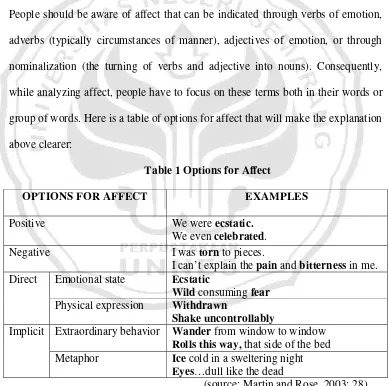
above clearer:
Table 1 Options for Affect
OPTIONS FOR AFFECT EXAMPLES
Positive We were ecstatic. We even celebrated. Negative I was torn to pieces.
I can’t explain the pain and bitterness in me. Direct Emotional state Ecstatic
Wild consuming fear Physical expression Withdrawn
Shake uncontrollably
Implicit Extraordinary behavior Wander from window to window Rolls this way, that side of the bed Metaphor Ice cold in a sweltering night
Eyes…dull like the dead
21
Affect is also realized in clause in various grammatical niches. Affect can
be as ‘quality’, as ‘process’ or as ‘comment’. One clause sometimes contains one
or more realizations of affect in any grammatical position.
2.4.2.2 Judgment
Besides affect, in appraisal, we also have judgment that refers to the act of judging
people’s characters. It relates to the human behavior evaluation that may be
negatively or positively assessed by a set of social norms. Therefore, judgment
involves an assertion relating to a set of religious, moral or legal rules or
regulations.
Judgment is similar to affect in the case of positive or negative, direct or
implied. White (2001) confirms while judgment is implied, we have to consider
the term of provoked and evoked judgment. He says that provoked judgment has
no explicit judgment wordings, whereas evoked is purely factual description
which is likely to lead to some inference of good/bad, praiseworthy/blameworthy,
appropriate/inappropriate behavior. Judgment differs from affect in the sense of
personal judgments of admiration or criticism, and moral judgments of praise or
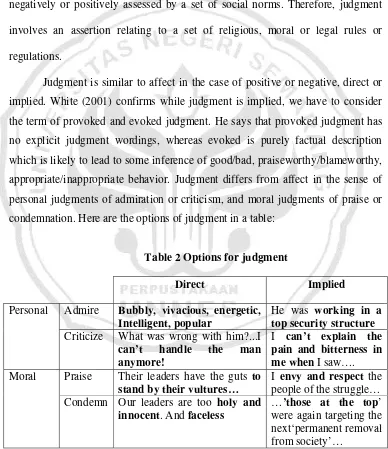
condemnation. Here are the options of judgment in a table:
Table 2 Options for judgment
Direct Implied
Personal Admire Bubbly, vivacious, energetic, Intelligent, popular
He was working in a top security structure Criticize What was wrong with him?...I
Judgment can be thought of as the institutionalization of feelings as Martin
and Rose’s explanation about norms of how people should and shouldn’t behave
above shows us.
2.4.2.3 Appreciation
Appreciation deals with aesthetic evaluation of humans that is
appreciating the value of things in discourse. It concerns with positive and
negative assessments of objects, artifacts, processes, and states of affairs rather
than with human behavior (White, 2001). Both appreciation and judgment share
the same feelings of the ‘appraised’. But they are different in the form that
judgment is done towards people (human subject) and appreciation is done
towards ‘things’.
Appreciation of things includes people’s attitudes about TV show, film,
book, CDs; about paintings, sculptures, homes, public buildings, parks; about
plays, recitals, parades, or spectacles and performance of any kind (Martin and
Rose, 2003: 33). As with the affect and judgment, things also can be appreciated
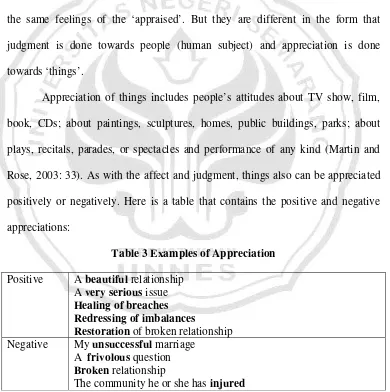
positively or negatively. Here is a table that contains the positive and negative
appreciations:
Table 3 Examples of Appreciation Positive A beautiful relationship
A very serious issue Healing of breaches Redressing of imbalances
Restoration of broken relationship Negative My unsuccessful marriage
A frivolous question Broken relationship
The community he or she has injured
23
2.4.3 Amplifying Attitudes
People may have different attitudes towards something or someone. It
deals with their feelings towards the situation. Martin and Rose (2003: 37)
confirm that attitudes are gradable. This means that we can say how strongly we
feel about someone or something. According to Martin and Rose (2003: 38), there
are two kinds of amplifying attitudes: force and focus. First, force is for ‘turning
the volume up or down’. Force involves a set of resources for adjusting how
strongly we feel about people and things This includes words that intensify
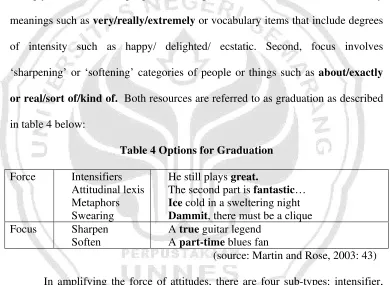
meanings such as very/really/extremely or vocabulary items that include degrees of intensity such as happy/ delighted/ ecstatic. Second, focus involves
‘sharpening’ or ‘softening’ categories of people or things such as about/exactly or real/sort of/kind of. Both resources are referred to as graduation as described in table 4 below:
Table 4 Options for Graduation Force Intensifiers
Attitudinal lexis Metaphors Swearing
He still plays great.
The second part is fantastic… Ice cold in a sweltering night Dammit, there must be a clique Focus Sharpen
Soften
A true guitar legend A part-time blues fan
(source: Martin and Rose, 2003: 43)
In amplifying the force of attitudes, there are four sub-types: intensifier,
attitudinal lexis, metaphors, and swearing. Intensifiers make it possible for people
to compare things or to say how strongly they feel about someone or something.
For instance, ‘a very serious issue’ seems to say that the issue implies something
dangerous behind it. Attitudinal lexis ‘lexis with attitudes’ refers to vocabulary
items that include the degrees of intensity, such as happy/delighted/ecstatic. These
2.4.4 Sources of Attitudes
According to Martin and Rose (2003: 39), source of attitudes is the
analysis of who the evaluations are coming from? This is the way a writer has the
responsibility of what s/he writes, whether it is her/his wordings or others’. There
are two terms related to this point: monoglossia (‘single voice’) and heteroglossia
(‘different voices’). Monoglossia refers to the source, which is simply the author,
and heteroglossia refers to the source of an attitude, which is other than the author.
For monoglossia, it relates to the author who makes a statement. The
responsibility of the proposal or proposition s/he makes is on her/him. In
heteroglossia, there are three ways of stating the source of attitudes: projection,
modality, and concession.
First, projection happens while people quote or report what people say or
think in their speaking or writing. According to Martin and Rose (2003: 44)
projection is the relation between people who say and what they say. Projections
may quote the exact words that someone generally say or report. Martin and Rose
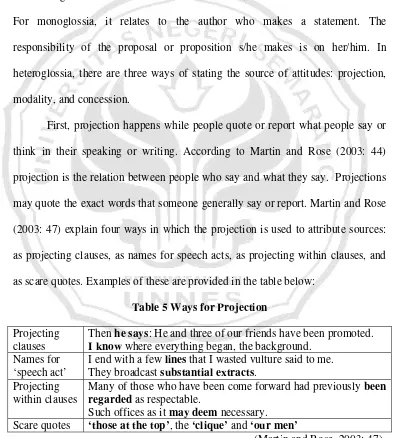
(2003: 47) explain four ways in which the projection is used to attribute sources:
as projecting clauses, as names for speech acts, as projecting within clauses, and
as scare quotes. Examples of these are provided in the table below:
Table 5 Ways for Projection Projecting
clauses
Then he says: He and three of our friends have been promoted. I know where everything began, the background.
Names for ‘speech act’
I end with a few lines that I wasted vulture said to me. They broadcast substantial extracts.
Projecting within clauses
Many of those who have been come forward had previously been regarded as respectable.
Such offices as it may deem necessary. Scare quotes ‘those at the top’, the ‘clique’ and ‘our men’
25
Second is modality. Halliday (in Martin and Rose, 2003: 42) describes
modality as a resource which set up a semantic space between yes and no- a cline
running between positive and negative poles. There are two general kinds of
modality, one for negotiating services, and the other for negotiating information.
The last concession is the way in which people track readers’ expectation,
adjusting them as our writings unfold. This can be done by stating something
which attracts readers’ expectations; that there is something people want to say
more. Consequently, concession is known as “counterexpectancy”.
2.5 Dialogues in Drama
Drama as one of literary work is simply called a play, which is written into a set
of dialogues to be performed orally. Serayawati (2000: 1) says that a good
dialogue is not only such a transcript of sentences, but it is a language that reveals
characters. Therefore, it has a context describing times, places, and themes.
According to Grolier Academic Encyclopedia (1983: 257), drama refers to
actions or deeds meaning “to act” or “to do” as they are performed in a theatre
setting.
Actions in a drama take place in the world where the characters live,
move, and have their beings so that it closely relates to human beings’ lives and
characteristics. Drama is a kind of contextualized text that the dialogues draw a
real life. This means that the dialogues in a drama can be regarded as near
real-life conversation. According to International Encyclopedia of the Social Science
vol. 3 (1968: 210), in comedies of manners, the action is based on the observation
of the ways of life of the characters in the play. The Importance of Being Earnest
drama. It deals with the lighter side of life and is rooted more in events of our
daily lives such as the way we live together in communities. Therefore, it
becomes interesting to be analyzed.
Appraisal as a discourse system is often used in the real and natural
conversation. It also may be used in literary text. It basically could apply in any
speech situation that involves the negotiating attitudes.
2.6 Theoretical Framework
An utterance could imply people’s attitudes. They may have intentions and
motives to their addressee. They can even switch from referent to referent without
losing their meanings. Discourse symbolizes and encodes social activity. While
communicating, people have to understand the context of a situation so that they
could negotiate well. People also use language in their social community to
achieve specific goal. But sometimes interpersonal and non explicit negotiation in
an interchange cannot be captured by semantic meaning. Consequently, it is
important for us to know the intentional use of language throughout negotiating
attitudes. The framework of this study is as the figure below:
Dialogues Problems Theories
Analysis Theoretical Framework
Sol
27 CHAPTER III
METHODOLOGY AND RESEARCH METHOD
3.1 Research Design
In this study I focused on the dialogues in which the characters
communicate and interact to each other through their performances. Dialogues of
a drama may be adopted from real-life situation so that they have themes that are
close with the situation that happened at that time. I use a qualitative research to
analyze data. According to Hammersley and Atkitson (1995) in Holloway, et al.
(1996: 4) qualitative method focuses on every day life of people. It describes
people’s lives and feelings so that it does not relate to numerical data. Berg (1989:
2) says that qualitative term does not relate to the numeral data, but it relates to
the meanings, concepts, definitions, and description of things. So, the qualitative
research is appropriate with my analysis that contains meanings, concepts, and
characteristics.
3.2 Source of the Data
The source of the data is all dialogues of Oscar Wilde’s drama “The Importance
of Being Earnest”. It is one of the greatest English comedies written in 1895. It
contains three acts with three different scenes. The characters of this drama are
Jack Worthing, Algernon Moncrief, Lady Bracknell, Gwendolen, Cecily, Dr.
3.3 Methods of the Study 3.3.1 Method of Data Collection
Scott (1990) said that the most important aim of the collection and analysis
of documents is the interpretation of their meanings: the researcher interprets
the meaning of the text in context, studies the situation and condition, and
establishes the writer’s intention (in Holloway, Immy, and Stephanie, 1996: 68).
To collect the data, I encoded the data by using coding sheet for appraisal
described in Eggins and Slade (1997: 139).
3.3.2 Method of data Analysis
The data analysis was conducted in several steps based on Eggins and
Slade’s (1997: 138-140) model as follows:
1. Identifying appraisal items; this step is to identify all the dialogues whether
they employ appraisal devices or not. These will most often be adjectives, but
they can also be nominal groups, verbs (particularly of affect and
appreciation), adverbs, and phrases.
2. Classifying appraisal items; this step is to classify the identified data into one
of the five appraisal devices explained above.
3. Summarizing appraisal choices. This analysis is to summarize the lexical
choices and to calculate the total number of appraisal devices used by each
character.
4. Interpretation of the appraisal items; this analysis is to interpret the appraisal
devices that appear in the drama based on the summarization table. Therefore,
29 CHAPTER IV
FINDINGS AND THEIR INTERPRETATION
I am trying to find out the appraisal devices used in the dialogues of Oscar
Wilde’s drama “The Importance of Being Earnest”. I took several steps. First, I
broke down a dialogue into some clauses. Second, I identified the clauses based
on the theory of appraisal explained in the previous chapter. I identified all the
appraising items in the drama before doing the classification. Then, I applied one
of five appraisal devices: affection, judgment, appreciation, amplification, and
source of attitudes in terms of projection. They are most often adjectives, but they
can also be nominal groups, verbs (particularly of affect and appreciation),
adverbs, and phrases.
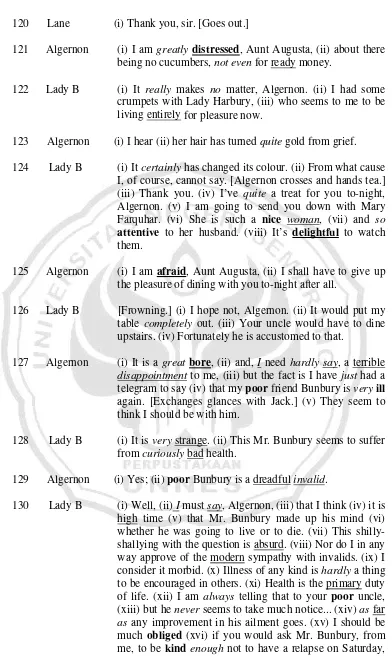
I classified the data that are categorized as appraising lexis by encoding
them as follows:
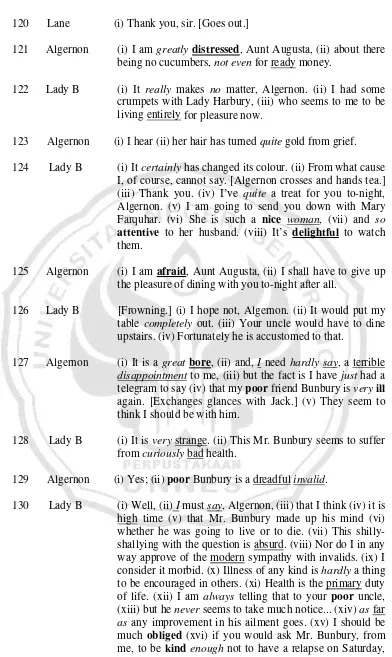
1. Bold and underlined for Affection (feeling, situation). For example the
word sorry in ‘I am sorry for that, for your sake (Algernon in act 1) means that sorry is affection.
2. Bold for Judgment (person) such as the word liar in ‘He is a liar’ refers to judgment
3. Underlined for Appreciation (things). For example the word wonderful in
‘I play with a wonderful expression’ (Algernon in act 1) means
appreciation.
4. Italics for Amplification (the frequency) such as the word accurately in
5. Italics and underlined for Source of attitudes (the speaker). For example
the words I know in I know, of course, howimportant it is not to keep a
business engagement refers to source of attitudes.
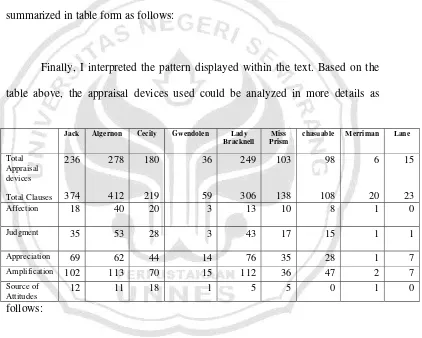
From the appraisal analysis in the text of the drama shown in the
appendices, we can see that Algernon produces the greatest number of appraisal
devices, followed by Lady Bracknell, Jack, Cecily, Miss Prism, Chasuable,
Gwendolen, Lane and with Merriman producing the least of all. This can be
summarized in table form as follows:
Finally, I interpreted the pattern displayed within the text. Based on the
table above, the appraisal devices used could be analyzed in more details as
follows:
4.1 Affection
I found some characters use direct emotional states to express their feelings. They
use the words such as fear, doubt, gladly, enthusiastic, afraid, don’t like, love,
don’t care, bored, happily, frightened, proud, sure, painful, hate, interested in, and
etc. The direct emotional statements could be negative or positive. The appraising
31
vocabulary of negative affection that frequently appears in the dialogues are
doubt, afraid, bored, don’t like, hate, painful, and sad. This shows that among the
characters there are conflicts and each person does not believe each other.
Therefore, they sometimes say negative statements. For example, Algernon says
that “I hate people” (in act 1, 103: iii), “well, I don’t like your clothes” (in act 2, 176: i), and “I am afraid Aunt Augusta won’t quite approve of your being here“ (in act 1, 33: ii-iii) to Jack. Based on my result, we could see that Algernon is the
most appraising speaker since he has the largest number of affection vocabulary.
He also tends to have negative mind/cynical to Jack.
Besides the negative affection, the drama also contains some positive
affection such as admirable, right, glad, pleased, graceful, enthusiastic, sure,
happy, delightful, and etc. For example, Jack uses the word delightful in “How perfectly delightful!” (in act 1, 32: i) and in love in “I am in love with Gwendolen” (in act 1, 36: i). This means that Jack expresses his emotional states
directly. He is also a protagonist who is the sympathetic and plausible character.
Jack has the least of affection. This means that his feeling is not too strong
to someone or something. He does not always give comment to the others, except
to Gwendolen and Algernon. For example, his word, doubt is in “I have no doubt about that, dear Algy “ (in act 1, 40: i). His affection words are mostly positive to Gwendolen such “I am in love with Gwendolen” (in act 1, 36: i). The dialogues generally draw how people had communicated their feelings to others
expressively. They usually speak openly, especially who have a high social status.
Affections that are used in the dialogues make the drama meaningful. It
has a power since each character negotiate their own feelings expressly. We also
can know what Oscar Wilde actually implies from the affection words he made.
To find out his power beyond the affection use in this drama, we also have to
consider the context of situation and the context of culture. I took some examples
to be interpreted per turn speaker (for more examples of affection, see appendix
1-5) as follows:
4.1.1 Positive affection
46 Cecily (i) I am glad to hear it.
Interpretation: the situation set in Cecily’s garden. She spoke with Algernon the
person who assumed as Earnest. Therefore, she was very
interested and respect to him. In this clause, we see that Cecily
respond him well by presenting her feelings that she is glad to hear
what Algy said.
48 Cecily (iii) though I am sure
Interpretation: in this clause, Cecily talked optimistic to Algernon. She believed
on her feeling that something he stated is very pleasant. We can
understand her feeling through the word ‘sure’. It shows people’s
optimistic (a feeling of believe ness).
132 Lady B (iii) I’m sure (iv) the programme will be delightful,
Interpretation: Lady Bracnell in this clause was communicating with Algernon
33
programme that Algy discussed. She tended to believe Algernon
well.
124 Lady B (viii) It’s delightful to watch them.
Interpretation: Lady Bracknell gave positive comment on Marry Farquhar’s
family. She seems interested in them.
28 Chasuble (ii) he usually likes to spend his Sunday in London.
Interpretation: Chasuable said that Jack’s feeling that he likes to stay in London
on Sunday. The word ‘likes’ shows Jack’s feeling to stay in
London on Sunday.
4.1.2 Negative affection
48 Cecily (i) I don’t think (ii) you should be soproud of that,
Interpretation: Cecily tends to have negative feeling to Algernon. She did not
believe in Algernon’s feeling about hypocrisy.
99 Jack (i) For heaven’s sake, don’t try to be cynical. (ii) It’s perfectly easy to be cynical.
Interpretation: in this turn, Jack talked to Algernon not to be cynical to him. This
shows that Algernon is a gambol person. He often comments
negatively on Jack. Moreover, Jack is an orphan who did not have
a high status like him.
Interpretation: the words ‘not sure’ and ‘not in favour’ express negative feelings
since they draw that Miss Prism was not optimist and she also did
not like to a modern changes.
127 Chasuble (vi) What seem to us bitter trials are often blessings in disguise.
Interpretation: Chasuable stated that the feeling of trials that were bitter is often
useful. The word ‘bitter’ shows negative feeling how people to
face a terrible situation.
4.1.3 Direct affection 4.1.3.1 Emotional state
24 Jack (iv) It is excessively boring.
Interpretation: the word ‘boring’ refers to Jack’s statement that he was boring
about people’s life in town and in country. He said this feeling
directly.
13 Algernon (ii) I am much interested in your family life, Lane.
Interpretation: Algernon said his feeling expressly to Lane that he was interested
in Lane’s family.
125 Algernon (i) I am afraid, Aunt Augusta,
Interpretation: in this dialogue, Algernon was worried that he could not eat
together with Lady Bracnell, his aunt. He said his feeling directly
35
2 Cecily (i) But I don’t like German.
14 Cecily (iv) I don’t like novels (v) that end happily.
Interpretation: Cecily also stated her feeling openly to Miss Prism. She did not
like German as she did not like novels that end happily.
40 Cecily (ii) I feel rather frightened. (iii) I am soafraid (iv) he will look just like every one else.
Interpretation: Cecily doubted to Earnest, in this case Earnest is Algernon in
which he will be as the other.
67 Algernon (i) I will. (ii) I feel better already.
Interpretation: Algernon said to Cecily that he had been good.
184 Algernon (iii) I’m in love with Cecily, (iv) and that is everything.
Interpretation: Algernon stated his feeling to himself that he loves Cecily much.
190 Algernon (i) I am afraid so.
Interpretation: Algernon worried about his parting to Cecily. Therefore, Algernon
was afraid to go away from Cecily.
3 Algernon (i) I’m sorry for that, for your sake.
Interpretation: Algernon stated his feeling that he understood Lane whom can not
listen to his playing biola since his position is as a butler in
67 Lady B. (v) So far I am satisfied.
Interpretation: Lady Bracknell said to Jack that she was statisfied to Mrs.
Markby’s dinner parties.
4.1.3.2 Physical Expression
61 Jack (iv) one should talk of in private.
Interpretation: in this dialogue, Jack talked to Algernon that someone should talk
in private. The word “in private” shows physical expression meant
talk personally.
190 Algernon (ii) It’s a very painful parting.
Interpretation: Algernon stated his feeling about his parting to Cecily. The word
“painful” parting refers to a physical expression that he was very
sad to leave Cecily.
6 Cecily (iii) he often looks a little bored
Interpretation: in this dialogue, Cecily spoke to Miss Prism about Jack’s
condition, her uncle. Based on her opinion, Jack often looked
bored. So, the word “bored” expresses Jack’s physical attitude that
he didn’t enjoy staying with Cecily.
37 Merriman (ii) He seemed verymuch disappointed.
Interpretation: Merriman told that Algernon seemed disappointed to Cecily. The
37
while knowing Jack in town. They express his feeling through
physical expression.
After finding the affection in Oscar Wilde’s drama, we can know how he
presents his feeling through the dialogues of the drama. He very concerns with
people’s feeling and attitude in that time. He describes the situation and people’s
culture well by using various affection vocabularies. He can invite the readers to
understand more about people custom and we can feel as the characters did
through his words.
4.2 Judgment
There are two options for judgment; personal and moral. I found some direct
personal admiration while the characters judge each other. They evaluate other
behavior. The appraising vocabulary of personal are young, unromantic, charming
old, tall, not tall, little, serious, perfect, well, poor, dear, childish, ridiculous,
unmarried, unfortunate, sentiment, small, foolish, careless, modern, tedious,
secret, careless, and etc (for the complete example, see appendix 6-13).
The clauses also contain praise and condemn judgment (moral) such as
smart in “I am always smart!” (act 1, 108: i) for praise, and serious and well for condemnation in “Dear Uncle Jack is so very serious! Sometimes he is so serious that I think he cannot be quite well” (act 2, 4: i-iii). These are the appraising vocabulary of moral judgment in the dialogues; kind, well-aware, generous, no
sense of moral, high moral, etc.
Most of the characters give many appraising words of judgment,
especially option for personal. They evaluate each other directly rather than
implied. It shows that they interact openly to others by commenting both
personally and morally. Moreover, Algernon and Lady Bracknell are the
characters who have the most appraising vocabulary of judgment. This means that
they frequently tend to judge others negatively, especially when judging Jack. It is
supported by the settings of the drama that the characters live in aristocracy
situation which makes them the greatest example of a hedonist who like nothing
better than to eat, gossip, and gambol without any consequence. Lady Bracknell is
also a remarkable character who only views marriage as a financial arrangement.
She is the major antagonist in the play who blocks her daughter’s potential
marriage. Following the examples of judgment taken from the data classification
in appendix (for more examples, see appendix 14-26):
4.2.1 Personal 4.2.1.1 Admire
76 Algernon (ii) as soon asyou are kind enough to inform me
Interpretation: the sentence “ you are kind” refers to Jack. He told that Jack was