DOI: 10.12928/TELKOMNIKA.v13i4.1827 1305
Distinguish Sea Turtle and Fish Using Sound
Technique in Designing Acoustic Deterrent Device
A Mahfurdz*1, Sunardi2, H Ahmad3, Syed Abdullah4, Nazuki4 1
Electrical Engineering Department, Sultan Ahmad Shah Polytechnic (POLISAS) 25350 Semambu, Kuantan Pahang, Malaysia, Ph. /Fax: +609-5655300/+609-5663140
2Department of Electrical Engineering, Universitas Ahmad Dahlan (UAD)
Jln. Prof. Soepomo, Janturan, Yogyakarta 55164, Indonesia, Ph. /Fax: +62274-379418/381523
3Faculty of Electrical and Electronics Engineering, Universiti Malaysia Pahang (UMP)
26600 Pekan Pahang, Malaysia, Ph. /fax: +609-424600/+609-424611
4Turtle and Marine Ecosystem Center (TUMEC), Malaysia Fisheries Department
23050 Rantau Abang, Dungun Terengganu, Malaysia, Ph. /Fax: +609-8458169/+609-8458017
*Corresponding author, email: [email protected], [email protected],
Abstract
Acoustic is a common method for underwater object classification and to observe fish schools or other marine animals in their environment, but it was never applied on sea turtle. Knowledge about turtle detection using sound is very limited and there are no target strength (TS) recorded before. In this study, an echo voltage reference methodincorporating standard target was used to measure ex situ target strength of two Green Turtle (Chelonian mydas) and three species of fish (Indian scad, Indian Mackerel and Bigeyescad). The echo signal of animals has been observed from echosounder output and every envelope of the echo was digitized at a sampling rate 1MHz using high speed analog to digital converter (USB-1208HS). The finding shows a significant difference between fish and turtles aged 18 years old. The result also demonstrates that TS increase as age of turtle increase. This result is considered important in designing an acoustic deterrent device. The result reveals that size, surface, and animal body part influence in determining target strength value.
Keywords: Acoustic deterrent device, target strength, echo voltage, marine animal detection
Copyright © 2015 Universitas Ahmad Dahlan. All rights reserved.
1. Introduction
Scientists believe that sea turtles are ancient reptiles that have inhabited the world oceans for 175 million years. Sea turtle populations have declined dramatically due to various activities such as fishing trawling, marine recreation and pollution. By-catch in fisheries activities has been determined to be a major factor of death for juvenile and adult sea turtles [1], [2]. For several years now we have heard large numbers of turtles were taken in fisheries net.
In Malaysia there are two regulations applied on turtle protection. The fisheries regulation (Prohibition of Fishing Method) Regulations 1985 has banned large meshed gill nets and fisheries regulation (Fisheries zoning) 1991 provides offshore protection to turtles during their nesting period [3]. Although many enforcements has been done through the existing laws, but still fail to prevent turtles from being caught in the fishing net.
Interviews with six islander drift net vessel owner and operators in Malaysia reported that 140 turtles were caught annually from 2005 to 2006. Green and hawksbill species were reported to be the most frequently caught in Malaysia [4]. In addition, the most frequently caught in Malaysia was green species and the majority trapped in fishing nets were adult turtles [5].
Sounds are extensively used in various fields and contribute many new innovations especially in the field of engineering and technology. This application also widely used in marine environment especially in developing acoustic deterrent device which is can avoid marine animals trapped in fishing gear.
and electric deterrents [6]. The commercial devices that emit high frequency noise or distress call will give temporary scares to birds. Compared to the traditional monofilament net, acoustic devices reduce bycatch rates by 50% without disturbing fishing activities. The acoustic pingers usually attached to the traditional gillnet can emit a sound signal within the hearing frequency of seabirds [7].
A study on Hector’s dolphins found that acoustic gillnet pingers can avoid dolphin incidental capture in the net. Three acoustic gillnet pingers (white, red and black pinger) were tested by using in situ method to observe Hector’s dolphin behavior. The dolphin species exhibited avoidance when exposed to the white acoustic pingers [8]. In addition, the study was conducted on the bottlenose species and it also contributed to the same results. The bottlenose dolphin avoided gillnet when exposed tosound emissions from acoustic pinger [9], [10].
Acoustic pinger is seen as a very effective device in solving the problem of marine mammals being accidentally caught in fishing net.This device has also been applied to several species of whales. The usage of acoustic pinger significantly reduced the number of porpoises species within 500 meters from the simulated net [11]. In addition, the investigation of acoustic pinger eliminating beakedwhale by-catch showed that the species trapped in gill net dropped to zero when the device was added to the net.
The idea of using an acoustic deterrent device to prevent sea turtles from entering fishing net was introduced by Lenhardt in 2002. The device has been designed to transmit sound in three frequency bands within the range of 200 Hz to 15 kHz [12]. Furthermore, there was a research conducted to identify type of sound that could frighten sea turtle in order to improve traditional turtle excluder device. Studies on green turtle reaction towards low frequency modulation (LFM) sound showed that animal would swim away when sound were emitted to them [13].
Although using ultrasound can avoid turtles from approaching the fishing net, sound must be emitted at all time. This situation will contribute to noise production in the water and could disrupt other marine life. Scientists and conservationists agree that we should avoid increasing anthropogenic sound levels in the ocean unless it is necessary to do so [14]. Other than that, this method also could not ensure whether or not the turtles have already swum away or still moving to the fishing nets.
Therefore, to overcome this problem a new system should be designed which as able to detect the presence of sea turtles earlier. Through this method, the repellent sound will be controlled and is not released all the time. One of the best methods to detect underwater object is using acoustic techniques. The turtle detection using sound technique is useful in order to design and improve acoustic deterrent device.
2. Animal Detection Using Sound
Target strength (TS) refers to the ability of a target to return an echo. Depending on the interest of the observer, the target may be a submarine, marine life, or sunken ship. In the context of sonar, TS is defined as 10 log of the ratio of the incident acoustic intensity to the reflected acoustic intensity, referenced to a specified distance (usually 1 meter) from the acoustic center of the target [15].
There are many approaches to modeling the scattering of sound by objects. The particular approach depends upon the shape and material properties of the body [16]. The study on acoustic strength of shelled animal is quite challenging because it involves a variety of body shapes and biology properties which make, their acoustic scattering characteristic sometimes very complicated [17]. Zooplanktons have a variety of body shapes and physical properties, so their acoustic scatterings characteristic are sometimes very complicated [18].
3. Material and Method
Target strength measurement can be conducted either by using the in situ method in natural habitats and ex situ method in the laboratory experiments. Normally ex situ methods are often chosen in measuring target strength of marine life. By using this method the experiment can be carried out independently without interference such as weather, water conditions and other disruptions. In addition the measurement distance can be control and measurement of each angle of the animal can be performs easily.
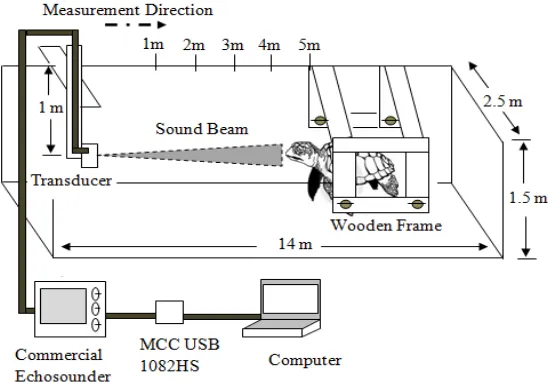
The experiments were conducted in indoor hatchery of Turtle and Marine Ecosystem Center (TUMEC) Rantau Abang, Dungun Terengganu, Malaysia. There are two green turtle and three species of the fish that were used in this study. The species of fish in this study were Indian scad (Decapterusrusselli), Bigeyescad (Selarcrumenophthalmus) and Indian mackerel (Rastrelligerkanagurta). The echo sound recording measurement conducted in a 13 m x 2.4 m rectangular tank contained saline water. The position transducer and animal is depicted in Figure 1 and the measurement angle of turtle and fish body is shown in Figure 2. The saline water supply was obtained directly from the sea shore. The quality of water was monitored regularly. Prior to the research, the sea water was change daily, to ensure water profile in the tank was conditioned similar with seawater.
Figure 1. Equipment setup an animal position in research tank Effects
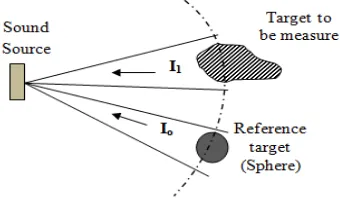
Modified dual frequency echo sounder V1082 used in this research. The echo signal from the time varying gain (TVG) circuit read directly into laptop computer. The frequency of echo sounder was setting at 200 kHz. This frequency has been chosen because have small beam which is can avoids and reduce reflected signal from tank wall. The envelope of the echo was digitized at a sampling rate 1MHz using analog to digital converter (USB-1208HS) read direct from echo recording program created in matlab. TS of the animal were calculated incorporating reference targets. In this experiment steel ball with radius 0.0215 m was used as a reference target. Reflected value from turtle and fish will be referring to reflected value from steel ball for every distance as shown in Figure 3.
Figure 3. Target strength measurement incorporating reference target
Target strength (TS) refers to the ability of a target to return an echo. Depending on the interest of the observer, the target may be a submarine, marine life, or sunken ship. In the context of sonar, TS is defined as 10 log of the ratio of the incident acoustic intensity to the reflected acoustic intensity, referenced to a specified distance (usually 1 meter) from the acoustic center of the target [15].
In practical work, spheres make good reference targets for sonar because their TS are relatively independent of orientation. The TS of sphere is represented by
TS = 10 log (a2 /4) (1)
The use of sphere as reference in calculating the value of the TS of marine life is not something new. This technique has been used in [21] as reference in calculating TS of clupeoids and gadoids species. In addition, the same method has been used to study TS of krill [22] and TS of squid [23]. Based on Figure 3, we can express TS equation, therefore,
TS = 10 log (I1/Io) + TS sphere (2)
where I1 is the echo intensity of object, Io is the echo intensity of the reference target (sphere),
and TS sphere is the known target strength of the sphere. However, most of the target strength measurement of the intensity value is always referred as peak square. TS of marine animals as suggested in [24] can be represented by
TS = 10 log (Venvelope2/ Vcalibrated2) + 20 log R+ TS sphere (3)
where Venvelope is the voltage received by theechosounder from the animal,Vcalibrated is the voltage received from a sphere at the same range, 20 log R is the TVG correction and TS sphere is known target strength of sphere (-39.372dB).
4. Results and Analysis
recorded contain the transmit pulse, the echo of the animals, and the reflected signal from the tank wall. Therefore, the sample had to be selected and filtered carefully in time domain.
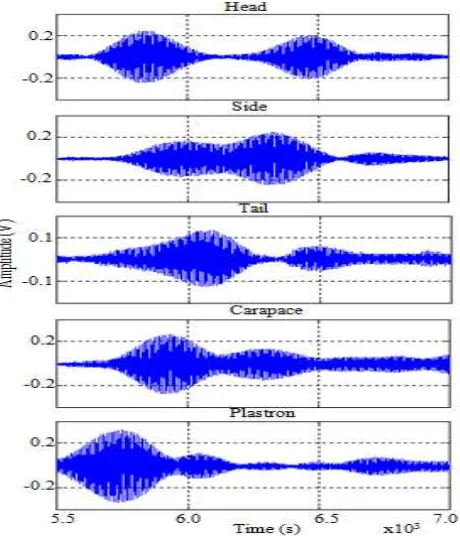
The example wave forms in time domain for 12 years old turtle at five different angles are shown in Figure 4. The echo result demonstrated each body part of turtle have different shape and amplitude. The lowest signal peak is recorded from tail angle. Head and side angle contributed amplitude voltage of 0.4 Volt. Meanwhile the high echo strength is coming from carapace and plastron angle in range 0.26 to 0.32 Volt peak to peak. One of the reasons that can be highlighted is that these parts have larger surfaces than the others. The greater the area is covered by the sound, the higher echo intensity is received. In addition, other possibility that could be considered is due to the hard surface of the shell and plastron.
Figure 4. Echo signal of 12 years old turtle at different angles
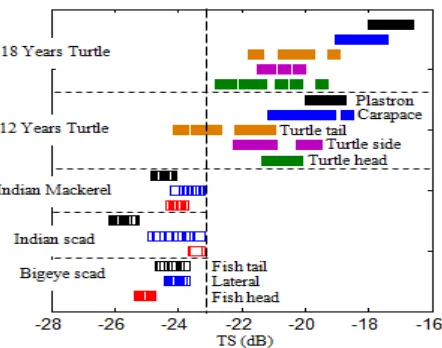
Figure 5. Target strength comparison between turtle and fish
The result demonstrated that the TS measurement at 5 meters distance is significant difference between adult green turtle and 3 species of fish. In addition, the result also showed TS value for each turtle angle is different which major contributer is from carapace and plastron angle. The sea turtle TS value range in this research is considered as an important finding especially as information to improve sea turtle acoustic deterrent device.
5. Conclusion
The TS of two green turtle and three species of fish was measure using modified echo sounder. The experimental results show that, there is significant difference between fish and turtles aged 18 years old at all angle. This values obtained are considered important in determining the best method of separating adult turtle from fish. The comparison between 12 years turtle and fish showed that there are overlapped occurs at tail angle. In addition, the finding also demonstrated that carapace and plastron is parts contributed high target strength. In other word, acoustic strength of the target is depends on size, surface and material. Although the study show significant result, but further research must be conduct for different species of fish, in order to ensure there are no overlap TS value between sea turtle and fish. Besides that, this study only focused measurement in the research tank, which is limited space and distance. Therefore, further research suggested conducting in the sea, where has vast area and not limited range.
References
[1] Mc Daniel CJ, Crowder LB and Priddy JA. “A spatial analysis of sea turtle abundance and shrimping intensity in the U.S Gulf of Mexico”. Proceedings of The Nineteenth Annual Symposium On Sea Turtle Conservation and Biology. 1999: 65.
[2] Arauz R. “Implementation of the turtle excluder device (TED) by the shrimp fleet of Pacific Central America”. Proceedings of The 18th International Symposium Sea Turtle Biology and Conservation. 2000: 104-105.
[3] Hamann M, Ibrahim K and Limpus C. Status of leatherback turtle in Malaysia. Indian Ocean South East Asian (IOSEA) Leatherback Turtle Assessment. 2006.
[4] Gilman E, Gearhart J, Price B, Eckert S, Miliken H, Wang J, Swimmer Y, Shiode D, Abe O, Peckham SH, Chaloupka M, Hall M, Mangel J, Shigueto JA, Palzell P, and Ishizaki A. “Mitigating sea turtle by catch in coastal passive net fisheries”. Fish and Fisheries. 2010; 11: 57-88.
[5] Yeo BH, Squires D, Ibrahim K, Gjertsen H, Syed Mohd Kamil SK, Zulkifli R, Groves T, Hong MC and Tan CH. “Fisher profiles and perceptions of sea turtle fishery interactions: case study of East Coast Peninsular Malaysia”. The World Fish Center Discuss. The World Fish Center, Penang, Malaysia. 2007.
[7] Lokkeborg S. “Best practices to mitigate seabird bycatch in longline, trawl and gillnet fisheries-efficiency and practical applicability”. Marine Ecology Progress Series. 2011; 435: 285-303.
[8] Stone GS, Cavagnaro L, Hutt A, Kraus S, Baldwin K and Brown J. Reactions of Hector’s dolphins to acoustic gillnet pingers. Sciences & Research Unit, Science Technology and Information Services, Department of Conservation, Welington, New Zealand. 2000.
[9] Cox TM, Read AJ, Swanner D, Urian K and Waples D. “Behavioral responses of bottlenose dolphins, Tusiops truncates, to gillnets and acoustic alarms”. Biological Conservation. 2003, 115: 203-212. [10] Gazo M, Gonzalvo J and Aguilar A. “Pingers as deterents of bottlenose dolphins interacting with
trammel nets”. Fisheries Research. 2008, 92: 70-75.
[11] Berggren P, Carlstrom J and Tregenza N. Mitigating of small cetacean bycatch; evaluation of acoustic alarms (MISNET). Final Report to the European Commission, 00/031, 2002.
[12] Lenhardt M. “Sea turtle auditory behavior”. Abstract. J. Acoust. Soc. Am. 2002; 112(5): 2314.
[13] Yudhana A. Turtle Hearing Classification for Turtle Excluder Devices Design. Ph.D Thesis. Universiti Teknologi Malaysia, Malaysia. 2011.
[14] Southwood A, Fritschhes K, Brill R and Swimmer Y. “Sound, chemical, and light detection in sea turtles and pelagic fishes:sensory based approaches to bycatch reduction in longline fisheries”. Endangered Species Research. 2008; 5: 225-238.
[15] Hodges RP. Underwater acoustic analysis, design and performance of sonar. United Kingdom : John Wiley & Son. 2010.
[16] Stanton TK, Wiebe PH and Chu D. “Difference between sound scattering by weakly scattering spheres and finite length cylinders with applications to sound scattering by zooplankton”. J. Acoust. Soc. Am. 1998; 103(1): 254-264.
[17] Stanton, TK and Chu D. “Review and recommendations for the modeling of acoustic scattering by fluid like elongated zooplankton: Euphausiids and Copepods”. ICES Journal of Marine Science. 2000; 57: 793-807.
[18] Mukai T, Lida K, Ando Y, Mikami H, Maki Y and Matsukura R. “Measurements of swimming angles, density and sound speed of the krill Euphausia Pacifica for target strength estimation”. MTTS/IEEE TECHNO -OCEAN ’04. 2004: 383-388.
[19] Stanton TK. “On acoustic scattering by a shell covered seafloor”. J. Acoust. Soc. Am. 2000; 108(2): 551-555.
[20] Warren JD, Stanton TK, Mc Gehee DE and Chu D. “Effect of animal orientation on acoustic estimates of zooplankton properties”. IEEE Journal of Oceanic Engineering. 2002; 27: 130-138.
[21] Nakken O and Olsen K. “Target strength measurements of fish”. Rapports et Procès-Verbaux des Réunions Conseil International pour l'Exploration de la Mer. 1977; 170: 52-69.
[22] Kalinowski J, Dyka A and Kilian L. “Target strength of krill”. Polish Polar Research. 1980; 1(4): 147-153.
[23] Arnaya N, Sano N and Lida K. “Studies on acoustic target strength of squid. I. Intensity and energy target strength,” Bull. Fac. Fish. Hokkaido Univ.1988; 39(3): 187-200.