• Tidak ada hasil yang ditemukan

LITERATURE REVIEW & THEORITICAL BACKGROUND “X” BUILD PLAN BUSINESS PROCESS IMPROVEMENT AT ELECTRONIC DEVICE MANUFACTURER.

N/A
N/A
Protected

Academic year: 2017

Membagikan "LITERATURE REVIEW & THEORITICAL BACKGROUND “X” BUILD PLAN BUSINESS PROCESS IMPROVEMENT AT ELECTRONIC DEVICE MANUFACTURER."

Copied!
8
0
0

Teks penuh

(1)

4

CHAPTER 2

LITERATURE REVIEW & THEORITICAL BACKGROUND

The past researches on BPIwill be explained on this chapter. This chapter will also provide a comparison between previous research and the contribution of this research.

2.1. Previous Researches on Business Process Improvement

Business process is a set of related tasks performed in order to achieve organization or business outcome. Processes have two important characteristics: there are recipients of the outcomes and there are interactions between organizational units (Davenport & Short, 1998).

Harringtonet al.(1997) defined BPI as a methodology that is designed to bring functionality improvement in both administrative and support processes using approaches such as process redesign, process benchmarking, and process re-engineering. BPI is an approach where fundamental activities in an organization are continuously improved by eliminating non-value-added activity and making an effective use of resources (Lee & Chuah, 2001; Zairi, 1997). BPI is a complex, knowledge intensive, collaborative process which consists of a contextualized knowledge processes that cannot be captured and prescribed by a process model (Seethamraju & Marjanovic, 2009). BPI is able to reduce the occurance of errors, cycle time, and cost significantly (Harrington et al., 1997).

According to Kaygusuz, (2013) in the research on the effect of business process improvement to business performance, there are factors in business that make business process improvement needs to be pushed forward such as reducing the costs, increasing efficiency, minimizing loss, and enhancing the efficiency of process.

(2)

5

As stated before, BPI is a complex processes that involves layers and multitude of elements in an organization. As the complexity of the process increases, it is becoming more difficult to understand the process, as well as more errors, defects, and exceptions occuring making it difficult to reengineer. Therefore, excessive complexity should be avoided(Cardoso, 2008).

In previous researches, various methods and approaches were used to implement BPI. In general, the researches followed a number of steps in order to implement BPI. In solving a case from fiber plant that produces viscose staple fiber, Sarkar, et al. (2014) studied the process, then assessing the process performance. After that the model for the improvement was developed. The model was evaluated and changed based on the results given afterwards.

Lee & Chuah (2001), on their research at manufacturer of optical frames and sunglasses, divided BPI into five phases: select the process, understand the process which is the process to identify and mapping the process tasks and sub-tasks, proceed with the process measurement, execute the process improvement, and review the improved process.

In their research to develop and evaluate a methodology for business process improvement, Adesola & Baines(2005) divided the research into three phases: forming the initial structure of BPI methodology, confirmation of the BPI methodology, and testing the BPI methodology. For the first phase, they divided the mapping process into five, namely: initiation, diagnosis, design, diagnosis & design, implementation, and process management. This methodology was coined as Model-based and Integrated Process Improvement (MIPI).

Paper (as cited from Zellner, 2011)divided the framework of BPI into five phases: process selection, process mapping, process improvement, and process implementation. The process improvement is divided into three main activities of improvement, namely: simplification, correction, and reengineering.

(3)

6

The aforementioned method and approaches as well as the other approaches have their different phases and steps in implementation. However, these phases can be grouped into five common stages: initiation, diagnosis, design, implementation, and process management (Adesola & Baines, 2005).

Initiation is the information-gathering stage where the current situation, process, and data are studied. Diagnosis is the stage where the non-value-added activities are identified and selected as the focus of improvements. Design is the stage where the selected activity(es) in diagnosis is improved. The improvement can be in a form of removing non-value-added activity, rearranging the work process, or combining the work process. Implementation is the stage where the proposed improvement is applied, and the process management stage is the follow-up stage after the implementation stage. Any feedbacks from the implemented improvement will be reviewed and used as the input for adjustment (Adesola & Baines, 2005; Coskun et al., 2008; Sarkar et al., 2014; Yadav & Paliwal, 2012; Zairi, 1997; Zellner, 2011).

2.2. Approaches and Methodologiesof BPI

A variety of methodologies such as six sigma, lean management, total quality management, just-in-time, kaizen, design of experiments, business process reenginering are available for business process improvement (Buavaraporn & Tannock, 2013; Gershon, 2010).

Even though there are a number of methodologies that have been proven to be effective in previous researches, there is no a specific methodology that can be used in all situation. This is because each business situation and business process have unique characteristics. Each methodology has its advantages and disadvantages, therefore there is no “the best” methodology for all business situation as they are always contextual (Seethamraju & Marjanovic, 2009).

(4)

7

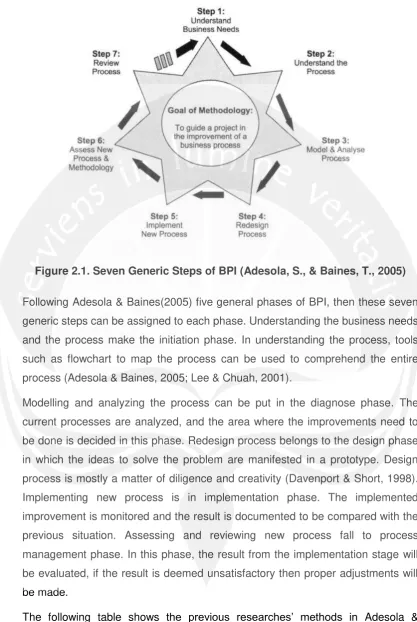
Figure 2.1. Seven Generic Steps of BPI (Adesola, S., & Baines, T., 2005)

Following Adesola & Baines(2005) five general phases of BPI, then these seven generic steps can be assigned to each phase. Understanding the business needs and the process make the initiation phase. In understanding the process, tools such as flowchart to map the process can be used to comprehend the entire process (Adesola & Baines, 2005; Lee & Chuah, 2001).

Modelling and analyzing the process can be put in the diagnose phase. The current processes are analyzed, and the area where the improvements need to be done is decided in this phase. Redesign process belongs to the design phase in which the ideas to solve the problem are manifested in a prototype. Design process is mostly a matter of diligence and creativity (Davenport & Short, 1998). Implementing new process is in implementation phase. The implemented improvement is monitored and the result is documented to be compared with the previous situation. Assessing and reviewing new process fall to process management phase. In this phase, the result from the implementation stage will be evaluated, if the result is deemed unsatisfactory then proper adjustments will be made.

(5)

8

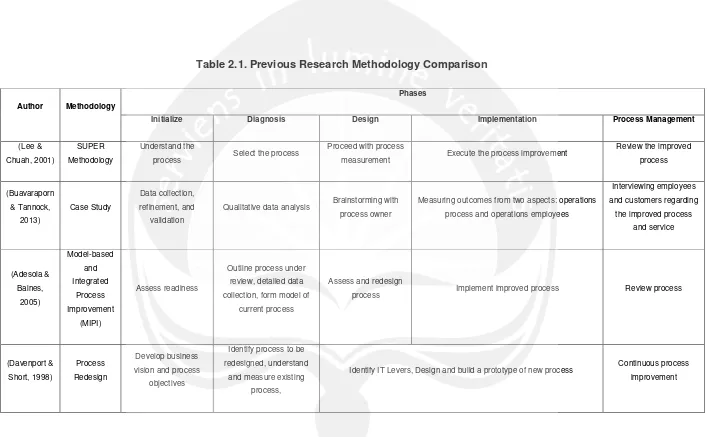
Table 2.1. Previous Research Methodology Comparison

Author Methodology

Phases

Initialize Diagnosis Design Implementation Process Management

(Lee & Chuah, 2001)

SUPER Methodology

Understand the

process Select the process

Proceed with process

measurement Execute the process improvement

Review the improved process (Buavaraporn & Tannock, 2013) Case Study Data collection, refinement, and validation

Qualitative data analysis Brainstorming with process owner

Measuring outcomes from two aspects: operations process and operations employees

Interviewing employees and customers regarding

the improved process and service (Adesola & Baines, 2005) Model-based and Integrated Process Improvement (MIPI) Assess readiness

Outline process under review, detailed data collection, form model of

current process

Assess and redesign

process Implement improved process Review process

(Davenport & Short, 1998)

Process Redesign

Develop business vision and process

objectives

Identify process to be redesigned, understand

and measure existing process,

(6)

9

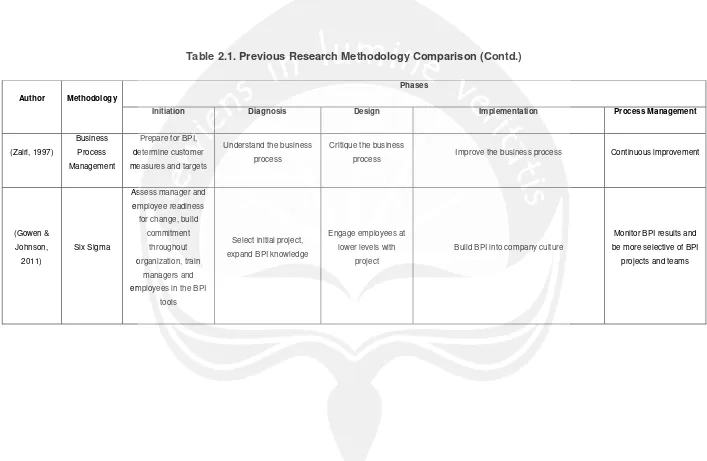
Table 2.1. Previous Research Methodology Comparison (Contd.)

Author Methodology

Phases

Initiation Diagnosis Design Implementation Process Management

(Zairi, 1997)

Business Process Management

Prepare for BPI, determine customer measures and targets

Understand the business process

Critique the business

process Improve the business process Continuous improvement

(Gowen & Johnson,

2011)

Six Sigma

Assess manager and employee readiness for change, build

commitment throughout organization, train

managers and employees in the BPI

tools

Select initial project, expand BPI knowledge

Engage employees at lower levels with

project

Build BPI into company culture

(7)

10

In their research, Whitman & Gibson, (1997) stated that IT plays a central role in a change effort. BPI and information technology have a recursive relationship, that is information technology should be able to support business process, and business process should be developed within the capability of the available information technology(Yair, 2011).

IT has been proven to be able to support functions in an organization. In his research at EA Cakes Ltd in New Zealand, Portougal(2005) implemented SAP to help in production planning such as inventory management and capacity utilization. In another function, IT would affect the qualitative features and quality of the relevance of accounting information (Hashemi, et al., 2016). The involvement of IT also helped in decision-making process in marketing by helping in data management in marketing management supporting system (van Bruggen, et al., 2001).

The use of data processing software such as Microsoft Excel has been frequently recorded in the previous researches (Islam & Ahmed, 2012; Walt & Toit, 2007; Yadav & Paliwal, 2012).

2.3. Business Process Mapping

Process mapping is an act to identify major activities and routine of workflow by tracking the flow of information, materials, and documents involved in the process and explains actions and decisions in a visual form, hence enabling the representation and analysis of business process (Barbrow & Hartline, 2015; Klotz, Horman, Bi, & Bechtel, 2008).

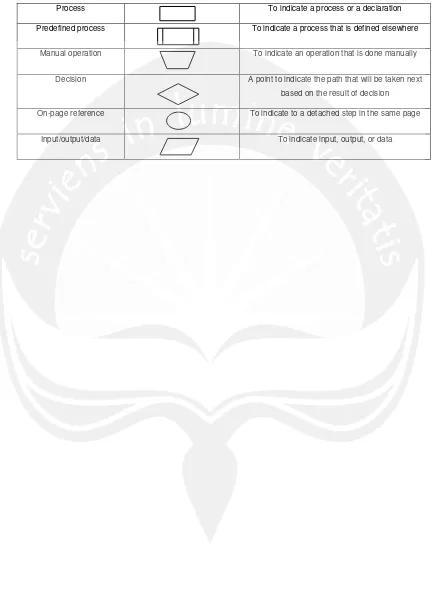
One of many tools that can be used to mapping process is flowchart. Process flowcharting is a picture about how something is done from start to finish (Divers, 2007). Divers, (2007) further explained that something might be a service or product and the magnitude might only involve a single person to multiple departments or even organizations. The standard flowchart symbols used in this research is listed in Table 2.2. The flowcharts are drawn using Microsoft Visio 2013.

Table 2.2. Standard Flowchart Symbols (Divers, 2007)

Name Symbol Function

(8)

11

Table 2.1. Standard Flowchart Symbols (cont.)

Process To indicate a process or a declaration

Predefined process To indicate a process that is defined elsewhere

Manual operation To indicate an operation that is done manually

Decision A point to indicate the path that will be taken next

based on the result of decision

On-page reference To indicate to a detached step in the same page

Gambar

Figure 2.1. Seven Generic Steps of BPI (Adesola, S., & Baines, T., 2005)
Table 2.1. Previous Research Methodology Comparison
Table 2.1. Previous Research Methodology Comparison (Contd.)
Table 2.1. Standard Flowchart Symbols (cont.)

Referensi

Dokumen terkait