• Tidak ada hasil yang ditemukan

Portable Power Generator From Renewable Energy.

N/A
N/A
Protected

Academic year: 2017

Membagikan "Portable Power Generator From Renewable Energy."

Copied!
24
0
0

Teks penuh

(1)

UNIVERSITI TEKNIKAL MALAYSIA MELAKA

PORTABLE POWER GENERATOR FROM RENEWABLE

ENERGY

This report submitted in accordance with requirement of the Universiti Teknikal Malaysia Melaka (UTeM) for the Bachelor Degree of Engineering Technology

(Department of Electronics & Computer Engineering Technology) (Hons.)

by

AZIZUL HAKIM BIN NOOR ZUBAIRI B071210147

900928-08-5413

(2)

UNIVERSITI TEKNIKAL MALAYSIA MELAKA

BORANG PENGESAHAN STATUS LAPORAN PROJEK SARJANA MUDA

TAJUK: PORTABLE POWER GENERATOR FROM RENEWABLE ENERGY

SESI PENGAJIAN: 2015/16 Semester 1

Saya AZIZUL HAKIM BIN NOOR ZUBAIRI

mengaku membenarkan Laporan PSM ini disimpan di Perpustakaan Universiti Teknikal Malaysia Melaka (UTeM) dengan syarat-syarat kegunaan seperti berikut:

1. Laporan PSM adalah hak milik Universiti Teknikal Malaysia Melaka dan penulis. 2. Perpustakaan Universiti Teknikal Malaysia Melaka dibenarkan membuat salinan

untuk tujuan pengajian sahaja dengan izin penulis.

3. Perpustakaan dibenarkan membuat salinan laporan PSM ini sebagai bahan pertukaran antara institusi pengajian tinggi.

4. **Sila tandakan ( )

SULIT

TERHAD

TIDAK TERHAD

(Mengandungi maklumat yang berdarjah keselamatan atau kepentingan Malaysia sebagaimana yang termaktub dalam AKTA RAHSIA RASMI 1972)

(Mengandungi maklumat TERHAD yang telah ditentukan oleh organisasi/badan di mana penyelidikan dijalankan)

( )

(3)

iv

DECLARATION

I hereby, declared this report entitled “Portable Power Generator From Renewable Energy” is the results of my own research except as cited in references.

Signature :………

Name : AZIZUL HAKIM BIN NOOR ZUBAIRI

(4)

v

APPROVAL

This report is submitted to the Faculty of Engineering Technology of UTeM as a partial fulfillment of the requirements for the degree of Bachelor of Engineering Technology (Department of Electronics & Computer Engineering Technology) (Hons.). The member of the supervisory is as follow:

(5)

vi

ABSTRACT

(6)

vii

ABSTRAK

(7)

viii

DEDICATIONS

To my beloved parents

My friends

My lecturers

For making me the person that I am today,

(8)

ix

ACKNOWLEDGMENTS

Praise is to Allah, lord of the Universe, and peace be upon Muhammad the prophet; praise befits His might and suffices. His Grace, peace and blessing are upon His generous Messenger, his family and companions, for giving the strength to complete this thesis.

I would also like to express my deepest gratitude and appreciation for a few individuals who had assisted me in the completion of this final year project. I would like to convey my thanks to my project supervisor, En Khairul Anuar Bin A Rahman for this attention, continuous comments, generous advices, time, patience and guidance throughout my project.

Deepest gratitude and personal appreciation to my family members for their patients, loves, supports and encouragements.

(9)

x

TABLE OF CONTENTS

DECLARATION ... iv

APPROVAL ... v

ABSTRACT ... vi

ABSTRAK ... vii

DEDICATIONS ... viii

ACKNOWLEDGMENTS ... ix

TABLE OF CONTENTS ... x

LIST OF FIGURES ... xv

LIST OF TABLE ... xvi

LIST OF SYMBOLS AND ABBREVIATIONS ... xvii

CHAPTER 1 ... 1

1.0 Introduction ... 1

1.1 Problem Statement ... 1

1.2 Objective ... 2

1.3 Scope Of Project ... 2

CHAPTER 2 ... 3

2.0 A Introduction ... 3

2.1 Solar Energy ... 3

2.1.1 Advantages and Disadvantages of solar energy ... 4

(10)

xi

2.2 Solar Photovoltaic ... 5

2.2.1 Photovoltaic Materials ... 6

2.2.2 Operation of Photovoltaic systems... 7

2.2.2.1 Why are batteries used in some PV systems ? ... 8

2.2.3 Advantages and Disadvantages of photovoltaic systems. ... 8

2.2.3.1 Advantages of Photovoltaic Systems :... 8

2.2.3.2 Disadvantages of Photovoltaic Panels : ... 9

2.3 Solar Thermal Energy ... 9

2.3.1 Evacuated tube solar thermal systems ... 10

2.3.2 Flat plate solar thermal systems ... 11

2.3.3 Operation of active solar thermal ... 12

2.3.4 Advantages and disadvantages of Solar Thermal Energy ... 13

2.3.4.1 Advantages of Solar Thermal Energy :... 13

2.3.4.2 Disadvantages of Solar Thermal Energy : ... 13

2.4 Wind Energy ... 13

2.4.1 Wind Energy operation ... 14

2.4.2 Turbine components ... 14

2.4.3 Operational of Turbines ... 15

2.4.4 Advantages and disadvantages of wind energy ... 15

2.4.4.1 Advantages of wind power : ... 15

2.4.4.2 Disadvantages of wind power : ... 15

(11)

xii

2.5.1 Advantages and Disadvantages of hydropower energy ... 16

2.5.1.1 Advantage of Hydropower Energy ... 16

2.5.1.2 Disadvantage of Hydropower Energy... 17

CHAPTER 3 ... 18

3.0 Introduction ... 18

3.1 Project Development ... 18

3.2 Flow Chart ... 19

3.3 System design and planning ... 20

3.3.1 Block diagram of the designed portable power generator ... 20

3.3.2 Portable Power Generator Schematic Diagram... 21

3.3.3 Sketching the Designed Portable Power Generator ... 21

3.4 Solar Panel ... 22

3.4.1 Introduction ... 22

3.4.2 Factors of Choosing a Module ... 22

3.4.3 Manufacture of module ... 23

3.4.4 Sizing the number of modules needed ... 24

3.5 Inverter ... 25

3.5.1 Introduction ... 25

3.5.2 Auntomatic on / off operation ... 25

3.5.3 Technical Parameter ... 26

3.6 Solar Charger Controller ... 26

3.6.1 Introduction ... 26

(12)

xiii

3.6.4 Technical Parameter ... 28

3.7 Batteries ... 29

3.7.1 Introduction ... 29

3.7.2 Specifications of Battery ... 29

3.8 Fuses ... 30

3.8.1 Introduction ... 30

3.8.2 Calculating of Total Fuses Used for Portable Power Generator ... 31

3.9 Voltmeter ... 31

3.9.1 Introduction ... 31

3.10 Cable Size ... 32

3.11 Complete Prototype ... 33

3.12 Prototype Cost ... 34

3.13 Conclusion ... 35

CHAPTER 4 ... 36

4.0 Introduction ... 36

4.1 Continuity Test ... 36

4.2 Prototype results and analysis ... 37

4.2.1 Prototype Results ... 37

4.3 Discussion ... 41

CHAPTER 5 ... 43

5.0 Introduction ... 43

(13)

xiv

5.2 Problem Encountered ... 44

5.3 Recommendation ... 45

APPENDIX A ... 47

APPENDIX B ... 50

(14)

xv

Figure 2.1: Major photovoltaic system components ... 8

Figure 2.2 : Types of solar thermal collector ... 9

Figure 2.3: Evacuated solar tube collector ... 11

Figure 2.4: Flat plate solar thermal panel ... 11

Figure 2.5: An indirect Solar Heating System ... 12

Figure 2.6: Part of Turbines ... 14

Figure 2.7: Hydropower Dam ... 16

Figure 3.1: Flow Chart of the project sequence ... 19

Figure 3.2 : Block diagram of Portable Power Generator ... 20

Figure 3.3: Portable Power Generator Schematic Diagram ... 21

Figure 3.4: Design of portable Power Generator ... 21

Figure 3.5: Front view of portable Power Generator ... 22

Figure 3.6: Solar Panel ... 23

Figure 3.7: Inverter 200W ... 25

Figure 3.8: Solar Charger Controller ... 27

Figure 3.9: Battery ... 29

Figure 3.10: Fuses ... 31

Figure 3.11: Volmeter ... 32

Figure 3.12: Completed Portable Power Generator ... 33

Figure 3.13: Top view of the prototype ... 34

Figure 4.1: Continuity Test Procedure ... 36

Figure 4.2: Continuity Test for Output of Solar Modules ... 37

Figure 4.3: Output Voltage of PV Panels at 12PM ... 37

Figure 4.4: Output Voltage of PV Panels at 2PM ... 38

Figure 4.5: Output Voltage of PV Panels at 4PM ... 38

Figure 4.6: Lpatop Charging ... 38

Figure 4.7: Mobile Charging ... 39

(15)

xvi

LIST OF TABLE

Table 2.1: Differences between Three Photovoltaic Materials ... 7

Table 3.1: Electrical Requirement for Each the Assumed Loads Of The Portable Power Generator... 20

Table 3.2: Technical parameter for the 200W inverter ... 26

Table 3.3: Trouble Shooting for Solar Charger Controller ... 28

Table 3.4: Technical parameter of Solar Charger Controller ... 28

Table 3.5: Standard Sizes of cables... 32

(16)

xvii V = Vollt

DC = Direct Current AC = Alternate Current VDC = Direct Voltage VAC = Alternate current

W = Watt

AH = Ampere/hour

H = hour

RM = Ringgit Malaysia Wh = Watt hour

(17)

1

CHAPTER 1

INTRODUCTION

1.0 Introduction

Solar energy is radiant light and heat from the sun harnessed using a range of ever-evolving technologies such as solar heating, solar photovoltaic, solar thermal energy, solar architecture and artificial photosynthesis.

It is an important source of renewable energy and its technologies are broadly characterized as either passive solar or active solar depending on the way they capture and distribute solar energy or convert it into solar power. Active solar techniques include the use of photovoltaic systems, concentrated solar power and solar water heating to harness the energy. Passive solar techniques include orienting a building to the Sun, selecting materials with favourable thermal mass or light dispersing properties, and designing spaces that naturally circulate air.

The main objective of this project is to produce a working prototype of a portable power generator, which will be designed based on the established project scopes. Thus it is vital to understand the theory and characteristic in portable power generator.

1.1 Problem Statement

(18)

2

technologies are also suited to small portable generator that can be used in rural and remote areas, where energy is often crucial in human development.

This portable power generator are needed to us because it is useful for emergency case such as when travelling, camping, power your construction site or keep your home running during a power outage.

1.2 Objective

The objectives of this project are to:

1) To develop portable power generator from renewable energy.

2) To of the developed portable power investigate the performance generator.

3) To investigate the effectiveness of renewable energy in daily life

1.3 Scope Of Project

(19)

3

CHAPTER 2

LITERATURE REVIEW

2.0 A Introduction

literature review is a text of a scholarly paper, which includes the current knowledge including substantive findings, as well as theoretical and methodological contributions to a particular topic. The purpose of this study is to clarify and gain more knowledge about the device that that will be made. Apart from that it is also important to collect data and information in the study..

2.1 Solar Energy

(20)

4

2.1.1.1 Advantages of solar energy :

1. No Pollution : Solar energy is non-polluting, clean, reliable and renewable source of electricity. It does not pollute the air by releasing harmful gases like carbon dioxide, nitrogen oxide and sulphur oxide. Solar energy does not require and fuel and thus avoid the problems of transportation of fuel or the storage of radioactive waste. Image processing has been intensively studied and there are a lot of different ways and methods available to be choose from, each with their own pros and cons.

2. Long lasting solar cells : Solar cells make no noise at all and there are no moving parts in solar cells which makes them long lasting and require very little maintenance. Solar energy provides cost effective solutions to energy problems where there is no electricity at all.

3. Renewable Source : Solar energy is a renewable source of energy and will continue to produce electricity as long as sun exists.

4. Low maintenance : Solar cells generally doesn‟t require any maintenance and run for long time. More solar panels can be added from time to time when needed. Although, solar panels have initial cost but there are no recurring costs. Initial cost that is incurred once can be recovered in the long run.

5. Solar panels does not create any noise and does not release offensive smell.

(21)

5

2.1.1.2 Disadvantages of solar energy :

1. Location : The location of solar panels is of major importance in the generation of electricity. Areas which remains mostly cloudy and foggy will produce electricity but at a reduced rate and may require more panels to generate enough electricity for your home. Houses which are covered by trees, landscapes or other buildings may not be suitable enough to produce solar power.

2. Pollution : Most of the photovoltaic panels are made up of silicon and other toxic metals like mercury, lead and cadmium. Pollution in the environment can also degrade the quality and efficiency of photovoltaic cells. New innovative technologies can overcome the worst of these effects.

3. Inefficiency : Since not all the light from the sun is absorbed by the solar panels therefore most solar panels have a 40% efficiency rate which means 60% of the sunlight gets wasted and is not harnessed.

4. Reliability : Unlike other renewable source which can also be operated during night, solar panels prove to be useless during night which means you have to depend on the local utility grid to draw power in the night. Else you can buy solar batteries to store excess power which you can later utilize in the night.

5. Installation area : For home users, a solar energy installation may not require huge space but for big companies, a large area is required for the system to be efficient in providing a source of electricity.

2.2 Solar Photovoltaic

(22)

6 the macroscopic level.

2.2.1 Photovoltaic Materials

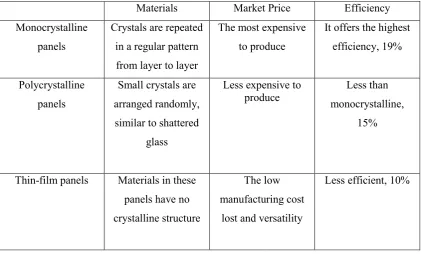
Manufacturing of PV panels can be broadly divided between crystalline and thin-film approaches. The former entails creating a silicon wafer that harnesses the photovoltaic effect and can be further divided between monocrystalline and polycrystalline solar cells, depending on whether the individual PV cell is fabricated from a single crystal or multiple crystals.

Monocrystalline cells are more efficient than multicrystalline in terms of converting sunlight into electrical output, but it is also more difficult to manufacture and hence more expensive per unit of surface area covered.

Thin film panel manufacturing entails a fundamentally different process, namely, laying down a thin layer of photovoltaic effect capable materials, either amorphous silicon or some non-silicon combination of metals, on backing materials. Thin-film cells use a mass-production process that is easier to scale up than the growing and cutting of crystals, and therefore the cheapest to produce but have the lowest efficiency per unit of surface area.

Both manufacturing cost per unit area and average efficiency have been improving in recent years. Most solar cells are made of a form of silicon. This is a hard material that is either dark blue or red in appearance. The blue cells are made as thin discs or squares in which are quite fragile. The red type of silicon is coated on to glass as a thin film.

(23)

7

Table 2.1: Differences between Three Photovoltaic Materials

2.2.2 Operation of Photovoltaic systems

PV systems are like any other electrical power generating systems, the equipment used is different than that used for conventional electromechanical generating systems. However, the principles of operation and interfacing with other electrical systems remain the same, and are guided by a well-established body of electrical codes and standards.

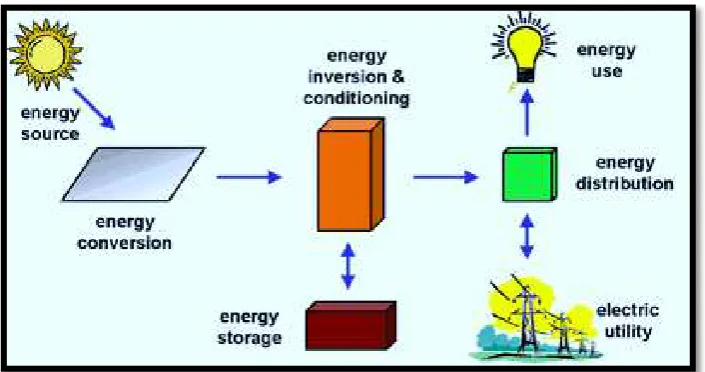
Although a PV array produces power when exposed to sunlight, a number of other components are required to properly conduct, control, convert, distribute, and store the energy produced by the array. Depending on the functional and operational requirements of the system, the specific components required may include major components such as a DC-AC power inverter, battery bank, system and battery controller, auxiliary energy sources and sometimes the specified electrical load (appliances).

In addition, an assortment of balance of system (BOS) hardware, including wiring, overcurrent, surge protection and disconnect devices, and other power

Materials Market Price Efficiency

Monocrystalline

produce monocrystalline, Less than

15%

Thin-film panels Materials in these

(24)

8 and the relationship of individual components.

Figure 2.1: Major photovoltaic system components

2.2.2.1 Why are batteries used in some PV systems ?

Batteries are often used in PV systems for the purpose of storing energy produced by the PV array during the day, and to supply it to electrical loads as needed (during the night and periods of cloudy weather). Other reasons batteries are used in PV systems are to operate the PV array near its maximum power point, to power electrical loads at stable voltages, and to supply surge currents to electrical loads and inverters. In most cases, a battery charge controller is used in these systems to protect the battery from overcharge and over discharge.

2.2.3 Advantages and Disadvantages of photovoltaic systems.

2.2.3.1 Advantages of Photovoltaic Systems :

1. Photovoltaic (PV) systems provide green and clean renewable power from solar energy.

Gambar

Table 2.1: Differences between Three Photovoltaic Materials
Figure 2.1: Major photovoltaic system components

Referensi

Dokumen terkait

Ontracted capacity Solar Energy Corporation of India Limited A Government of India Enterprise 6th Floor, Plate-B, NBCC Office Block Tower-2, East Kidwai Nagar, New Delhi – 110023