PROSIDING SEMINAR NASIONAl
DAN KONG RES MAKSI 2012
AKSELERASIINOVASIINDUSTRI KELAPA SAWIT UNTUK
MENINGKATKAN CAVA SAING GLOBAL
tHmoei.
t<t:Sfff!PUfl!300 Mifl¥21k Gor«!'I!lEditor:
Ani Suryani
Khaswar Syamsu
Dede Saputra
Kartika Sari Suparman
Iman Sulaeman
Yuii Sukmawati
DISELENGGARAKAN OlEH :
MAKSI
セA[@
..
.
DIDUKUNG OLEH :
AKSELERASIINOVASIINDUSTRI KELAPA SAWIT
UNTUK MENINGKATKAN DA VA SAING GLOBAL
Prosiding Seminar Nasional
&Kongres MAKSI
Bogor, 26 Januari 2012
Editor:
Ani Suryani Khaswar Syamsu
Dede Saputra Kartika Sari Suparman
Iman Sulaeman Yuli Sukmawati
Design Cover:
Nurwandi Nanda Cahyana
Diterbitkan oleh:
Masyarakat Perkelapa-Sawitan Indonesia (MAKSI)
Bogor-Indonesia, 2012
Perpustakaan Nasional: Katalog Dalam Terbitan
ISBN
978-979-96096-9-4
Copyright©2012
Akselemsi lnovasi Indus!!"i Kelapa Sawi! untuk Men ingka!kan Daya Sa ing Global
DAFTAR 151
Kata Pengantar .... ... .. ... .. .... ... ... ... .... ... .... ... .... ... ... .. .. .. ... .. ... .... ... .
Daftar Isi. ... .. .... ... .... ... ... .. ... ... .. ... ... .... ... ... ... .. ... .. ... . ii
Se kiia s Tentang Masya ra kat Perkel apa-Sawitan Indonesia (MAKSI ) .... ... ... .. ... .... . Susunan Acara ... ... ... ... ... ... ... ... ... .. .. .. ... .. ... .... ... ... ... .. .. ... .... ... 5
Sambutan Ketua Umum MAKSI .. .. ... .... ... .. ... .. ... .. .. .... ... .... ... 8
Sambutan Rektor IPB ... .. ... .. .... ... ... ... ... .. ... .. ... ... .... ... .. .. .. ... . .. .. ... ... .. . 11
Keynote Speech Menteri Pertanian RI .. .. .. ... .... ... ... ... .. .. ... .... .. ... .. .. .. ... 14
Keynote Speech KIN ... ... ... ... .. ... ... ... ... .. ... ... ... ... .. .. ... ... ... 17
Keynote Speech Kementerian Riset dan Te knologi RI .. .... .... ... .. .. .... .... ... ... .. .. .. .... . 26
Sidang Pie no ... ... ... ... ... .. .... .. .... ... .. ... .. .. ... .... .... ... ... .. ... .... 30
Peng embangan Klaster Industri Hilir Kelapa Sawit Melalui Insentif Inovasi (lr. Arya Wargadalam, MA- KEMENPERIN RI) ... .... .. ... .. ... .. ... .. .. 31
Peranan Dewan Min yak Sawit Indonesia (D MSI ) dalam Apli kasi Inovasi dan Manajemen Kelapa Sawit yang Berorientasi Kele stari an Ling kungan (/r. Oerom Bangun- OMS/) ... .... ... ... .. .. ... ... ... ...... .. ... ... ... ... .. . 38
Ki at PT Perkebunan Nusantara III Dalam Membangun Ind ustri Kelap a Sawit Sesuai MP3EI (lr. Amri Siregar- PT PN III ) ... .. ... : ... .. ... .... .. ... .. .. ... ... .... .. .... .. .. .. 44
Success Story Peran Bank Mandiri Dalam Penguatan Industri Kelapa Sawit Na sional (Rafjon Yahya- Bank Mandiri) ... .. ... .. ... .. .... .. .. .... .. ... .. .... .. .. 55
Rangkuman Diskusi ... ... ... ... ... ... .... ... .. セ@.. ... ... ... .... ... ... ... ... .. 60
Sidang Para lei Bidang Hulu Kelapa Sawit... .. ... ... .... .. .. ... .. ... ... .. .. .... .. .. .. ... 72
Sidang Paralel Bidang Hilir Kelap a Sawit... ... .... .. ... ... ... ... ... .. .. 188
Sidang Pa ralel Sosial , Ekonomi , Bisnis dan Manajemen Kelapa Sawit. ... .. ... .. .. .. .... 293
Makalah Poster ... .. ... .. ... .. .. ... .... ... .. .. ... ... .. ... ... ... .. .... ... .. ... .. ... .. ... 411
Susunan Panitia ... .... .. ... .. ... ... .... ... ... .... .. .. ... ... .. ... ... ... .. ... ... .. . 478
Akselerasi il'lov{lsi Industri Kelnpa Salvi l unluk lVlel'l il'lgkalknn Oayn Sail1g Global
TRANSPORTATION NETWORK ANALYSIS TO SUPPORT PALM OIL
BASED INDUSTRY DEVELOPMENT IN SUMATERA ECONOMIC
CORRIDOR
Hermawan Prasetya
1,Taufik Djatna and Yandra Arkeman
21Center for Assessment of Policies for Competitiveness Enhancement National Agency for Assessment and Application of Technology, Jakarta, Indonesia
E-mai l : [email protected] 20epartment of Agroindustrial Technology Bogor Agricultural University, Bogor, Indonesia E-mail: [email protected]@ipb.ac.id
ABSTRACT
Optimum transportation network would accelerate regional economic growth. The essence of development of economic corridor is how to enhance link among hub to key
industry nodes and supporting infrastructure. The aim of this paper is to analyze
transportation network to support Sumatera Economic Corridor (SEC) which contained of
typology analysis, capacity analysis and optimization analysis of the network. Methods
were employed respectively minimum spanning tree, maximum flow and goal
programming. Conclusions of the research are (1) typology of network which was identified
to support SEC development optimally, (2) the comparison between maximum flow and
milling capacity were above 75 %. And (3) by added some goal to previous analysis,
provided information that comparison betwe en maximum flow and milling capacity wa s not difference significantly.
Keyword: Transportation Network, Palm Oil Based Industry and Economic Corridor
INTRODUCTION
Transportation network is an essential thing to support economic development in a region. Well planned transportation network would accelerate regional economic growth, because it addresses to handle continuing economic surge and traffic congestion (Kasikitwiwat and Chen 2005). In this context, transportation network planning was important subject in transportation planning and development (Babazadeh , Poorzahedy et al. 2011).
Transportation network analysis is part of transportation supply model (Cascetta 2009).
Related to design problem , there were three group variables which should be considered in transportation supply design , i.e.: network topology, network performance and prices and fares. Also, discussion about transportation network, should be talked about transportation network capacity which it is important in transportation planning or design (Kasikitwiwat and Chen 2005).
Corridor economic development was a development concept in some urban scale which adopted by Government of Indonesia to develop wider areas. There were six economic corridor areas which covered nearly all of region of Republic of Indonesia. The corridor economic was built by hub and nodes in c'orridor area. It is assumed that there were six guiding principles define successful corridor area, i.e.: (1) Corridor to connect at least two hubs , (2) Corridor to link hubs with rural areas, (3) Corridor to connect hubs over land (or bridge), (4) Corridor to connect to mega hubs where feasible, (5) Avoid lengthy and highly heterogeneous corridors and (6) Corridors to link hubs to key industry nodes and supporting infrastructure (Anonymous 2010).
Based on these assumptions , it could be inferred that transportation network analysis and design was an important key to ensure the successfully of economic corridor development.
This paper will present transportation network analysis in corridor economic area. The analysis contained of typology analysis , capacity analysis and optimization analysis of the
Prosiding Seminar Nasional dan Kongres MAK SI 2012
355
-Aksclemsi Illovasi Ill d/lstri Kelnpn Snw i/ till/uk ャvQ ・ セNG ゥャQ ァ ォョャォョャQ@ Dnyn Sning Globnl
network . The results of analysis were expected to give recommendations in masterpla-acceleration and spreading of development of Indonesia Economic 2011 -2025 . determined three main strategies . i.e. : Indonesia economic corrido r development. strengtha of national connectivity and acceleration of technology capabilities (Anonymous 2011).
Sumatera economic corridor was chosen as area of work . because it was highest gro -of economic corridor among si x economic corridors in Indonesia. The corridor is constructe d seven linking hub and fi ve proposed location of specifi c economic zones . Based on Gro Regional Domestic Product 200 8. th ere were three biggest economic sectors. i.e manufacturing . mining . and agricultural. Three commodities will be focused to develop in t -corridor. i.e.: palm oil . rubber and coal. In 2006 . contribution of Sumatera on area of pal m plantation in national level was 73 %. and on palm oil production was 80 % (Anonymous 20 10
Several researchers were conducted researches on transportation netw ork analysis a -design. A detailed network analysis using Geographic Information Systems was conducte d --better understand and increase efficiency in del ivery of harvested round wood on West Virg i !:
roadways (Harouff. Grushecky et al. 2007) . The concepts of ultimate capacity and practice capacity are applied to the transportation problem to relax the limitation of the reserve capa concept. therefore the concepts can yie ld information regarding the spatial distribution of demand pattern (Kasikitwiw at and Chen 2005) . Network optimization study employed heuristic of particle swarm optimization (PSO) (Babazadeh . Poorzahed y et al. 2011). The res of stud y shows that PSO capabi lity can be compared with HACO (H ybrid Ant Color Optimization).
In this paper. network analysi s wou ld use several methods to explain typology of netwo capa city of network and optimization . Methods will used to describe them respecti vely Mini m -Spanning Tree (MSPT ). Maximum Flow and Goal Programming . Sensitive analysis '"""-conducted to explore variation of network anal ysis result over years . because it would ZZセ@ exercised to formulate re comm endation into the masterplan 20112025 . Geographic Inform a -Sys tem (GIS) and Microsoft Excel softwa res were employe d to perform these analyses .
METHOD OLOGY
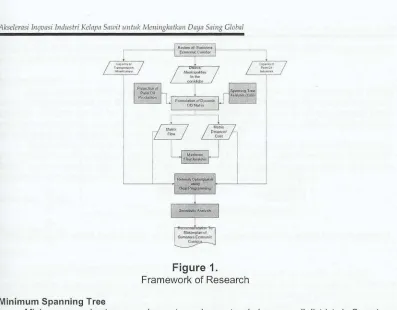
FrameworkThi s research was started by rev iewi ng of Masterpl an of Sumatera economic corr : development. One of outp ut of thi s reviewing was identifi cation of district/municipalities wh:,-there were predicted as hinterland areas of Sumatera Economic. corridor hub areas or 0 areas . Based on identifi cation of these areas . two Origin Destination (00) matrixes キ セ ]@ formulated as bas is to next analyse s. Relations among areas were estimated by Min im Spanning Tree (MST) and Shortest Path analysis . Geographic Information system (GIS ) s_ imp lemented to conduct these anal yses in formulation two 00 matrixes. i.e. : matrix of dista
==
and matrix of flow.The next step was analysis network capacity and netw ork optimization. These 。ョ。 ャケウセ⦅@
used two matrixes which produced in previous step . Maximum flow and goal programming IA€=
implemented to ana lyze capacity and optimum of network respectively. Some iteratio ns _ analysis were done. due to dynamic change of flow of good in time horizon of masterp--Sensitivity analysis was implemented to explore change. of capacity and optimum network 0 _ years.
Formulation of recommendation was final step of this research . The recommend a :-would comprise of some network aspect. such as optimum network should be develop:-addition of industrial capacity in certain year and development of port scenario . The frame of this research was presented in Figure 1.
Akselerasi b19vasi Indush-i Kelapa Smui/ ull/uk Meningkatkal1 Daya Saing Global
Figure 1.
Framework of Research
Minimum Spanning Tree
Minimum spanning tree was chosen to analyze network, because all districts in Sumatera corridor should be connected with certain milling area or refinery area . Palm oil production in all districts should be processed less than 8 hours for harvest time , to avoid their quality decreasing . Minimum spanning tree identified spanning tree with the minimum of length less than or equal to the length of every other spann ing tree (Ravindran 2009). The objective of minimum spanning tree is to select a minimum total cost set of links . In masterplan context, minimum total cost represented minimum investation in transportation sector which should be allocated by government or private companies .
[image:7.486.36.433.28.338.2]In this research , transportation networks were designed to connect among production areas, milling areas and port areas_ 36 districts/municipalities were selected to represent three types of areas (27 districts represented palm oil production areas , 5 districts milling areas , and 4 district port area) . Network ink between palm oil production areas , milling area and port area was represented palm oil value chain. The value chain and distribution of these districts in Sumatera corridor was offered in Figure 2 and Figure 3.
Figure 2.
Palm Oil Value Chain
[image:7.486.33.472.400.694.2]• "selernsi 1l1ovnsi ll1dustri Kelnpo Snwit ul1tuk MCl1il1gknlk.OI1 Dnyn Snil1g Globnl
).jodes kI SUm.1rera Comdor • Mll UtiG • PORT
• kabupalerl
_ Ro.lOI'elwor1>
D SumaleraCorridor Area
c:::J Dis tric t r・Aゥセ ョU@
300 300
Figure 3.
'.1;). セ G@...
600 Miles
Distribution of Palm Oil production Areas , Milling Areas and Ports in Su m2-=
Corridor
Figure 2. Show 4 steps of palm oil processing. Initial step is palm oil ha rv est. .; lantation areas, then it is milled to produce CPO and kernel oil in certain milli ng E.
-- ransport time from harvesting to milling process should be less than 8 hours, if time m '=
e one, quality of CPO/kernel oil wo uld decrease and significantly. After that, CPO/ker= ould be exported or processed to produce various products . In the study, supply ch a'- _ a uld be focused on harvesting to CPO production only.
Figu re 3, show distribution of nodes and current road netwo rk of SEC wh ich we 'Iized as basic data of network analysis. Industrial capacity per year was utilized -a -alysis without conversion, -and port c-ap-acity -and port h-andling c-ap-abil ity should be cor
=-a c=-ap =-acity per d=-ay (=-assumed time oper=-ation of port is 20 hour per d=-ay), before the, employed in network analysis.
Formula of minimum spanning tree was presented below:
, fin imum
L
cijxij(i ,j)E A
セ オ「 ェ ・」エ@ to
L Xii
=1
N
1-1
(i , j )EA
L
X ij=I SI-1
sセn@(i , j) c A ( S)
Xij
E{O,l}
(i , ))
EA
• here :
Cif = transport cost from ito j
Xl) = arc or segment i to j =total number of Nodes
S =set of Nodes which they induced selected arc
Based on minimum spanning tree analysis, transportation networks in Sumatera cc vould be split into 4 networks. Splitting networks were done to distribute flow of palm oi l p
_-0 4 ports in Sumatera corridor. It was assumed, each districts would conveyed their proc
358
- - - - Prosiding Seminar Nas ional dan Kongres MA K . _-tksclern
-
e pre:;onne
axi n
" re as , :apac Jrov ic :::e shi
e m '::009) :::stric axir ::: Jbje rJer an F F セ@ [
a ォU・ャ・セ。ウ ゥ@ Il10vasi Indus tri Kelapa Sawi t un /uk Meningka tkan Oaya Sa il1g Global
be processed into nearest milling area. Each network comprised of some path network which connected among palm oil production areas , milling area and port area.
Maximum Flow
It was expected that all palm oil product in all district should be transported to milling areas , to be processed and then to be shipped in certain port. In solving this expected, network capacity analysis should be employed . Knowledge of overall capacity of the network might provide an advantage over competitor. It can be achieved by finding the maximum flow that can be shipped on the network (Ravindran 2009).
The objective of maximum flow analysis is to determine a feasible pattern of flow throug h the network that maximize the total flow from the supply node to destination node (Ravindran 2009). In this research, districts of palm oil production were defined as supply nodes and milling districts as destination nodes. Formula of Maximum flow was presented below.
11
Ma ximize
I
a;p;
[ セ j@
11
Subject to
I
111;[セ j@
Where:
a
i=
harvest area of palm oil in area i at selected yearPi
=
productivity of palm oil in area i at selected yearl11i
=
milling industry capacity w hich area i transported product toThere were some assumptions which would be used to predict palm oil production (Man urung 2001). These assumptions were:
• Palm oil plant productivity was 20-29 ton/hectare, • Palm oil plat started to produce at ye ar 4th,
• Maxim um production of palm oil at Year 10th until Yea r 18th,
• Oecla ining productio n start Year 19th and at Yea r 25th pa lm oil become not productive more , • Maximum leve l of extra ction is 24% and minimum leve l of extraction is 5 %
Goal Programming
The last network analysis in this research wa s optimization network analysis , which would use goal programming method . Goal programming is a variation of linear programming considering more than one objective (goals) in the objective function. The method falls under the class of methods that use completely prespecified preference of the decision maker in solving the Multi Criteria Mathematical Programming (Ravindran 2009).
In formulation of goal programming equations for this research, it is need to be identified initial linear programming and some objecti ves (goals) in order of their importance. The objective of initial programming is to maximize palm oil to be processed and shipped. Limitations of the linear prog ramming were:
a. Capacity of milling industry b. Port capacity
c. Transport Time from estate to milling area should be less than 8 hours,
Some goals should be added to this model in order of their importance were described below :
1. Transport time in longest path in each transport network should be less than 8 hours, 2. Total flow of palm oil from estate to milling area should be less than milling capacity,
Akselernsi lnovnsi industri Kelapn Sawit untuk Meningka tfrnl1 Dny" Snil1g Global
3. Total shipped of CPO from milling area should be less than port capacity, 4. Average shipped CPO per day should be less than port handling capability.
Based on initial linear programming and some goals which should be achieved , _-programming formula was described below.
. . .
Minimize P d , P d , P d , P d
1 1 2 2 3 3 4 4
Su bject to
11 X
'"
-.!l... + r
-d+
=8
L.. 1 1i= 1 V
11
I a;.p; +d; -d;
=1
;=1
11
I(a; .p;)r+d; -d; =Pc
;=1
セ@
ai·Pi
+r
+d+ =Ph
L.. 4 4
i=1
365
ai' Pi'
v,dl-, dt ,d; ,d; ,d; ,d;, d;, d;
20
W here:
P = priorities of goal ,
d = deviation of certain goal variable ,
Xi} = segment of network i to j,
V =average of velocity over the segment of road (it is assumed 40 km per hour),
Cli = harvest area of palm oil in area i,
Pi
= productivity of palm oil in area i,r
= rendement (0.24)I = certain milling industry capacity,
Pc = certain port capacity,
Ph = certain port handling capability.
RESULT AND DISCUSSION
Short Description on Sumatera Economic Corridor
Vision of Sumatera Economic Corridor (SEC) development is to accomplish this areG _ center of agricultural production, agricultural processing area and national er"'";' resources area . Target of the corridor development is to multiply Gross Regional o ッ ュセ@
Product (GORP) 3.4 times in 2030 with annually economic growth 6.3 %. There are Nセ@
=-commodities should be focus as economic prime movers in this area , palm oil, rubber an (Anonymous 2011).
In development SEC supporting, it was identified some key infrastructures such as _ railway or road network, power generation and milling/refinery industry capacity. Four p SEC area were determined as outlet for all products in this area. Also, it was set up traGi Trans-Sumatera road network and railway network which planned to serve CPO transpo in Riau Province. To support energy demand for SEC development, it was planned to coal through mine-mouth and processing plant development in South Sumatera Province. assumed that milling industries were located in hub areas (capital city of each pro
-ansi Inovasi Indu s!l'i Kelapa Sawi! un!uk iVlenil1gka!kal1 Om/a Saing Global
=:: efore palm oil production would be transported to milling areas (capital cities of each _ tinces). In this research, data on capacity of ports and milling industries are important to
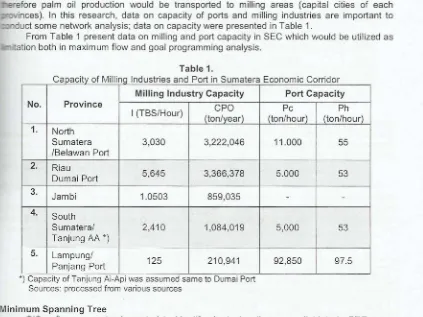
duct some network analysis ; data on capacity were presented in Table 1.
[image:11.486.38.461.69.386.2]From Table 1 present data on milling and port capacity in SEC which would be utilized as - cation both in maximum flow and goal programming analysis.
Table 1.
C apacity 0 fM il ing n ustries and Port in I I d S umatera Economic Corridor
Milling Industry Capacity No. Province CPO
I (TBS/Hour)
(ton/year)
1. North
Sumatera 3,030 3,222,046
/Belawan Port
2. Riau
Dumai Port 5,645 3,366,378
3. Jambi 1.0503
859,035
4. South
Sumatera/ 2,410 1,084,019
Tanjung AA *)
5. Lampung /
Panjang Port 125 210,941
*) Capacity of TanJung AI-ApI was assumed same to Dumal Port Sources: processed from various sources
Minimum Spanning Tree
Port Capacity
Pc Ph
(ton/hour) (ton/hour)
11.000 55
5.000 53
-
-5,000 53
92 ,850 97 .5
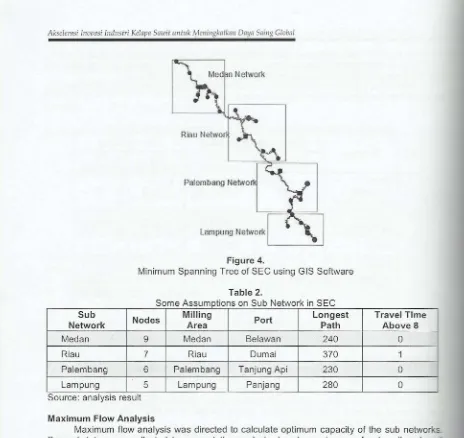
GIS software was implemented to identify shortest path among districts in SEC area. The software has capability to calculate length of roads which they connected among district. By using this software , identification of shortest path among district could be conducted in short ime. In this research, shortest road distance represented minimum transport cost, because it was assumed, transport cost per length of road is uniform in all areas. Result of minimum spanning tree was presented in Figure 4.
Figure 4 show result of minimum spanning tree analysis which was supported by using GIS software. The analysis identified current shortest road networks which connected all of the nodes. Furthermore, in fashioning network analysis more simple, the network was split into four sub networks, which break based on shortest path to milling areas. The sub networks are Medan sub network, Riau sub network, Palembang sub network and Lampung sub network.
In next analysis , the sub network would be smallest unit of analysis . Some assumptions on sub networks in SEC were presented in Table 2.
Akselera si lnovasi lndustri Kelapa Sawit untuk lvIenil1gkatkal1 Dnya Sail1g Global
Sub Network Medan Riau Palembang Lampung
[image:12.486.10.474.19.457.2]Lampung Netwo rk
Figure 4.
Minimum Spanning Tree of SEC using GIS Software
Table 2.
Some Assumptions on Sub Network in SEC Nodes Milling Port Longest
Area Path
9 Medan Belawan 240
7 Riau Dumai 370
6 Palembang Tanjung Ap i 230
5 Lampung Panjang 280 Source : analysis result
Maximum Flow Analysis
Travel Time Above 8
o
o
o
Maximum flow analysis was directed to calculate optimum capacity of the sub network_ Several data were collected to support the analysis, i.e.: harvest area of palm oil, palm productivity, and length of path . Several variables were computed using previous data, such
c:
amount of flow of palm oil, transport time (assumed average of velocity is 40 Km per hour), a : longest transportation time from node to milling area . Because flow of palm oil was calculate production between harvest area and productivity, therefore harvest area was assumed a:unfixed variable and the others were fi xed.
The goal of the analysis is to determine maximum harvest area in each n _ (districts/municipalities) which would affect to maximum flow of palm oil. Two constraints we'?: defined, i.e.: total flow of palm oil should less than milling industry capacity and longest transpc-time should less than 8 hours. The calculations were employed solver in Microsoft ExCE Results of calculations in each sub network were presented below.
-selemsi Inovasi Indus!,.! Kelapa Sawi! un!uk Meningka!kall Dnya Sn il1g Global
Table. 3
Calculation of Maximum Flow in SEC
Sub Network Maximum Flow Milling capacity % Medan 3,116,558.7 3,222,046 97% Riau 3,144,001 .17 3,366 ,378 93% Palembang 925,648 .20 1,084,109 85% Lampung 157,418.89 210,491 .00 75% Sources: analysIs result
Tables 3 show a result of maximum flow analysis . From this table, the ratios between maximum fLQW aD.d m.iHi.t:lQ, セエセ@ Gᆱセセ@ セqrL|Gセ@ エ|セ@ セセ@
°10.
-r;l;>te セQエゥHq@ iii'. セセセG「WN@ キセ@ _\iセu@'S®
network were above oh 90 %, therefore it was said combination of harvest area in two sub network were nearly optimum , if compared to milling capacity . In response to estate area growth, milling capacity should be increased in short time .
Goal Programming Analysis
Objective of the analysis was to calculate minimum deviation of several determining goals. Four goals were determined and added to this analysis . These goals related to transport ti me , flow of palm oil compared with milling capacity, port capacity and port handling capability. The result of analysis was presented in Table 4.
Table 4.
G
oa IP rogramming or ach ub Network in f E S S EC Goals DeviationGoal Constraint %
d+ d- Total
Medan Sub Network
Flow of Palm Oil - 0.000001 3,22 2, 046 3, 089 ,941 95.9 %
Transport Time 0.000825 - 8 7.4 91. 9%
Port Capacity 0.003543 0.023289 96,360, 000 754,755. 3 0. 8%
Port Handling 0.000000 0.0002 39 1,100 2,067.8 188.0%
Riau Sub Network
Flow of Palm Oil 0.000000 0.025000 3366378 3143578.96 93.4%
Transport Time 0.000000 0.001967 8 9.2 114.4%
Port Capacity - - 43,800,000 755,851.93 1.7%
Port Handling 0.000000 0.002792 1,060 2,070 .83 195.4%
Palembang Sub Network
Flow of Palm Oil 0.022437 0.053373 1,084,109 928 ,904 85 .7%
Transport Time 0.038452 0.036639 8 5.9 73.1%
Port Capacity 0.053830 0.056716 43,800,000 210,451 0.5%
Port Handling 0.045140 0.056298 1,060 577 54.4%
Lampung Sub Network
Flow of Palm Oil 0.050898 0.045509 210,491.0 152,791 .3 72 .6%
Transport Time 0.024145 0.006321 8 7.0 87.2%
Port Capacity - 0.025295 813366000 32 ,910.92 0.0%
Port Handling
-
- 1950 90 .17 4.6%Sources: anal sis result y
Akselemsi Inovasi Indus!ri Kelapa Sawil unluk 0eningka!km1 Daya Sa i71g Global
Table 4 shows calculation result in four sub networks. Some ratio between constraint and goa were above 100 %. Transport time in Riau sub network was 114.4 % , it was mean that in 」・イエ 。 ゥ セ@
path , transport time more than 8 hours, and therefore it was possible decreasing in palm 0
quality. Also some ports have handling capability under average CPO production per 、 。 セ@
therefore it was predicted CPO accumulation in port at certain day.
If it was compared between Table 3 and 4, there was no difference on ratio mill i _ capacity and maximum flow significantly, therefore said that adding some goals in U":; calculation in SEC did not affect in the ratio.
CONCLUSION AND RECOMMENDATION
Conclusion
Based on previous network analysis , it could be inferred some conclusions. TpE conclusions are :
1. Minimum spanning tree analysis using GIS software could be identified an typolog y : network which expected to support SEC development optimally,
2. Maximum flow analysis show comparison between maximum flow and milling capacity we-=-above 75 % .
3. By added some goal previous analysis, called goal programming, provided information tpc
comparison between maximum flow and milling capacity was not difference significantly. Recommendation
1. Certain network path which produced by minimum spanning tree , recommended to sup p セ@
SEC development as guidance to develop road network.
2. Milling industry should be reallocated in optimum location to reduce transport time in Ric_ sub net work .
3. Increasing of port handling capability in Medan and Riau sub network to reduce possin == CPO accumulation in certain day.
BIBLIOGRAPH
Anonymous (2010). "Indonesia Economic Development Corridors Eastern Sumatera Nor West Java Economic Development Corridor Master Plan." Executive Summa ry -Indonesia Economic Development Corridors Masterplan .
Anonymous(2011 )."Masterplan Percepatan dan perluasanpembangunan Ekono"-Indonesia2011 -2025 " Kementerian Koordinator BidangPerekonomian-BAPPENAS , :::-Januari2011.
Babazadeh, A. , H. Poorzahedy, et al. (2011). "Application of particle swarm optimization .: transportation network design problem." Journal of King Saud University - Science (20" xxx, xxx-xxx.
Cascetta, E. (2009). Transportation Systems Analysis. New York, Springer.
Harouff, S. E., S. T. Grushecky, et al. (2007) . "West Virginia Forest Industry Transporta . Network Analysis Using GIS." Proceedings of the 16th Central Hardwoods Fo Conference.
Kasikitwiwat, P. and A. Chen (2005). "Analysis Of Transportation Network Capacity Related - _ Different System Capacity Concepts." Journal of the Eastern Asia Society :... Transportation Studies, Vol. 6, pp. 1439 - 1454, 2005.
Manurung, E. G. T. (2001) . "Analisis Valuasi Ekonomi Investasi Perkebunan Kelapa Sa . Indonesia ." Environmental Policy and Institutional Strengthening IQC-PCE-I-806-96-00 セ@
00.
Ravindran, A. R., Ed. (2009). Operation Research Methodologies. New York, CRC Press Ta
-& Francis Group.